
Water Purifier Market Growth, Demand & Size by 2034
Coverage: By Technology (UV Purifier, RO Purifier, Gravity Purifier); Distribution Channel (Retail Store, Direct Sales, Online); End-User (Industrial, Commercial, Residential) , and Geography (North America, Europe, Asia Pacific, and South and Central America)
- Status : Data Released
- Report Code : TIPRE00002829
- Category : Electronics and Semiconductor
- No. of Pages : 150
- Available Report Formats :


- Last update date : September 28, 2026


2025 Market Size
US$ 54.46 Bn
Base year value
2034 Forecast
US$ 115.96 Bn
Projected by 2034
CAGR 2026-2034
8.76 %
Growth rate
Addressable Market
US$ 763.53 Bn
(2026-2034)
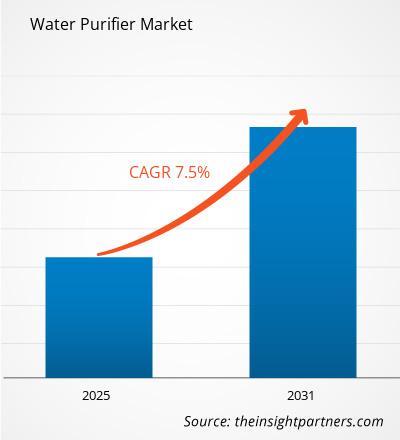
The water purifier market was valued at US$ 54.46 Billion in 2025 and is projected to reach US$ 115.96 Billion by 2034, registering a CAGR of 8.76% during 2026–2034. Expansion is being shaped by increasing household and institutional emphasis on drinking-water quality, broader availability of purification technologies, and continued replacement demand across residential, commercial, and industrial applications. Technology diversification and wider channel accessibility are further supporting market development.
North America is expected to register a CAGR in the 7.8–9.2% range from 2026–2034, supported by heightened consumer attention to contaminants, aging water infrastructure, and demand for point-of-use purification. The water purifier market size is also benefiting from wider adoption of digitally monitored systems, online purchasing, and advanced filtration technologies addressing dissolved solids, microbial contaminants, and emerging substances such as PFAS.
Water Purifier Market Assessment and Insights
- North America: The region represented approximately 24–27% share in 2025 and is projected to grow at a 7.8–9.2% CAGR between 2026–2034, supported by contamination awareness, replacement demand, and advanced residential filtration adoption.
- US: The US represented approximately 73–76% of North America's 2025 share and is expected to expand at a 7.5–8.9% CAGR between 2026–2034, led by household and commercial demand.
- Europe: Europe accounted for approximately 20–23% share in 2025 and is projected to grow at a 7.0–8.4% CAGR between 2026–2034, with Germany, the UK, France, Italy, and Spain supporting demand through quality standards and sustainability priorities.
- Asia Pacific: Asia Pacific held approximately 31–34% share in 2025 and is expected to expand at a 9.6–11.2% CAGR between 2026–2034, with China, India, Japan, and South Korea driving adoption.
- Largest Segment: Residential end users represented approximately 55–59% market share in 2025, growing at a 8.1–9.3% CAGR between 2026–2034 as household purification becomes increasingly mainstream.
- High Growth Segment: Online distribution represented approximately 18–22% market share in 2025, expanding at a 10.5–12.0% CAGR between 2026–2034 through convenience and digital product discovery.
- Key companies analyzed in detail: A. O. Smith India Water Products Pvt. Ltd., Aquatech International LLC, BWT Holding GmbH, BRITA Group, Coway Co., Ltd., Culligan International Company, EcoWater Systems LLC, Eureka Forbes Ltd., Evoqua Water Technologies LLC, Kinetico Incorporated, Kent RO Systems Ltd., and Panasonic Holdings Corporation.
Source: The Insight Partners' analysis based on proprietary research, government publications, company annual reports, investor presentations, industry databases, and expert interviews.
The water purifier market has evolved from basic sediment and gravity-based filtration toward multi-stage systems combining reverse osmosis, ultraviolet treatment, membrane filtration, mineral management, and digital monitoring. Production methodologies have shifted focus to compact designs, modular cartridges, better membrane efficiency, reduced water waste, and servicing ease. The manufacturers have also designed equipment based on the type of source water, developing different solutions for city homes, institutions, and industries.
Future growth potential will definitely lie in areas where urbanization, water quality issues, and purchasing ability meet. Regulations concerning contaminants, investments in infrastructure and greater consumer awareness are driving further demand for decentralized treatment processes. Hence, the manufacturers are now marketing their products based on performance, cost-effectiveness, connectivity, and lower environmental impact. Emerging markets in South and Southeast Asia remain especially important for volume expansion, according to the Water Purifier Market report.
Water Purifier Market Report Scope
| Report Attribute | Details |
|---|---|
| Market size in 2025 | US$ 54.46 Billion |
| Market Size by 2034 | US$ 115.96 Billion |
| Global CAGR (2026 - 2034) | 8.76% |
| Historical Data | 2021-2024 |
| Forecast period | 2026-2034 |
Water Purifier Market Analysis
The water purifier market growth is supported by demand for reliable drinking-water treatment across households, offices, hospitality facilities, healthcare settings, and industrial operations. These include the suppliers of membranes, filtration media, parts, system integration, distribution, installation, service, and replacement cartridges. The dynamics of supply are increasingly tending towards modular construction, which not only reduces complexity but also gives manufacturers the flexibility to tackle different types of contaminants without altering the overall platform design.
The preferences of consumers are also changing in favor of systems that provide both efficiency and convenience. Reverse osmosis is especially important when there are concerns about dissolved solids and chemicals. At the same time, UV systems are useful where microbial contamination is the issue because it does not affect water chemistry. A technology combination is increasingly being used by manufacturers, rather than a single treatment process.
Competitive positioning within the water purifier market increasingly depends on technology breadth, service infrastructure, brand credibility, distribution reach, and lifecycle economics. The competition between Culligan International Company, Coway Co., Ltd., BRITA Group, BWT Holding GmbH, and Eureka Forbes Ltd. occurs through combinations of product lines, service approaches, and geographic locations. A. O. Smith India Water Products Pvt. Ltd., Aquatech International LLC, EcoWater Systems LLC, Evoqua Water Technologies LLC, and Kinetico Incorporated contribute to increasing the competition.
Increasingly, investments are being focused on smart monitoring systems, high-performance membranes, small-scale systems, and channel expansion. The strategy of geographic localization is being employed in response to variations in water composition, customer preferences, regulatory environment, and economics of services. With the entry of Kent RO Systems Ltd. and Panasonic Holdings Corporation into the competitive benchmark, competition becomes wider and includes filtration technologies, consumer devices, and Asian distribution channels. Strategic partnerships and acquisitions can further accelerate local service coverage and customer acquisition, as highlighted in the Water Purifier Market forecast.
● REPORT CUSTOMIZATION
Tailor This Report To Align With Your Specific Business Requirements
This report can be customized to align precisely with your business objectives, scope, and target markets. Customization options include tailored segmentation, geography, competitive analysis, and strategic insights to support informed decision-making.
Customize This Report →WHAT YOU CAN ADJUST
- ● Segmentations
- ● Geography
- ● Competitive Analysis
- ● Language Preferences
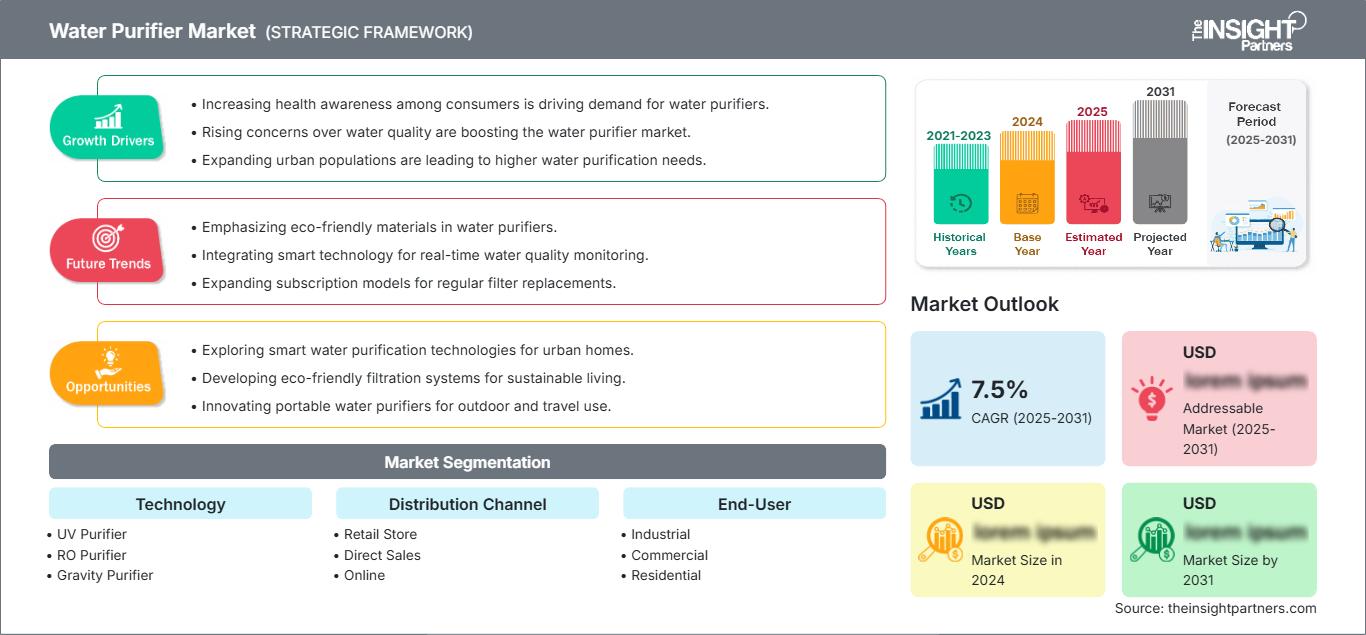
Water Purifier Market: Strategic Insights
Regional Insights
North America Water Purifier Market
North America accounted for approximately 24–27% share of the Water Purifier Market in 2025 and is expected to grow at a 7.8–9.2% CAGR through 2034. The region benefits from established household filtration practices, high replacement demand, and concern regarding contaminants in municipal and private water supplies. Reverse osmosis units are especially significant when families look for comprehensive reduction of contaminants, whereas UV units can be considered in tandem with filtration systems in the case of microbial issues.
The US is the primary regional market due to the number of consumers who have purchased these units, the extensive distribution networks, and the availability of point-of-use and point-of-entry units. The Canadian market is driven by the increased demand for household systems due to changing water quality and infrastructure issues. Online sales make products more available, but special dealers remain significant for systems that require installation. Regulators' focus on PFAS and other contaminants will drive demand for treatment units.
U.S. Water Purifier Market
The U.S. accounted for approximately 73–76% of North America's 2025 water purifier market share and is projected to expand at a 7.5–8.9% CAGR through 2034. Drivers include consumers’ worries about water pollution, replacement of old treatment machines, and increased usage of under-sink, countertop, pitcher, and whole-house filtration systems. Businesses also play a role in contributing to the demand through point-of-use filtration.
The key players in this industry include Culligan International Company, A. O. Smith India Water Products Pvt. Ltd., due to its portfolio across the globe, EcoWater Systems LLC, Kinetico Incorporated, and other known filter providers. Multi-stage filtration, online monitoring, and cartridge replacement are some trends seen in the application of this technology. Online retailing is also becoming an increasing trend regarding filter cartridges and compact filtration systems, but dealers continue playing a crucial role in premium installation.
Europe Water Purifier Market
Europe represented approximately 20–23% share of the Water Purifier Market in 2025 and is forecast to expand at a 7.0–8.4% CAGR through 2034. Germany continues to be an important market, while the UK, France, Italy, and Spain contribute significantly to the demand. Issues related to sustainability, consumer preferences for less consumption of bottled water, and high demands for quality products justify the adoption of decentralized water purification solutions. The BRITA Group and BWT Holding GmbH are regionally important companies in terms of consumer and water purification uses.
The UK offers good potential for the domestic market owing to consumer awareness and preference for point-of-use products. Germany has advantages owing to engineering expertise and sustainable consumption trends and the popularity of filtration products. France, Italy, and Spain offer good potential for compact units and hospitality markets due to the preference for better taste and lesser consumption of bottled water.
APAC Water Purifier Market
APAC accounted for approximately 31–34% share of the Water Purifier Market in 2025 and is projected to grow at a 9.6–11.2% CAGR through 2034, making it the leading regional growth engine. China provides an important demand point, whereas India is undergoing rapid growth via urbanization and increased consumer awareness. Japan and South Korea offer advanced markets for technologies, and Australia offers strong filtration demand.
China profits from significant residential use and manufacturing capacities. India combines significant demand potential in households with poor water quality at the sources and increasing organized retail and Internet distribution channels. South Korea features a high level of penetration for technologically advanced rental and services solutions, and Japan places emphasis on the efficiency of the appliances. Australia makes its contribution via household filtration and water efficiency needs.
Further policy support regarding drinking water access, urban development, and water conservation is recommended.
Middle East & Africa Water Purifier Market
The Middle East and Africa Water Purifier Market represented a smaller portion of global demand but is expected to grow at approximately 6.8–8.2% CAGR through 2034. Saudi Arabia and the UAE remain important Middle Eastern markets because of desalination dependence, water scarcity, and investment in residential and commercial infrastructure. South Africa contributes a significant demand associated with household and institutional water-quality requirements.
The UAE and Saudi Arabia are positioned around premium treatment systems, while South Africa provides opportunities for decentralized purification. The rest of MEA markets are influenced by infrastructure gaps, water availability, and affordability. Energy efficiency is increasingly important because treatment can carry substantial operating costs, particularly in water-stressed environments. Commercial, hospitality, healthcare, and institutional applications offer attractive opportunities where dependable treated water is required alongside broader infrastructure development.
Segmentation Analysis
Technology
The Technology segment is projected to grow at a 8.4–9.5% CAGR from 2026–2034. Adoption increasingly depends on source-water characteristics, contaminant profiles, operating costs, and desired purification performance. RO systems retain strong commercial and residential relevance, while UV and gravity solutions address different treatment requirements and affordability levels.
- UV Purifier: UV purification maintains an important role where microbial control is prioritized. Its chemical-free operation and ability to preserve mineral composition make it suitable for households, institutions, and applications requiring targeted disinfection.
- RO Purifier: RO purification occupies a leading position because membrane treatment can address dissolved solids and multiple contaminants. Demand remains strongest where source-water mineralization or chemical contamination makes conventional filtration insufficient.
- Gravity Purifier: Gravity systems remain strategically relevant in cost-sensitive applications because they can operate without continuous electricity. Their simplicity supports household and community use where infrastructure or power reliability constraints advanced treatment adoption.
Distribution Channel
The Distribution Channel segment is expected to expand at a 9.2–10.4% CAGR from 2026–2034 as manufacturers combine physical retail, direct engagement, and digital commerce. Channel selection increasingly depends on product complexity, installation requirements, customer trust, and replacement-filter economics. Online channels are particularly important for compact systems and recurring consumables.
- Retail Store: Retail remains important for consumers seeking physical product evaluation and immediate availability. Demonstrations, dealer advice, installation support, and established appliance networks strengthen the channel for premium purification equipment.
- Direct Sales: Direct sales support complex systems requiring consultation, site assessment, installation, and maintenance. Commercial and institutional buyers particularly benefit from customized proposals and ongoing service relationships.
- Online: Online distribution improves geographic reach and price transparency while supporting convenient replenishment of filters and accessories. Digital reviews, comparison tools, and subscription models can shorten purchase cycles.
End-User
The End-User segment is forecast to grow at a 8.0–9.2% CAGR from 2026–2034. Residential users remain the principal demand base, while commercial and industrial customers increasingly require application-specific treatment. Product specifications are consequently becoming more closely aligned with water chemistry, consumption volume, compliance needs, and operating economics.
- Industrial: Industrial users prioritize dependable treatment, process consistency, and operating efficiency. Systems are selected according to application-specific water quality requirements, throughput, maintenance schedules, and integration with broader treatment infrastructure.
- Commercial: Commercial adoption spans offices, hospitality, healthcare, education, food service, and retail environments. Demand is supported by requirements for reliable drinking water, controlled operating costs, and service contracts.
- Residential: Residential adoption remains broad because households increasingly seek control over drinking-water quality. Compact designs, replacement subscriptions, smart monitoring, and multi-stage purification are strengthening consumer acceptance.
Opportunity Snapshot
| End-User | Revenue Contribution (High/Medium/Low) | Trend Tag (MAX 2 words) | Adoption Stage (Emerging/Scaling/Mature) |
| Industrial | Medium | Process Water | Scaling |
| Commercial | Medium | Office Hydration | Scaling |
| Residential | High | Smart Filtration | Mature |
Water Purifier Market Growth Drivers and Impact Analysis
Increasing concern over emerging water contaminants
The increasing focus on PFAS, heavy metals, microorganisms and many others affects how consumers analyze treatment technologies for drinking water. It affects not only the first purchase, since the consumer can decide to replace their simple filter with a more complex one with extended functions due to contamination issues. An example of how manufacturers respond is represented by Culligan with its introduction of ZeroWater technology by 2025. The regulations increase attention to treatment functions from the buyers’ perspective. The recommendation for the manufacturers is the shift from visual distinctions to validated performance and technology combination. Those who can provide the solution for various contaminant types while managing maintenance will have better customer retention.
Expansion of decentralized purification across households and institutions
Decentralized treatments are gaining relevance in cases where the centralized approach does not solve all of the consumer needs, the specific conditions of water chemistry, or contamination issues. Point-of-use systems make it possible for households, offices, hospitality businesses, and health-care institutions to treat water locally. It allows one to decrease reliance on bottled water and have more control over the treatment process. It is especially true from the commercial point of view for manufacturers, since the decentralized approach generates a need for regular filter replacements. Rentals and subscriptions will decrease the entry barrier and generate stable income. It is also favorable for compact design, which will be suitable for kitchens, workplaces, and small-scale business establishments.
Digitalization of purification equipment and service models
Connected technology will affect the equipment used for purification in such a way that it will be possible for it to track the condition of the filters, water, operating status and maintenance needs. This will allow for a reduction of uncertainties about the need to replace cartridges and enable better management of the installed equipment by the service providers. For the manufacturers of the products, connectivity offers an opportunity for shifting from equipment sales to service revenue models. It will be possible for the data gathered through the connectivity to inform the design process by showing where the failure points are. In order to succeed, the connected systems should offer some utility since they increase both acquisition and maintenance costs due to more sensors and software.
Water Purifier Market Future Trends
Intelligent water-quality monitoring becomes embedded in mainstream systems
The water purifier market trends are moving toward integrated sensing that provides users with clearer information about filter condition, water quality, and system performance. Future systems are likely to combine sensors with mobile applications, automated alerts, and predictive maintenance functions rather than treating connectivity as an optional premium feature. Manufacturers may increasingly use sensor data to recommend replacement intervals based on actual consumption instead of fixed schedules. This can reduce unnecessary cartridge changes while helping users avoid overdue maintenance. Commercial systems could extend the concept through centralized fleet dashboards that allow operators to monitor multiple installations. Over time, intelligent monitoring should make purification equipment easier to manage, but adoption will depend on affordability, data reliability, and whether customers perceive measurable benefits from the additional technology.
Lower-waste membrane architectures and resource-efficient treatment
Environmentally sustainable performance is going to gain significance in design criteria since consumers are going to look at the environmental impact throughout the entire life cycle of the purification systems. The companies are likely to develop membranes that feature high efficiency, longevity, low energy needs, and effective cartridge design. The design of the water-efficient RO systems may also become more significant since these systems can have reject water in the process of purification. Thus, product design may come to be based on membrane improvements along with recovery methods, storage, and flow management. Material design is also going to receive increased attention as companies try to use fewer plastics and materials that are recyclable.
Water Purifier Market Opportunities
Localized platforms for high-growth emerging markets
The water purifier scope offers substantial opportunities for manufacturers that localize products according to regional water conditions, purchasing power, and service infrastructure. India, Southeast Asia, and selected African and Middle Eastern markets can require very different combinations of filtration, storage, installation, and maintenance. Rather than exporting standardized premium equipment, companies can develop modular platforms with selectable treatment stages and locally appropriate price points. Partnerships with regional distributors, installers, appliance retailers, and digital marketplaces can improve reach while reducing customer-acquisition costs. Localized cartridge production can also shorten supply chains and make recurring maintenance more affordable. Manufacturers should prioritize configurations that solve specific water-quality problems while minimizing unnecessary technology. This approach can expand addressable demand without compromising product differentiation or service economics.
Recurring service ecosystems built around purification equipment
The water purifier Forecasts point toward greater monetization of installed equipment through filter subscriptions, maintenance plans, rental arrangements, and digitally managed service contracts. Recurring models can reduce the upfront purchase barrier for households while giving manufacturers more predictable revenue. Commercial customers may value contracts that combine equipment, maintenance, consumables, and performance monitoring under a single agreement. The opportunity is particularly attractive where replacement filters represent a meaningful share of lifecycle spending. Companies can strengthen retention by using usage data to schedule service proactively and by offering automated replenishment. Successful models will require reliable logistics, transparent pricing, and consistent service quality. Providers with broad installation networks can use these capabilities to create customer relationships that extend beyond the initial equipment transaction.
Frequently Asked Questions

- Comprehensive Market Sizing and Forecast Analysis
- Detailed Segmentation Analysis
- In-Depth Market Dynamics Assessment
- Regional and Country-Level Insights
- Competitive Landscape and Company Benchmarking
- Strategic Business Intelligence
Recent Reports
Testimonials

The Insight Partners' SCADA System Market report is comprehensive, with valuable insights on current trends and future forecasts. The team was highly professional, responsive, and supportive throughout. We are very satisfied and highly recommend their services.
RAN KEDEM Partner, Reali Technologies LTDs
I requested a report on a very specific software market and the team produced the report in a few days. The information was very relevant and well presented. I then requested some changes and additions to the report. The team was again very responsive and I got the final report in less than a week.
JEAN-HERVE JENN Chairman, Future Analytica
We worked with The Insight Partners for an important market study and forecast. They gave us clear insights into opportunities and risks, which helped shape our plans. Their research was easy to use and based on solid data. It helped us make smart, confident decisions. We highly recommend them.
PIYUSH NAGPAL Sr. Vice President, High Beam Global
The Insight Partners delivered insightful, well-structured market research with strong domain expertise. Their team was professional and responsive throughout. The user-friendly website made accessing industry reports seamless. We highly recommend them for reliable, high-quality research services
YUKIHIKO ADACHI CEO, Deep Blue, LLC.
This is the first time I have purchased a market report from The Insight Partners.While I was unsure at first, I visited their web site and felt more comfortable to take the risk and purchase a market report.I am completely satisfied with the quality of the report and customer service. I had several questions and comments with the initial report, but after a couple of dialogs over email with their analyst I believe I have a report that I can use as input to our strategic planning process.Thank you so much for taking the extra time and making this a positive experience.I will definitely recommend your service to others and you will be my first call when we need further market data.
JOHN SUZUKI President and Chief Executive Officer, Board Director, BK Technologies
I wish to appreciate your support and the professionalism you displayed in the course of attending to my request for information regarding to infectious disease IVD market in Nigeria. I appreciate your patience, your guidance, and the fact that you were willing to offer a discount, which eventually made it possible for us to close a deal. I look forward to engaging The Insight Partners in the future, all thanks to the impression you have created in me as a result of this first encounter.
DR CHIJIOKE ONYIA MANAGING DIRECTOR, PineCrest Healthcare Ltd.Reason to Buy
- Informed Decision-Making
- Understanding Market Dynamics
- Competitive Analysis
- Identifying Emerging Markets
- Customer Insights
- Market Forecasts
- Risk Mitigation
- Boosting Operational Efficiency
- Strategic Planning
- Investment Justification
- Tracking Industry Innovations
- Aligning with Regulatory Trends





 Get Free Sample for