
X-Ray Security Screening System Market Size, Trends & Demand by 2034
Coverage: By Component (Solution, Services); Type (Product Screening, People Screening); End-user (Government, Commercial, Transportation) , and Geography (North America, Europe, Asia Pacific, and South and Central America)
- Status : Data Released
- Report Code : TIPRE00017190
- Category : Electronics and Semiconductor
- No. of Pages : 150
- Available Report Formats :


- Last update date : September 30, 2026


2025 Market Size
US$ 4.94 Bn
Base year value
2034 Forecast
US$ 11.45 Bn
Projected by 2034
CAGR 2026-2034
9.79 %
Growth rate
Addressable Market
US$ 73.00 Bn
(2026-2034)
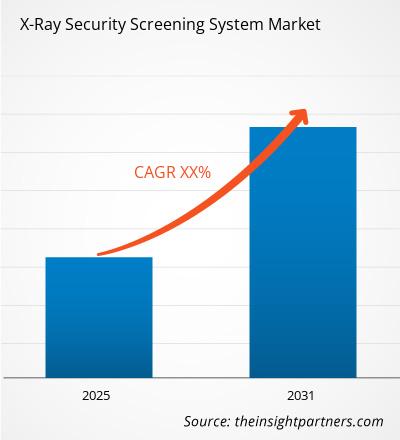
The x-ray security screening system market is valued at US$ 4.94 Billion in 2025 and is projected to reach US$ 11.45 Billion by 2034, registering a CAGR of 9.79% during 2026–2034. Expansion is supported by increasing requirements for automated inspection across airports, borders, logistics facilities, public venues, and critical infrastructure. Technology evolution toward computed tomography, dual-view imaging, remote screening, and algorithm-assisted threat detection is strengthening system capabilities while improving throughput and operator decision-making.
Across North America, the x-ray security screening system market size is expected to expand at an estimated 8.5–10.0% CAGR during 2026–2034. Replacement of legacy screening equipment, airport modernization, air-cargo security requirements, and government investment in automated inspection are key structural drivers. Demand is also supported by growing adoption of three-dimensional imaging and software-enabled threat recognition across transportation and public-security environments.
X-Ray Security Screening System Market Assessment and Insights
- North America: The region is estimated to represent 31–35% x-ray security screening system market share in 2025 and expand at a 8.5–10.0% CAGR between 2026–2034, supported by airport modernization, cargo inspection requirements, and replacement of aging screening infrastructure.
- US: The US is estimated to account for 78–82% of North American demand in 2025 and grow at a 8.3–9.8% CAGR during 2026–2034, driven by federal screening standards and airport investment.
- Europe: Europe is estimated at 27–31% share in 2025 and is projected to grow at a 8.7–10.2% CAGR between 2026–2034. Germany, the UK, France, Italy, and Spain are strengthening automated checkpoint and cargo inspection capabilities.
- Asia Pacific: Asia Pacific is estimated at 23–27% share in 2025 and is expected to record a 10.2–12.0% CAGR through 2034. China, Japan, South Korea, and India are leading regional investment through airport expansion and infrastructure modernization.
- Largest Segment: Product Screening is estimated to hold a 60–64% market share in 2025 and expand at a 9.0–10.2% CAGR during 2026–2034 as baggage, cargo, and parcel inspection requirements intensify.
- High Growth Segment: Services is estimated to account for a 25–29% market share in 2025 and grow at a 10.5–12.0% CAGR through 2034, reflecting increasing demand for maintenance, integration, upgrades, and training.
- Key companies analyzed in detail: 3DX-RAY Ltd.; Adani Systems Inc.; Analogic Corporation; Astrophysics Inc.; GILARDONI S.p.A.; Leidos, Inc.; Nuctech Company Limited; OSI Systems, Inc.; Smiths Detection Group Ltd.; Westminster Group Plc; Rapiscan Systems, Inc.
Source: The Insight Partners' analysis based on proprietary research, government publications, company annual reports, investor presentations, industry databases, and expert interviews.
The x-ray security screening system market growth is evolving from traditional two dimensional inspection to more advanced high resolution multi view, CT and software enabled solutions. Detection performance, without compromising on the speed and throughput of passengers or cargo handling, is becoming critical for airports and border control authorities. Consequently, equipment vendors are designing their products to incorporate higher speeds, automation of imaging interpretation, remote screening, and modular design.
In terms of future prospects, spending in the x-ray security screening system market is set to extend from well-established aviation segments to fast-growing airports, seaports, logistic routes, government establishments, and large public installations. The focus of regulators on detection performance and resiliency of the solutions will favor purchasing cycles, as will the development programs in Asia Pacific and Middle East. Service revenues will gain importance as the customer will look at lifecycle services, cyber security updates, calibration, operator training and upgrades rather than only replacement of equipment.
X-Ray Security Screening System Market Report Scope
| Report Attribute | Details |
|---|---|
| Market size in 2025 | US$ 4.94 Billion |
| Market Size by 2034 | US$ 11.45 Billion |
| Global CAGR (2026 - 2034) | 9.79% |
| Historical Data | 2021-2024 |
| Forecast period | 2026-2034 |
X-Ray Security Screening System Market Analysis
Passenger volumes, security concerns, and large throughput inspection without adding personnel are driving factors behind the development of the x-ray security scanning system market. According to IATA, there was 5.3% increase in global passengers demand and 7.1% increase in international passenger demand in 2025. The market consists of the producers of the X-ray generators, detectors, conveyor systems, imaging and processing software, artificial intelligence systems, integration solutions, maintenance services, and security operators.
At present, supply dynamics in the x-ray security screening system market are beneficial for vendors offering hardware and software platforms solutions. The computed tomography system enables volumetric imaging whereas dual energy and multi-view systems help to discriminate materials better. Availability of components, development of specific detectors, certification and cyber-security requirements influence delivery times and TCO. Therefore, customers select vendors not only due to equipment price, but also its detection, integration and service capabilities.
The x-ray security screening system market analysis shows that the competitive environment is formed by technology suppliers, specialized equipment manufacturers, and security solutions providers. Smiths Detection Group Ltd., Leidos, Inc., OSI Systems, Inc., Nuctech Company Limited, Analogic Corporation, Astrophysics Inc., and Rapiscan Systems, Inc. compete using differentiators such as unique imaging technology, regulatory compliance, application area, and global services. Specialized companies like 3DX-RAY Ltd. and GILARDONI S.p.A. add competition to portable, industrial and specialized inspection applications.
Artificial intelligence, remote screening, autonomous alarm processing, and modular computed tomography are gaining increasing attention as investments in the market. For instance, the collaboration of Smiths Detection with artificial intelligence software vendors exemplifies the move towards open architecture when the third-party software can be used along with the screening hardware. This type of strategy can prolong the relevance of the equipment and avoid its replacement. At the same time, regional manufacturing and training are becoming important competitive factors.
● REPORT CUSTOMIZATION
Tailor This Report To Align With Your Specific Business Requirements
This report can be customized to align precisely with your business objectives, scope, and target markets. Customization options include tailored segmentation, geography, competitive analysis, and strategic insights to support informed decision-making.
Customize This Report →WHAT YOU CAN ADJUST
- ● Segmentations
- ● Geography
- ● Competitive Analysis
- ● Language Preferences
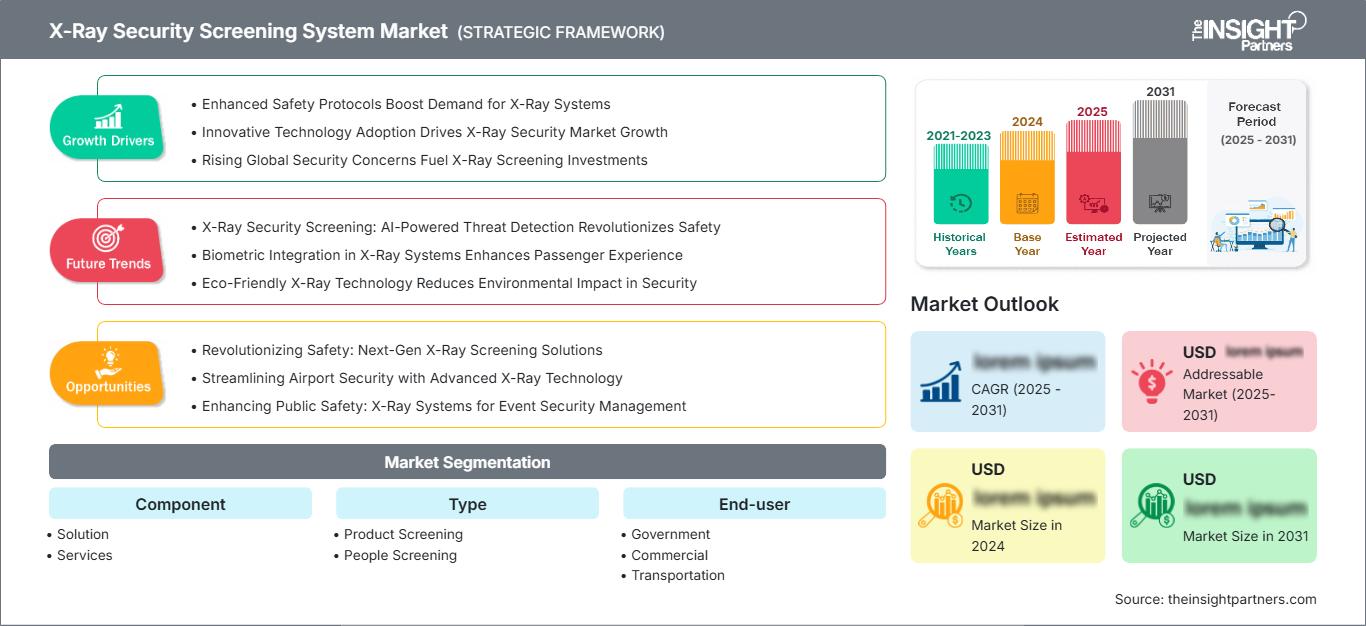
X-Ray Security Screening System Market: Strategic Insights
Regional Insights
North America x-ray security screening system market
The x-ray security screening system market report shows that North America is estimated to account for 31–35% of the market in 2025 and expand at an 8.5–10.0% CAGR through 2034. The US is a key regional market, backed by the presence of robust airport networks, aviation-security regulations at the federal level, cargo-screening systems for air cargo, and modernizing legacy checkpoints. The Canadian market is represented via airport, border, and critical infrastructure deployments.
Replacement purchases have a lot of significance when the buyers make a shift from traditional systems to CT and advanced multi-view systems. Air-cargo security is an important end-use segment due to the need of integration of high detection capability along with high throughput in the screening systems. Software, monitoring, training, and maintenance services are part of procurement decisions, enhancing the service offerings along with the hardware purchases.
U.S. x-ray security screening system market
The US is estimated to represent 78–82% of North American demand in 2025 and is expected to grow at an 8.3–9.8% CAGR during 2026–2034. Federal standards, improvements at the airport, and increased air cargo inspection requirements provide further justification for purchasing the system. Leading vendors have existing ties with the airport, federal entities, and security integrators.
The x-ray security screening system market forecast shows that usage trends include CT scanning of the baggage and automated threat detection. The qualification process of the TSA provides a very high technical bar for vendors and motivates them to keep working on their products. In 2025, according to Smiths Detection, its SDX 100100 DV HC X-ray system was put on the TSA Air Cargo Screening Technology List.
Europe x-ray security screening system market
Europe is estimated to hold a 27–31% share in 2025 and grow at an 8.7–10.2% CAGR. The UK, Germany, France, Italy, and Spain are important markets, with Germany representing one of the region's strongest technology and airport-infrastructure bases. EU aviation-security requirements continue to encourage modernization of screening infrastructure.
In the UK, there is a program for developing advanced airport technologies, whereas Germany plans to develop its checkpoint capacity. In France and Italy, automated screening at transport centers is being developed, and in Spain, the security infrastructure of airports will be upgraded due to an increasing number of passengers. Regulatory standards, capacity development at airports, and the need to decrease waiting time are beneficial for CT scanning and automated screening systems.
APAC x-ray security screening system market
APAC is estimated at 23–27% share in 2025 and is projected to register a 10.2–12.0% CAGR. With China being the largest consumer of such solutions, Japan, South Korea, India, and Australia contribute by building more airports, upgrading borders, and securing critical infrastructure. The number of passengers has been increasing rapidly and will ensure ongoing investments.
Infrastructure development initiated by the government and increased international traffic drive the need for automatic screening. Japan upgrades airport checkpoints using mini CT, while India builds new aviation infrastructure. China and South Korea are favored due to their highly developed manufacturing sector and extensive transportation infrastructure.
Middle East & Africa x-ray security screening system Market
Middle East and Africa is expected to record a 9.0–11.0% CAGR during 2026–2034. Saudi Arabia and the UAE lead regional demand through airport expansion, border-security modernization, tourism infrastructure, and large transportation projects. South Africa remains a key market for aviation and cargo-security applications.
Saudi investment under Vision 2030 is encouraging localized security-technology capabilities, while UAE infrastructure development supports high-throughput inspection requirements. Across the wider region, ports, airports, energy facilities, and land borders require non-intrusive inspection. Growing trade flows and infrastructure investment are supporting demand for mobile, high-energy, and automated X-ray platforms.
Segmentation Analysis
Component
Component segmentation comprises Solution and Services. Solutions remain central because customers require integrated imaging, conveyors, detection algorithms, and control systems. Services are gaining importance as installed equipment becomes more technologically complex. The component segment is expected to expand at a 9.2–10.4% CAGR during 2026–2034, with lifecycle support becoming increasingly strategic.
- Solution: Integrated screening platforms combine imaging hardware, software, conveyors, controls, and threat-detection capabilities. Demand is strongest where customers require certified systems capable of supporting high-throughput passenger, baggage, cargo, and parcel inspection.
- Services: Installation, integration, maintenance, training, calibration, upgrades, and technical support form an expanding lifecycle opportunity. Customers increasingly prefer service agreements that preserve system performance and reduce operational downtime.
Type
Type segmentation consists of Product Screening and People Screening. Product Screening remains the largest application because baggage, cargo, parcels, and freight require continuous inspection. The type segment is projected to grow at a 9.0–10.2% CAGR during 2026–2034 as security agencies increase automated inspection capacity.
- Product Screening: Baggage, cargo, parcels, and freight inspection require scalable imaging and conveyor architectures. Demand is reinforced by aviation growth, e-commerce logistics, customs enforcement, and border-security requirements.
- People Screening: People-screening applications increasingly emphasize throughput, privacy, detection sensitivity, and integration with checkpoint workflows. Adoption is supported by airports, government facilities, public venues, and other high-security environments.
End-user
End-user segmentation includes Government, Commercial, and Transportation. Transportation represents a major demand center because airports, ports, rail networks, and logistics facilities require continuous screening. The segment is expected to grow at a 9.5–10.8% CAGR during 2026–2034. The x-ray security screening system scope is broadening as commercial and government facilities adopt technologies previously concentrated in aviation.
- Government: Border agencies, customs authorities, defense organizations, courts, and public institutions use screening to protect personnel, facilities, and controlled access points.
- Commercial: Corporate campuses, logistics operators, retail facilities, event venues, and private-security providers increasingly deploy inspection equipment where threat exposure or regulatory requirements justify automated screening.
- Transportation: Airports, ports, rail stations, and cargo terminals require high-throughput systems that balance detection accuracy with passenger and freight flow. Transportation remains strategically important because infrastructure expansion directly increases screening requirements.
Opportunity Snapshot
| End-user | Revenue Contribution (High/Medium/Low) | Trend Tag | Adoption Stage |
| Government | High | Border Modernization | Scaling |
| Commercial | Medium | Venue Security | Scaling |
| Transportation | High | CT Checkpoints | Mature |
X-Ray Security Screening System Market Growth Drivers and Impact Analysis
Rising throughput requirements at transport and logistics hubs
Growing passenger, baggage, parcel, and cargo volumes are increasing the operational value of high-throughput screening. IATA reported 5.3% growth in global passenger demand during 2025, with international demand increasing 7.1%, creating sustained pressure on airports to process larger flows without compromising security. Similar requirements apply to cargo terminals and logistics hubs where inspection delays can affect supply-chain performance. The resulting investment favors systems with faster image acquisition, automated alarm resolution, wider conveyors, and centralized screening. Suppliers that combine detection capability with workflow optimization can address both security and productivity objectives. The impact extends beyond new equipment because existing installations increasingly require software upgrades, conveyor modifications, and remote-screening capabilities to accommodate higher throughput.
Expansion of computed tomography and intelligent threat detection
Computed tomography is changing screening economics by providing volumetric images that support more sophisticated threat identification and reduce reliance on manual interpretation. Integration with artificial intelligence can further prioritize suspicious images and support consistent operator decisions. The commercial effect is significant because advanced systems create opportunities for premium equipment, software licenses, integration services, and recurring upgrades. Smiths Detection's collaborations with AI companies demonstrate the industry's movement toward open architectures capable of incorporating third-party algorithms. This model can accelerate innovation without requiring complete hardware replacement whenever a new detection capability becomes available. It also encourages vendors to build extensible platforms, strengthening long-term customer relationships. Over time, the combination of CT imaging and intelligent analytics is expected to influence procurement specifications across airports, cargo facilities, borders, and other high-security environments.
Government investment in resilient security infrastructure
National security programs increasingly emphasize resilient screening infrastructure capable of operating across airports, borders, ports, public facilities, and critical infrastructure. Procurement decisions are therefore moving beyond individual scanners toward integrated programs covering equipment, training, maintenance, remote monitoring, and technology refresh. This favors suppliers with established service networks and regulatory expertise. Regional localization is another impact area, particularly in countries seeking domestic assembly and technical capabilities. Saudi Arabia's planned screening-equipment manufacturing and training facility with METCO and Smiths Detection illustrates how security procurement can become linked with industrial-development objectives. Such programs can shorten maintenance cycles, develop local operator skills, and improve system availability. For suppliers, the opportunity is consequently broader than equipment sales, encompassing localized production, integration, training, lifecycle services, and long-term technology partnerships.
X-Ray Security Screening System Market Future Trends
Remote and centralized screening architectures
The x-ray security screening system market trends indicate that remote screening is likely to become a defining architectural trend as airports and other facilities seek to separate image interpretation from physical checkpoint locations. Centralized screening rooms can consolidate specialist personnel, standardize operating procedures, and distribute workload across multiple lanes or facilities. Advances in secure networking and redundant server infrastructure make such models increasingly practical. The next phase should involve greater use of algorithm-assisted triage, allowing experienced operators to focus on complex alarms while routine images are processed automatically. For equipment manufacturers, interoperability will become increasingly important because customers may operate scanners from multiple generations or vendors. This trend can also reshape facility design by reducing the staffing footprint at individual checkpoints. The resulting procurement model should emphasize complete screening ecosystems, cybersecurity, uptime, data management, and remote support rather than standalone imaging equipment. The x-ray security screening system trends will therefore increasingly reflect software-defined operational models.
Adaptive screening through AI-enabled image interpretation
Artificial intelligence is expected to move from experimental enhancement toward a more structured layer within screening workflows. Future systems will increasingly combine high-resolution imaging with algorithms trained to identify specific threat categories, prioritize alarms, and assist operators with image interpretation. Regulatory validation will remain essential because security agencies require demonstrable performance, explainability, and controlled software updates. Vendors with open architectures may have an advantage because customers can introduce specialized algorithms without replacing established scanner infrastructure. AI adoption could also support differentiated screening policies, where risk-based workflows determine the level of inspection applied to different baggage or cargo categories. Such systems may improve resource allocation while maintaining security standards. The most successful implementations will likely combine algorithmic assistance with human oversight, audit trails, cybersecurity controls, and continuously managed software versions.
X-Ray Security Screening System Market Opportunities
Localized manufacturing and lifecycle service ecosystems
Localization offers an important opportunity in countries investing heavily in airports, borders, and critical infrastructure. Governments increasingly value domestic technical skills, rapid maintenance, training capacity, and resilient supply chains alongside equipment performance. Suppliers can respond by establishing assembly operations, regional service centers, training academies, and spare-parts inventories close to major customers. Such infrastructure can reduce downtime and strengthen relationships with public-sector buyers. The opportunity is particularly relevant in emerging markets where screening fleets are expanding quickly and local technical capacity may lag equipment deployment. Partnerships with domestic integrators can further improve procurement access while supporting regulatory compliance and workforce development. For investors and manufacturers, the strongest opportunity may therefore lie in integrated lifecycle models that combine equipment, software, maintenance, training, upgrades, and localized support rather than depending solely on one-time scanner sales.
Screening modernization for non-aviation applications
A substantial opportunity exists beyond airports as governments and commercial organizations strengthen protection at ports, rail stations, logistics hubs, public venues, government buildings, and energy infrastructure. These applications often have different space, mobility, throughput, and inspection requirements from aviation checkpoints, creating demand for specialized system configurations. Portable X-ray equipment can address temporary security operations, while high-energy systems can inspect vehicles, containers, and cargo. Commercial operators may also favor compact systems that can be deployed without major facility reconstruction. Suppliers that adapt established imaging technologies to application-specific workflows can expand their addressable customer base. The opportunity is particularly attractive where infrastructure investment is accelerating but security modernization remains fragmented. A portfolio spanning portable, fixed, CT, dual-view, and high-energy platforms can therefore provide broader exposure to emerging screening requirements.
Frequently Asked Questions

- Comprehensive Market Sizing and Forecast Analysis
- Detailed Segmentation Analysis
- In-Depth Market Dynamics Assessment
- Regional and Country-Level Insights
- Competitive Landscape and Company Benchmarking
- Strategic Business Intelligence
Recent Reports
Testimonials

The Insight Partners' SCADA System Market report is comprehensive, with valuable insights on current trends and future forecasts. The team was highly professional, responsive, and supportive throughout. We are very satisfied and highly recommend their services.
RAN KEDEM Partner, Reali Technologies LTDs
I requested a report on a very specific software market and the team produced the report in a few days. The information was very relevant and well presented. I then requested some changes and additions to the report. The team was again very responsive and I got the final report in less than a week.
JEAN-HERVE JENN Chairman, Future Analytica
We worked with The Insight Partners for an important market study and forecast. They gave us clear insights into opportunities and risks, which helped shape our plans. Their research was easy to use and based on solid data. It helped us make smart, confident decisions. We highly recommend them.
PIYUSH NAGPAL Sr. Vice President, High Beam Global
The Insight Partners delivered insightful, well-structured market research with strong domain expertise. Their team was professional and responsive throughout. The user-friendly website made accessing industry reports seamless. We highly recommend them for reliable, high-quality research services
YUKIHIKO ADACHI CEO, Deep Blue, LLC.
This is the first time I have purchased a market report from The Insight Partners.While I was unsure at first, I visited their web site and felt more comfortable to take the risk and purchase a market report.I am completely satisfied with the quality of the report and customer service. I had several questions and comments with the initial report, but after a couple of dialogs over email with their analyst I believe I have a report that I can use as input to our strategic planning process.Thank you so much for taking the extra time and making this a positive experience.I will definitely recommend your service to others and you will be my first call when we need further market data.
JOHN SUZUKI President and Chief Executive Officer, Board Director, BK Technologies
I wish to appreciate your support and the professionalism you displayed in the course of attending to my request for information regarding to infectious disease IVD market in Nigeria. I appreciate your patience, your guidance, and the fact that you were willing to offer a discount, which eventually made it possible for us to close a deal. I look forward to engaging The Insight Partners in the future, all thanks to the impression you have created in me as a result of this first encounter.
DR CHIJIOKE ONYIA MANAGING DIRECTOR, PineCrest Healthcare Ltd.Reason to Buy
- Informed Decision-Making
- Understanding Market Dynamics
- Competitive Analysis
- Identifying Emerging Markets
- Customer Insights
- Market Forecasts
- Risk Mitigation
- Boosting Operational Efficiency
- Strategic Planning
- Investment Justification
- Tracking Industry Innovations
- Aligning with Regulatory Trends





 Get Free Sample for