
Software Asset Management Market Demand, Trends & Forecast by 2034
Coverage: By Component (Solutions and Services), Deployment Type (On-premises and Cloud-Based), Organization Size (SMEs and Large Enterprises), and Industry Vertical (BFSI, IT and Telecom, Manufacturing, Retail and Consumer Goods, Government, Healthcare and Life Sciences, Media and Entertainment, and Others)
- Status : Data Released
- Report Code : TIPRE00012382
- Category : Technology, Media and Telecommunications
- No. of Pages : 150
- Available Report Formats :


- Last update date : October 26, 2026


2025 Market Size
US$ 2.8 Bn
Base year value
2034 Forecast
US$ 8.5 Bn
Projected by 2034
CAGR 2026-2034
13.88 %
Growth rate
Addressable Market
US$ 51.03 Bn
(2026-2034)
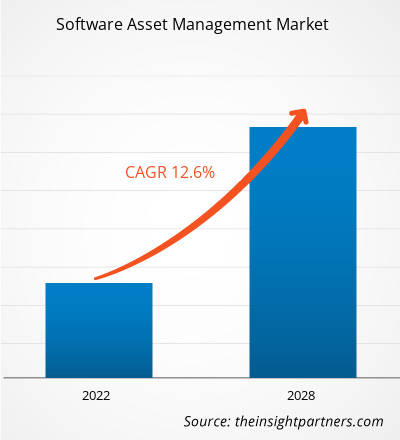
The software asset management market was valued at US$ 2.8 Billion in 2025 and is estimated to reach US$ 8.5 Billion by 2034, registering a CAGR of 13.88% between 2026 and 2034. This expansion is driven by escalating enterprise software portfolios, rising license compliance audits, and growing adoption of hybrid IT environments. Organizations across BFSI, healthcare, and manufacturing sectors increasingly deploy structured governance tools, reinforcing the software asset management market as a core enabler of cost control and risk mitigation in digital operations.
North America continues to anchor global demand, with the software asset management market size in the region expanding steadily on the back of stringent regulatory audits, dense enterprise software concentration, and early cloud adoption. Structural drivers such as hybrid workforce, IT sprawl and rising cybersecurity mandates are compelling large enterprises to formalize asset governance frameworks, sustaining above-average regional growth through 2034 across diverse industry applications.
Software Asset Management Market Assessment and Insights
- North America: Holds an estimated 34–38% revenue share in 2025 and is projected to grow at a CAGR of 12.5–13.5% between 2026 and 2034, supported by dense enterprise software estates and stringent compliance audits.
- US: Commands roughly 85–90% of North America's share in 2025, expanding at a CAGR of 12.3–13.2% through 2034, led by cloud governance mandates.
- Europe: Accounts for approximately 24–28% share in 2025, growing at a CAGR of 13.0–14.0% between 2026 and 2034, with the UK, Germany, and France leading regional adoption through regulatory harmonization initiatives.
- Asia Pacific: Represents nearly 20–24% share in 2025 and is forecast to expand at the fastest CAGR of 15.5–16.8% through 2034, led by China, India, and Japan amid rapid enterprise digitalization.
- Largest Segment: The Solutions component held an estimated 58–62% market share in 2025 and is projected to grow at a CAGR of 13.2–14.0% between 2026 and 2034, driven by license optimization tools.
- High Growth Segment: The Cloud-Based deployment type is the fastest-growing segment, holding 34–38% share in 2025 and expanding at a CAGR of 15.8–16.9% through 2034, propelled by SaaS proliferation.
- Key companies analyzed in detail: Microsoft Corporation, Ivanti, Inc., Snow Software AB, BMC Software, Inc., Certero, Flexera Software LLC, IBM Corporation, Micro Focus International plc, ServiceNow, Inc., Broadcom Inc.
Source: The Insight Partners' analysis based on proprietary research, government publications, company annual reports, investor presentations, industry databases, and expert interviews.
The enterprise IT landscape has changed significantly over the past decade. The environment has moved away from fixed, license-persistently owned software asset portfolios to a new era of highly dynamic software estates that consist of a combination of on-premise software assets and multi-cloud environments. In turn, this development has added additional layers of complexity to entitlements management, usage rights management, and renewals management, leading businesses to move away from spreadsheets in favor of automated discovery solutions.
Looking ahead, adoption is expected to broaden beyond traditional IT-heavy sectors into manufacturing, retail, and life sciences as digital transformation initiatives mature, contributing to growth in the Software Asset Management Market share. Emerging economies across Southeast Asia and Latin America present untapped opportunities as regulatory scrutiny around software licensing intensifies. Vendor investment in AI-driven optimization engines and expanding SaaS management capabilities will further accelerate platform consolidation and cross-industry penetration through the forecast period.
Software Asset Management Market Report Scope
| Report Attribute | Details |
|---|---|
| Market size in 2025 | US$ 2.8 Billion |
| Market Size by 2034 | US$ 8.5 Billion |
| Global CAGR (2026 - 2034) | 13.88% |
| Historical Data | 2021-2024 |
| Forecast period | 2026-2034 |
Software Asset Management Market Analysis
Rising software license compliance risk remains the foremost demand driver, as enterprises face escalating penalties from vendor audits and unbudgeted true-up costs. The software asset management market growth is further reinforced by expanding cloud subscription sprawl, which complicates entitlement tracking across decentralized procurement channels. Enterprises are consolidating vendor relationships and centralizing governance functions to curb redundant spend and strengthen negotiating leverage during renewal cycles.
Ecosystem covers players including software companies, systems integrators, managed service providers, and SAM software development firms working together to provide end-to-end visibility. Industry supply dynamics have been such that there is demand for platforms having the capability of automated discovery, normalization, and predictive analysis. Smaller vendors are adding AI capability to their reconciliation engines, whereas larger IT service management firms are adding asset governance modules to their services platform.
Competitive intensity within the software asset management market analysis reveals consolidation among established IT governance vendors expanding through acquisitions and platform integrations. Microsoft Corporation and IBM Corporation use their wide reach in enterprises to integrate asset management into cloud environments, while Flexera Software LLC, Snow Software AB, and Certero differentiate themselves through their optimization capabilities and precise tracking of multi-cloud entitlements.
More emphasis is now being placed on integration capabilities, with ServiceNow, Inc. incorporating SAM into its IT service management processes, and Ivanti, Inc. and BMC Software, Inc. focusing on endpoint and asset visibility. Compliance-related capabilities are further strengthened by Broadcom Inc. and Micro Focus International plc, while investments are mainly focused on AI-based license optimization and SaaS expenditure management solutions offered by the vendors.
● REPORT CUSTOMIZATION
Tailor This Report To Align With Your Specific Business Requirements
This report can be customized to align precisely with your business objectives, scope, and target markets. Customization options include tailored segmentation, geography, competitive analysis, and strategic insights to support informed decision-making.
Customize This Report →WHAT YOU CAN ADJUST
- ● Segmentations
- ● Geography
- ● Competitive Analysis
- ● Language Preferences
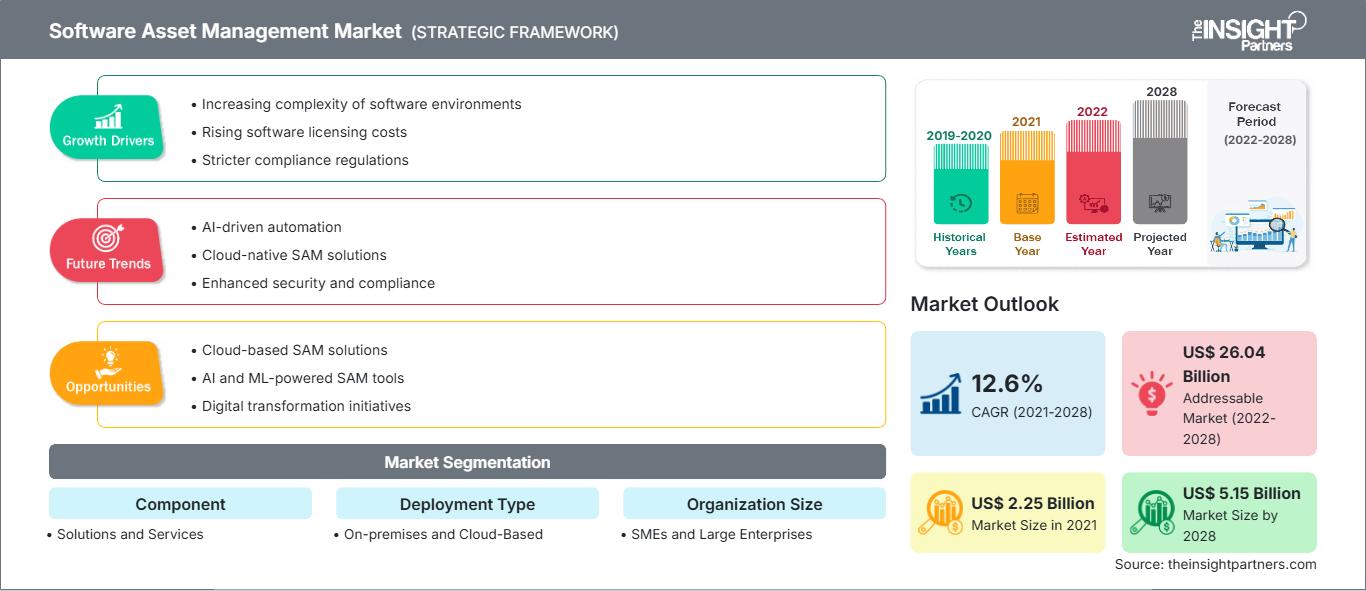
Software Asset Management Market: Strategic Insights
Regional Insights
North America Software Asset Management Market
North America held an estimated 34–38% revenue share of the global software asset management market in 2025 and is projected to grow at a CAGR of 12.5–13.5% between 2026 and 2034. The region's maturity stems from dense enterprise software concentration, aggressive vendor audit cycles, and early institutionalization of formal license governance programs across financial services, technology, and healthcare organizations operating complex hybrid infrastructures.
The structural forces at play involve the increasing regulatory pressures in cybersecurity, the proliferation of IT resources within the increasingly remote workforces in large enterprises, and procurement centralization. In Canada, similar adoption trends are emerging due to the need for digital transformation of the public sector and modernization of medium-sized enterprises, while in Mexico, the increasing technology services industry adds to the regional demand.
U.S. Software Asset Management Market
The United States commands approximately 85–90% of North America's software asset management revenue share in 2025 and is forecast to expand at a CAGR of 12.3–13.2% through 2034. This dominance reflects concentrated enterprise software spend across Fortune 500 organizations, stringent compliance enforcement, and mature managed service provider networks supporting continuous license reconciliation across sprawling multi-cloud environments, according to the Software Asset Management Market report.
Presence is still strong for the likes of Microsoft Corporation, IBM Corporation, ServiceNow, Inc., BMC Software, Inc., and Broadcom Inc., all of which have major presence in the home country, along with strong enterprise clientele. In terms of application trends, there are AI-supported discovery tools, SaaS spend optimization dashboards, and unified endpoint management platforms, as big businesses and governments prefer automated compliance tracking over old auditing procedures.
Europe Software Asset Management Market
Europe accounted for approximately 24–28% share of the global software asset management market in 2025, growing at a CAGR of 13.0–14.0% between 2026 and 2034. Regional momentum is anchored by regulatory harmonization under data protection frameworks and rising enterprise adoption of centralized IT governance to manage cross-border software licensing complexity across diversified manufacturing and financial services sectors.
Leading in the regional uptake is the UK, whose adoption is being boosted by financial services compliance regulations and the presence of managed service providers that support mid-market digital governance programs. Following close behind is Germany, whose adoption is fueled by its efforts to digitalize the manufacturing industry and integrate Industry 4.0, which calls for stringent software asset management. France, Italy, and Spain have been steadily adopting automation in licensing optimization.
APAC Software Asset Management Market
Asia Pacific held nearly 20–24% share of the software asset management market in 2025 and is projected to expand at the fastest regional CAGR of 15.5–16.8% through 2034. Leading the region’s adoption is China, owing to its large-scale enterprise digitization efforts, whereas Japan follows suit on account of its advanced IT governance ecosystem, with contributions to demand from India, South Korea, and Australia stemming from increased technology service and financial sector modernization efforts.
In terms of industrial and policy enablers, these include the government's push for digitization of the economy, increasing regulation of cybersecurity, and investments made in cloud computing infrastructure in the manufacturing and telecommunications industries. The increasing IT outsourcing efforts in India, coupled with data governance standards in Australia, help position APAC as the main driver of growth in the global landscape.
Middle East & Africa Software Asset Management Market
The Middle East and Africa region is registering steady adoption, with Saudi Arabia emerging as the leading market amid Vision 2030-aligned digital transformation and government IT modernization programs. The region is projected to grow at a CAGR of 12.0–13.0% between 2026 and 2034, supported by expanding enterprise cloud infrastructure investment and rising public sector compliance requirements, according to the Software Asset Management Market forecast.
The United Arab Emirates is close behind, due to the need for digitalization of its financial center and the implementation of smart government programs, which call for central management of software. South Africa and the Rest of MEA add on demand in a piecemeal fashion, via telecom network builds and increasing enterprise IT formalization.
Segmentation Analysis
Component
The Solutions sub-segment is projected to grow at a CAGR of 13.2–14.0% between 2026 and 2034. This defines the core software asset management market scope, encompassing discovery, reconciliation, and optimization platforms that enterprises deploy to automate license tracking, reduce compliance risk, and consolidate fragmented software inventories across hybrid and multi-cloud infrastructure environments.
- Solutions: Automated discovery and license optimization platforms dominate enterprise procurement, offering real-time entitlement tracking and reducing manual audit dependency across distributed IT environments.
- Services: Implementation, consulting, and managed SAM services support enterprises lacking internal governance expertise, driving steady demand among mid-sized organizations pursuing outsourced compliance management.
Deployment Type
Cloud-Based deployment is projected to grow at a CAGR of 15.8–16.9% between 2026 and 2034, reflecting accelerating SaaS proliferation and key Software Asset Management Market trends. Enterprises increasingly favor cloud-hosted platforms for scalability, reduced infrastructure overhead, and simplified integration with existing multi-cloud ecosystems, while on-premises deployment retains relevance among regulated industries requiring stringent data residency control.
- On-premises: Preferred by highly regulated sectors requiring direct infrastructure control, sustained demand persists among government and BFSI organizations with strict data residency mandates.
- Cloud-Based: Rapid adoption reflects enterprise preference for scalable, subscription-based governance tools offering seamless integration across distributed multi-cloud environments and remote workforce infrastructure.
Organization Size
Large Enterprises in the Software Asset Management Market are projected to grow at a CAGR of 13.0–13.8% between 2026 and 2034, driven by complex multi-vendor software portfolios requiring centralized governance frameworks and dedicated compliance resources across globally distributed operational units. Increasing adoption of cloud applications, hybrid IT environments, and software license optimization strategies continues to support demand for comprehensive software asset management solutions among large organizations.
- SMEs: Growing awareness of compliance risk and affordable cloud-based tools is driving incremental adoption among smaller organizations previously reliant on manual tracking methods.
- Large Enterprises: Complex multi-vendor software estates and stringent audit exposure sustain strong demand for comprehensive, integrated governance platforms across global operational footprints.
Industry Vertical
The IT and Telecom vertical is projected to grow at a CAGR of 14.0–14.9% between 2026 and 2034, reflecting concentrated software asset density and continuous infrastructure modernization requiring rigorous license lifecycle management across technology-intensive operational environments.
- BFSI: Stringent regulatory compliance and extensive software portfolios drive consistent demand for automated audit-readiness and entitlement tracking platforms across financial institutions.
- IT, Telecom: High software density and continuous infrastructure upgrades sustain leading adoption, requiring rigorous lifecycle governance across distributed technology environments.
- Manufacturing: Industry 4.0 integration and expanding operational technology software estates drive growing demand for centralized asset visibility and compliance tracking.
- Retail: Omnichannel platform proliferation and seasonal licensing fluctuations drive rising adoption of flexible, subscription-aware governance tools among retail enterprises.
- Consumer Goods: Expanding digital supply chain software adoption is driving incremental demand for centralized license tracking across consumer goods manufacturers.
- Government: Public sector digitalization and stringent procurement accountability requirements sustain steady adoption of compliance-focused governance platforms across government agencies.
- Healthcare, Life Sciences: Regulatory data protection requirements and expanding clinical software portfolios drive rising demand for rigorous compliance and audit-readiness tools.
- Media, Entertainment: Growing reliance on creative and production software licensing drives incremental adoption of usage-based tracking and optimization platforms.
Opportunity Snapshot
| Industry Vertical | Revenue Contribution | Trend Tag | Adoption Stage |
| BFSI | High | Audit Readiness | Mature |
| IT, Telecom | High | Cloud Licensing | Mature |
| Manufacturing | Medium | Industry 4.0 | Scaling |
| Retail | Medium | Omnichannel Tracking | Scaling |
| Consumer Goods | Low | Supply Chain SAM | Emerging |
| Government | Medium | Public Procurement | Scaling |
| Healthcare, Life Sciences | High | Compliance Automation | Scaling |
| Media, Entertainment | Low | Usage-Based Licensing | Emerging |
Software Asset Management Market Growth Drivers and Impact Analysis
Escalating Software License Compliance Risk and Vendor Audit Frequency
Firms are increasingly under pressure due to formal audits performed by prominent software vendors, which usually end up in significant, unplanned true-up charges in the absence of comprehensive entitlement documentation. This has led to increased interest in automated platforms that continuously reconcile the deployment of software products with their entitlement. Companies without a governance structure are exposed to higher risks, thereby making the establishment of compliance management infrastructure a priority for their board members. The rise in the number of sophisticated licensing schemes, such as consumption or hybrid subscriptions, adds complexity to the process of entitlement tracking, increasing the importance of specialized tools. The impact of this trend is mostly felt by those vendors that provide real-time audit readiness solutions, as firms consider this aspect an imperative component of risk management.
Accelerating Multi-Cloud and SaaS Adoption Across Enterprise IT Environments
With the fast adoption of SaaS apps and multitudes of clouds, software visibility in corporate IT is becoming difficult to control due to decentralized purchasing that allows different departments to sign up for cloud services without the need for IT governance. This problem leads to numerous challenges in IT governance and, hence, the growing need for products to help discover shadow IT and reconcile cloud subscription costs with real-life usage. Today’s corporations realize that uncontrolled SaaS adoption results in higher operating expenses due to duplicating subscriptions and unused licenses. SaaS vendors that provide cloud spend optimization alongside on-premises software tracking capabilities are seeing disproportionate demand.
Growing Enterprise Focus on IT Cost Optimization and Vendor Consolidation
The increased pressure on enterprises to be financially prudent has made them more vigilant when making decisions involving discretionary spend on information technology (IT), where they can see the value of using Software Asset Management Platforms to help them spot unused licenses, make the best of vendor agreements and merge duplicate subscriptions of software within different divisions. The finance and procurement professionals are now working together with IT to use governance data to optimize vendor renewals by getting the best cost savings through effective contract negotiation. This collaboration between the financial and technical players has seen an increase in the importance of the governance tools beyond the IT compliance role to the whole organization.
Software Asset Management Market Future Trends
AI-Driven Predictive License Optimization
Emerging software asset management market trends point toward deeper integration of artificial intelligence and machine learning capabilities within governance platforms, enabling predictive modeling of future license requirements based on historical usage patterns and organizational growth trajectories. Instead of being merely responsive to compliance measures, future platforms will proactively offer recommendations for contract restructurings, license allocations, and timing of renewals. This is how new platforms will turn into strategic advisory solutions that will radically change vendor differentiation criteria and procurement approaches within enterprises in terms of their software procurement during the forecasted period, especially those dealing with hundreds of software entitlements simultaneously.
Convergence with Broader IT Service Management Ecosystems
There is a growing convergence between governance platforms and unified endpoint management, cybersecurity posture management, and IT service management ecosystems due to enterprise preference for integrated technology platforms rather than isolated technologies. These developments make it possible to correlate software consumption information with cybersecurity vulnerability analysis and device management to achieve full visibility into operations. Vendors developing interoperability through open APIs and native integrations with leading cloud service vendors stand a good chance of acquiring disproportional market share owing to the preference of enterprises for consolidation of their vendor relationships and simplified integration processes.
Software Asset Management Market Opportunities
Expansion Into Underpenetrated SME and Mid-Market Segments
SMEs are a great source of potential due to the fact that budget constraints and lack of awareness have been a hindrance in terms of tool adoption in comparison to larger firms. Reduced cost and complexity of cloud-based platforms make it possible for vendors to target this market through tiered scalable solutions that address the specific needs of the SME market, which has low budgets and is not aware of governance. Managed service providers offering governance solutions through IT services are an effective channel of distribution for the scattered SME market that does not have any compliance staff internally.
Vertical-Specific Platform Development for Regulated Industries
Healthcare, life sciences, and government sectors present significant opportunities for vendors developing vertical-specific governance capabilities addressing unique regulatory data protection and procurement accountability requirements. Generic platforms often inadequately address specialized compliance frameworks governing clinical software or public sector procurement, creating a differentiation opportunity for purpose-built solutions. Vendors investing in industry-specific certification, regulatory alignment, and specialized reporting capabilities can command premium positioning within these historically underserved verticals. As regulatory scrutiny intensifies across healthcare data protection and government procurement transparency mandates, platforms demonstrating deep vertical expertise rather than generic horizontal functionality are positioned to capture disproportionate share within these high-compliance, high-value organizational segments through the forecast period.
Frequently Asked Questions

- Comprehensive Market Sizing and Forecast Analysis
- Detailed Segmentation Analysis
- In-Depth Market Dynamics Assessment
- Regional and Country-Level Insights
- Competitive Landscape and Company Benchmarking
- Strategic Business Intelligence
Recent Reports
Testimonials

The Insight Partners provided valuable market intelligence that supported our global go-to-market strategy. Their team was professional, responsive, and attentive to our feedback, providing thoughtful analysis and helpful methodological clarifications throughout the project.
Junmo Kim Chief Financial Officer (CFO), Enertech Co., Ltd.
The Insight Partners' SCADA System Market report is comprehensive, with valuable insights on current trends and future forecasts. The team was highly professional, responsive, and supportive throughout. We are very satisfied and highly recommend their services.
RAN KEDEM Partner, Reali Technologies LTDs
I requested a report on a very specific software market and the team produced the report in a few days. The information was very relevant and well presented. I then requested some changes and additions to the report. The team was again very responsive and I got the final report in less than a week.
JEAN-HERVE JENN Chairman, Future Analytica
We worked with The Insight Partners for an important market study and forecast. They gave us clear insights into opportunities and risks, which helped shape our plans. Their research was easy to use and based on solid data. It helped us make smart, confident decisions. We highly recommend them.
PIYUSH NAGPAL Sr. Vice President, High Beam Global
The Insight Partners delivered insightful, well-structured market research with strong domain expertise. Their team was professional and responsive throughout. The user-friendly website made accessing industry reports seamless. We highly recommend them for reliable, high-quality research services
YUKIHIKO ADACHI CEO, Deep Blue, LLC.
This is the first time I have purchased a market report from The Insight Partners.While I was unsure at first, I visited their web site and felt more comfortable to take the risk and purchase a market report.I am completely satisfied with the quality of the report and customer service. I had several questions and comments with the initial report, but after a couple of dialogs over email with their analyst I believe I have a report that I can use as input to our strategic planning process.Thank you so much for taking the extra time and making this a positive experience.I will definitely recommend your service to others and you will be my first call when we need further market data.
JOHN SUZUKI President and Chief Executive Officer, Board Director, BK Technologies
I wish to appreciate your support and the professionalism you displayed in the course of attending to my request for information regarding to infectious disease IVD market in Nigeria. I appreciate your patience, your guidance, and the fact that you were willing to offer a discount, which eventually made it possible for us to close a deal. I look forward to engaging The Insight Partners in the future, all thanks to the impression you have created in me as a result of this first encounter.
DR CHIJIOKE ONYIA MANAGING DIRECTOR, PineCrest Healthcare Ltd.Reason to Buy
- Informed Decision-Making
- Understanding Market Dynamics
- Competitive Analysis
- Identifying Emerging Markets
- Customer Insights
- Market Forecasts
- Risk Mitigation
- Boosting Operational Efficiency
- Strategic Planning
- Investment Justification
- Tracking Industry Innovations
- Aligning with Regulatory Trends






 Get Free Sample for