
5G Testing Market Size, Trends & Demand by 2034
5G Testing Market Size and Forecasts (2021–2034), Global and Regional Share, Trends, and Growth Opportunity Analysis Report Coverage : By Offering (Hardware, Services);End Users (IDMs & ODMs, Telecom Equipment Manufacturers, Telecom Service Providers, Others); Geography (North America, Europe, Asia-Pacific, Middle East & Africa, South and Central America)
- Status : Data Released
- Report Code : TIPRE00039695
- Category : Electronics and Semiconductor
- No. of Pages : 150
- Available Report Formats :


- Last update date : August 21, 2026


2025 Market Size
US$ 2.43 Bn
Base year value
2034 Forecast
US$ 4.09 Bn
Projected by 2034
CAGR 2026-2034
6.72 %
Growth rate
Addressable Market
US$ 30.70 Bn
(2026-2034)
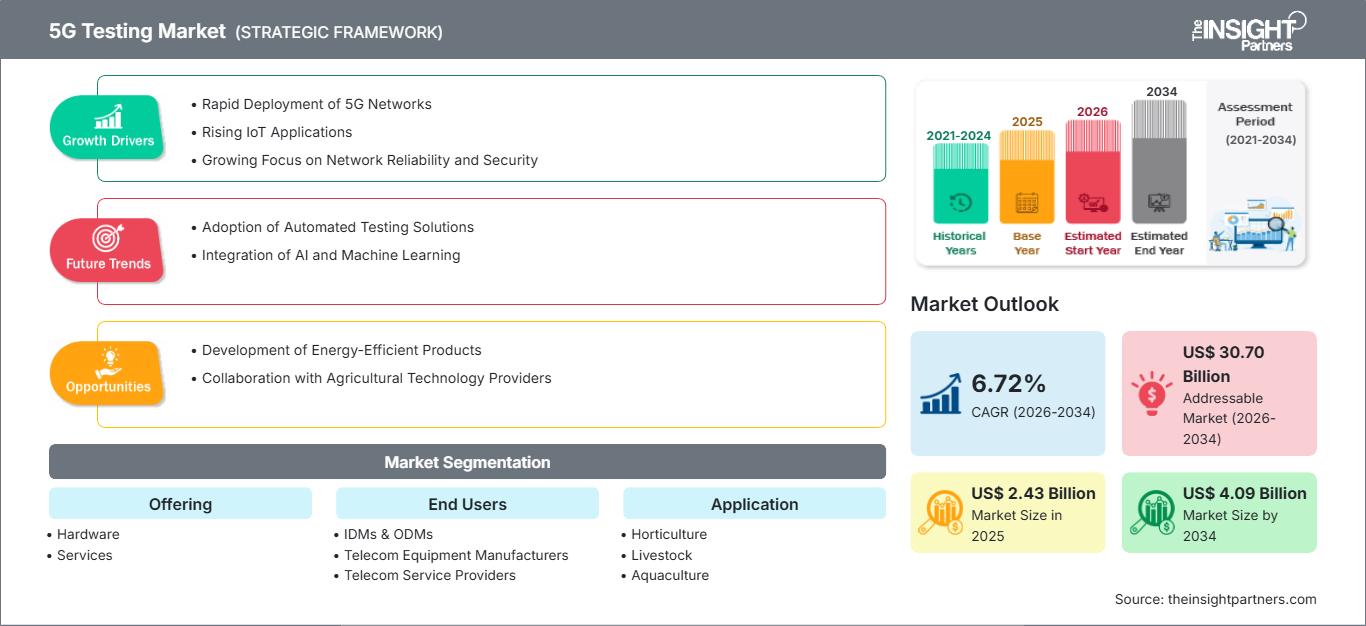
The 5G Testing Market was valued at US$ 2.43 Billion in 2025 and is projected to reach US$ 4.09 Billion by 2034, registering a CAGR of 6.72% during 2026–2034. Demand is being shaped by increasingly complex radio architectures, device interoperability requirements, network densification, and continuing evolution of 5G-Advanced capabilities across communications infrastructure, semiconductor development, and connected-device ecosystems.
North America remains a high-value testing environment, with the 5G Testing Market size supported by extensive standalone-network deployment, device certification activity, and investment in private wireless infrastructure. The regional market is estimated to expand at a 6.2–6.8% CAGR during 2026–2034. North America recorded the world's highest 5G subscription penetration at 79% at the end of 2025, strengthening recurring requirements for network optimization, conformance, performance, and service-assurance testing.
5G Testing Market Assessment and Insights
- North America: Accounted for an estimated 34–37% share in 2025 and is expected to record a 6.2–6.8% CAGR between 2026–2034, supported by mature 5G adoption, standalone networks, private wireless deployments, and advanced device validation requirements.
- US: Represented approximately 82–86% of North American revenue in 2025, with an estimated 6.3–6.9% CAGR during 2026–2034, reflecting concentrated operator, chipset, defense, cloud, and equipment-testing activity.
- Europe: Held an estimated 25–28% share in 2025 and is projected to grow at a 5.8–6.4% CAGR during 2026–2034. Germany and the UK lead regional demand, followed by France, Italy, and Spain.
- Asia Pacific: Represented approximately 29–32% of the market in 2025, with a projected 7.2–7.9% CAGR during 2026–2034. China, Japan, South Korea, and India support demand through network expansion, semiconductor manufacturing, and device-production ecosystems.
- Largest Segment: Hardware represented an estimated 60–64% market share in 2025 and is projected to expand at a 5.8–6.4% CAGR during 2026–2034, reflecting sustained expenditure on RF, protocol, signaling, and production-test platforms.
- High Growth Segment: Services accounted for an estimated 36–40% market share in 2025 and is expected to register a 7.8–8.6% CAGR during 2026–2034, driven by managed testing, benchmarking, optimization, automation, and interoperability requirements.
- Key companies analyzed in detail: Anritsu Corporation, Keysight Technologies, Inc., Teradyne, Inc., Emerson Electric Co. (NI), Spirent Communications plc, now part of Keysight Technologies, Inc., VIAVI Solutions Inc., MACOM Technology Solutions Holdings, Inc., Rohde & Schwarz GmbH & Co. KG, GL Communications Inc., and EXFO Inc.
Source: The Insight Partners' analysis based on proprietary research, government publications, company annual reports, investor presentations, industry databases, and expert interviews.
The testing needs have transformed from traditional RF testing and coverage testing to testing massive MIMO, beamforming, carrier aggregation, Open RAN interfaces, network slicing, standalone cores, private networks, and non-terrestrial connectivity. 3GPP Release 18 introduced the first framework for the 5G-Advanced specifications, while Release 19 introduced additional changes to radio performance, AI-enabled functionality, and new network capabilities. This trend results in an increasing number of scenarios that need to be tested by equipment suppliers, network operators, and device manufacturers prior to commercial deployment.
The next step in the development will involve a gradual transition from 5G-Advanced testing to initial 6G studies, particularly in the FR3 spectrum, AI-RAN, NTN, digital twins, and software-defined testing. Additionally, investment funds will be allocated to India, Southeast Asia, the Middle East, and other markets where the upgrade of wireless networks and private wireless programs takes place. Worldwide 5G subscriptions accounted for approximately one-third of mobile subscriptions by the end of 2025, broadening the installed infrastructure base requiring continuous performance assurance.
5G Testing Market Report Scope
| Report Attribute | Details |
|---|---|
| Market size in 2025 | US$ 2.43 Billion |
| Market Size by 2034 | US$ 4.09 Billion |
| Global CAGR (2026 - 2034) | 6.72% |
| Historical Data | 2021-2024 |
| Forecast period | 2026-2034 |
5G Testing Market Analysis
The principal 5G Testing Market growth driver is the increasing complexity of validating networks across radio, transport, core, device, application, and service layers. Network operators are going beyond mere coverage validation into end-to-end validation of latency, throughput, slicing, mobility, security, and power consumption characteristics. As 5G will account for 48% of global mobile data traffic in 2025, testing becomes increasingly about optimizing the real-life networks rather than limited to development labs.
This ecosystem goes from semiconductors and RF component makers, through device makers, telecom equipment providers, operators, test labs and certification organizations. Therefore, the technology supply situation favors platforms that can integrate signal creation, network simulation, protocol validation, analysis, and automation capabilities. The modular nature of the architecture allows users to upgrade the existing instruments as 3GPP standard evolves.
Competitive positioning within the 5G Testing Market analysis increasingly depends on platform breadth, automation depth, software integration, and the ability to address both 5G-Advanced and emerging 6G workflows. Keysight strengthened its wireless-testing portfolio through the October 2025 acquisition of Spirent, while VIAVI acquired selected Spirent high-speed Ethernet, network-security, and channel-emulation activities following regulatory divestiture requirements.
Anritsu Corporation and Rohde & Schwarz GmbH & Co. KG are key players in device testing, RF testing, signaling testing, NTN testing, and infrastructure testing; Emerson offers NI solution for modular automated test solutions; EXFO Inc. and GL Communications Inc. have a presence in network assurance testing and protocol based testing. Investment is moving towards reusable software environment, virtual lab, digital twins, cloud orchestration, and AI driven test development because customers are looking for better asset utilization and faster test cycles.
● REPORT CUSTOMIZATION
Tailor This Report To Align With Your Specific Business Requirements
This report can be customized to align precisely with your business objectives, scope, and target markets. Customization options include tailored segmentation, geography, competitive analysis, and strategic insights to support informed decision-making.
Customize This Report →WHAT YOU CAN ADJUST
- ● Segmentations
- ● Geography
- ● Competitive Analysis
- ● Language Preferences
5G Testing Market: Strategic Insights
Regional Insights
North America 5G Testing Market
North America represented an estimated 34–37% share in 2025 and is projected to expand at a 6.2–6.8% CAGR during 2026–2034. Its leadership reflects advanced 5G penetration, established device-certification infrastructure, private-network investment, and the concentration of semiconductor, cloud, defense, and communications-equipment development. North America reached 79% 5G subscription penetration at the end of 2025, the highest level among major global regions.
The regional 5G Testing Market share is also supported by increasing requirements for standalone-core assurance, Open RAN interoperability, automotive connectivity, NTN testing, and network benchmarking. Operators are expanding automation because software-defined and cloud-native networks require continuous validation rather than periodic field testing. Vendors with integrated RF, protocol, emulation, and assurance capabilities are consequently positioned to capture spending across laboratory development and operating-network environments.
U.S. 5G Testing Market
The U.S. accounted for approximately 82–86% of North American revenue in 2025 and is expected to register a 6.3–6.9% CAGR during 2026–2034. Demand comes from nationwide operators, chipset designers, infrastructure suppliers, aerospace and defense programs, automotive developers, hyperscale technology companies, and independent laboratories. Testing intensity increases as network architecture incorporates standalone cores, edge computing, spectrum aggregation, and enterprise-specific service profiles.
Keysight Technologies, Inc., VIAVI Solutions Inc., Anritsu Corporation, Emerson Electric Co. through NI, and other suppliers maintain substantial commercial and engineering activity in the country. U.S. applications increasingly include private 5G validation, C-V2X, industrial communications, NTN, Open RAN, advanced antenna systems, and service assurance. High capital intensity favors modular equipment and software-defined test environments that can be upgraded across successive standards rather than replaced for every technology generation.
Europe 5G Testing Market
Europe represented approximately 25–28% of global revenue in 2025 and is projected to record a 5.8–6.4% CAGR during 2026–2034. Germany leads through telecom engineering, automotive electronics, industrial wireless applications, and the presence of Rohde & Schwarz. The UK supports network benchmarking, private-network development, research laboratories, and communications technology validation, creating demand across both hardware and testing services.
France, Italy, and Spain are progressing through 5G densification, industrial digitization, transport connectivity, and enterprise-network initiatives. Western Europe reached approximately 54% 5G subscription penetration at the end of 2025, indicating significant room for further standalone migration and advanced-service commercialization. Testing demand will increasingly concentrate on network slicing, industrial reliability, interoperability, cybersecurity, and multi-vendor environments as operators transition from coverage expansion toward service differentiation.
APAC 5G Testing Market
Asia Pacific accounted for an estimated 29–32% share in 2025 and is expected to deliver the fastest regional expansion at a 7.2–7.9% CAGR during 2026–2034. China, Japan, and South Korea combine high network density with extensive telecom-equipment, semiconductor, and consumer-device manufacturing, creating substantial laboratory and production-testing requirements.
India is becoming increasingly important through rapid subscriber migration, domestic electronics manufacturing, and network expansion, while Australia sustains demand around operator optimization and enterprise connectivity. Northeast Asia reached approximately 60% 5G penetration in 2025, reinforcing the region's transition toward 5G-Advanced validation.
Middle East & Africa 5G Testing Market
The Middle East & Africa market is projected to expand at a 6.8–7.5% CAGR during 2026–2034. Saudi Arabia and the UAE lead regional adoption through national digital infrastructure programs, smart-city development, private wireless systems, and advanced mobile networks. GCC markets reached approximately 53% 5G subscription penetration at the end of 2025.
South Africa remains the principal sub-Saharan testing market, supported by operator modernization and enterprise connectivity. Elsewhere, adoption is comparatively selective, favoring portable field-test systems and service-led testing models over large laboratory deployments.
Segmentation Analysis
Offering
The Offering segment is expected to record an estimated 6.5–7.0% CAGR during 2026–2034. The 5G Testing Market scope increasingly spans physical RF instrumentation, network emulation, protocol systems, automation software, field optimization, and managed testing. Customers are balancing capital-intensive laboratory platforms with service engagements that provide specialized expertise for interoperability, benchmarking, certification preparation, and network optimization.
- Hardware: Hardware remains the largest offering because RF generators, analyzers, channel emulators, signaling testers, drive-test equipment, probes, and production-test systems form the physical measurement foundation for 5G development and deployment.
- Services: Services are gaining strategic importance as operators and manufacturers outsource specialized interoperability, benchmarking, network optimization, certification preparation, and automated testing activities to reduce internal engineering workload and accelerate deployment programs.
End Users
The End Users segment is projected to expand at an estimated 6.4–7.0% CAGR during 2026–2034. Testing requirements vary substantially across semiconductor companies, device manufacturers, infrastructure vendors, and service providers. Increasing software content and cross-vendor interoperability are extending validation responsibilities throughout the value chain, creating recurring demand from product development through production, deployment, optimization, and lifecycle assurance.
- IDMs & ODMs: Integrated device manufacturers and original design manufacturers require high-throughput validation covering RF performance, protocol behavior, power consumption, antennas, chipsets, and production quality before devices progress toward operator acceptance and commercialization.
- Telecom Equipment Manufacturers: Infrastructure suppliers rely on testing to verify base stations, small cells, massive MIMO radios, Open RAN components, transport interfaces, timing, interoperability, and performance across increasingly disaggregated network architectures.
- Telecom Service Providers: Operators represent strategically important users because live-network testing now encompasses coverage, latency, throughput, slicing, mobility, service assurance, benchmarking, interference management, private networks, and continuous optimization.
Opportunity Snapshot
| End Users | Revenue Contribution (High/Medium/Low) | Trend Tag | Adoption Stage |
| IDMs & ODMs | High | Device Validation | Mature |
| Telecom Equipment Manufacturers | High | Open RAN | Scaling |
| Telecom Service Providers | High | Service Assurance | Scaling |
| Others | Low | Lab Expansion | Emerging |
5G Testing Market Growth Drivers and Impact Analysis
Expansion of 5G-Advanced Network Complexity
5G-Advanced introduces more demanding combinations of carrier aggregation, massive MIMO, advanced uplink capabilities, reduced-capability devices, network slicing, positioning, NTN integration, and intelligent network functions. Release 18 created a 5G-Advanced baseline specification, whereas Release 19 is further advancing technology to make it more automated and optimized. Each added functionality creates more scenarios for RF testing, protocol testing, interoperability testing, and performance testing of chipsets, devices, radio networks, cores, and services. Thus, there would be an increase in test cases, which makes laboratories interested in automated regression testing and reusable software tools. Those vendors who manage to combine different test areas in scalable platforms will reduce customer equipment duplications.
Growth of Standalone, Private 5G, and Open RAN Deployments
Standalone and private 5G systems introduce testing aspects beyond traditional radio access tests, as enterprises and operators need to prove functionality, latency, security, network slicing, inter-device interactions, and service levels for specific applications in the core network. Open RAN adds another layer to the system by separating network elements previously provided by vertical providers. The O-RAN ALLIANCE certification program is designed to increase trust in interoperable products, and certifiable products are beginning to appear in testing labs around the globe. As a result, multivendor integration testing prior to the product commercialization becomes critical.
Rising Requirement for Continuous Network Assurance
The approach towards testing will transition from being an event associated with the development phase towards one of continuous assurance, in light of the fact that 5G will be cloud native, programmable, and service-based networks. During 2025, the proportion of 5G's share of mobile data traffic was 48%. This shows that the networks have become commercial and carry significant operational loads. The higher load means that the consequences of congestion, interference, bugs in software, handover failures, and application performance problems affect the business more. Hence, there is a requirement for the automated assurance system that can identify problems at the radio, transport, core, and application layer level.
5G Testing Market Future Trends
AI-Assisted and Software-Defined Testing
The most important 5G Testing Market trends increasingly center on automation, AI-assisted workflows, and software-defined instrumentation. Engineers who test products are being faced with rapidly growing numbers of frequency ranges, configurations of devices, network conditions, and scenarios of protocols. Research in academia in the field of specification-aware automated testing in O-RAN shows how AI could be used to create test processes, analyze them using technical specification, and even aid in the root cause analysis process. Commercial entities use natural language processing, automated creation of scenarios, analysis, and digital twins. During the forecast period, product differentiation will become increasingly based on software, orchestration, and data intelligence.
Convergence of 5G-Advanced, NTN, and Early 6G Validation
Test platforms are beginning to bridge current 5G deployments with NTN and early 6G research rather than treating each technology as an isolated equipment cycle. Rohde & Schwarz demonstrated FR1–FR3 carrier aggregation in 2026 using an upgraded CMX500 platform, illustrating how existing systems can evolve toward higher-frequency research. NTN further increases the importance of channel emulation, mobility simulation, timing, protocol conformance, and propagation modeling because satellite links introduce conditions that terrestrial laboratories cannot reproduce directly. Vendors offering upgradeable RF architectures and software-defined capabilities should benefit as research laboratories and equipment manufacturers seek to preserve earlier capital investments while preparing for emerging spectrum and network architectures.
5G Testing Market Opportunities
Managed Testing for Emerging 5G Economies
There are substantial opportunities in service-led testing when 5G network rollout is outpacing the establishment of local laboratories. The 5G Testing Market Forecasts reveal that countries in the Asia Pacific region and some Middle Eastern countries can achieve growth rates higher than the global average due to the growth of standalone deployments and industrial connections in operators’ networks. The model itself can help to reduce entry barriers for small suppliers of devices and equipment. The business model in particular suits India, Southeast Asia, and Gulf regions where the ecosystem expands beyond the existing telecom vendors.
Private Network and Industrial Validation Platforms
With Enterprise 5G, there is the possibility of bringing testing closer to the industrial world of manufacturing, logistics, mining, utilities, transportation, and intelligent infrastructure. Private testing differs from public testing in that validation must be performed in light of specific operational goals such as latency determinism, device density, application robustness, indoor penetration, cybersecurity, and enterprise integration. Suppliers can produce standardized testing solutions that include RF testing, network emulation, acceptance testing, application benchmarking, and post-deployment assurance. Collaboration with system integrators and industrial automation companies will help suppliers extend sales outside the traditional telecom channels. This is especially appealing to service providers due to optimization needs resulting from each implementation.
Frequently Asked Questions

- Comprehensive Market Sizing and Forecast Analysis
- Detailed Segmentation Analysis
- In-Depth Market Dynamics Assessment
- Regional and Country-Level Insights
- Competitive Landscape and Company Benchmarking
- Strategic Business Intelligence
Recent Reports
Testimonials

The Insight Partners' SCADA System Market report is comprehensive, with valuable insights on current trends and future forecasts. The team was highly professional, responsive, and supportive throughout. We are very satisfied and highly recommend their services.
RAN KEDEM Partner, Reali Technologies LTDs
I requested a report on a very specific software market and the team produced the report in a few days. The information was very relevant and well presented. I then requested some changes and additions to the report. The team was again very responsive and I got the final report in less than a week.
JEAN-HERVE JENN Chairman, Future Analytica
We worked with The Insight Partners for an important market study and forecast. They gave us clear insights into opportunities and risks, which helped shape our plans. Their research was easy to use and based on solid data. It helped us make smart, confident decisions. We highly recommend them.
PIYUSH NAGPAL Sr. Vice President, High Beam Global
The Insight Partners delivered insightful, well-structured market research with strong domain expertise. Their team was professional and responsive throughout. The user-friendly website made accessing industry reports seamless. We highly recommend them for reliable, high-quality research services
YUKIHIKO ADACHI CEO, Deep Blue, LLC.
This is the first time I have purchased a market report from The Insight Partners.While I was unsure at first, I visited their web site and felt more comfortable to take the risk and purchase a market report.I am completely satisfied with the quality of the report and customer service. I had several questions and comments with the initial report, but after a couple of dialogs over email with their analyst I believe I have a report that I can use as input to our strategic planning process.Thank you so much for taking the extra time and making this a positive experience.I will definitely recommend your service to others and you will be my first call when we need further market data.
JOHN SUZUKI President and Chief Executive Officer, Board Director, BK Technologies
I wish to appreciate your support and the professionalism you displayed in the course of attending to my request for information regarding to infectious disease IVD market in Nigeria. I appreciate your patience, your guidance, and the fact that you were willing to offer a discount, which eventually made it possible for us to close a deal. I look forward to engaging The Insight Partners in the future, all thanks to the impression you have created in me as a result of this first encounter.
DR CHIJIOKE ONYIA MANAGING DIRECTOR, PineCrest Healthcare Ltd.Reason to Buy
- Informed Decision-Making
- Understanding Market Dynamics
- Competitive Analysis
- Identifying Emerging Markets
- Customer Insights
- Market Forecasts
- Risk Mitigation
- Boosting Operational Efficiency
- Strategic Planning
- Investment Justification
- Tracking Industry Innovations
- Aligning with Regulatory Trends





 Get Free Sample for