
Active Optical Cable Market Share, Size & Demand by 2034
Coverage: by Protocol (Infiniband, Ethernet, HDMI, USB, Displayport, Others); Connector (QSFP, SFP, CXP, Cx4, CFP, Others); Application (Data Center, Consumer Electronics, Telecommunication, High-Performance Computing, Others) , and Geography (North America, Europe, Asia Pacific, and South and Central America)
- Status : Data Released
- Report Code : TIPRE00010526
- Category : Electronics and Semiconductor
- No. of Pages : 150
- Available Report Formats :


- Last update date : July 15, 2026


2025 Market Size
US$ 5.29 Bn
Base year value
2034 Forecast
US$ 14.81 Bn
Projected by 2034
CAGR 2026-2034
12.13 %
Growth rate
Addressable Market
US$ 88.13 Bn
(2026-2034)
The Active Optical Cable Market was valued at US$ 5.29 Billion in 2025 and is projected to reach US$ 14.81 Billion by 2034, expanding at a CAGR of 12.13% during 2026–2034. Active optical cables integrate optical transceivers within cable assemblies to support high-speed, low-latency transmission across data centers, high-performance computing, telecommunications, and consumer electronics without the distance, weight, and electromagnetic limitations of copper interconnects.
North America is expected to advance at a CAGR range of 11.4–11.8% during 2026–2034, supported by hyperscale cloud buildouts, AI accelerator clusters, and 400G/800G networking upgrades. Regional demand also benefits from enterprise migration toward fiber-rich architectures, where Active Optical Cable Market adoption improves rack density, lowers electromagnetic interference, and extends reach for switch-to-server and switch-to-storage connectivity.
Active Optical Cable Market Assessment and Insights
- North America: 31–35% share in 2025 and CAGR between 2026–2034 of 11.4–11.8%; hyperscale cloud, AI infrastructure, and high-speed Ethernet upgrades sustain regional demand.
- US: 80–84% of North America share in 2025 and CAGR between 2026–2034 of 11.5–11.9%; data center clusters, HPC labs, and telecom modernization drive deployments.
- Europe: 19–23% share in 2025 and CAGR between 2026–2034 of 10.5–10.9%; Germany, the UK, France, Italy, and Spain lead through cloud, automotive electronics, and industrial networking.
- Asia Pacific: 36–40% share in 2025 and CAGR between 2026–2034 of 13.1–13.5%; China, Japan, South Korea, India, and Australia benefit from electronics manufacturing and digital infrastructure.
- Largest Segment: Data Center held 43–47% market share in 2025, CAGR range 12.5–12.9%, supported by AI clusters, cloud regions, and 400G/800G switching.
- High Growth Segment: High-Performance Computing held 14–18% market share in 2025, CAGR range 13.6–14.0%, driven by supercomputing, AI training, and scientific simulation workloads.
- Key companies analyzed in detail: 3M Company; Amphenol Corporation; Broadcom Inc.; EMCORE Corporation; Fiberon Technologies Inc.; Coherent Corp.; Molex, LLC; Shenzhen Gigalight Technology Co., Ltd.; The Siemon Company; TE Connectivity plc.
Source: The Insight Partners' analysis based on proprietary research, government publications, company annual reports, investor presentations, industry databases, and expert interviews.
The active optical cable market report has shifted from specialized high-performance computing links toward mainstream data center, enterprise, and professional audiovisual infrastructure. Improvements in VCSELs, multimode fiber assemblies, signal conditioning, and connector miniaturization have reduced installation complexity while supporting higher bandwidth. Production dynamics now emphasize scalable optical engine supply, interoperability testing, thermal management, and factory-terminated designs that shorten deployment cycles for dense switch fabrics and rack-level interconnects.
Forward demand will be shaped by Asia Pacific electronics ecosystems, North American hyperscale investment, and European cloud sovereignty programs. Regulatory and industry pressure for energy-efficient digital infrastructure favors lighter, lower-loss optical links. As AI, 5G transport, immersive video, and edge computing increase traffic density, Active Optical Cable growth will depend on cost reduction, multi-vendor compatibility, higher-speed Ethernet roadmaps, and reliable supply of optical components.
Active Optical Cable Market Report Scope
| Report Attribute | Details |
|---|---|
| Market size in 2025 | US$ 5.29 Billion |
| Market Size by 2034 | US$ 14.81 Billion |
| Global CAGR (2026 - 2034) | 12.13% |
| Historical Data | 2021-2024 |
| Forecast period | 2026-2034 |
Active Optical Cable Market Analysis
Demand is anchored in bandwidth-intensive workloads that require short-reach, high-speed connections inside and between racks. The Active Optical Cable Market analysis reflects the move from copper reach limits toward optical links for Ethernet, InfiniBand, HDMI, USB, and DisplayPort applications. Data centers remain the largest demand pool because AI training clusters and cloud services require predictable latency, cable flexibility, and signal integrity.
The value chain includes VCSEL and laser suppliers, optical engine designers, connector manufacturers, cable assemblers, switch vendors, hyperscale operators, telecom carriers, and professional AV integrators. Supply dynamics depend on photonic component availability, thermal design, firmware compatibility, and qualification cycles. Active Optical Cable market size expands as buyers prioritize pre-terminated, plug-and-play interconnects that reduce field errors and support faster infrastructure commissioning.
The competitive landscape combines diversified interconnect suppliers and optical specialists. Amphenol Corporation, Molex, LLC, TE Connectivity plc, and The Siemon Company compete through connector breadth and enterprise channel access, while Broadcom Inc., EMCORE Corporation, Coherent Corp., and Shenzhen Gigalight Technology Co., Ltd. strengthen optical component and module capabilities. 3M Company and Fiberon Technologies Inc. support specialized connectivity niches.
Investment trends emphasize 400G, 800G, and emerging 1.6T interconnect roadmaps, tighter thermal budgets, and optical cabling for AI server clusters. Strategic positioning increasingly depends on validated compatibility with switches, storage, GPUs, and network interface cards. Vendors that combine connector reliability, optical performance, compliance testing, and global logistics can improve Active Optical Cable market share as hyperscale procurement becomes more standardized.
● REPORT CUSTOMIZATION
Tailor This Report To Align With Your Specific Business Requirements
This report can be customized to align precisely with your business objectives, scope, and target markets. Customization options include tailored segmentation, geography, competitive analysis, and strategic insights to support informed decision-making.
Customize This Report →WHAT YOU CAN ADJUST
- ● Segmentations
- ● Geography
- ● Competitive Analysis
- ● Language Preferences
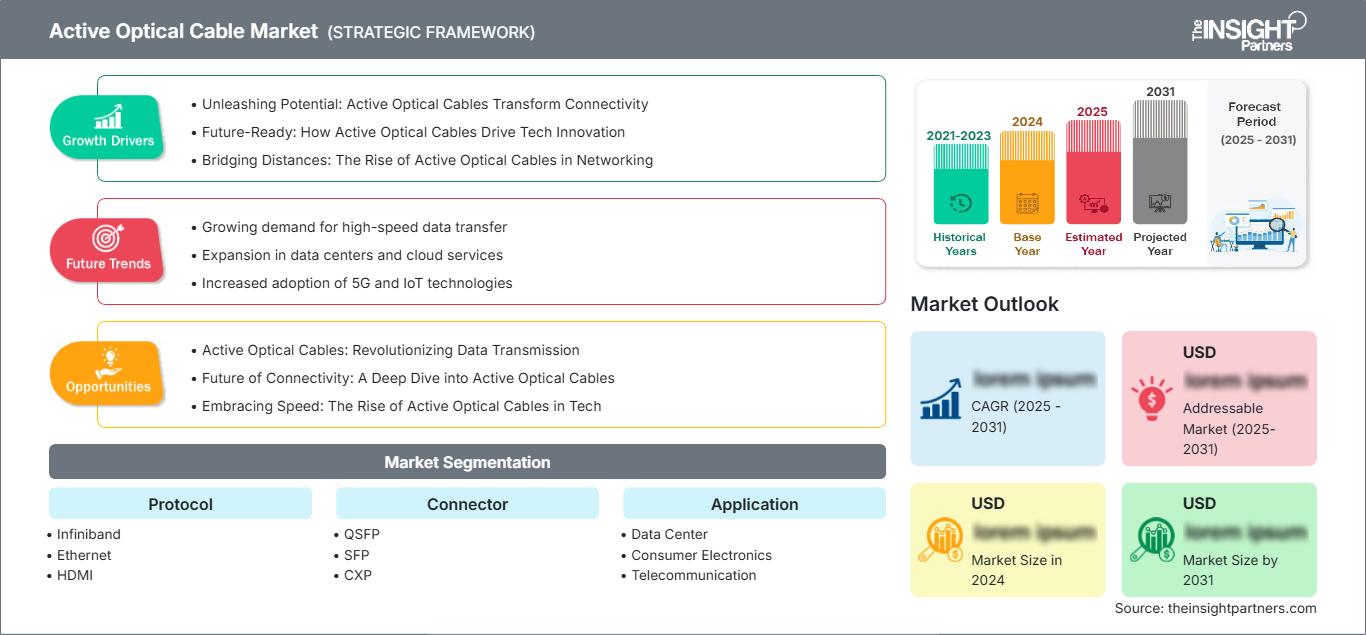
Active Optical Cable Market: Strategic Insights
Regional Insights
North America Active Optical Cable Market
North America accounted for 31–35% share in 2025 and is expected to grow at a CAGR of 11.4–11.8% during 2026–2034. Hyperscale cloud operators, enterprise AI deployments, and high-speed Ethernet refresh cycles create strong demand for short-reach optical interconnects. Active optical cables reduce congestion inside cabinets and support longer reach than copper.
Regional uptake is bolstered by semiconductor design hubs, financial services computing needs, defense simulation, and co-location growth. Buyers are now considering Active Optical Cable technology alongside power, cooling, and density initiatives. Compatibility with Ethernet, InfiniBand, and USB standards continues to matter because providers must implement an interoperable environment across multiple vendors' networks.
U.S. Active Optical Cable Market
The U.S. Active Optical Cables market accounted for 80-84% of North America in 2025 and is projected to grow at a CAGR of 11.5-11.9% through 2034. Demand is driven by cloud regions, AI campuses, supercomputer centers, telecommunications laboratories, and professional AV applications. Ecosystem players include Broadcom Inc., Amphenol Corporation, Molex, LLC, 3M Company, and The Siemon Company.
Key application areas include 400G/800G data center fabrics, GPU interconnect density, AV-over-IP systems, and federal government research computing centers. The scope of the Active Optical Cable market is expanding as the purchase teams evaluate weight, airflow, bend radius, and power budget requirements. Demand in the U.S. market is driven by domestic investments in semiconductors and digital infrastructure.
Europe Active Optical Cable Market
Europe held 19–23% share in 2025 and is forecast to grow at a CAGR of 10.5–10.9% during 2026–2034. Germany leads regional adoption through industrial automation, automotive electronics, cloud infrastructure, and research computing. Buyers prioritize energy-efficient interconnects, standards compliance, and reliable procurement for enterprise and carrier networks.
The UK active optical cable market is driven by the need for low-latency cabling due to financial services computing, the expansion of the colocation sector, and advanced AI research facilities. France has been driving demand through its national cloud initiatives, telecom network upgrades, aerospace electronics, and HPC centers. Italy and Spain have smaller markets but are driven by data center investments, computing in universities, and digital transformation efforts.
Factors such as sustainability, energy efficiency, and data infrastructure sovereignty contribute to the adoption of the technology in Europe. The active optical cable industry in Europe includes TE Connectivity plc, Amphenol Corporation, Molex, LLC, and The Siemon Company, which cater to their enterprise and industrial clients through existing channels.
APAC Active Optical Cable Market
APAC accounted for 36–40% share in 2025 and is expected to grow at a CAGR of 13.1–13.5% through 2034. China leads through cloud infrastructure, electronics manufacturing, and telecom investment.
Japan and South Korea focus on semiconductor ecosystems, supercomputing, and consumer electronics. India is going big on data center parks, digital public infrastructure, and enterprise cloud migrations.
Australia includes colocation, research, and telecoms. APAC is the fastest-growing region for Active Optical Cable market deployments, driven by industrial policies, AI, and export electronics.
Middle East & Africa Active Optical Cable Market
Middle East & Africa Active Optical Cable market is projected to grow at a CAGR of 9.2–9.6% during 2026–2034. Saudi Arabia leads through cloud zones, smart-city infrastructure, and digital government programs.
UAE investments in adoption come from the data center sector, aviation tech, and finance, whereas South African inputs into digitization come from enterprise connectivity, research compute, and telecoms upgrades.
Digitization in the energy sector, sovereign cloud initiatives, and infrastructure diversification drive adoption, although cost constraints and limited local expertise mean adoption is mostly limited to premium projects.
Segmentation Analysis
Protocol
The protocol segment is projected to grow at a CAGR of 12.0–12.4% during 2026–2034. Ethernet dominates large-scale data center upgrades, while Infiniband remains important for clustered computing and AI workloads. HDMI, USB, and DisplayPort support professional AV, consumer electronics, digital signage, and workstation applications where long-reach, low-interference transmission is required.
- Infiniband serves high-performance computing and AI training clusters that require low latency, high throughput, and stable fabric performance across dense compute nodes.
- Ethernet represents the broadest enterprise and hyperscale protocol base, supporting 100G, 400G, 800G, and emerging higher-speed switch-to-server and switch-to-storage connections.
- HDMI supports long-distance audiovisual transmission in conference rooms, control centers, medical displays, broadcast facilities, and high-resolution digital signage installations.
- USB demand is linked to industrial vision, professional peripherals, extended workstation setups, and device connectivity where signal quality must be preserved over longer distances.
- DisplayPort addresses graphics-intensive workstations, simulation environments, control rooms, and professional displays that require high-resolution video with low interference and flexible routing.
Connector
The connector segment is expected to grow at a CAGR of 11.8–12.2% during 2026–2034. QSFP leads because hyperscale networks require compact, high-port-density links for 400G and 800G environments. SFP remains relevant for enterprise and telecom access, while CXP, Cx4, and CFP support legacy, specialized, or high-throughput deployments.
- QSFP is central to modern data center fabrics, offering compact port density, broad switch compatibility, and strong alignment with high-speed Ethernet and AI infrastructure.
- SFP supports enterprise, telecom, storage, and edge networking applications where modularity, installed-base compatibility, and predictable performance remain critical procurement factors.
- CXP serves selected high-bandwidth and legacy computing environments that require parallel optical connectivity and stable throughput across specialized infrastructure.
- Cx4 remains relevant in limited replacement and installed-base scenarios where organizations maintain older high-speed interconnect architectures before full migration.
- CFP addresses carrier, transport, and earlier high-capacity optical deployments where larger form factors remain operationally acceptable and validated equipment lifecycles continue.
Application
The application segment is forecast to grow at a CAGR of 12.3–12.7% during 2026–2034. Data center deployments dominate revenue, while consumer electronics, telecommunications, and high-performance computing create differentiated demand. Adoption improves where users require higher bandwidth, longer reach, reduced cabling bulk, and immunity to electromagnetic interference in dense digital environments.
- Data Center applications generate the largest revenue contribution because cloud, AI, storage, and switching architectures require dense, reliable, high-speed interconnects across racks.
- Consumer Electronics demand is driven by premium displays, gaming, virtual production, home theaters, and extended USB or HDMI connectivity requiring lightweight long-reach cables.
- Telecommunications uses active optical cables in central offices, 5G transport environments, aggregation sites, and network equipment rooms where signal quality and cable manageability matter.
- High-Performance Computing adoption is expanding as supercomputers, AI clusters, and scientific simulation platforms require low-latency optical links between processors, accelerators, and storage.
Opportunity Snapshot
| Application | Revenue Contribution | Trend Tag | Adoption Stage |
| Data Center | High | AI Fabrics | Scaling |
| Consumer Electronics | Medium | 8K Display | Scaling |
| Telecommunication | Medium | 5G Transport | Scaling |
| High-Performance Computing | High | GPU Clusters | Emerging |
Active Optical Cable Market Growth Drivers and Impact Analysis
AI Data Centers Require Denser Optical Interconnects
Clusters for training and inference of AI algorithms involve thousands of GPUs, accelerators, switches, and storage devices packed into high-density sites. Copper becomes less suitable for handling as speed increases and distance increase in rack clusters. Active optical cables solve this problem by decreasing weight, optimizing bending radius, and ensuring signal integrity while achieving high-speed transfers. The effects can be seen in the quicker qualification of 400G/800G connections, increased use of QSFP connectors, and procurement by cloud companies developing repeatable cluster architectures.
Cloud and Colocation Expansion Raises Cabling Complexity
Cloud clusters and colocation sites continue to grow, driven by increasing rack densities, larger switching fabrics, and a wider range of customer applications. Providers require interconnection products that simplify deployment while still enabling airflow, tracing, and deterministic performance. Active optical cables simplify installations because the transmitter, receiver, and fiber-optic cable are integrated into a single tested unit at the factory. This minimizes the risks associated with field terminations and provides faster deployment times, along with standardized cabling kits. With facility growth in metro areas, there is a growing need for fast-to-deploy low-latency links that can be deployed quickly across repeatable infrastructure designs.
Professional AV and Edge Networks Need Longer Reach
Most professional applications, such as audiovisual systems, broadcasting, medical imaging systems, control rooms, and edge computing, may require high-resolution transmission over distances where copper cables cannot perform reliably. Active optical cables allow long-reach transmission, less electromagnetic interference, and lightweight installations for HDMI, USB, and DisplayPort connections. The effects extend beyond data centers, as integrators can lay cables inside complex buildings without bulky repeaters or copper cabling. This expands the target market and helps in enterprise collaboration, immersive displays, and distributed edge infrastructure.
Active Optical Cable Market Future Trends
Transition Toward 800G and 1.6T Cable Assemblies
Future deployments will increasingly require active optical assemblies that support 800G and early 1.6T switching roadmaps. This transition will shift design priorities toward lower power per bit, better thermal dissipation, higher optical engine reliability, and tighter interoperability validation. Suppliers that align with Ethernet roadmaps and switch vendor requirements will be better positioned for hyperscale qualification. The Active Optical Cable market trends also encourage more rigorous testing of cable firmware, diagnostics, and link stability because failures in AI clusters can disrupt expensive compute capacity.
Silicon Photonics Integration Improves Cost and Scale
Silicon photonics is expected to influence active optical cable design by enabling more efficient integration of optical functions and supporting scalable manufacturing. As optical engines become smaller and more standardized, suppliers can improve cost curves, power efficiency, and consistency across high-volume assemblies. This direction supports Active Optical Cable market growth in hyperscale data centers and eventually in edge, telecom, and enterprise environments. The trend will also increase the importance of packaging expertise, test automation, and supply chain partnerships around lasers, drivers, and optical coupling.
Active Optical Cable Market Opportunities
Qualified Cabling Kits for AI Infrastructure Builds
There is an opportunity to add value by providing pre-qualified cabling solutions for AI server clusters, GPU nodes, and dense switch fabric deployments. This solution will consist of pre-qualified QSFP solutions with proven reach options, along with diagnostic data and evidence of compatibility with popular switching fabrics. In this age of predictability, purchasing departments are looking to deploy systems without integration risks and in shorter times. Suppliers that collaborate with the switching, server, and accelerator ecosystems will convert AO cable opportunities into design wins across hyperscale, enterprise AI, research computing, and sovereign cloud projects.
Expansion into Professional AV and Medical Imaging Connectivity
AV systems, digital signage, simulation, surgical visualization, and diagnostic imaging applications require a secure solution to transmit high-definition video and peripheral signals over distance. Active optical cable market forecast is possible through certified HDMI, USB, and DisplayPort cables that meet the needs of integrators seeking flexible routing, reduced electromagnetic interference, and easy installation. Opportunities for action can be found in strategic channel partnerships with AV distribution channels, health care integrators, and broadcast systems designers. Interoperability and ruggedization can help vendors expand their customer base beyond data centers.
Recent Developments
- March 2026: Coherent Corp. (NYSE: COHR), a global leader in photonics, announced it will showcase breakthrough innovations powering the next generation of AI-driven datacenter and communications networks at OFC 2026, March 17 –19, at the L.A. Convention Center in Los Angeles, California, Booth #1401. From 400G/lane, 3.2T transceivers and emerging architectures for 12.8T and beyond, to advanced co-packaged optics (CPO), multi-rail transport, and open optical networking platforms, Coherent will demonstrate how its vertical technology stack - spanning materials, devices, modules, and systems - is redefining performance, scalability, and energy efficiency for the AI era.
- March 2026: NVIDIA and Coherent Corp. (NYSE: COHR) announced a multiyear strategic agreement to advance the frontier of advanced optics technologies, including manufacturing capacity and research and development, to enable next-generation AI infrastructure. The nonexclusive agreement includes an NVIDIA multibillion-dollar purchase commitment and future access and capacity rights for advanced laser and optical networking products. In addition, NVIDIA is investing $2 billion in Coherent to support research and development, future capacity and operations as Coherent builds out its U.S.-based manufacturing capabilities.
- March 2026: A collaborative team of researchers from MediaTek, Microsoft Research, and other suppliers has successfully designed a next-generation Active Optical Cable (AOC) powered by miniaturized MicroLED light sources. This revolutionary design of an Active MicroLED Cable can significantly improve power efficiency in data centers compared to current technologies. The use of an Active MicroLED Cable would also deliver high reliability like copper but at a much farther reach.
Frequently Asked Questions

- Comprehensive Market Sizing and Forecast Analysis
- Detailed Segmentation Analysis
- In-Depth Market Dynamics Assessment
- Regional and Country-Level Insights
- Competitive Landscape and Company Benchmarking
- Strategic Business Intelligence
Recent Reports
Testimonials

The Insight Partners' SCADA System Market report is comprehensive, with valuable insights on current trends and future forecasts. The team was highly professional, responsive, and supportive throughout. We are very satisfied and highly recommend their services.
RAN KEDEM Partner, Reali Technologies LTDs
I requested a report on a very specific software market and the team produced the report in a few days. The information was very relevant and well presented. I then requested some changes and additions to the report. The team was again very responsive and I got the final report in less than a week.
JEAN-HERVE JENN Chairman, Future Analytica
We worked with The Insight Partners for an important market study and forecast. They gave us clear insights into opportunities and risks, which helped shape our plans. Their research was easy to use and based on solid data. It helped us make smart, confident decisions. We highly recommend them.
PIYUSH NAGPAL Sr. Vice President, High Beam Global
The Insight Partners delivered insightful, well-structured market research with strong domain expertise. Their team was professional and responsive throughout. The user-friendly website made accessing industry reports seamless. We highly recommend them for reliable, high-quality research services
YUKIHIKO ADACHI CEO, Deep Blue, LLC.
This is the first time I have purchased a market report from The Insight Partners.While I was unsure at first, I visited their web site and felt more comfortable to take the risk and purchase a market report.I am completely satisfied with the quality of the report and customer service. I had several questions and comments with the initial report, but after a couple of dialogs over email with their analyst I believe I have a report that I can use as input to our strategic planning process.Thank you so much for taking the extra time and making this a positive experience.I will definitely recommend your service to others and you will be my first call when we need further market data.
JOHN SUZUKI President and Chief Executive Officer, Board Director, BK Technologies
I wish to appreciate your support and the professionalism you displayed in the course of attending to my request for information regarding to infectious disease IVD market in Nigeria. I appreciate your patience, your guidance, and the fact that you were willing to offer a discount, which eventually made it possible for us to close a deal. I look forward to engaging The Insight Partners in the future, all thanks to the impression you have created in me as a result of this first encounter.
DR CHIJIOKE ONYIA MANAGING DIRECTOR, PineCrest Healthcare Ltd.Reason to Buy
- Informed Decision-Making
- Understanding Market Dynamics
- Competitive Analysis
- Identifying Emerging Markets
- Customer Insights
- Market Forecasts
- Risk Mitigation
- Boosting Operational Efficiency
- Strategic Planning
- Investment Justification
- Tracking Industry Innovations
- Aligning with Regulatory Trends





 Get Free Sample for