
Applicant Tracking System (ATS) Market Size, Share, and Analysis by 2034
Coverage: By Deployment Model (Cloud and On-Premise); Component (Solution and Services); and End-user (BFSI, IT & Telecommunication, Manufacturing, and Government)
- Status : Data Released
- Report Code : ATIPTE100001362
- Category : Technology, Media and Telecommunications
- No. of Pages : 164
- Available Report Formats :


- Last update date : August 27, 2026


2025 Market Size
US$ 3.52 Bn
Base year value
2034 Forecast
US$ 8.23 Bn
Projected by 2034
CAGR 2026-2034
10.0 %
Growth rate
Addressable Market
US$ 52.58 Bn
(2026-2034)
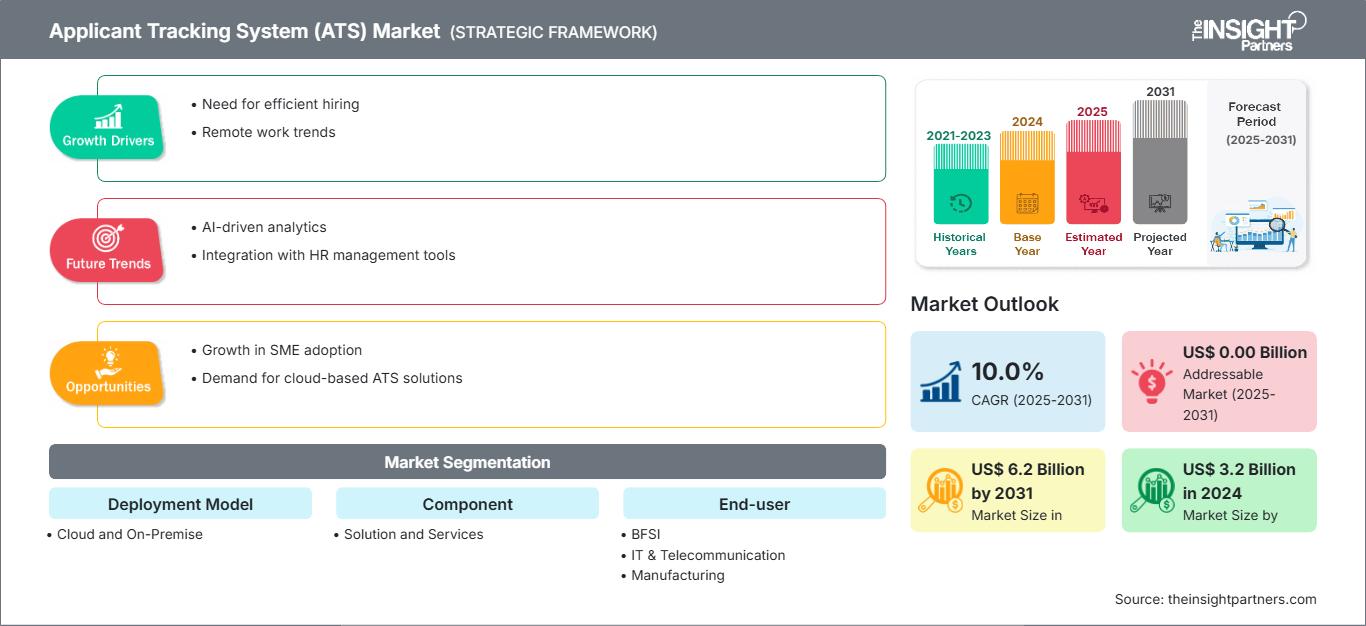
The applicant tracking system market was valued at US$ 3.52 Billion in 2025 and is projected to reach US$ 8.23 Billion by 2034, registering a CAGR of 10.0% during 2026–2034. The expansion reflects sustained enterprise spending on hiring automation, candidate relationship management, compliance-led workflow tracking, and analytics-backed recruiting decisions across BFSI, IT & Telecommunication, Manufacturing, and Government end users.
Across North America, buyer maturity remains high as employers modernize recruitment stacks for hybrid workforce planning, regulated hiring, and high-volume screening. The applicant tracking system market size in the region is supported by cloud-first HR transformation, integration with payroll and HCM suites, and rising demand for auditable AI-enabled candidate matching. The region is estimated to expand at a CAGR range of 8.6–9.4% during 2026–2034.
Applicant Tracking System (ATS) Market Assessment and Insights
- North America: The region accounted for 34–36% share in 2025 and is growing at a CAGR range of 8.6–9.4% during 2026–2034, led by enterprise SaaS renewal cycles, compliance monitoring, and analytics-led recruiting operations.
- US: The country represented 78–82% of North America in 2025 and is growing at a CAGR range of 8.8–9.6% during 2026–2034, supported by large employer adoption and vendor concentration.
- Europe: Europe held 24–26% share in 2025 and is growing at a CAGR range of 8.0–8.8% during 2026–2034, with the UK, Germany, France, Italy, and Spain leading compliance-oriented hiring software adoption.
- Asia Pacific: Asia Pacific captured 22–24% share in 2025 and is growing at a CAGR range of 11.8–12.8% during 2026–2034, with China, India, Japan, South Korea, and Australia driving scalable cloud recruiting deployments.
- Largest Segment: Cloud represented 68–72% market share in 2025 and is growing at a CAGR range of 10.6–11.6% during 2026–2034, owing to flexible integration and lower infrastructure burden.
- High Growth Segment: Services held 25–29% market share in 2025 and is growing at a CAGR range of 11.2–12.2% during 2026–2034, as implementation, configuration, and compliance advisory demand increases.
- Key companies analyzed in detail: ApplicantStack, Oracle Corporation, iCIMS, Inc., Workable Software Limited, Hyrell, Bullhorn, Inc., ClearCompany, LLC, Greenhouse Software, Inc., Employ Inc., Automatic Data Processing, Inc., SAP SE, 4Talent, Grupo Navent S.R.L., Gupy Tecnologia em Recrutamento LTDA, Kenoby, Pemasys.
Source: The Insight Partners' analysis based on proprietary research, government publications, company annual reports, investor presentations, industry databases, and expert interviews.
Recruitment software has shifted from resume storage toward workflow intelligence, automated screening, branded career sites, and structured interview management. Cloud architecture changed production dynamics by reducing custom deployment cycles and enabling frequent releases across integrations, analytics, and compliance modules. Vendors now compete on ecosystem depth, AI governance, candidate engagement, and sector-specific templates rather than basic requisition tracking, which keeps the applicant tracking system market aligned with broader HCM modernization.
Expectations are that forward demand will be robust in developing countries where formal hiring processes, identity verification, and workforce services are becoming more prevalent. Regulations favoring equitable hiring, data privacy, and auditability are raising buyer awareness of transparent workflows. Investments are being made in multilingual technology platforms, skill taxonomies, scheduling, and recruitment analytics for distributed teams, especially in the Asia Pacific and Latin America, which are seeing more cloud adoption growth opportunities.
Applicant Tracking System (ATS) Market Report Scope
| Report Attribute | Details |
|---|---|
| Market size in 2025 | US$ 3.52 Billion |
| Market Size by 2034 | US$ 8.23 Billion |
| Global CAGR (2026 - 2034) | 10.0% |
| Historical Data | 2021-2024 |
| Forecast period | 2026-2034 |
Applicant Tracking System (ATS) Market Analysis
The applicant tracking system market growth is linked to three operating pressures: faster hiring cycles, cleaner compliance records, and improved candidate communication. Employers are confronted with a flood of applicants in digital roles despite having strict documentation in regulated industries. The ATS solutions connect the process of job ad placement, screening, interview scheduling, offer management, onboarding transition, and reporting, thus becoming an integral element in the HR workflow connecting HR, hiring managers, job ads, background check suppliers, and payroll software.
From a supply standpoint, vendors that are capable of integrating with HCM, collaboration, identity verification, and AI assessment partners without building silos are the preferred ones. Cloud-based services support modular upgrades, and on-premises requests remain strong from government agencies and heavily regulated organizations. Service revenue is growing due to the necessity for buyers to have change management, configuration, data migration, localization, and risk assessment of bias.
The applicant tracking system market analysis indicates a fragmented competitive structure, with enterprise suite providers and specialist recruiting platforms targeting different buying centers. Oracle Corporation, SAP SE, and Automatic Data Processing, Inc. emphasize suite integration, while iCIMS, Inc., Greenhouse Software, Inc., Bullhorn, Inc., ClearCompany, LLC, Workable Software Limited, and Employ Inc. compete on recruiting depth, user experience, and implementation speed.
Strategic positioning is increasingly defined by AI explainability, internal mobility support, and vertical workflows. ApplicantStack, Hyrell, 4Talent, Grupo Navent S.R.L., Gupy Tecnologia em Recrutamento LTDA, Kenoby, and Pemasys strengthen competition in SMB, regional, and localized hiring use cases. Investment momentum favors platforms that convert applicant data into workforce planning signals, not merely applicant records.
● REPORT CUSTOMIZATION
Tailor This Report To Align With Your Specific Business Requirements
This report can be customized to align precisely with your business objectives, scope, and target markets. Customization options include tailored segmentation, geography, competitive analysis, and strategic insights to support informed decision-making.
Customize This Report →WHAT YOU CAN ADJUST
- ● Segmentations
- ● Geography
- ● Competitive Analysis
- ● Language Preferences
Applicant Tracking System (ATS) Market: Strategic Insights
Regional Insights
North America applicant tracking system market
North America held 34–36% share in 2025 and is projected to grow at a CAGR range of 8.6–9.4% during 2026–2034. The applicant tracking system market share is anchored by large enterprise replacement cycles, sophisticated recruiting analytics, and demand for platforms that support equal employment opportunity documentation, audit trails, and privacy governance across multistate hiring operations.
Cloud implementations are leading new investments by organizations that place more importance on self-service dashboarding, automation of communications, and payroll, background checking, and collaboration capabilities. The financial services, tech industry, healthcare-related organizations, and government continue to be active buyers of this technology. Additionally, vendor density in the region drives more feature development in areas such as AI-assisted recruiting, interview scheduling, and candidate management.
U.S. applicant tracking system Market
The U.S. accounted for 78–82% of North America applicant tracking system market in 2025 and is expected to expand at a CAGR range of 8.8–9.6% during 2026–2034. Large employers adopt the use of ATS systems to bring together distributed recruiting teams, manage requisition approvals automatically, and manage candidate communications in a highly regulated environment. The inclusion of the likes of Oracle Corporation, iCIMS, Inc., Greenhouse Software, Inc., Bullhorn, Inc., ClearCompany, LLC, Employ Inc., and Automatic Data Processing, Inc. boosts enterprise usage.
Application trends within the nation are leaning towards skills-based application screening, rediscovery of candidates, and AI help that is governed. Recruiters require improved signal quality as more applications come in through digital recruitment means. There is also increased demand from mid-market organizations that require structured recruiting without being bogged down by highly customized processes.
Europe applicant tracking system Market
Europe represented 24–26% share of the applicant tracking system market in 2025 and is forecast to grow at a CAGR range of 8.0–8.8% during 2026–2034. UK still leads because of digital recruitment readiness, professional services hiring needs, and cloud HR systems adoption. Employers care about the consent of candidates, data retention control, accessibility, and selection process workflows because the privacy and labor laws affect software selection.
Germany demonstrates stable demand from manufacturers, engineering companies, BFSI, and public sector organizations that need structured vacancy management and integration with workforce planning systems. Buyers like configurable workflows, role-based access, and secure hosting options for both cloud and selective on-premises solutions.
France, Italy, and Spain develop thanks to multilingual career sites, job board integration, and the digitization of public hiring. France cares about compliance and communication with candidates, Italy prefers SME-oriented cloud solutions, and Spain takes advantage of hiring revival in the service sector.
APAC applicant tracking system Market
Asia Pacific held 22–24% share of the applicant tracking system market in 2025 and is expected to register a CAGR range of 11.8–12.8% during 2026–2034, making it the fastest-growing major region. China leads on a regional scale, while India contributes strong growth from IT services, BFSI expansion, and high-volume campus hiring.
Japan, South Korea, and Australia add demand through workforce aging, structured compliance, and cloud HR upgrades. Government digitalization, manufacturing expansion, and cross-border services delivery encourage the adoption of multilingual platforms. The applicant tracking system market benefits from buyers seeking standardization across dispersed offices and faster candidate screening without expanding recruiter headcount proportionately.
Middle East & Africa applicant tracking system Market
Middle East & Africa is projected to grow at a CAGR range of 9.2–10.2% during 2026–2034, with the UAE leading adoption. Large infrastructure, aviation, energy, and government transformation programs require transparent sourcing, localization policies, and digital onboarding connections for mixed national and expatriate workforces.
Saudi Arabia is scaling hiring technology through national workforce programs and megaproject recruitment, while South Africa shows demand from BFSI, telecom, and shared services. The rest of MEA adoption remains uneven but improves where employers consolidate recruitment, compliance tracking, and contractor hiring workflows into cloud-based systems.
Segmentation Analysis
Deployment Model
Deployment Model is expected to grow at a CAGR range of 9.8–10.8% during 2026–2034. The applicant tracking system market scope across deployment is shaped by the trade-off between scalability and control. Cloud dominates new adoption because it supports frequent updates, integration marketplaces, remote recruiter access, and easier analytics deployment, while on-premise remains relevant for organizations with strict hosting policies.
- Cloud: Cloud solutions hold the strongest market position as enterprises seek faster implementation, lower infrastructure ownership, continuous upgrades, and integration with digital HR suites across multiple locations.
- On-Premise: On-premise systems remain strategically important for government, defense-linked, and tightly regulated enterprises requiring direct infrastructure control, customized security layers, and internal governance over sensitive hiring records.
Component
Component is forecast to grow at a CAGR range of 10.0–11.0% during 2026–2034. Solution spending remains the revenue base, but services are gaining strategic weight as enterprises configure workflows, migrate historical candidate data, and implement responsible automation. Buyers increasingly evaluate total adoption success rather than software licenses alone.
- Solution: Solutions account for the central technology layer, including requisition management, resume parsing, interview workflows, candidate communication, analytics, and integration capabilities that standardize hiring processes.
- Services: Services are expanding as buyers require implementation consulting, integration support, administrator training, compliance configuration, and optimization reviews for AI-assisted and high-volume recruiting workflows.
End-user
End-user is projected to grow at a CAGR range of 9.7–10.7% during 2026–2034. Demand varies by hiring intensity, regulatory exposure, and workforce structure. BFSI and IT & Telecommunication remain major adopters, while manufacturing and government deployments are improving as organizations digitize workforce planning, contractor hiring, and transparent selection processes.
- BFSI: BFSI buyers prioritize compliance-ready recruiting records, role-based approvals, audit trails, and integration with background checks due to regulated hiring and recurring demand for digital, risk, and customer-facing talent.
- IT & Telecommunication: IT & Telecommunication organizations require scalable candidate pipelines, skills matching, campus hiring management, and recruiter productivity tools to compete for specialized technical and project-based talent.
- Manufacturing: Manufacturing adoption is supported by plant-level workforce needs, apprenticeship hiring, safety-sensitive role screening, and the need to coordinate blue-collar and engineering recruitment centrally.
- Government: Government users emphasize transparency, equal opportunity documentation, localization rules, and secure applicant records, making configurable workflows and auditable decision histories critical procurement factors.
Opportunity Snapshot
| End-user | Revenue Contribution (High/Medium/Low) | Trend Tag (MAX 2 words, specific) | Adoption Stage (Emerging/Scaling/Mature) |
| BFSI | High | Compliance Hiring | Mature |
| IT & Telecommunication | High | Skills Matching | Scaling |
| Manufacturing | Medium | Plant Hiring | Scaling |
| Government | Medium | Public Recruitment | Emerging |
Applicant Tracking System (ATS) Market Growth Drivers and Impact Analysis
AI-enabled recruiting automation improves hiring productivity
With the rise in application volume, manual screening will not be feasible anymore for large and mid-market companies. ATS modules that incorporate AI technology allow resume parsing, candidate ranking, job matching, scheduling interviews, and automated communication, thereby decreasing the recruiter's burden. The driver affects the market wherever employers have to deal with thousands of applications for positions in technology, at the frontline level, and among graduates. But the use of the technology will depend on explainability, human screening, and monitoring of bias due to the risks associated with hiring. The vendors that will offer transparency of the scoring, flexibility in screening criteria, and audit trails are likely to win the buyers' confidence.
Compliance and auditability become core buying criteria
Companies now look at recruitment systems as compliance infrastructures as opposed to mere administration systems. With data privacy responsibilities, equality and affirmative action record-keeping requirements, record retention policies, and industry-specific hiring compliance, there is a need for traceable decision records starting from the job opening up to the point of acceptance of the job offer. This results in a need for ATS solutions that will be able to capture consent, approvals, communications with the candidates, reviewer notes, and reasons for rejections in one unified process. It is apparent in the BFSI, government, manufacturing, and multinational sectors where hiring decisions may be subject to an audit internally or externally. There is also more emphasis on services due to governance-based purchasing.
Cloud HR transformation accelerates system replacement
Many firms are now upgrading their scattered recruitment software suites as part of HCM transformation initiatives. They prefer cloud-based ATS solutions that are easier to integrate with payroll, learning, workforce planning, communication, identity management, and analytics applications than existing ones. This will enhance recruiter reach within mixed teams and reduce time to deploy new features. In terms of market consequences, there is an increasing number of consolidations in the platform. This is because organizations with several business units or locations want cloud ATS integration to help them streamline job postings, career sites, interview formats, and taxonomy of reports. As such, vendors with open APIs, built-in connectors, and robust governance will have more opportunities to capitalize on transformation spend.
Applicant Tracking System (ATS) Market Future Trends
Responsible AI governance will define platform differentiation
The next phase of the applicant tracking system market trends will be shaped by responsible AI controls, not automation volume alone. Employers will expect vendors to document how models support sourcing, ranking, interview preparation, and candidate communication. Features such as explainable recommendations, bias testing, human override, model usage logs, and configurable exclusions will become procurement requirements. Regulatory scrutiny of automated employment decision tools is also likely to push buyers toward platforms that separate workflow assistance from final selection decisions. Vendors that can combine productivity with fairness, transparency, and defensible audit trails will gain preference among enterprise, government, and multinational customers seeking scalable but accountable recruiting technology.
Skills intelligence will connect hiring and workforce planning
Skills Intelligence is the future for ATSs because more and more companies are connecting external hires to internal mobility and upskilling programs. Rather than opening a requisition for each position, the system will make a recommendation based on whether the position should be filled from internal sources, alums, silver medallists, or sourcing. This will necessitate the need for better taxonomy, rediscovering of candidates, inclusion of employee profiles, and analytics that can uncover skills gaps before opening requisitions. The result will be a greater strategic importance of recruitment platforms in workforce planning discussions. Those vendors who have good skills graphs and are interoperable with learning systems will be able to go beyond transaction management.
Applicant Tracking System (ATS) Market Opportunities
Mid-market cloud migration creates scalable vendor whitespace
Mid-sized employers offer a major opportunity because many still rely on spreadsheets, email chains, basic HR modules, or disconnected point tools for hiring coordination. These organizations need an enterprise-grade structure but cannot absorb complex implementations. Vendors can capture this whitespace through configurable templates, packaged integrations, guided onboarding, and transparent subscription pricing. The applicant tracking system market Forecasts indicate that the strongest returns will come from solutions that combine ease of use with compliance-ready reporting and candidate engagement. Channel partnerships with payroll providers, managed service providers, and regional HR consultants can accelerate adoption. This opportunity is particularly attractive in the Asia Pacific, Latin America, and parts of Europe.
Verticalized platforms can improve procurement relevance
Industry-specific ATS configurations are an underpenetrated investment opportunity. BFSI needs audit-ready approvals and background verification workflows, manufacturing requires plant hiring and safety-sensitive screening, IT & Telecommunication needs skills matching and campus pipelines, and government buyers prioritize transparent scoring and localization. Vendors can differentiate by packaging templates, integrations, analytics dashboards, and compliance settings by vertical rather than selling generic workflow automation. This approach shortens sales cycles because buyers can see operational fit earlier. It also supports services revenue through policy mapping and data migration. Companies that combine vertical expertise with flexible cloud architecture can increase both customer retention and average contract value.
Frequently Asked Questions

- Comprehensive Market Sizing and Forecast Analysis
- Detailed Segmentation Analysis
- In-Depth Market Dynamics Assessment
- Regional and Country-Level Insights
- Competitive Landscape and Company Benchmarking
- Strategic Business Intelligence
Recent Reports
Testimonials

The Insight Partners' SCADA System Market report is comprehensive, with valuable insights on current trends and future forecasts. The team was highly professional, responsive, and supportive throughout. We are very satisfied and highly recommend their services.
RAN KEDEM Partner, Reali Technologies LTDs
I requested a report on a very specific software market and the team produced the report in a few days. The information was very relevant and well presented. I then requested some changes and additions to the report. The team was again very responsive and I got the final report in less than a week.
JEAN-HERVE JENN Chairman, Future Analytica
We worked with The Insight Partners for an important market study and forecast. They gave us clear insights into opportunities and risks, which helped shape our plans. Their research was easy to use and based on solid data. It helped us make smart, confident decisions. We highly recommend them.
PIYUSH NAGPAL Sr. Vice President, High Beam Global
The Insight Partners delivered insightful, well-structured market research with strong domain expertise. Their team was professional and responsive throughout. The user-friendly website made accessing industry reports seamless. We highly recommend them for reliable, high-quality research services
YUKIHIKO ADACHI CEO, Deep Blue, LLC.
This is the first time I have purchased a market report from The Insight Partners.While I was unsure at first, I visited their web site and felt more comfortable to take the risk and purchase a market report.I am completely satisfied with the quality of the report and customer service. I had several questions and comments with the initial report, but after a couple of dialogs over email with their analyst I believe I have a report that I can use as input to our strategic planning process.Thank you so much for taking the extra time and making this a positive experience.I will definitely recommend your service to others and you will be my first call when we need further market data.
JOHN SUZUKI President and Chief Executive Officer, Board Director, BK Technologies
I wish to appreciate your support and the professionalism you displayed in the course of attending to my request for information regarding to infectious disease IVD market in Nigeria. I appreciate your patience, your guidance, and the fact that you were willing to offer a discount, which eventually made it possible for us to close a deal. I look forward to engaging The Insight Partners in the future, all thanks to the impression you have created in me as a result of this first encounter.
DR CHIJIOKE ONYIA MANAGING DIRECTOR, PineCrest Healthcare Ltd.Reason to Buy
- Informed Decision-Making
- Understanding Market Dynamics
- Competitive Analysis
- Identifying Emerging Markets
- Customer Insights
- Market Forecasts
- Risk Mitigation
- Boosting Operational Efficiency
- Strategic Planning
- Investment Justification
- Tracking Industry Innovations
- Aligning with Regulatory Trends





 Get Free Sample for