
Application Lifecycle Management (ALM) Market Analysis and Forecast by 2034
Coverage: by Component (Software and Service); Deployment Model (Cloud and On-Premises); Enterprise (Small & Medium Enterprise, Large Enterprise), and Geography (North America, Europe, Asia Pacific, and South and Central America)
- Status : Data Released
- Report Code : TIPTE00002434
- Category : Technology, Media and Telecommunications
- No. of Pages : 150
- Available Report Formats :


- Last update date : August 27, 2026


2025 Market Size
US$ 6.29 Bn
Base year value
2034 Forecast
US$ 15.45 Bn
Projected by 2034
CAGR 2026-2034
10.5 %
Growth rate
Addressable Market
US$ 96.39 Bn
(2026-2034)
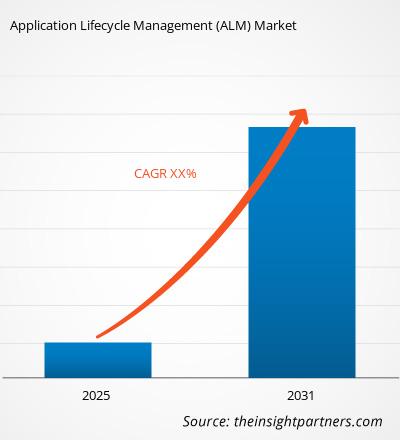
The application lifecycle management market was valued at US$ 6.29 Billion in 2025 and is projected to reach US$ 15.45 Billion by 2034, registering a CAGR of 10.5% during 2026–2034. The market is advancing as enterprises connect planning, requirements, source control, testing, release governance, and service feedback into unified digital engineering workflows that improve traceability, auditability, and delivery predictability.
North America remains a highly mature adoption base, with the application lifecycle management market size supported by cloud DevOps penetration, regulated-sector software modernization, and high enterprise spending on developer productivity platforms. The region is estimated to expand at a CAGR of 9.6–10.8% during 2026–2034, driven by AI-assisted software engineering, cybersecurity compliance, and large-scale migration from fragmented toolchains to integrated lifecycle platforms.
Application Lifecycle Management (ALM) Market Assessment and Insights
- North America accounted for 34–38% share in 2025 and is projected to grow at a CAGR of 9.6–10.8% during 2026–2034, supported by enterprise DevOps maturity, cloud-native modernization, and regulated software governance.
- US represented 78–82% of North America in 2025 and is expected to grow at a CAGR of 9.4–10.6% during 2026–2034 as large technology, finance, healthcare, and defense users standardize lifecycle platforms.
- Europe held 24–28% share in 2025 and is forecast to grow at a CAGR of 8.8–10.0% during 2026–2034, led by the UK, Germany, and France through automotive software, public-sector digitalization, and compliance-driven development.
- Asia Pacific captured 25–29% share in 2025 and is projected to grow at a CAGR of 11.4–12.8% during 2026–2034, with China, India, Japan, South Korea, and Australia scaling distributed engineering and cloud delivery.
- Largest Segment: Software held 66–70% market share in 2025 and is estimated to grow at a CAGR of 9.8–10.9% during 2026–2034 due to platform consolidation and automation.
- High Growth Segment: Cloud held 58–62% market share in 2025 and is projected to grow at a CAGR of 11.8–13.2% during 2026–2034 as subscription delivery accelerates.
- Key companies analyzed in detail: Atlassian Corporation, Digital.ai Software, Inc., Open Text Corporation, IBM Corporation, Inflectra Corporation, Microsoft Corporation, Parasoft Corporation, Siemens Digital Industries Software, HP Development Company, L.P., VersionOne, Inc., and Perforce Software, Inc.
Source: The Insight Partners' analysis based on proprietary research, government publications, company annual reports, investor presentations, industry databases, and expert interviews.
Software engineering has moved from sequential project control to continuous product delivery, changing the role of lifecycle platforms from repositories of requirements into operating systems for digital product execution. The application lifecycle management market is shaped by API-first architectures, automated testing, CI/CD pipelines, security scanning, and evidence-based release controls. Production dynamics now favor vendors that connect developer environments, project planning, compliance records, and quality analytics without forcing teams into rigid delivery models.
As adoption is expected to spread during the forecast period, new software development centers that will emerge in India, Southeast Asia, the Gulf region, and Eastern Europe will enable increased enterprise-level engineering capabilities. The need for auditing and traceability of testing in the field of medical devices, automotive electronics, financial institutions, and public utilities will also contribute to investments in these solutions.
Application Lifecycle Management (ALM) Market Report Scope
| Report Attribute | Details |
|---|---|
| Market size in 2025 | US$ 6.29 Billion |
| Market Size by 2034 | US$ 15.45 Billion |
| Global CAGR (2026 - 2034) | 10.5% |
| Historical Data | 2021-2024 |
| Forecast period | 2026-2034 |
Application Lifecycle Management (ALM) Market Analysis
Rising software complexity is the primary source of application lifecycle management market growth as organizations release features across web, mobile, embedded, and cloud environments simultaneously. Increasingly, enterprises will want one governance layer to tie together backlog planning, change sources, test artifacts, security exemptions, and deployments. This demand is highest where software defects have potential for causing operational, safety, or compliance issues, such as finance, health technology, auto, aerospace, and critical infrastructure.
There are shifts happening on the supply side towards ecosystems as opposed to individual products. Suppliers are building AI assistants, workflow automation capabilities, observability connections, and policy enforcement engines into lifecycle platforms. Open APIs are commercially significant as buyers tend to keep their Git repositories, test automation frameworks, IT service management platforms, and enterprise architecture systems around.
Competition in the application lifecycle management market analysis is concentrated around platform breadth, deployment flexibility, governance strength, and developer experience. Broad development ecosystems serve Atlassian Corporation and Microsoft Corporation, whereas credibility in regulated engineering and quality management comes to the fore for Open Text Corporation, IBM Corporation, Siemens Digital Industries Software, Parasoft Corporation, and Perforce Software, Inc.
Strategic positioning now involves AI-powered planning, test creation, code reviews, and impact analysis. Digital.ai Software, Inc., Inflectra Corporation, and VersionOne, Inc. address large enterprises that look for visibility of their portfolios and software deliveries in the age of agility. Migration to cloud, agentic workflows, and design-based security get investment as customers ask for productivity improvements without compromising audit functions.
● REPORT CUSTOMIZATION
Tailor This Report To Align With Your Specific Business Requirements
This report can be customized to align precisely with your business objectives, scope, and target markets. Customization options include tailored segmentation, geography, competitive analysis, and strategic insights to support informed decision-making.
Customize This Report →WHAT YOU CAN ADJUST
- ● Segmentations
- ● Geography
- ● Competitive Analysis
- ● Language Preferences
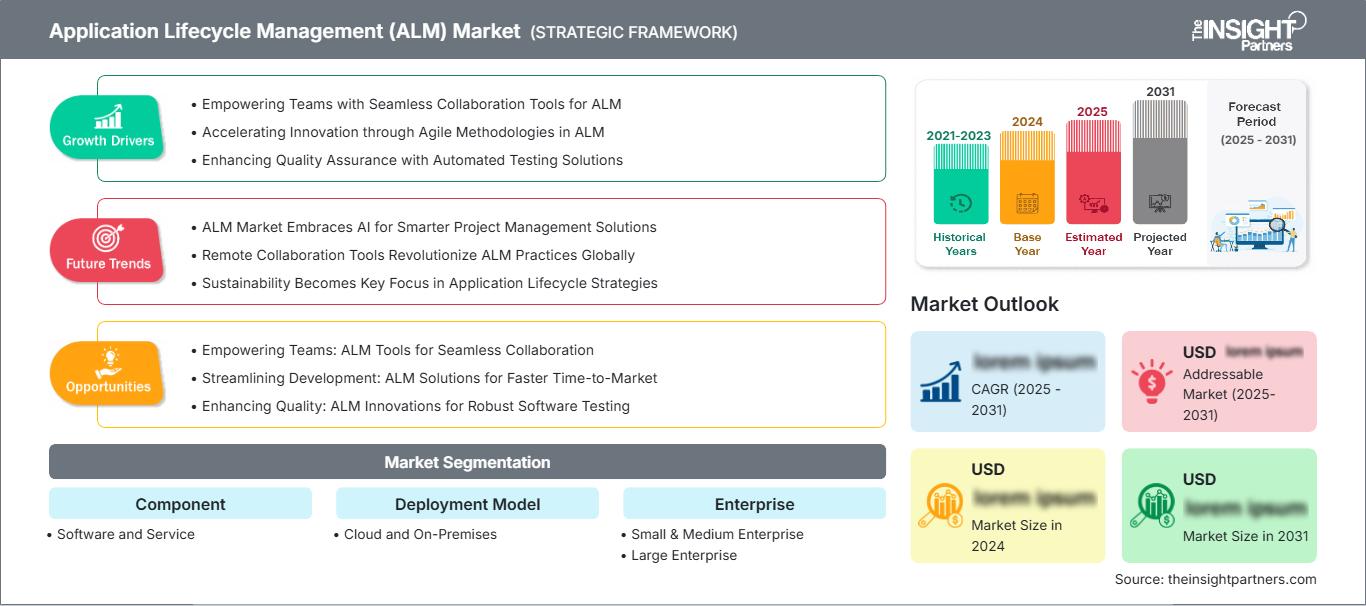
Application Lifecycle Management (ALM) Market: Strategic Insights
Regional Insights
North America application lifecycle management market
North America accounted for 34–38% share in 2025 and is projected to grow at a CAGR of 9.6–10.8% during 2026–2034. Advantages include the maturity of DevOps practices, well-established cloud infrastructure, substantial revenue earned by software publishers, and significant investment by enterprises in developer tools. Financial, healthcare, technology, aerospace, and government contracting companies use the software because of regulatory compliance with respect to software delivery logs.
The regional application lifecycle management market share remains supported by the U.S. concentration of platform vendors and large engineering workforces. Canada contributes through public cloud modernization, banking technology, telecom software, and AI research commercialization. Demand is moving beyond agile boards and defect tracking toward release intelligence, policy automation, software bill of materials integration, and AI-governed development workflows.
U.S. application lifecycle management Market
The U.S. represented 78–82% of North America application lifecycle management market in 2025 and is expected to expand at a CAGR of 9.4–10.6% during 2026–2034. Adoption is reinforced by software-intensive industries, large enterprise engineering teams, and heavy use of platforms from Microsoft Corporation, Atlassian Corporation, IBM Corporation, Open Text Corporation, and Perforce Software, Inc. Buyers prioritize traceability from requirements to production because cybersecurity, privacy, and AI governance reviews now affect release timing.
Application trends in the U.S. are centered on cloud DevOps, regulated quality management, AI-assisted coding, and real-time portfolio visibility. Healthcare software, defense systems, financial platforms, and automotive electronics require stronger links between risk controls and delivery artifacts. This makes lifecycle platforms strategically important for reducing audit effort while maintaining product velocity.
Europe application lifecycle management Market
Europe held 24–28% share of the application lifecycle management market in 2025 and is forecast to grow at a CAGR of 8.8–10.0% during 2026–2034. The UK leads regional adoption through financial technology, public-sector digital services, telecom modernization, and enterprise cloud migration. Buyers emphasize secure software delivery, supplier oversight, and documented release approvals as operational resilience and data protection expectations intensify.
Germany is a big contributor owing to its software for the automotive industry, industrial automation, embedded software, and safety-critical product development. Siemens Digital Industries Software, as well as specialized test ecosystems, will benefit from the need for requirements traceability, model-based engineering compliance, and proof of compliance in supply chains.
France, Italy, and Spain are progressing thanks to aerospace and defense, banking, utilities, and government digital programs. Italy, with its high rate of enterprise cloud adoption, will be better prepared for hosted lifecycle tools, whereas France, with its technology modernization, will be able to consolidate platforms.
APAC application lifecycle management Market
APAC captured 25–29% share of the application lifecycle management market in 2025 and is projected to expand at a CAGR of 11.4–12.8% during 2026–2034. China remains the largest country market, supported by cloud services, manufacturing software, digital platforms, and electric vehicle engineering. Japan and South Korea emphasize quality control, embedded systems, electronics, and automotive safety, creating demand for governed lifecycle records.
India is the fastest-scaling engineering hub, driven by global capability centers, software services exports, and domestic digital platforms. Australia adds demand from banking, government, mining technology, and telecom modernization. Across the region, policy support for digital infrastructure and cloud adoption accelerates platform standardization among distributed engineering teams.
Middle East & Africa application lifecycle management Market
The Middle East & Africa region is projected to grow at a CAGR of 10.0–11.4% during 2026–2034, with Saudi Arabia leading due to digital government, smart infrastructure, energy diversification, and large technology transformation programs. The UAE follows with cloud-first enterprise strategies, fintech growth, and aviation and logistics modernization.
South Africa contributes through banking, telecom, insurance, and public-sector software renewal, while the rest of MEA shows selective adoption in energy, utilities, and infrastructure projects. Lifecycle tools are increasingly used to control vendor delivery, test documentation, and cybersecurity remediation across complex modernization programs.
Segmentation Analysis
Component
Component is projected to grow at a CAGR of 9.6–10.9% during 2026–2034. The application lifecycle management market scope across components reflects a balance between platform subscriptions and implementation expertise. Software remains the revenue anchor, while services gain relevance as enterprises integrate lifecycle records with identity systems, cloud pipelines, test automation suites, and audit reporting frameworks.
- Software remains the largest sub-segment as enterprises standardize planning, requirements, testing, release, and reporting modules into unified platforms that improve visibility, compliance, and cross-functional delivery governance.
- Service demand is rising as buyers need consulting, migration, integration, training, and managed administration to connect existing DevOps tools with enterprise lifecycle governance and reporting models.
Deployment Model
Deployment Model is projected to grow at a CAGR of 10.2–11.6% during 2026–2034. Cloud is expanding faster because subscription access, faster upgrades, and distributed collaboration fit modern engineering operations. On-premises remains relevant where data residency, intellectual property protection, export controls, or validated environments require tighter infrastructure control.
- Cloud is the high-growth sub-segment as enterprises favor rapid implementation, elastic collaboration, AI feature access, and easier integration with CI/CD, observability, and identity platforms.
- On-Premises continues to serve defense, aerospace, automotive, and regulated healthcare environments where controlled validation, data sovereignty, and internal security policies influence deployment decisions.
Enterprise
Enterprise is projected to grow at a CAGR of 9.9–11.1% during 2026–2034. Large enterprises dominate current spending due to scale, compliance exposure, and multi-team complexity. Small and medium enterprises are increasing adoption as cloud platforms reduce upfront cost and deliver preconfigured workflows for agile delivery, test management, and release governance.
- Small & Medium Enterprise adoption is moving from basic project tracking to integrated lifecycle management as digital products, cybersecurity expectations, and remote engineering teams increase coordination needs.
- Large Enterprise users prioritize portfolio synchronization, audit trails, automated evidence collection, policy enforcement, and integration across global engineering centers, suppliers, and enterprise architecture functions.
Opportunity Snapshot
| Segments | Revenue Contribution | Trend Tag | Adoption Stage |
| Software | High | Platform Suites | Mature |
| Service | Medium | Migration Support | Scaling |
| Cloud | High | SaaS Delivery | Scaling |
| On-Premises | Medium | Secure Hosting | Mature |
| Small & Medium Enterprise | Medium | Lean DevOps | Scaling |
| Large Enterprise | High | Governance Automation | Mature |
Application Lifecycle Management (ALM) Market Growth Drivers and Impact Analysis
AI-Assisted Engineering Needs Governed Workflow Control
The coding assistants based on AI technology are speeding up development cycles, yet companies require the lifecycle management to avoid uncontrolled code changes, duplication of bugs, and low traceability. To put it more concretely, this means growth in the need for integration of AI activities with the process of requirements management, reviews, testing, vulnerability assessments, and release approvals. The effects of the driver can be seen in increased customer demand for the capabilities of agent sessions monitoring, automation of test cases generation, and backlog optimization with requirements in mind.
Regulated Industries Require End-to-End Traceability
Medical devices, automotive electronics, banking platforms, aerospace systems, and public infrastructure software require documented links between requirements, risk assessments, test cases, defects, approvals, and releases. This need is becoming stronger as connected products and digital services increase liability exposure. The application lifecycle management market benefits because manual spreadsheets and disconnected tickets cannot reliably support compliance reviews across complex suppliers and distributed teams. Lifecycle platforms reduce audit preparation effort, improve defect root-cause analysis, and show whether safety, security, or privacy requirements were verified before release. This driver sustains demand for on-premises and hybrid deployments alongside cloud platforms in sensitive environments.
Cloud-Native Delivery Expands Platform Standardization
Organizations implementing microservices, containers, APIs, and continuous deployment require standardized lifecycle visibility of evolving software assets. Lack of coordinated planning and quality governance can result in risks, redundant testing efforts, and confusion regarding responsibility in such an environment. Consequently, cloud-native software delivery raises the need for lifecycle management solutions that unify product managers, developers, test engineers, security professionals, and release managers through one evidence path. On the business side, it leads to higher investments in integrated offerings, orchestration capabilities, and analytics dashboard functionality that tracks cycle time, escaped bugs, failed changes, and compliance.
Application Lifecycle Management (ALM) Market Future Trends
Agentic Lifecycle Orchestration
Agentic lifecycle orchestration will be one of the defining application lifecycle management market trends as enterprises move beyond AI code completion toward AI-supported planning, testing, remediation, and release preparation. In future systems, agents will increasingly be given responsibility for routine changes while still retaining human oversight, corporate context, and audit logs. The critical factor will be whether or not agents are able to comprehend requirements, architectural restrictions, previous faults, and policies prior to making any changes. This development will lead to vendors having to develop improved context graphs, workflow monitoring, costing controls, and approvals. The enterprise is likely to take governance of agents as being an integral part of software delivery risk management.
Lifecycle Analytics Becomes a Board-Level Metric
Analytics around the lifecycle will shift from engineering dashboards to executive decision-making based on analytics linking software delivery performance to product revenue, customer experience, resilience, and compliance risks. In the future, purchasers will require platforms that can provide analytics on work stalled, rework costs, lack of test coverage, age of security remediations, and predictability of releases within portfolios. It will lead to the increasing demand for analytics layers that can collect data from repository systems, pipelines, incident management, and roadmaps for the products. As more and more of an organization's value comes from digital products, software delivery data will be pertinent to technology governance groups, risk groups, and investors.
Application Lifecycle Management (ALM) Market Opportunities
Cloud Expansion Among Mid-Market Engineering Teams
Engineer groups in the mid-tier market represent an immediate avenue for growth in that many use disparate project management, testing, and source code collaboration products. The cloud providers can make inroads into this segment by providing built-in workflows, reduced administrative overhead, and pricing based on team size. Companies can also foster adoption using templates for compliant software, integration with popular repositories, and migration from spreadsheet and defect-tracking systems. Application lifecycle management market Forecasts indicate that cloud-led adoption will continue to outpace traditional deployment as distributed engineering becomes standard. Providers that package onboarding, compliance reporting, and AI-assisted planning into modular offerings can improve conversion and retention.
Verticalized Compliance Solutions for Safety-Critical Software
There is a lucrative opportunity for solutions that are tailored vertically to the automotive, med-tech, aerospace, defense, and automation industries. These industries require something beyond just agile tracking since they need to be able to demonstrate control over requirements, risk, verification, and releases. The vendors can differentiate themselves by offering solutions that incorporate industry-specific templates, validation documents, digital signatures, supplier portals, and integration with modeling and test automation solutions. This opportunity allows for premium pricing since the cost of failure in the form of audits, recalls, or certification delays is greater than software subscription costs.
Frequently Asked Questions

- Comprehensive Market Sizing and Forecast Analysis
- Detailed Segmentation Analysis
- In-Depth Market Dynamics Assessment
- Regional and Country-Level Insights
- Competitive Landscape and Company Benchmarking
- Strategic Business Intelligence
Recent Reports
Testimonials

The Insight Partners' SCADA System Market report is comprehensive, with valuable insights on current trends and future forecasts. The team was highly professional, responsive, and supportive throughout. We are very satisfied and highly recommend their services.
RAN KEDEM Partner, Reali Technologies LTDs
I requested a report on a very specific software market and the team produced the report in a few days. The information was very relevant and well presented. I then requested some changes and additions to the report. The team was again very responsive and I got the final report in less than a week.
JEAN-HERVE JENN Chairman, Future Analytica
We worked with The Insight Partners for an important market study and forecast. They gave us clear insights into opportunities and risks, which helped shape our plans. Their research was easy to use and based on solid data. It helped us make smart, confident decisions. We highly recommend them.
PIYUSH NAGPAL Sr. Vice President, High Beam Global
The Insight Partners delivered insightful, well-structured market research with strong domain expertise. Their team was professional and responsive throughout. The user-friendly website made accessing industry reports seamless. We highly recommend them for reliable, high-quality research services
YUKIHIKO ADACHI CEO, Deep Blue, LLC.
This is the first time I have purchased a market report from The Insight Partners.While I was unsure at first, I visited their web site and felt more comfortable to take the risk and purchase a market report.I am completely satisfied with the quality of the report and customer service. I had several questions and comments with the initial report, but after a couple of dialogs over email with their analyst I believe I have a report that I can use as input to our strategic planning process.Thank you so much for taking the extra time and making this a positive experience.I will definitely recommend your service to others and you will be my first call when we need further market data.
JOHN SUZUKI President and Chief Executive Officer, Board Director, BK Technologies
I wish to appreciate your support and the professionalism you displayed in the course of attending to my request for information regarding to infectious disease IVD market in Nigeria. I appreciate your patience, your guidance, and the fact that you were willing to offer a discount, which eventually made it possible for us to close a deal. I look forward to engaging The Insight Partners in the future, all thanks to the impression you have created in me as a result of this first encounter.
DR CHIJIOKE ONYIA MANAGING DIRECTOR, PineCrest Healthcare Ltd.Reason to Buy
- Informed Decision-Making
- Understanding Market Dynamics
- Competitive Analysis
- Identifying Emerging Markets
- Customer Insights
- Market Forecasts
- Risk Mitigation
- Boosting Operational Efficiency
- Strategic Planning
- Investment Justification
- Tracking Industry Innovations
- Aligning with Regulatory Trends





 Get Free Sample for