
Automatic Tolling System Market Size and Competitive Analysis by 2034
Coverage: By Offering (Hardware and Services) and Type (Unmanned Self-Service Automated Tollbooth Collection Systems, Unmanned Automated Toll Booth Collection Systems, and Unmanned Wireless Automated Toll Booth Collection Systems), and Geography
- Status : Data Released
- Report Code : TIPRE00023227
- Category : Electronics and Semiconductor
- No. of Pages : 150
- Available Report Formats :


- Last update date : July 17, 2026


2025 Market Size
US$ 8.66 Bn
Base year value
2034 Forecast
US$ 15.39 Bn
Projected by 2034
CAGR 2026-2034
6.6 %
Growth rate
Addressable Market
US$ 108.75 Bn
(2026-2034)
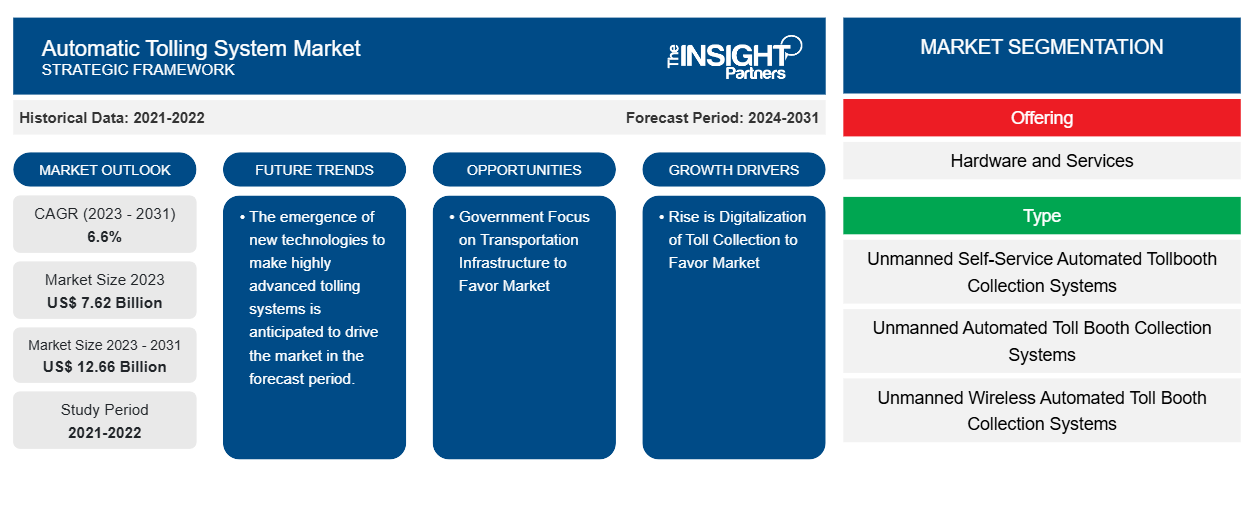
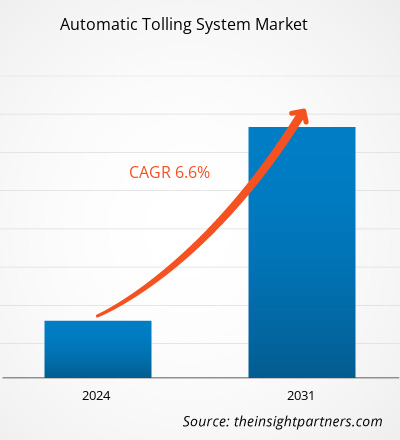
The Automatic Tolling System Market size was valued at US$ 8.66 Billion in 2025 and is projected to reach US$ 15.39 Billion by 2034; it is expected to register a CAGR of 6.6% during 2026–2034. Adoption is being influenced by open-road tolling, RFID, license plate recognition, and back-office automation as road authorities move away from staffed toll plazas to cashless, multi-lane free-flow systems.
In North America, the Automatic Tolling Systems Market size is driven by the conversion of existing booth tolls to all-electronic tolling and account-based payment solutions. The regional forecast for 2026–2034 with a modeled compound annual growth rate of 5.8 to 6.4 percent is influenced by federal highway upgrade programs, the development of express lanes, and agency emphasis on revenue management.
Automatic Tolling System Market Assessment and Insights
- North America accounted for 31–34% of the Automatic Tolling System Market share in 2025 and is projected to grow at a CAGR of 5.8–6.4% during 2026–2034, led by all-electronic tolling upgrades and express-lane programs.
- US represented 80–84% of North America in 2025 and is expected to grow at a CAGR of 5.9–6.5% through corridor modernization.
- Europe held 25–28% share in 2025 and is forecast to grow at 5.4–6.0% CAGR, led by Germany, France, Italy, Spain, and the UK.
- Asia Pacific captured 24–27% share in 2025 and is projected to expand at 7.2–7.8% CAGR, with China, India, Japan, South Korea, and Australia leading deployments.
- Largest Segment Hardware held 58–62% market share in 2025 and is expected to grow at 5.7–6.3% CAGR as gantries, readers, antennas, and cameras remain core assets.
- High Growth Segment Services held 38–42% market share in 2025 and is expected to grow at 7.0–7.6% CAGR due to managed operations and cloud back offices.
- Key companies analyzed in detail: Conduent Business Services, LLC, EFKON GmbH, FEIG ELECTRONIC GmbH, Mitsubishi Heavy Industries Machinery Systems, Ltd., Neology, Inc., RTX Corporation, Siemens Mobility GmbH, STMicroelectronics N.V., Thales S.A., and TransCore.
Source: The Insight Partners' analysis based on proprietary research, government publications, company annual reports, investor presentations, industry databases, and expert interviews.
Migration through technology development has made the Automatic Tolling System Market transition from lane-based cash payment systems to free flow-based identification and digital payment matching and enforcement. The roadside system has evolved into an integrated RFID reader, DSRC system, ANPR cameras, classifiers, and redundant sensor system, while software production involves configurable transaction engines, image review process, fraud detection, and agency-specific customer care platform capable of processing high-volume transactions.
The future demand will likely become stronger in the emerging toll corridors where governments require revenue from roads without raising the fuel tax. There is an increased interest in barrier-free tolling solutions, satellite tolling, and interoperable accounts. The regulatory tailwind includes the EU requirements of electronic tolls, US state-level cashless tolling mandate, and FASTag in India that offer useful models to agencies in developing tolling infrastructure.
Automatic Tolling System Market Report Scope
| Report Attribute | Details |
|---|---|
| Market size in 2025 | US$ 8.66 Billion |
| Market Size by 2034 | US$ 15.39 Billion |
| Global CAGR (2026 - 2034) | 6.6% |
| Historical Data | 2021-2024 |
| Forecast period | 2026-2034 |
Automatic Tolling System Market Analysis
The Automatic Tolling System Market trends include congestion pricing, increased tolled express lanes, and reduction of stop-and-go lines at plazas. The agencies prefer systems which count all entries, have proper vehicle classification and are able to link toll accounts through mobile, card and invoicing mechanisms. Suppliers include hardware providers, integrators, payment processors, civil contractors, and law enforcers.
For suppliers, the Automatic Tolling System market dynamics prefer modular roadside equipment and service agreements since the agency prefers low risk on maintenance and measureable collection. The supply depends on semiconductors, camera lens, cyber secure communications and cloud hosting. There is an increased demand when tolling authorities replace their booths with gantry system to provide fast identification and low cost labor intensive cash handling.
The competitive positioning in Automatic Tolling System Market report is determined by the installed base, agency references, software configuration, and service level capability. Conduent Business Services, LLC, TransCore, Neology, Inc., Siemens Mobility GmbH, Thales S.A., EFKON GmbH, and Mitsubishi Heavy Industries Machinery Systems, Ltd. use end-to-end solutions in their competition, whereas FEIG ELECTRONIC GmbH and STMicroelectronics N.V. improve their competitive position at the component level.
Investment trends in the market include consolidations in tolling platforms, back office management, and AI image processing. The RTX Corporation is involved in market operations through sensing and defense, while technology companies deal with road user charges, multi-protocol readers, and video-only tolling. Buyers' concerns include lifecycle cost, interoperability, security, and migration from plaza operations to electronic tolling.
● REPORT CUSTOMIZATION
Tailor This Report To Align With Your Specific Business Requirements
This report can be customized to align precisely with your business objectives, scope, and target markets. Customization options include tailored segmentation, geography, competitive analysis, and strategic insights to support informed decision-making.
Customize This Report →WHAT YOU CAN ADJUST
- ● Segmentations
- ● Geography
- ● Competitive Analysis
- ● Language Preferences
Automatic Tolling System Market: Strategic Insights
Regional Insights
North America Automatic Tolling System Market
North America held 31–34% Automatic Tolling System Market share in 2025 and is expected to grow at 5.8–6.4% CAGR during 2026–2034. State turnpike organizations, bridge entities, and managed lane providers are moving to all-electronic toll collection to improve traffic flow, minimize pollution and personnel risk. The US is still the main market, and Canada is developing interoperable tolling on its urban corridors.
Drivers of local market include RFID transponders, video tolling, dynamic pricing and account-based tolling. There is FHWA-related infrastructure development in terms of tolls, as well as state express lanes that promote the replacement of old booths tolls by gantries. Providers of toll technology have stable income, as there are long-term contracts, and it is necessary to ensure image processing, violation processing, customer care and cyber security.
U.S. Automatic Tolling System Market
The US accounted for 80–84% of North America in 2025 and is projected to grow at 5.9–6.5% CAGR. Toll agencies are using pay-by-plate, E-ZPass interoperability, high-occupancy toll lanes, and automated violation workflows to manage heavy commuter volumes. Large bridge, tunnel, and expressway networks create repeat demand for upgrades and service renewals.
Company presence is highly focused on state transportation departments and regional toll authorities. TransCore, Conduent Business Services, LLC, Neology, Inc., Siemens Mobility GmbH, and Thales S.A. provide solutions for roadside equipment, back-office software, and enforcement procedures. Software application development trends include dynamic express lanes, use of video only collection in congested urban areas, and automated customer assistance solutions.
Europe Automatic Tolling System Market
Europe represented 25–28% share in 2025 and is forecast to grow at 5.4–6.0% CAGR. Germany is ahead of the pack with heavy good vehicles tolling and CO2-related road charges, while France invests in free flow motorways sections. In Italy, Spain and the UK, mixed concession systems, urban access restriction schemes and interoperable fee collection systems are encouraged.
The European Electronic Toll Services regime needs interoperability among toll regimes, fostering the need for multi-standards onboard units and accredited operators and back office interfaces. Germany and France are leading nations since they have big road infrastructures and they also modernize. The regional vendors try to outdo each other in compliance, accurate cross-border accounting, and emission-charging integration.
APAC Automatic Tolling System Market
APAC held 24–27% share in 2025 and is expected to grow at 7.2–7.8% CAGR, the highest regional range. Leading by expressways digitization is China, whereas India’s FASTag, Japan’s ETC system, South Korea’s smart roads, and Australia’s tunnel projects promote wider use.
The factors driving such development are public-private highway concessions, significant commuter routes, and the nation-wide digital payments system. The growth of transactions via FASTag in India and video-only tunnel projects in Australia demonstrate the move towards the combination of RFID, ANPR, and GNSS technology.
Middle East & Africa Automatic Tolling System Market
Middle East & Africa is projected to grow at 6.4–7.0% CAGR during 2026–2034. Saudi Arabia and UAE represent the leaders for regional demand due to urban expressways, logistics networks, and smart city initiatives that need automation in payments and enforcement. South Africa represents the most matured African country.
Spend on energy-related infrastructure development and city-to-port freight lanes drive the need for upgrading the tolling system. Free flow gantries and account-based collections are considered by many agencies as means to alleviate the congestion at toll plazas. Demand in rest of MEA region is project-driven.
Segmentation Analysis
Offering
Offering is expected to grow at 6.2–6.8% CAGR during 2026–2034. The Automatic Tolling System Market forecast across offerings spans roadside hardware, transaction processing, customer care, analytics, maintenance, and enforcement support. Buyers are moving from capital-heavy isolated systems toward lifecycle procurement, where equipment reliability and managed service performance are evaluated together.
- Hardware remains the largest offering because gantries, antennas, transponders, cameras, classifiers, and controllers are essential for high-speed capture, lane accuracy, and continuous toll point availability.
- Services are gaining strategic importance as agencies outsource image review, account management, payment reconciliation, maintenance, cybersecurity monitoring, and performance reporting under long-term operating agreements.
Type
Type is expected to grow at 6.4–7.0% CAGR during 2026–2034. Type-level demand reflects how agencies balance unmanned booths, plaza automation, and wireless free-flow systems. Mature networks often retrofit existing lanes, while new expressways favor wireless or gantry-based collection that reduces land requirements, improves throughput, and supports dynamic tolling.
- Unmanned Self-Service Automated Tollbooth Collection Systems serve transitional corridors where agencies retain booth structures but reduce staffing through card, tag, or machine-assisted payment collection.
- Unmanned Automated Toll Booth Collection Systems support higher automation at controlled lanes, combining sensors, barriers, payment interfaces, and back-office matching for plazas not yet converted to free-flow.
- Unmanned Wireless Automated Toll Booth Collection Systems are strategically preferred for high-volume corridors because RFID, DSRC, ANPR, and wireless communication enable tolling without stopping vehicles.
Opportunity Snapshot
| Type | Revenue Contribution | Trend Tag | Adoption Stage |
| Unmanned Self-Service Automated Tollbooth Collection Systems | Medium | Plaza Retrofit | Mature |
| Unmanned Automated Toll Booth Collection Systems | Medium | Lane Automation | Scaling |
| Unmanned Wireless Automated Toll Booth Collection Systems | High | Free Flow | Scaling |
Automatic Tolling System Market Growth Drivers and Impact Analysis
Conversion from Cash Plazas to Free-Flow Tolling
The removal of manned toll plaza booths by transport agencies stems from the fact that stopping-and-starting collection leads to increased congestion, risk of accidents, increased fuel usage, and cost of operation. Free flow gantries enable vehicles to remain at the same speed on the highway while systems such as RFID, license plate recognition, and classification capture billing events. Market penetration is highest where existing plazas are consuming valuable urban real estate or causing queues at peak periods. Procurement trends have consequently shifted from individual components to roadside and back office solutions bundles.
Digital Payments and Account-Based Mobility Platforms
The development of cashless mobility has led to the inclusion of tolling within a wider payment system. More and more motorists look for such options as automatic payments from bank accounts, mobile notifications, digital wallet integration, license plate-based billing, and integrated statements in relation to bridges, tunnels, highways, and parking lots. It enables agencies to have greater audit control and reduced cash leakage as payment channels are tied up with validated accounts. Thus, the selection of vendors depends not only on the roadside read rate but also on the ability to reconcile transactions in back office.
Infrastructure Funding Models and Managed-Lane Expansion
The use of tolls to provide funding for maintaining roads, building new expressways, bridges, tunnels, and congestion managed lanes without being dependent solely on the fuel tax is one of the trends. The management of such lanes requires tolling technology which allows calculating tolls at different speeds and rates. For public-private partnerships, there is a need for clear revenue assurances to the investors as well. Consequently, the performance guarantees, long-term operations, and dashboard analytics are becoming more common.
Automatic Tolling System Market Future Trends
AI-Led Image Processing and Sensor Fusion
The Automatic Tolling System Market trends for Automatic Tolling Systems are towards AI-driven image analysis, sensor fusion, and exception handling processes that limit human intervention. Emerging systems incorporate advanced license plate reading, vehicle detection, vehicle classification, RFID transactions, and context-aware lane transactions to make transactions robust. During the forecast period, authorities are expected to apply machine learning to enhance license plate reading capabilities even in adverse weather conditions, occlusion, or at high speed. Strategically, there would be reduced revenue leakage and quick dispute resolution especially in video-only systems.
GNSS and Distance-Based Charging Readiness
Distance-based pricing is anticipated to become more relevant as electric cars reduce the impact of fuel taxation revenues and road organizations look for usage-dependent funding. Pilots with GNSS have the ability to price vehicles based on distance, type of vehicle, route, or emissions type, without requiring toll plazas. In the short term, adoption will be selective due to the need to solve the privacy, enforcement, device authentication, and accounting issues. But companies that create systems capable of handling gantry data as well as satellite data will be better prepared for future governments moving from corridor pricing to road user pricing schemes.
Automatic Tolling System Market Opportunities
Cloud Back-Office Modernization for Toll Agencies
Most tolling organizations have their old back offices, which were built to serve lane operations and not account-based multi-channel digital mobility. This presents an opportunity for vendors to provide cloud migration services, business rule configuration, automatic reconciliation, and customer care integration. Automatic Tolling System Market Forecast projects services to grow more compared to hardware since agencies require regular updates, security, and data analytics rather than system deployment. Providers can create value by providing modular migration solutions that safeguard current accounts but integrate APIs for mobile payments, parking, congestion charges, and road-use charging.
Video-Only Tolling for Urban Tunnels and Bridges
Tunnels and bridges may be constrained spatially such that traditional toll plazas do not make sense. With video tolling, there would be no need for barriers, fewer civil works, and an easier process for non-tag occasional users. High value can be seen in emerging tunnel projects as well as retrofits with difficult maintenance requirements. There are plenty of ways vendors could create value through overhead vehicle recognition, ALPR, automated vehicle classification, and integration with existing billing systems. The most promising opportunities would exist when the government needs to alleviate congestion but can’t increase right-of-way.
Recent Developments
- June 2026: ViaPlus, in collaboration with the National Highways Authority of India (NHAI) and Indian Highways Management Company Limited (IHMCL), launched India's first barrier-free electronic tolling system at the Daulatpura Toll Plaza on the Delhi–Jaipur Expressway. The Multi-Lane Free Flow (MLFF) system enables vehicles to pass without stopping by combining FASTag, Automatic Number Plate Recognition (ANPR), and AI-powered toll processing. The initiative aims to reduce congestion, save travel time, improve fuel efficiency, and lower vehicle emissions.
- July 2026: NHAI expanded the Multi-Lane Free Flow (MLFF) tolling system by launching it at the Manoharpura Toll Plaza on the Delhi–Jaipur section of NH-48 in Rajasthan. The barrier-free system allows uninterrupted vehicle movement with automated toll collection through FASTag and ANPR technology, minimizing human intervention. Following the successful implementation, NHAI announced plans to extend MLFF to the Shahjahanpur Toll Plaza, making the entire Delhi–Jaipur corridor barrier-free.
- June 2026: Conduent announced a definitive agreement to sell its Tolling business to Quarterhill Inc. for US$70 million in cash as part of its strategy to simplify operations and strengthen its financial position. Under the deal, Quarterhill will also assume most of the tolling business's liabilities, while Conduent will receive a 7% equity stake in Quarterhill. The tolling business, which processes more than 14 million toll transactions daily across the U.S. and U.K., is expected to continue operating seamlessly during the transition, with the transaction anticipated to close before the end of 2026.
Frequently Asked Questions

- Comprehensive Market Sizing and Forecast Analysis
- Detailed Segmentation Analysis
- In-Depth Market Dynamics Assessment
- Regional and Country-Level Insights
- Competitive Landscape and Company Benchmarking
- Strategic Business Intelligence
Recent Reports
Testimonials

The Insight Partners' SCADA System Market report is comprehensive, with valuable insights on current trends and future forecasts. The team was highly professional, responsive, and supportive throughout. We are very satisfied and highly recommend their services.
RAN KEDEM Partner, Reali Technologies LTDs
I requested a report on a very specific software market and the team produced the report in a few days. The information was very relevant and well presented. I then requested some changes and additions to the report. The team was again very responsive and I got the final report in less than a week.
JEAN-HERVE JENN Chairman, Future Analytica
We worked with The Insight Partners for an important market study and forecast. They gave us clear insights into opportunities and risks, which helped shape our plans. Their research was easy to use and based on solid data. It helped us make smart, confident decisions. We highly recommend them.
PIYUSH NAGPAL Sr. Vice President, High Beam Global
The Insight Partners delivered insightful, well-structured market research with strong domain expertise. Their team was professional and responsive throughout. The user-friendly website made accessing industry reports seamless. We highly recommend them for reliable, high-quality research services
YUKIHIKO ADACHI CEO, Deep Blue, LLC.
This is the first time I have purchased a market report from The Insight Partners.While I was unsure at first, I visited their web site and felt more comfortable to take the risk and purchase a market report.I am completely satisfied with the quality of the report and customer service. I had several questions and comments with the initial report, but after a couple of dialogs over email with their analyst I believe I have a report that I can use as input to our strategic planning process.Thank you so much for taking the extra time and making this a positive experience.I will definitely recommend your service to others and you will be my first call when we need further market data.
JOHN SUZUKI President and Chief Executive Officer, Board Director, BK Technologies
I wish to appreciate your support and the professionalism you displayed in the course of attending to my request for information regarding to infectious disease IVD market in Nigeria. I appreciate your patience, your guidance, and the fact that you were willing to offer a discount, which eventually made it possible for us to close a deal. I look forward to engaging The Insight Partners in the future, all thanks to the impression you have created in me as a result of this first encounter.
DR CHIJIOKE ONYIA MANAGING DIRECTOR, PineCrest Healthcare Ltd.Reason to Buy
- Informed Decision-Making
- Understanding Market Dynamics
- Competitive Analysis
- Identifying Emerging Markets
- Customer Insights
- Market Forecasts
- Risk Mitigation
- Boosting Operational Efficiency
- Strategic Planning
- Investment Justification
- Tracking Industry Innovations
- Aligning with Regulatory Trends






 Get Free Sample for