
Computer Microchips Market Share, Size & Demand by 2034
Coverage: by Product Type (Microprocessor Chip, Interface Chip, Memory Chip, Others); End-User (Consumer Electronics, Automotive, Healthcare, Military and Aerospace, Others) , and Geography (North America, Europe, Asia Pacific, and South and Central America)
- Status : Data Released
- Report Code : TIPRE00010531
- Category : Electronics and Semiconductor
- No. of Pages : 150
- Available Report Formats :


- Last update date : July 27, 2026


2025 Market Size
US$ 33.5 Bn
Base year value
2034 Forecast
US$ 87.5 Bn
Projected by 2034
CAGR 2026-2034
11.26 %
Growth rate
Addressable Market
US$ 533.75 Bn
(2026-2034)
The Computer Microchips Market was valued at US$ 33.5 Billion in 2025 and is projected to reach US$ 87.5 Billion by 2034, registering a CAGR of 11.26% from 2026 to 2034. The market is being shaped by accelerated computing demand, higher semiconductor content per device, and widening deployment across consumer electronics, automotive, healthcare, military and aerospace systems.
North America will witness an expansion of demand due to growing chip intensity in cloud computing centers, defense electronics, auto industry electrification, and medical devices' digitalization at the rate of 10.4% – 11.6% CAGR. North America's Computer Microchips Market size is driven by the development of design ecosystems, reshoring trends, and foundry partnerships.
Computer Microchips Market Assessment and Insights
- North America held 28–32% share in 2025 and is growing at a CAGR of 10.4–11.6% during 2026–2034, supported by AI infrastructure, defense procurement, advanced automotive platforms, and strong fabless design activity.
- US represented 82–86% of North America in 2025 and is growing at a CAGR of 10.6–11.8%, led by cloud computing, aerospace electronics, and semiconductor policy incentives.
- Europe accounted for 14–18% share in 2025 and is advancing at a CAGR of 8.8–10.0%, with Germany, France, the UK, Italy, and Spain leading automotive, industrial, and defense demand.
- Asia Pacific captured 43–47% of the Computer Microchips Market share in 2025 and is expanding at a CAGR of 11.8–13.0%, led by China, Taiwan, South Korea, Japan, and India across manufacturing, memory, foundry, and device assembly.
- Largest Segment Memory Chip held 38–42% market share in 2025 and is growing at a CAGR of 11.4–12.6%, driven by servers, smartphones, AI accelerators, and high-bandwidth computing architectures.
- High Growth Segment Healthcare held 8–11% share in 2025 and is growing at a CAGR of 12.6–14.0%, supported by connected diagnostics, imaging systems, wearables, and regulated medical electronics.
- Key companies analyzed in detail: Advanced Micro Devices, Inc., Analog Devices, Inc., Intel Corporation, MediaTek Inc., NVIDIA Corporation, Qualcomm Technologies, Inc., Samsung Electronics Co., Ltd., Taiwan Semiconductor Manufacturing Company Limited, Texas Instruments Incorporated, and United Microelectronics Corporation.
Source: The Insight Partners' analysis based on proprietary research, government publications, company annual reports, investor presentations, industry databases, and expert interviews.
Evolution in technology trends will move computer microchips away from generic silicon-based microchips to workload-optimized architectures, advanced packaging, chiplet technologies, and heterogeneity. In addition, the Computer Microchips Market will be impacted by manufacturing dynamics relating to wafer capacity, electronic design automation, substrates, and process node specialization. As leading edge logic caters to applications such as AI and data centers, mature node interface and analog microchips continue to be necessary for automobiles, medical devices, aerospace platforms, and industrial controls.
Investment is now focusing on geographically diverse manufacturing, secure supply chains, and more valuable design capabilities. Government subsidies in the United States, Europe, Japan, South Korea, and India have improved fabs' economics, while businesses are ensuring the supply of their critical systems. Geographies are emerging through manufacturing, test, and specialty manufacturing but not necessarily replacing advanced node fabs..
Computer Microchips Market Report Scope
| Report Attribute | Details |
|---|---|
| Market size in 2025 | US$ 33.5 Billion |
| Market Size by 2034 | US$ 87.5 Billion |
| Global CAGR (2026 - 2034) | 11.26% |
| Historical Data | 2021-2024 |
| Forecast period | 2026-2034 |
Computer Microchips Market Analysis
Computer Microchips Market growth is driven by compute density, training of AI models, edge inference, and proliferation of connected devices. This demand encompasses both processors in high-performance systems, interface chips for data transfer, and memory chips in bandwidth-intensive workloads. The supply side is still influenced by wafer starts, packaging, lithography, and lengthy qualifications in automobiles, healthcare, defense, and aerospace industries.
Value creation happens through intellectual property, design, wafer manufacturing, packaging, testing, and system integration. Semiconductor foundries and IDM companies are focused on yields, node progressions, and specialty process technologies. Simultaneously, customers have been revising their purchasing approaches in light of recent shortages and their vulnerability to narrow geographic production hubs.
Computer Microchips Market Report reveals competition based on scale, architecture, software ecosystems, and fabrication capabilities. NVIDIA Corporation and Advanced Micro Devices, Inc. compete in accelerated computing, while Intel Corporation seeks to regain its process and foundry capability. Qualcomm Technologies, Inc. and MediaTek Inc. continue to be pivotal in connected processors, while Analog Devices, Inc. and Texas Instruments Incorporated bolster their interface and signal chain capabilities.
Capital allocation continues to focus on advanced packaging technology, chiplet strategy, AI data center silicon, and regional manufacturing capabilities. Samsung Electronics Co., Ltd., Taiwan Semiconductor Manufacturing Company Limited, and United Microelectronics Corporation have been defining their capacity strategies in advanced and mature nodes. Differentiation is built upon supply assurance, design enablement, power performance, and servicing of regulated end markets.
● REPORT CUSTOMIZATION
Tailor This Report To Align With Your Specific Business Requirements
This report can be customized to align precisely with your business objectives, scope, and target markets. Customization options include tailored segmentation, geography, competitive analysis, and strategic insights to support informed decision-making.
Customize This Report →WHAT YOU CAN ADJUST
- ● Segmentations
- ● Geography
- ● Competitive Analysis
- ● Language Preferences
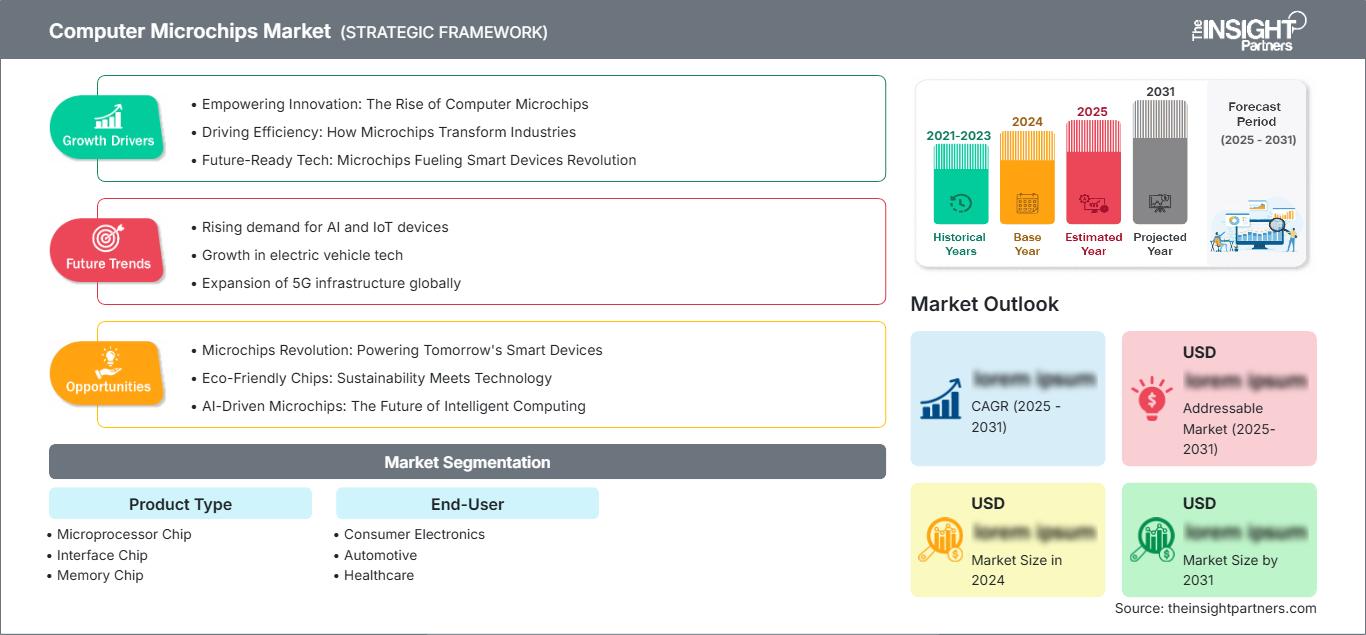
Computer Microchips Market: Strategic Insights
Regional Insights
North America Computer Microchips Market
North America held 28–32% share in 2025 and is projected to grow at a CAGR of 10.4–11.6% through 2034. The Computer Microchips Market share in the region is concentrated in the US because hyperscale data centers, AI infrastructure, defense electronics, and chip design clusters create recurring demand for high-value processors, memory interfaces, and specialty semiconductors.
Regional policy support is improving manufacturing depth through incentives for fabs, advanced packaging, and workforce development. Automotive electrification, satellite systems, medical imaging, and secure communications add diversified demand beyond consumer devices. Suppliers benefit from proximity to large cloud customers and defense programs, but still rely on Asia-based manufacturing partners for leading-edge and assembly capacity.
U.S. Computer Microchips Market
The U.S. accounted for 82–86% of the North American market share in 2025 and will grow at a CAGR of 10.6–11.8%. Factors contributing to the demand include construction of AI servers, defense upgrade, aerospace electronic systems, and sophisticated medical equipment. The presence of major design houses including NVIDIA Corporation, Advanced Micro Devices, Inc., Intel Corporation, Qualcomm Technologies, Inc., and Analog Devices, Inc. will further boost local innovation.
Emerging application areas include accelerators, high-speed memory interfaces, customized processors, and security embedded systems. While federal government support for semiconductors fabrication is promoting investments in fabs, the overall supply chain remains dependent on offshore wafer fabrication and packaging facilities. Buyers are qualifying multiple vendors to deal with geopolitical and lifecycle challenges.
Europe Computer Microchips Market
Europe had an 14–18% market share in 2025 and expected to record CAGR between 8.8% and 10.0%. Germany is leading the region's demand through automotive electronics, industrial automation, and powertrain electrification. Britain is contributing through design, defense, and communications, whereas France is helping through aerospace, secure electronics, and semiconductor application for high reliability.
Italy and Spain are emerging due to automotive components, industrial machinery, and renewable energy control systems. Due to the policy focus in Europe on supply chain security, the companies are investing in specialty chips, advanced packaging, and automotive capacity. Growth rate in Europe is lower than that of Asia Pacific, as consumer electronics manufacturing is not in volume.
APAC Computer Microchips Market
APAC region had a 43-47% market share in 2025 and expected to have a growth rate of 11.8-13.0%. China drives end-use demand, while Taiwan and South Korea lead the way for foundries and memory capabilities. Japan supplies materials, equipment and automotive electronics, and India is developing design services, assembly and government-funded semiconductor schemes.
Industrial policy, diversification of exports and electronics manufacturing scale makes APAC the manufacturing hub of the Computer Microchips Market. The supply chain of smart phones, servers, automobiles and consumer electronic devices is dependent on the wafer and packaging capabilities of the region.
Middle East & Africa Computer Microchips Market
Middle East & Africa is projected to grow at a CAGR of 9.2–10.4% as Saudi Arabia, the UAE, and South Africa increase investment in data centers, defense electronics, smart infrastructure, and healthcare digitization. The UAE leads regional adoption through cloud, telecom, and logistics technology programs.
Energy diversification, AI infrastructure, and sovereign digital programs are creating demand for processors, memory, and interface chips. South Africa contributes through telecom, mining automation, and medical equipment channels, while the rest of MEA remains import dependent. Local manufacturing is limited, so distribution partnerships and lifecycle support are key competitive factors.
Segmentation Analysis
Product Type
Product Type is expected to grow at a CAGR of 10.8–12.0% from 2026 to 2034 as the Computer Microchips Market scope covers processing, memory, and interface functions across connected systems. Demand is shifting toward higher compute density, lower power consumption, and faster data transfer, while mature-node products remain essential for control, sensing, and embedded reliability.
- Microprocessor Chip demand is strongest in PCs, servers, embedded controllers, vehicles, and defense systems, where performance-per-watt, architecture compatibility, and software support influence supplier selection and replacement cycles.
- Interface Chip products support signal conversion, connectivity, power management, and communication between devices, making them strategically important for automotive electronics, industrial automation, healthcare systems, and aerospace platforms.
- Memory Chip remains the largest product category because AI servers, smartphones, graphics systems, and edge devices require greater capacity, faster bandwidth, and tighter integration with processors.
End-User
End-User demand is forecast to grow at a CAGR of 11.0–12.2% during 2026–2034 as electronics intensity rises across mobility, healthcare, defense, and consumer platforms. Buyers increasingly evaluate chips by lifecycle assurance, thermal performance, cybersecurity requirements, and supplier resilience rather than unit price alone.
- Consumer Electronics generates high-volume demand through smartphones, computers, wearables, gaming devices, and smart home systems, with purchasing patterns driven by refresh cycles and feature integration.
- Automotive adoption is expanding as vehicles add advanced driver assistance, electrified powertrains, infotainment, connectivity, and safety systems that require durable, qualified chips with long supply commitments.
- Healthcare uses chips in imaging, diagnostics, patient monitoring, surgical devices, and wearables, where reliability, miniaturization, data security, and regulatory compliance shape procurement decisions.
- Military and Aerospace demand centers on rugged processors, secure communications, avionics, radar, satellites, and mission systems that require extended lifecycles, radiation tolerance, and trusted supply chains.
Opportunity Snapshot
| End-User | Revenue Contribution | Trend Tag | Adoption Stage |
| Consumer Electronics | High | Edge AI | Mature |
| Automotive | High | Software Vehicles | Scaling |
| Healthcare | Medium | Connected Care | Scaling |
| Military and Aerospace | Medium | Secure Silicon | Emerging |
Computer Microchips Market Growth Drivers and Impact Analysis
AI Infrastructure Expands Demand for Advanced Silicon
The growing requirements for chips, memory chips, and fast interconnects to effectively transfer data from one accelerator to another or to the server or storage have increased the need for AI training and inference. Global semiconductor revenues were reported at US$791.7 billion in 2025, which is a result of the solid performance by the logic and memory segments. For the market, this generates direct demand for high-performance chips and indirect demand for power management, connectivity, and thermal monitoring chips.
Automotive Electronics Shift Toward Software-Defined Platforms
Automobiles are turning into distributed computing systems where semiconductors enable the electrification of powertrains, driver assistance, connectivity, battery management, infotainment and safety systems. The evolution leads to higher semiconductor content per vehicle as well as the expansion of demand beyond microprocessors to interface and memory devices. Additionally, qualification cycles for the automotive industry generate recurring revenues since components stay in production for several years even after platform launches. From an industry perspective, the effect on the market means a growing need for testing reliability, functional safety and supply chain agreements.
Healthcare Digitization Increases Need for Reliable Embedded Chips
The evolution of medical technology will lead to connected diagnostics, intelligent imaging, remote monitoring, and miniaturized wearables. These applications have requirements for chips that are energy efficient, capable of secure data management, signal processing capability, and reliable under controlled operations. The effect on the Computer Microchips Market is that of an increased-value market due to the needs of the healthcare segment being more concerned about validation and lifetime support than cost-based purchasing. The chip vendors with documentation and reliable production strategies can benefit from the growth in imaging products, patient monitors, implant-associated electronics, and point-of-care diagnostics.
Computer Microchips Market Future Trends
Chiplet Architectures Move Into Mainstream Computing
Computer Microchips Market trends are increasingly defined by chiplet-based design, where processors, memory interfaces, and specialized accelerators are integrated through advanced packaging rather than built as one monolithic die. This approach improves yield, shortens design cycles, and enables companies to combine different process nodes in one package. Over the forecast period, chiplets will support customized AI, automotive, and defense systems while reducing dependence on the most expensive leading-edge wafers. Suppliers with packaging ecosystems, interconnect standards, and design tools will gain stronger influence.
Secure and Sovereign Supply Chains Gain Strategic Priority
Semiconductor access is now being viewed as a strategic concern rather than merely a procurement concern on the part of governments and enterprise customers. The future focus will be on reliability through known fabs, local diversification, secure firmware, export control, and lifespan availability. The companies that can provide origin assurance, have secondary locations, and can offer their products for use in regulated areas like defense, health care, and infrastructure are likely to benefit from this trend. Specialization will still occur but at a premium price point.
Computer Microchips Market Opportunities
Localized Advanced Packaging Capacity
Advanced packaging is becoming a strategic bottleneck as AI processors and memory-intensive designs require dense interconnects, thermal management, and high-bandwidth integration. Computer Microchips Market Forecasts indicate that companies able to expand packaging capacity near design centers and end customers can reduce logistics risk and improve customization speed. Investment opportunities include substrate partnerships, test capacity, thermal materials, and design-for-packaging services. Regional packaging hubs can also serve defense, automotive, and healthcare buyers that require trusted supply chains without necessarily needing full leading-edge wafer fabrication.
Specialty Chips for Regulated End Markets
The regulated industries present great potential due to their appreciation of reliability, traceability, and longevity of the product lifecycle. The clients from the healthcare industry, the military/aerospace market, as well as the automotive market need chips that will satisfy the requirements of safety, traceability, and environmental regulations. It is possible for suppliers to develop robust processors, interfaces, security controllers, and memories with an extended lifecycle. This opportunity is different from the consumer electronic devices due to the lack of necessity of frequent refreshing and reliance on qualification.
Recent Developments
- June 2026: NVIDIA Corporation announced that Taiwan Semiconductor Manufacturing Company Limited is using NVIDIA accelerated computing and AI across lithography, process simulation, advanced process control, and automated defect inspection, improving fab productivity and yield learning for advanced semiconductor production.
- June 2026: IBM (NYSE: IBM) unveiled a major semiconductor breakthrough with the introduction of the world’s first sub-1 nanometer (nm) chip technology, featuring a revolutionary transistor architecture at the 0.7 nm, or 7 angstrom node. The achievement marks a landmark moment for an industry facing the physical limits of traditional chip scaling. Semiconductors play critical roles in everything from computing, to appliances, to communication devices, transportation systems, and critical infrastructure.
- June 2026: Microsoft unveiled Majorana 2, a new quantum computing chip and the successor to its 2025-era Majorana 1 quantum processor. During Microsoft Build 2026, the company said the new chip was developed with the help of artificial intelligence tools and represents a major step towards building commercially viable quantum computers.
Frequently Asked Questions

- Comprehensive Market Sizing and Forecast Analysis
- Detailed Segmentation Analysis
- In-Depth Market Dynamics Assessment
- Regional and Country-Level Insights
- Competitive Landscape and Company Benchmarking
- Strategic Business Intelligence
Recent Reports
Testimonials

The Insight Partners' SCADA System Market report is comprehensive, with valuable insights on current trends and future forecasts. The team was highly professional, responsive, and supportive throughout. We are very satisfied and highly recommend their services.
RAN KEDEM Partner, Reali Technologies LTDs
I requested a report on a very specific software market and the team produced the report in a few days. The information was very relevant and well presented. I then requested some changes and additions to the report. The team was again very responsive and I got the final report in less than a week.
JEAN-HERVE JENN Chairman, Future Analytica
We worked with The Insight Partners for an important market study and forecast. They gave us clear insights into opportunities and risks, which helped shape our plans. Their research was easy to use and based on solid data. It helped us make smart, confident decisions. We highly recommend them.
PIYUSH NAGPAL Sr. Vice President, High Beam Global
The Insight Partners delivered insightful, well-structured market research with strong domain expertise. Their team was professional and responsive throughout. The user-friendly website made accessing industry reports seamless. We highly recommend them for reliable, high-quality research services
YUKIHIKO ADACHI CEO, Deep Blue, LLC.
This is the first time I have purchased a market report from The Insight Partners.While I was unsure at first, I visited their web site and felt more comfortable to take the risk and purchase a market report.I am completely satisfied with the quality of the report and customer service. I had several questions and comments with the initial report, but after a couple of dialogs over email with their analyst I believe I have a report that I can use as input to our strategic planning process.Thank you so much for taking the extra time and making this a positive experience.I will definitely recommend your service to others and you will be my first call when we need further market data.
JOHN SUZUKI President and Chief Executive Officer, Board Director, BK Technologies
I wish to appreciate your support and the professionalism you displayed in the course of attending to my request for information regarding to infectious disease IVD market in Nigeria. I appreciate your patience, your guidance, and the fact that you were willing to offer a discount, which eventually made it possible for us to close a deal. I look forward to engaging The Insight Partners in the future, all thanks to the impression you have created in me as a result of this first encounter.
DR CHIJIOKE ONYIA MANAGING DIRECTOR, PineCrest Healthcare Ltd.Reason to Buy
- Informed Decision-Making
- Understanding Market Dynamics
- Competitive Analysis
- Identifying Emerging Markets
- Customer Insights
- Market Forecasts
- Risk Mitigation
- Boosting Operational Efficiency
- Strategic Planning
- Investment Justification
- Tracking Industry Innovations
- Aligning with Regulatory Trends





 Get Free Sample for