
Data Center Structured Cabling Market Share, Growth & Demand by 2034
Coverage: by Product Type (Copper Wire, Fiber Optic); Industrial Vertical (IT and Telecommunication, Residential and Commercial, Government and Education, Industrial, Others) , and Geography (North America, Europe, Asia Pacific, and South and Central America)
- Status : Data Released
- Report Code : TIPRE00010815
- Category : Electronics and Semiconductor
- No. of Pages : 150
- Available Report Formats :


- Last update date : July 31, 2026


2025 Market Size
US$ 14.56 Bn
Base year value
2034 Forecast
US$ 34.21 Bn
Projected by 2034
CAGR 2026-2034
9.95 %
Growth rate
Addressable Market
US$ 216.93 Bn
(2026-2034)
The Data Center Structured Cabling Market stood at US$ 14.56 Billion in 2025 and will further grow up to US$ 34.21 Billion by 2034 at a CAGR of 9.95% from 2026 to 2034. The market is getting driven by the rise in density of compute halls, networks that are ready for AI, and switching from legacy point-to-point cable infrastructure to standardized copper & fiber infrastructure to support scaling and performance.
Within North America, the Data Center Structured Cabling Market Size is fueled by the presence of cloud regions, colocation facilities, and AI Infrastructure deployments, which demand high-density backbone. The regional market is projected to grow at a CAGR of 8.8-9.4% from 2026 to 2034, with factors such as a shortage in core data center facility vacancies, preleasing, and adoption of 400G/800G Ethernet environment.
Data Center Structured Cabling Market Assessment and Insights
- North America held a 37–40% share in 2025 and is growing at an 8.8–9.4% CAGR during 2026–2034, supported by hyperscale leasing, frontier data center campuses, and high fiber utilization.
- The US represented 78–82% of North America in 2025 and is expanding at an 8.7–9.3% CAGR, led by AI clusters and cloud-region densification.
- Europe accounted for a 22–25% share in 2025 and is growing at an 8.1–8.7% CAGR during 2026–2034, with the UK, Germany, France, and the Netherlands leading cabling upgrades.
- Asia Pacific held a 25–28% share in 2025 and is growing at a 10.6–11.4% CAGR during 2026–2034, led by China, Japan, India, South Korea, and Australia.
- Largest Segment Fiber Optic held 58–62% market share in 2025 and is growing at a 10.4–11.1% CAGR, driven by high-speed interconnects and AI workloads.
- High Growth Segment IT and Telecommunication held 43–47% market share in 2025 and is growing at a 10.8–11.6% CAGR, reflecting cloud, telecom, and colocation demand.
- Key companies analyzed in detail: Nexans S.A., Legrand SA, Panduit Corp., Corning Incorporated, Belden Inc., The Siemon Company, TE Connectivity plc, Teknon Corporation, Hitachi, Ltd., Paige Electric Co., LP, and Leviton Manufacturing Co., Inc.
Source: The Insight Partners' analysis based on proprietary research, government publications, company annual reports, investor presentations, industry databases, and expert interviews.
In terms of technology migration, the Data Center Structured Cabling Market growth is shifting from a hybrid approach based on copper-based buildout towards fiber-based, modular, and pre-terminated solutions. There is an increased focus on low insertion loss, quick moves-adds-changes, and improved air flow management with growing rack density requirements. In terms of production, there is also a shift towards higher fiber count, MPO/MTP connectivity, Category 6A copper, and shielded systems in order to provide for large campus facilities with limited timeframes.
Further forward, investment will be made into secondary and energy-driven geographies that feature large land tracts and power availability, allowing for accelerated builds of data centers. A focus on resilient digital infrastructure, national AI capabilities, and cybersecurity compliance is anticipated to drive continued specification-led demand in the market, both from greenfield hyperscale campuses and retrofits within enterprises and government organizations.
Data Center Structured Cabling Market Report Scope
| Report Attribute | Details |
|---|---|
| Market size in 2025 | US$ 14.56 Billion |
| Market Size by 2034 | US$ 34.21 Billion |
| Global CAGR (2026 - 2034) | 9.95% |
| Historical Data | 2021-2024 |
| Forecast period | 2026-2034 |
Data Center Structured Cabling Market Analysis
Factors affecting demand are the need for AI hyperscale cluster infrastructure, 5G core network expansion, migration to cloud computing within enterprises, and colocation growth. The highest growth rate of the Data Center Structured Cabling Market share is anticipated in regions where there is a requirement for consistent latency, high port density, and quick deployment of compute, storage, and switching infrastructures.
Drivers of supply continue to include glass fiber availability, connector accuracy, copper price fluctuations, and project-based sourcing. Integrators are moving to standardize the bill of materials in repeatable campuses, while manufacturers are moving closer to localizing their assemblies for faster delivery. This leads to a market characterized by specifications, reliability, and certifications taking as much importance as price.
Competitive positions are based on breadth of portfolio, distribution, and engineering capabilities. According to the Data Center Structured Cabling Market report, Nexans S.A., Legrand SA, Panduit Corp., Corning Incorporated, Belden Inc., and The Siemon Company compete via high-density fiber infrastructures, copper solutions, cabinets, and application-specific solutions.
The trends in investments will include businesses that can provide solutions for the migration of 400G/800G systems, pre-termination of installations, and reporting on sustainability. The following companies enhance the ecosystem: TE Connectivity plc, Leviton Manufacturing Co., Inc., Hitachi, Ltd., Paige Electric Co., LP, and Teknon Corporation.
● REPORT CUSTOMIZATION
Tailor This Report To Align With Your Specific Business Requirements
This report can be customized to align precisely with your business objectives, scope, and target markets. Customization options include tailored segmentation, geography, competitive analysis, and strategic insights to support informed decision-making.
Customize This Report →WHAT YOU CAN ADJUST
- ● Segmentations
- ● Geography
- ● Competitive Analysis
- ● Language Preferences
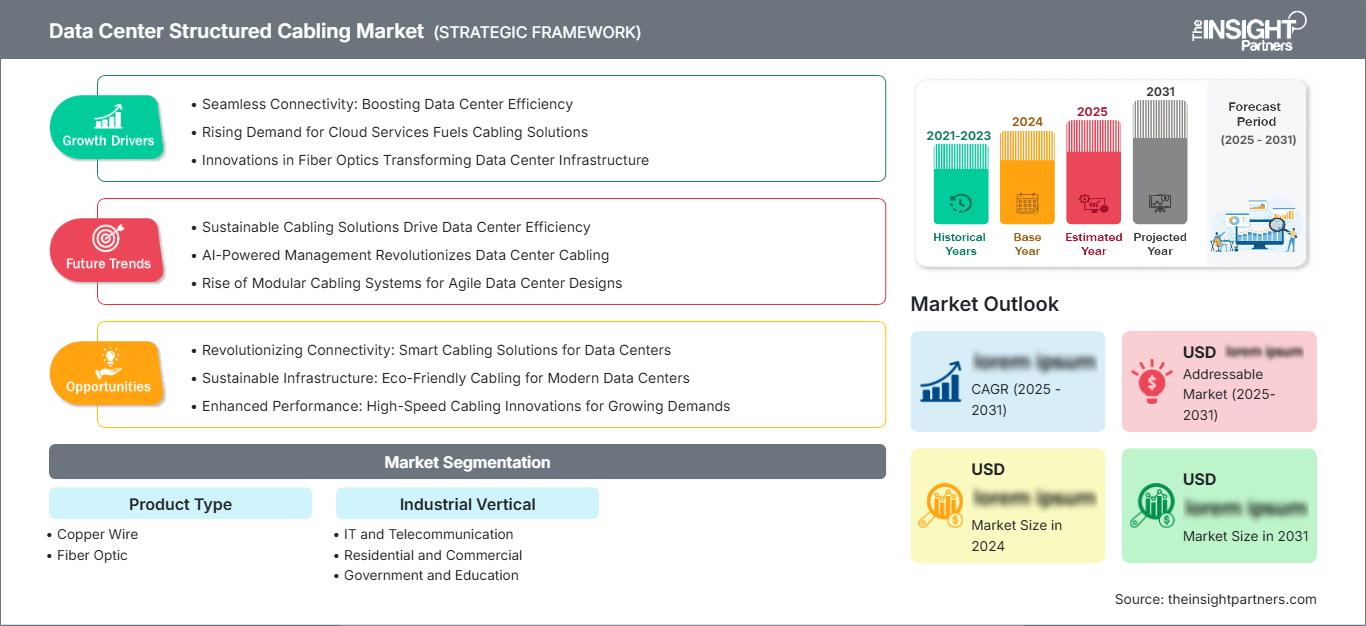
Data Center Structured Cabling Market: Strategic Insights
Regional Insights
North America Data Center Structured Cabling Market
North America generated a 37–40% share in 2025 and is projected to grow at an 8.8–9.4% CAGR during 2026–2034. The market share is reinforced by low vacancy in major hubs, precommitted hyperscale pipelines, and construction spreading into power-rich frontier markets.
Training for AI, cloud availability zones, and edge interconnects is driving higher fiber counts per rack and the deployment of modular cabling systems. Service providers in Virginia, Texas, Georgia, Arizona, and Ohio are now specifying structured pathways with certification to minimize commissioning risk and ensure future bandwidth growth without rebuilds.
U.S. Data Center Structured Cabling Market
The US accounted for a 78–82% share of North America revenues in 2025 and will experience an 8.7–9.3% CAGR from 2026 to 2034. The high density of hyperscale zones, AI campuses, and the expansion of colocation drives the need for fiber trunks, cross-connects, and copper connections in dense halls.
There is a broad vendor landscape, featuring Panduit Corp., Belden Inc., Corning Incorporated, The Siemon Company, and Leviton Manufacturing Co., Inc. Hyperscale, enterprise, and telecommunications deployments benefit from solutions provided by those companies. Emerging applications embrace transition to 400G switching, AI fabrics, and airflow-preserving structured cabling solutions.
Europe Data Center Structured Cabling Market
In Europe, the market accounted for a share of 22–25% in 2025 and is expected to increase at a CAGR of 8.1–8.7% during 2026-2034. The UK and Germany are driving the region. London is still a dense network environment, while energy issues in Frankfurt drive a need for efficient cabling systems, minimizing rework and maximizing space usage.
In France, Italy, Spain, and the Netherlands, cloud computing, sovereign data, and digitalization projects promote the development of robust structured cabling systems. Market penetration is fueled by energy reporting requirements, building permits, and business innovation that leads to the need for fiber-optic backbones and Category 6A cabling.
APAC Data Center Structured Cabling Market
The APAC region has a market share of 25-28% in 2025 and is expected to grow at a 10.6%-11.4% CAGR between 2026 and 2034. In the region, China dominates the deployments of such facilities, whereas Japan, South Korea, India, and Australia are investing in cloud zones, telecom facilities, and artificial intelligence enabled infrastructure.
Growing adoption of policies related to digital infrastructure, semiconductor clusters, and data localization will boost purchases of high-density fiber and modular copper solutions. Furthermore, industrial automation and 5G backhaul applications will also drive demand for structured cabling installations.
Middle East & Africa Data Center Structured Cabling Market
Middle East and Africa is growing at a 9.7–10.5% CAGR during 2026–2034, led by Saudi Arabia and the UAE. Energy-backed digital infrastructure programs, cloud regions, and government data strategies are increasing demand for structured fiber pathways and certified copper connectivity.
South Africa and the rest of MEA are expanding through enterprise modernization, subsea cable landings, and regional colocation hubs. Cabling specifications increasingly emphasize heat tolerance, maintainability, and scalable distribution frames suited to phased data hall expansion.
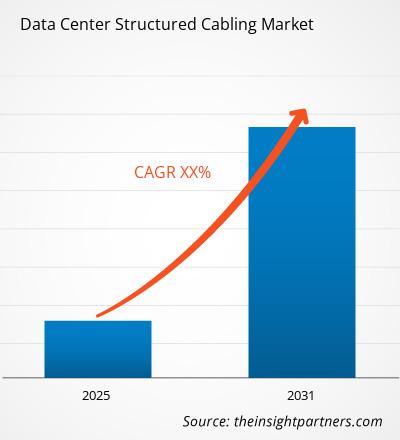
Segmentation Analysis
Product Type
The Product Type segment is expected to grow at a 9.6–10.3% CAGR during 2026–2034. Data Center Structured Cabling Market scope across product selection is shifting toward hybrid architectures in which copper supports short-reach links and power-enabled devices, while fiber carries high-bandwidth switching, storage, and interconnect traffic across increasingly dense facilities.
- Copper Wire remains important for short horizontal runs, management networks, and equipment rooms where cost, familiarity, and PoE compatibility support practical deployment within controlled distances.
- Fiber Optic is the largest product type, favored for high bandwidth, lower latency, electromagnetic immunity, and migration paths toward 400G and 800G data center fabrics.
Industrial Vertical
The Industrial Vertical segment is projected to grow at a 9.8–10.6% CAGR during 2026–2034. Demand differs by workload intensity: telecom and IT facilities prioritize bandwidth and uptime, commercial buildings need converged connectivity, public institutions focus on resilience, and industrial users require cabling that tolerates interference, vibration, and phased modernization.
- IT and Telecommunication is the highest growth vertical, supported by cloud platforms, telecom core upgrades, colocation demand, and high-bandwidth interconnects needed for AI and edge services.
- Residential and Commercial adoption is linked to smart buildings, Wi-Fi 7 backbones, surveillance, access control, and enterprise networks that require structured pathways for scalable connectivity.
- Government and Education demand is shaped by digital public services, campus networks, research computing, cybersecurity requirements, and resilient infrastructure procurement across public-sector facilities.
- Industrial users deploy structured cabling for automation, machine vision, private networks, and operational technology integration where shielding, uptime, and maintainable designs are strategically important.
Opportunity Snapshot
| Industrial Vertical | Revenue Contribution | Trend Tag | Adoption Stage |
| IT and Telecommunication | High | AI Fabrics | Scaling |
| Residential and Commercial | Medium | Smart Buildings | Scaling |
| Government and Education | Medium | Secure Campus | Scaling |
| Industrial | Medium | OT Networks | Emerging |
Data Center Structured Cabling Market Growth Drivers and Impact Analysis
AI Data Centers Require Denser Physical Connectivity
The emergence of AI clusters is changing the cabling density, as these AI clusters need much more high-speed connections than what traditional server racks need. There will be an increase in the demand for pre-terminated fiber trunks, high-density cabling, and pathways that prevent errors during rapid campus cabling installations. From a business point of view, operators will get to reduce the time taken in deployment, easier troubleshooting processes, and the ability to preserve capacity within these pathways to increase speeds in future deployments.
Cloud and Colocation Expansion Standardizes Repeatable Designs
Both major cloud vendors and colocation facilities are increasingly replicating their design across several campus locations in order to mitigate risk during construction and speed up the time to revenue. Structured cabling facilitates such an approach, because it allows for turning intricate connectivity demands into standardized and tested designs. Repeatable designs enable the procurement team to procure equipment earlier, allow the integration team to train their crew, and help facility owners manage documentation throughout the entire process. With the expansion of data center pipelines to secondary markets, cabling systems can help maintain the performance standards.
Bandwidth Migration Drives Fiber-Rich Architectures
Migration from 100G and 200G environments toward 400G and 800G networks increases the technical importance of optical performance, connector quality, and channel testing. Fiber-rich architectures reduce signal loss over longer in-building distances and support higher aggregation between switches, storage, and compute zones. Copper remains relevant for short links, but the strategic spend shifts toward optical trunks and high-density panels. This driver improves supplier value capture because performance validation, installation discipline, and migration planning become essential to reliable network operations.
Data Center Structured Cabling Market Future Trends
Pre-Terminated and Modular Deployment Models
One of the most influential Data Center Structured Cabling Market trends is the shift toward factory-terminated, modular cabling sets that can be installed with less field splicing and lower error rates. Over the forecast period, operators are expected to buy more engineered kits aligned to rack layouts, switch architectures, and phased capacity releases. This will change vendor relationships from component supply to design-linked deployment support, improving traceability, installation speed, and quality assurance across multi-building campuses.
Cabling Designs for High-Density Cooling Environments
As liquid cooling and higher rack densities become more common, cabling pathways will be planned around airflow, service access, and thermal separation rather than only distance and port count. Future designs are likely to use slimmer assemblies, better labeling, overhead distribution, and routing that reduces blockage near rear-door heat exchangers or coolant manifolds. Suppliers that combine connectivity performance with mechanical design guidance will gain relevance as facility engineers coordinate power, cooling, and network infrastructure earlier in the build cycle.
Data Center Structured Cabling Market Opportunities
Secondary Data Center Hubs and Power-Rich Campuses
Data Center Structured Cabling Market Forecasts point to expanding opportunities in secondary hubs where power access, land availability, and permitting speed are stronger than in saturated core markets. Cabling vendors can target early-stage campus planning by offering standardized architectures, phased bill-of-materials, and commissioning support before buildings reach fit-out. The opportunity is investment-led because owners want repeatable designs that protect uptime while allowing data halls to open in stages. Partnerships with electrical contractors and data center developers will be central to winning these projects.
Retrofit Programs in Enterprise and Public Facilities
Enterprises, universities, hospitals, and government agencies are modernizing aging networks to support cloud access, cybersecurity platforms, video analytics, and distributed computing. Retrofit programs create opportunities for audited cabling assessments, Category 6A upgrades, fiber backbone replacement, labeling remediation, and pathway redesign. Unlike hyperscale projects, these buyers value minimal disruption and lifecycle documentation. Vendors that package design, installation, testing, and compliance records can convert fragmented maintenance spending into structured modernization programs with recurring service potential.
Recent Developments
- April 2026: STL Optical Connectivity launched the Neuralis data center connectivity suite, a high-density fiber cabling portfolio designed for AI, hyperscale computing, and edge infrastructure. The solution provides ultra-high-density pre-terminated fiber systems, advanced data center interconnect cabling, and scalable connectivity architectures to support GPU clusters and high-bandwidth workloads. Neuralis helps data center operators improve deployment speed, optimize space utilization, and build future-ready networks for AI-driven environments.
- June 2025: STL expanded its data center portfolio with advanced cabling and connectivity solutions designed to support AI-driven infrastructure requirements. The portfolio includes high-performance fiber and copper cabling, pre-terminated multi-fiber systems, and high-density connectivity solutions to enable faster data transmission, lower latency, and scalable deployments for hyperscale, colocation, enterprise, and telecom data centers. The solutions help operators build flexible, reliable, and future-ready data center networks capable of supporting increasing AI workloads and high-density computing environments.
- April 2026: Sterlite Technologies (STL) launched NetXs, a structured cabling solution suite designed for high-speed and high-volume data transmission across data centers, enterprises, and digital networks. The solution includes advanced copper cabling options with improved bandwidth, scalability, reliability, and reduced signal interference to support evolving connectivity requirements. NetXs helps organizations build flexible and future-ready network infrastructure for cloud adoption, automation, and next-generation digital applications.
Frequently Asked Questions

- Comprehensive Market Sizing and Forecast Analysis
- Detailed Segmentation Analysis
- In-Depth Market Dynamics Assessment
- Regional and Country-Level Insights
- Competitive Landscape and Company Benchmarking
- Strategic Business Intelligence
Recent Reports
Testimonials

The Insight Partners' SCADA System Market report is comprehensive, with valuable insights on current trends and future forecasts. The team was highly professional, responsive, and supportive throughout. We are very satisfied and highly recommend their services.
RAN KEDEM Partner, Reali Technologies LTDs
I requested a report on a very specific software market and the team produced the report in a few days. The information was very relevant and well presented. I then requested some changes and additions to the report. The team was again very responsive and I got the final report in less than a week.
JEAN-HERVE JENN Chairman, Future Analytica
We worked with The Insight Partners for an important market study and forecast. They gave us clear insights into opportunities and risks, which helped shape our plans. Their research was easy to use and based on solid data. It helped us make smart, confident decisions. We highly recommend them.
PIYUSH NAGPAL Sr. Vice President, High Beam Global
The Insight Partners delivered insightful, well-structured market research with strong domain expertise. Their team was professional and responsive throughout. The user-friendly website made accessing industry reports seamless. We highly recommend them for reliable, high-quality research services
YUKIHIKO ADACHI CEO, Deep Blue, LLC.
This is the first time I have purchased a market report from The Insight Partners.While I was unsure at first, I visited their web site and felt more comfortable to take the risk and purchase a market report.I am completely satisfied with the quality of the report and customer service. I had several questions and comments with the initial report, but after a couple of dialogs over email with their analyst I believe I have a report that I can use as input to our strategic planning process.Thank you so much for taking the extra time and making this a positive experience.I will definitely recommend your service to others and you will be my first call when we need further market data.
JOHN SUZUKI President and Chief Executive Officer, Board Director, BK Technologies
I wish to appreciate your support and the professionalism you displayed in the course of attending to my request for information regarding to infectious disease IVD market in Nigeria. I appreciate your patience, your guidance, and the fact that you were willing to offer a discount, which eventually made it possible for us to close a deal. I look forward to engaging The Insight Partners in the future, all thanks to the impression you have created in me as a result of this first encounter.
DR CHIJIOKE ONYIA MANAGING DIRECTOR, PineCrest Healthcare Ltd.Reason to Buy
- Informed Decision-Making
- Understanding Market Dynamics
- Competitive Analysis
- Identifying Emerging Markets
- Customer Insights
- Market Forecasts
- Risk Mitigation
- Boosting Operational Efficiency
- Strategic Planning
- Investment Justification
- Tracking Industry Innovations
- Aligning with Regulatory Trends





 Get Free Sample for