
Electronic Potting and Encapsulating Market Size, Demand & Growth by 2034
Coverage: By Application (Power Supplies, Motors, Connectors, Ignition Coils, Electronic Modules, Others); End-use Industry (Consumer Electronics, Telecommunication, Automotive, Marine, Healthcare, Others) , and Geography (North America, Europe, Asia Pacific, and South and Central America)
- Status : Data Released
- Report Code : TIPRE00019370
- Category : Electronics and Semiconductor
- No. of Pages : 150
- Available Report Formats :


- Last update date : September 03, 2026


2025 Market Size
US$ 3.31 Bn
Base year value
2034 Forecast
US$ 4.68 Bn
Projected by 2034
CAGR 2026-2034
3.92 %
Growth rate
Addressable Market
US$ 36.28 Bn
(2026-2034)
The Electronic Potting and Encapsulating Market can be considered a rapidly growing market of materials and processes that help assemble reliable electronics in automotive, consumer, telecommunication, marine, and healthcare markets. The market is evaluated at US$ 3.31 Billion in 2025 and predicted to be worth US$ 4.68 Billion by 2034, representing a 3.92% CAGR from 2026 to 2034. These materials increase electrical insulation, environmental resistance, thermal characteristics, and mechanical properties.
In North America, the demand for this product is predicted to grow at around 5.1%–5.8% CAGR during 2026 to 2034 years due to automotive electrification, aerospace electronics, industrial automation, and local semiconductor production. The Electronic Potting and Encapsulating Market size is also determined by the rising demands for reliable power electronics, small-size electronics, and materials that can endure thermal cycling, vibrations, humidity, and aggressive chemical environment.
Electronic Potting and Encapsulating Market Assessment and Insights
- North America: North America is projected to hold a 27–31% Electronic Potting and Encapsulating Market share in 2025 and grow at a 5.1–5.8% CAGR between 2026 and 2034, supported by automotive electronics, aerospace systems, industrial automation, and high-reliability manufacturing.
- US: The US is estimated at 82–86% of North American demand in 2025, with growth of 5.0–5.7% CAGR between 2026 and 2034, led by aerospace, automotive electronics, and industrial power systems.
- Europe: Europe is estimated to represent a 23–27% share in 2025 and expand at 4.7–5.4% CAGR between 2026 and 2034, with Germany, France, Italy, and the UK supporting automotive and industrial electronics demand.
- Asia Pacific: Asia Pacific is estimated at a 36–40% share in 2025 and is expected to grow at 6.0–6.8% CAGR between 2026 and 2034, led by China, Japan, South Korea, India, and Australia.
- Largest Segment: Electronic Modules represent an estimated 30–34% market share in 2025, supported by complex control systems, power electronics, and automotive integration, with 5.2–5.9% CAGR between 2026 and 2034.
- High Growth Segment: Automotive represents an estimated 24–28% market share in 2025 within end-use demand and is expected to register 5.4–6.1% CAGR between 2026 and 2034.
- Key companies analyzed in detail: Winmate Inc., Henkel AG & Co. KGaA, Dymax Corporation, LANTAS Beck India Limited, Elkem ASA, Intertronics Ltd., DOPAG India Pvt. Ltd., Parker LORD, MG Chemicals, and EFI Polymers.
Source: The Insight Partners' analysis based on proprietary research, government publications, company annual reports, investor presentations, industry databases, and expert interviews.
Market evolution has seen movement from general purpose epoxy encapsulant into application specific silicone, polyurethane, epoxy, and light curing materials. Choice of material now takes into account factors such as coefficient of thermal expansion, dielectric properties, cure time, viscosity, thermal conductivity, and stress relief. Automated dispensing is now becoming an important aspect of production where bubble free filling and volume control impacts electrical reliability and yield.
In the future, the technology should become adopted in applications like high density electronics, electric vehicle, connectivity, and industrial control equipment. Localized electronics manufacturing in India and southeast Asia adds new requirement of application engineering and localized supply. Regulations concerning health and safety, restricted substances, and reliability drive suppliers to develop low emission and halogen free encapsulants.
Electronic Potting and Encapsulating Market Report Scope
| Report Attribute | Details |
|---|---|
| Market size in 2025 | US$ 3.31 Billion |
| Market Size by 2034 | US$ 4.68 Billion |
| Global CAGR (2026 - 2034) | 3.92% |
| Historical Data | 2021-2024 |
| Forecast period | 2026-2034 |
Electronic Potting and Encapsulating Market Analysis
The demand is currently influenced by increased electronic content per car, smaller sizes of devices, and exposure to vibration, humidity, chemicals, and thermal cycling. It is, therefore, evident that the growth in the Electronic Potting and Encapsulating Market depends on the development of power supplies, motors, connectors, ignition coils, and electronic modules. The value chain comprises resin producers, formulators, dispensing equipment providers, electronics producers, assembly providers, and original equipment manufacturers (OEMs).
Increasing supply dynamics are now more favorable towards providers of materials who have the capacity of integrating process development with material formulation. Henkel manufactures electronic and thermal management materials whereas Dymax focuses on fast curing encapsulation for board-level protection. DOPAG supplies precision dispensing and mixing equipment for polyurethane, epoxy, and silicone materials.
Competitive dynamics are fragmented among global materials firms, formulators, distributors, and process machinery vendors. Henkel AG & Co. KGaA, Dymax Corporation, Parker LORD, and Elkem ASA compete based on their unique chemistries and application engineering know-how. In turn, Intertronics Ltd. provides its customers with material and equipment solutions. EFI Polymers specializes in custom-formulated epoxies and urethanes. It creates differentiation when off-the-shelf materials fail to meet thermal, electrical, or processing needs of their customers.
The industry is moving towards investing in thermally conductive materials, faster cure, local manufacture, and process automation. Strategic positioning shifts from pure resin sales to process solutions. Testing services, application laboratories, regulatory know-how, and technical support available locally enable suppliers to shorten the process of qualifying their materials. Therefore, formulation, production, technical support, and qualification of materials for automotive, medical, aerospace, and industrial applications are becoming key competitive drivers in the market.
● REPORT CUSTOMIZATION
Tailor This Report To Align With Your Specific Business Requirements
This report can be customized to align precisely with your business objectives, scope, and target markets. Customization options include tailored segmentation, geography, competitive analysis, and strategic insights to support informed decision-making.
Customize This Report →WHAT YOU CAN ADJUST
- ● Segmentations
- ● Geography
- ● Competitive Analysis
- ● Language Preferences
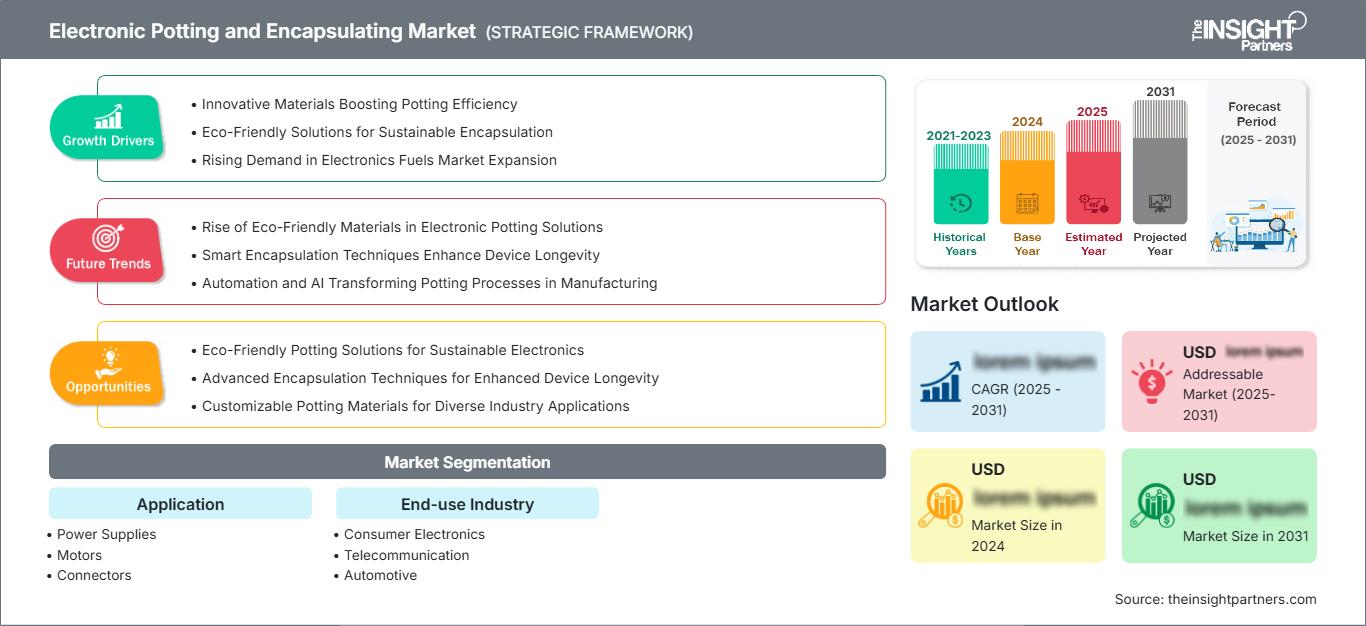
Electronic Potting and Encapsulating Market: Strategic Insights
Regional Insights
North America Electronic Potting and Encapsulating Market
The North America region is forecasted to hold 27-31% share in 2025, growing at a 5.1-5.8% CAGR between 2025 and 2034. The region has existing aerospace, automotive, industrial automation, and electronics manufacturing industries. Demand arises from applications that need high reliability, electrical insulation, heat dissipation, and protection against vibrations and environmental exposure. Regional examples of the market point to the United States as the leading country in North American potting and encapsulation demand.
Electric vehicle adoption and reshoring of electronics manufacturing should drive demand in the coming years. While Canada provides demand via power generation equipment and industrial equipment markets, Mexico relies on its auto manufacturing industry. Suppliers are focusing more on low viscosity compounds, thermal conductive properties, and automated dispensing. The stringent qualification needs in the region mean that established players who have application labs and reliability data will get an edge over their competitors.
U.S. Electronic Potting and Encapsulating Market Market
The US accounts for 82-86% of North America demand in 2025 and is forecast to grow at 5.0-5.7% CAGR. The industry of aerospace, defense, electric vehicle, industrial control, and medical electronics results in the emergence of various needs for encapsulation. In addition, there are specialized encapsulants manufacturers in the region as well as large international companies that supply materials and thus increase formulation, qualification, and technical service capacity of the region.
Application demand is shifting towards electronic modules, power supplies, motors, and connectors where thermal cycling and mechanical properties influence system life cycle. In automotive manufacturing, flexible and thermally conductive formulations are preferred, whereas low outgassing and dielectric stability are the most important factors in aerospace applications. Industrial customers show increasing preference for automated metering and mixing equipment.
Europe Electronic Potting and Encapsulating Market
The European market holds 23-27% share in 2025 and is expected to expand with 4.7-5.4% CAGR, led by Germany in terms of regional demand. Growth drivers include automotive electrification, industrial automation, medical device applications, and strict reliability requirements. The German country is the prime production hub, followed by the UK, France, Italy, and Spain. Similar trends are noted in the regional market where automotive electronics and industrial electronics become key demand sources.
Demand in the UK is fueled by aerospace, defense, medical electronics, and specialty electronics. In Germany, growth is driven by automotive power electronics and industrial machinery. France has potential in aerospace and transportation sectors, whereas Italy and Spain derive demand from industrial machinery, automotive applications, renewable-energy electronics, and consumer electronics. Europe’s end-use customers favor material traceability, regulation adherence, thermal properties, and compatibility with automated manufacturing process.
APAC Electronic Potting and Encapsulating Market
APAC is forecast to account for 36%-40% market share in 2025 and is expected to see 6.0%-6.8% CAGR growth, which will make it the leading regional market. The biggest contributor in the region is still going to be China, whereas Japan, South Korea, India, and Australia have complementary demands due to electronics, automotive, industrial, and telecoms manufacturing.
The size of electronics manufacturing in China justifies high volume consumptions, whereas Japan and South Korea focus on advanced materials and automotive applications. India is developing electronics manufacturing and local supply chains, thus opening up more opportunities in formulations and dispensing. Manufacturing projects backed by the government, EV adoption, semiconductor investments, and automation of industries will increase the pool of customers.
Middle East & Africa Electronic Potting and Encapsulating Market Market
MEA is a comparatively smaller market with growth potential, where demand is mainly focused on telecommunications, industrial electronics, power generation, and transportation applications. Saudi Arabia and UAE are leading investments in this region, while South Africa is a mature market in terms of electronics and industrial sectors. 5.8-6.6% CAGR is projected in this region due to the need for infrastructure upgrades and environmental protection.
Industrial diversification in Saudi Arabia and infrastructure and technological development in UAE are key to driving electronics applications. Mining, energy, telecommunications, and industrial automation in South Africa add to the demand. Rest of MEA is mainly driven by projects, where electrification, communications network, and industrialization drive electronics demand. Environmental conditions such as high temperature, dust, humidity, and vibration make encapsulation systems ideal.
Segmentation Analysis
Application
Application demand is increasingly determined by the reliability requirements of individual electronic architectures. The Electronic Potting and Encapsulating Market scope extends from power conversion and motors to connectors, ignition systems, and sophisticated electronic modules. Electronic Modules remain the largest application, while power electronics and motor protection provide attractive expansion opportunities. The application segment is expected to grow at 4.7–5.8% CAGR from 2026 to 2034.
- Power Supplies: Power supplies require insulation, thermal protection, and moisture resistance. Demand is supported by industrial equipment, telecommunications hardware, chargers, and distributed power systems where reliable operation and controlled heat dissipation are essential.
- Motors: Motor potting protects windings and electronics from vibration, moisture, and thermal cycling. Adoption is strengthened by electric motors, industrial automation, appliances, and compact drive systems requiring improved insulation and operational durability.
- Connectors: Connectors benefit from encapsulation where exposure to water, chemicals, vibration, and corrosion can compromise electrical continuity. Demand is particularly relevant to automotive, marine, industrial, and outdoor electronic assemblies.
- Ignition Coils: Ignition coils require materials with strong dielectric properties, thermal stability, and resistance to vibration. Automotive qualification requirements make formulation consistency and long-term insulation performance important purchasing considerations.
- Electronic Modules: Electronic modules represent the largest application because integrated control units combine multiple sensitive components. Automotive, industrial, telecommunications, and consumer equipment manufacturers increasingly use encapsulation to protect compact assemblies from thermal and mechanical stresses.
End-use Industry
End-use demand reflects differences in operating conditions, qualification requirements, production volumes, and electronics density. The segment is expected to expand at 4.3–6.1% CAGR from 2026 to 2034, with automotive representing the strongest growth profile. Consumer electronics provides scale, while healthcare and telecommunications favor specialized formulations with controlled dielectric and environmental characteristics.
- Consumer Electronics: Compact devices require protection without excessive weight or volume. Demand centers on wearables, smart devices, chargers, power modules, and connected equipment where miniaturization raises sensitivity to moisture and thermal stress.
- Telecommunication: Telecommunications equipment increasingly operates in outdoor and distributed environments. Encapsulation supports protection against humidity, dust, corrosion, and temperature variation in network equipment, power units, and connected infrastructure.
- Automotive: Automotive electronics face vibration, temperature cycling, chemicals, and high power density. Electrification, advanced control systems, sensors, and power conversion equipment are increasing the need for thermally stable and mechanically compliant formulations.
- Marine: Marine electronics require strong resistance to saltwater, humidity, vibration, and corrosion. Potting is strategically important for navigation, communication, control, and power equipment operating in demanding offshore environments.
- Healthcare: Healthcare electronics prioritize reliability, cleanliness, and controlled material performance. Encapsulation supports diagnostic equipment, sensors, power assemblies, and portable devices where moisture resistance and stable electrical behavior are essential.
Opportunity Snapshot
| End-use Industry | Revenue Contribution | Trend Tag | Adoption Stage |
|---|---|---|---|
| Consumer Electronics | High | Miniaturized Devices | Mature |
| Telecommunication | Medium | Outdoor Networks | Scaling |
| Automotive | High | EV Electronics | Scaling |
| Marine | Low | Saltwater Protection | Scaling |
| Healthcare | Medium | Medical Sensors | Scaling |
Electronic Potting and Encapsulating Market Growth Drivers and Impact Analysis
Higher electronic content in electric and hybrid vehicles
Automotive electrification increases the number and complexity of electronic modules exposed to heat, vibration, humidity, and electrical stress. Battery-management units, inverters, onboard chargers, DC-DC converters, motors, sensors, and control modules require protection strategies matched to increasingly compact architectures. Potting materials can combine dielectric insulation with mechanical reinforcement and thermal management, reducing failure exposure in critical assemblies. The commercial effect extends beyond resin consumption because higher-value formulations can command qualification-driven pricing. Suppliers that demonstrate low viscosity, rapid curing, thermal conductivity, and flexibility are better positioned for integrated powertrain designs. Henkel's 2025 launch of thermally conductive silicone potting solutions for EV power conversion components illustrates this shift toward application-specific materials.
Miniaturization is increasing material-performance requirements
Shrinking electronic assemblies reduce available space for protection while increasing component density and localized heat generation. Conventional materials may become unsuitable when viscosity, cure shrinkage, thermal expansion, or mechanical stiffness interfere with delicate components. Low-viscosity systems, flexible silicones, UV-curable materials, and dual-cure formulations can address difficult geometries while reducing processing time. The impact is particularly relevant to wearables, sensors, telecommunications modules, and advanced control electronics. Suppliers are therefore investing in formulations that penetrate narrow gaps without creating voids or excessive stress. Dymax's light-curable encapsulation portfolio demonstrates the direction, with rapid curing and secondary cure mechanisms supporting complex PCB geometries.
Automation is improving process consistency and production economics
Electronic Potting and Encapsulating Market trends indicate that automated metering, mixing, dispensing, and curing are becoming more important as electronics manufacturers seek repeatable material volumes and lower process variation. Manual potting can introduce inconsistencies in mixing ratio, filling depth, bubbles, and cure conditions, particularly in high-volume manufacturing. Automated equipment enables recipe control, repeatability, traceability, and integration with production lines. DOPAG's electronics solutions demonstrate how precision metering and mixing technology is being integrated with polyurethane, epoxy, and silicone materials for electronic component protection. This trend creates opportunities for equipment suppliers and materials companies to develop jointly qualified systems, increasing switching costs and strengthening application-level relationships with OEMs and contract manufacturers.
Electronic Potting and Encapsulating Market Future Trends
Data-driven formulation and adaptive dispensing
The Electronic Potting and Encapsulating Market forecast indicates that formulation development is likely to become more closely connected with process data, component geometry, and operating-condition simulation. Suppliers will increasingly use digital models to optimize viscosity, thermal conductivity, cure profiles, and coefficient of thermal expansion before customer validation. Dispensing systems can also capture material temperature, pressure, shot volume, and curing parameters, allowing manufacturers to identify deviations earlier. This creates a pathway toward adaptive production in which process settings are adjusted according to measured conditions rather than fixed recipes. The result should be greater consistency for high-density electronic modules and more efficient qualification of specialized materials. Technical differentiation will increasingly depend on combining chemistry, application engineering, equipment integration, and production analytics.
Hybrid curing systems for complex electronic assemblies
Hybrid curing is likely to gain relevance where light cannot penetrate shadowed regions of dense assemblies. UV or LED curing can provide rapid surface fixation, while secondary moisture or heat curing completes polymerization in areas inaccessible to light. This approach can shorten production cycles without sacrificing protection in intricate geometries. Dymax already offers dual-cure and multi-cure encapsulation approaches for applications involving PCB components, bare dies, wire bonds, and flexible circuits. Future formulations are expected to improve cure depth, reduce energy requirements, and increase compatibility with automated dispensing. Adoption should be strongest where manufacturers balance high throughput with demanding reliability requirements and cannot tolerate incomplete curing or extended thermal exposure.
Electronic Potting and Encapsulating Market Opportunities
Localized materials and application engineering in India
India presents an attractive opportunity for suppliers able to combine local technical support with reliable material availability. Electronics manufacturing expansion is increasing demand for adhesives, encapsulants, thermal-management materials, and automated dispensing systems. Henkel's 2026 customer application center in Bengaluru illustrates the strategic importance of localized testing and co-development for next-generation electronics manufacturing. Suppliers can capture value by establishing formulation support, qualification laboratories, distributor networks, and application centers close to electronics clusters. The opportunity is strongest in automotive electronics, power conversion, consumer devices, telecommunications equipment, and industrial controls. Local technical validation can reduce qualification delays while helping manufacturers select materials according to thermal, electrical, environmental, and processing requirements.
Specialized protection for offshore and harsh-environment electronics
Demand for ruggedized electronics creates opportunities beyond mainstream consumer and automotive applications. Marine communications, offshore renewable-energy equipment, subsea sensors, industrial monitoring, and remote infrastructure require protection against saltwater, pressure, humidity, vibration, and thermal cycling. Intertronics reported a 2025 case in which polyurethane potting supported certification of a subsea wireless communication device for environmental monitoring and offshore renewable applications. Suppliers can target these niches with formulations optimized for low water absorption, flexible mechanical behavior, dielectric stability, and long service life. The commercial opportunity lies in application-specific qualification, where technical performance and reliability documentation can be more important than lowest material cost.
Recent Developments
- January 2026: Henkel launched Loctite STYCAST US 8000 A/B, a next-generation two-component polyurethane potting compound designed to improve the electrical insulation, mechanical durability, and long-term reliability of industrial and power electronics. The material is engineered to protect applications such as motor controls, power supplies, inverters, battery management units, HVAC control modules, and industrial sensors from heat, humidity, vibration, corrosion, and insulation breakdown. With low ionic content, a UL 746 RTI rating of 140°C, UL 94 V-0 certification, high dielectric strength, and low mixed viscosity for void-free encapsulation, the solution supports reliable and efficient high-volume manufacturing.
- February 2026: WEVO-CHEMIE launched the WEVOSIL 2210x FL range of two-component silicone potting compounds for next-generation electric vehicle power electronics. The materials are designed to protect DC/DC converters, inverters, inductive components, transformers, capacitors, and other sensitive electronic assemblies operating under high currents, elevated temperatures, vibration, and space constraints. The range provides thermal management, electrical insulation, moisture and corrosion protection, mechanical stability, and vibration damping, with selected grades offering thermal conductivity of up to 1.5 W/m·K and continuous operating temperatures of up to 200°C.
- May 2026: Greenwood Aerospace highlighted the growing use of potting and encapsulation technologies for protecting electronic assemblies in military and government aircraft from moisture, vibration, thermal cycling, chemical exposure, corrosion, and other harsh operating conditions. The company’s aerospace adhesives and sealants portfolio includes epoxy, polyurethane, silicone, and conductive sealing solutions for applications such as sensors, avionics, cameras, wiring harnesses, and power electronics.
Frequently Asked Questions

- Comprehensive Market Sizing and Forecast Analysis
- Detailed Segmentation Analysis
- In-Depth Market Dynamics Assessment
- Regional and Country-Level Insights
- Competitive Landscape and Company Benchmarking
- Strategic Business Intelligence
Recent Reports
Testimonials

The Insight Partners' SCADA System Market report is comprehensive, with valuable insights on current trends and future forecasts. The team was highly professional, responsive, and supportive throughout. We are very satisfied and highly recommend their services.
RAN KEDEM Partner, Reali Technologies LTDs
I requested a report on a very specific software market and the team produced the report in a few days. The information was very relevant and well presented. I then requested some changes and additions to the report. The team was again very responsive and I got the final report in less than a week.
JEAN-HERVE JENN Chairman, Future Analytica
We worked with The Insight Partners for an important market study and forecast. They gave us clear insights into opportunities and risks, which helped shape our plans. Their research was easy to use and based on solid data. It helped us make smart, confident decisions. We highly recommend them.
PIYUSH NAGPAL Sr. Vice President, High Beam Global
The Insight Partners delivered insightful, well-structured market research with strong domain expertise. Their team was professional and responsive throughout. The user-friendly website made accessing industry reports seamless. We highly recommend them for reliable, high-quality research services
YUKIHIKO ADACHI CEO, Deep Blue, LLC.
This is the first time I have purchased a market report from The Insight Partners.While I was unsure at first, I visited their web site and felt more comfortable to take the risk and purchase a market report.I am completely satisfied with the quality of the report and customer service. I had several questions and comments with the initial report, but after a couple of dialogs over email with their analyst I believe I have a report that I can use as input to our strategic planning process.Thank you so much for taking the extra time and making this a positive experience.I will definitely recommend your service to others and you will be my first call when we need further market data.
JOHN SUZUKI President and Chief Executive Officer, Board Director, BK Technologies
I wish to appreciate your support and the professionalism you displayed in the course of attending to my request for information regarding to infectious disease IVD market in Nigeria. I appreciate your patience, your guidance, and the fact that you were willing to offer a discount, which eventually made it possible for us to close a deal. I look forward to engaging The Insight Partners in the future, all thanks to the impression you have created in me as a result of this first encounter.
DR CHIJIOKE ONYIA MANAGING DIRECTOR, PineCrest Healthcare Ltd.Reason to Buy
- Informed Decision-Making
- Understanding Market Dynamics
- Competitive Analysis
- Identifying Emerging Markets
- Customer Insights
- Market Forecasts
- Risk Mitigation
- Boosting Operational Efficiency
- Strategic Planning
- Investment Justification
- Tracking Industry Innovations
- Aligning with Regulatory Trends





 Get Free Sample for