
Electrostatic Precipitator Market Growth, Demand & Size by 2034
Coverage: by Technology (Wet and Dry); and Application (Chemical, Metal, Power Generation, Cement, Manufacturing, and Others), and Geography (North America, Europe, Asia Pacific, and South and Central America)
- Status : Data Released
- Report Code : TIPEL00002691
- Category : Electronics and Semiconductor
- No. of Pages : 150
- Available Report Formats :


- Last update date : August 12, 2026


2025 Market Size
US$ 431.59 Bn
Base year value
2034 Forecast
US$ 832.66 Bn
Projected by 2034
CAGR 2026-2034
7.57 %
Growth rate
Addressable Market
US$ 5,694.43 Bn
(2026-2034)
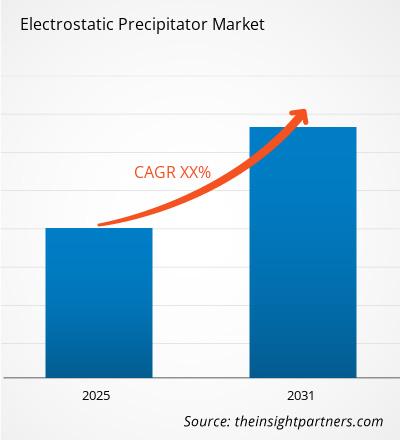
The Electrostatic Precipitator Market size stood at US$ 431.59 billion in 2025, and it is forecasted to rise to US$ 832.66 billion in 2034, registering a CAGR of 7.57% from 2026 to 2034. Growth is driven by increasing demands for high efficiency particulate removal in power generation, cement, metals, chemicals, manufacturing, continued replacements of outdated systems, and usage of wet and dry technologies in newly regulated plants.
North America market for Electrostatic Precipitator is expected to increase at a CAGR of 6.4%-6.8% up to 2034. The demand from retrofitting projects is fueled by stringent particulate control monitoring, aged utility and industrial plants, and integration of precipitator improvements along with scrubbers, sorbent injection, and continuous emission monitors in capital projects. The demand for Electrostatic Precipitators has also expanded into waste to energy, metals processing, and cement modernization, in addition to traditional coal-fired power plants.
Electrostatic Precipitator Market Assessment and Insights
- North America: Electrostatic Precipitator Market Share in 2025 is estimated at 25–27%, with a CAGR between 2026–2034 of 6.4–6.8%, supported by utility retrofits, cement upgrades, waste-to-energy investment, and strict particulate-compliance programs.
- US: The country represents 80–84% of North American demand in 2025 and is growing at a 6.5–6.9% CAGR during 2026–2034.
- Europe: Share in 2025 is estimated at 21–23%, with a 6.0–6.4% CAGR during 2026–2034; Germany leads, while the UK, France, Italy, and Spain sustain retrofit demand.
- Asia Pacific: Share in 2025 is estimated at 38–42%, with an 8.4–8.8% CAGR during 2026–2034; China leads, followed by India, Japan, South Korea, and Australia.
- Largest Segment: Dry technology holds a 67–71% market share in 2025 and is expected to record a 6.8–7.2% CAGR during 2026–2034.
- High Growth Segment: Wet technology holds a 29–33% market share in 2025 and is expected to record an 8.8–9.2% CAGR during 2026–2034.
- Key companies analyzed in detail: Mitsubishi Heavy Industries, Ltd.; Mutares SE & Co. KGaA; FLSmidth & Co. A/S; ELEX AG; Babcock & Wilcox Enterprises, Inc.; KC Cottrell Co., Ltd.; Beltran Technologies, Inc.; John Wood Group PLC; Siemens Aktiengesellschaft; Thermax Limited.
Source: The Insight Partners' analysis based on proprietary research, government publications, company annual reports, investor presentations, industry databases, and expert interviews.
Electrostatic precipitators have advanced from mechanical precipitators to an overall system design with optimally engineered electrodes, high frequency electrical power supplies, flow models, and control systems. Dry electrostatic precipitators continue to dominate in situations requiring the capture of collectable dust in high-temperature and high-volume processes, while the wet electrostatic precipitators continue polishing sulfuric acid mist, condensibles, heavy metals, and submicron particulates. The current state of production economics is focused on module-based design, standard internal configurations, and retrofit-friendly components. The suppliers are placing increased value in diagnostics, controls, replacements, and guarantees in light of varying fuels and process loads.
Until 2034, the developing industrial corridors in Asia, the Middle East, and Africa will attract new plant construction; mature markets will focus investments in rebuilding and efficiency restoration. Tighter particulate regulations, increased permits, evidence of a relationship between air pollutants and mortality, and increased health awareness increase investment visibility. Investments will flow to those systems that have a tolerance for variation in fuel source, integration with scrubbing systems and pre-treatment carbon capture systems, and provide quantifiable energy savings.
Electrostatic Precipitator Market Report Scope
| Report Attribute | Details |
|---|---|
| Market size in 2025 | US$ 431.59 Billion |
| Market Size by 2034 | US$ 832.66 Billion |
| Global CAGR (2026 - 2034) | 7.57% |
| Historical Data | 2021-2024 |
| Forecast period | 2026-2034 |
Electrostatic Precipitator Market Analysis
The Electrostatic Precipitator Market growth hinges on regulatory compliance replacement, industrial capacity expansion, and necessity of controlling particulates without significant pressure drop. Value chain starts with application engineering and dust characterization followed by electrodes, collection plates, transformer rectifier, rapper, control systems, structural steel, commissioning, and after-market services. Purchase consideration factors include gas volume, temperature, resistivity, moisture content, particulate size, and footprint.
Supply conditions are increasingly tilting towards suppliers that can offer combination of local manufacturing along with proprietary electrical engineering and global installation support. Steel, copper, electronics, and field labor skills influence project delivery timeline, with brownfield operations requiring proper outage scheduling. Operators are benchmarking initial investment against energy consumption, efficiency, maintenance frequency, and non-compliance penalties. Precipitators achieving more than 99% collection efficiency continue being feasible if properly engineered and operated.
The Electrostatic Precipitator Market analysis shows a relatively concentrated industry that includes diversified engineering companies and specialists. Mitsubishi Heavy Industries, Babcock & Wilcox, FLSmidth, Thermax, KC Cottrell, and ELEX rely on expertise in installed base, air quality systems and retrofit engineering. Siemens and John Wood Group offer automation, electrification, and engineering, while Beltran Technologies offers wet electrostatic precipitator solutions. Mutares gains its strategic position through portfolio investments in industrial technologies.
Investments go into higher frequency power conversion, predictive diagnostics, corrosion resistance for wet collectors, and upgrade kits. The strategic positioning is less dependent on individual equipment and more on proven outlet results, outage management, remote monitoring, and responsiveness. Companies with experience of work with different types of fuels and processes are able to estimate risks better. Collaboration with local fabricators and engineering contractors allows gaining access to new markets, while acquisitions of existing installed bases bring additional revenues from services.
● REPORT CUSTOMIZATION
Tailor This Report To Align With Your Specific Business Requirements
This report can be customized to align precisely with your business objectives, scope, and target markets. Customization options include tailored segmentation, geography, competitive analysis, and strategic insights to support informed decision-making.
Customize This Report →WHAT YOU CAN ADJUST
- ● Segmentations
- ● Geography
- ● Competitive Analysis
- ● Language Preferences
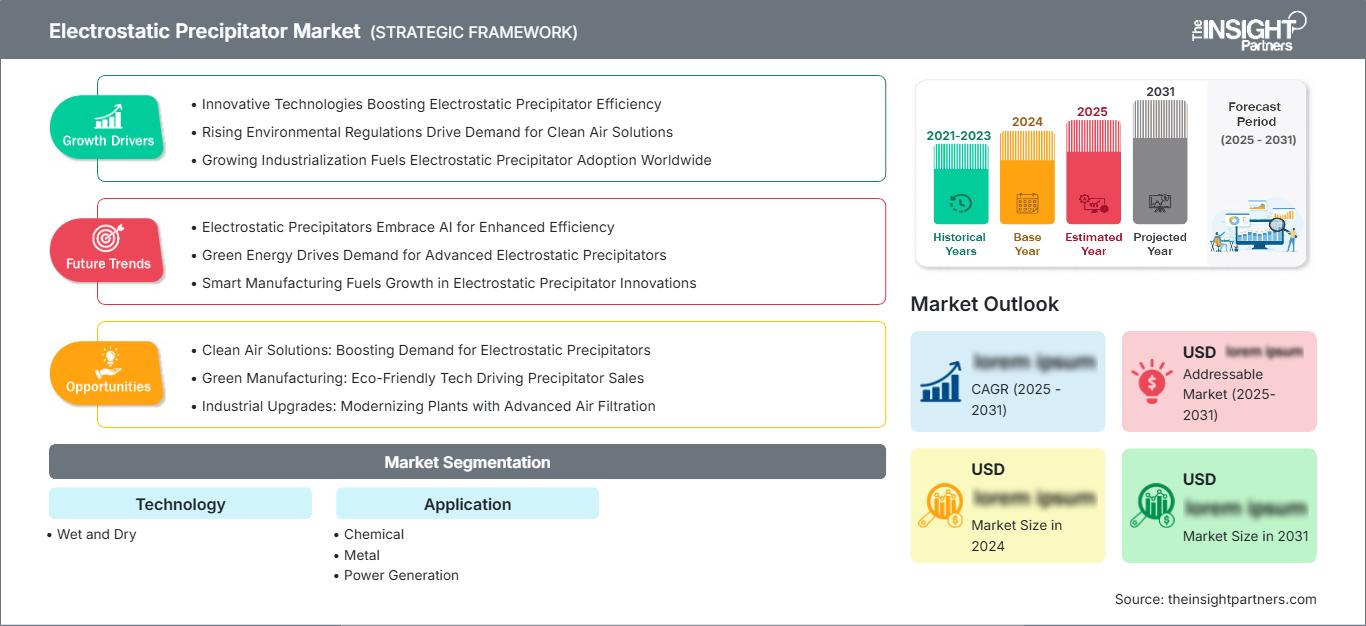
Electrostatic Precipitator Market: Strategic Insights
Regional Insights
North America Electrostatic Precipitator Market
North America represents an approximate market share of 25–27% in the Electrostatic Precipitator Market in 2025, with forecasted growth at a rate of 6.4-6.8% CAGR to 2034. Drivers include replacing older utility and industrial units, improved efficiency when handling load changes, and the integration of electrostatic precipitators with flue-gas desulfurization, activated carbon injection, and constant monitoring. The diversity of end-users such as cement, metals, chemicals, pulp processing, and waste to energy extends the addressable base beyond coal generation.
Regulatory compliance and economics support control retrofits compared to unit replacement when vessels and ducts are still viable. High frequency power supplies, optimal gas distribution, and controllers can regain performance without lengthy downtimes. Local supply of structural parts and field labor lowers the risk of implementation, while specialized electrodes and electronics require supplier-specific expertise. The United States leads regional spending, while Canada adds mining, metals, cement, and utilities, and Mexico adds industrial manufacturing applications.
U.S. Electrostatic Precipitator Market
United States makes up 80-84% of the Electrostatic Precipitator Market demand in North America in 2025 and is forecast to register a CAGR of 6.5-6.9% through 2034. Utilities' retirement schedules will impact greenfield coal applications, yet an extensive installed base keeps the focus on repairs, replacement control, rapper refurbishment, and upgrades. National and state regulations on particulates, opacity monitoring, and industrial permit application will keep expenditures alive in cement plants, steel mills, refineries, chemical processing, biomass, and waste combustion.
Engineering or project management skills related to the product are possessed by Babcock & Wilcox Enterprises, Inc., Siemens Aktiengesellschaft, John Wood Group PLC, and dedicated service companies in the nation. Application demand is increasingly focusing on brownfield optimization in cases where the process changes result in altered dust loading or resistivity. Wet technology becomes important in dealing with acid mist, metal fumes, and polishing, whereas dry technology holds its own in handling hot gases.
Europe Electrostatic Precipitator Market
European Electrostatic Precipitator Market share is estimated at 21–23% for 2025 and expected to experience 6.0–6.4% CAGR until 2034, being led by Germany. Revised Industrial Emissions Directive reinforces permitting and investment certainty. Low outlet dust, high energy efficiency, and digital controls become key components of investments in cement, metals, chemicals, and waste-to-energy assets of Germany.
The United Kingdom focuses on waste-to-energy, biomass, process industry retrofits, and lifecycle services. Nuclear-powered electricity combined with cement, oil refining, chemical processes, and municipal waste applications define the French market, while Italian and Spanish markets are created by cement, ceramics, metals, and industrial cogeneration. In all these markets, wet polishing gets growing attention due to fine aerosol and acid mist. Consumption of total energy, corrosion control, water consumption, and compatibility with carbon-capture pretreatment are evaluated.
APAC Electrostatic Precipitator Market
Asia Pacific holds an approximate market share of 38-42% in 2025 and is forecasted to witness a CAGR of 8.4-8.8% during 2034. This region not only stands out to be the largest but also experiences the fastest growth among all others. China dominates owing to its extensive presence in power generation, steel, cement, chemicals, and waste processing operations.
India adds to this with thermal power capacity, industrial expansion, and retrofits. Japan and South Korea focus on high efficiency modernization. Australia’s contribution comes from mining, mineral processing, metals, and power applications. The drivers for the regional demand include fabrication at local level, increasing enforcement and high particulate content in case of coal and bulk material industry.
Middle East & Africa Electrostatic Precipitator Market
The Middle East & Africa market is projected to grow at a 7.0–7.4% CAGR through 2034, led by Saudi Arabia. Investment in cement, metals, refining, petrochemicals, and utility infrastructure supports both new systems and retrofits. The UAE emphasizes efficient industrial assets and waste treatment, while South Africa’s power and mineral-processing base sustains rehabilitation demand.
Across the Rest of MEA, project economics depend on financing, local service coverage, water availability, and harsh operating conditions. Dry units remain prevalent for cement and bulk solids, whereas wet systems target refinery aerosols and metal fumes. Localization requirements encourage partnerships covering fabrication, installation, and long-term maintenance.
Segmentation Analysis
Technology
The Technology segment is expected to expand at a 7.4–7.8% CAGR during 2026–2034. Electrostatic Precipitator Market scope spans wet and dry collection architectures selected according to gas temperature, moisture, particle resistivity, aerosol behavior, and downstream treatment. Dry systems dominate high-volume, high-temperature processes, while wet systems address sticky dust, condensed metal fumes, acid mist, and submicron polishing. Technology choice increasingly includes controls, water management, corrosion protection, and retrofit constraints.
- Wet: Demand is scaling in refining, chemicals, metals, biomass, and final polishing applications where saturated streams, condensables, acid mist, or sticky particles require washing-based electrode cleaning and corrosion-resistant construction.
- Dry: The established design remains strategically important for power, cement, metals, and manufacturing because it handles large hot-gas volumes with low pressure loss, recoverable dust, and extensive retrofit compatibility.
Application
The Application segment is expected to grow at a 7.3–7.7% CAGR during 2026–2034. Demand reflects compliance intensity, plant utilization, particulate characteristics, and the cost of process interruption. Power generation remains the largest installed-base opportunity, while cement, metals, chemicals, and general manufacturing contribute diversified replacement and greenfield spending. Application engineering is decisive because gas chemistry, temperature excursions, dust loading, and upstream combustion conditions materially affect collection performance.
- Chemical: Producers use wet and dry configurations for process dust, acid mist, catalyst fines, and product recovery, prioritizing corrosion resistance, stable operation across variable recipes, and integration with scrubbers.
- Metal: Smelters and steel facilities demand systems capable of handling metal fumes, sinter dust, and high-temperature exhaust while improving workplace conditions, recovering valuable material, and meeting stringent stack limits.
- Power Generation: A large installed base supports rebuilds, controls upgrades, and performance restoration, particularly where coal, biomass, or waste-derived fuels create variable ash resistivity and changing particulate loads.
- Cement: Kilns, clinker coolers, and mills require reliable dust capture under abrasive conditions, making robust internals, gas conditioning, and retrofit execution critical to production continuity and regulatory compliance.
- Manufacturing: Diverse processes use compact or customized collectors for fumes and fine dust, with purchasing decisions shaped by footprint, energy use, maintainability, product recovery, and compatibility with existing ventilation.
Opportunity Snapshot
| Application | Revenue Contribution | Trend Tag | Adoption Stage |
| Chemical | Medium | Acid Mist | Scaling |
| Metal | High | Fume Recovery | Mature |
| Power Generation | High | Fleet Retrofit | Mature |
| Cement | High | Kiln Upgrade | Scaling |
| Manufacturing | Medium | Process Capture | Scaling |
Electrostatic Precipitator Market Growth Drivers and Impact Analysis
Tighter particulate limits accelerate compliance capital
Permits will become more stringent, and there will be more monitoring as well as higher financial risks in case the collection system fails. The U.S. EPA has classified electrostatic precipitators as able to achieve collection efficiencies above 99%. In Europe, the revision of the Industrial Emissions Directive is expected to cut significant air pollutants, including PM2.5, by 40% in 2050 compared to 2020. That adds to the value of retrofit solutions for increasing the efficiency of gas flow, power distribution, rapping and control without changing the existing casing. The effect on the market is increased opportunities for audit, rebuilding and guaranteeing the performance of the system. Vendors who are able to measure outlet emissions and execution risk may turn regulations into revenues.
Industrial expansion sustains high-volume dust control
Particulates from coal-fired processes, cement production, metal and mineral processing, chemical plants, and manufacturing continue to be significant sources of exhaust particulates, especially in the Asia-Pacific region and industrializing regions. In 2024, the International Energy Agency noted that the world’s coal demand had reached 8.79 billion tonnes, and coal continues to be utilized for energy generation and industries. As renewable energy increases, there is an urgent need for continued exhaust particulate control of current coal-fired and process operations over the life of their plants. Additional greenfield applications include new cement kilns, steel capacity, waste-to-energy plants, and captive boilers. The trend supports dry precipitators for large volumes of hot gases and wet precipitators in cases where aerosols and condensables dominate.
Lifecycle economics favor modernization over replacement
Many precipitators that are currently installed have casings that are structurally sound but may be obsolete in terms of their electrodes, transformers, rectifiers, controls, rappers, or gas flow configuration. Specific modernizations can bring back efficiency, reduce sparking, decrease auxiliary energy costs, and increase the life of the assets while taking less time out of production than replacing the whole unit. Babcock & Wilcox claims an installed base experience globally of over 5,000 units, providing perspective of how large the serviceable installed base is. Customers are requiring diagnostic services more often now prior to receiving capital approval, thereby ensuring funds are spent on limited areas or components.
Electrostatic Precipitator Market Future Trends
AI-assisted optimization and condition-based maintenance
Electrostatic Precipitator Market trends increasingly point toward closed-loop optimization using field voltage, current, spark rate, opacity, gas temperature, and load data. Machine-learning tools will identify deteriorating electrodes, insulators, rappers, or flow distribution before emissions drift becomes material. Operators can then schedule maintenance around planned outages rather than respond to exceedances. Digital twins will support tuning when fuel composition or production rates change, while remote service centers will compare performance across fleets. Adoption will begin with large utilities and process groups that already collect high-frequency operating data, then expand through packaged controllers and subscription analytics available to mid-sized facilities.
Hybrid trains for ultra-low particulate and carbon capture
Future installations will increasingly combine dry precipitation, sorbent injection, scrubbers, wet polishing, and fabric filtration according to pollutant chemistry and outlet guarantees. Carbon-capture projects make upstream particulate and aerosol control more important because contamination can degrade solvents, heat exchangers, and downstream equipment. Wet precipitators are likely to gain as final polishing devices for sulfuric acid mist and condensables, while dry units remain efficient first-stage collectors. Engineering value will shift toward whole-train optimization, including pressure drop, water balance, corrosion, waste handling, and controls integration. Suppliers able to warrant combined-system performance will capture larger project scopes and recurring service opportunities.
Electrostatic Precipitator Market Opportunities
Cross-OEM retrofit platforms for aging fleets
A scalable opportunity lies in modular upgrade platforms that fit vessels supplied by multiple original manufacturers. Investors and equipment companies can build recurring revenue by combining inspections, computational flow studies, electrode packages, high-frequency power supplies, controls, installation, and performance testing. Standardized modules shorten engineering cycles, but application databases remain essential for addressing dust resistivity and process variability. Commercial models can include phased modernization, guaranteed outlet levels, and multi-year service. Priority targets are utilities, cement groups, steel producers, and chemical operators with geographically distributed fleets. Acquiring specialist service businesses can add installed-base access, field technicians, and proprietary replacement designs.
Localized systems for emerging industrial corridors
Manufacturers can capture growth by localizing steelwork, hoppers, ducting, installation, and routine spares while retaining proprietary control, electrode, and application engineering. India, Southeast Asia, the Middle East, and selected African markets offer demand from cement, metals, captive power, refining, chemicals, and waste treatment. Joint ventures with regional fabricators reduce freight and improve tender eligibility, while training centers strengthen commissioning and maintenance quality. Investors should prioritize partners with safety systems, quality traceability, and access to industrial clients. A hub-and-spoke service model can turn greenfield projects into long-term parts and optimization contracts.
Recent Developments
- April 2025: Valmet Electrostatic Precipitator (ESP) is a cost-effective and energy-efficient solution for removing dust particles from flue gases. For Olvi Group, a Finnish-origin international beverage company, the installation of Valmet ESP brings improved reliability and performance in emission control.
- July 2024: Ducon has introduced advanced Wet Electrostatic Precipitator (WESP) technology designed to improve the removal of fine particulate matter, acid mists, and hazardous pollutants from industrial emissions. The system uses high-voltage electrostatic forces combined with a wet collection process to capture extremely small particles that are difficult to remove using conventional filtration methods.
- April 2025: Büttner, now operating as Siempelkamp Energy & Drying Solutions GmbH, has secured its first order for a Wet Electrostatic Precipitator (WESP) system, marking the company’s entry into the mineral wool manufacturing sector. The project involves the complete delivery, installation, and commissioning of an advanced air-cleaning system at a European customer facility.
Frequently Asked Questions

- Comprehensive Market Sizing and Forecast Analysis
- Detailed Segmentation Analysis
- In-Depth Market Dynamics Assessment
- Regional and Country-Level Insights
- Competitive Landscape and Company Benchmarking
- Strategic Business Intelligence
Recent Reports
Testimonials

The Insight Partners' SCADA System Market report is comprehensive, with valuable insights on current trends and future forecasts. The team was highly professional, responsive, and supportive throughout. We are very satisfied and highly recommend their services.
RAN KEDEM Partner, Reali Technologies LTDs
I requested a report on a very specific software market and the team produced the report in a few days. The information was very relevant and well presented. I then requested some changes and additions to the report. The team was again very responsive and I got the final report in less than a week.
JEAN-HERVE JENN Chairman, Future Analytica
We worked with The Insight Partners for an important market study and forecast. They gave us clear insights into opportunities and risks, which helped shape our plans. Their research was easy to use and based on solid data. It helped us make smart, confident decisions. We highly recommend them.
PIYUSH NAGPAL Sr. Vice President, High Beam Global
The Insight Partners delivered insightful, well-structured market research with strong domain expertise. Their team was professional and responsive throughout. The user-friendly website made accessing industry reports seamless. We highly recommend them for reliable, high-quality research services
YUKIHIKO ADACHI CEO, Deep Blue, LLC.
This is the first time I have purchased a market report from The Insight Partners.While I was unsure at first, I visited their web site and felt more comfortable to take the risk and purchase a market report.I am completely satisfied with the quality of the report and customer service. I had several questions and comments with the initial report, but after a couple of dialogs over email with their analyst I believe I have a report that I can use as input to our strategic planning process.Thank you so much for taking the extra time and making this a positive experience.I will definitely recommend your service to others and you will be my first call when we need further market data.
JOHN SUZUKI President and Chief Executive Officer, Board Director, BK Technologies
I wish to appreciate your support and the professionalism you displayed in the course of attending to my request for information regarding to infectious disease IVD market in Nigeria. I appreciate your patience, your guidance, and the fact that you were willing to offer a discount, which eventually made it possible for us to close a deal. I look forward to engaging The Insight Partners in the future, all thanks to the impression you have created in me as a result of this first encounter.
DR CHIJIOKE ONYIA MANAGING DIRECTOR, PineCrest Healthcare Ltd.Reason to Buy
- Informed Decision-Making
- Understanding Market Dynamics
- Competitive Analysis
- Identifying Emerging Markets
- Customer Insights
- Market Forecasts
- Risk Mitigation
- Boosting Operational Efficiency
- Strategic Planning
- Investment Justification
- Tracking Industry Innovations
- Aligning with Regulatory Trends





 Get Free Sample for