
Film Capacitor Market Size, Demand & Growth by 2034
Coverage: by Type (Paper Film Capacitor, Plastic Film Capacitor); Applications (Electronics, Home Appliance, Communication, Others); Industry Vertical (Automotive, Power and Utilities, Consumer and electronics, Government and Defense, Others) , and Geography (North America, Europe, Asia Pacific, and South and Central America)
- Status : Data Released
- Report Code : TIPRE00009134
- Category : Electronics and Semiconductor
- No. of Pages : 150
- Available Report Formats :


- Last update date : September 09, 2026


2025 Market Size
US$ 2.6 Bn
Base year value
2034 Forecast
US$ 4.53 Bn
Projected by 2034
CAGR 2026-2034
6.37 %
Growth rate
Addressable Market
US$ 32.27 Bn
(2026-2034)
The Film Capacitor Market was valued at US$ 2.6 Billion in 2025 and is projected to reach US$ 4.53 Billion by 2034, expanding at a CAGR of 6.37% during 2026–2034. Growth is attributed to the increased adoption of low loss and self-healing capacitors in the areas of power conversion, automotive electronics, household appliances, communication infrastructure, renewable energy generation, and military applications due to the impact of thermal resistance, pulse capability, and longevity on capacitor selection.
The North American Film Capacitor Market for film capacitors is projected to grow between 5.8–6.4% over the forecast period to 2034, fueled by demand for DC-link, snubber, and interference suppression capacitors due to rising investments in electric drivetrains, data center power supplies, power grid upgrades, and domestic electronic appliances. There will be more demand for polypropylene capacitors from renewable energy generation and charging infrastructure.
Film Capacitor Market Assessment and Insights
- North America: Accounted for 26–29% share in 2025 and is expected to grow at 5.8–6.4% CAGR between 2026–2034, supported by EV power electronics, data centers, grid upgrades, and defense-grade component qualification.
- US: Represented 78–82% of North American demand in 2025 and is projected to expand at 5.9–6.5% CAGR between 2026–2034.
- Europe: Held 23–26% share in 2025 and is forecast to grow at 5.6–6.2% CAGR between 2026–2034, led by Germany, the UK, France, Italy, and Spain.
- Asia Pacific: Captured 40–44% share in 2025 and is anticipated to register 6.8–7.4% CAGR between 2026–2034, with China, Japan, South Korea, and India driving production and consumption.
- Largest Segment: Plastic film capacitors held 83–87% market share in 2025 and are expected to record 6.4–7.0% CAGR between 2026–2034.
- High Growth Segment: Automotive represented 27–31% market share in 2025 and is forecast to post 7.3–8.0% CAGR between 2026–2034 as vehicle electrification accelerates.
- Key companies analyzed in detail: KYOCERA AVX Components Corporation, Cornell Dubilier Electronics, Inc., Resonac Holdings Corporation, KEMET Corporation, Ningbo Topo Electronic Co., Ltd., Panasonic Industry Co., Ltd., TDK Corporation, Vishay Intertechnology, Inc., WIMA GmbH & Co. KG, and Xiamen Faratronic Co., Ltd.
Source: The Insight Partners' analysis based on proprietary research, government publications, company annual reports, investor presentations, industry databases, and expert interviews.
The film capacitors have moved from heavy paper dielectrics towards metallized polypropylene and polyester constructions that allow control of self-healing, lower equivalent series resistance, and greater volumetric efficiencies. The advancements in automatic winding, precise metallization, segmented electrodes, resins and electrical testing have facilitated uniform production while helping in making smaller package sizes possible. The production process still depends on the quality of polymer film, aluminum and zinc metallization and winding machines, thereby compelling suppliers to maintain a balance between regional manufacturing capacities and supply agreements.
Up to 2034, investments will be made in thin dielectric films, high temperature encapsulation, and modular DC link constructions for use in electric vehicles, renewable inverters, energy storage, and industrial motor drives. Asia will continue to be the major manufacturing region whereas North American and European buyers would prefer localized manufacturing and traceability. Standards and regulations for efficiency, vehicle emissions, renewables and grid resilience would boost demand, while the cost of certification and film-resin would determine supplier economics.
Film Capacitor Market Report Scope
| Report Attribute | Details |
|---|---|
| Market size in 2025 | US$ 2.6 Billion |
| Market Size by 2034 | US$ 4.53 Billion |
| Global CAGR (2026 - 2034) | 6.37% |
| Historical Data | 2021-2024 |
| Forecast period | 2026-2034 |
Film Capacitor Market Analysis
Growth in Film Capacitor Market depends on applications involving switching, filtering, or storing of electrical energy. Low dielectric losses and failure-proof self-healing are valued in traction inverters, charging systems, solar inverters, motor drives, power supplies, home appliances, and communication equipment. Sales of electric cars topped 17 million units in 2024, rising over 25% in comparison to previous years. This means the potential customer base for automotive DC-link and suppression capacitors is growing.
The supply chain starts with dielectrics, such as polymer, metallization, lead frames, terminals, resin, and casing, then proceeds through film coating, slitting, winding, impregnation, encapsulation, and testing. Polypropylene film with thin dielectrics is crucial in the market since tight tolerances and lower defect rates determine the voltage rating. A vendor with its own metallization, application engineering, and automated inspections can reduce risks of qualification, whereas customers are buying dual-sourced standard series and bespoke modules only.
The Film Capacitor Market Report is characterized by a fragmented product portfolio and a concentrated set of technical skills among automotive, energy, and industrial variants. TDK Corporation, Panasonic Industry Co., Ltd., Vishay Intertechnology, Inc., KEMET Corporation, and KYOCERA AVX Components Corporation compete on basis of voltage range, thermal resistance, size, qualifications, and global presence. WIMA GmbH & Co. KG and Cornell Dubilier Electronics, Inc. maintain their niches for use in harsh power-electronics applications.
Investments are being made into automation of winding, metallization control, humidity-proof packing, and regional application labs. Resonac Holdings Corporation provides material know-how, while Xiamen Faratronic Co., Ltd. and Ningbo Topo Electronic Co., Ltd. provide cost-effective Asia-based production. The strategic focus is increasingly on a combination of comprehensive catalog with customized design solutions: standard capacitors are used in appliances and electronics, while specialized busbar mounted modules – in traction, charging, storage, and grid converters. Long qualification periods ensure strong customer lock-in but hamper profitability of added capacity.
● REPORT CUSTOMIZATION
Tailor This Report To Align With Your Specific Business Requirements
This report can be customized to align precisely with your business objectives, scope, and target markets. Customization options include tailored segmentation, geography, competitive analysis, and strategic insights to support informed decision-making.
Customize This Report →WHAT YOU CAN ADJUST
- ● Segmentations
- ● Geography
- ● Competitive Analysis
- ● Language Preferences
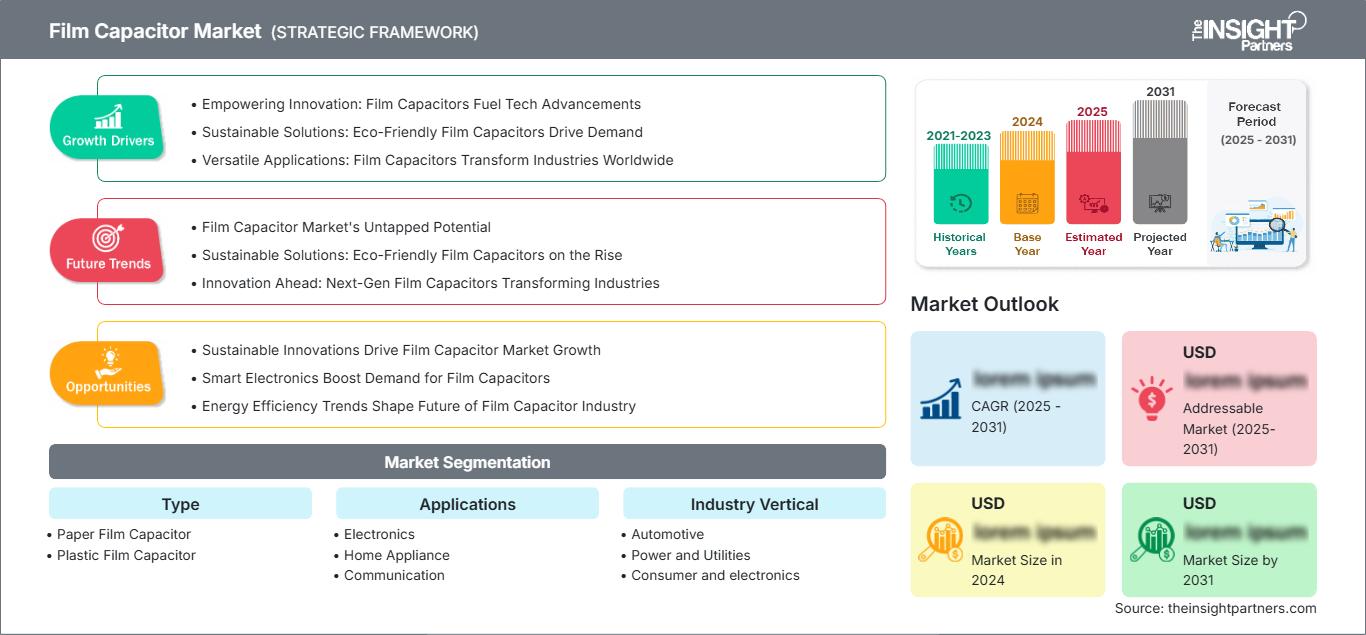
Film Capacitor Market: Strategic Insights
Regional Insights
North America Film Capacitor Market
North America had 26-29% Film Capacitor Market share in 2025 and is expected to witness 5.8-6.4% CAGR until 2034. Applications include vehicle electrification, power conversion at data centers, renewable energy integration, heating ventilation air conditioning, industrial automation, and military electronics. Region's culture of reliability, AEC-Q200 certification, and consistent lead-times favors purchase of high-end polypropylene capacitors over price-based components. Grid strengthening and installation of storage systems increases need for DC-link and filter capacitors.
The trend for component sourcing is that of regionalization, whereby the manufacturers make use of North America’s engineering, distribution, and testing facilities, along with film winding operations globally, to reduce the customization cycle of assemblies. The Canadian market is motivated by renewable energy generation, electric transportation and industry. In contrast, the Mexican market is influenced by electronic and automotive manufacturing activities. The growth is limited by lengthy qualification and importing of dielectric film, while the growth fundamentals are steady.
U.S. Film Capacitor Market
In 2025, the country was 78-82% of the market in North America and is forecasted to grow at a 5.9-6.5% CAGR from 2026-2034. Applications include automotive converters, charging equipment, solar and storage inverters, defense applications, aerospace electronics, data center applications, and industrial drives. Domestic sourcing preferences lead vendors to ensure engineering capabilities and stock locally, even though the production of winding and films might be internationally sourced.
KYOCERA AVX Components Corporation, Cornell Dubilier Electronics, Inc., KEMET Corporation, and Vishay Intertechnology, Inc. have strong commercial and technical footprints. Growing trends include smaller-sized units that handle high ripples in DC-link, humidity resistant capacitors, and durable components used in power systems with high utilization. The diversified clientele in the country means there is no reliance on one application type; however, vehicle program timing and renewable projects financing can contribute to quarter-to-quarter volatility.
Europe Film Capacitor Market
The European market was worth 23–26% of the global revenue in 2025 and is expected to expand at 5.6–6.2% CAGR until 2034. Germany dominates due to automotive engineering, industrial drives, renewable inverters, and a strong power-electronics industry supply chain. The UK relies on aerospace, defense, charging, and grid systems due to design specialization and infrastructure upgrades. France profits from rail, nuclear, aerospace, and electrification programs, whereas Italy leverages the expertise in capacitors with machinery, motors, and renewables.
Benefits of Spain's solar power installation and infrastructure investments include the future opportunities in filtering and inverter systems. Competitors in the market include WIMA GmbH & Co. KG, TDK Corporation, Vishay Intertechnology, Inc., among others. High requirements for energy efficiency, safety, and emission standards in vehicles increase the popularity of the product; yet, high costs of energy and decreased manufacturing slow down the market development.
APAC Film Capacitor Market
Share of Asia Pacific was 40-44% in 2025 and is predicted to attain 6.8-7.4% CAGR until 2034. China holds its leadership position due to scale in production of electric vehicles, renewable energy inverters, electronics, appliances, and capacitors. Japan provides advanced material and highly reliable components, whereas South Korea has strong presence in automotive, batteries, and electronics industries.
Presence of power infrastructure in India, presence of local electronics manufacturers, and investments in mobility enhance market scope. Solar, storage, mining, and grid are some more factors contributing to the growth of Asia Pacific.
Middle East & Africa Film Capacitor Market
MEA market is expected to exhibit 5.1% to 5.8% CAGR from 2026 to 2034. Market leadership in MEA region comes from Saudi Arabia through investments in utilities, industry diversification, renewables, and IT infrastructures. In addition, United Arab Emirates offers solar, transportation, building, and ICT infrastructures while South Africa has mining, renewable energy generation, and grid stabilization applications.
Elsewhere in MEA, power quality enhancement, water infrastructure, telecommunications expansion, and distributed generation drive selective demand. The nature of procurement in MEA region is project-based and import-driven.
Segmentation Analysis
Type
The Film Capacitor Market scope by type covers paper film and plastic film capacitors, with the category expected to expand at 6.1–6.7% CAGR during 2026–2034. Selection depends on voltage, frequency, loss characteristics, safety classification, footprint, and environmental endurance. Plastic constructions dominate modern designs, while paper-based units retain relevance where impregnation, pulse behavior, or legacy specifications matter.
- Paper Film Capacitor: Demand is concentrated in specialized high-voltage, pulse, EMI-suppression, and replacement applications where impregnated construction and established qualification histories outweigh size and cost disadvantages.
- Plastic Film Capacitor: Polypropylene and polyester variants lead mainstream adoption because low losses, self-healing behavior, compact packaging, broad voltage availability, and scalable winding processes suit automotive and industrial conversion.
Applications
Applications are forecast to grow at 6.0–6.6% CAGR through 2034 as designers increase filtering, coupling, timing, suppression, and energy-buffering content. Electronics provides broad unit demand, home appliances require motor-run and interference-control performance, and communication equipment needs stable low-loss components in power supplies and infrastructure. Miniaturization raises thermal and layout constraints, rewarding suppliers with design-support tools.
- Electronics: Power supplies, lighting, controls, instrumentation, and computing equipment sustain diversified volume demand, with compact footprints and consistent electrical parameters determining design wins across standardized platforms.
- Home Appliance: Air conditioners, refrigerators, washing machines, fans, and small motors use film capacitors for motor operation, suppression, and power conversion, creating dependable replacement and original-equipment demand.
- Communication: Base stations, network power systems, broadband equipment, and backup infrastructure prioritize low loss, long operating life, and reliability under continuous electrical and thermal loading.
Industry Vertical
Industry vertical demand is projected to register 6.5–7.1% CAGR during 2026–2034. Automotive leads incremental value through electrified powertrains and charging, while power and utilities require long-life capacitors in generation, conversion, transmission, and storage assets. Consumer electronics contributes scale, and government and defense applications support premium specifications, traceability, and extended qualification.
- Automotive: Traction inverters, onboard chargers, DC-DC converters, compressors, and interference filters increase capacitor value per vehicle, making thermal endurance, vibration resistance, and AEC-Q200 compliance strategically significant.
- Power and Utilities: Solar and wind inverters, grid compensation, storage, drives, and power-quality equipment create high-value demand for capacitors offering low losses, high ripple-current capability, and long service life.
- Consumer and electronics: Broad device volumes sustain demand for compact, economical capacitors used in supplies, lighting, audio, controls, and appliances, although buyers maintain strong price and footprint pressure.
- Government and Defense: Radar, communications, aerospace, power conditioning, and mission systems prioritize documented reliability, controlled sourcing, pulse performance, and lifecycle availability over lowest acquisition cost.
Opportunity Snapshot
| Industry Vertical | Revenue Contribution | Trend Tag | Adoption Stage |
| Automotive | High | EV Inverters | Scaling |
| Power and Utilities | High | Grid Storage | Scaling |
| Consumer and electronics | Medium | Compact Power | Mature |
| Government and Defense | Medium | Mission Power | Mature |
Film Capacitor Market Growth Drivers and Impact Analysis
Electrified Mobility Raises Capacitor Content per Vehicle
Film capacitors are used in electric vehicles through traction inverters, onboard chargers, DC-DC converters, compressors, and electromagnetic interference filters. In 2024, there were over 17 million electric car sales globally, registering an increment by more than 25% compared to the sales registered in 2023, showing the size of the converters market. Increasing battery voltage and frequency result in higher demands for low losses, ripple current capability, and temperature resistance. As such, automobile qualification, metallization patterning, compact busbar assembly, and humidity resistance are among the top purchasing considerations. Component makers that will collaborate on DC-link assembly will earn more value than catalog makers. Program lifecycles provide recurring revenues after successful validations, even though the lengthy approval process and stringent traceability make the entry very difficult.
Renewable Power and Storage Expand Conversion Equipment
Capacitors are necessary in solar, wind, battery storage, and grid support applications for purposes of DC linking, AC filtering, smoothing, snubbing, and harmonics management. Every inverter and bidirectional converter needs components that withstand repetitive electrical stress for many years while requiring very little maintenance. Customers in utilities factor in lifecycle costs, thermal behavior, and failure rate, which favors higher-performance polypropylene components. Distributed generation adds to the pool of customers by increasing market scope to commercial and residential units. Impact on the market goes beyond new applications since aged inverters and power quality components necessitate replacement parts. Increased competition among manufacturers can be achieved through modular design, simulation, and regional stock management while delays, interest rate, and interconnection problems form major reasons for volatility in the market.
Power Density and Reliability Reshape Electronic Design
Data centers, communication networks, automation equipment, appliances, and high-efficiency power supplies are moving toward faster switching and higher power density. These architectures reduce space while increasing electrical and thermal stress, elevating the value of capacitors with low equivalent series resistance, stable capacitance, controlled self-healing, and compact lead spacing. Continuous-duty systems also place greater emphasis on humidity endurance and predictable lifetime. Manufacturers therefore invest in thinner films, cleaner winding environments, automated defect detection, and improved encapsulation. The commercial impact is a shift from commodity comparisons toward system-level performance, particularly where downtime is costly. However, customers still demand standardized footprints and competitive pricing, requiring suppliers to combine technical differentiation with scale-efficient production and broad distribution.
Film Capacitor Market Future Trends
Thinner Films and Smarter Self-Healing Architectures
Film Capacitor Market trends will increasingly center on ultrathin polypropylene, segmented metallization, optimized fuse patterns, and digital life modeling. These advances can raise energy density without sacrificing controlled failure behavior, enabling smaller inverter and charger packages. Manufacturers will pair material science with automated optical inspection and electrical screening to identify defects earlier. Simulation libraries and application-specific lifetime calculators will become commercial differentiators because customers need faster design validation. Progress will be incremental rather than disruptive, since thinner films intensify handling, moisture, and breakdown risks. Suppliers that control metallization uniformity, winding tension, resin chemistry, and accelerated testing should gain an advantage in automotive and grid systems where qualification evidence matters.
Modular Capacitor Assemblies Move Closer to Power Semiconductors
Future designs will integrate film capacitors more tightly with busbars, cooling structures, sensors, and power modules. Shorter current paths reduce stray inductance and improve switching performance, particularly in silicon-carbide converters operating at high frequency. Standardized modular platforms may replace fully customized assemblies in selected vehicle and industrial programs, reducing development time while preserving configurable capacitance and terminal geometry. Thermal monitoring and condition-estimation algorithms could support predictive maintenance in grid and factory assets. This trend favors suppliers capable of mechanical, electrical, and thermal co-design, while increasing collaboration with semiconductor, inverter, and system manufacturers. Interface standards and reparability will determine how quickly integrated architectures scale beyond premium applications.
Film Capacitor Market Opportunities
Localize High-Reliability Supply for Strategic Industries
Film Capacitor Market Forecasts point to an investable gap in regionally qualified supply for automotive, defense, aerospace, data-center, and grid customers. Manufacturers can establish finishing, testing, application engineering, and inventory hubs near demand centers while retaining globally efficient film production. This hybrid model shortens lead times, supports traceability, and reduces customer exposure to logistics disruption. Priority actions include securing dielectric-film agreements, qualifying alternate metallization sources, automating end-of-line testing, and building local failure-analysis capability. Public incentives for electronics and energy manufacturing may improve project economics. The opportunity is strongest for standardized high-reliability families that can serve several platforms, avoiding excessive dependence on one customized program or a single end customer.
Develop Durability-Optimized Products for Harsh Climates
Hot, humid, dusty, and high-altitude operating environments create a differentiated opportunity across charging, solar, storage, telecom, industrial, and infrastructure systems. Suppliers can target these conditions with improved encapsulation, corrosion-resistant terminals, robust self-healing patterns, and documented temperature-humidity-bias performance. Investment should combine materials development with accelerated life testing and field-data partnerships in the Middle East, India, Southeast Asia, Africa, and Latin America. Offering application-specific derating guidance can reduce system failures and strengthen engineering relationships. Commercial success will depend on balancing added durability against footprint and cost, then distributing through partners capable of technical support. Products validated across several harsh-environment applications can achieve better capacity utilization than narrowly customized variants.
Recent Developments
- November 2025: Sinolong New Materials has launched a new generation of high-performance BOPP (biaxially oriented polypropylene) capacitor film, marking a significant development in China’s supply chain for advanced electronic and new-energy materials. The product, marketed as “long plastic high-performance capacitor film,” is designed for applications including electric vehicles, solar power, wind energy, household appliances, and power grids.
- February 2026: TDK Corporation has expanded its portfolio of X2 safety film capacitors with the new B3292xU/V series, designed for EMI suppression in space-constrained industrial and automotive applications. The new capacitors offer a 350 V AC rating, compact lead spacing, and improved robustness for demanding power-electronics environments.
- March 2026: Panasonic has expanded its range of metallized polypropylene (PP) film capacitors for automotive applications, adding new voltage options aimed at the growing requirements of electric vehicles and automotive power electronics. The company's automotive film-capacitor portfolio is designed for applications such as DC/DC converters, AC/DC converters, inverters, and other high-frequency, high-current circuits used in xEVs. Panasonic says its PP-film technology combines compact construction with high safety and reliability.
Frequently Asked Questions

- Comprehensive Market Sizing and Forecast Analysis
- Detailed Segmentation Analysis
- In-Depth Market Dynamics Assessment
- Regional and Country-Level Insights
- Competitive Landscape and Company Benchmarking
- Strategic Business Intelligence
Recent Reports
Testimonials

The Insight Partners' SCADA System Market report is comprehensive, with valuable insights on current trends and future forecasts. The team was highly professional, responsive, and supportive throughout. We are very satisfied and highly recommend their services.
RAN KEDEM Partner, Reali Technologies LTDs
I requested a report on a very specific software market and the team produced the report in a few days. The information was very relevant and well presented. I then requested some changes and additions to the report. The team was again very responsive and I got the final report in less than a week.
JEAN-HERVE JENN Chairman, Future Analytica
We worked with The Insight Partners for an important market study and forecast. They gave us clear insights into opportunities and risks, which helped shape our plans. Their research was easy to use and based on solid data. It helped us make smart, confident decisions. We highly recommend them.
PIYUSH NAGPAL Sr. Vice President, High Beam Global
The Insight Partners delivered insightful, well-structured market research with strong domain expertise. Their team was professional and responsive throughout. The user-friendly website made accessing industry reports seamless. We highly recommend them for reliable, high-quality research services
YUKIHIKO ADACHI CEO, Deep Blue, LLC.
This is the first time I have purchased a market report from The Insight Partners.While I was unsure at first, I visited their web site and felt more comfortable to take the risk and purchase a market report.I am completely satisfied with the quality of the report and customer service. I had several questions and comments with the initial report, but after a couple of dialogs over email with their analyst I believe I have a report that I can use as input to our strategic planning process.Thank you so much for taking the extra time and making this a positive experience.I will definitely recommend your service to others and you will be my first call when we need further market data.
JOHN SUZUKI President and Chief Executive Officer, Board Director, BK Technologies
I wish to appreciate your support and the professionalism you displayed in the course of attending to my request for information regarding to infectious disease IVD market in Nigeria. I appreciate your patience, your guidance, and the fact that you were willing to offer a discount, which eventually made it possible for us to close a deal. I look forward to engaging The Insight Partners in the future, all thanks to the impression you have created in me as a result of this first encounter.
DR CHIJIOKE ONYIA MANAGING DIRECTOR, PineCrest Healthcare Ltd.Reason to Buy
- Informed Decision-Making
- Understanding Market Dynamics
- Competitive Analysis
- Identifying Emerging Markets
- Customer Insights
- Market Forecasts
- Risk Mitigation
- Boosting Operational Efficiency
- Strategic Planning
- Investment Justification
- Tracking Industry Innovations
- Aligning with Regulatory Trends





 Get Free Sample for