
Flip Chips Market Trends, Share & Demand by 2034
Coverage: By Packaging Technology (2.5D IC, 3D IC, 2D IC); Bumping Technology (Copper Pillar, Gold Bumping, Solder Bumping, Others); End User (Electronics, Automotive, Industrial, Healthcare and Life Sciences, IT and Telecommunications, Aerospace and Defense, Others) , and Geography (North America, Europe, Asia Pacific, and South and Central America)
- Status : Data Released
- Report Code : TIPRE00021271
- Category : Electronics and Semiconductor
- No. of Pages : 150
- Available Report Formats :


- Last update date : September 09, 2026


2025 Market Size
US$ 13.37 Bn
Base year value
2034 Forecast
US$ 18.15 Bn
Projected by 2034
CAGR 2026-2034
3.46 %
Growth rate
Addressable Market
US$ 143.19 Bn
(2026-2034)
The Flip Chips Market reached US$ 13.37 Billion in 2025 and is projected to attain US$ 18.15 Billion by 2034, expanding at a CAGR of 3.46% during 2026–2034. Demand is based on the shift of the packaging industry towards the use of area array interconnects, which help to decrease the length of the electrical path, provide better heat dissipation and facilitate a higher number of inputs/outputs within computing, communications, automotive, industrial, healthcare, aerospace and military systems.
Within North America, the Flip Chips Market size is forecast to grow at a modeled CAGR of 3.5-4.0% up to 2034. AI infrastructure development and local semiconductor initiatives contribute to the increased demand for high-density substrates, copper pillars and more advanced testing facilities. The region can benefit from the growing Arizona and New Mexico packaging hubs as well as the presence of processor, cloud, automotive and defense customers.
Flip Chips Market Assessment and Insights
- North America: The region held a modelled 27–29% share in 2025 and is expected to grow at 3.5–4.0% CAGR during 2026–2034, supported by AI accelerators, resilient supply chains, and domestic packaging investment.
- US: The country represented 83–85% of North American demand in 2025 and is projected to expand at 3.7–4.2% CAGR during 2026–2034.
- Europe: Europe accounted for a modelled 17–19% share in 2025 and should rise at 2.8–3.3% CAGR through 2034, led by Germany, the UK, France, Italy, and Spain.
- Asia Pacific: Asia Pacific captured a modelled 46–48% share in 2025 and is forecast to grow at 3.8–4.3% CAGR through 2034, led by China, Japan, South Korea, and Taiwan.
- Largest Segment: Electronics held a modelled 41–43% market share in 2025 and is expected to record a 3.1–3.6% CAGR during 2026–2034.
- High Growth Segment: IT and Telecommunications represented a modelled 18–20% share in 2025 and is projected to grow at 4.6–5.1% CAGR during 2026–2034.
- Key companies analyzed in detail: 3M Company, Advanced Micro Devices, Inc., Amkor Technology, Inc., Apple Inc., Fujitsu Limited, Intel Corporation, International Business Machines Corporation, Samsung Electronics Co., Ltd., Texas Instruments Incorporated, and Taiwan Semiconductor Manufacturing Company Limited.
Source: The Insight Partners' analysis based on proprietary research, government publications, company annual reports, investor presentations, industry databases, and expert interviews.
Competition is evolving from the conventional solder bumped 2D package to the copper pillar, 2.5D interposer, and 3D vertically stacked architecture. More and more often, foundries, outsourced assembly and test services, substrate vendors, and integrated device manufacturers will develop packages together with silicon, memory, power, and thermal technologies. The economics of manufacturing is going to be more focused on yield learning from multiple dies, underfill optimization, warpage avoidance, and known good die technology, with HBM and chiplets driving advanced capacity into large dense packages.
For the period out to 2034, investment is expected to expand beyond traditional Asian cluster regions as the USA, Europe, India, and the Middle East develop semiconductor ecosystems based on security, localization, and digital infrastructure needs. While public incentives will lower the upfront cost barrier, commercial success will continue to rely on qualifying substrates, materials, equipment, and engineering resources. Lead-free, automotive, and energy efficiency requirements will be beneficial to suppliers who can qualify the packaging technology over its lifetime and thermal cycle testing.
Flip Chips Market Report Scope
| Report Attribute | Details |
|---|---|
| Market size in 2025 | US$ 13.37 Billion |
| Market Size by 2034 | US$ 18.15 Billion |
| Global CAGR (2026 - 2034) | 3.46% |
| Historical Data | 2021-2024 |
| Forecast period | 2026-2034 |
Flip Chips Market Analysis
The Flip Chips Market is characterized by reduced distances between connections, increased input/output density, and better heat transfer compared with wire bonding technology. AI accelerators, networking chips, high-end smartphones, automotive domain controllers, and industrial edge computing systems require increased bandwidth in reduced spaces. There is a need for increased production of bumps, redistribution layers, substrates, underfill, assembly, testing, and thermal interface materials.
There is an agglomeration of supplier base in terms of Asian semiconductor foundries and outsourced assemblies, while diversification is happening. Wafer fabrication quality, substrate availability, bump uniformity, and package yield determine the quantity of output produced. The copper pillars technique allows for reduction of pitch but there are applications in which solder use is justified because of cost factors and reliable equipment. The qualification process takes the longest time in automotive, aerospace, defense, and healthcare industries.
Flip Chips market report reveals that competition is moving from standalone assembly capabilities to design-to-test platforms. Taiwan Semiconductor Manufacturing Company Limited, Intel Corporation, Samsung Electronics Co., Ltd., and Amkor Technology, Inc. are developing advanced packaging capabilities while Advanced Micro Devices, Inc., Apple Inc., and Fujitsu Limited affect architecture via chiplet, processor and system requirements.
Growing importance is placed on capacity assurances, design enablements, and geographical resilience. International Business Machines Corporation offers its capabilities related to advanced flip chip packaging and technologies; Texas Instruments Incorporated couples packaging technologies with analog and embedded portfolios; 3M Company produces process-protection and wafer support solutions. Growing attention is paid to large interposers, smaller copper contacts, and automated inspection & co-design for thermal management. Suppliers that will manage to shorten qualification times without lowering yields will have better chances of securing important programs.
● REPORT CUSTOMIZATION
Tailor This Report To Align With Your Specific Business Requirements
This report can be customized to align precisely with your business objectives, scope, and target markets. Customization options include tailored segmentation, geography, competitive analysis, and strategic insights to support informed decision-making.
Customize This Report →WHAT YOU CAN ADJUST
- ● Segmentations
- ● Geography
- ● Competitive Analysis
- ● Language Preferences
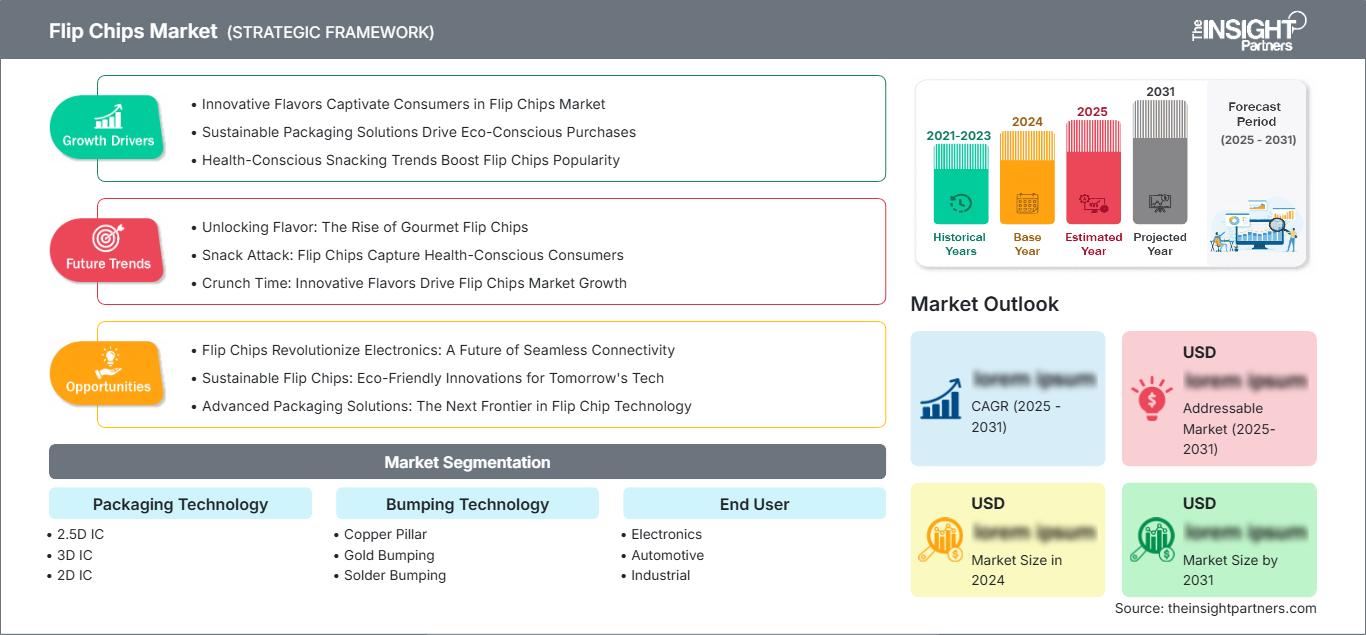
Flip Chips Market: Strategic Insights
Regional Insights
North America Flip Chips Market
A model North America region had 27-29% Flip Chips Market share in 2025 and is predicted to grow at 3.5-4.0% CAGR in 2026-2034. High bandwidth applications in AI servers, cloud networking, advance defense electronics and automotive compute drive the need for high density packages. North America is a combination of fabless design dominance with substrate, materials, assembly, and test process maturity, despite foreign equipment and Asian upstream capability dependencies.
Government initiatives and corporate investments are leading to an increase in local manufacturing. Arizona advanced package manufacturing, Quebec manufacturing locations, as well as Intel manufacturing in New Mexico facilitate redundancy in the supply chain and proximity to customers. Usage must emphasize the use of copper pillar, 2.5D and 3D technology since the tradeoff between bandwidth, thermal and security is more important than cost. The aerospace manufacturing and enterprise system assembly capabilities of Canada provide for downstream manufacturing and testing in Mexico. Regulation of industry leads to a long qualification period but makes the market visible to new entrants.
U.S. Flip Chips Market
United States represented 83-85% of the North American market in 2025 and has been projected to experience growth in the range of 3.7-4.2% CAGR during 2026-2034. Strengths within the domestic market involve processor design, cloud infrastructure, defense, automobile electronics, materials, equipment, and assembly. Challenges on the accelerator roadmap involve increase in package body size, proximity of memory, and power delivery issues that offer chances for copper pillars and silicon bridges.
Intel Corporation, Advanced Micro Devices, Inc., Apple Inc., Amkor Technology, Inc., International Business Machines Corporation, Texas Instruments Incorporated, and 3M Company drive the domestic ecosystem with design, manufacturing, assembly, and materials. Applications demand not only in data centers but also include medical imaging, aerospace systems, vehicle sensing, and industrial automation. Federal and state incentives help projects but workforce availability, substrates, and high volume yields are issues. Design suppliers that can co-qualify their parts with domestic fabs and customers will have priority in secure, low latency, and regulated programs.
Europe Flip Chips Market
Europe held 17-19% market share through modeling in 2025 and is forecasted to grow at a CAGR of 2.8-3.3% through 2026-2034, driven by Germany. The main application areas driving demand include automotive electronics, industrial automation, power management, aerospace, and secure communications. Policy priorities include resilient semiconductor manufacturing capacity, and local equipment, material, and research ecosystems can assist in qualifying advanced packaging concepts.
Demand in the UK is driven by processor design and photonic and research capability to foster small heterogeneous packages in computing and communications. Germany is influenced by the country’s industrial and automotive sector that requires stringent thermal cycling and reliability standards. The French country relies on aerospace, defense, communications, and national semiconductor programs, Italy on industrial electronics and automotive, while Spain is focused on developing design and manufacturing capabilities through digitalization initiatives. Growth is constrained by lower consumer assembly exposure than Asia; however, there is still higher-value content driving more premium packaging applications.
APAC Flip Chips Market
The Asia-Pacific region held a modeled 46-48% share in 2025 and will have a growth rate of 3.8-4.3% CAGR from 2026-2034, with China leading. The Asia-Pacific region holds foundries, memory, substrates, assembly, equipment, and electronics manufacturing; hence it enables fast yield learning and scaling.
While Japan provides raw material and equipment, South Korea links up memory with foundry and packaging, India is offering incentives for design and production, whereas Australia is supporting the importance of defense and research. Geopolitical power causes duplicity of capacity and supplier certification due to industrial policy, export diversification, AI infrastructure, smartphones, and automotive electronics.
Middle East & Africa Flip Chips Market
Middle East & Africa will witness a growth rate of 3.0-3.5% CAGR during 2026-2034, with UAE being at the forefront. Government AI initiatives, telecommunication upgrades, defense electronics, and industrial electronics drive packaged semiconductors demand; however, sophisticated packaging continues to be mostly outsourced.
Saudi Arabia invests in technology & data center investments to support economic diversification, whereas UAE focuses on logistics, financing capabilities, and cloud computing investments. South Africa offers opportunities in the field of telecommunications, mining, and healthcare. Rest of MEA is driven by grid modernization and intelligent infrastructures. Local packaging investments are contingent on skilled workforce, water supply, power supply, and anchor customer demand.
Segmentation Analysis
Packaging Technology
Packaging Technology is projected to register a modelled 3.5–4.0% CAGR during 2026–2034. The Flip Chips Market scope spans mature planar assemblies and increasingly complex interposer or stacked designs. Selection depends on bandwidth, power, package height, thermal dissipation, yield, and cost. AI and high-performance computing pull 2.5D and 3D adoption, while cost-sensitive electronics sustain substantial 2D volumes.
- 2.5D IC: Interposer-based integration serves accelerators, networking processors, and high-bandwidth memory by combining dense routing with manageable thermal design, making it strategically important for scalable heterogeneous systems.
- 3D IC: Vertical die stacking shortens signal paths and increases functional density, supporting premium computing and compact devices where bandwidth-per-watt improvements justify complex bonding, thinning, and thermal processes.
- 2D IC: Planar flip-chip formats remain the volume foundation across processors, communications, automotive, and industrial devices because manufacturers can leverage established substrates, assembly tools, qualification data, and cost structures.
Bumping Technology
Bumping Technology is expected to expand at a modelled 3.4–3.9% CAGR through 2034. Fine-pitch requirements increasingly favor copper pillars, but solder retains broad installed capacity and process familiarity. Gold remains relevant in selected high-reliability or specialty connections. Suppliers compete through bump uniformity, metallurgy control, wafer handling, inspection, underfill compatibility, and manufacturing yields across progressively thinner dies.
- Copper Pillar: Copper pillars support finer pitches, improved current handling, and controlled standoff height, positioning the technology for mobile processors, automotive compute, networking silicon, and advanced multi-die packages.
- Gold Bumping: Gold bumping maintains strategic relevance in displays, sensors, medical devices, and specialty electronics where corrosion resistance, stable contact behavior, and proven thermocompression processes outweigh higher material cost.
- Solder Bumping: Solder bumping remains widely adopted because of mature infrastructure, scalable throughput, and broad design familiarity, serving mainstream computing, communications, industrial, and consumer packages with established reliability profiles.
End User
End User demand is projected to grow at a modelled 3.6–4.1% CAGR during 2026–2034. Electronics provides the broadest volume base, while IT and telecommunications shows the highest growth profile as AI servers and high-speed networking expand. Automotive and industrial buyers prioritize reliability, healthcare requires traceability, and aerospace and defense programs emphasize secure supply, qualification depth, and long service lives.
- Electronics: Smartphones, computers, wearables, and smart-home devices sustain high-volume demand for compact packages, balancing interconnect density, thermal performance, battery efficiency, assembly yield, and aggressive product refresh cycles.
- Automotive: Driver assistance, infotainment, electrification, and centralized computing increase package complexity, while extended temperature operation, vibration resistance, traceability, and long qualification cycles shape supplier selection and pricing.
- Industrial: Factory automation, robotics, machine vision, energy systems, and edge control favor durable packages that combine compact footprints with reliable operation under heat, dust, vibration, and prolonged duty cycles.
- Healthcare and Life Sciences: Imaging, diagnostics, monitoring, and laboratory instruments require miniaturized, energy-efficient packages supported by robust validation, controlled manufacturing changes, traceability, and dependable multi-year component availability.
- IT and Telecommunications: AI servers, cloud systems, routers, and 5G infrastructure accelerate adoption of 2.5D and 3D designs integrating compute, memory, and networking functions for bandwidth and energy efficiency.
- Aerospace and Defense: Radar, avionics, satellites, secure communications, and mission computing create lower-volume, higher-value opportunities where radiation tolerance, thermal reliability, trusted sourcing, and extensive qualification govern adoption.
Opportunity Snapshot
| End User | Revenue Contribution | Trend Tag | Adoption Stage |
| Electronics | High | Device Density | Mature |
| Automotive | Medium | Domain Compute | Scaling |
| Industrial | Medium | Edge Automation | Scaling |
| Healthcare and Life Sciences | Low | Compact Diagnostics | Emerging |
| IT and Telecommunications | High | AI Bandwidth | Scaling |
| Aerospace and Defense | Low | Trusted Electronics | Scaling |
Flip Chips Market Growth Drivers and Impact Analysis
AI Compute Raises Interconnect Density Requirements
AI training and inference systems move exceptional data volumes between logic and memory, making package-level bandwidth a system constraint. Flip-chip interconnects shorten electrical paths and permit dense area-array connections, while 2.5D interposers place high-bandwidth memory beside accelerators. The impact extends across bumping, substrates, underfill, inspection, and thermal materials because larger packages magnify warpage and yield risks. Suppliers that coordinate silicon, package, and cooling design can reduce qualification iterations and protect production economics. Demand also spreads beyond hyperscale data centers into enterprise servers, sovereign AI, telecom networks, and advanced edge systems. This diversified application base supports sustained capacity utilization while requiring multiple package sizes, power envelopes, and reliability profiles.
Vehicle Electronics Increase Reliability-Qualified Content
Modern vehicles consolidate sensing, infotainment, connectivity, power management, and automated-driving functions into increasingly capable electronic platforms. Flip-chip formats provide the input/output density and heat paths needed for domain controllers, radar processors, power devices, and communication modules. Commercial impact emerges slowly because automotive qualification involves extended temperature cycling, vibration, moisture, traceability, and controlled change management. Once approved, however, programs can run for many years and provide predictable volumes. Electric vehicles add further semiconductor content through battery management, traction, charging, and cabin systems. Packaging suppliers that maintain stable materials, geographically resilient production, and failure-analysis support can secure durable positions, while component vendors benefit from smaller footprints and improved electrical performance.
Regional Capacity Programs Diversify Advanced Packaging
Governments and manufacturers increasingly treat packaging as strategically important rather than a commodity backend step. Incentives in the US, Europe, India, Japan, and other jurisdictions are lowering initial barriers for assembly, test, substrates, and workforce programs. Commercially, regional capacity can reduce logistics exposure, improve intellectual-property control, and align with procurement requirements in defense, communications, and critical infrastructure. It also creates opportunities for local materials and equipment suppliers. Investments must still overcome high utilization thresholds, scarce process expertise, and dependence on globally sourced tools. Successful projects will therefore cluster near anchor fabs and customers, use phased capacity ramps, and secure multiyear commitments before expanding specialized bumping or heterogeneous-integration lines.
Flip Chips Market Future Trends
Hybrid Bonding Moves Toward Production Scale
Flip Chips Market trends will increasingly reflect the transition from solder microbumps toward direct copper-to-copper hybrid bonding in premium 3D designs. Finer connection pitches can improve bandwidth density and energy efficiency while reducing interconnect resistance. Commercial adoption will begin with AI accelerators, stacked memory, and advanced mobile processors before broadening as yields improve. Manufacturing priorities will include exceptionally flat surfaces, particle control, alignment accuracy, wafer thinning, and nondestructive inspection. Hybrid bonding will not immediately displace conventional bumps, because cost and process complexity remain substantial. Instead, suppliers will operate mixed technology portfolios and match connection methods to performance, volume, package architecture, and lifecycle requirements.
Optical Links Enter the Package Boundary
As electrical input/output approaches power and reach limits, co-packaged optics and silicon photonics will shape next-generation package architectures. Bringing optical engines closer to switches and accelerators can reduce board-level transmission losses and increase bandwidth density, but it adds alignment, fiber coupling, thermal isolation, and test complexity. Flip-chip assembly will remain important for attaching logic, photonic dies, drivers, and supporting components within heterogeneous modules. Early deployment should concentrate in high-end data-center networking and AI clusters, where energy savings justify premium cost. Broader adoption will depend on standardized interfaces, repair strategies, volume-capable photonics assembly, and verified reliability across temperature and mechanical stress.
Flip Chips Market Opportunities
Build Regional Design-to-Test Service Platforms
Investors can capture value by pairing local advanced assembly with package design, reliability engineering, failure analysis, and final test rather than funding standalone capacity. Flip Chips Market Forecasts favor customers that need secure, responsive supply for AI, automotive, aerospace, defense, and healthcare applications. A phased platform can begin with established solder and copper-pillar processes, then add 2.5D or 3D capabilities as anchor programs mature. Partnerships with substrate vendors, universities, tool suppliers, and nearby fabs can reduce execution risk. Commercial differentiation should emphasize faster qualification, transparent traceability, and engineering support, while long-term contracts can stabilize utilization during the expensive yield-learning period.
Develop Reliability Solutions for Harsh Environments
Materials and packaging specialists can target automotive, industrial, medical, aerospace, and defense programs that require performance beyond consumer operating conditions. Opportunity areas include low-void underfills, warpage-control films, corrosion-resistant metallization, thermal interfaces, and inspection analytics. Suppliers should invest in application-specific test vehicles and shared qualification data to demonstrate behavior under temperature cycling, vibration, humidity, and extended service. The Flip Chips Market rewards solutions that lower lifecycle risk rather than only reducing unit cost. Joint development with device makers and system integrators can secure design-in positions early, while dual-site manufacturing and controlled material-change procedures strengthen procurement confidence and protect long-duration revenue streams.
Recent Developments
- April 2025: Nexperia has introduced a new range of bidirectional ESD protection diodes using an advanced flip-chip land-grid-array (FC-LGA) package. The technology is designed to protect high-speed automotive communication systems while maintaining strong signal integrity.
- August 2025: Indium Corporation has launched WS-910 Flip-Chip Flux, a new water-soluble dipping flux developed for advanced semiconductor assembly. The product is designed to address the challenges created by increasingly smaller semiconductor packages, including thin or warped substrates, fine-pitch connections and assemblies with high I/O counts.
- May 2024: Daktronics has introduced its new Flip-Chip COB (Chip on Board) LED display technology worldwide, expanding its Narrow Pixel Pitch (NPP) display portfolio. The technology is designed to deliver improved durability and reliability while reducing power consumption. The new product family offers pixel pitches ranging from 1.8 mm down to 0.9 mm, making it suitable for applications where detailed, high-resolution visuals are required.
Frequently Asked Questions

- Comprehensive Market Sizing and Forecast Analysis
- Detailed Segmentation Analysis
- In-Depth Market Dynamics Assessment
- Regional and Country-Level Insights
- Competitive Landscape and Company Benchmarking
- Strategic Business Intelligence
Recent Reports
Testimonials

The Insight Partners' SCADA System Market report is comprehensive, with valuable insights on current trends and future forecasts. The team was highly professional, responsive, and supportive throughout. We are very satisfied and highly recommend their services.
RAN KEDEM Partner, Reali Technologies LTDs
I requested a report on a very specific software market and the team produced the report in a few days. The information was very relevant and well presented. I then requested some changes and additions to the report. The team was again very responsive and I got the final report in less than a week.
JEAN-HERVE JENN Chairman, Future Analytica
We worked with The Insight Partners for an important market study and forecast. They gave us clear insights into opportunities and risks, which helped shape our plans. Their research was easy to use and based on solid data. It helped us make smart, confident decisions. We highly recommend them.
PIYUSH NAGPAL Sr. Vice President, High Beam Global
The Insight Partners delivered insightful, well-structured market research with strong domain expertise. Their team was professional and responsive throughout. The user-friendly website made accessing industry reports seamless. We highly recommend them for reliable, high-quality research services
YUKIHIKO ADACHI CEO, Deep Blue, LLC.
This is the first time I have purchased a market report from The Insight Partners.While I was unsure at first, I visited their web site and felt more comfortable to take the risk and purchase a market report.I am completely satisfied with the quality of the report and customer service. I had several questions and comments with the initial report, but after a couple of dialogs over email with their analyst I believe I have a report that I can use as input to our strategic planning process.Thank you so much for taking the extra time and making this a positive experience.I will definitely recommend your service to others and you will be my first call when we need further market data.
JOHN SUZUKI President and Chief Executive Officer, Board Director, BK Technologies
I wish to appreciate your support and the professionalism you displayed in the course of attending to my request for information regarding to infectious disease IVD market in Nigeria. I appreciate your patience, your guidance, and the fact that you were willing to offer a discount, which eventually made it possible for us to close a deal. I look forward to engaging The Insight Partners in the future, all thanks to the impression you have created in me as a result of this first encounter.
DR CHIJIOKE ONYIA MANAGING DIRECTOR, PineCrest Healthcare Ltd.Reason to Buy
- Informed Decision-Making
- Understanding Market Dynamics
- Competitive Analysis
- Identifying Emerging Markets
- Customer Insights
- Market Forecasts
- Risk Mitigation
- Boosting Operational Efficiency
- Strategic Planning
- Investment Justification
- Tracking Industry Innovations
- Aligning with Regulatory Trends





 Get Free Sample for