
Gaming Peripheral Market Size, Share & Forecast by 2034
Coverage: by Product (Headsets, Keyboard, Mice, Controller, Others); Type (Wired, Wireless); Distribution Channel (Online, Offline) , and Geography (North America, Europe, Asia Pacific, and South and Central America)
- Status : Data Released
- Report Code : TIPRE00011490
- Category : Electronics and Semiconductor
- No. of Pages : 150
- Available Report Formats :


- Last update date : September 10, 2026


2025 Market Size
US$ 6.63 Bn
Base year value
2034 Forecast
US$ 10.95 Bn
Projected by 2034
CAGR 2026-2034
5.73 %
Growth rate
Addressable Market
US$ 79.66 Bn
(2026-2034)
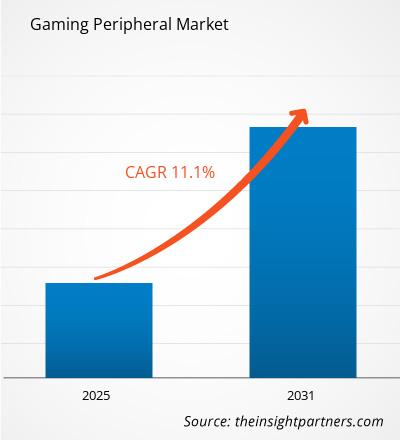
The global Gaming Peripheral market was valued at US$ 6.63 billion in 2025 and is expected to reach US$ 10.95 billion by 2034; it is estimated to record a CAGR of 5.73% during 2026-2034.
Gaming Peripheral Market Assessment and Insights
- North America holds a modeled 31–33% Gaming Peripheral Market share in 2025 and is projected to expand at a 5.8–6.2% CAGR between 2026–2034, supported by premium accessories, esports, replacement cycles, and established PC and console ecosystems.
- US represents 76–78% of North America's 2025 market and is expected to grow at a 5.6–6.0% CAGR between 2026–2034, supported by broad gamer participation and premium accessory adoption.
- Europe accounts for a modeled 25–27% share in 2025 and is expected to grow at a 6.0–6.4% CAGR between 2026–2034, with Germany, the UK, France, Italy, and Spain providing substantial demand.
- Asia Pacific represents an estimated 34–36% share in 2025 and is projected to record a 7.1–7.5% CAGR between 2026–2034, led by China, Japan, South Korea, India, and Australia.
- Largest Segment: Headsets represent a modeled 28–32% market share in 2025 and are projected to grow at a 6.1–6.5% CAGR during 2026–2034, supported by PC, console, and multiplayer gaming.
- High Growth Segment: Wireless represents a modeled 56–60% market share in 2025 and is projected to grow at a 7.0–7.4% CAGR during 2026–2034, driven by convenience and low-latency connectivity.
- Key companies analyzed in detail: Anker Innovations Limited, Cooler Master Technology Inc., Corsair Gaming, Inc., HP Inc. through HyperX, Logitech International S.A., Rapoo Corporation, Razer Inc., Redragon USA, SteelSeries ApS, Turtle Beach Corporation.
Source: The Insight Partners' analysis based on proprietary research, government publications, company annual reports, investor presentations, industry databases, and expert interviews.
Gaming Peripheral Market is evolving to move beyond simple peripheral input gadgets towards an ecosystem of devices incorporating fast connectivity, customizable controls, responsive lighting, positional audio, and device synchronization. Features like mechanical keyboards, superior sensors, wireless technology, and software customization are increasingly key differentiators. Cost-effective manufacturing alongside high-end specifications is another aspect that manufacturers will be considering, along with platform compatibility between PC, consoles, portable and cloud platforms.
During the forecast period, focus will increasingly move towards wireless technology, ergonomics, functionalities for creators, and peripherals that can be used by more than one device. Growth opportunities in emerging regions like Asia, Latin America, and Middle East leave room for growth as gamers develop in those regions. Sustainability may also come into play when making material choices, packaging, reparability and product life cycle decisions.
Gaming Peripheral Market Report Scope
| Report Attribute | Details |
|---|---|
| Market size in 2025 | US$ 6.63 Billion |
| Market Size by 2034 | US$ 10.95 Billion |
| Global CAGR (2026 - 2034) | 5.73% |
| Historical Data | 2021-2024 |
| Forecast period | 2026-2034 |
Gaming Peripheral Market Analysis
Growth in the Gaming Peripheral Market is driven by rising player engagement, premiumization, and the need for accurate interaction in PC and console gaming. The market encompasses semiconductor vendors, suppliers of switches and sensors, audio components makers, original equipment manufacturers, software platforms, distributors, retail stores, and online marketplaces. More focus is put on responsive, comfortable, audio-capable, battery-efficient, software-enabled, and compatible products than functional products alone.
Supply drivers include component availability, semiconductor costs, wireless chipsets, batteries, switches, optical sensors, microphones, specialized plastics. Big players have an advantage of spreading development expenses across a wide range of products. Meanwhile, specialist brands often compete through product launches and niche product specs. Effective channel management is critical as gaming accessories have shorter lifecycles compared to many computer peripherals, which poses more risks of markdowns and obsolescence.
Gaming Peripheral Market competitive structure includes diversified tech companies, gaming specialists, and value brands. Logitech International S.A. competes by offering broad ranges of peripherals and software integration features. Corsair Gaming, Inc. offers a connected gaming and creator ecosystem. Razer Inc., SteelSeries ApS, and Turtle Beach Corporation represent brands with strong gaming identities. Meanwhile, Cooler Master Technology Inc., Rapoo Corporation, and Redragon USA target performance-driven and value-conscious consumers.
Investments are shifting towards proprietary software, wireless technologies, advanced sensors, modular platforms, and cross-category ecosystems. Anker Innovations Limited can use consumer electronics competencies, and HP Inc. through its HyperX brand benefits from integration into computing portfolio. Competitive positioning will rely on reduced latency, improved battery performance, increased comfort, and device switching. Alliances with game publishers, esports professionals, creators, and platform providers can help in product promotion and specification setting.
● REPORT CUSTOMIZATION
Tailor This Report To Align With Your Specific Business Requirements
This report can be customized to align precisely with your business objectives, scope, and target markets. Customization options include tailored segmentation, geography, competitive analysis, and strategic insights to support informed decision-making.
Customize This Report →WHAT YOU CAN ADJUST
- ● Segmentations
- ● Geography
- ● Competitive Analysis
- ● Language Preferences
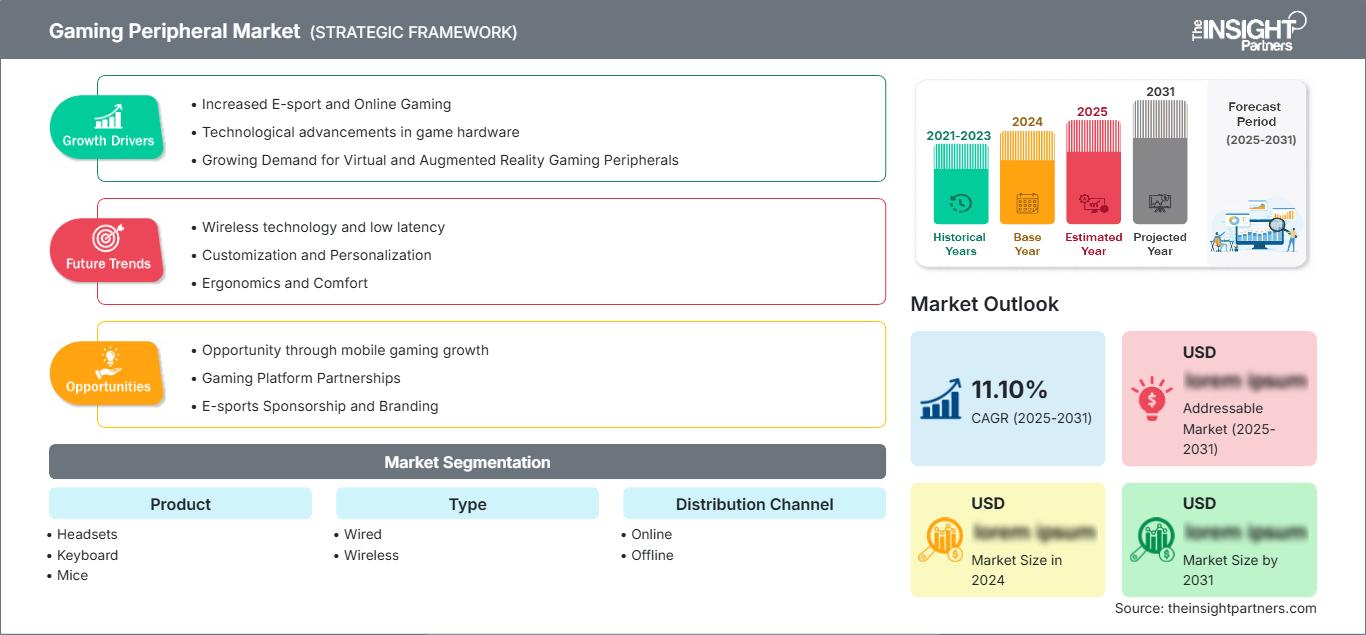
Gaming Peripheral Market: Strategic Insights
Regional Insights
North America Gaming Peripheral Market
North America held a modeled 31–33% share in 2025 and is projected to expand at a 5.8–6.2% CAGR through 2034. This is aided by the availability of well-established PC and console ownership, specialty retail stores, good penetration into e-commerce, and use of premium accessories. The United States plays a major role in this, whereas Canada provides further demand due to gaming communities, creators, and tech-savvy users.
This opportunity is supported by a mature replacement cycle and a high level of interest for wireless headsets, mechanical keyboards, high-precision mice, and customizable controllers. Gaming communities for esports and streaming add to the decision-making process by raising awareness about professional standards. The competition here is tough, thus software compatibility, compatibility, battery life, ergonomics, and unique industrial design are critical aspects when deciding on purchases.
U.S. Gaming Peripheral Market
The US represented a modeled 76–78% share of North America's 2025 market and is expected to grow at a 5.6–6.0% CAGR through 2034. There is an existing large customer base of gamers, well-developed retail network, and strong demand for high-end keyboards, mice, headsets, and controllers. Replacement sales will always be relevant since gamers tend to replace their parts separately instead of replacing the entire gaming system.
Such companies as Logitech International S.A., Razer Inc., Corsair Gaming, Inc., Turtle Beach Corporation, and HP Inc. by its brand HyperX have notable presence in both PC and console segments. Trends in application include the demand for wireless devices, spatial sound, programmable controls, ergonomic design, and cross-platform compatibility. Additionally, there is an active community of content creators and streamers that increase the range of applications of peripheral devices.
Europe Gaming Peripheral Market
Europe accounted for a modeled 25–27% share in 2025 and is projected to grow at a 6.0–6.4% CAGR through 2034. Germany holds the largest national market share, followed by the UK, France, Italy, and Spain. Established gaming communities, console usage, esports, and e-commerce enable the regional demand.
The UK sustains strong demand for high-end gaming headphones, keyboards, mice, and controllers due to the presence of established esports and streaming communities. Germany enjoys substantial PC gaming and good distribution of consumer electronics coupled with tech-savvy shoppers. France exhibits rising demand for connected devices and console devices, whereas Italy and Spain offer potential through e-commerce, gaming communities, and adoption of premium peripherals. In Europe, energy efficiency, packaging, materials, and product durability gain importance in product purchase and design.
APAC Gaming Peripheral Market
APAC held a modeled 34–36% share in 2025 and is expected to record a 7.1–7.5% CAGR through 2034. China is the market leader in terms of demand, followed by Japan, South Korea, India, and Australia. Gaming populations, PC cafes, esports, mobile gamers, and increasing disposable incomes drive peripheral consumption.
China integrates high-volume manufacturing with high domestic demand, while Japan and South Korea have mature gaming scenes and gaming enthusiasts. India has volume opportunity with the increase in gamer participation and online commerce. Premium demand comes from Australia through PC and console players. Suppliers within the region fight hard on price, while global brands compete on technology, design, software, and integration.
Middle East & Africa Gaming Peripheral Market
Middle East and Africa demand is projected to grow at a modeled 6.3–6.7% CAGR through 2034, led by Saudi Arabia and the UAE. South Africa remains an important African market, while the Rest of MEA provides emerging opportunities through online retail and expanding gaming communities.
There is investment by the two states in entertainment and esports infrastructure that encourages the high demand for top-quality gaming hardware. South Africa gains an advantage due to its developed PC and console gaming communities, while other MEA regions continue developing thanks to enhanced connectivity and digital commerce. The wireless nature of the hardware, headsets, and strong controller designs matter now more than ever. Distribution channels on a local level and pricing according to the region also still matter due to increased import expenses, currency fluctuation, and retail fragmentation.
Segmentation Analysis
Product
Product includes Headsets, Keyboard, Mice, Controller, Others. The segment is projected to expand at a 6.2–6.6% CAGR during 2026–2034. The Gaming Peripheral Market scope across these categories is shaped by replacement frequency, specialization, platform compatibility, and increasing demand for performance-oriented features such as low latency, programmable controls, spatial audio, and ergonomic construction.
- Headsets: Maintain a leading position because multiplayer gaming, voice communication, streaming, and immersive audio require dedicated sound solutions. Wireless models and spatial-audio capabilities are increasingly important purchase considerations.
- Keyboard: Demand is concentrated among PC gamers and enthusiasts seeking mechanical switches, rapid actuation, customization, and durable construction. Software-driven personalization supports differentiation and encourages upgrades.
- Mice: Precision sensors, lightweight construction, adjustable controls, and wireless responsiveness shape purchasing decisions. Competitive PC gaming supports premium demand for products designed around speed and accuracy.
- Controller: Controllers remain central to console gaming while expanding across PCs, handhelds, and cloud platforms. Custom controls, ergonomic layouts, wireless connectivity, and platform compatibility influence adoption.
- Others: Specialized accessories serve niche requirements across gaming setups, supporting incremental category expansion. Their strategic importance lies in completing ecosystems and increasing the value of broader peripheral portfolios.
Type
Type comprises Wired and Wireless products. The segment is projected to grow at a 6.7–7.1% CAGR during 2026–2034. Wireless adoption is benefiting from improved latency, battery efficiency, multi-device connectivity, and cleaner gaming setups, while wired products retain relevance where uninterrupted connectivity and lower acquisition cost remain priorities.
- Wired: Continues to serve competitive users and price-sensitive buyers who prioritize stable connectivity, uninterrupted operation, and simple plug-and-play functionality across supported gaming platforms.
- Wireless: Gains preference among users seeking mobility, cleaner setups, and multi-device flexibility. Improved low-latency protocols and longer battery life are reducing traditional performance concerns associated with wireless peripherals.
Distribution Channel
Distribution Channel comprises Online and Offline. The segment is projected to expand at a 6.4–6.8% CAGR during 2026–2034. Online channels benefit from broad assortment, price comparison, reviews, direct brand stores, and frequent promotional campaigns, while physical retail remains valuable for product demonstrations and immediate availability.
- Online: Increasingly important for informed buyers comparing specifications, compatibility, reviews, and pricing. Direct-to-consumer stores and major marketplaces enable brands to reach geographically dispersed gaming communities efficiently.
- Offline: Remains strategically relevant for consumers wanting physical demonstrations, immediate purchase, local support, and confidence in ergonomics. Specialty gaming stores can influence premium purchases through hands-on product experiences.
Opportunity Snapshot
| Product | Revenue Contribution | Trend Tag | Adoption Stage |
|---|---|---|---|
| Headsets | High | Spatial Audio | Mature |
| Keyboard | High | Rapid Actuation | Mature |
| Mice | High | Lightweight Design | Mature |
| Controller | High | Cross Platform | Scaling |
| Others | Low | Specialty Gear | Emerging |
Gaming Peripheral Market Growth Drivers and Impact Analysis
Expansion of competitive and social gaming ecosystems
The elements of competitive gaming and social multiplayer games make the need for accessories that are responsive, comfortable, and designed for communication even more important. According to Statista, in the United States, the total number of people who played video games was about 205 million in 2025. This shows how large the pool of potential gamers is and provides enough space for repeated purchases and different pricing tiers. Professional players and streamers have an effect on the mainstream purchasing process by setting standards of products and their performance levels. It affects not only the professional sector, as features designed for competitive gaming, such as high polling, lagless wireless connections, and good microphones, are gradually introduced into mainstream products.
Premiumization of performance-oriented accessories
Peripherals have become a subject of interest in the sense that they are increasingly being looked at from the perspective of performance, thereby leaving an opportunity for premium items characterized by unique sensors, mechanical buttons, spatial sound, customization options, and sophisticated wireless capabilities. US gaming industry saw great spending on accessories in 2025, demonstrating the importance of a special hardware within the overall entertainment industry. The premiumization strategy helps with developing a recurrent cycle, as aficionados are able to exchange separate elements as technologies evolve. This is an encouragement for manufacturers to develop own software, firmware, sensor technology, materials and ergonomics. The influence of the premiumization strategy works best in case of headsets, keyboards, mice, and controllers, when every improvement can be easily communicated to the buyer.
Growth of multi-device and creator-oriented gaming
Gamers' needs now expand into gaming, streaming, content creation, communications, and general computing uses. This broadening of the use case allows companies to increase the number of people who could use an accessory that used to cater only to a particular gaming console. People now look forward to having a headset which would cater to all their activities ranging from playing games to making phone calls, recording video, and watching videos, and keyboards and mice that will control both gaming and work activities. Hardware manufacturers get an advantage from designing a piece of hardware which can be used on multiple devices as it allows people to buy one product in place of several traditional gadgets.
Gaming Peripheral Market Future Trends
Intelligent software and adaptive peripheral ecosystems
Gaming Peripheral Market trends are moving toward software-defined experiences in which hardware settings, profiles, lighting, macros, audio controls, and device behavior can be managed through unified applications. In future, it will be common to see context awareness being utilized to give recommendations based on the games or applications or user preferences. Cloud synchronization can make it possible for the profiles to transfer from one device to another, whereas local computing would help in reducing the latency and ensuring privacy for certain functions. Additionally, artificial intelligence would also enable noise reduction, mic optimization, input customization, and accessibility capabilities without necessarily having to configure everything manually. The competitive impact is that the software can be used to extend the life cycle of the product as well as the switching cost.
Magnetic sensing and next-generation input precision
Magnetic sensing technologies are likely to influence future keyboards and controllers as manufacturers seek more precise actuation, adjustable response characteristics, and greater component durability. Hall-effect designs can enable configurable actuation and reduce mechanical contact in selected input mechanisms, while newer sensing approaches may eventually provide further improvements in accuracy and power efficiency. Adoption will depend on manufacturing cost, firmware maturity, user benefit, and compatibility with established production processes. Premium gaming products are likely to adopt these technologies first because enthusiasts are more willing to pay for measurable responsiveness. As component costs decline and software ecosystems mature, magnetic sensing could move into broader product tiers. This transition would create opportunities for manufacturers with strong engineering capabilities and flexible platform architectures.
Gaming Peripheral Market Opportunities
Localized product portfolios for high-growth gaming communities
The Gaming Peripheral Market Forecasts support investment in localized portfolios for India, Southeast Asia, Latin America, the Middle East, and selected African markets where gaming participation is expanding from a lower installed base. Rather than applying uniform global assortments, manufacturers can tailor pricing, connectivity, language support, warranty coverage, and platform compatibility to local conditions. Regional assembly or packaging can reduce logistics exposure and improve channel responsiveness. Partnerships with e-commerce platforms, esports organizers, gaming cafés, and local creators can strengthen product discovery without requiring extensive physical retail investment. Companies should prioritize categories with clear performance benefits, particularly headsets, mice, keyboards, and wireless controllers. A tiered portfolio can capture first-time buyers while creating upgrade pathways toward premium models.
Cross-platform ecosystems and recurring software engagement
A second opportunity lies in building peripheral ecosystems that connect PC, console, handheld, and creator workflows through shared software and account-based settings. Investors should favor platforms capable of supporting several product categories because ecosystem breadth can increase customer lifetime value and reduce dependence on individual launches. Unified applications can provide firmware updates, customization, diagnostics, profiles, and compatibility management, creating recurring engagement after the initial hardware purchase. Manufacturers can also introduce subscription-free premium software features while monetizing complementary hardware categories. Strategic partnerships with game publishers and device manufacturers can improve interoperability and accelerate adoption. The most attractive models will combine open compatibility with proprietary experiences, allowing brands to reach broader audiences without surrendering differentiation.
Recent Developments
- August 2026: Dell Technologies’ Alienware and Team Liquid extended their long-standing esports partnership for another five years through 2031, marking a 20-year relationship between the organizations. The renewed agreement will continue collaboration across performance testing, product development, content creation, global events and community engagement, with Alienware powering Team Liquid’s Race to World First World of Warcraft competition.
- August 2026: Samsung Electronics announced plans to showcase its latest gaming innovations at Gamescom 2026 in Cologne, Germany, from August 26–30, presenting an integrated gaming experience spanning mobile, PC and console platforms. Under the “#PlaySamsung” theme, the company will highlight products including the Odyssey G8, the world’s first 6K gaming monitor, the 9100 PRO high-performance SSD and Galaxy Z Fold8 Ultra.
- February 2026: Pulsar Gaming Gears, the esports peripheral brand of AplusX Inc., officially launched its new Pulsar eS collection through an exclusive strategic partnership with VAXEE Corporation. The initial product lineup includes the Pulsar eS FS-1 gaming mouse, eS PD170 and PD170+ mousepads, and eS Armsleeves, with the products developed specifically for competitive esports and intended for broad, non-limited-edition availability.
Frequently Asked Questions

- Comprehensive Market Sizing and Forecast Analysis
- Detailed Segmentation Analysis
- In-Depth Market Dynamics Assessment
- Regional and Country-Level Insights
- Competitive Landscape and Company Benchmarking
- Strategic Business Intelligence
Recent Reports
Testimonials

The Insight Partners provided valuable market intelligence that supported our global go-to-market strategy. Their team was professional, responsive, and attentive to our feedback, providing thoughtful analysis and helpful methodological clarifications throughout the project.
Junmo Kim Chief Financial Officer (CFO), Enertech Co., Ltd.
The Insight Partners' SCADA System Market report is comprehensive, with valuable insights on current trends and future forecasts. The team was highly professional, responsive, and supportive throughout. We are very satisfied and highly recommend their services.
RAN KEDEM Partner, Reali Technologies LTDs
I requested a report on a very specific software market and the team produced the report in a few days. The information was very relevant and well presented. I then requested some changes and additions to the report. The team was again very responsive and I got the final report in less than a week.
JEAN-HERVE JENN Chairman, Future Analytica
We worked with The Insight Partners for an important market study and forecast. They gave us clear insights into opportunities and risks, which helped shape our plans. Their research was easy to use and based on solid data. It helped us make smart, confident decisions. We highly recommend them.
PIYUSH NAGPAL Sr. Vice President, High Beam Global
The Insight Partners delivered insightful, well-structured market research with strong domain expertise. Their team was professional and responsive throughout. The user-friendly website made accessing industry reports seamless. We highly recommend them for reliable, high-quality research services
YUKIHIKO ADACHI CEO, Deep Blue, LLC.
This is the first time I have purchased a market report from The Insight Partners.While I was unsure at first, I visited their web site and felt more comfortable to take the risk and purchase a market report.I am completely satisfied with the quality of the report and customer service. I had several questions and comments with the initial report, but after a couple of dialogs over email with their analyst I believe I have a report that I can use as input to our strategic planning process.Thank you so much for taking the extra time and making this a positive experience.I will definitely recommend your service to others and you will be my first call when we need further market data.
JOHN SUZUKI President and Chief Executive Officer, Board Director, BK Technologies
I wish to appreciate your support and the professionalism you displayed in the course of attending to my request for information regarding to infectious disease IVD market in Nigeria. I appreciate your patience, your guidance, and the fact that you were willing to offer a discount, which eventually made it possible for us to close a deal. I look forward to engaging The Insight Partners in the future, all thanks to the impression you have created in me as a result of this first encounter.
DR CHIJIOKE ONYIA MANAGING DIRECTOR, PineCrest Healthcare Ltd.Reason to Buy
- Informed Decision-Making
- Understanding Market Dynamics
- Competitive Analysis
- Identifying Emerging Markets
- Customer Insights
- Market Forecasts
- Risk Mitigation
- Boosting Operational Efficiency
- Strategic Planning
- Investment Justification
- Tracking Industry Innovations
- Aligning with Regulatory Trends





 Get Free Sample for