
Gas Leak Detector Market Share, Size & Demand by 2034
Coverage: By Technology (Ultrasonic, Infrared, Electromechanical, Others); End-user (Commercial, Industrial), and Geography (North America, Europe, Asia Pacific, and South and Central America)
- Status : Data Released
- Report Code : TIPRE00017142
- Category : Electronics and Semiconductor
- No. of Pages : 150
- Available Report Formats :


- Last update date : September 17, 2026


2025 Market Size
US$ 1.89 Bn
Base year value
2034 Forecast
US$ 3.26 Bn
Projected by 2034
CAGR 2026-2034
6.24 %
Growth rate
Addressable Market
US$ 23.30 Bn
(2026-2034)
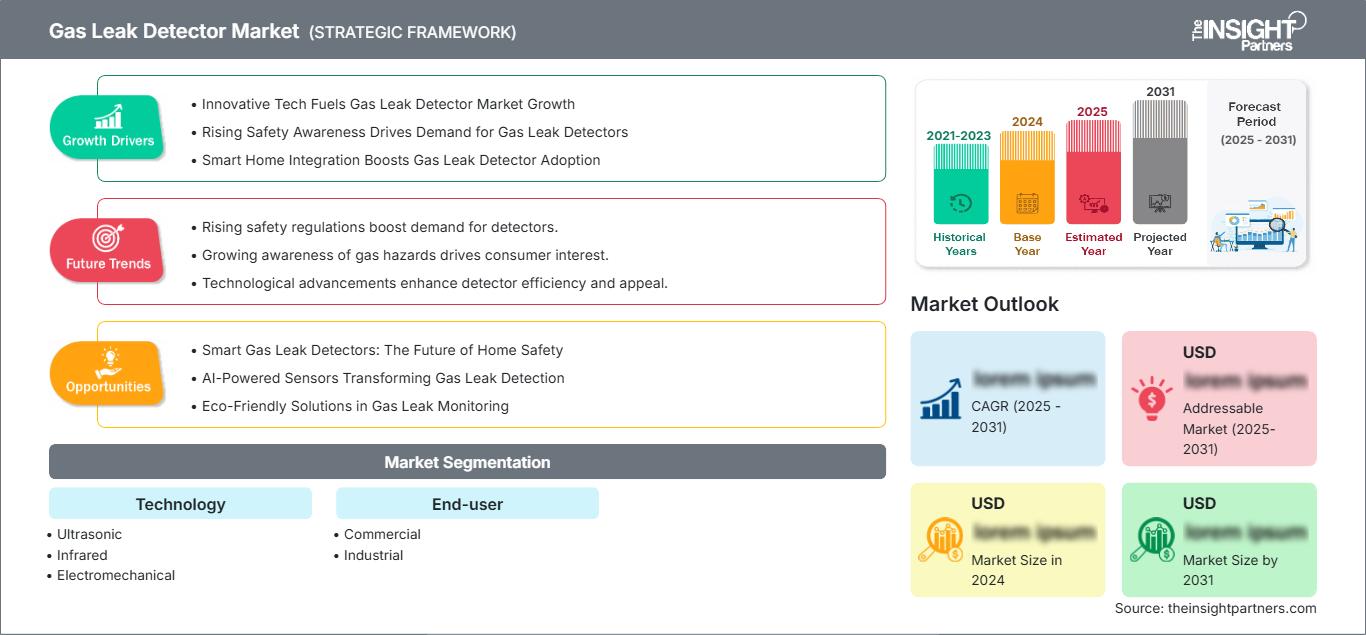
The Gas Leak Detector Market was valued at US$ 1.89 Billion in 2025 and is projected to reach US$ 3.26 Billion by 2034, expanding at a CAGR of 6.24% during 2026–2034. Procurement is increasingly shaped by requirements for earlier hazard identification, continuous monitoring, device connectivity, and dependable operation across industrial plants, utility networks, commercial buildings, and confined work environments.
North America is expected to record a 5.8–6.4% CAGR during 2026–2034 as the Gas Leak Detector Market size benefits from process-safety obligations, methane-emissions control, and replacement of legacy fixed instruments. Oil and gas operations, chemical processing, utility distribution, data centers, and commercial facilities are adopting connected detectors that support centralized alarms, audit trails, and faster maintenance response.
Gas Leak Detector Market Assessment and Insights
- North America held 31–34% Gas Leak Detector Market share in 2025 and is growing at a CAGR of 5.8–6.4% during 2026–2034, supported by process safety, utility modernization, and methane monitoring.
- US represented 84–87% of North America in 2025 and is growing at a CAGR of 5.9–6.5% during 2026–2034 as compliance spending sustains replacements.
- Europe accounted for 26–29% share in 2025 and is growing at a CAGR of 5.5–6.1% during 2026–2034, led by Germany, the UK, France, Italy, and Spain.
- Asia Pacific captured 27–31% share in 2025 and is growing at a CAGR of 6.8–7.5% during 2026–2034, led by China, Japan, India, South Korea, and Australia.
- Largest Segment Industrial end users held 68–72% market share in 2025 and are growing at a CAGR of 6.1–6.7% during 2026–2034 on mandatory monitoring demand.
- High Growth Segment Infrared technology held 29–33% market share in 2025 and is growing at a CAGR of 7.0–7.8% during 2026–2034 through low-maintenance deployment.
- Key companies analyzed in detail: ABB Ltd.; Emerson Electric Co.; Hermann Sewerin GmbH; Honeywell International Inc.; Ion Science Ltd.; MSA Safety Incorporated; Omega Engineering, Inc.; Pfeiffer Vacuum GmbH; SKF Group; Johnson Controls International plc
Source: The Insight Partners' analysis based on proprietary research, government publications, company annual reports, investor presentations, industry databases, and expert interviews.
The evolution of detectors is from standalone catalytic and electrochemical sensors to networked IR, ultrasonic and multiple sensor detectors. Fixed systems continue to be essential for ongoing safety at plants, whereas wireless gateways and handheld units increase protection while maintenance activities and operations within confined spaces take place. Present production requirements focus on durability of sensors, immunity to poisoning, approval for use in hazardous locations, energy efficient communications and compatibility with DCS, fire and building management systems.
Further demand will grow with new industrial belts featuring gas distribution systems, petrochemical industries, semiconductor manufacturing plants and large commercial complexes. Increasing investment will target software connected units, replaceable sensing components and documentation-based compliance process. Methane, exposure limits for employees and critical infrastructure protection regulations will increase replacement rates, while projects related to hydrogen and biogas utilization will generate new detection needs.
Gas Leak Detector Market Report Scope
| Report Attribute | Details |
|---|---|
| Market size in 2025 | US$ 1.89 Billion |
| Market Size by 2034 | US$ 3.26 Billion |
| Global CAGR (2026 - 2034) | 6.24% |
| Historical Data | 2021-2024 |
| Forecast period | 2026-2034 |
Gas Leak Detector Market Analysis
Growth in Gas Leak Detector Market comes from mandatory expenses on safety in the oil & gas, chemical, mining, power, food processing, refrigeration and utilities sectors. Buyers assess limits of detection, reaction speed, gas selectivity, installation site, calibration burden and overall lifetime cost of ownership. The ecosystem encompasses sensor makers, detector vendors, controls-systems providers, distributors, installers, calibrators and safety solution companies, and after-sale capability matters to account retention over time.
Supply situation rests upon availability of optical parts, electrochemical cells, microcontrollers, certified housings and communication modules. Suppliers are simplifying their platforms through the use of interchangeable sensors and common digital interfaces. Dual sourcing and regional coverage are increasing among customer demands. Certification cycle time, component validation and calibration capability can become constraining factors when launching products, especially in hazardous area applications for oil & gas refineries, terminals, pipelines and chemical companies.
Gas Leak Detector Market analysis shows rivalry across wide automation platform and specialized sensing segment. Installed base and integration of control systems are key benefits for ABB Ltd., Emerson Electric Co., Honeywell International Inc., MSA Safety Incorporated, and Johnson Controls International plc. Field detection experience helps to distinguish Hermann Sewerin GmbH and Ion Science Ltd., and Pfeiffer Vacuum GmbH, Omega Engineering, Inc. and SKF Group cater to leak testing and instrumentation as well as maintenance-led applications.
Investment flows into connected devices, cloud-based dashboards and ongoing calibration or fleet management services. Positioning requires certified hardware, precise gas detection, open communications, cybersecurity and channel coverage. Providers that can tie alarm events with work orders, asset management history and audit reports will have an edge over competitors that simply offer cheap sensors in highly regulated industrial environments.
● REPORT CUSTOMIZATION
Tailor This Report To Align With Your Specific Business Requirements
This report can be customized to align precisely with your business objectives, scope, and target markets. Customization options include tailored segmentation, geography, competitive analysis, and strategic insights to support informed decision-making.
Customize This Report →WHAT YOU CAN ADJUST
- ● Segmentations
- ● Geography
- ● Competitive Analysis
- ● Language Preferences
Gas Leak Detector Market: Strategic Insights
Regional Insights
North America Gas Leak Detector Market
North America held 31–34% share in 2025 and is projected to expand at a 5.8–6.4% CAGR through 2034. The Gas Leak Detector market is bolstered through the use of process safety initiatives, methane reduction efforts, investments in pipeline integrity, and aging fixed detector replacements in refineries, chemical facilities, utilities, mines, and manufacturing facilities.
Adoption trends are shifting towards the use of infrared detection, wireless portable devices, and software that helps manage alarm management and maintenance. Canada's involvement is via its oil sands, natural gas production, mining, and municipal infrastructure. The Mexico involvement is manufacturing, auto production, food processing industries, and industrial gas distribution systems.
U.S. Gas Leak Detector Market
The U.S. represented 84–87% of North American revenue in 2025 and is expected to grow at a 5.9–6.5% CAGR during 2026–2034. Refining, upstream energy, chemicals, utilities, wastewater treatment, warehousing, and semiconductor manufacturing sustain detector deployment, while confined-space rules support portable instrument fleets and recurring bump-test demand.
Honeywell International Inc., MSA Safety Incorporated, Emerson Electric Co., ABB Ltd., and Johnson Controls International plc have strong business presence through direct sales, integrators, and distributors. The application trend involves use of NDIR hydrocarbon sensors, connectivity in multigas devices, shutdown automation, and methane audit trail processes. There is increasing fleet standardization for cost reduction and simplification of operations.
Europe Gas Leak Detector Market
Europe accounted for 26–29% share in 2025 and is expected to grow at a 5.5–6.1% CAGR through 2034, with Germany leading through chemicals, machinery, automotive production, industrial gases, and hydrogen projects. ATEX-compliant equipment, automation, and safety standards for the facility drive steady replacement demand at existing industrial facilities.
The UK is bolstered by oil and gas, water, laboratories, and buildings’ specifications. The French market relies on chemicals, nuclear power, transport, and food processing, whereas Italy and Spain participate via refining, manufacturing, utilities, and hospitality. Europe’s energy transition raises the relevance of hydrogen, biomethane, and refrigerant detection, which favors selective optical sensing and digital maintenance documentation.
APAC Gas Leak Detector Market
Asia Pacific held 27–31% share in 2025 and is forecast to grow at a 6.8–7.5% CAGR during 2026–2034. China leads through chemicals, refining, LNG, electronics, mining, and urban gas distribution, while Japan and South Korea emphasize high-specification industrial safety and semiconductor manufacturing.
India’s pipeline expansion, manufacturing investment, and city-gas networks create scalable demand. Australia contributes mining and LNG applications. Policy attention to factory safety, emissions, and infrastructure reliability encourages fixed monitoring, portable inspection, and connected alarm systems across new-build and retrofit projects.
Middle East & Africa Gas Leak Detector Market
Middle East and Africa is projected to expand at a 5.2–5.9% CAGR during 2026–2034, led by Saudi Arabia. Refining, petrochemicals, gas processing, LNG, utilities, and large construction programs require certified fixed and portable detection systems.
The UAE adds data centers, logistics, and commercial infrastructure, while South Africa supports mining, chemicals, and power applications. Rest of MEA demand remains project-based, with service coverage, calibration access, and training influencing vendor selection.
Segmentation Analysis
Technology
The Technology segment is expected to grow at a 6.2–6.9% CAGR during 2026–2034. Gas Leak Detector Market scope across technologies reflects trade-offs among target gas, detection distance, maintenance frequency, response speed, and installed cost. Infrared systems gain favor for hydrocarbons and carbon dioxide, ultrasonic units protect open areas, and electromechanical devices remain relevant where proven, economical point detection is required.
- Ultrasonic detectors identify pressurized-gas leak sound rather than concentration, making them strategically valuable in outdoor, ventilated, or noisy industrial zones where gas clouds may disperse before reaching point sensors.
- Infrared detectors provide selective, stable hydrocarbon detection with strong poisoning resistance and lower routine maintenance, supporting fixed monitoring in refineries, gas processing, compressor stations, commercial refrigeration, and enclosed technical rooms.
- Electromechanical detectors remain broadly deployed for combustible or toxic gases because established designs, familiar maintenance practices, and accessible pricing suit industrial plants, utility sites, laboratories, kitchens, and building safety systems.
End-user
The End-user segment is anticipated to advance at a 6.0–6.6% CAGR during 2026–2034. Industrial facilities generate the majority of revenue because high-risk processes require continuous monitoring, portable inspection, calibration, and integration with shutdown systems. Commercial adoption is expanding through hospitality, healthcare, laboratories, data centers, parking structures, refrigeration, and building-management applications where occupant safety and asset continuity are priorities.
- Commercial demand centers on hotels, hospitals, laboratories, kitchens, retail facilities, data centers, and parking structures, where simple installation, remote alerts, building integration, and low maintenance support adoption.
- Industrial users prioritize certified fixed networks and portable instruments across oil and gas, chemicals, mining, manufacturing, power, wastewater, and food processing, making reliability, service response, and documentation strategically important.
Opportunity Snapshot
| End-user | Revenue Contribution | Trend Tag | Adoption Stage |
| Commercial | Medium | Smart Buildings | Scaling |
| Industrial | High | Connected Safety | Mature |
Gas Leak Detector Market Growth Drivers and Impact Analysis
Tightening Process-Safety and Exposure-Control Requirements
Industrial companies have to check the presence of hazardous atmosphere before going inside a confined space, limit employee exposure, and keep reliable alarm systems in place in case of combustible and toxic gases. Such requirements ensure that investments into detection devices are more stable in weak capital cycles. Oil refineries, chemical processing companies, mines, utility operations, wastewater facilities, and food processing businesses buy stationary and handheld devices along with calibration, training, and maintenance services. The effect in practice is seen through faster replacement cycles of outdated detectors, wider detector distribution, and higher demand for electronic documentation confirming inspections and action. Manufacturers with certified devices, local support teams, and traceable calibration services can turn regulatory challenges into regular income streams.
Methane Abatement Across Oil, Gas, and Utility Networks
Programs designed to reduce methane emissions have changed the leak detection paradigm from safety testing to systematic leak detection, measurement, repair, and verification activities. Technology must be provided to the upstream sector, pipelines, gas distribution companies, storage facilities, and LNG sites that detect small leaks on big and complex sites. Infrared and laser-based sensors, mobile devices, and interconnected systems enhance the sensitivity of detection and create site-specific data for maintenance teams. There is much more than detectors when it comes to the market effects; operators also need software and data exchange between devices. Companies that offer such capabilities will benefit from a broader scope of projects.
Industrial Expansion in High-Growth Asian Economies
The capacity of new compounds, semiconductor, battery, steel, food-processing, data center, and gas distribution facilities is increasing the base of hazardous operations in Asia-Pacific. New facilities have detection built into engineering specifications, thus enabling vendors to shape decisions on sensors, alarm systems, communications, and service throughout the life of the equipment. Manufacturing locally will drive down prices, but international players will still seek certified products. This will manifest itself in growing demand for fixed installations in new facilities, portable detectors for contractors, and calibration in proximity to industrial hubs.
Gas Leak Detector Market Future Trends
Software-Orchestrated Detection and Maintenance
Gas Leak Detector Market trends will increasingly center on platforms that connect alarm events, field investigations, asset history, and maintenance work orders. Instead of managing fixed, portable, and mobile instruments separately, operators will seek common dashboards with role-based access, offline field capability, cybersecurity controls, and automated escalation. Analytics will help prioritize leak severity, identify failing sensors, and document closure. This transition changes vendor economics by adding subscriptions, data services, and longer customer relationships. It also raises interoperability expectations, encouraging manufacturers to support third-party devices and open interfaces rather than closed fleets that complicate enterprise-wide safety management.
Optical Sensing for Low-Carbon Gas Infrastructure
Infrared and laser-based technologies will gain relevance as hydrogen blending, biomethane, carbon capture, and advanced refrigeration create new monitoring profiles. No single sensor covers every gas, so future systems will combine optical, ultrasonic, and electrochemical methods according to molecular properties, ventilation, pressure, and risk. Buyers will demand lower false-alarm rates, reduced calibration burden, and evidence of performance under humidity, dust, and temperature variation. This trend favors modular detector platforms and application engineering. It also creates opportunities for specialist suppliers to develop sensors, algorithms, and sampling systems tailored to emerging fuels and industrial decarbonization projects.
Gas Leak Detector Market Opportunities
Managed Detection Services for Mid-Sized Industrial Sites
Many mid-sized manufacturers, cold-storage operators, laboratories, and utilities lack specialist teams to manage detector placement, calibration, bump testing, firmware, and compliance records. Vendors can address this gap through managed programs that bundle equipment, installation, scheduled maintenance, cloud reporting, and emergency support. The commercial model converts irregular capital purchases into predictable service revenue while reducing ownership complexity for customers. Investment should focus on standardized site assessments, remote device health, mobile technician workflows, and regional calibration capacity. Partnerships with safety integrators and insurers could further expand adoption by linking verified monitoring practices to operational-risk reduction and business-continuity planning.
Integrated Safety Packages for Hydrogen and Biogas Projects
Gas Leak Detector Market Forecasts support targeted investment in hydrogen, biomethane, and renewable-gas infrastructure, where detection requirements must be addressed during project design. Suppliers can assemble packages covering fixed detectors, open-path monitoring, portable instruments, ventilation interfaces, alarms, and maintenance documentation. Early collaboration with engineering contractors, electrolyzer vendors, storage operators, and utilities improves specification influence and creates opportunities for multi-site standardization. The strongest offers will combine application-specific sensor selection with hazardous-area certification and commissioning support. Building demonstration sites and validated detection layouts can shorten customer evaluation, reduce deployment risk, and establish reference projects in an emerging infrastructure category.
Recent Developments
- March 2026: ABB has launched EmissionVision, a cloud-based workflow management platform designed to help natural gas operators modernize the way they detect, investigate and repair methane leaks. The new platform brings emission detection, field investigations and data analysis together in a single digital environment. ABB says the system is intended to help operators move away from manual leak surveys toward faster, more traceable and auditable workflows.
- June 2025: Swiss robotics company ANYbotics has introduced a new gas leak and presence detection solution for its ANYmal autonomous inspection robot, giving industrial operators a way to automate the identification, localization and monitoring of hazardous gas leaks. The system combines ANYmal’s autonomous mobility with modular gas sensors and 360-degree acoustic imaging, allowing the robot to inspect areas that can be difficult, dangerous or expensive for human workers to access. The solution is aimed at industries including energy, oil and gas, chemicals, mining and metals.
- February 2025: ATSMI Equipment has announced the availability of advanced gas detection solutions from Industrial Scientific Corporation, aimed at improving safety and hazard monitoring across industrial environments. The new generation of detectors is designed to provide early warning of hazardous gas conditions, helping industrial operators identify potential leaks before they develop into more serious safety incidents. The systems combine sensitive gas sensors, processing technology and monitoring capabilities to deliver reliable measurements in demanding workplaces.
Frequently Asked Questions

- Comprehensive Market Sizing and Forecast Analysis
- Detailed Segmentation Analysis
- In-Depth Market Dynamics Assessment
- Regional and Country-Level Insights
- Competitive Landscape and Company Benchmarking
- Strategic Business Intelligence
Recent Reports
Testimonials

The Insight Partners provided valuable market intelligence that supported our global go-to-market strategy. Their team was professional, responsive, and attentive to our feedback, providing thoughtful analysis and helpful methodological clarifications throughout the project.
Junmo Kim Chief Financial Officer (CFO), Enertech Co., Ltd.
The Insight Partners' SCADA System Market report is comprehensive, with valuable insights on current trends and future forecasts. The team was highly professional, responsive, and supportive throughout. We are very satisfied and highly recommend their services.
RAN KEDEM Partner, Reali Technologies LTDs
I requested a report on a very specific software market and the team produced the report in a few days. The information was very relevant and well presented. I then requested some changes and additions to the report. The team was again very responsive and I got the final report in less than a week.
JEAN-HERVE JENN Chairman, Future Analytica
We worked with The Insight Partners for an important market study and forecast. They gave us clear insights into opportunities and risks, which helped shape our plans. Their research was easy to use and based on solid data. It helped us make smart, confident decisions. We highly recommend them.
PIYUSH NAGPAL Sr. Vice President, High Beam Global
The Insight Partners delivered insightful, well-structured market research with strong domain expertise. Their team was professional and responsive throughout. The user-friendly website made accessing industry reports seamless. We highly recommend them for reliable, high-quality research services
YUKIHIKO ADACHI CEO, Deep Blue, LLC.
This is the first time I have purchased a market report from The Insight Partners.While I was unsure at first, I visited their web site and felt more comfortable to take the risk and purchase a market report.I am completely satisfied with the quality of the report and customer service. I had several questions and comments with the initial report, but after a couple of dialogs over email with their analyst I believe I have a report that I can use as input to our strategic planning process.Thank you so much for taking the extra time and making this a positive experience.I will definitely recommend your service to others and you will be my first call when we need further market data.
JOHN SUZUKI President and Chief Executive Officer, Board Director, BK Technologies
I wish to appreciate your support and the professionalism you displayed in the course of attending to my request for information regarding to infectious disease IVD market in Nigeria. I appreciate your patience, your guidance, and the fact that you were willing to offer a discount, which eventually made it possible for us to close a deal. I look forward to engaging The Insight Partners in the future, all thanks to the impression you have created in me as a result of this first encounter.
DR CHIJIOKE ONYIA MANAGING DIRECTOR, PineCrest Healthcare Ltd.Reason to Buy
- Informed Decision-Making
- Understanding Market Dynamics
- Competitive Analysis
- Identifying Emerging Markets
- Customer Insights
- Market Forecasts
- Risk Mitigation
- Boosting Operational Efficiency
- Strategic Planning
- Investment Justification
- Tracking Industry Innovations
- Aligning with Regulatory Trends





 Get Free Sample for