
Gas Meters Market Size, Trends & Growth by 2034
Coverage: by Technology (Standard Meters, Smart Meters); Type (Diaphragm, Rotary, Turbine, Ultrasonic, Others); Application (Residential, Commercial, Industrial) , and Geography (North America, Europe, Asia Pacific, and South and Central America)
- Status : Data Released
- Report Code : TIPRE00011811
- Category : Electronics and Semiconductor
- No. of Pages : 150
- Available Report Formats :


- Last update date : September 10, 2026


2025 Market Size
US$ 2.09 Bn
Base year value
2034 Forecast
US$ 2.8 Bn
Projected by 2034
CAGR 2026-2034
3.74 %
Growth rate
Addressable Market
US$ 22.70 Bn
(2026-2034)
The Gas Meter Market was valued at US$ 2.09 Billion in 2025 and is projected to reach US$ 2.8 Billion by 2034, expanding at a CAGR of 3.74% during 2026–2034. Expansion is associated with replacement of aging metering infrastructure, increasing deployment of connected devices, and utilities' emphasis on accurate consumption measurement, leak detection, remote reading, and operational efficiency across residential, commercial, and industrial gas networks.
North America remains an important regional market, supported by established natural gas distribution networks and ongoing replacement of legacy meters. The Gas Meter Market size is expected to benefit from smart-meter modernization, safety requirements, and digital utility programs. Increasing interest in remote monitoring and automated data collection should support demand as utilities seek lower field-service costs and improved visibility across distributed customer networks.
Gas Meters Market Assessment and Insights
- North America holds a modeled 29–31% Gas Meter Market share in 2025 and is projected to expand at a 3.4–3.8% CAGR between 2026–2034, supported by replacement programs, utility modernization, and increasing smart-meter adoption.
- US represents 84–86% of North America's 2025 market and is expected to grow at a 3.3–3.7% CAGR between 2026–2034, supported by extensive gas distribution infrastructure and replacement demand.
- Europe accounts for a modeled 28–30% share in 2025 and is projected to grow at a 3.6–4.0% CAGR between 2026–2034, with the UK, Germany, France, Italy, and Spain providing established demand.
- Asia Pacific represents an estimated 25–27% share in 2025 and is expected to record a 4.1–4.5% CAGR between 2026–2034, led by China, Japan, India, South Korea, and Australia.
- Largest Segment: Smart Meters represent a modeled 54–58% market share in 2025 and are projected to grow at a 4.5–4.9% CAGR during 2026–2034, supported by digital utility modernization.
- High Growth Segment: Ultrasonic meters represent a modeled 12–15% market share in 2025 and are projected to grow at a 5.0–5.4% CAGR during 2026–2034, supported by solid-state measurement and smart integration.
- Key companies analyzed in detail: ABB Ltd, AEM SA, Apator SA, Badger Meter, Inc., Diehl Metering GmbH, EDMI Limited, Honeywell International Inc., Itron, Inc., Landis+Gyr AG, Zenner Gas S.r.l.
Source: The Insight Partners' analysis based on proprietary research, government publications, company annual reports, investor presentations, industry databases, and expert interviews.
Gas meter market has advanced from mechanically operated diaphragm systems to electronic systems with the capabilities of communications, remote meter reading, remote valve operation, pressure monitoring, and solid-state metering. Manufacturers' focus is on accuracy maintenance, battery life, small electronics, modular communication modules, and compatibility with regional metrological standards. Regular meters play an important role because of existing installation, whereas smart metering architectures become an integral part of utilities' information management system.
The future growth of the Gas Meter Market should be driven by modernization in North America and Europe, as well as network construction in the Asia-Pacific region and some Middle Eastern countries. Meters are becoming considered by utilities as part of connected infrastructure, not just metering equipment. Regulatory pressure towards accurate billing, customer transparency, energy efficiency, safety, and digitization will promote smart installations. Suppliers with scalable communication solutions and retrofit capabilities will benefit from replacement business.
Gas Meters Market Report Scope
| Report Attribute | Details |
|---|---|
| Market size in 2025 | US$ 2.09 Billion |
| Market Size by 2034 | US$ 2.8 Billion |
| Global CAGR (2026 - 2034) | 3.74% |
| Historical Data | 2021-2024 |
| Forecast period | 2026-2034 |
Gas Meters Market Analysis
Gas Meter Market development is affected by infrastructure replacement needs, more stringent measuring requirements, digital utilities transformation, and a reduction in manual meter-reading activity. The ecosystem consists of meter producers, measurement-component providers, communications providers, utility operators, system integrators, software suppliers, installers, and maintenance services providers. Demand differs depending on applications, with residential implementations paying more attention to cost-effectiveness and safety and commercial and industrial users valuing measurement accuracy, robustness, pressure control, and integration features.
Production trends shift toward the suppliers able to offer metrology hardware together with communications capabilities, sensors, valves, and software interfaces. Availability of semiconductor components, batteries and battery chemistry, pressure sensors, ultrasonic transducers, communications modules, and special enclosures might affect manufacturing economics. Certifications and type approvals are relevant for market entry, as metering systems should comply with technical and legal jurisdiction-specific standards. Extended replacement cycles make installed-base compatibility an issue, especially when utilities require upgrades without complete redesign of their field infrastructure.
Gas Meter Market competitors include diversified automation suppliers, specialists in metering hardware, and utility technology suppliers. Among the first ones are ABB Ltd and Honeywell International Inc., whose capabilities cover wide range of industrial and measurement areas, while Itron, Inc. and Landis+Gyr AG offer metering, communications, and utility software solutions. Other specialists include AEM SA, Apator SA, Badger Meter, Inc., Diehl Metering GmbH, EDMI Limited, and Zenner Gas S.r.l.
Technology developments in the industry are focused on ultrasonic sensing, remote communication, edge computing, cybersecurity measures, batteries optimization, and modular smart meter architectures. Suppliers are positioning meters as parts of overall digital utility solutions rather than separate billing devices. Thus, competitive advantages should be provided by the lifecycle cost, communication interoperability, data quality, safety features, installation possibilities, and services. Suppliers will have to pay attention to utilities' installed base to ensure phased transition without disruption of field operations and billing processes.
● REPORT CUSTOMIZATION
Tailor This Report To Align With Your Specific Business Requirements
This report can be customized to align precisely with your business objectives, scope, and target markets. Customization options include tailored segmentation, geography, competitive analysis, and strategic insights to support informed decision-making.
Customize This Report →WHAT YOU CAN ADJUST
- ● Segmentations
- ● Geography
- ● Competitive Analysis
- ● Language Preferences
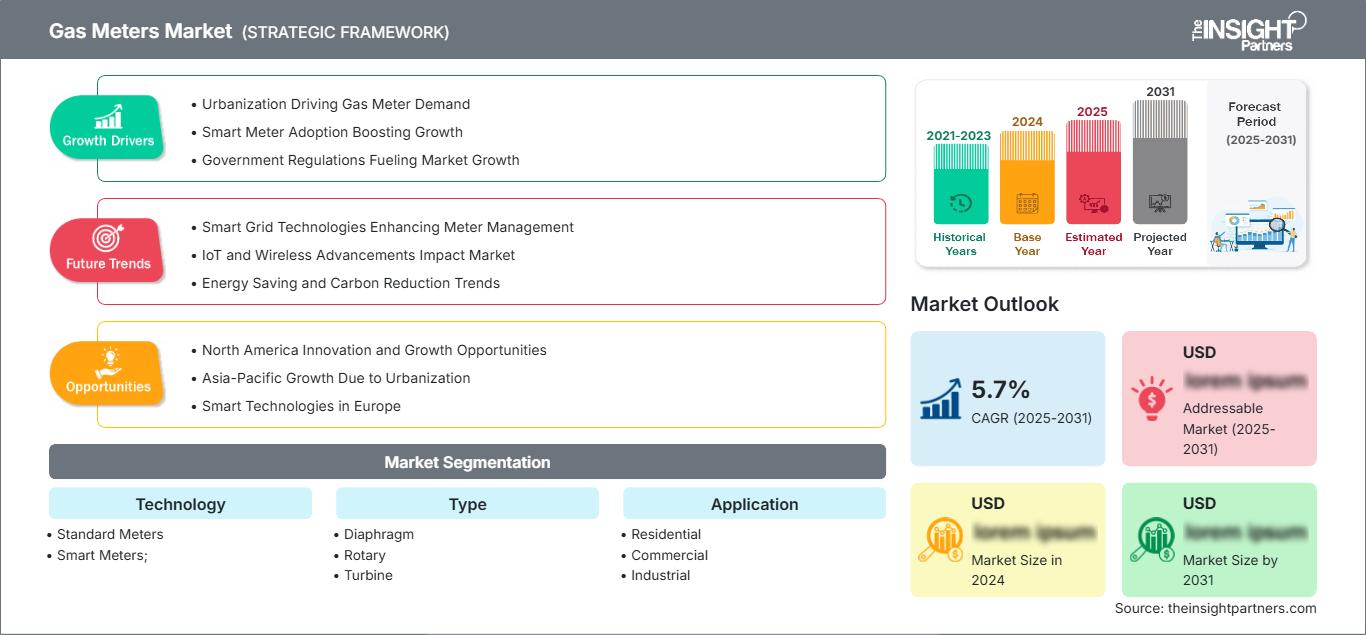
Gas Meters Market: Strategic Insights
Regional Insights
North America Gas Meter Market
North America held a modeled 29–31% share in 2025 and is projected to expand at a 3.4–3.8% CAGR through 2034. USA leads in regional demand on account of an extensive residential gas distribution network, utility procurement policies, and upgrade of outdated mechanical technology. Canada makes its contribution from residential, commercial, and industrial gas networks, especially where utilities are upgrading their measurement and communication capability.
Modern meters that provide remote readouts, diagnostics, and safety valve features are gaining traction as the favored type of meter in regional demand. Solid state and ultrasonic technologies are being evaluated by utilities as the need for increased accuracy and compatibility justifies costs of upgrades. Certification requirements provide a barrier of entry but also provide assurance of reliable procurement cycles for qualified manufacturers. North America's advanced existing stock implies that replacement and upgrading will take precedence over new house connections, leading to stable growth until 2034.
U.S. Gas Meter Market
The US represented a modeled 84–86% share of North America's 2025 market and is projected to grow at a 3.3–3.7% CAGR through 2034. Large gas distribution networks, residential use, industrial uses, and current utility metering replacement cycles are the main sources of demand. Modern metering technology is becoming more concerned about safety, telemetry, and the need to minimize field visits.
Itron Inc., Honeywell International Inc., and Landis+Gyr AG have very good positions within smart and advanced metering applications, whereas other vendors cater to standard residential and commercial applications. Current applications include solid state metering, remote cutoff capability, pressure sensing, and cellular communications. Utilities are also looking for technologies that can be seamlessly incorporated within their current operations, which means that the possibility of retrofitting and flexible communications can become as important as the actual metering capability.
Europe Gas Meter Market
Europe accounted for a modeled 28–30% share in 2025 and is expected to expand at a 3.6–4.0% CAGR through 2034. UK and Germany represent the key markets with a well-established distribution network and widespread digital metering activities. The demand from residential replacement, commercial use, and utilities’ modernization is contributed by France, Italy, and Spain as well.
In the UK, a wide-scale smart metering system has been implemented, and gas meters are used in addition to the existing electricity meters and communication networks. In Germany, metrology industry competencies are combined with utility modernization and residential replacement. In France, accuracy of measurements and digital utility services remain the focus areas, and residential replacement networks, commercial use, and residential replacement provide demand in Italy and Spain. The European procurement is increasingly driven by cybersecurity, interoperability, consumers' access to their data, metrology standards, and lifetime performance.
APAC Gas Meter Market
APAC held a modeled 25–27% share in 2025 and is projected to grow at a 4.1–4.5% CAGR through 2034. China leads the regional markets, trailed by Japan, India, South Korea, and Australia. Gas-network development, urbanization, industrialization, and meter replacement drive the demand in major economies.
China leverages its strong manufacturing capabilities and urban gas networks. Japan and South Korea have advanced utilities, while India provides structural opportunities due to its urban gas distribution network. Australia is gaining importance owing to its digitalization of gas metering systems. Regional utilities are trying to find a balance between affordability of the product and safety, remote monitoring, and life cycle. Infrastructure and energy efficiency programs supported by the government can speed up implementation of smart meters.
Middle East & Africa Gas Meter Market
Middle East and Africa demand is projected to expand at a modeled 3.9–4.3% CAGR through 2034, with Saudi Arabia leading regional investment. The UAE makes their contribution through business and infrastructure activities, whereas South Africa supplies the demand through already functioning utilities and industries. As for RoMEA, it is quite disparate and depends on the level of network development.
Infrastructure projects, construction of cities, industrialization, and use of natural gas define regional demands. Saudi Arabia and the UAE allow deploying intelligent and remote-controlled solutions in emerging developments, while South Africa is focused on replacement and reliability. Extreme weather conditions, disparate networks, and differing communication systems make rugged meters and flexible connection more valuable. Manufacturers who produce rugged devices and provide local services will be able to meet procurement demands.
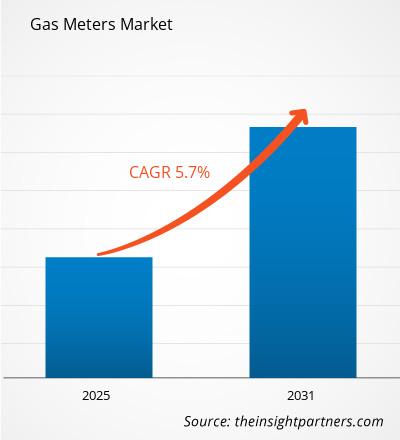
Segmentation Analysis
Technology
Technology comprises Standard Meters and Smart Meters. The segment is projected to grow at a 4.0–4.4% CAGR during 2026–2034. The Gas Meter Market scope within this segment is increasingly influenced by utilities' shift toward remote reading, digital billing, operational analytics, safety monitoring, and connected infrastructure, while conventional meters retain a substantial replacement base.
- Standard Meters: Continue serving established residential and commercial networks where low acquisition cost, mechanical simplicity, and long service life remain priorities. Their installed base supports sustained replacement demand.
- Smart Meters: Gain adoption through remote reading, communications, diagnostics, automated data collection, and safety functions. Utilities increasingly view connected meters as infrastructure for broader customer-service and network-management applications.
Type
Type includes Diaphragm, Rotary, Turbine, Ultrasonic. The segment is projected to grow at a 3.8–4.2% CAGR during 2026–2034. Diaphragm meters remain central to residential applications, while rotary and turbine technologies serve higher-flow installations. Ultrasonic designs are gaining attention where solid-state measurement and advanced digital functionality are priorities.
- Diaphragm: Remains widely deployed in residential and small commercial networks because of established manufacturing processes, reliable mechanical operation, and compatibility with existing utility infrastructure.
- Rotary: Serves commercial and industrial installations requiring dependable measurement across higher flow conditions. Compact construction and established operating characteristics support continued use in network applications.
- Turbine: Addresses higher-volume commercial and industrial measurement requirements where flow characteristics and installation conditions support turbine-based measurement. Utilities and industrial users value established operating practices and proven equipment.
- Ultrasonic: Gains strategic importance through solid-state measurement, low mechanical wear, digital diagnostics, and communication integration. The technology is particularly relevant to smart-meter modernization and advanced utility applications.
Application
Application consists of Residential, Commercial, Industrial. The segment is projected to grow at a 3.7–4.1% CAGR during 2026–2034. Residential deployments provide the largest installed base, while commercial and industrial applications generate higher requirements for measurement performance, durability, flow handling, data integration, and specialized installation conditions.
- Residential: Represents the broadest installed base and remains the principal replacement market. Demand increasingly favors compact smart systems offering remote reading, safety monitoring, and improved billing visibility.
- Commercial: Includes offices, retail properties, hospitality facilities, and institutional buildings. Buyers increasingly value accurate measurement, remote monitoring, and integration with building-management and energy-management systems.
- Industrial: Requires robust equipment capable of handling higher flows and demanding operating conditions. Measurement accuracy, maintenance access, pressure conditions, and integration with industrial control systems influence procurement decisions.
Opportunity Snapshot
| Application | Revenue Contribution | Trend Tag | Adoption Stage |
|---|---|---|---|
| Residential | High | Smart Billing | Scaling |
| Commercial | Medium | Remote Monitoring | Scaling |
| Industrial | Medium | Flow Analytics | Mature |
Gas Meters Market Growth Drivers and Impact Analysis
Replacement of aging gas-meter infrastructure
Aging installed bases create a dependable replacement cycle because mechanical meters eventually require inspection, refurbishment, or replacement to maintain measurement performance and operational safety. Utilities are increasingly evaluating replacements as opportunities to introduce communications and diagnostic functions rather than simply installing equivalent mechanical equipment. This changes the value proposition from a single measurement device to a connected asset capable of supporting remote operations. The impact is strongest in mature networks across North America and Europe, where large installed populations can generate recurring procurement programs. Replacement activity also supports demand for retrofit-compatible communication modules and meters that minimize changes to existing service connections. Suppliers with broad product families can use these programs to transition customers gradually from standard technology toward smart architectures while controlling installation disruption and maintaining billing continuity.
Utility focus on remote monitoring and operational efficiency
Utilities face pressure to improve field productivity while maintaining accurate billing and reliable service. Connected gas meters can reduce manual reading requirements, support remote diagnostics, and provide more frequent information about consumption and equipment status. This creates measurable operational value when customer populations are geographically dispersed or field access is costly. Smart technology can also support automated alerts for abnormal conditions and, where supported, remote valve operations. The commercial effect is a gradual shift in procurement criteria from meter purchase price toward total lifecycle cost. Vendors can benefit by offering communication modules, head-end software, data services, and maintenance capabilities alongside hardware. Utility modernization programs therefore create opportunities for suppliers that can demonstrate interoperability with existing billing, customer-service, and asset-management platforms.
Greater emphasis on gas safety and measurement integrity
Safety remains a fundamental procurement consideration because gas distribution systems require reliable measurement and rapid identification of abnormal operating conditions. Modern meters increasingly integrate pressure sensing, temperature monitoring, tamper detection, or automatic shutoff capabilities depending on application and regional requirements. These features can reduce operational exposure while supporting utility response to unusual consumption or equipment conditions. Measurement integrity is equally important because inaccurate readings can affect billing, customer confidence, and network accounting. Regulators and utilities therefore continue to emphasize certified performance and traceable measurement. The market impact favors manufacturers with established metrology expertise, rigorous testing processes, and field-service capabilities. As connected functionality becomes more common, cybersecurity and secure communications will also become integral to maintaining trust in digitally managed metering infrastructure.
Gas Meters Market Future Trends
Edge intelligence and interoperable gas-meter platforms
Gas Meter Market trends are increasingly moving toward meters that process information locally before transmitting selected data to utility platforms. Edge intelligence can enable faster detection of abnormal flow, pressure changes, tampering, or equipment conditions while reducing communication overhead. Future devices are likely to combine sensing, diagnostics, communications, and configurable logic within compact platforms. Interoperability will become increasingly important because utilities operate mixed fleets acquired over multiple procurement cycles. Open interfaces and multi-vendor communication capabilities can reduce dependence on proprietary architectures and simplify phased modernization. Suppliers that combine local intelligence with secure cloud connectivity may gain an advantage because utilities can obtain actionable information without replacing every component of their existing technology stack. This approach should support gradual digital transformation while controlling capital expenditure.
Ultrasonic measurement expands beyond premium installations
Ultrasonic technology is positioned to move gradually from specialized and premium applications toward broader residential and commercial deployment as utilities become more comfortable with solid-state measurement. The absence of conventional moving measurement components can reduce mechanical wear and enable additional sensing and diagnostic functionality. Integrated shutoff valves, pressure transducers, cellular communications, and longer-life batteries can further increase the technology's value. Cost remains a constraint, particularly in price-sensitive residential programs, so adoption will depend on manufacturing scale and demonstrable lifecycle savings. Over time, procurement teams are likely to compare technologies using total ownership cost rather than initial unit price alone. This can improve the commercial position of ultrasonic platforms where remote operations, safety functionality, and reduced maintenance provide measurable utility benefits.
Gas Meters Market Opportunities
Smart retrofit programs for established utility networks
The Gas Meter Market Forecasts indicate an opportunity to modernize mature networks through retrofit strategies that add communications and digital functionality without requiring complete replacement of supporting utility systems. Suppliers can develop modular devices compatible with existing meter bodies, service connections, and billing infrastructure. This approach can reduce installation time and spread capital spending over multiple procurement cycles. Opportunities are particularly relevant in regions with large populations of conventional meters and established utility service organizations. Investors should prioritize platforms supporting several communications technologies because network conditions vary across territories. Partnerships with installers, utilities, and software providers can further accelerate deployment by combining hardware with commissioning and data-management capabilities. Retrofit-oriented products can therefore address modernization needs while minimizing disruption to customers and field operations.
Integrated metering for commercial and industrial energy management
Commercial and industrial facilities provide an opportunity to position gas meters as part of broader energy-management systems rather than isolated billing equipment. Advanced meters can provide consumption data for building-management platforms, process monitoring, cost allocation, and operational optimization. Suppliers can target hospitals, hotels, manufacturing sites, campuses, logistics facilities, and large commercial properties where energy visibility has direct financial relevance. Investment should focus on meters with robust communications, configurable measurement intervals, strong data integrity, and integration through established industrial or building protocols. Bundling meters with analytics and service agreements can create recurring revenue while improving customer retention. The opportunity is particularly attractive where facility managers are already deploying digital energy-management systems and can incorporate gas measurement into a wider portfolio of monitored utilities.
Recent Developments
- August 2026: Sensirion’s next-generation SGM5304 gas meter module successfully completed EN 17526 certification at the Netherlands Measurement Institute (NMi), enabling gas meter manufacturers to pursue MID approval with reduced certification effort, lower development costs and faster time-to-market. The certification confirms compliance with EN 17526 metrological requirements for pressure- and temperature-compensated G4 and G6 operating ranges, as well as a newly introduced temperature-only compensated G4 mode.
- July 2026: Mahanagar Gas Limited (MGL) partnered with India Post, Maharashtra Circle, to launch technology-enabled doorstep domestic PNG meter-reading services across Mumbai. The initiative, formalized through an MoU, makes MGL the first City Gas Distribution company in India to engage India Post for domestic gas meter reading, beginning with a pilot in selected areas of South Mumbai before a phased expansion.
- May 2025: ABB and RMG signed a supply framework agreement under which RMG will provide ABB with ultrasonic gas meters for the U.S. energy market, expanding ABB’s instrumentation portfolio for high-precision gas measurement in custody-transfer and midstream applications. The partnership combines RMG’s ultrasonic measurement technology with ABB’s flow computers and broader measurement solutions, enabling U.S. oil and gas customers to access high-accuracy gas measurement supported by ABB’s established instrumentation offering.
Frequently Asked Questions

- Comprehensive Market Sizing and Forecast Analysis
- Detailed Segmentation Analysis
- In-Depth Market Dynamics Assessment
- Regional and Country-Level Insights
- Competitive Landscape and Company Benchmarking
- Strategic Business Intelligence
Recent Reports
Testimonials

The Insight Partners' SCADA System Market report is comprehensive, with valuable insights on current trends and future forecasts. The team was highly professional, responsive, and supportive throughout. We are very satisfied and highly recommend their services.
RAN KEDEM Partner, Reali Technologies LTDs
I requested a report on a very specific software market and the team produced the report in a few days. The information was very relevant and well presented. I then requested some changes and additions to the report. The team was again very responsive and I got the final report in less than a week.
JEAN-HERVE JENN Chairman, Future Analytica
We worked with The Insight Partners for an important market study and forecast. They gave us clear insights into opportunities and risks, which helped shape our plans. Their research was easy to use and based on solid data. It helped us make smart, confident decisions. We highly recommend them.
PIYUSH NAGPAL Sr. Vice President, High Beam Global
The Insight Partners delivered insightful, well-structured market research with strong domain expertise. Their team was professional and responsive throughout. The user-friendly website made accessing industry reports seamless. We highly recommend them for reliable, high-quality research services
YUKIHIKO ADACHI CEO, Deep Blue, LLC.
This is the first time I have purchased a market report from The Insight Partners.While I was unsure at first, I visited their web site and felt more comfortable to take the risk and purchase a market report.I am completely satisfied with the quality of the report and customer service. I had several questions and comments with the initial report, but after a couple of dialogs over email with their analyst I believe I have a report that I can use as input to our strategic planning process.Thank you so much for taking the extra time and making this a positive experience.I will definitely recommend your service to others and you will be my first call when we need further market data.
JOHN SUZUKI President and Chief Executive Officer, Board Director, BK Technologies
I wish to appreciate your support and the professionalism you displayed in the course of attending to my request for information regarding to infectious disease IVD market in Nigeria. I appreciate your patience, your guidance, and the fact that you were willing to offer a discount, which eventually made it possible for us to close a deal. I look forward to engaging The Insight Partners in the future, all thanks to the impression you have created in me as a result of this first encounter.
DR CHIJIOKE ONYIA MANAGING DIRECTOR, PineCrest Healthcare Ltd.Reason to Buy
- Informed Decision-Making
- Understanding Market Dynamics
- Competitive Analysis
- Identifying Emerging Markets
- Customer Insights
- Market Forecasts
- Risk Mitigation
- Boosting Operational Efficiency
- Strategic Planning
- Investment Justification
- Tracking Industry Innovations
- Aligning with Regulatory Trends





 Get Free Sample for