
Gear Motors Market Growth, Size & Forecast by 2034
Coverage: by Gear Type (Helical Gear Motors, Planetary Gear Motors, Helical-Bevel Gear Motors, Worm Gear Motors, Others); Rated Power (Up to 7.5 kW, 7.5 kW - 75 kW, Above 75 kW); Torque (Up to 10000 Nm, Above 10000 Nm); Industry Vertical (Automotive and Transportation, Aerospace and Defense, Building and Construction, Power Generation, Food and Beverage, Metals and Mining, Others) , and Geography (North America, Europe, Asia Pacific, and South and Central America)
- Status : Data Released
- Report Code : TIPRE00005582
- Category : Electronics and Semiconductor
- No. of Pages : 150
- Available Report Formats :


- Last update date : September 17, 2026


2025 Market Size
US$ 6.38 Bn
Base year value
2034 Forecast
US$ 10.20 Bn
Projected by 2034
CAGR 2026-2034
5.35 %
Growth rate
Addressable Market
US$ 75.19 Bn
(2026-2034)
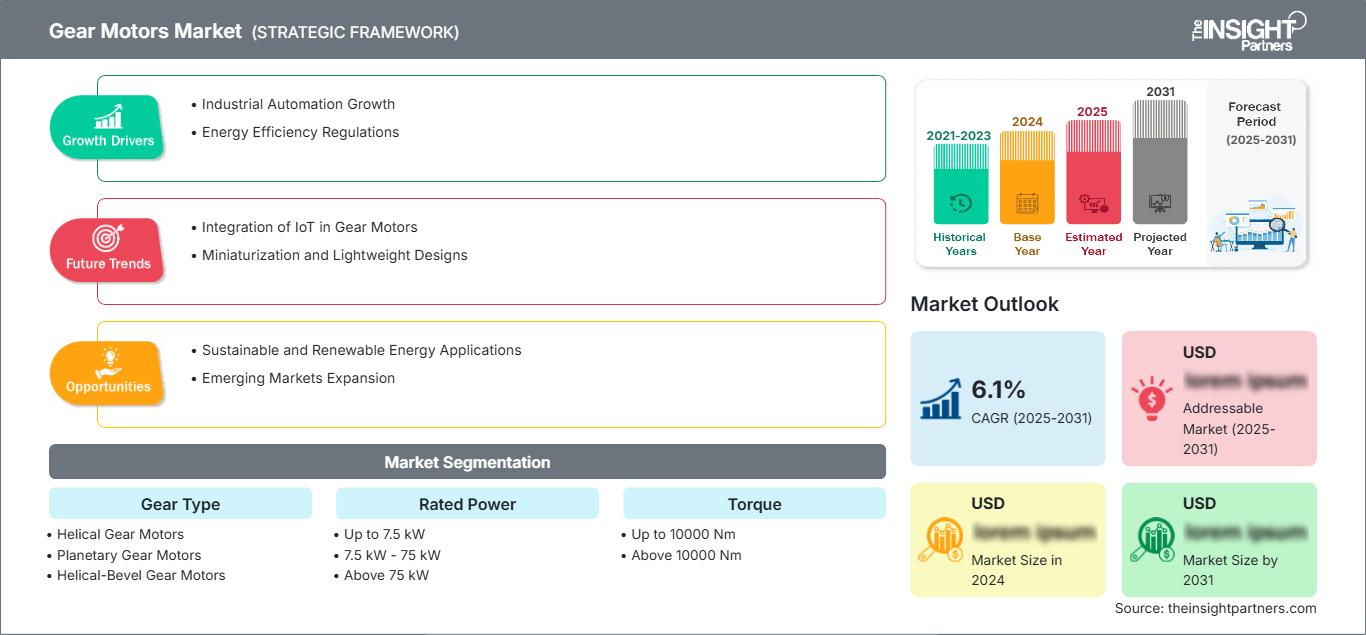
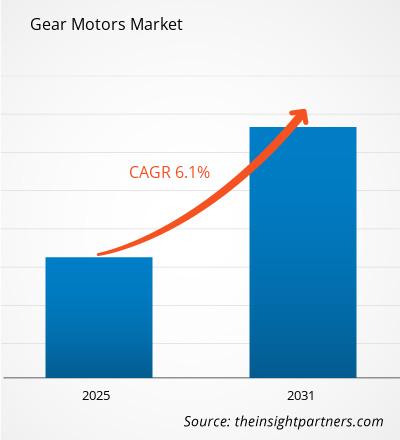
The Gear Motors Market is positioned for sustained expansion as industrial automation, energy-efficient motion systems, and material-handling infrastructure increase demand for integrated torque transmission. The market is valued at US$ 6.38 Billion in 2025 and is projected to reach US$ 10.20 Billion by 2034, advancing at a CAGR of 5.35% during 2026–2034. Demand is increasingly influenced by compact designs, premium-efficiency motors, digital monitoring, and application-specific drive configurations.
North America is expected to maintain a significant position, with the Gear Motors Market size supported by reshoring, warehouse automation, food processing modernization, and infrastructure investment. A modeled regional CAGR of 5.7–6.2% during 2026–2034 reflects replacement of legacy drives and broader deployment of electronically controlled motion systems. The United States remains the principal demand center, while Canada benefits from mining, logistics, and energy-related equipment investment.
Gear Motors Market Assessment and Insights
- North America: North America is estimated to hold a 23–27% Gear Motors Market share in 2025 and grow at a CAGR of 5.7–6.2% between 2026–2034, supported by manufacturing reshoring, logistics automation, and replacement of inefficient drive systems.
- US: The US represents 78–82% of North American demand in 2025 and is expected to expand at a CAGR of 5.8–6.3% during 2026–2034, led by automated warehouses and advanced manufacturing.
- Europe: Europe is estimated at a 21–25% share in 2025 and is projected to grow at a CAGR of 5.5–6.0% during 2026–2034, with Germany, Italy, France, and the UK supporting demand through automation and efficiency upgrades.
- Asia Pacific: Asia Pacific accounts for an estimated 36–40% share in 2025 and is expected to grow at a CAGR of 5.9–6.5% during 2026–2034, led by China, Japan, India, and South Korea.
- Largest Segment: Helical Gear Motors hold an estimated 41–45% market share in 2025 and are projected to grow at a CAGR of 5.0–5.6% during 2026–2034.
- High Growth Segment: Planetary Gear Motors represent approximately 12–16% market share in 2025 and are projected to expand at a CAGR of 6.8–7.8% during 2026–2034.
- Key companies analyzed in detail: ABB Group, Bonfiglioli Riduttori S.p.A., Eaton Corporation, Elecon Engineering Company Limited, Emerson Electric Co., Johnson Electric Holdings Limited, SEW-EURODRIVE GmbH & Co KG, Siemens AG, Sumitomo Heavy Industries, Ltd., Watt Drive WEG Group.
Source: The Insight Partners' analysis based on proprietary research, government publications, company annual reports, investor presentations, industry databases, and expert interviews.
Gear Motors Market transitioned from a traditional design of fixed-speed transmissions to miniaturized electromechanical assemblies comprising of electric motors, gears, sensors, brakes, and adjustable speed drives. The Helical and Helical Bevel designs are still significant due to their tradeoffs between efficiency, torque density, and manufacturing experience. Manufacturing of such devices has been evolving towards modular platforms, standard interfaces, digitally controlled components, and high-efficiency motors.
The Gear Motors Market will most probably be driven by investments into the industrial sectors in South-East Asia, India, Mexico, and certain countries in the Middle East. Increased regulatory pressure on motor efficiency would drive replacement cycles, and localization would become more frequent for faster deliveries and decreased risks of component availability. Warehouse automation, renewable energy installations, food processing, and mining should increase the diversity of applications in which the compact high-torque drives can compete with purely mechanical systems.
Gear Motors Market Report Scope
| Report Attribute | Details |
|---|---|
| Market size in 2025 | US$ 6.38 Billion |
| Market Size by 2034 | US$ 10.20 Billion |
| Global CAGR (2026 - 2034) | 5.35% |
| Historical Data | 2021-2024 |
| Forecast period | 2026-2034 |
Gear Motors Market Analysis
The demand for gearmotors depends significantly on automation intensity as these products transfer the rotational speed of the motor into torque and controlled speed for specific application needs. The Gear Motors Market's expansion is thus affected by conveyor systems, packaging machines, robotics, pumps, mixers, hoisting equipment, and production lines. The supply chain includes electric motor makers, gearbox manufacturers, bearing and sealing element suppliers, inverters providers, system integrators, OEMs, distributors, and maintenance services. Typical criteria for selection include torque value, duty cycle, ratio, mounting method, thermal properties, braking function, and environmental protection features.
Supply conditions in the Gear Motors Market are becoming more favorable for modular product families capable of supporting multiple segments with minor customization. Manufacturers are balancing their expenses on steel, copper, bearings, magnets, and electronics components against demands on efficiency and reliability. The use of digital design tools helps to streamline configuration process by correlating application requirements with motor and gearbox specifications. It is possible to implement decentralized purchasing strategy when the OEM has standard drive interfaces for different machine platforms.
Competitive differentiation in the Gear Motors Market relies not only on mechanical engineering but also on electronics, software, and servicing aspects. ABB Group, Eaton Corporation, Emerson Electric Co., and Siemens AG differentiate through comprehensive automation portfolio, whereas Bonfiglioli Riduttori S.p.A., SEW-EURODRIVE GmbH & Co KG, Sumitomo Heavy Industries, Ltd., and Watt Drive WEG Group focus on dedicated transmission and motion products. Elecon Engineering Company Limited and Johnson Electric Holdings Limited extend specialization in selected applications.
Development in the Gear Motors Market is now focused on efficient motors, sensors, digital commissioning procedures, and regional production. According to Bonfiglioli, its R&D activities in 2025 would be focused on developing sensorized gearboxes, highly efficient gear units, and small drives for automated guided vehicles. SEW-EURODRIVE's 2025-2026 portfolio shows the presence of integrated decentralized electronics, IE5-class products, and condition monitoring. These tendencies prove the fact that competitive differentiation goes beyond gearbox geometry.
● REPORT CUSTOMIZATION
Tailor This Report To Align With Your Specific Business Requirements
This report can be customized to align precisely with your business objectives, scope, and target markets. Customization options include tailored segmentation, geography, competitive analysis, and strategic insights to support informed decision-making.
Customize This Report →WHAT YOU CAN ADJUST
- ● Segmentations
- ● Geography
- ● Competitive Analysis
- ● Language Preferences
Gear Motors Market: Strategic Insights
Regional Insights
North America Gear Motors Market
North America is modeled at a 23–27% share in 2025, with a 5.7–6.2% CAGR through 2034. The US is responsible for dominating regional demand, thanks to reshoring, warehousing automation, food processing, pharmaceuticals, and improvement in industrial material handling equipment. The contribution from Canada includes mining, energy, pulp & paper, and infrastructure machinery, while Mexico's contribution involves automotive manufacturing and nearshoring-based growth in production.
The regional procurement process emphasizes reliability, availability of services, standardization of mounting, and lifecycle economics. Conveyors, packaging lines, pumps, mixers, and lifting equipment continue to be crucial applications. The replacement of old motors by higher efficiency combinations is increasingly being analyzed on the basis of lifecycle economics rather than outright cost of procurement. This is partly because of the substantial impact that downtime costs have.
U.S. Gear Motors Market
According to the Gear Motors Market report, the U.S. represents approximately 78–82% of North American demand in 2025 and is expected to grow at a 5.8–6.3% CAGR. The applications for gearmotors include industrial automation, logistics centers, aircraft production, food processing, and high-tech equipment. There is an increasing demand for small gearmotors that can incorporate brakes, sensors, and variable speed drives.
The suppliers offer a wide range of applications for their products in conveyors, packaging machines, pumps, lifting machines, and factory automation systems. The industry receives significant support from investments in local production and upgrades of existing facilities. The application trends are pointing towards predictive maintenance, space savings, energy savings, and quick replacement. There is also a need for interchangeability in mounting and servicing due to large installed bases.
Europe Gear Motors Market
Europe represents a modeled 21–25% share in 2025 and is projected to expand at a 5.5–6.0% CAGR, with Germany leading regional demand. Automated warehousing, packaging, and process equipment in the UK and Germany markets, and machinery, food processing, automotive, construction, and renewable energy equipment in the French, Italian, and Spanish markets drive demand.
The UK market features modernized automated warehousing, packaging, and process equipment. The German market enjoys a well-developed industrial automation ecosystem along with its automotive and machinery production. In turn, the French market places a lot of emphasis on modernization and energy efficiency, while the Italian market features good machinery, packaging, and food processing equipment. The Spanish market has a combination of demand from manufacturing, logistics, food processing, and renewable energy.
APAC Gear Motors Market
APAC holds an estimated 36–40% share in 2025 and is projected to grow at a 5.9–6.5% CAGR, making China the leading regional market. While Japan and South Korea offer sophisticated automation, India and Australia have industrial, mining, infrastructure, and process equipment applications.
China has advantages with abundant manufacturing of machinery and factory automation, and India gains through manufacturing localization and infrastructure development. In Japan and South Korea, there is precision engineering and robotics; in Australia, there is mining and material handling. Industrial policies that encourage manufacturing, automation, and energy efficiency will lead to acceptance of compact and high-duty transmissions throughout the region.
Middle East & Africa Gear Motors Market
Middle East and Africa demand is developing from a smaller base, with Saudi Arabia leading regional opportunities through industrial diversification, logistics, water, and energy projects. The UAE supports warehouse, construction, utilities, and infrastructure applications, while South Africa contributes mining, metals, and processing demand.
The regional market is modeled to expand at a 4.8–5.5% CAGR through 2034. Energy infrastructure, desalination, construction, mining modernization, and logistics investments create recurring requirements for reliable torque transmission. Buyers often emphasize rugged construction, thermal performance, service access, and compatibility with harsh operating conditions. Local distribution and technical support remain important for project-based procurement.
Segmentation Analysis
Gear Type
Gear Type remains a foundational selection variable because gearbox geometry determines efficiency, torque density, noise, footprint, and application suitability. The segment is projected to grow at a 5.2–6.0% CAGR during 2026–2034. Helical designs remain broadly applicable, while planetary architectures gain attention where compactness, precision, and high torque density justify higher specification complexity.
- Helical Gear Motors: Widely selected for conveyors, pumps, mixers, and industrial machinery because efficient power transmission, smooth operation, and established maintenance practices support broad OEM acceptance.
- Planetary Gear Motors: Important for compact, high-torque applications requiring low backlash and high torque density, including robotics, precision machinery, mobile equipment, and demanding positioning systems.
- Helical-Bevel Gear Motors: Provide right-angle transmission with efficient power delivery, supporting conveyors, packaging machinery, material handling, and applications where installation geometry limits conventional arrangements.
- Worm Gear Motors: Remain relevant where compact right-angle construction, high reduction ratios, and favorable cost characteristics outweigh comparatively lower efficiency in selected intermittent-duty applications.
Rated Power
Rated Power influences thermal design, installation requirements, and equipment matching. The segment is projected to expand at a 5.0–5.8% CAGR during 2026–2034 as automation increases demand across small machinery and larger process equipment. Modular platforms enable manufacturers to address multiple power classes without extensive redesign.
- Up to 7.5 kW: Serves packaging, conveyors, small pumps, food machinery, and light automation, where compact dimensions, low energy consumption, and simple installation are important purchasing criteria.
- 7.5 kW - 75 kW: Supports mainstream industrial machinery, material handling, processing, and manufacturing equipment requiring balanced torque, efficiency, thermal performance, and operational flexibility.
- Above 75 kW: Addresses heavy-duty applications such as metals, mining, power generation, large conveyors, and process machinery where reliability and sustained torque capacity are critical.
Torque
Torque segmentation is projected to grow at a 5.3–6.1% CAGR through 2034, reflecting continued demand for application-specific mechanical output. Torque selection depends on load inertia, acceleration, duty cycle, speed reduction, and service factor. Higher torque requirements increasingly favor compact planetary and optimized helical architectures.
- Up to 1 Nm: Targets compact motion systems, light automation, small actuators, and precision mechanisms where minimal footprint and controlled output are more important than heavy-load capability.
- Above 1 Nm: Covers the majority of industrial transmission requirements, including conveyors, mixers, pumps, lifting systems, machinery, and process equipment requiring sustained mechanical output.
Industry Vertical
Industry Vertical demand is projected to expand at a 5.4–6.2% CAGR during 2026–2034. Adoption is diversified across transportation, construction, energy, food production, mining, and industrial processing. Equipment operators increasingly assess gearmotors through energy consumption, uptime, maintenance intervals, and compatibility with automated control systems.
- Automotive and Transportation: Requires reliable drives for conveyors, assembly equipment, vehicle production machinery, material handling, and automated logistics systems.
- Aerospace and Defense: Prioritizes precision, repeatability, reliability, and controlled motion for specialized manufacturing and support equipment operating under demanding qualification requirements.
- Building and Construction: Uses gearmotors in elevators, ventilation, material handling, automated doors, mixers, and construction machinery requiring dependable torque transmission.
- Power Generation: Applies geared drives in auxiliary systems, cooling, material handling, tracking equipment, and renewable-energy infrastructure where reliability and continuous operation are essential.
- Food and Beverage: Favors hygienic, efficient, and easily maintainable drives for conveyors, filling, packaging, mixing, and processing equipment.
- Metals and Mining: Requires high-duty transmission systems capable of handling heavy loads, dust, vibration, temperature variation, and continuous operating cycles.
- Others: Includes diverse industrial and commercial applications where application-specific torque, speed reduction, footprint, and reliability determine gearmotor selection.
Opportunity Snapshot
| Industry Vertical | Revenue Contribution | Trend Tag | Adoption Stage |
| Automotive and Transportation | High | Factory Automation | Mature |
| Aerospace and Defense | Medium | Precision Motion | Scaling |
| Building and Construction | Medium | Smart Equipment | Scaling |
| Power Generation | High | Energy Efficiency | Mature |
| Food and Beverage | High | Hygienic Drives | Mature |
| Metals and Mining | High | Heavy Duty | Mature |
| Others | Medium | Custom Motion | Scaling |
Gear Motors Market Growth Drivers and Impact Analysis
Industrial automation increases demand for integrated motion systems
Automation investments increase the number of controlled motion points within factories, warehouses, packaging facilities, and process plants. Each conveyor, actuator, lifting unit, or material flow module may require its own drive system, thus increasing the scope of potential equipment that can be addressed. Gearmotors seem to be especially useful, since these devices combine both speed reduction and motor power supply into one integrated package. Furthermore, their ability to integrate with the sensor systems and variable speed drives allows for automatic operation and fault diagnosis. In view of the shorter production cycles and higher equipment utilization rates, the cost of unscheduled downtime becomes much higher, which makes it more advantageous to have standard and serviceable equipment that can be monitored electronically.
Energy-efficiency requirements accelerate replacement of legacy drive systems
Industrial operators increasingly evaluate motors and transmission systems according to lifecycle electricity consumption rather than acquisition price alone. Increased motor efficiency, efficient gearing, variable speed, and proper matching of load will minimize energy losses in cases where there is fluctuation in process demand. This provides a means of replacing inefficient systems that are still mechanically fit. Efficiency improvements are particularly appealing in the case of conveyor systems, pumps, fans, mixing machinery, and processing equipment. Attention to motor efficiency from regulators makes the move towards high efficiency equipment even more appealing, although its implementation is based on the payback period and installation considerations. In this case, manufacturers that provide efficient motors, optimized gear ratios, and drives will be able to meet the dual purpose of sustainability and cost savings without machine replacement.
Warehouse and logistics expansion broadens compact drive applications
Automated warehouses require large numbers of conveyors, sorters, lifts, shuttles, and positioning mechanisms, creating demand for compact transmission systems with predictable performance. Growth in e-commerce fulfillment and distribution modernization increases the number of automated material-flow points within individual facilities. Gearmotors are well suited to these applications because they provide controlled speed and torque within constrained installation spaces. The expansion also changes purchasing criteria, with operators emphasizing low noise, rapid commissioning, service accessibility, and predictable maintenance. Sensor-ready configurations can provide operating information that supports preventive intervention before mechanical failure interrupts throughput. Consequently, logistics automation can create recurring replacement and retrofit demand in addition to new-equipment orders, giving manufacturers opportunities to develop application-specific packages for conveyors, lifts, and mobile warehouse systems.
Gear Motors Market Future Trends
Sensorized gearmotors will become increasingly configurable
Future products will increasingly combine gearboxes, motors, sensors, brakes, encoders, and communication interfaces within configurable platforms. Embedded temperature, vibration, speed, and torque information can improve asset visibility without requiring separate monitoring hardware. This architecture should support condition-based maintenance and simplify integration into industrial control networks. Suppliers are likely to expand software tools that translate operating data into actionable maintenance indicators, while OEMs will seek standardized interfaces that reduce engineering effort. The commercial value will increasingly depend on data quality, cybersecurity, interoperability, and useful diagnostics rather than sensor presence alone. Over time, modular sensor packages could allow customers to select monitoring capabilities according to criticality, enabling premium functionality for high-value equipment while maintaining cost discipline for less demanding machinery.
High-efficiency architectures will reshape product specifications
According to the Gear Motors Market trends, the next phase of product development is likely to emphasize complete system efficiency rather than motor efficiency alone. Gear geometry, bearing selection, lubrication, motor technology, inverter control, and load matching all influence the energy consumed by a drive system. Manufacturers will therefore increasingly design motor and gearbox combinations as coordinated packages. Permanent-magnet, synchronous reluctance, and other high-efficiency technologies may gain greater application coverage where lifecycle savings justify higher initial costs. Compact mechanical designs can also reduce material usage and installation footprint. Procurement teams are expected to compare products using total cost of ownership, operating profiles, maintenance requirements, and efficiency performance. This shift should favor suppliers that can validate system-level savings under realistic application conditions rather than relying solely on component-level ratings.
Gear Motors Market Opportunities
Regionalized manufacturing can improve response and customization
Manufacturers can capture incremental opportunities by expanding regional production and final configuration capabilities in high-growth industrial economies. Localized manufacturing can reduce transportation exposure, shorten delivery times, and enable voltage, mounting, braking, and environmental configurations suited to regional equipment standards. India, Southeast Asia, Mexico, and selected Middle Eastern markets offer attractive platforms because industrial investment is expanding while customers increasingly expect local technical support. Regional assembly can also improve resilience against component disruptions by creating alternative sourcing pathways. Companies should prioritize facilities near established machinery clusters and develop partnerships with system integrators that influence specifications early in equipment design. A localized strategy is most valuable when combined with standardized global platforms, allowing scale efficiencies while retaining sufficient flexibility for local requirements.
Digital services can create recurring aftermarket value
The Gear Motors Market Forecasts increasingly point toward opportunities beyond initial equipment sales as installed bases become more connected. Manufacturers can develop recurring service models around condition monitoring, remote diagnostics, maintenance planning, spare-parts forecasting, and performance optimization. Such services can be particularly valuable in mining, metals, food processing, logistics, and power applications where unexpected stoppages carry substantial operational costs. Digital offerings can also strengthen customer retention by linking replacement recommendations to measured operating conditions. Suppliers should establish clear cybersecurity practices, data ownership policies, and interoperability standards before scaling connected services. A tiered model could provide basic monitoring for broad installed populations while offering advanced analytics to critical assets. This approach creates service differentiation without requiring every customer to adopt a fully digital maintenance architecture.
Recent Developments
- December 2025: Innomotics India agreed to acquire Siemens Limited’s Low Voltage Motors and Geared Motors business in India for an enterprise value of INR 2,200 crore. The transaction, including related customer-service operations, was intended to give Innomotics India an end-to-end portfolio spanning low- and high-voltage motors, geared motors, and large drives, while expanding its market presence and ability to provide integrated drive solutions to industrial customers. The deal was subsequently completed in June 2026.
- June 2026: Siemens India completed the sale of its Low Voltage Motors and Geared Motors businesses, including related customer-service operations, to Innomotics India Pvt. Ltd. The transaction consolidates these activities within Innomotics’ motors and drives portfolio, providing continuity for customers while allowing Siemens India to focus its portfolio on businesses with stronger strategic alignment.
- April 2024: WEG renamed its Austrian Watt Drive Antriebstechnik business as WEG Gear Systems, upgrading the operation into a global competence centre for gear technology. The unit, acquired by WEG in 2011, was given responsibility for the group’s worldwide gears and geared-motors activities, strengthening its role in developing and supplying specialised drive and gear solutions and leveraging WEG’s global manufacturing and market presence.
Frequently Asked Questions

- Comprehensive Market Sizing and Forecast Analysis
- Detailed Segmentation Analysis
- In-Depth Market Dynamics Assessment
- Regional and Country-Level Insights
- Competitive Landscape and Company Benchmarking
- Strategic Business Intelligence
Recent Reports
Testimonials

The Insight Partners provided valuable market intelligence that supported our global go-to-market strategy. Their team was professional, responsive, and attentive to our feedback, providing thoughtful analysis and helpful methodological clarifications throughout the project.
Junmo Kim Chief Financial Officer (CFO), Enertech Co., Ltd.
The Insight Partners' SCADA System Market report is comprehensive, with valuable insights on current trends and future forecasts. The team was highly professional, responsive, and supportive throughout. We are very satisfied and highly recommend their services.
RAN KEDEM Partner, Reali Technologies LTDs
I requested a report on a very specific software market and the team produced the report in a few days. The information was very relevant and well presented. I then requested some changes and additions to the report. The team was again very responsive and I got the final report in less than a week.
JEAN-HERVE JENN Chairman, Future Analytica
We worked with The Insight Partners for an important market study and forecast. They gave us clear insights into opportunities and risks, which helped shape our plans. Their research was easy to use and based on solid data. It helped us make smart, confident decisions. We highly recommend them.
PIYUSH NAGPAL Sr. Vice President, High Beam Global
The Insight Partners delivered insightful, well-structured market research with strong domain expertise. Their team was professional and responsive throughout. The user-friendly website made accessing industry reports seamless. We highly recommend them for reliable, high-quality research services
YUKIHIKO ADACHI CEO, Deep Blue, LLC.
This is the first time I have purchased a market report from The Insight Partners.While I was unsure at first, I visited their web site and felt more comfortable to take the risk and purchase a market report.I am completely satisfied with the quality of the report and customer service. I had several questions and comments with the initial report, but after a couple of dialogs over email with their analyst I believe I have a report that I can use as input to our strategic planning process.Thank you so much for taking the extra time and making this a positive experience.I will definitely recommend your service to others and you will be my first call when we need further market data.
JOHN SUZUKI President and Chief Executive Officer, Board Director, BK Technologies
I wish to appreciate your support and the professionalism you displayed in the course of attending to my request for information regarding to infectious disease IVD market in Nigeria. I appreciate your patience, your guidance, and the fact that you were willing to offer a discount, which eventually made it possible for us to close a deal. I look forward to engaging The Insight Partners in the future, all thanks to the impression you have created in me as a result of this first encounter.
DR CHIJIOKE ONYIA MANAGING DIRECTOR, PineCrest Healthcare Ltd.Reason to Buy
- Informed Decision-Making
- Understanding Market Dynamics
- Competitive Analysis
- Identifying Emerging Markets
- Customer Insights
- Market Forecasts
- Risk Mitigation
- Boosting Operational Efficiency
- Strategic Planning
- Investment Justification
- Tracking Industry Innovations
- Aligning with Regulatory Trends





 Get Free Sample for