
Graphene Electronics Market Share, Size & Demand by 2034
Coverage: by Material (Photo-Voltaic Graphene Materials, Graphene Nano-Technology Materials, Structured Materials, Electronic Materials, Nanotechnology Materials, Electric and Conducting Materials, Photovoltaic Materials, Other Materials); Devices (Graphene Transistors, Graphene Supercapacitors, Graphene Sensors, Graphene Ics and Chips, Other Devices); Application (Communication Application, Computing Application, Consumer Application, Data Storage Application, Display and Touch Application, Sensing Application Sector, Thermal Management Application, Other Applications) , and Geography (North America, Europe, Asia Pacific, and South and Central America)
- Status : Data Released
- Report Code : TIPRE00011664
- Category : Electronics and Semiconductor
- No. of Pages : 150
- Available Report Formats :


- Last update date : August 25, 2026


2025 Market Size
US$ 1.79 Bn
Base year value
2034 Forecast
US$ 31.14 Bn
Projected by 2034
CAGR 2026-2034
37.35 %
Growth rate
Addressable Market
US$ 107.93 Bn
(2026-2034)
The global Graphene Electronics market was valued at US$ 1.79 billion in 2025 and is expected to reach US$ 31.14 billion by 2034; it is estimated to record a CAGR of 37.35% during 2026-2034.
Graphene Electronics Market Assessment and Insights
- North America held a modelled 31–34% share in 2025 and is expected to grow at a 40.0–43.0% CAGR during 2026–2034, supported by foundry capacity, sensor commercialization, and defense-grade electronics.
- US represented 81–84% of North American revenue in 2025 and should expand at a 40.5–43.5% CAGR through 2034.
- Europe accounted for a modelled 25–28% share in 2025 and is projected to record a 39.0–42.0% CAGR, led by the UK, Germany, France, Italy, and Spain.
- Asia Pacific captured a modelled 34–37% share in 2025 and should advance at a 44.0–47.0% CAGR, led by China, South Korea, Japan, India, and Australia.
- Largest Segment Electronic Materials held a modelled 31–35% market share in 2025 and is projected to post a 41.0–44.0% CAGR during 2026–2034.
- High Growth Segment Graphene Sensors represented a modelled 22–26% market share in 2025 and are expected to grow at a 45.0–48.0% CAGR during 2026–2034.
- Key companies analyzed in detail: AMG Critical Materials N.V.; Universal Matter GBR Ltd., formerly Applied Graphene Materials plc; Grafoid Inc.; GrafTech International Ltd.; Graphene Laboratories, Inc.; Graphene Square Inc.; Graphenea Semiconductor S.L.; Graphenea Inc.; Haydale plc; and Samsung Electronics Co., Ltd.
Source: The Insight Partners' analysis based on proprietary research, government publications, company annual reports, investor presentations, industry databases, and expert interviews.
Graphene electronics have moved on from mechanically cleaved flakes to large-area chemical vapor deposition growth, transfer-less growth, printable inks, and foundry-compatible fabrication. Economics are now increasingly determined by defect density, grain size distribution, contact resistance, contamination level, and lot-to-lot reproducibility in addition to experimental mobilities. Supplier firms are specializing into materials, wafers/foundry, functionalization technology platforms, devices, and system integration. Such trends make Graphene Electronics Market compatible with the qualification-driven procurement model.
Until 2034, investment must expand beyond well-established US, European, Chinese, Japanese, and South Korean regions into India, Southeast Asia, and the Gulf region. Programs of public semiconductor initiatives, European 2D-material pilot lines, and national advanced-material development strategies reduce the costs of prototyping. Favorable regulatory trends are expected to benefit traceable formulations, safety in handling and lifecycle performance of materials, whereas procurement trends will reward suppliers with reference wafers and application engineering.
Graphene Electronics Market Report Scope
| Report Attribute | Details |
|---|---|
| Market size in 2025 | US$ 1.79 Billion |
| Market Size by 2034 | US$ 31.14 Billion |
| Global CAGR (2026 - 2034) | 37.35% |
| Historical Data | 2021-2024 |
| Forecast period | 2026-2034 |
Graphene Electronics Market Analysis
Growth in Graphene Electronics Market is attributed to demand for highly sensitive and power efficient sensors, fast-charging storage, transparent conductive films, compact radio-frequency components, and thermal management in power dense electronics. The value chain involves suppliers of graphite and precursor materials, graphene material, functionalization services, wafer foundries, designers of devices, packagers, electronics manufacturers, and end users of applications.
Constraints on supply exist due to variations in quality, contamination during transfer, lack of standardization, and costly qualification process. Material which works well in composite films may not perform well for transistors and biosensors. Thus, higher value revenue is generated through specialized formulations, qualified wafers, and customized devices rather than raw powder.
The Graphene Electronics market analysis reveals a fragmented competitive environment. AMG Critical Materials N.V., Universal Matter GBR Ltd., GrafTech International Ltd., Graphene Laboratories, Inc., and Haydale plc are involved by providing materials and processing capability. Graphene Square Inc., Graphenea Semiconductor S.L., Graphenea Inc., and Grafoid Inc. focus on special graphene platforms, while Samsung Electronics Co., Ltd. links materials innovation to device manufacturing.
Investments are now being made in foundry capability, wafer reproducibility, direct growth, surface chemistry modification, and joint development with sensor, battery, photonics, and semiconductor customers. Strategic positioning requires demonstrating that manufacture is possible within current process window limitations. Joint development can save time in qualification, although intellectual property boundaries are significant as value lies in the interface between graphene quality and device/package.
● REPORT CUSTOMIZATION
Tailor This Report To Align With Your Specific Business Requirements
This report can be customized to align precisely with your business objectives, scope, and target markets. Customization options include tailored segmentation, geography, competitive analysis, and strategic insights to support informed decision-making.
Customize This Report →WHAT YOU CAN ADJUST
- ● Segmentations
- ● Geography
- ● Competitive Analysis
- ● Language Preferences
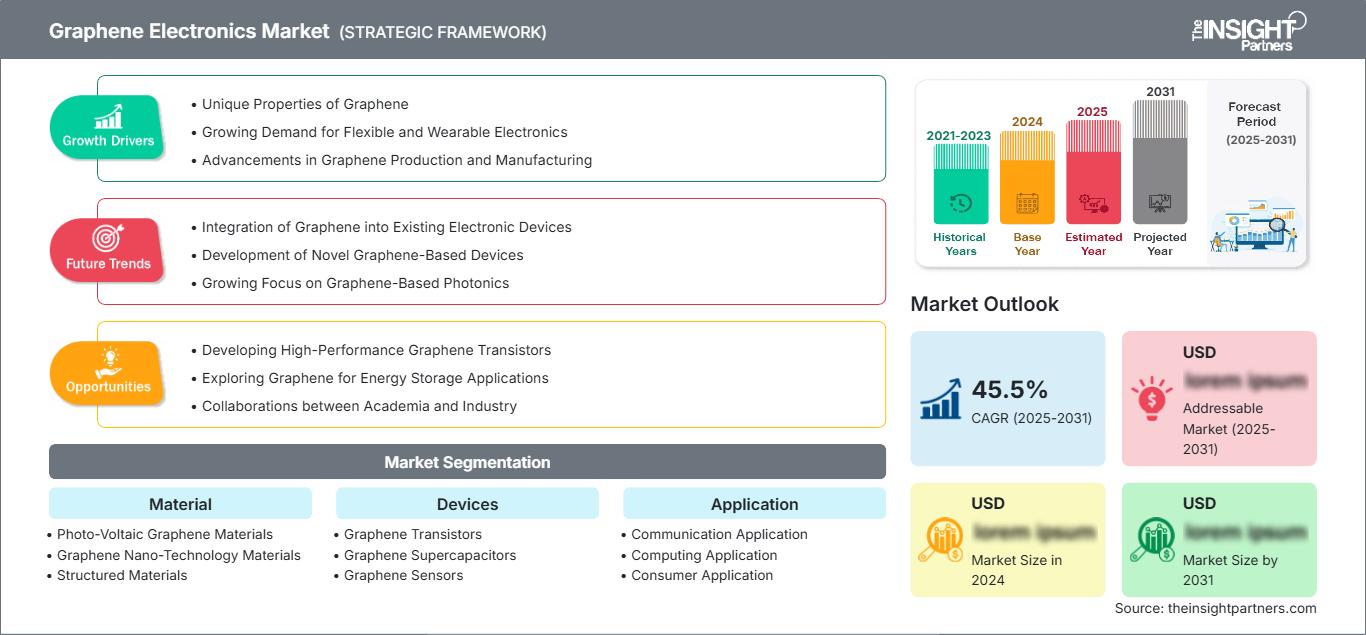
Graphene Electronics Market: Strategic Insights
Regional Insights
North America Graphene Electronics Market
North America held a modelled 31–34% Graphene Electronics Market share in 2025 and is projected to register a 40.0–43.0% CAGR through 2034. Commercial momentum comes from semiconductor research, biosensors, cryogenic measurement, aerospace, defense, electric vehicles, and thermal management. Foundry-oriented business models are improving access to graphene field-effect transistors and reference devices, reducing the engineering burden for universities, start-ups, and established electronics manufacturers.
In the region, a procurement climate that supports traceable materials, recorded uniform wafers, and application services within the vicinity exists. The federal semiconductor funding and advanced manufacturing programs enhance prototyping capabilities but adoption is subject to reliability information and compatibility with existing packaging technology. Research contributions and nanomaterials knowledge from Canada, as well as electronic manufacturing know-how from Mexico, are provided. Suppliers able to span both material creation and device verification will benefit from repeated design successes.
U.S. Graphene Electronics Market
In 2025, the U.S. was responsible for 81-84% of North America's market, and is projected to grow at a CAGR of 40.5-43.5% during 2026-2034. Areas of application include quantum computing instrumentation, medical and environmental sensors, radio frequency study, energy storage systems, defense electronics, and thermal interfaces. Companies that are involved in graphene-related business or have research activities in graphene include Graphene Laboratories, Inc., Graphenea Inc., GrafTech International Ltd., and Samsung Electronics Co., Ltd.
Development of applications has shifted from individual samples to GFET-based configurations, dispersions, coatings, and sensors. Customers value reliability of performance, packaging compatibility, and reference data over theoretical performance. Start-ups based on university research and specialty foundries speed up commercialization process, whereas leading electronics companies give an opportunity to find scalable solutions. Long qualification processes become a limitation factor particularly in healthcare, automotive, aerospace, and defense industries.
Europe Graphene Electronics Market
The modeled market share of Europe was estimated at 25-28% in 2025 and is forecast to show a CAGR of 39.0-42.0% until 2034. The leading country by commercialisation is the UK through materials firms, sensor fabs, and University of Manchester community. Germany brings to the market semiconductor equipment, automotive electronics, metrology, and industrial customers with a high need for graphene sensors, thermal management, and conductive materials.
France provides microelectronics, photonics, aerospace, and R&D, Italy is represented by printed electronics and advanced materials, and Spain is known for nanoscience together with graphene fabs. Pilot lines supported by EU grants make access easier for multi-project wafers and facilitate process standardisation. Commercial development will rely on the qualification of demonstrators, where the key will be the combined position of materials suppliers with manufacturing and application testing.
APAC Graphene Electronics Market
The Asia-Pacific region had an estimated share of 34-37% in 2025 and is expected to post a growth rate of 44.0-47.0% CAGR, which is the fastest amongst all regions. China dominates on the strength of scale in electronics, battery, display, and material processing capabilities. South Korea adds semiconductors and consumer devices, Japan offers its strengths in precision materials and sensors, and India is building its capabilities in advanced electronics.
Australia provides graphite ore, university research, and supercapacitors. Domestic policy efforts towards semiconductor and clean energy development, together with contract manufacturing, provide multiple avenues for scaling. Its strength lies in the density of its ecosystem, although suppliers have to maintain quality over large volumes and meet stringent yields, reliability, and cost targets of device manufacturers.
Middle East & Africa Graphene Electronics Market
Middle East and Africa should register a 37.0–40.0% CAGR through 2034. Saudi Arabia leads through industrial diversification, renewable energy, advanced materials, and electronics investment. The UAE is building research and commercialization links, while South Africa contributes mining, universities, and sensing applications.
Rest-of-MEA demand remains project-led, with opportunities in energy infrastructure, water monitoring, security, and harsh-environment sensing. Limited local foundry capacity and specialist service constrain adoption. Regional investors can reduce risk through partnerships, application laboratories, and pilot production rather than immediate large-scale materials capacity.
Segmentation Analysis
Material
The Material segment is projected to grow at a 41.0–44.0% CAGR during 2026–2034. Graphene Electronics Market scope spans films, powders, inks, foams, heterostructures, and functionalized formulations. Adoption depends on matching purity, layer count, flake geometry, surface chemistry, conductivity, and transfer quality to each device architecture. Electronic Materials lead because validated wafers and device-grade films command premium value.
- Photo-Voltaic Graphene Materials support transparent electrodes, charge-transport layers, and flexible solar architectures, with strategic value tied to conductivity, optical transmission, coating uniformity, and scalable deposition.
- Graphene Nano-Technology Materials address nanoscale sensors, transistors, and hybrid structures, where controlled dimensions, clean interfaces, and reproducible electronic properties determine commercial suitability.
- Structured Materials include engineered films, foams, laminates, and patterned architectures that improve thermal pathways, mechanical stability, ion transport, or device integration.
- Electronic Materials occupy the leading position through device-grade wafers, films, and formulations used in sensing, radio-frequency, logic research, photonics, and packaging.
- Nanotechnology Materials serve research and emerging production requiring tailored surface area, functionalization, and compatibility with nanoscale fabrication, diagnostics, or deposition processes.
- Electric and, Conducting Materials support inks, electrodes, interconnects, antennas, and coatings, where low resistance, flexibility, printability, and adhesion influence adoption.
- Photovoltaic Materials are strategically relevant for lightweight, flexible, and transparent solar devices, but require stable interfaces, scalable coating methods, and durable encapsulation.
Devices
The Devices segment should expand at a 43.0–46.0% CAGR through 2034. Commercialization is strongest where graphene provides a differentiated sensing, power, thermal, or high-frequency function rather than replacing silicon directly. Device vendors increasingly offer reference chips and development kits to shorten prototyping. Graphene Sensors form the high-growth segment as biosensing, environmental monitoring, automotive, and cryogenic applications progress.
- Graphene Transistors target radio-frequency, sensing, optoelectronic, and experimental logic functions, with adoption governed by gating stability, contact resistance, passivation, and wafer uniformity.
- Graphene Supercapacitors combine rapid charging, high power, and long cycle life, creating strategic opportunities in transport, grid support, wearables, and backup systems.
- Graphene Sensors gain the strongest momentum through molecular, magnetic, gas, strain, and biosensing applications that exploit high surface sensitivity and compact form factors.
- Graphene Ics and Chips remain an emerging category centered on hybrid integration, foundry process flows, and specialized functions where silicon-compatible manufacturing can be demonstrated.
Application
The Application segment is expected to register a 42.0–45.0% CAGR during 2026–2034. Demand is distributed across communications, computing, consumer devices, storage, displays, sensing, and thermal management. Sensing leads near-term commercialization because graphene can deliver measurable performance without displacing complete semiconductor platforms. Longer-term value will emerge from hybrid integration with CMOS, photonics, batteries, and flexible substrates.
- Communication Application uses graphene in radio-frequency components, antennas, photodetectors, and modulators, where speed, bandwidth, compactness, and tunable conductivity can create differentiated performance.
- Computing Application centers on experimental transistors, interconnects, thermal interfaces, and quantum instrumentation, with commercialization dependent on integration yield and stable device behavior.
- Consumer Application includes wearables, flexible devices, fast-charging components, transparent conductors, and smart surfaces, where cost, durability, and manufacturability drive supplier selection.
- Data Storage Application explores conductive, magnetic, and thermal functions that can improve density, switching, or heat control in next-generation memory systems.
- Display and Touch Application targets transparent electrodes and flexible interfaces, balancing optical transmission, sheet resistance, bending durability, patterning, and large-area uniformity.
- Sensing Application Sector leads commercialization through biosensors, gas sensors, Hall sensors, and environmental devices that exploit graphene’s exposed surface and electrical responsiveness.
- Thermal Management Application addresses heat spreading in processors, batteries, power electronics, and displays, where thin, lightweight materials can reduce localized temperature rise.
Opportunity Snapshot
| Application | Revenue Contribution | Trend Tag | Adoption Stage |
| Communication Application | Medium | RF Integration | Emerging |
| Computing Application | Low | Hybrid Logic | Emerging |
| Consumer Application | High | Flexible Devices | Scaling |
| Data Storage Application | Low | Memory Interfaces | Emerging |
| Display and Touch Application | Medium | Transparent Electrodes | Scaling |
| Sensing Application Sector | High | GFET Sensing | Scaling |
| Thermal Management Application | High | Heat Spreading | Scaling |
| Other Applications | Low | Specialty Integration | Emerging |
Graphene Electronics Market Growth Drivers and Impact Analysis
Commercial Sensor Platforms Reduce Integration Barriers
The graphene field effect transistor providers are now making a change from selling just raw samples for research purposes to offering packaged transistors, reference boards, multiproject wafers, and customizable foundry services. The significance of this change in terms of cost and time savings will be huge as the process of evaluation of graphene becomes easier for biosensor developers, gas sensor developers, Hall sensor developers, and environmental monitoring experts. There would be a significant commercial benefit too as the users will only have to worry about the receptors, calibration, software, and certification while leaving the complexities of growing and transferring graphene on someone else.
Power Density and Thermal Constraints Intensify
The infrastructure of artificial intelligence, electric cars, smaller power electronics, and faster consumer electronic gadgets are placing more heat and power density into smaller spaces. The thermal conductivity and surface area characteristics of graphene make it suitable for thermal spreaders, thermal interface materials, conductive coatings, and high power electrodes. For the vendors, there is the added benefit of a larger addressable market beyond simply replacing transistors. There are formulating possibilities to incorporate graphene into plastics, inks, foils, and electrodes using existing manufacturing equipment. But the buyers need tangible benefits in the areas of heat reduction, resistance, weight savings, or charging speed.
Pilot Lines Create a Bridge to Semiconductor Manufacturing
Dedicated 2D-material pilot lines and multi-project wafer programs are giving device developers access to standardized fabrication without funding complete facilities. Shared runs distribute mask, process, and characterization costs across multiple customers, enabling faster iteration and comparable data. The market impact extends beyond research because pilot lines define practical design rules, contamination controls, transfer methods, and packaging interfaces. These capabilities can reveal which device concepts are manufacturable before large capital commitments. Foundries gain a pipeline of qualified processes, while materials suppliers receive clearer specifications. Successful programs may also reduce geographic concentration by enabling regional semiconductor ecosystems to test graphene alongside conventional materials.
Graphene Electronics Market Future Trends
Transfer-Free and Wafer-Scale Integration
Graphene Electronics Market trends will increasingly focus on direct growth, cleaner transfer, larger wafers, and process modules compatible with semiconductor contamination rules. Reducing wrinkles, residues, grain boundaries, and alignment errors is essential for reproducible electrical behavior. Future platforms will combine graphene with silicon, compound semiconductors, photonics, and insulating 2D layers rather than positioning it as a universal replacement. Foundries will package validated steps into repeatable flows, allowing designers to purchase performance instead of developing materials expertise. The winning suppliers will document uniformity across wafers and lots, not only peak results from individual devices.
Graphene-CMOS Sensing Systems
Future sensor products will place graphene transducers directly above or beside CMOS readout, calibration, memory, and connectivity circuits. This architecture preserves graphene’s surface sensitivity while using established electronics for signal conditioning and digital interfaces. Integrated platforms should reduce system size, noise, assembly complexity, and customer development time. They will also enable multiplexed arrays that detect several biomarkers, gases, ions, or magnetic conditions on one chip. Commercial success depends on stable passivation, reference channels, functionalization workflows, and scalable packaging. As these elements mature, value will migrate from standalone graphene devices toward complete sensing subsystems.
Graphene Electronics Market Opportunities
Application-Specific Foundry and Qualification Services
Graphene Electronics Market Forecasts support investment in specialized foundry services that package material selection, device fabrication, functionalization, testing, and reliability evidence for defined applications. Investors should prioritize platforms serving molecular sensing, cryogenics, radio-frequency devices, photonics, or thermal interfaces rather than general-purpose capacity. Shared process design kits and reference devices can convert custom engineering into repeatable revenue. Partnerships with CMOS foundries, packaging houses, universities, and certification laboratories will shorten commercialization. The opportunity is attractive because customers pay for reduced technical risk and faster qualification, while the foundry accumulates reusable know-how across programs without competing directly in every end market.
Fast-Charging Storage and Pulsed-Power Systems
Graphene-based supercapacitors create an investable opportunity where rapid charge, high power, and long cycling matter more than maximum energy density. Priority applications include regenerative braking, grid stabilization, data-center backup, industrial actuators, drones, wearables, and power buffering beside batteries. Developers should target complete electrode systems, scalable thermal treatment, electrolyte compatibility, and pouch-cell validation rather than material performance alone. Joint development with equipment manufacturers can generate application-specific requirements and reference deployments. Commercial advantage will depend on demonstrating cost per delivered power, safety, lifetime, and manufacturability against activated-carbon supercapacitors and lithium-ion alternatives.
Recent Developments
- August 2026: Graphene Manufacturing Group Ltd is pleased to provide the latest progress update on the next generation graphene battery technology being developed by GMG and the University of Queensland (“UQ”) under a Joint Development Agreement with Rio Tinto, one of the world’s largest metals and mining groups, and with the support of the Battery Innovation Center of Indiana (“BIC”) in the United States of America. This new branding refers to the safe and fast charging nature of the Company’s batteries and how the Graphene is used to enhance their performance and cycle life.
- November 2025: Graphenea Semiconductor S.L. announced a strategic collaboration with Melexis to accelerate evaluation of an integrated GFET-on-CMOS platform for biosensing. The initiative combines graphene transistors with semiconductor readout electronics and targets scalable diagnostic and environmental sensing, including biomarkers and PFAS detection –
- February 2025: Paragraf Limited detailed its graphene molecular sensor platform for ion sensing, environmental monitoring, and healthcare diagnostics. The directly deposited graphene approach is designed to avoid transfer-related defects and contamination, supporting more consistent field-effect sensing across demanding liquid and gas applications.
Frequently Asked Questions

- Comprehensive Market Sizing and Forecast Analysis
- Detailed Segmentation Analysis
- In-Depth Market Dynamics Assessment
- Regional and Country-Level Insights
- Competitive Landscape and Company Benchmarking
- Strategic Business Intelligence
Recent Reports
Testimonials

The Insight Partners' SCADA System Market report is comprehensive, with valuable insights on current trends and future forecasts. The team was highly professional, responsive, and supportive throughout. We are very satisfied and highly recommend their services.
RAN KEDEM Partner, Reali Technologies LTDs
I requested a report on a very specific software market and the team produced the report in a few days. The information was very relevant and well presented. I then requested some changes and additions to the report. The team was again very responsive and I got the final report in less than a week.
JEAN-HERVE JENN Chairman, Future Analytica
We worked with The Insight Partners for an important market study and forecast. They gave us clear insights into opportunities and risks, which helped shape our plans. Their research was easy to use and based on solid data. It helped us make smart, confident decisions. We highly recommend them.
PIYUSH NAGPAL Sr. Vice President, High Beam Global
The Insight Partners delivered insightful, well-structured market research with strong domain expertise. Their team was professional and responsive throughout. The user-friendly website made accessing industry reports seamless. We highly recommend them for reliable, high-quality research services
YUKIHIKO ADACHI CEO, Deep Blue, LLC.
This is the first time I have purchased a market report from The Insight Partners.While I was unsure at first, I visited their web site and felt more comfortable to take the risk and purchase a market report.I am completely satisfied with the quality of the report and customer service. I had several questions and comments with the initial report, but after a couple of dialogs over email with their analyst I believe I have a report that I can use as input to our strategic planning process.Thank you so much for taking the extra time and making this a positive experience.I will definitely recommend your service to others and you will be my first call when we need further market data.
JOHN SUZUKI President and Chief Executive Officer, Board Director, BK Technologies
I wish to appreciate your support and the professionalism you displayed in the course of attending to my request for information regarding to infectious disease IVD market in Nigeria. I appreciate your patience, your guidance, and the fact that you were willing to offer a discount, which eventually made it possible for us to close a deal. I look forward to engaging The Insight Partners in the future, all thanks to the impression you have created in me as a result of this first encounter.
DR CHIJIOKE ONYIA MANAGING DIRECTOR, PineCrest Healthcare Ltd.Reason to Buy
- Informed Decision-Making
- Understanding Market Dynamics
- Competitive Analysis
- Identifying Emerging Markets
- Customer Insights
- Market Forecasts
- Risk Mitigation
- Boosting Operational Efficiency
- Strategic Planning
- Investment Justification
- Tracking Industry Innovations
- Aligning with Regulatory Trends





 Get Free Sample for