
Hardware Accelerators Market Demand, Share & Growth by 2034
Coverage: By Type (Graphics Processing Unit, Video Processing Unit, AI Accelerator, Regular Expression accelerator, Cryptographic Accelerator, Others); Application (Deep Learning Training, Public Cloud Inference, Enterprise Inference, Others); End User (IT and Telecommunication, BFSI, Retail, Hospitality, Logistics, Automotive, Healthcare, Energy, Others) , and Geography (North America, Europe, Asia Pacific, and South and Central America)
- Status : Data Released
- Report Code : TIPRE00017726
- Category : Electronics and Semiconductor
- No. of Pages : 150
- Available Report Formats :


- Last update date : August 18, 2026


2025 Market Size
US$ 9.96 Bn
Base year value
2034 Forecast
US$ 35.42 Bn
Projected by 2034
CAGR 2026-2034
15.14 %
Growth rate
Addressable Market
US$ 193.65 Bn
(2026-2034)
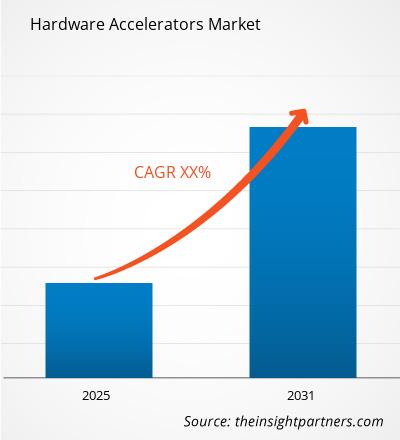
The Hardware Accelerators Market was valued at US$ 9.96 Billion in 2025 and is projected to reach US$ 35.42 Billion by 2034, registering a compound annual growth rate (CAGR) of 15.14% from 2026 to 2034. The market encompasses specialized hardware components designed to offload compute-intensive tasks from general-purpose CPUs, including graphics processing units, AI accelerators, video processing units, and cryptographic accelerators. Growing adoption of artificial intelligence workloads, deep learning training, and cloud-based inference continues to drive sustained market expansion across data centers and enterprise IT environments.
North America represents a substantial revenue base for the Hardware Accelerators Market size, with the region estimated to account for approximately 43–47% of global revenues in 2025. The regional market is expected to expand at a CAGR of 13.5–15.5% through 2034, supported by massive hyperscaler investments, robust AI infrastructure spending, and the presence of leading semiconductor manufacturers. Strong demand from data centers, cloud service providers, and enterprise AI deployments continues to reinforce North America's dominant market position.
Hardware Accelerators Market Assessment and Insights
- North America – Estimated to hold approximately 43–47% share of the global Market in 2025, driven by massive hyperscaler investments and strong AI infrastructure spending. The region is projected to grow at a CAGR of 13.5–15.5% from 2026 to 2034.
- US – The United States accounts for approximately 85–90% of North America Market revenues in 2025. The market is anticipated to expand at a CAGR of 13–15% through 2034, underpinned by data center expansions and enterprise AI adoption.
- Europe – Europe represents an estimated 22–26% share of the global market in 2025, with the UK, Germany, and France as leading national markets. The regional market is projected to grow at a CAGR of 12–14% from 2026 to 2034.
- Asia Pacific – Asia Pacific is estimated to account for approximately 24–28% of Market revenues in 2025. The region is expected to register the fastest growth at a CAGR of 15–17% through 2034, led by China, Japan, and India.
- Largest Segment – Graphics Processing Units (GPUs) represent the largest product segment, accounting for an estimated 55–60% of global market share in 2025, with a projected CAGR of 14–16% from 2026 to 2034.
- High Growth Segment – AI Accelerators are the fastest-growing segment, with an estimated market share of 18–22% in 2025 and a projected CAGR of 18–20% from 2026 to 2034.
- Key companies analyzed in detail – Achronix Semiconductor Corporation, Advanced Micro Devices, Inc., Cisco Systems, Inc., Hewlett Packard Enterprise Development LP, Intel Corporation, NVIDIA Corporation, Oracle Corporation, Revvx Hardware Accelerator, VMware, Inc., Xilinx
Source: The Insight Partners' analysis based on proprietary research, government publications, company annual reports, investor presentations, industry databases, and expert interviews.
The Hardware Accelerators Market has undergone a fundamental transformation from general-purpose computing architectures toward specialized, workload-optimized silicon designed for AI, machine learning, and high-performance computing applications. The improvements in semiconductor production through reduced process nodes and advanced packaging have resulted in unparalleled performance while also being more power-efficient. The differentiation of hardware accelerators is now happening based on software ecosystems and platform integration, allowing more ease for developers to use accelerators within cloud, enterprise, and edge computing deployments. Due to the shift towards a heterogeneous architecture where there are CPUs, GPUs, AI accelerators, and FPGAs, the competitive dynamics are changing.
Moving forward, the Market is poised for strong growth owing to the increase in demand for computing power from generative AI workloads and large language models. Increased adoption of AI by enterprises across various sectors including healthcare, automotive, and finance is also anticipated to result in other demand drivers for inference and training hardware accelerators. Investments by the government in semiconductor manufacturing and AI infrastructure in the United States, Europe, and Asia Pacific will support growth in the market. The combination of hardware acceleration with edge computing, autonomous vehicles, and quantum computing will lead to new frontiers in specialized processor architecture.
Hardware Accelerators Market Report Scope
| Report Attribute | Details |
|---|---|
| Market size in 2025 | US$ 9.96 Billion |
| Market Size by 2034 | US$ 35.42 Billion |
| Global CAGR (2026 - 2034) | 15.14% |
| Historical Data | 2021-2024 |
| Forecast period | 2026-2034 |
Hardware Accelerators Market Analysis
The Growth of the Hardware Accelerators Market can be attributed to the increasing need for powerful computing capabilities that will provide artificial intelligence and machine learning capabilities. Currently, more than 65% of machine learning training operations require dedicated hardware accelerators compared to the traditional CPU architecture, indicating a paradigm shift towards dedicated computing platforms. The rise in the use of generative AI models, large language models, and deep learning models has led to an increasing demand for GPU and AI accelerators with data centers and cloud providers allocating billions of dollars to the development of accelerators infrastructure. In addition, the enterprise-level adoption of AI in various sectors, such as healthcare, automotive, retail, and finance is driving demand for accelerators as enterprises implement AI-powered applications for fraud detection, autonomous vehicles, recommendation systems, and predictive analytics. The increasing complexity of AI models in terms of parameters from millions to trillions further increases the demand for accelerators.
In terms of competition, the Hardware Accelerators Market report points to a highly consolidated supply side where only a few incumbent semiconductor vendors have managed to secure market positions. NVIDIA Corporation holds the leading market position within the GPU accelerator segment thanks to its highly developed CUDA software ecosystem and ongoing hardware innovations. Advanced Micro Devices, Inc. has made considerable progress by virtue of its Instinct line of AI accelerators, whereas Intel Corporation is working towards increasing its presence in the market with its Gaudi AI accelerators and FPGAs. The total market share of the top three competitors (NVIDIA, AMD, and Intel) comes to roughly 85-90%. Competitive forces are increasingly moving in the direction of software differentiation and locking-in the customer into vendor's ecosystem. Indeed, each of the main vendors develops proprietary software programming frameworks, libraries, and tools that add up to switching costs of the customers from one supplier to another. In terms of investment activity, there is an apparent trend towards development of custom silicon, exemplified by the initiatives of major hyperscalers like Google (with TPUs), Amazon (with Trainium), and Microsoft (with Maia).
● REPORT CUSTOMIZATION
Tailor This Report To Align With Your Specific Business Requirements
This report can be customized to align precisely with your business objectives, scope, and target markets. Customization options include tailored segmentation, geography, competitive analysis, and strategic insights to support informed decision-making.
Customize This Report →WHAT YOU CAN ADJUST
- ● Segmentations
- ● Geography
- ● Competitive Analysis
- ● Language Preferences
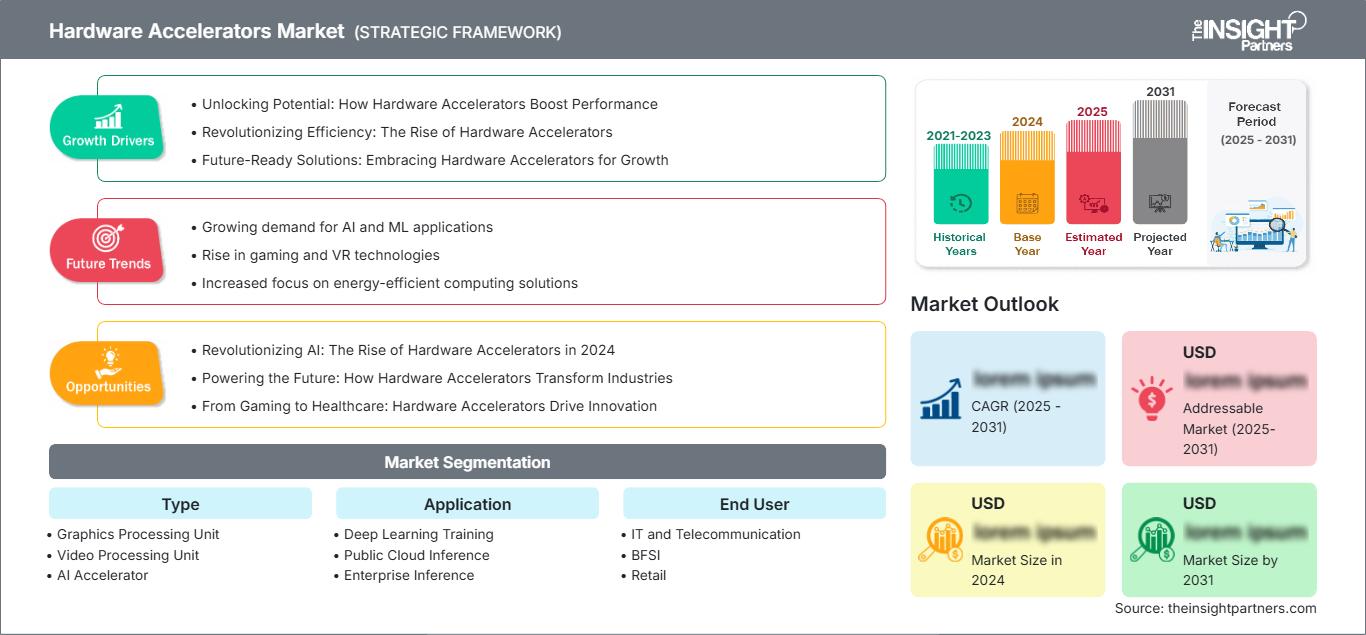
Hardware Accelerators Market: Strategic Insights
Regional Insights
North America Hardware Accelerators Market
The North American region made up of 43-47% of the global Hardware Accelerators Market share in 2025 due to the prominence of the region as the epicenter of the world in regards to AI research, cloud computing, and semiconductor innovations. The region's growth rate in terms of CAGR was forecasted to be 13.5-15.5% between 2026 and 2034. The huge investment by hyperscale cloud service providers like Amazon Web Services, Microsoft Azure, and Google Cloud in accelerating infrastructure was propelling the growth of the market, with expansion of data centers in places like Virginia, Texas, and Pacific Northwest helping meet the rising demand for more computer capacity. The United States dominated the region, with silicon valley, Seattle, and Austin as leading centers for AI accelerators. Investments by the government of Canada in AI research and data centers in Toronto and Vancouver were boosting the growth of Canada in the market. Leading accelerators such as NVIDIA, AMD, and Intel, alongside the presence of extensive R&D infrastructure and venture capital investment in AI startups, was also contributing to the dominant market share of the region.
U.S. Hardware Accelerators Market
The US has a dominant presence in the North America Hardware Accelerators Market, with an estimated revenue share of 85%-90% of the region in 2025. The forecasted Compound Annual Growth Rate (CAGR) for the U.S. market will be 13%-15% for the period between 2026 and 2034. The major demand factors in the North America region are investments in huge data center infrastructures, AI implementation in enterprises, and government policies promoting semiconductor manufacturing in the region. The large technology portfolios and collaborations with the cloud providers for market vendors like NVIDIA, AMD, Intel, and Hewlett Packard Enterprise make up their dominant presence in the market. The increased adoption of hardware accelerators for AI in the enterprise inference tasks and edge computing infrastructure is driving the market forward.
Europe Hardware Accelerators Market
Europe had an estimate of 22-26% of the total market share in 2025 with a regional market expected to experience a CAGR of 12-14% between 2026 and 2034. The UK dominates the European market, fueled by strong research centers specializing in AI and investments in data centers and AI. Germany is the second biggest market in Europe, experiencing demand from the automobile and manufacturing industry for use of hardware accelerators in developing AI-driven products such as autonomous cars and AI-driven industrial processes. In France and Italy, there is increased usage of hardware accelerators in healthcare and finance industries, whereas in Spain, the market enjoys the increase in cloud infrastructure investment and AI research.
APAC Hardware Accelerators Market
Asia Pacific is projected to have a share of around 24–28% of the Market in 2025 and will experience the fastest regional growth with a CAGR of 15–17% during 2026–2034. China continues to be the dominant market, owing to heavy investments by the country's government into AI and semiconductor self-sufficiency. Countries such as Japan and South Korea are contributing towards the market through the use of advanced technology in the automotive, electronics, and manufacturing industries. India is poised to be one of the fast-growing markets in the region owing to factors such as increasing investments in cloud infrastructure, rising number of experts in AI, and government measures towards digital transformation.
Middle East & Africa Hardware Accelerators Market
In terms of market size, the Middle East & Africa is a small yet growing share of the total Hardware Accelerators Market and has a projected CAGR of 11–13% during the forecast period from 2026 to 2034. Markets such as Saudi Arabia and the UAE are leading the pack owing to investments being made in the infrastructure for AI, smart cities, and government digitalization programs. In the case of South Africa, growth in the Hardware Accelerators Market can be attributed to the use of AI in enterprises along with investments in data centers in financial services and telecommunication industries. The remaining part of the region, including countries like Egypt and Kenya, shows steady adoption of Hardware Accelerators.
Segmentation Analysis
Type
The Hardware Accelerators Market scope encompasses segmentation by type into Graphics Processing Unit, Video Processing Unit, AI Accelerator, Regular Expression accelerator, and Cryptographic Accelerator. Graphics Processing Units dominate the market with an estimated 55–60% share in 2025, driven by their superior parallel processing capabilities for AI training and inference workloads. The segment is projected to grow at a CAGR of 14–16% from 2026 to 2034. AI Accelerators represent the fastest-growing category with a projected CAGR of 18–20%, fueled by increasing deployment of specialized silicon for machine learning and deep learning applications.
- Graphics Processing Unit – GPUs dominate the accelerator landscape with their massive parallel processing capabilities, making them ideal for AI training and HPC workloads. Their extensive software ecosystem and developer tools create significant switching costs for enterprise customers.
- Video Processing Unit – VPUs are specialized processors designed for video encoding, decoding, and image processing workloads. They are increasingly deployed in cloud gaming, video streaming, and computer vision applications where real-time processing is critical.
- AI Accelerator – AI accelerators are purpose-built silicon optimized for machine learning inference and training workloads. This segment is experiencing the fastest growth as enterprises deploy specialized hardware for AI applications.
- Regular Expression accelerator – RegEx accelerators are designed to accelerate pattern matching and regular expression processing, commonly used in network security, intrusion detection, and data analytics applications.
- Cryptographic Accelerator – Cryptographic accelerators provide hardware-accelerated encryption and decryption capabilities, critical for secure communications, blockchain, and data protection applications.
Application
The market is segmented by application into Deep Learning Training, Public Cloud Inference, and Enterprise Inference. Deep learning training represents the largest application segment, accounting for an estimated 38–42% of market revenues in 2025, driven by the massive computational requirements of training large language models and generative AI systems.
- Deep Learning Training – Training workloads require massive parallel compute capabilities for processing large datasets and iterating model parameters. This segment benefits from continuous model complexity growth and expanding AI research activities.
- Public Cloud Inference – Public cloud inference encompasses AI model deployment in cloud environments for serving predictions to end users. This segment benefits from growing cloud adoption and API-based AI service consumption.
- Enterprise Inference – Enterprise inference involves deploying AI models within private data centers and on-premises infrastructure. This segment is growing as organizations seek data sovereignty and reduced latency for business-critical AI applications.
End User
The Hardware Accelerators Market serves multiple end-user industries including IT and Telecommunication, BFSI, Retail, Hospitality, Logistics, Automotive, Healthcare, and Energy. IT and Telecommunication constitutes the largest end-user segment, accounting for an estimated 36–40% of market revenues in 2025, driven by data center expansions, cloud service provider investments, and telecommunications network modernization.
- IT and Telecommunication – This segment represents the primary market for hardware accelerators, encompassing cloud providers, data center operators, and telecommunications companies deploying AI for network optimization and service delivery.
- BFSI – Banking, financial services, and insurance institutions are adopting accelerators for fraud detection, algorithmic trading, risk analytics, and customer personalization applications requiring low-latency processing.
- Retail – Retail organizations deploy accelerators for inventory management, demand forecasting, personalized recommendations, and computer vision applications in stores and warehouses.
- Hospitality – Hospitality companies leverage accelerators for customer service automation, revenue management, and operational optimization through AI-powered analytics.
- Logistics – Logistics and supply chain organizations use accelerators for route optimization, demand forecasting, warehouse automation, and real-time tracking analytics.
- Automotive – Automotive manufacturers and autonomous vehicle developers deploy accelerators for sensor data processing, computer vision, and AI model training for advanced driver assistance systems.
- Healthcare – Healthcare organizations adopt accelerators for medical imaging analysis, drug discovery, genomic sequencing, and clinical decision support systems requiring high-performance compute.
- Energy – Energy companies leverage accelerators for predictive maintenance, resource exploration, grid optimization, and renewable energy forecasting applications.
Opportunity Snapshot
| End User | Revenue Contribution | Trend Tag | Adoption Stage |
|---|---|---|---|
| IT and Telecommunication | High | Cloud AI | Mature |
| BFSI | High | FinTech AI | Scaling |
| Retail | Medium | Personalization | Scaling |
| Hospitality | Low | Service AI | Emerging |
| Logistics | Medium | Supply Chain | Scaling |
| Automotive | Medium | Autonomous | Scaling |
| Healthcare | Medium | Medical AI | Scaling |
| Energy | Low | Grid Optimization | Emerging |
Hardware Accelerators Market Growth Drivers and Impact Analysis
Soaring Demand for AI and Machine Learning Compute Capacity
The exponential growth of artificial intelligence and machine learning workloads has created unprecedented demand for specialized hardware acceleration. Generative AI models, large language models, and deep learning frameworks require massive parallel compute capabilities that general-purpose CPUs cannot efficiently provide. AI model parameter counts have grown from millions to trillions in just a few years, with each generation demanding exponentially more compute capacity. Enterprises across industries are deploying AI applications for fraud detection, autonomous systems, personalized recommendations, and predictive analytics, driving sustained demand for GPU and AI accelerator infrastructure. Hyperscale cloud providers are investing billions annually in accelerator capacity to meet customer demand for AI-powered services.
Growing Enterprise AI Adoption Across Industries
The democratization of artificial intelligence through cloud-based AI services and open-source frameworks has accelerated enterprise AI adoption across virtually every industry vertical. Healthcare organizations are deploying accelerators for medical imaging analysis and drug discovery, automotive companies are using them for autonomous vehicle development, and financial institutions are leveraging them for fraud detection and algorithmic trading. The total addressable market for enterprise AI is expanding rapidly, with organizations recognizing that AI capabilities are essential for maintaining competitive advantage. This broad-based adoption is creating diversified demand for hardware accelerators across training, inference, and edge computing applications, reducing concentration risk and supporting sustainable market growth.
Government Investments in Semiconductor and AI Infrastructure
Governments worldwide are implementing policies and funding programs to strengthen domestic semiconductor manufacturing capabilities and AI research infrastructure. The United States CHIPS and Science Act, the European Chips Act, and similar initiatives in China, Japan, and India are catalyzing significant investments in semiconductor production capacity and AI research facilities. These government programs are reducing barriers to entry for new accelerator vendors, supporting R&D activities, and creating long-term demand visibility for hardware accelerator manufacturers. Additionally, government procurement of AI infrastructure for defense, research, and public sector applications is creating stable demand streams that complement commercial market dynamics.
Hardware Accelerators Market Future Trends
Rise of Custom Silicon and Domain-Specific Accelerators
The Hardware Accelerators Market trends indicate a significant shift toward custom silicon and domain-specific accelerators designed for specific workload types. Major cloud providers including Google (TPU), Amazon (Trainium and Inferentia), and Microsoft (Maia) are developing their own custom accelerators to optimize cost and performance for their specific workloads. This trend is extending to enterprise customers who are increasingly considering custom silicon solutions for their unique AI and data processing requirements. The growing availability of open-source chip design tools and reduced barriers to semiconductor manufacturing are enabling a new wave of specialized accelerator vendors targeting niche applications. This trend is expected to increase competition in the accelerator market and drive innovation in architectural approaches.
Convergence of AI Acceleration with Edge Computing and IoT
The deployment of AI capabilities at the edge, including IoT devices, autonomous systems, and edge data centers, is creating new opportunities for specialized hardware accelerators optimized for power-constrained environments. Edge AI accelerators are being designed with lower power consumption, reduced form factors, and enhanced security features to support real-time inference in applications including autonomous vehicles, smart cameras, industrial sensors, and consumer devices. The proliferation of 5G networks and the growing volume of data generated at the edge are driving demand for localized AI processing that reduces latency and bandwidth requirements. This trend is expanding the addressable market for hardware accelerators beyond traditional data centers and creating new product categories optimized for edge deployment scenarios.
Hardware Accelerators Market Opportunities
Expansion into Emerging Markets with Growing Digital Infrastructure
The Hardware Accelerators Market Forecasts indicate significant growth opportunities in emerging economies across Asia Pacific, Latin America, and Africa as these regions invest in digital infrastructure, cloud computing, and AI capabilities. Countries such as India, Indonesia, Brazil, and Mexico are witnessing rapid data center construction, expanding cloud service availability, and growing enterprise AI adoption driven by digital transformation initiatives. Government programs promoting AI research, semiconductor manufacturing, and technology innovation are creating favorable conditions for market entry. Vendors that develop cost-optimized accelerator solutions tailored to emerging market requirements, including power efficiency and thermal management considerations, are well-positioned to capture market share in these high-growth regions. Partnerships with local cloud providers, system integrators, and technology distributors will be critical for successful market penetration.
Development of Accelerators for Specialized AI Workloads
Beyond general-purpose GPU and AI accelerators, there is growing demand for specialized hardware optimized for specific AI workload types including large language model inference, computer vision, recommendation systems, and generative AI. Each workload has unique computational characteristics, memory bandwidth requirements, and latency constraints that can be addressed through purpose-built architectures. The rapid evolution of AI models is creating opportunities for vendors that can rapidly develop and deploy specialized accelerators for emerging workload types. Vendors that offer flexible, programmable accelerator architectures with robust software toolchains enabling workload optimization can differentiate themselves in an increasingly competitive market. Strategic partnerships with AI framework developers, model providers, and research institutions will enable the development of validated solutions that deliver measurable performance improvements for specific use cases.
Recent Developments
- March 2025: Australian Renewable Energy Agency (ARENA) — supported the selection of hardware-focused climate technology startups through its accelerator initiative. The program aims to help early-stage companies commercialize innovative hardware solutions addressing emissions reduction, renewable energy, and climate challenges by providing funding, mentorship, and market access support.
- July 2026: OGBC Group — launched its Global Hardware Accelerator in San Francisco to support next-generation hardware startups combining artificial intelligence innovation with global supply chain capabilities. The accelerator is designed to shorten product development cycles and help founders scale hardware technologies from research to commercialization.
- August 2026: Advanced Micro Devices, Inc. (AMD) — agreed to acquire Taalas, an AI chip startup specializing in dedicated inference silicon. The acquisition strengthens AMD’s AI accelerator roadmap by integrating Taalas’ specialized hardware technology with AMD Instinct GPUs and broader AI computing platforms to improve AI inference efficiency.
Frequently Asked Questions

- Comprehensive Market Sizing and Forecast Analysis
- Detailed Segmentation Analysis
- In-Depth Market Dynamics Assessment
- Regional and Country-Level Insights
- Competitive Landscape and Company Benchmarking
- Strategic Business Intelligence
Recent Reports
Testimonials

The Insight Partners' SCADA System Market report is comprehensive, with valuable insights on current trends and future forecasts. The team was highly professional, responsive, and supportive throughout. We are very satisfied and highly recommend their services.
RAN KEDEM Partner, Reali Technologies LTDs
I requested a report on a very specific software market and the team produced the report in a few days. The information was very relevant and well presented. I then requested some changes and additions to the report. The team was again very responsive and I got the final report in less than a week.
JEAN-HERVE JENN Chairman, Future Analytica
We worked with The Insight Partners for an important market study and forecast. They gave us clear insights into opportunities and risks, which helped shape our plans. Their research was easy to use and based on solid data. It helped us make smart, confident decisions. We highly recommend them.
PIYUSH NAGPAL Sr. Vice President, High Beam Global
The Insight Partners delivered insightful, well-structured market research with strong domain expertise. Their team was professional and responsive throughout. The user-friendly website made accessing industry reports seamless. We highly recommend them for reliable, high-quality research services
YUKIHIKO ADACHI CEO, Deep Blue, LLC.
This is the first time I have purchased a market report from The Insight Partners.While I was unsure at first, I visited their web site and felt more comfortable to take the risk and purchase a market report.I am completely satisfied with the quality of the report and customer service. I had several questions and comments with the initial report, but after a couple of dialogs over email with their analyst I believe I have a report that I can use as input to our strategic planning process.Thank you so much for taking the extra time and making this a positive experience.I will definitely recommend your service to others and you will be my first call when we need further market data.
JOHN SUZUKI President and Chief Executive Officer, Board Director, BK Technologies
I wish to appreciate your support and the professionalism you displayed in the course of attending to my request for information regarding to infectious disease IVD market in Nigeria. I appreciate your patience, your guidance, and the fact that you were willing to offer a discount, which eventually made it possible for us to close a deal. I look forward to engaging The Insight Partners in the future, all thanks to the impression you have created in me as a result of this first encounter.
DR CHIJIOKE ONYIA MANAGING DIRECTOR, PineCrest Healthcare Ltd.Reason to Buy
- Informed Decision-Making
- Understanding Market Dynamics
- Competitive Analysis
- Identifying Emerging Markets
- Customer Insights
- Market Forecasts
- Risk Mitigation
- Boosting Operational Efficiency
- Strategic Planning
- Investment Justification
- Tracking Industry Innovations
- Aligning with Regulatory Trends





 Get Free Sample for