
High-Speed Board-to-Board Connectors Market Size, Growth & Demand by 2034
Coverage: By Type (Below 1.00 mm, 1.00 mm-2.00 mm, Above 2.00 mm); Application (Transportation, Consumer Electronics, Communications, Industries, Military, Others) , and Geography (North America, Europe, Asia Pacific, and South and Central America)
- Status : Data Released
- Report Code : TIPRE00017146
- Category : Electronics and Semiconductor
- No. of Pages : 150
- Available Report Formats :


- Last update date : August 25, 2026


2025 Market Size
US$ 2.7 Bn
Base year value
2034 Forecast
US$ 4.17 Bn
Projected by 2034
CAGR 2026-2034
4.94 %
Growth rate
Addressable Market
US$ 31.17 Bn
(2026-2034)
The High-Speed Board-to-Board Connectors Market size was valued at US$ 2.7 billion in 2025 and is projected to reach US$ 4.17 billion by 2034 at a CAGR of 4.94% in the forecast period of 2026–2034. Market demand is driven by the requirement for small-sized electronics, AI servers, 5G radio unit equipment, ADAS technology, and ruggedized embedded systems, which need controlled impedance, low insertion loss, and proper mechanical alignment between PCBs.
It is anticipated that North America will continue to be one of the most technically challenging regions, with a CAGR of 4.6% to 5.2%. In terms of market size, the growth of the High-Speed Board-to-Board Connectors Market is driven by domestic data centers, defense electronics refresh cycles, and automotive computing platforms.
High-Speed Board-to-Board Connectors Market Assessment and Insights
- North America accounted for 30–33% share in 2025 and is projected to grow at a CAGR range of 4.6–5.2% during 2026–2034, supported by AI infrastructure, aerospace electronics, and defense modernization.
- US represented 78–82% of North America in 2025 and is expected to expand at a 4.7–5.3% CAGR range, led by hyperscale computing and military electronics.
- Europe held 20–23% share in 2025 and is forecast to grow at 4.1–4.7% CAGR, with Germany, the UK, and France leading adoption in automotive, industrial, and aerospace electronics.
- Asia Pacific captured 36–39% share in 2025 and is expected to record a 5.2–5.8% CAGR range, driven by China, Japan, South Korea, and India electronics manufacturing ecosystems.
- Largest Segment Communications held 34–37% market share in 2025 and is projected to grow at a 5.0–5.6% CAGR range, supported by 5G, switches, routers, and AI servers.
- High Growth Segment Transportation represented 19–22% share in 2025 and is expected to expand at a 5.4–6.0% CAGR range as vehicle electronics density rises.
- Key companies analyzed in detail: Amphenol Corporation, ERNI Deutschland GmbH, Hon Hai Precision Industry Co., Ltd., HARTING Technology Group, HIROSE ELECTRIC CO., LTD., Japan Solderless Terminal Mfg. Co., Ltd., Molex, LLC, Samtec, Inc., TE Connectivity plc, Yamaichi Electronics Co., Ltd.
Source: The Insight Partners' analysis based on proprietary research, government publications, company annual reports, investor presentations, industry databases, and expert interviews.
Product architectures are transitioning away from traditional mezzanine connections to low-loss, high-pin-count arrays that allow for PAM4, PCIe upgrades, and coplanarity requirements. Automated assembly, molding, and simulation-driven validation are being pursued by manufacturers due to connector failures limiting board density, thermal design, and availability. High-speed board-to-board connectors market growth is a direct result of the move from commodity connector selection to qualified signal paths.
Between now and 2034, demand will expand in India, Southeast Asia, Mexico, and Eastern Europe as electronics manufacturing moves closer to end-user regions. Government funding for semiconductor package design, communications infrastructure, and military electronics will enhance the ability of these regions to qualify components. The focus on standards-based safety in automotive and aerospace will give preference to companies with traceability, high-temperature capability, and application expertise.
High-Speed Board-to-Board Connectors Market Report Scope
| Report Attribute | Details |
|---|---|
| Market size in 2025 | US$ 2.7 Billion |
| Market Size by 2034 | US$ 4.17 Billion |
| Global CAGR (2026 - 2034) | 4.94% |
| Historical Data | 2021-2024 |
| Forecast period | 2026-2034 |
High-Speed Board-to-Board Connectors Market Analysis
Pull factors behind the demand for such systems include increased amounts of processing carried out within shrinking physical spaces. Artificial Intelligence accelerators, 5G baseband processors, driver assistance controllers, and industrial vision systems all require reliable connections within small printed circuit boards. The analysis provided in this High-Speed Board-to-Board Connectors market report highlights how buyers now focus on impedance matching, durability, stacking, and manufacturing capability instead of viewing connectors as an afterthought.
The value chain consists of copper alloy producers, stamping companies, resin compound producers, plating companies, connector producers, distributors, EMS companies, and OEM engineering departments. Supply dynamics are still influenced by the cost of gold plating, high temperature polymers, and varying regional demand. Thus, dual sourcing and lifecycle considerations become critical criteria.
In the High-Speed Board-to-Board Connectors market forecast, it is noted that the competitive landscape is dominated by vendors capable of combining high-speed simulation, tooling accuracy, and worldwide qualification services. Amphenol Corporation, Molex, LLC, Samtec, Inc., TE Connectivity plc, and HIROSE ELECTRIC CO., LTD. are competing aggressively in the communications and computing domain, whereas ERNI Deutschland GmbH, HARTING Technology Group, and Yamaichi Electronics Co., Ltd. maintain their strengths in industrial and embedded domains.
Investments will be directed towards application-specific platforms, second sourcing programs, and regional manufacture expansion. Hon Hai Precision Industry Co., Ltd. and Japan Solderless Terminal Mfg. Co., Ltd. contribute to the depth of the ecosystem through electronics assembly volume and component specialization. The market share of top-tier vendors is secured by qualification cycles, although niche vendors may occupy niches where ruggedness or ultra-low profile become key considerations.
● REPORT CUSTOMIZATION
Tailor This Report To Align With Your Specific Business Requirements
This report can be customized to align precisely with your business objectives, scope, and target markets. Customization options include tailored segmentation, geography, competitive analysis, and strategic insights to support informed decision-making.
Customize This Report →WHAT YOU CAN ADJUST
- ● Segmentations
- ● Geography
- ● Competitive Analysis
- ● Language Preferences
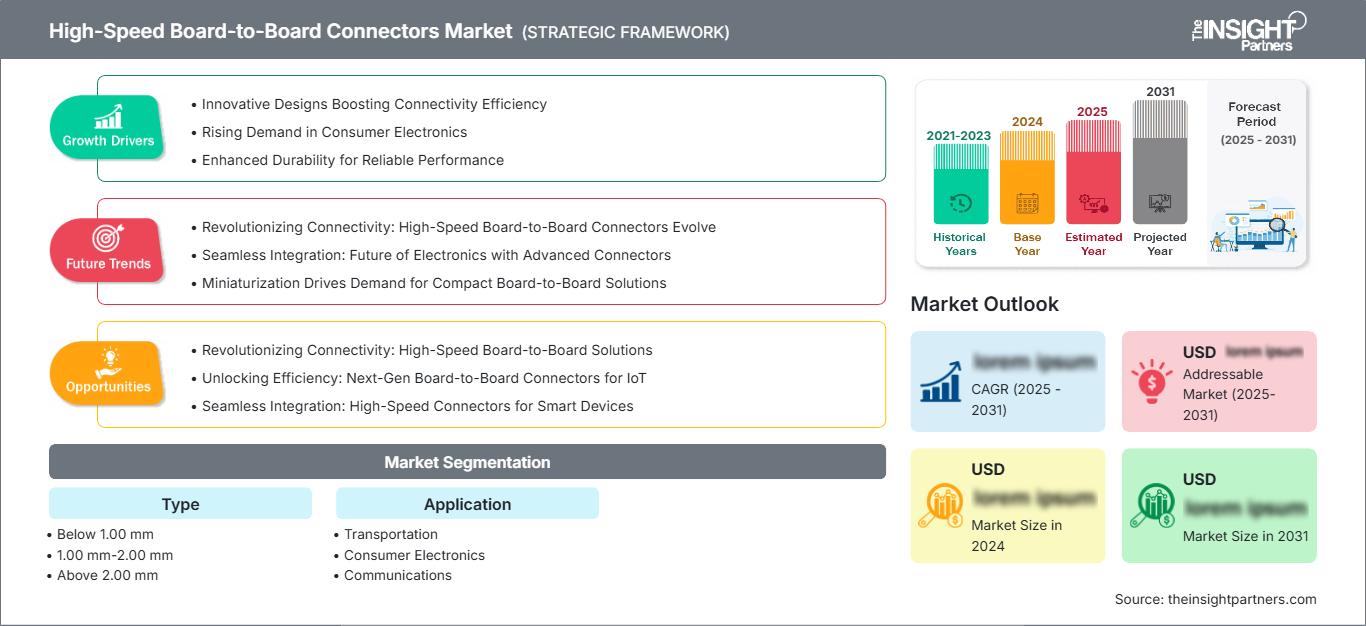
High-Speed Board-to-Board Connectors Market: Strategic Insights
Regional Insights
North America High-Speed Board-to-Board Connectors Market
North America represented 30–33% of global demand in 2025 and is projected to expand at a 4.6–5.2% CAGR through 2034. The region benefits from strong semiconductor design activity, hyperscale cloud investment, aerospace electronics programs, and military communications upgrades requiring qualified high-density interconnects.
The region’s High-Speed Board-to-Board Connectors Market share remains supported by stringent reliability expectations in rugged computing, avionics, medical electronics, and automotive testing platforms. OEMs favor suppliers offering local engineering support, second-source continuity, and proven signal-integrity models for compact assemblies.
U.S. High-Speed Board-to-Board Connectors Market
The U.S. accounted for 78–82% of North America in 2025 and is forecast to grow at a 4.7–5.3% CAGR range. Demand is concentrated in data center accelerators, satellite electronics, defense communication modules, medical imaging systems, and software-defined vehicle platforms.
Domestic presence from Amphenol Corporation, Molex, LLC, Samtec, Inc., and TE Connectivity plc helps shorten design cycles for high-reliability programs. Application trends point to higher-speed mezzanine connectors in networking equipment, validated rugged board stacks in defense electronics, and space-efficient interconnects in embedded automotive controllers.
Europe High-Speed Board-to-Board Connectors Market
Europe held 20–23% share in 2025 and is expected to grow at a 4.1–4.7% CAGR range through 2034. Germany leads regional consumption because premium automotive electronics, factory automation, and industrial controls require high vibration tolerance, stable pitch accuracy, and long-term supply continuity.
The UK contributes through aerospace, defense electronics, and communications testing platforms, where qualification traceability remains central. France, Italy, and Spain add demand from rail electronics, avionics, renewable energy converters, and industrial machinery, supporting diversified procurement across ERNI Deutschland GmbH, HARTING Technology Group, HIROSE ELECTRIC CO., LTD., and Yamaichi Electronics Co., Ltd.
APAC High-Speed Board-to-Board Connectors Market
Asia Pacific accounted for 36–39% share in 2025 and is forecast to expand at a 5.2–5.8% CAGR range. China remains the leading country by electronics assembly scale, while Japan and South Korea support demand through precision components, semiconductor tools, telecom equipment, and advanced consumer devices.
India and Australia add incremental growth through telecom infrastructure, defense electronics, transportation modernization, and industrial automation. Policy support for semiconductor packaging, domestic electronics manufacturing, and digital infrastructure encourages regional sourcing, making APAC the fastest-growing regional contributor for compact high-speed board interconnect systems.
Middle East & Africa High-Speed Board-to-Board Connectors Market
Middle East and Africa is projected to grow at a 3.8–4.4% CAGR range through 2034, with Saudi Arabia leading regional demand. Energy automation, data center construction, defense communication upgrades, and smart infrastructure projects create selective opportunities for ruggedized board-to-board connector platforms.
South Africa provides the principal sub-Saharan opportunity through telecommunications, industrial equipment, and transport systems. The rest of MEA is influenced by energy infrastructure, defense electronics, and modernization projects. Connector adoption is generally project-driven, with procurement emphasizing environmental durability, dependable supply, and compatibility with established electronic architectures rather than extensive product customization.
Segmentation Analysis
Type
Type segmentation is expected to expand at a CAGR of 4.8–5.4% between 2026–2034. Miniaturization remains central to purchasing decisions as manufacturers seek greater circuit density without increasing enclosure dimensions. The High-Speed Board-to-Board connectors Market scope increasingly favors fine-pitch architectures for portable electronics and high-density computing, while larger pitches retain relevance where mechanical robustness and power handling receive greater priority.
- Below 1.00 mm: Fine-pitch designs serve compact electronics, wearables, mobile equipment, and dense computing assemblies. Demand reflects pressure to reduce board footprint while retaining sufficient contact density and reliable mating performance.
- 1.00 mm-2.00 mm: Mid-pitch connectors balance density, mechanical tolerance, current capacity, and manufacturability. They remain important across industrial equipment, transportation electronics, communications systems, and applications requiring practical assembly conditions.
- Above 2.00 mm: Larger-pitch configurations support applications prioritizing mechanical strength, spacing, power capability, and easier assembly. Their position remains relevant in industrial, transportation, and specialized equipment with less severe packaging constraints.
Application
Application segmentation is projected to grow at a CAGR of 5.0–5.6% from 2026–2034. Demand differs according to bandwidth, mechanical environment, qualification requirements, and equipment life cycle. Communications and advanced computing applications favor high-density interconnects, while transportation and military systems emphasize reliability under vibration, temperature variation, and demanding operating conditions.
- Transportation: Vehicle and rail electronics require compact connections between control, sensing, infotainment, and power-management boards. Increasing electronic content strengthens demand for reliable interconnects capable of surviving vibration and thermal cycling.
- Consumer Electronics: Smartphones, wearables, gaming systems, laptops, and compact devices prioritize low-profile connectors. Manufacturers favor fine pitches that conserve internal space while maintaining reliable electrical and mechanical performance.
- Communications: Networking equipment, telecom hardware, servers, and data infrastructure require high-density signal paths. Connector designs supporting high bandwidth, controlled impedance, shielding, and efficient thermal packaging gain strategic importance.
- Industries: Industrial automation, robotics, instrumentation, and control equipment require durable PCB connections with repeatable assembly and long service life. Reliability and resistance to mechanical stress influence connector selection.
- Military: Defense electronics demand qualified interconnects capable of operating under vibration, shock, temperature variation, and electromagnetic constraints. Long product life cycles and controlled sourcing make reliability and continuity strategically important.
Opportunity Snapshot
| Application | Revenue Contribution | Trend Tag | Adoption Stage |
| Transportation | High | Vehicle Electronics | Scaling |
| Consumer Electronics | High | Device Miniaturization | Mature |
| Communications | High | AI Networking | Scaling |
| Industries | Medium | Factory Automation | Scaling |
| Military | Medium | Rugged Electronics | Mature |
High-Speed Board-to-Board Connectors Market Growth Drivers and Impact Analysis
Increasing Data Throughput Requirements in Computing Infrastructure
Increased computing loads have increased the significance of signal integrity at all interconnection points in servers, accelerators, storage devices, and network equipment. According to the International Energy Agency, world-wide electricity consumption by data centers will be expected to more than double by 2030 due to continued growth in digital infrastructure and AI loadings. Higher computing capacities mean more dense electronic designs, hence increased need for small board-to-board connectors with well-controlled electrical attributes. Impact on the market goes beyond just volume of connectors since buyers are now evaluating insertion loss, crosstalk, shielding, mechanical robustness, and thermal considerations. Those suppliers that qualify their products in line with new interface demands stand to benefit from design-in, while those not able to maintain signal integrity at high speeds risk being replaced.
Automotive Electronics Are Increasing Board-Level Interconnect Complexity
Vehicle architectures are becoming more electronically integrated as advanced driver assistance, infotainment, electrification, centralized computing, and zonal architectures increase the number of electronic control functions. This increases the need for connectors that work effectively in vibrating, thermal, electromagnetic, and packaging environments. The market effect becomes quite significant for fine pitch and floating connectors due to the requirement by automotive companies to accommodate assembly variances in addition to electrical continuity. Connector suppliers are thus spending on mechanical flexibility, shielding, sturdy contacts, and small sizes. The qualification process will also create somewhat high switching costs once the product is integrated into the vehicle model. This is where established automotive engineering and reliability experience become critical.
Miniaturization Is Raising the Value of Precision Interconnect Engineering
Miniaturization is changing connector design from a basic mechanical interface into a precision component of overall system architecture. With tighter pitches, there will be greater contact density even in limited spaces on a PCB, while at the same time, tighter tolerances are becoming sensitive to any variation in manufacturing processes, any contamination, proper mate positioning, and electrical interference. In response to this, there has been an improvement in manufacturers' equipment accuracy, inspection process, plating accuracy, and automation in assembly process. The market impact will be a trend towards the development of value-added engineered products compared to just standard parts. End users are now basing their selection of connectors on system-level considerations such as performance and reliability.
High-Speed Board-to-Board Connectors Market Future Trends
High-Density Mezzanine Architectures Will Move Toward Higher Bandwidth
The High-Speed Board-to-Board connectors Market trends point toward connector architectures designed for substantially higher data rates without proportional increases in footprint. Emerging designs will combine finer pitches, improved grounding, shorter electrical paths, optimized contact geometry, and better control of impedance discontinuities. PCI Express, CXL, Ethernet, and accelerator-oriented architectures will influence future connector specifications as computing platforms become increasingly modular. Designers are also likely to prioritize thermal compatibility and mechanical stability because higher-density systems generate greater localized heat and tighter packaging constraints. Connector vendors that integrate electrical simulation earlier into product development can shorten qualification cycles and improve design confidence. Over time, the boundary between conventional board connectors and specialized high-speed mezzanine interconnects will become less distinct as more electronic platforms require both density and bandwidth.
Integrated Signal Integrity and Mechanical Compliance Will Become Standard
Future product development will increasingly treat electrical, mechanical, and thermal characteristics as a single connector design problem. Floating structures can compensate for board misalignment, while optimized contact geometries help maintain stable electrical performance during repeated mating and vibration. At the same time, shielding structures will become more integrated into connector housings to control electromagnetic interference without adding bulky external components. Design tools will increasingly model connector behavior alongside PCB traces, packages, and system-level channels rather than evaluating the interconnect separately. This approach should improve first-pass performance and reduce costly redesigns. The High-Speed Board-to-Board connectors Market trends will therefore favor suppliers that combine materials science, mechanical engineering, electromagnetic modeling, and automated manufacturing capabilities within one development process.
High-Speed Board-to-Board Connectors Market Opportunities
Regionalized Supply Chains for Critical Electronic Interconnects
The High-Speed Board-to-Board connectors Forecasts indicate opportunities for suppliers that establish production and qualification capabilities closer to major electronics manufacturing clusters. Customers increasingly seek resilience against logistics disruptions, component shortages, tariffs, and extended qualification lead times. Regional manufacturing can reduce transportation exposure while improving engineering response and inventory availability. Asia Pacific remains central to electronics production, whereas North America and Europe offer opportunities for localized high-reliability manufacturing serving automotive, defense, aerospace, and advanced computing programs. Investment should prioritize flexible tooling, automated inspection, localized technical support, and dual-source qualification. Companies that combine global product consistency with regional manufacturing responsiveness can improve customer retention while reducing procurement risk for complex electronic platforms.
High-Reliability Interconnects for Electrification and Advanced Mobility
Vehicle electrification creates an opportunity for connector suppliers to expand beyond conventional signal interconnects into compact interfaces supporting increasingly integrated electronic modules. Electric vehicles, charging systems, power electronics, battery-management systems, domain controllers, and advanced sensing architectures require numerous connections within constrained spaces. The opportunity is strongest where connector designs can combine signal integrity with vibration resistance, thermal stability, assembly tolerance, and long service life. Suppliers can target design wins by collaborating earlier with automotive engineering teams and offering simulation, prototyping, qualification, and production support as an integrated service. A differentiated High-Speed Board-to-Board connectors Report should therefore assess automotive electronics not only by connector demand but also by architectural shifts that determine where PCB-to-PCB interfaces are technically preferable.
Recent Developments
- May 2026: IRISO Electronics Co., Ltd. — introduced a new connector product, expanding its high-speed connectivity portfolio for next-generation electronic applications.
- September 2025: KINSUN Industries Inc. — launched two new board-to-board connectors: a Quick Connect Daisy-Chain Connector supporting power and signal transmission for modular PCB expansion, and a High-Speed Data Board-to-Board Connector supporting up to 100 pins and data rates up to 10Gbps, with 0.5mm and 0.8mm pitch options.
- August 2025: ATTEND Technology Inc. — launched its Floating Board-to-Board Connector series with ±0.5mm X/Y misalignment compensation, 0.5mm pitch, up to 100 contacts and high-speed transmission up to 8 GT/s, targeting automotive electronics, industrial automation, AI/edge computing and other high-reliability applications.
Frequently Asked Questions

- Comprehensive Market Sizing and Forecast Analysis
- Detailed Segmentation Analysis
- In-Depth Market Dynamics Assessment
- Regional and Country-Level Insights
- Competitive Landscape and Company Benchmarking
- Strategic Business Intelligence
Recent Reports
Testimonials

The Insight Partners' SCADA System Market report is comprehensive, with valuable insights on current trends and future forecasts. The team was highly professional, responsive, and supportive throughout. We are very satisfied and highly recommend their services.
RAN KEDEM Partner, Reali Technologies LTDs
I requested a report on a very specific software market and the team produced the report in a few days. The information was very relevant and well presented. I then requested some changes and additions to the report. The team was again very responsive and I got the final report in less than a week.
JEAN-HERVE JENN Chairman, Future Analytica
We worked with The Insight Partners for an important market study and forecast. They gave us clear insights into opportunities and risks, which helped shape our plans. Their research was easy to use and based on solid data. It helped us make smart, confident decisions. We highly recommend them.
PIYUSH NAGPAL Sr. Vice President, High Beam Global
The Insight Partners delivered insightful, well-structured market research with strong domain expertise. Their team was professional and responsive throughout. The user-friendly website made accessing industry reports seamless. We highly recommend them for reliable, high-quality research services
YUKIHIKO ADACHI CEO, Deep Blue, LLC.
This is the first time I have purchased a market report from The Insight Partners.While I was unsure at first, I visited their web site and felt more comfortable to take the risk and purchase a market report.I am completely satisfied with the quality of the report and customer service. I had several questions and comments with the initial report, but after a couple of dialogs over email with their analyst I believe I have a report that I can use as input to our strategic planning process.Thank you so much for taking the extra time and making this a positive experience.I will definitely recommend your service to others and you will be my first call when we need further market data.
JOHN SUZUKI President and Chief Executive Officer, Board Director, BK Technologies
I wish to appreciate your support and the professionalism you displayed in the course of attending to my request for information regarding to infectious disease IVD market in Nigeria. I appreciate your patience, your guidance, and the fact that you were willing to offer a discount, which eventually made it possible for us to close a deal. I look forward to engaging The Insight Partners in the future, all thanks to the impression you have created in me as a result of this first encounter.
DR CHIJIOKE ONYIA MANAGING DIRECTOR, PineCrest Healthcare Ltd.Reason to Buy
- Informed Decision-Making
- Understanding Market Dynamics
- Competitive Analysis
- Identifying Emerging Markets
- Customer Insights
- Market Forecasts
- Risk Mitigation
- Boosting Operational Efficiency
- Strategic Planning
- Investment Justification
- Tracking Industry Innovations
- Aligning with Regulatory Trends





 Get Free Sample for