
High Speed Motors Market Share, Size & Demand by 2034
Coverage: By Product (Induction Motor, Permanent Magnet Motor, Others); Power Range (High Voltage, Low Voltage); Application (Machine Tools, Power Generation, Compressor, Bearings, Others), and Geography (North America, Europe, Asia Pacific, and South and Central America)
- Status : Data Released
- Report Code : TIPRE00014289
- Category : Electronics and Semiconductor
- No. of Pages : 150
- Available Report Formats :


- Last update date : September 10, 2026


2025 Market Size
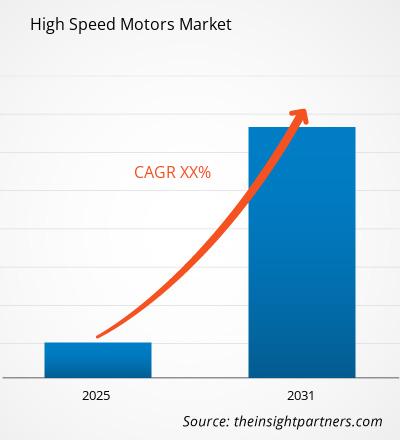
US$ 584.25 Mn
Base year value
2034 Forecast
US$ 701. Mn
Projected by 2034
CAGR 2026-2034
2.04 %
Growth rate
Addressable Market
US$ 5,824.84 Mn
(2026-2034)
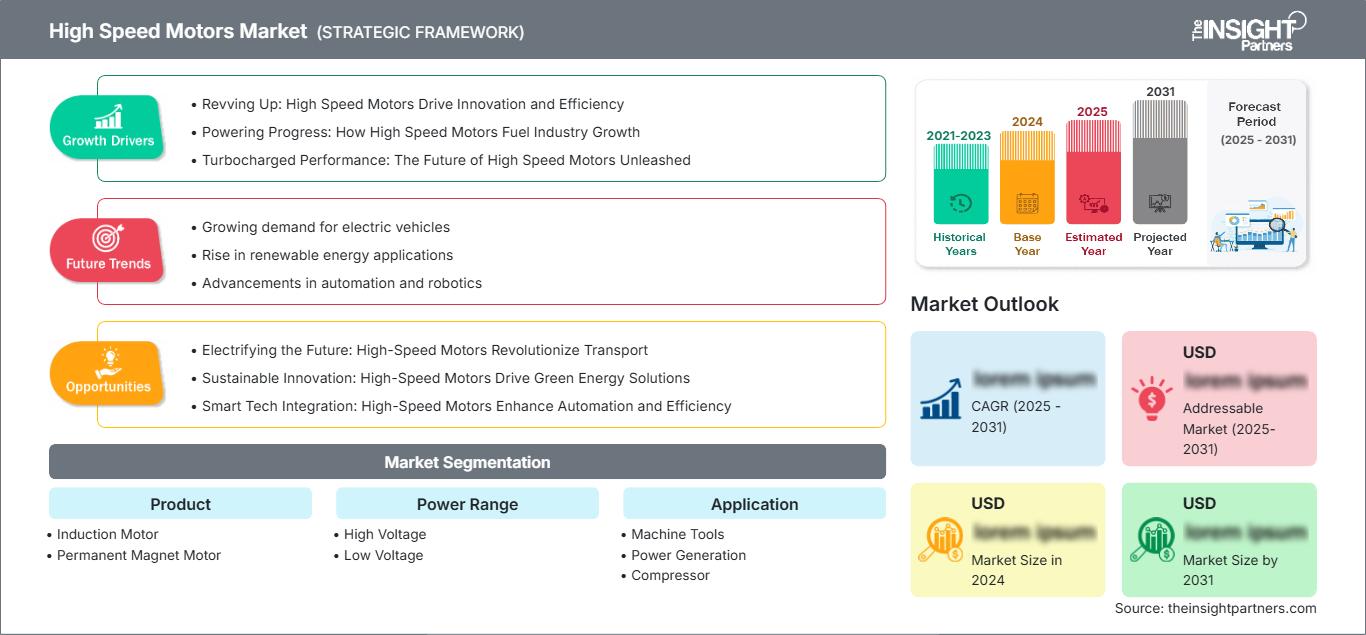
The High Speed Motors market is valued at US$ 584.25 Million in 2025 and is projected to reach US$ 701.0 Million by 2034, advancing at a CAGR of 2.04% from 2026 to 2034. The Market is on course for controlled growth owing to the preference of industrial end-users for small, efficient, high-speed drive solutions. Growth is underpinned by automation of machinery, compressor upgrades, and increased adoption of direct-drive solutions, which are more efficient due to reduced mechanical inefficiencies.
The High Speed Motors market size growth in North America is projected at an estimated rate of 2.4–3.0% CAGR between 2026 and 2034, driven by automation in industries, aircraft manufacturing, and upgrades to rotating machinery. Compressor applications continue to be important since high-speed electrical drives can help in minimizing the need for gearboxes, better control, and reduced maintenance exposure in process plants.
High Speed Motors Market Assessment and Insights
- North America: North America is estimated to hold a 27–31% share in 2025 and grow at a 2.4–3.0% CAGR between 2026–2034, supported by compressor upgrades, aerospace production, industrial automation, and replacement of mechanically coupled drive systems.
- US: The US represents approximately 22–25% of the global market in 2025, with a 2.5–3.1% CAGR between 2026–2034, driven by manufacturing modernization and energy-efficiency investments.
- Europe: Europe is estimated at 25–29% share in 2025, expanding at 2.1–2.7% CAGR between 2026–2034. Germany, Italy, France, and the UK remain important markets because of machinery manufacturing, process industries, and efficiency-oriented motor replacement programs.
- Asia Pacific: Asia Pacific accounts for approximately 31–35% share in 2025 and is expected to grow at 2.7–3.3% CAGR between 2026–2034. China, Japan, South Korea, and India benefit from machine-tool production, electronics manufacturing, industrial automation, and expanding compressor installations.
- Largest Segment: Permanent Magnet Motor is estimated at a 48–52% market share in 2025, supported by high power density and efficiency, with a 2.5–3.1% CAGR between 2026–2034.
- High Growth Segment: Machine Tools is estimated at a 24–28% market share in 2025, with a 3.0–3.6% CAGR between 2026–2034, reflecting demand for faster and more precise machining.
- Key companies analyzed in detail: ABB Ltd., Emerson, GE Company, Meidensha Corporation, Mitsubishi Electric Corporation, Nidec Industrial Solutions, Siemens AG, Synchrony, TOSHIBA, and Turbo Power Systems (TPS).
Source: The Insight Partners' analysis based on proprietary research, government publications, company annual reports, investor presentations, industry databases, and expert interviews.
There has been a change in approach from traditional motor selection to high-speed drive technology that integrates the motor with power electronics, cooling, sensing, and control software. The permanent magnet and synchronous motors are more relevant where torque density and efficiency are key factors. There has been more emphasis by manufacturers on designing rotors, bearings, cooling systems, and inverters as an integrated unit, along with more precise balance and quality control during manufacturing.
Future innovations would concentrate on smaller-sized direct drive system, digitally controlled motor, and improved efficiency in compressors and machine tools. Electrification in the industry, higher energy efficiency requirements, and modernization of old machinery might contribute to replacement opportunities. The location of new production sites in India and South-East Asia would be beneficial for logistical reasons; however, customers from Europe and North America will be concerned about life cycle costs.
High Speed Motors Market Report Scope
| Report Attribute | Details |
|---|---|
| Market size in 2025 | US$ 584.25 Million |
| Market Size by 2034 | US$ 701. Million |
| Global CAGR (2026 - 2034) | 2.04% |
| Historical Data | 2021-2024 |
| Forecast period | 2026-2034 |
High Speed Motors Market Analysis
The High Speed Motors market is driven by the end uses where speed, accuracy, and small size have an impact on cost effectiveness. High spindle speed is needed for efficiency in machine tools, while direct drive is more suitable for compressors because it allows eliminating intermediate gears. Supply chain covers electrical steel, copper, magnets, bearings, shafts, insulation, power electronics, motor manufacturing and testing, and system integration into industrial processes. Suppliers thus compete based on the performance of the motor and other components.
Supply chain issues include specific manufacturing technologies, including rotor balancing, thermal management, high frequency electrical design, and use of high quality bearings. Magnets in permanent magnet machines must be specially selected, while induction motors can use different materials. The customers tend to purchase drive systems rather than only the motor, which means coordination of the supplier’s motor and inverter business and support services.
The Competitive High Speed Motors Market report reveals the presence of a fragmented market characterized by diversified electrical-equipment producers, as well as motor and drive makers. ABB Ltd., Emerson, Siemens AG, Mitsubishi Electric Corporation, and TOSHIBA are active participants in the industrial electrification and automation environment. Nidec Industrial Solutions concentrates on specialized high-speed machines. Turbo Power Systems (TPS) specializes in high-performance electric-machines design and development. GE Company and Meidensha Corporation contribute their competences in industrial power and rotating equipment.
Capital investments are becoming oriented at motor platforms of enhanced efficiency, condition monitoring, improved cooling, and production automation technologies. The success of strategic positioning involves an opportunity to provide systems tailored to specific applications, not just the motors themselves. Synchrony focuses on specialized high-speed motors, while generalists can count on opportunities for replacements through their installed base, controls knowledge, and services.
● REPORT CUSTOMIZATION
Tailor This Report To Align With Your Specific Business Requirements
This report can be customized to align precisely with your business objectives, scope, and target markets. Customization options include tailored segmentation, geography, competitive analysis, and strategic insights to support informed decision-making.
Customize This Report →WHAT YOU CAN ADJUST
- ● Segmentations
- ● Geography
- ● Competitive Analysis
- ● Language Preferences
High Speed Motors Market: Strategic Insights
Regional Insights
North America High Speed Motors Market
The region held an estimated share of 27-31% in 2025 and is expected to grow at a CAGR of 2.4-3.0% through 2034. Key drivers include the US investments in manufacturing, compression machinery upgrade, production of the aerospace industry, and automation in process industries. Increasing consideration of high speed drives is observed due to the potential for lower losses associated with mechanical transmission, compact footprint, and variable speed control. Canada’s contribution comes from its energy, mining, and industrial processing markets, whereas Mexico's benefit is from industrial relocation.
In terms of the customer landscape, suppliers need to be able to offer motor, drive, controller, and service solutions. Machinery tools are one of the application areas, whereas compressors represent an opportunity for direct-drive application. Initiatives in the field of energy efficiency and industrial digitization drive replacement of old rotating equipment. The United States dominates the market as a country and represents an estimated share of 22-25% in 2025 and grows at a CAGR of 2.5-3.1%.
U.S. High Speed Motors Market
USA comprised about 22-25% of the High Speed Motors market share in 2025, and is expected to grow at 2.5-3.1% CAGR. Industrial Automation, Aerospace Manufacturing, Semiconductor investments and Process Equipment upgrade boost the demand. Compressors and Machine Tools are using high-speed motors which offer better performance due to good control and compact mechanical design.
In North America, USA contributes around 79-81% of total regional demand. Suppliers like ABB Ltd., Emerson, GE Company, Siemens AG, Nidec Industrial Solutions etc. operate through Motors, Drives, Automation and Rotating Equipments portfolios. Digital monitoring of equipment and more efficient equipment are becoming more prevalent for the users. The industrial consumers are now more concerned about energy consumption, maintenance, vibration performance, and total life-cycle costs of high-speed motors apart from its purchase cost.
Europe High Speed Motors Market
Europe accounted for 25–29% share in 2025 and is projected to register 2.1–2.7% CAGR growth. In Europe, Germany dominates the market, followed by the UK, France, Italy, and Spain. Germany enjoys the advantage of machine-tool manufacturing and industrial automation, whereas the UK has chances in aerospace, energy, and process equipment. France contributes in terms of industrial machinery and transportation engineering.
Italy and Spain have scope in machinery manufacturing, industrial equipment, compressors, and energy-intensive manufacturing operations. There is growing emphasis on energy efficiency, small drives, predictive maintenance, and compliance within the customer base in Europe. The well-established engineering ecosystem in Europe facilitates advanced motor design, while industrial decarbonization promotes replacing existing inefficient rotating equipment. Germany continues to be the largest national market due to its wide automation, machinery, automotive, and process industry ecosystem.
APAC High Speed Motors Market
The APAC region accounts for roughly 31-35% market share in 2025 and is forecasted to witness growth at a rate of 2.7-3.3% CAGR. China is leading due to the use of machine tools and industrial manufacturing, and Japan and South Korea offer advanced automation. Meanwhile, India and Australia bring in their potential in manufacturing, mining, energy, and process industries.
Policy support from the government for the purpose of modernizing industry and increasing energy efficiency goes hand-in-hand with private investments into automated manufacturing. China retains its leadership position, while India improves its manufacturing capabilities. High speed motors can be used in precision machining, compressors, pumps, and custom rotating equipment.
Middle East & Africa High Speed Motors Market
Demand in the Middle East & Africa region is predicted to grow at a CAGR of 2.0-2.6%, driven by oil and gas production, desalination, industrial facilities, and power generation activities. In the region, Saudi Arabia accounts for the biggest demand followed by UAE and South Africa, whereas the Rest of MEA region provides select growth opportunities.
High speed drives are important in applications such as compressors and processing plants, where reliable performance and speed control are critical. While Saudi Arabia and UAE profit from diversification into new industries as well as infrastructure development activities, South Africa adds mining and processing related demand to the market.
Segmentation Analysis
Product
Product selection increasingly reflects the balance between efficiency, speed capability, thermal behavior, cost, and application requirements. The High Speed Motors Market scope is shaped by both induction and permanent magnet architectures. Product demand is expected to expand at a 2.2–2.8% CAGR from 2026–2034, with permanent magnet designs gaining attention where power density is critical.
- Induction Motor: Induction motors remain relevant where rugged construction, established supply chains, and operating familiarity are priorities. Their comparatively straightforward architecture supports industrial applications requiring dependable performance and manageable maintenance.
- Permanent Magnet Motor: Permanent magnet motors are increasingly selected for high power density, efficiency, and compact configurations. They are strategically important in applications where reduced size, high rotational speed, and precise control justify higher system complexity.
Power Range
Power-range segment in the High Speed Motors market depends on application load, operating speed, voltage infrastructure, and installation conditions. The segment is projected to grow at a 1.9–2.5% CAGR from 2026–2034, with low-voltage systems benefiting from automation and machine-tool deployments, while high-voltage systems remain important for larger industrial installations.
- High Voltage: High-voltage systems serve larger compressors, industrial drives, and power-generation equipment. Their strategic value stems from suitability for high-power continuous-duty applications where transmission efficiency and equipment reliability influence operating economics.
- Low Voltage: Low-voltage motors address machine tools, compact compressors, and automated production equipment. Demand is supported by easier integration with industrial drives, widespread electrical infrastructure, and the increasing use of variable-speed control.
Application
Application segment in the High Speed Motors market determine motor speed, torque characteristics, cooling configuration, bearing design, and control architecture. This segment is expected to expand at a 2.6–3.2% CAGR from 2026–2034. Machine tools and compressors are especially relevant because high rotational speed can directly influence productivity, equipment compactness, and process efficiency.
- Machine Tools: High-speed motors support spindle applications requiring precision, rapid acceleration, and stable operation. Demand is linked to automated machining, aerospace components, automotive production, and increasingly complex workpieces requiring shorter cycle times.
- Power Generation: High-speed motor systems support auxiliary equipment and specialized rotating machinery in power facilities. Their importance increases where compact equipment, controlled operation, and efficient electrical integration support plant modernization.
- Compressor: Compressors represent a strategically significant application because direct-drive high-speed motors can reduce gearbox requirements. Adoption is supported by process industries seeking controllable operation, improved equipment footprints, and reduced mechanical transmission complexity.
- Bearings: Bearing systems are critical to reliable high-speed operation because friction, vibration, temperature, and lubrication directly affect service life. Demand for specialized bearing solutions rises alongside higher rotational speeds and tighter equipment tolerances.
Opportunity Snapshot
| Application | Revenue Contribution | Trend Tag | Adoption Stage |
|---|---|---|---|
| Defence | Medium | Precision Drive | Scaling |
| Commercial | High | Industrial Automation | Mature |
High Speed Motors Market Growth Drivers and Impact Analysis
Energy-efficiency requirements favor higher-performance rotating equipment
Electric power usage in the industry provides a high level of motivation for motor efficiencies since rotating equipment works continuously and constitutes a large portion of operating expenses. More efficient motor solutions allow cutting down losses in order to ensure necessary motor speed and torque, especially in compressors and automated equipment. Thus, purchasing priorities are shifting from price of equipment to lifetime cost, energy usage, and risk of breakdowns. Moreover, industrial companies increasingly use motors with frequency converters and sensors. Market implications of this trend include a slow transition towards complete motor-drive kits and substitution of inefficient existing equipment. Companies which are able to prove their efficiency, thermal stability, and operational reliability have an advantage in participating in modernization programs. Efficiency regulations add fuel to this fire.
Direct-drive architectures reduce mechanical transmission complexity
High-speed direct-drive configurations can reduce or eliminate gearboxes, couplings, and other mechanical transmission elements between the motor and driven equipment. This architecture can lower mechanical losses, reduce component count, and simplify maintenance, although it requires careful engineering of bearings, cooling, rotor dynamics, and control systems. Compressors provide an important application because high rotational speed can be matched directly with process requirements. Machine tools similarly benefit when motor and spindle arrangements deliver fast acceleration and precise speed control. The market impact extends beyond motor sales because customers increasingly evaluate complete drive trains rather than individual components. This favors suppliers with capabilities spanning motor engineering, power electronics, controls, thermal management, and service. It also creates opportunities for specialized manufacturers able to solve application-specific vibration, balancing, and cooling challenges.
Industrial automation increases demand for precise high-speed operation
Industrial automation is increasing the value of motors capable of rapid acceleration, stable high-speed operation, and precise electronic control. Machine tools, robotics-related equipment, automated production lines, and advanced manufacturing systems increasingly require compact drive components that can operate reliably under demanding duty cycles. High-speed motors can support shorter machining cycles and more responsive process control when properly matched with inverters and mechanical systems. The impact is strongest in industries producing complex components where productivity and dimensional accuracy influence manufacturing economics. Suppliers are consequently investing in sensors, digital diagnostics, improved insulation systems, and control algorithms alongside motor hardware. This broadens the competitive basis from electromagnetic performance alone to integrated system reliability. As automated factories expand, high-speed motor demand should increasingly follow investment in advanced production equipment rather than conventional motor replacement cycles.
High Speed Motors Market Future Trends
Digital condition monitoring will become embedded in high-speed motor platforms
Future High Speed Motors Market trends will increasingly involve embedded sensors and analytics that monitor vibration, temperature, bearing condition, rotor behavior, and electrical performance. Instead of relying mainly on periodic inspections, operators will use continuous measurements to identify abnormal operating conditions before failures occur. Digital monitoring can also support condition-based maintenance, reducing unnecessary component replacement and improving equipment availability. Motor manufacturers are likely to integrate sensing hardware with drives and industrial communication protocols, creating standardized data pathways for plant-management systems. Cloud connectivity may become more common in distributed industrial environments, although critical applications will continue to emphasize local control and cybersecurity. The resulting product architecture will treat diagnostics as an integral motor function rather than an aftermarket accessory, strengthening recurring service opportunities while improving lifecycle visibility for industrial customers.
Advanced cooling and materials will support higher rotational speeds
Higher rotational speeds create thermal and mechanical challenges that require improved cooling systems, insulation materials, bearings, magnetic materials, and rotor construction. Future products are likely to use more sophisticated liquid or forced-air cooling arrangements where conventional thermal designs cannot dissipate heat efficiently. Manufacturers will also optimize electromagnetic materials and rotor structures to control losses at elevated frequencies. Advanced manufacturing techniques can improve dimensional consistency and balancing, which becomes increasingly important as rotational speed rises. These developments should enable smaller motors to deliver greater power density without compromising reliability. The trend is particularly relevant to compressors, machine tools, and specialized industrial equipment where available installation space is constrained. Over time, improved materials and thermal architectures can expand the range of applications suitable for high-speed electric drives and strengthen their competitiveness against mechanically coupled alternatives.
High Speed Motors Market Opportunities
Localized manufacturing can strengthen emerging-market supply chains
Manufacturers can capture opportunities by developing localized production and service capabilities in India, Southeast Asia, and other industrializing economies where machinery investment is expanding. Local assembly, testing, balancing, and service centers can reduce lead times and improve responsiveness to application-specific requirements. Strategic partnerships with machine-tool producers, compressor manufacturers, and industrial automation integrators can further strengthen market access. The High Speed Motors Market Forecasts should therefore be evaluated not only through unit demand but also through regional value-chain localization. Suppliers that combine imported core technologies with local engineering and service capabilities may achieve stronger customer acceptance. Investment priorities should include precision manufacturing, rotor balancing, thermal testing, digital diagnostics, and technician training. Such localization can also reduce dependence on long international supply chains for routine service components and create a stronger installed-base relationship.
Application-specific motor platforms can improve competitive differentiation
A second opportunity lies in developing application-specific motor platforms rather than relying exclusively on generalized product families. Compressors, machine tools, power-generation equipment, and bearing-intensive systems impose different requirements for speed, torque, cooling, vibration control, and maintenance. Suppliers can therefore create differentiated packages combining motor, inverter, control software, sensors, and service contracts. This approach allows manufacturers to compete on measurable operating outcomes instead of motor specifications alone. Engineering partnerships with original equipment manufacturers can provide early access to new equipment programs and establish design-in positions that are difficult for competitors to displace. Investment should prioritize simulation tools, application engineering, test facilities, and digital commissioning. Such capabilities can shorten customization cycles while improving reliability. The strongest opportunity is likely to emerge where customers value complete performance guarantees and lifecycle optimization over lowest initial acquisition cost.
Recent Developments
- May 2026: ABB Ltd. introduced an IE6 Hyper-Efficiency motor for hazardous areas using magnet-free synchronous reluctance technology. The company stated that the motor is certified to ATEX and IECEx requirements and can reduce energy losses by up to 60% compared with IE3 induction motors, extending high-efficiency motor technology into demanding industrial environments including chemicals, marine, oil and gas, pharmaceuticals, and food processing.
- December 2025: Siemens AG announced that its board had approved the sale of its low-voltage motors and geared motors businesses in India to Innomotics India Private Limited for an enterprise value of INR 2,200 crore. The transaction was expected to close in June 2026 subject to customary conditions and regulatory approvals, representing a strategic portfolio change in Siemens' motor activities in the Indian market.
- June 2025: Nidec Corporation inaugurated its Orchard Hub manufacturing campus in Hubli-Dharwad, Karnataka. The 50-acre facility was established as the company's eighth and largest Indian manufacturing facility and is intended to support production across generators, wind turbine equipment, energy storage systems, electric-vehicle motors, controllers, chargers, and high-efficiency motors and drives, strengthening Nidec's manufacturing footprint in India.
Frequently Asked Questions

- Comprehensive Market Sizing and Forecast Analysis
- Detailed Segmentation Analysis
- In-Depth Market Dynamics Assessment
- Regional and Country-Level Insights
- Competitive Landscape and Company Benchmarking
- Strategic Business Intelligence
Recent Reports
Testimonials

The Insight Partners provided valuable market intelligence that supported our global go-to-market strategy. Their team was professional, responsive, and attentive to our feedback, providing thoughtful analysis and helpful methodological clarifications throughout the project.
Junmo Kim Chief Financial Officer (CFO), Enertech Co., Ltd.
The Insight Partners' SCADA System Market report is comprehensive, with valuable insights on current trends and future forecasts. The team was highly professional, responsive, and supportive throughout. We are very satisfied and highly recommend their services.
RAN KEDEM Partner, Reali Technologies LTDs
I requested a report on a very specific software market and the team produced the report in a few days. The information was very relevant and well presented. I then requested some changes and additions to the report. The team was again very responsive and I got the final report in less than a week.
JEAN-HERVE JENN Chairman, Future Analytica
We worked with The Insight Partners for an important market study and forecast. They gave us clear insights into opportunities and risks, which helped shape our plans. Their research was easy to use and based on solid data. It helped us make smart, confident decisions. We highly recommend them.
PIYUSH NAGPAL Sr. Vice President, High Beam Global
The Insight Partners delivered insightful, well-structured market research with strong domain expertise. Their team was professional and responsive throughout. The user-friendly website made accessing industry reports seamless. We highly recommend them for reliable, high-quality research services
YUKIHIKO ADACHI CEO, Deep Blue, LLC.
This is the first time I have purchased a market report from The Insight Partners.While I was unsure at first, I visited their web site and felt more comfortable to take the risk and purchase a market report.I am completely satisfied with the quality of the report and customer service. I had several questions and comments with the initial report, but after a couple of dialogs over email with their analyst I believe I have a report that I can use as input to our strategic planning process.Thank you so much for taking the extra time and making this a positive experience.I will definitely recommend your service to others and you will be my first call when we need further market data.
JOHN SUZUKI President and Chief Executive Officer, Board Director, BK Technologies
I wish to appreciate your support and the professionalism you displayed in the course of attending to my request for information regarding to infectious disease IVD market in Nigeria. I appreciate your patience, your guidance, and the fact that you were willing to offer a discount, which eventually made it possible for us to close a deal. I look forward to engaging The Insight Partners in the future, all thanks to the impression you have created in me as a result of this first encounter.
DR CHIJIOKE ONYIA MANAGING DIRECTOR, PineCrest Healthcare Ltd.Reason to Buy
- Informed Decision-Making
- Understanding Market Dynamics
- Competitive Analysis
- Identifying Emerging Markets
- Customer Insights
- Market Forecasts
- Risk Mitigation
- Boosting Operational Efficiency
- Strategic Planning
- Investment Justification
- Tracking Industry Innovations
- Aligning with Regulatory Trends





 Get Free Sample for