
Image Signal Processor Market Size, Share & Demand by 2034
Coverage: By Component (Hardware, Software, Services); Image Processing Method (Analog Image Processing, Digital Image Processing); Image Type (1D, 2D, 3D); Technology (Single Instruction Multiple Data (SIMD), Multiple Instruction Multiple Data (MIMD)); Application (Smart Cities, Security and Internet Protocol (IP) Cameras, Automotive, Gaming, Smartphones, Smart Homes, Drones, Personal Robots, Others) , and Geography (North America, Europe, Asia Pacific, and South and Central America)
- Status : Data Released
- Report Code : TIPRE00017727
- Category : Electronics and Semiconductor
- No. of Pages : 150
- Available Report Formats :


- Last update date : September 21, 2026


2025 Market Size
US$ 2.27 Bn
Base year value
2034 Forecast
US$ 4.82 Bn
Projected by 2034
CAGR 2026-2034
8.71 %
Growth rate
Addressable Market
US$ 31.74 Bn
(2026-2034)
The Image Signal Processor Market size was valued at US$ 2.27 Billion in 2025 and is projected to reach US$ 4.82 Billion by 2034, expanding at a CAGR of 8.71% during 2026–2034. The market covers hardware, software, and services that transform raw sensor output through functions such as demosaicing, noise reduction, color correction, exposure control, high dynamic range processing, image stabilization, and compression for real-time digital imaging systems.
North America Image Signal Processor Market is estimated to increase at 8.0–8.6% during 2026–2034 as advanced driver-assistance cameras, edge AI, medical visualization, industrial inspection, and security systems expand. Regional demand benefits from integrated device design, automotive safety qualification, and strong semiconductor intellectual property ecosystems. The modeled range is triangulated against primary semiconductor shipment classifications and current supplier product roadmaps, using 2025 as the common base year.
Image Signal Processor Market Assessment and Insights
- North America: Held 29–32% Image Signal Processor Market share in 2025 and is expected to grow at 8.0–8.6% CAGR between 2026–2034, supported by automotive vision, edge AI devices, medical imaging, surveillance, and semiconductor design concentration.
- US: Represented 80–84% of North American demand in 2025 and is projected to expand at 8.1–8.7% CAGR between 2026–2034.
- Europe: Accounted for 21–24% share in 2025 and is forecast to grow at 7.7–8.3% CAGR between 2026–2034, led by Germany, the UK, France, Italy, and Spain.
- Asia Pacific: Captured 38–42% share in 2025 and is anticipated to register 9.4–10.0% CAGR between 2026–2034, with China, Japan, South Korea, and India leading production and consumption.
- Largest Segment: Hardware held 62–66% market share in 2025 and is expected to record 8.0–8.6% CAGR between 2026–2034.
- High Growth Segment: 3D represented 17–21% market share in 2025 and is forecast to post 10.5–11.3% CAGR between 2026–2034.
- Key companies analyzed in detail: Arm Limited, Intel Corporation, OmniVision Technologies, Inc., Panasonic Holdings Corporation, onsemi, Sigma Corporation, Sony Semiconductor Solutions Corporation, STMicroelectronics N.V., Texas Instruments Incorporated, and THine Electronics, Inc.
Source: The Insight Partners' analysis based on proprietary research, government publications, company annual reports, investor presentations, industry databases, and expert interviews.
Today’s image processing chains include more flexible designs based on heterogeneous integration of sensor interface circuits, programmable vector processor cores, dedicated neural networks, data compression and software optimization technologies. Cost effectiveness relies now on advanced node technology, semiconductor IP reuse, firmware portability, and sensor alignment capabilities. Special purpose hardware makes sense where determinism, low power consumption, safety isolation, or multi camera aggregation exceeds the performance of general purpose application processors, while embedded ISPs help to lower bill-of-material costs in smartphones, microcontrollers, and small edge devices.
Between 2019 and 2034, the growth will switch to automotive surround view, cabin surveillance, industrial machine vision, robotics, endoscopy, and spatial computing applications. The development will prefer scalable image processing chains which enable use of various color filter arrays, HDR, sensor fusion, and over the air firmware updating. Safety regulations in automotive sector, automation plans in manufacturing, and regional semiconductor incentive programs improve the visibility of demand, while export restrictions, advanced nodes, cybersecurity needs, and functional safety certification processes affect the design options and financial gains.
Image Signal Processor Market Report Scope
| Report Attribute | Details |
|---|---|
| Market size in 2025 | US$ 2.27 Billion |
| Market Size by 2034 | US$ 4.82 Billion |
| Global CAGR (2026 - 2034) | 8.71% |
| Historical Data | 2021-2024 |
| Forecast period | 2026-2034 |
Image Signal Processor Market Analysis
Growth of the Image Signal Processor Market is fueled by increased pixel resolution, multicamera devices, dark-light operation, and machine-readable images. Camera shipments by members of the Camera & Imaging Products Association (CIPA) hit 8.49 million in 2024, increasing 10.0% over the previous year, with mirrorless cameras seeing 16.1% growth, indicating that there is demand for high-level imaging pipelines. In automotive, security, medical, and industrial applications, more processing is added since accurate perception relies on deterministic exposure, tone mapping, defect correction, and timely data preparation prior to neural inference.
The system involves CMOS sensor manufacturers, processor designers, semiconductor foundries, memory makers, algorithm designers, camera module producers, operating system companies, and equipment original equipment manufacturers. Raw Bayer or alternate color filter array information passes through analog conversion, calibration, digital processing, compression, and application-level analysis. Supply chain robustness is dependent on foundry capacity, qualified packaging, firmware, tuning between the sensor and ISP, and long product life cycles. IP reuse reduces development costs, but proprietary tuning and safety data persist as barriers to competition.
Image Signal Processor Market analysis reveals competition among licensable architectures, standalone ASICs, sensor-to-pipeline systems, microcontrollers, and application processors. The compute intellectual property is provided by Arm Limited; the programmable edge platform solutions come from Intel Corporation; while OmniVision Technologies, Inc. offers sensor-to-application processor systems. Sony Semiconductor Solutions Corporation and onsemi marry their sensor expertise to meet automotive and industrial demands; STMicroelectronics N.V. and Texas Instruments Incorporated focus on embedded processing, camera interfaces, tools, and long-lifecycle products.
Positioning of vendors becomes increasingly determined by complete reference platforms instead of just silicon. THine Electronics, Inc. stands out in camera interfaces and ISPs; Sigma Corporation offers its professional imaging expertise; and Panasonic Holdings Corporation contributes via imaging, automotive, and industrial systems. Money moves into neural processing, functional safety, cybersecurity, tuning automation, and low-power multi-stream pipelines. Vendors that are capable of validating sensors fast, offering reproducible image quality and maintaining software for multiple generations can win designs regardless of pricing.
● REPORT CUSTOMIZATION
Tailor This Report To Align With Your Specific Business Requirements
This report can be customized to align precisely with your business objectives, scope, and target markets. Customization options include tailored segmentation, geography, competitive analysis, and strategic insights to support informed decision-making.
Customize This Report →WHAT YOU CAN ADJUST
- ● Segmentations
- ● Geography
- ● Competitive Analysis
- ● Language Preferences
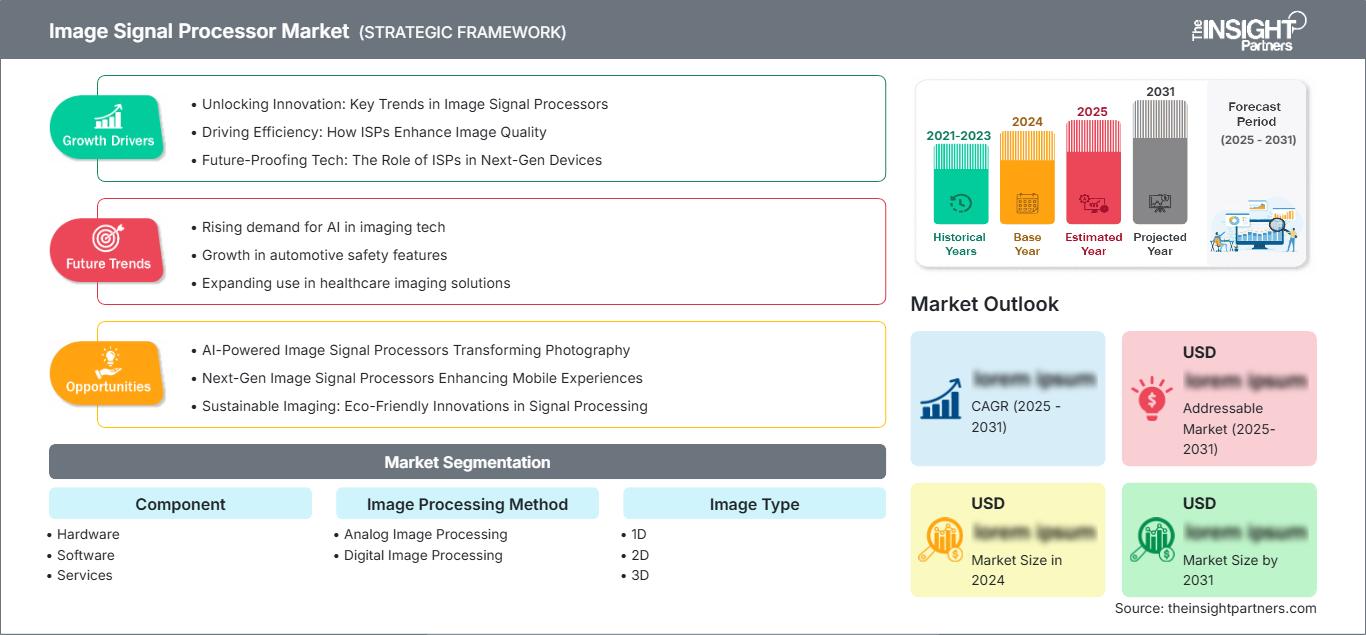
Image Signal Processor Market: Strategic Insights
Regional Insights
North America Image Signal Processor Market
North America held 29–32% Image Signal Processor Market share in 2025 and is expected to post 8.0–8.6% CAGR through 2034. The drivers are derived from applications of advanced driver assistance systems, medical visualization, aerospace, surveillance, robotics, and cloud-enabled edge computing. The regional ecosystem of semiconductors that focuses on processors, software tools, camera module design and qualification exists. The categories of products as defined by WSTS in the forms of logic and CMOS image sensors are used for shipment modeling in 2025 range.
For automotive projects, the requirements include multiple camera processing, high dynamic range feature, security, and documentation of functional safety. For healthcare applications, compact and low latency processors for endoscopy and point of care imaging applications are required, and vision is used in factories for inspection and robotic applications. Favorable incentives in semiconductors locally for prototyping and advanced packaging exist, but the manufacturing processes are globally distributed. The longer validation period, export restrictions, and limited advanced node capacities affect the growth, but there is added value with local application engineering and software.
U.S. Image Signal Processor Market
The U.S. represented 80–84% of North American demand in 2025 and is projected to grow at 8.1–8.7% CAGR during 2026–2034. There is strong demand from automotive camera systems, defense imaging systems, medical devices, warehouse robotics, security systems, and creator electronics. The nation offers a unique blend of semiconductor intellectual property, programmable computing, artificial intelligence software, and system integration services, making it possible for companies to integrate ISPs into large perception systems instead of standalone image enhancement applications.
Key companies include Arm Limited, Intel Corporation, OmniVision Technologies, Inc., onsemi, Texas Instruments Incorporated, and STMicroelectronics N.V. Application focus will move toward multi-exposure HDR, driver and occupant monitoring, factory inspection systems, and low-power embedded vision systems. Purchasing will be looking at security, software lifetime, functional safety, and sensor compatibility along with throughput performance. Federal manufacturing initiatives will bolster local capability, but foundry implementation and foreign packaging will still be key challenges for consistent scaling.
Europe Image Signal Processor Market
Europe accounted for 21–24% of global revenue in 2025 and is forecast to expand at 7.7–8.3% CAGR through 2034. Germany excels in premium cars, automation, machine vision, and optics. The UK has semiconductor IP rights, defense, and imaging in medicine. France covers automotive, aerospace, security, and embedded electronics needs, aided by local semiconductor research and investments.
Italy helps in factory automation, robotics, vehicles, and professional imaging, whereas Spain reaps the benefits of smart infrastructures, security, and automotive electronics. The safety of vehicles, cybersecurity, privacy, and efficiency of energy consumption in Europe favor semiconductor devices that have predictable lifecycle support and behavior. STMicroelectronics N.V., Arm Limited, onsemi, and Sony Semiconductor Solutions Corporation supply the regional programs with engineering and distribution services. The slower consumer electronics scaling than Asia hinders the volume of semiconductors, but critical designs remain profitable.
APAC Image Signal Processor Market
Asia Pacific held 38–42% share in 2025 and should register 9.4–10.0% CAGR through 2034. China leads through smartphone, surveillance, EV, camera-module, and electronics manufacturing scale. Japan contributes advanced sensors, cameras, optics, and industrial automation, while South Korea anchors mobile devices, memory, and automotive electronics.
India expands through electronics incentives, video security, healthcare, and local device assembly; Australia adds mining, defense, smart infrastructure, and machine vision. Regional industrial policy, dense packaging ecosystems, and short camera-module supply chains reinforce leadership. CIPA reported 2024 digital-camera shipment growth of 24.5% in China and 11.0% in Japan, validating continued imaging demand.
Middle East & Africa Image Signal Processor Market
The Middle East & Africa market is projected to record 7.0–7.7% CAGR during 2026–2034. The UAE leads through smart-city surveillance, logistics, aviation, and healthcare digitization. Saudi Arabia adds industrial diversification, autonomous mobility pilots, and infrastructure security, while South Africa supports mining vision, traffic systems, retail analytics, and medical equipment.
Across the rest of MEA, adoption remains project-led and import-dependent. Harsh-climate reliability, low-power edge processing, secure video handling, and distributor support influence procurement. Energy infrastructure and transport modernization create selective opportunities, although limited semiconductor design capacity and variable data-governance frameworks slow broad deployment.
Segmentation Analysis
Component
The Image Signal Processor Market scope by component covers hardware, software, and services and is expected to expand at 8.4–9.0% CAGR during 2026–2034. Hardware captures the largest value through dedicated logic, integrated pipelines, and memory interfaces. Software increasingly differentiates image quality, while services address calibration, tuning, validation, and lifecycle support across sensors and operating conditions.
- Hardware: Dedicated ASICs, integrated ISP blocks, processors, and accelerators dominate revenue because they provide deterministic throughput, low latency, energy efficiency, and qualified interfaces for demanding camera architectures.
- Software: Algorithms, tuning suites, drivers, and middleware shape image quality and portability, enabling vendors to update noise reduction, HDR, color science, and AI-assisted enhancement after deployment.
- Services: Sensor calibration, pipeline tuning, safety validation, integration, and long-term maintenance are strategically important where varied optics, illumination, temperatures, and regulatory requirements complicate product development.
Image Processing Method
Image processing methods are projected to grow at 8.3–8.9% CAGR through 2034. Digital processing dominates modern cameras because programmable pipelines support complex correction, compression, analytics, and multi-frame fusion. Analog processing remains relevant near sensor front ends, where signal conditioning, gain control, and conversion quality determine downstream noise, dynamic range, and power performance.
- Analog Image Processing: Front-end conditioning remains essential for preserving signal integrity before conversion, particularly in low-light, medical, scientific, and automotive environments where noise and dynamic range affect decisions.
- Digital Image Processing: Programmability, scalability, and compatibility with AI workflows make digital pipelines the principal method for real-time enhancement, compression, multi-camera fusion, and application-specific optimization.
Image Type
Image type demand is expected to register 9.0–9.6% CAGR during 2026–2034. Two-dimensional imaging remains the installed-base core across consumer, automotive, security, and industrial devices. Three-dimensional pipelines grow faster as depth sensing, stereo vision, structured light, and time-of-flight enter robotics and spatial systems. One-dimensional processing serves specialized line-scan and coded-data applications.
Technology
Technology demand is forecast to grow at 8.7–9.3% CAGR during 2026–2034. Single Instruction Multiple Data architectures suit repetitive pixel operations with predictable parallelism and efficient power use. Multiple Instruction Multiple Data designs support heterogeneous, concurrent workloads across enhancement, compression, sensor fusion, and AI, making them increasingly relevant to complex multi-camera systems.
- Single Instruction Multiple Data: Vectorized execution efficiently applies common operations across many pixels, supporting deterministic filtering, color conversion, resizing, and demosaicing within constrained power and silicon budgets.
- Multiple Instruction Multiple Data: Independent processing elements handle concurrent camera streams and mixed workloads, improving flexibility for multi-sensor perception, layered analytics, and dynamically scheduled edge-computing tasks.
- 1D: Line-scan inspection, barcode reading, document capture, and spectral applications sustain specialized demand where rapid sequential processing and precise synchronization outweigh the need for full-frame spatial context.
- 2D: Smartphones, cameras, vehicles, security devices, and medical systems maintain the largest installed base, supported by mature sensors, algorithms, displays, and compression standards.
- 3D: Robotics, augmented reality, industrial metrology, biometrics, and autonomous machines drive strategic adoption because depth-aware pipelines improve localization, measurement, gesture recognition, and environmental understanding.
Opportunity Snapshot
| Image Type | Revenue Contribution | Trend Tag | Adoption Stage |
| 1D | Low | Line Scan | Mature |
| 2D | High | Multi Camera | Mature |
| 3D | Medium | Depth Fusion | Scaling |
Image Signal Processor Market Growth Drivers and Impact Analysis
Multi-Camera Automotive Safety Raises Processing Content
Vehicles increasingly combine front, rear, surround-view, mirror-replacement, cabin-monitoring, and driver-assistance cameras. Before perception algorithms can run on these streams, synchronization, dynamic range, LED flicker reduction, correction for distortions, and safety monitoring is needed. Sony Semiconductor Solutions Corp came up with an 8-megapixel automotive sensor with built-in MIPI A-PHY in October 2025, which proves that power and bandwidth limitations are leading processing closer to the sensor. ISP vendors will be favored because of the increasing number of cameras and their requirements, but entering the automotive market calls for years of product longevity, cybersecurity, traceability, and proof of safety.
Edge AI Converts Cameras into Local Decision Systems
Image processing tasks such as factory inspection, smart security, robotics, retail analytics, and healthcare devices are becoming more local to cut down on latency, bandwidth consumption, and privacy concerns. The quality of ISP processing is relevant to inference as bad tone mapping, motion compensation, or noise reduction can affect recognition performance. STM32N6 by STMicroelectronics N.V. includes a separate camera interface, ISP, and neural accelerator providing up to 600 GOPS, an example of how the image processing and inference converge. This combination widens the addressable market beyond top-of-the-line application processors to energy-efficient embedded chips. Companies able to supply calibrated pipelines, models, compression, and secure updates will capitalize on platform benefits, whereas fragmented sensors and use cases require additional effort.
Higher-Quality Capture Sustains Consumer Imaging Investment
The trends in consumer demand have changed to be focused more on low light performance, computational zoom, stabilization and consistent color from multiple cameras. In 2024, CIPA data revealed that there were 8.49 million units of digital cameras shipped out of which 5.61 million units belonged to mirrorless category, while Sony Semiconductor Solutions Corporation’s sensor roadmap for 2025 mobile included 50 megapixels HDR sensors and nearly 200 megapixels AI-based sensors. These trends will increase the demands for computing in tasks such as remosaicing, multi-frame fusion, noise suppression, and power efficient video. Dedicated cameras are few in numbers compared to phones, but still, they dictate the algorithms and workflow demands.
Image Signal Processor Market Future Trends
AI-Directed, Scene-Adaptive Imaging Pipelines
Image Signal Processor market trends will be more and more focused on pipelines which do scene classification, depth estimation, motion detection, and adaptive adjustments of processing parameters frame by frame. Neural components will assist in deterministic blocks without replacing them to preserve the predictable latency of safety critical operations and to increase performance of denoising, auto focus, tone mapping and remosaicing. The management of training data and reproducibility of tuning will become procurement requirements since the image quality decisions will be performed inside learnable models. Therefore, the suppliers must provide controlled interface, versioning of models, monitoring of confidence level and possibility to roll back.
Software-Defined Tuning and Cross-Sensor Portability
The next generation of platforms will decouple imaging kernels that can be reused with respect to sensor calibration on an individual basis, which allows OEMs to swap their sensors, optics, and computing targets without redeveloping. Automated testing will utilize objective measures for image quality, as well as synthetic images and recorded raw images to speed up the testing process. Containerization of tool chains and common metadata standards will allow better cooperation between sensor vendors, processor providers, camera module manufacturers, and system OEMs. This trend favors players with large databases of tests and stable software interfaces rather than just top-performing silicon.
Image Signal Processor Market Opportunities
Build Medical-Grade Imaging Reference Platforms
Image Signal Processor Market Forecasts indicate an actionable gap in validated platforms for endoscopy, surgical visualization, dental scanning, patient monitoring, and portable diagnostics. In March 2026, OmniVision Technologies, Inc. and ATL Medical launched the OH0131 ISP for a turnkey arthroscopy imaging system, evidencing market demand for the combination of sensor, kernel board, host interface, and optimized algorithms. It is possible for manufacturers to create performance data related to color fidelity, reflection handling, smoke and shadow handling, latency, and electromagnetic compatibility. The reference design can help OEMs cut down on product development costs and work with small medical device manufacturers. Sustainable competitive advantage should involve clinical workflow knowledge, long-term parts availability, quality processes, and software maintenance rather than features cycling as consumer goods.
Target 3D Vision for Robotics and Industrial Metrology
Depth sensing imaging offers business possibilities in areas like autonomous mobile robots, collaborative robots, warehouse automation, dimension inspection, agriculture, and spatial interfaces. Synchronized stereo pipelines, time-of-flight calibration, structured-light decoding, confidence maps, and inertial fusion represent some of the possibilities for suppliers. Reference equipment, calibration equipment, and middleware capable of translating depth data into coordinate data rather than just better images are all part of success. OEMs of robots and machine vision systems can provide application knowledge and assist with validation of the technology. A licensing-based revenue model could include processor fees, tools for developers, tuning services, and algorithms.
Recent Developments
- March 2026: OMNIVISION and ATL Medical have announced the integration of OMNIVISION’s OVMed OH0131 image signal processor (ISP) into ATL Medical’s PREVOYANCE Complete Imaging System, designed for arthroscope camera applications. The PREVOYANCE platform is a turnkey medical imaging solution that uses Chip-on-Tip technology to deliver high-quality visualization for medical-device manufacturers. The system can be used with a camera control unit (CCU) for image processing, display and storage.
- January 2026: Chips&Media and Visionary.ai have announced a new collaboration aimed at transforming image processing through an AI-powered, full-image signal processor. The companies say their technology combines Chips&Media’s hardware expertise with Visionary.ai’s AI-based image-processing software to improve image quality across challenging conditions, including low-light and high-dynamic-range (HDR) environments.
- December 2023: NXP Semiconductors has highlighted the benefits of integrated image signal processing (ISP) in its i.MX 8M Plus applications processor, along with a network of technology partners that help customers develop and optimize camera and computer-vision systems. Designing a high-quality imaging system involves more than selecting a camera sensor and lens. The ISP must be carefully calibrated and tuned to deliver accurate colors, sharp images, appropriate exposure, low noise and good performance across different lighting conditions.
Frequently Asked Questions

- Comprehensive Market Sizing and Forecast Analysis
- Detailed Segmentation Analysis
- In-Depth Market Dynamics Assessment
- Regional and Country-Level Insights
- Competitive Landscape and Company Benchmarking
- Strategic Business Intelligence
Recent Reports
Testimonials

The Insight Partners' SCADA System Market report is comprehensive, with valuable insights on current trends and future forecasts. The team was highly professional, responsive, and supportive throughout. We are very satisfied and highly recommend their services.
RAN KEDEM Partner, Reali Technologies LTDs
I requested a report on a very specific software market and the team produced the report in a few days. The information was very relevant and well presented. I then requested some changes and additions to the report. The team was again very responsive and I got the final report in less than a week.
JEAN-HERVE JENN Chairman, Future Analytica
We worked with The Insight Partners for an important market study and forecast. They gave us clear insights into opportunities and risks, which helped shape our plans. Their research was easy to use and based on solid data. It helped us make smart, confident decisions. We highly recommend them.
PIYUSH NAGPAL Sr. Vice President, High Beam Global
The Insight Partners delivered insightful, well-structured market research with strong domain expertise. Their team was professional and responsive throughout. The user-friendly website made accessing industry reports seamless. We highly recommend them for reliable, high-quality research services
YUKIHIKO ADACHI CEO, Deep Blue, LLC.
This is the first time I have purchased a market report from The Insight Partners.While I was unsure at first, I visited their web site and felt more comfortable to take the risk and purchase a market report.I am completely satisfied with the quality of the report and customer service. I had several questions and comments with the initial report, but after a couple of dialogs over email with their analyst I believe I have a report that I can use as input to our strategic planning process.Thank you so much for taking the extra time and making this a positive experience.I will definitely recommend your service to others and you will be my first call when we need further market data.
JOHN SUZUKI President and Chief Executive Officer, Board Director, BK Technologies
I wish to appreciate your support and the professionalism you displayed in the course of attending to my request for information regarding to infectious disease IVD market in Nigeria. I appreciate your patience, your guidance, and the fact that you were willing to offer a discount, which eventually made it possible for us to close a deal. I look forward to engaging The Insight Partners in the future, all thanks to the impression you have created in me as a result of this first encounter.
DR CHIJIOKE ONYIA MANAGING DIRECTOR, PineCrest Healthcare Ltd.Reason to Buy
- Informed Decision-Making
- Understanding Market Dynamics
- Competitive Analysis
- Identifying Emerging Markets
- Customer Insights
- Market Forecasts
- Risk Mitigation
- Boosting Operational Efficiency
- Strategic Planning
- Investment Justification
- Tracking Industry Innovations
- Aligning with Regulatory Trends





 Get Free Sample for