
Industrial Communication Market Size, Share & Growth by 2034
Coverage: by Component (Hardware, Software, and Services), Protocol (Fieldbus, Wireless, and Industrial Ethernet), Application (Aerospace & Defense, Automotive and Transportation, Chemicals and Fertilizers, Energy & Power, Electrical and Electronics, Food & Beverages, Mining, Pharmaceutical, and Others), and Geography (North America, Europe, Asia Pacific, and South and Central America)
- Status : Data Released
- Report Code : TIPEL00002690
- Category : Electronics and Semiconductor
- No. of Pages : 150
- Available Report Formats :


- Last update date : September 21, 2026


2025 Market Size
US$ 24.23 Bn
Base year value
2034 Forecast
US$ 38.4 Bn
Projected by 2034
CAGR 2026-2034
5.25 %
Growth rate
Addressable Market
US$ 284.11 Bn
(2026-2034)
The Industrial Communication Market is being shaped by the convergence of industrial networking, automation, edge computing, and connected control architectures. The market was valued at US$ 24.23 Billion in 2025 and is projected to reach US$ 38.4 Billion by 2034, expanding at a CAGR of 5.25% during 2026–2034. Demand is increasingly linked to deterministic connectivity, cybersecurity, machine interoperability, and data exchange across increasingly automated production environments.
Across North America, the Industrial Communication Market size is supported by advanced manufacturing modernization, industrial cybersecurity requirements, and investment in connected production assets. Regional expansion is expected to remain moderate, with a CAGR range of 2.1–3.0% during 2026–2034. Adoption is reinforced by industrial Ethernet upgrades and the deployment of private wireless networks in factories, utilities, logistics, and process facilities.
Industrial Communication Market Assessment and Insights
- North America: North America represented a 15–17% Industrial Communication Market share in 2025 and is expected to expand at a 2.1–3.0% CAGR between 2026–2034, supported by factory modernization, industrial cybersecurity, private wireless connectivity, and automation investment.
- US: The US accounted for 57–59% of North American demand in 2025 and is expected to grow at a 2.1–3.0% CAGR between 2026–2034, led by advanced manufacturing and energy infrastructure.
- Europe: Europe held a 23–25% share in 2025 and is projected to grow at a 4.0–4.5% CAGR between 2026–2034. Germany, the UK, France, Italy, and Spain remain important markets, supported by Industry 4.0 modernization.
- Asia Pacific: Asia Pacific represented a 38–40% share in 2025 and is expected to record a 6.0–6.5% CAGR between 2026–2034, with China, Japan, South Korea, and India leading industrial digitization and connected-factory investment.
- Largest Segment: Industrial Ethernet represented a 55–60% market share in 2025 and is expected to grow at a 6.0–6.5% CAGR during 2026–2034, reflecting rising demand for deterministic IP-based connectivity.
- High Growth Segment: Wireless represented a 7–10% market share in 2025 and is expected to expand at a 10.0–12.5% CAGR during 2026–2034 as flexible production and private wireless deployments increase.
- Key companies analyzed in detail: Honeywell International, Inc., SICK AG, Belden Inc., ABB Ltd., Siemens AG, Omron Corporation, Rockwell Automation, Inc., Moxa Inc., ifm electronic GmbH, Mitsubishi Electric Group.
Source: The Insight Partners' analysis based on proprietary research, government publications, company annual reports, investor presentations, industry databases, and expert interviews.
Production architectures in the Industrial Communication Market are shifting from isolated field networking to industrial Ethernet, edge communications, wireless technologies, and software-defined infrastructure. The rise of industrial Ethernet is being fueled by increased bandwidth and interoperability, which enables machine vision, robotics, digital twin applications, and analytics. Fieldbus systems have become part of existing production lines, forming a replacement and gateway market instead of a technological replacement cycle. Suppliers of hardware are now integrating switches, gateways, controllers, and interfaces with diagnostic and cybersecurity functions.
In the coming years, spending should diversify to include emerging manufacturing economies, such as India and Southeast Asia, while existing plants in Europe and North America continue to focus on brownfield upgrades. Increased regulatory interest in cyber resiliency and OT cybersecurity will make companies invest in network segmentation, authentication, monitoring, and device management. The digitalization of energy systems will be another structure play, with energy grids relying on digital infrastructure alongside physical infrastructure.
Industrial Communication Market Report Scope
| Report Attribute | Details |
|---|---|
| Market size in 2025 | US$ 24.23 Billion |
| Market Size by 2034 | US$ 38.4 Billion |
| Global CAGR (2026 - 2034) | 5.25% |
| Historical Data | 2021-2024 |
| Forecast period | 2026-2034 |
Industrial Communication Market Analysis
Industrial Communication market growth is highly associated with the development of connected machines, PLCs, sensors, robotics, and supervisory systems. Growth will be driven by the demand for deterministic data transfer from the manufacturing facilities to higher levels of analytics. The market includes semiconductor and network components, industrial switches, gateways, controllers, software platforms, system integrators, security solution providers, and maintenance services, thereby offering many revenue opportunities along the connectivity life cycle.
Increasingly, supply dynamics in the Industrial Communication Market become biased in favor of suppliers capable of addressing hybrid legacy/modern solutions. In brownfields, the need for protocol translation, managed switches, secure gateways, and engineering services arises due to economic infeasibility of replacement of existing infrastructure. Industrial Ethernet develops concurrently with fieldbus systems without any substitution. Wireless communication technologies add another layer for mobile machines, autonomous vehicles, remote monitoring and other applications that involve restrictions in cable laying.
Market Analysis of Industrial Communication shows a fragmented competitive environment that includes automation providers, networking firms, sensor makers, and diversified industrial technology providers. Competition among Siemens AG, ABB Ltd., Rockwell Automation, Inc., Honeywell International, Inc., and Mitsubishi Electric Group involves automation eco-systems whereas Belden Inc. and Moxa Inc. focus on industrial networking infrastructure. Omron Corporation, SICK AG, and ifm electronic GmbH enhance connectivity by means of sensors and machines.
Competition positioning is based on such key points as interoperability, security, lifecycle support, and integration into edge computing or cloud computing platforms. Recent investment trends include software-centric networking, industrial AI, private wireless networks, and secure device management. Moreover, companies make use of partnerships and portfolio expansion to bridge OT and IT environments. One of the major competitive advantages is connected to the capability of preserving legacy protocols and adopting new IP-based protocols.
● REPORT CUSTOMIZATION
Tailor This Report To Align With Your Specific Business Requirements
This report can be customized to align precisely with your business objectives, scope, and target markets. Customization options include tailored segmentation, geography, competitive analysis, and strategic insights to support informed decision-making.
Customize This Report →WHAT YOU CAN ADJUST
- ● Segmentations
- ● Geography
- ● Competitive Analysis
- ● Language Preferences
Industrial Communication Market: Strategic Insights
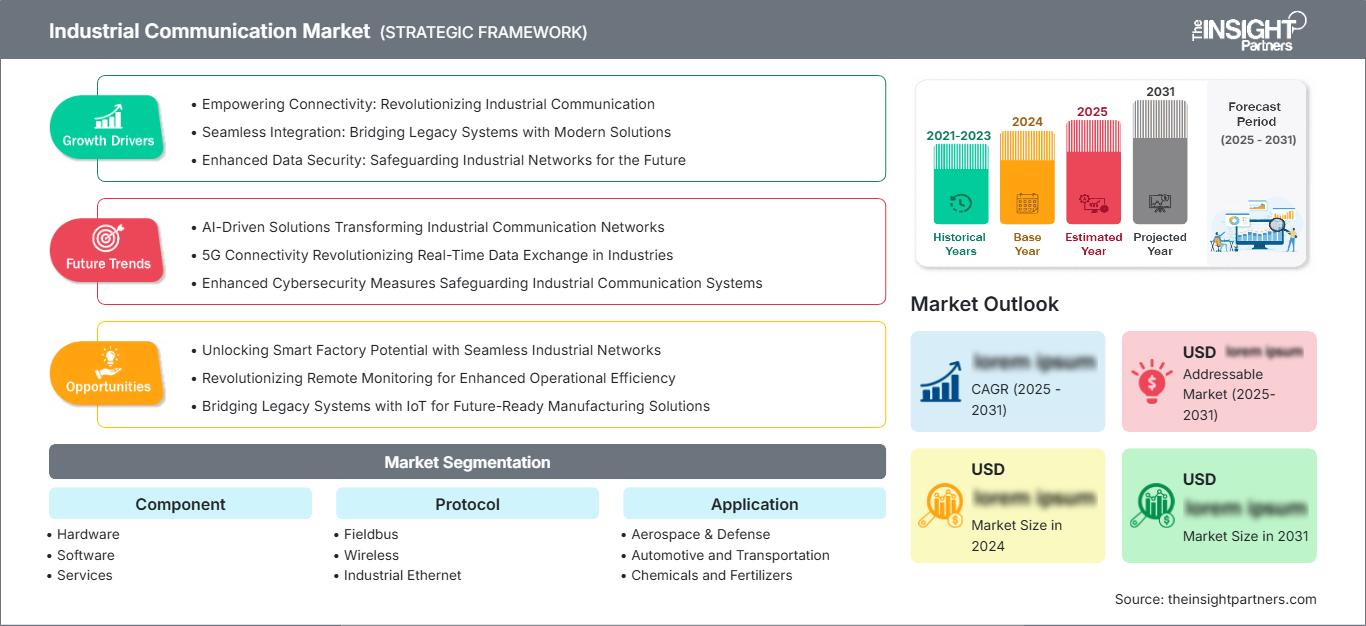
Regional Insights
North America Industrial Communication Market
North America represented a 15–17% share in 2025 and is expected to expand at a 2.1–3.0% CAGR through 2034. The region benefits from mature automation infrastructure, advanced automotive production, semiconductor investment, energy modernization, and demand for secure operational technology networks. The US accounts for 57–59% of regional demand, while Canada contributes through mining, energy, food processing, and manufacturing applications.
The importance of Industrial Ethernet will not go away in modernization initiatives, whereas private wireless networks cater to mobility of equipment, autonomous operations, and hard-to-wire production setups. The need for cybersecurity measures is also raising the demand for managed switches, network segmentation, secure gateways, and network monitoring. Investments made in data centers and electrical infrastructure are generating a corresponding demand for industrial communications and controls. Regional buyers usually emphasize interoperability with existing automation systems, lifecycle support, and reduced downtime.
U.S. Industrial Communication Market
The Industrial Communication Market report shows that the US represented 57–59% of North American demand in 2025 and is projected to grow at a 2.1–3.0% CAGR through 2034. Advanced manufacturing, aerospace, automotive, pharmaceuticals, food processing, oil and gas, and utilities generate broad application demand. Rockwell Automation, Inc., Honeywell International, Inc., Belden Inc., and other suppliers maintain substantial technology and integration presence across these industries.
The trends in application areas are towards interconnectivity of production lines, security and remote connectivity, machine diagnostics, robotics, and edge computing. Investments in semiconductor and battery manufacturing are adding to the need for determinism in networking and high-speed data networks. Moreover, legacy fieldbuses are being upgraded with gateways and Ethernet network solutions without full-scale replacement. This creates a layering market where next-generation connectivity coexists with legacy control systems.
Europe Industrial Communication Market
Europe held a 23–25% share in 2025 and is expected to grow at a 4.0–4.5% CAGR through 2034, with Germany the leading country. Industrial modernization, automation, cybersecurity requirements, and sustainability investment support adoption across major manufacturing economies. Germany remains the regional anchor because of its machinery, automotive, chemicals, and automation industries.
Demand for automation is high within the process industries, energy, logistics, and advanced manufacturing in the UK, while Germany has the advantage of being ahead with its implementation of Industry 4.0 technology and automation in the factories. Opportunities can be seen in aerospace, nuclear energy, transportation, and discrete manufacturing in France. In Italy, the strengths include machinery, packaging, food processing, and automation technology. In Spain, automotive manufacturing and renewable energy are among the areas of strength.
APAC Industrial Communication Market
APAC represented a 38–40% share in 2025 and is expected to grow at a 6.0–6.5% CAGR through 2034, making it the leading regional market. China leads, followed by Japan, South Korea, India, and Australia. Semiconductor, electronics, automotive, machinery, energy, and mining investments sustain connectivity demand.
Smart manufacturing systems help China gain more out of its initiatives, Japan and South Korea have developed highly automated industries with high levels of industrial networking development. While India focuses on connected manufacturing through investments in industrial and digital sectors, Australia generates demand by utilizing mining and energy sectors. Ethernet continues to lead, but private wireless technology is becoming important for manufacturing processes involving mobility.
Middle East & Africa Industrial Communication Market
The Middle East and Africa Industrial Communication Market is expected to grow at a 4.0–4.5% CAGR through 2034. Saudi Arabia and the UAE lead regional investment, supported by industrial diversification, energy modernization, smart infrastructure, and large-scale automation programs. South Africa contributes through mining, metals, utilities, food processing, and manufacturing.
Energy remains a major connectivity application across the region, while infrastructure projects create demand for secure control networks and remote monitoring. Saudi Arabia is positioned as the leading regional market through industrial diversification, and the UAE benefits from digital infrastructure investment. Rest-of-MEA demand remains concentrated in oil and gas, mining, utilities, transportation, and water infrastructure, where rugged communication equipment and long lifecycle support are particularly important.
Segmentation Analysis
Component
Component demand in the Industrial Communication Market is distributed across physical networking infrastructure, software, and implementation support. Hardware remains the principal revenue contributor because every industrial architecture requires switches, interfaces, gateways, controllers, and related equipment. The segment is expected to grow at a 4.8–5.5% CAGR during 2026–2034, while software and services benefit from cybersecurity, analytics, remote management, and lifecycle requirements.
- Hardware: Hardware remains strategically important because industrial switches, gateways, controllers, interfaces, and connectivity devices form the physical foundation for both greenfield and brownfield automation deployments.
- Software: Software demand is increasing as manufacturers require network management, diagnostics, cybersecurity, device configuration, analytics, and integration layers that convert connectivity into operational visibility.
- Services: Services support installation, engineering, commissioning, maintenance, cybersecurity, and lifecycle upgrades, making them particularly relevant where industrial networks combine legacy protocols with modern architectures.
Protocol
Protocol selection is increasingly application-specific, balancing determinism, interoperability, installed base, cybersecurity, and bandwidth. Industrial Ethernet remains the leading protocol category and is expected to grow at a 6.0–6.5% CAGR during 2026–2034. Wireless should record the fastest expansion as factories introduce mobile equipment and flexible layouts.
- Fieldbus: Fieldbus remains important in installed process and factory equipment, sustaining replacement, gateway, migration, and maintenance demand even as newer Ethernet architectures expand.
- Wireless: Wireless connectivity enables mobile assets, autonomous vehicles, remote monitoring, flexible workcells, and difficult-to-cable installations, strengthening its role in future factory architectures.
- Industrial Ethernet: Industrial Ethernet offers high bandwidth, interoperability, deterministic performance, and compatibility with modern automation systems, making it central to factory modernization and machine integration.
Application
Application demand varies according to latency, reliability, environmental conditions, cybersecurity requirements, and production economics. The application segment is expected to grow at a 5.0–5.8% CAGR during 2026–2034, with energy, automotive, electronics, and process industries providing substantial connectivity requirements.
- Aerospace & Defense: High-reliability manufacturing and secure infrastructure require deterministic communication, traceability, network resilience, and strict control over industrial data flows.
- Automotive and Transportation: Robotics, battery manufacturing, automated assembly, machine vision, and flexible production increase demand for high-speed communication and integrated control architectures.
- Chemicals and Fertilizers: Process plants prioritize deterministic connectivity, remote monitoring, hazardous-area compatibility, and secure integration with distributed control and safety systems.
- Energy & Power: Grid modernization, generation automation, substations, and distributed energy resources increase demand for resilient communications linking field equipment with control systems.
- Electrical and Electronics: Semiconductor and electronics production requires precise synchronization, high data throughput, machine integration, and reliable communication across highly automated production environments.
- Food & Beverages: High-throughput processing and packaging require robust networks supporting machine coordination, quality monitoring, traceability, and hygienic production environments.
- Mining: Mining operators require rugged communication infrastructure for remote equipment, autonomous vehicles, process monitoring, and geographically dispersed operations.
- Pharmaceutical: Pharmaceutical production depends on secure, traceable, and highly reliable communications supporting automation, environmental monitoring, validation, and quality-control processes.
Opportunity Snapshot
| Application | Revenue Contribution | Trend Tag | Adoption Stage |
| Aerospace & Defense | Medium | Secure Networks | Scaling |
| Automotive and Transportation | High | Factory Ethernet | Mature |
| Chemicals and Fertilizers | High | Process Connectivity | Mature |
| Energy & Power | High | Grid Digitization | Scaling |
| Electrical and Electronics | High | Fab Connectivity | Scaling |
| Food & Beverages | Medium | Line Automation | Mature |
| Mining | Medium | Mine Automation | Scaling |
| Pharmaceutical | Medium | Traceability | Scaling |
Industrial Communication Market Growth Drivers and Impact Analysis
Expansion of Industrial Ethernet and Connected Automation
The Industrial Communication Market forecast shows that Industrial Ethernet adoption is expanding because manufacturers need communication architectures capable of supporting machine vision, robotics, motion control, analytics, and higher volumes of operational data. Contrast this with standalone legacy systems, which may be easier to integrate among control devices, machinery, edge devices, and enterprise systems using an Ethernet system. The implication for business is that the focus moves from simple connection needs to management, diagnostic, cybersecurity, and lifecycle considerations. It goes beyond switching and interfaces because the need for modernization implies gateways, engineering, software, and maintenance solutions. Those vendors who can deliver on deterministic behavior while retaining backward compatibility will be in a good position to service both greenfield and brownfield requirements.
Rising Cybersecurity Requirements for Operational Technology
Cybersecurity is increasingly becoming a consideration in the purchase of communication infrastructure for industry, not a separate issue of information technology. Interconnected controllers, remote maintenance facilities, sensors, gateways, and edge computing add to the attack surface in factories and utility companies. This implies that network segmentation, authentication, secure remote access, anomaly detection, secure management of firmware updates, and secure device configuration are necessary. Such needs make more software and services added onto communication equipment to create more value from ongoing management. Attention from regulatory agencies to cyber resilience creates additional justification for investments since vendors have to offer better protection of interconnected industrial assets. Vendors with experience in automation and cybersecurity can thus compete in the provision of reliable operation and network performance.
Industrial Digitalization Across Emerging Manufacturing Economies
Manufacturing expansion in Asia, the Middle East, and selected Latin American economies is creating new demand for communication infrastructure as facilities are designed around connected automation. Greenfield plants can deploy Ethernet, wireless, edge computing, and cybersecurity architectures without the constraints of older networks, allowing vendors to introduce modern solutions at the initial engineering stage. Automotive, electronics, battery, chemicals, food processing, and energy projects are particularly relevant because production systems require continuous data exchange among machines and supervisory applications. Emerging markets also create opportunities for localized engineering and support because communication architectures require commissioning, integration, training, and maintenance. Suppliers that combine standardized platforms with regional service capabilities can improve deployment efficiency while addressing different regulatory, workforce, and infrastructure conditions.
Industrial Communication Market Future Trends
Convergence of Industrial Networks With Edge Intelligence
The Industrial Communication Market trends indicate that future architectures will increasingly combine industrial networking with distributed computing at the edge, reducing the distance between machine data and operational decisions. Instead of transmitting every signal to centralized platforms, edge systems can filter, contextualize, and analyze information near production equipment. Communication infrastructure will therefore become part of the computing architecture, with switches, gateways, controllers, and software coordinating data flows. Vendors are likely to integrate diagnostics, cybersecurity, device management, and analytics into common platforms. This convergence should make network performance more closely tied to production outcomes, particularly for predictive maintenance, quality control, energy optimization, and autonomous equipment. Customers will increasingly evaluate communication solutions according to their ability to support data-intensive workloads without compromising deterministic industrial operations.
Private Wireless Networks for Flexible Production
Private wireless networks are positioned to expand where fixed cabling limits production flexibility, mobility, or deployment economics. Future factories may use wireless connectivity for autonomous mobile robots, wearable devices, temporary production cells, condition monitoring, and geographically distributed equipment while retaining wired Ethernet for deterministic control. Improvements in spectrum availability, industrial-grade equipment, network management, and security should strengthen the business case. Wireless architectures will not eliminate wired networks, but they can reduce cabling requirements and enable faster reconfiguration of production areas. Suppliers that combine wireless connectivity with industrial controllers, gateways, cybersecurity, and application software are likely to gain an advantage because customers increasingly seek integrated architectures rather than standalone communication products.
Industrial Communication Market Opportunities
Industrial Network Modernization in Brownfield Facilities
Brownfield modernization represents a significant investment opportunity because many factories cannot replace installed automation systems solely to obtain modern connectivity. Suppliers can address this gap through protocol gateways, managed switches, secure remote-access platforms, edge devices, and migration services that connect legacy equipment with Ethernet-based architectures. The commercial opportunity is strongest where downtime is costly and equipment has long remaining life. Vendors can develop staged modernization programs that begin with network visibility and segmentation, then introduce higher-performance communication and analytics as production requirements evolve. Such approaches reduce implementation risk and spread capital expenditure across multiple project phases. Strategic partnerships with system integrators can further expand reach because network upgrades often require engineering expertise, controls knowledge, and site-specific commissioning.
Connectivity Solutions for Energy and Infrastructure Digitization
Energy and infrastructure modernization creates opportunities for rugged communication platforms capable of supporting substations, generation assets, storage systems, water infrastructure, transportation networks, and distributed energy resources. Grid investment is increasingly accompanied by digitalization, creating demand for communication architectures that can connect field devices with control centers and analytics platforms. The IEA projects that annual global grid investment will need to rise toward US$600 billion by 2030, while digital and smart-grid investment is also expected to expand. Vendors can target this opportunity through secure gateways, industrial switches, remote monitoring, protocol conversion, and lifecycle services designed for long operating periods and demanding environmental conditions.
Recent Developments
- August 2026: HCLTech completed the acquisition of HPE’s Telco Solutions business, strengthening its AI-led telecom capabilities through additional intellectual property, engineering talent, and global delivery resources. The transaction supports telecom modernization across network virtualization, edge and data-center networking, private 5G, multi-cloud, and autonomous network operations.
- January 2026: HMS Networks completed its acquisition of selected assets from Molex’s Industrial Communications business, with the transaction consolidated into HMS from January 2. The acq.uired portfolio includes interface card and software solutions, together with development teams in Canada and France, expanding HMS’s industrial networking capabilities and customer reach.
- August 2025: NXP Semiconductors completed its acquisition of port GmbH, strengthening its industrial edge portfolio through integration of port’s industrial communication protocol expertise with NXP processors. The combination supports multi-protocol connectivity, simplifies protocol switching, and enables more scalable solutions for software-defined factories and intelligent industrial edge applications.
Frequently Asked Questions

- Comprehensive Market Sizing and Forecast Analysis
- Detailed Segmentation Analysis
- In-Depth Market Dynamics Assessment
- Regional and Country-Level Insights
- Competitive Landscape and Company Benchmarking
- Strategic Business Intelligence
Recent Reports
Testimonials

The Insight Partners provided valuable market intelligence that supported our global go-to-market strategy. Their team was professional, responsive, and attentive to our feedback, providing thoughtful analysis and helpful methodological clarifications throughout the project.
Junmo Kim Chief Financial Officer (CFO), Enertech Co., Ltd.
The Insight Partners' SCADA System Market report is comprehensive, with valuable insights on current trends and future forecasts. The team was highly professional, responsive, and supportive throughout. We are very satisfied and highly recommend their services.
RAN KEDEM Partner, Reali Technologies LTDs
I requested a report on a very specific software market and the team produced the report in a few days. The information was very relevant and well presented. I then requested some changes and additions to the report. The team was again very responsive and I got the final report in less than a week.
JEAN-HERVE JENN Chairman, Future Analytica
We worked with The Insight Partners for an important market study and forecast. They gave us clear insights into opportunities and risks, which helped shape our plans. Their research was easy to use and based on solid data. It helped us make smart, confident decisions. We highly recommend them.
PIYUSH NAGPAL Sr. Vice President, High Beam Global
The Insight Partners delivered insightful, well-structured market research with strong domain expertise. Their team was professional and responsive throughout. The user-friendly website made accessing industry reports seamless. We highly recommend them for reliable, high-quality research services
YUKIHIKO ADACHI CEO, Deep Blue, LLC.
This is the first time I have purchased a market report from The Insight Partners.While I was unsure at first, I visited their web site and felt more comfortable to take the risk and purchase a market report.I am completely satisfied with the quality of the report and customer service. I had several questions and comments with the initial report, but after a couple of dialogs over email with their analyst I believe I have a report that I can use as input to our strategic planning process.Thank you so much for taking the extra time and making this a positive experience.I will definitely recommend your service to others and you will be my first call when we need further market data.
JOHN SUZUKI President and Chief Executive Officer, Board Director, BK Technologies
I wish to appreciate your support and the professionalism you displayed in the course of attending to my request for information regarding to infectious disease IVD market in Nigeria. I appreciate your patience, your guidance, and the fact that you were willing to offer a discount, which eventually made it possible for us to close a deal. I look forward to engaging The Insight Partners in the future, all thanks to the impression you have created in me as a result of this first encounter.
DR CHIJIOKE ONYIA MANAGING DIRECTOR, PineCrest Healthcare Ltd.Reason to Buy
- Informed Decision-Making
- Understanding Market Dynamics
- Competitive Analysis
- Identifying Emerging Markets
- Customer Insights
- Market Forecasts
- Risk Mitigation
- Boosting Operational Efficiency
- Strategic Planning
- Investment Justification
- Tracking Industry Innovations
- Aligning with Regulatory Trends





 Get Free Sample for