
Industrial Hearables Market Size, Share & Trends by 2034
Coverage: by Type (In Ear, Over Ear); Connectivity Type (Bluetooth, Wi-Fi, DECT, Others); Application (Industrial Wireless Audio/Voice Application, Industrial Noise Cancellation); End-User (Construction, Manufacturing, Mining, Others) , and Geography (North America, Europe, Asia Pacific, and South and Central America)
- Status : Data Released
- Report Code : TIPRE00007098
- Category : Electronics and Semiconductor
- No. of Pages : 150
- Available Report Formats :


- Last update date : September 21, 2026


2025 Market Size
US$ 5. Bn
Base year value
2034 Forecast
US$ 12.71 Bn
Projected by 2034
CAGR 2026-2034
10.92 %
Growth rate
Addressable Market
US$ 78.29 Bn
(2026-2034)
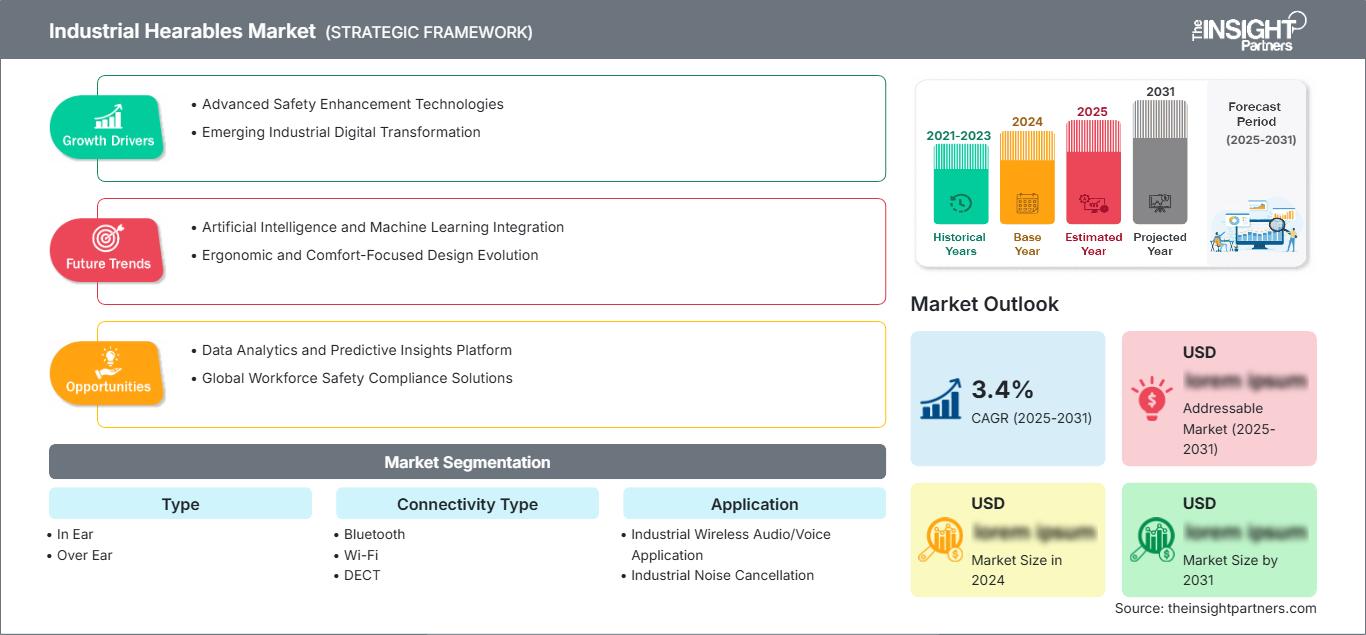
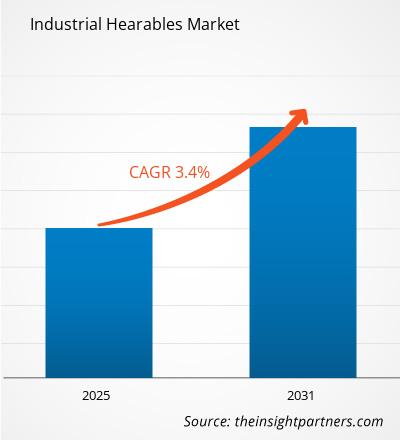
The global Industrial Hearables market was valued at US$ 5 billion in 2025 and is expected to reach US$ 12.71 billion by 2034; it is estimated to record a CAGR of 10.92% during 2026-2034.
Industrial Hearables Market Assessment and Insights
- North America: North America is estimated to hold a 25–29% share in 2025 and is projected to grow at a CAGR of 11.50%–13.50% between 2026–2034, supported by industrial safety requirements, connected PPE, and replacement cycles.
- US: The US represents an estimated 75–80% of North America's 2025 market and is projected to grow at a CAGR of 11.50%–13.50%, led by manufacturing, construction, and worker-safety programs.
- Europe: Europe is estimated at 22–26% share in 2025 and is projected to grow at a CAGR of 11.00%–13.00%, with Germany, the UK, France, Italy, and Spain supported by stringent occupational-noise controls and industrial automation.
- Asia Pacific: Asia Pacific is estimated at 31–35% share in 2025 and is projected to grow at a CAGR of 13.00%–15.00%, led by China, Japan, South Korea, India, and Australia amid manufacturing expansion and infrastructure investment.
- Largest Segment: Manufacturing is estimated to account for a 35–40% market share in 2025 and is projected to expand at a CAGR of 11.00%–13.00%, supported by continuous plant-floor communication requirements.
- High Growth Segment: In Ear devices are estimated to represent a 30–34% share in 2025 and are projected to grow at a CAGR of 13.00%–15.00%, driven by compact connected protection.
- Key companies analyzed in detail: 3M Company, Eartex Ltd. (EAVE), EERS Global Technologies Inc., Fujikon Industrial Co., Ltd., Pro Tech Technologies, Inc., Sensear Pty Ltd., Setcom Corporation, Silentium Ltd., Sonetics Corporation, and TechnoFirst.
Source: The Insight Partners' analysis based on proprietary research, government publications, company annual reports, investor presentations, industry databases, and expert interviews.
The Industrial Hearables Market has moved away from traditional passive hearing protection to incorporate electronically aided hearables that facilitate communication, environmental hearing, noise canceling, and digital monitoring. The inclusion of Bluetooth technology, digital signal processing, better microphone design, and battery-powered systems has broadened the applications for both fixed-floor plants and mobile operations. Design for ergonomic comfort, radio communication compatibility, and PPE interoperability are key considerations for manufacturers of such products. Today’s product ranges show more evidence of convergence between hearing protection and industrial communications.
Moving ahead, some trends to watch out for include the proliferation of connected worker initiatives, smart factory implementations, modernization of infrastructure, and the use of data in safety management. For the Incremental Demand, Asia Pacific offers substantial opportunity for manufacturing and construction applications, and for Replacement Demand, North America and Europe will be home to a lot of value. The regulatory focus on occupational noise exposure serves as another structural tailwind here.
Industrial Hearables Market Report Scope
| Report Attribute | Details |
|---|---|
| Market size in 2025 | US$ 5. Billion |
| Market Size by 2034 | US$ 12.71 Billion |
| Global CAGR (2026 - 2034) | 10.92% |
| Historical Data | 2021-2024 |
| Forecast period | 2026-2034 |
Industrial Hearables Market Analysis
The market demand is driven by the need to preserve hearing while not isolating workers from alarms, machinery noises, orders, and communication. The occupational noise regulations provide a compliance regime for industrial companies which ensures a robust demand base for hearing protection. The value chain goes from acoustic components’ suppliers, microphone and DSP vendors to headsets makers, radio integrators, distributors, safety management professionals, and end users in industrial sector. Increasing supply-side factors support modular products that would be able to work across various communication platforms and use replaceable components.
According to the Industrial Hearables Market Report, the market is also fueled by development of connected PPEs and measurable worker exposure. Manufacturing is a key driver of demand as workers operate in both noisy and non-noisy environments and need to maintain consistent communication all the time. Ruggedness of the solution in construction and mining industries also is important as there is a need to work in presence of machinery, dust, vibrations and changing acoustic environment. Therefore, competition happens based on attenuation, voice intelligibility, power consumption, interoperability and TCO.
The competition in the industrial hearables sector is characterized by fragmentation in the form of various safety equipment companies, communication providers, acoustic technology providers, and OEM/OEMs. PELTOR brand from 3M Company is our competitor. Sensear Pty Ltd. emphasizes speech enhancement and noise reduction technology in industrial communication. On the other hand, Sonetics Corporation is a provider of wireless team communication technology.
Resources flow into areas of signal processing, communication software development, miniature electronics, and application-level integrations. EERS Global Technologies Inc., Setcom Corporation, Pro Tech Technologies, Inc., Fujikon Industrial Co., Ltd., Silentium Ltd., and TechnoFirst represent differentiations in the market in terms of acoustic processing, communication, production, and noise-canceling technologies. Competitive advantages increasingly depend on the certification readiness of products, communication ecosystem in place, field reliability, and evidence of safety results.
● REPORT CUSTOMIZATION
Tailor This Report To Align With Your Specific Business Requirements
This report can be customized to align precisely with your business objectives, scope, and target markets. Customization options include tailored segmentation, geography, competitive analysis, and strategic insights to support informed decision-making.
Customize This Report →WHAT YOU CAN ADJUST
- ● Segmentations
- ● Geography
- ● Competitive Analysis
- ● Language Preferences
Industrial Hearables Market: Strategic Insights
Regional Insights
North America Industrial Hearables Market
North America will have around 25–29% Industrial Hearables Market share by 2025 and is expected to experience a CAGR of 11.50%–13.50% until 2034. Most of the regional demand is driven by the US through manufacturing, construction, mining, transportation, and energy. There are strong occupational noise rules, and other related safety practices drive the adoption of more advanced protective equipment over traditional alternatives.
Other key countries in North America like Canada and Mexico create additional demand through infrastructural, resource extraction, manufacturing, and industrial logistics activities. Buyers tend to consider device suitability with respect to current radios, hard hats, respiratory protection, and communication procedures at work. North American manufacturers take advantage of already developed distribution channels and solid safety purchase practices that allow selling premium solutions.
U.S. Industrial Hearables Market
The US is estimated to make up 75%-80% of the North American market in 2025 and will continue to grow at a rate of 11.50%-13.50% CAGR. Industrial manufacturing, construction, mining, transportation, and energy are major applications and are driven by needs for workplace hearing conservation due to specific occupational exposure levels required under regulations.
Market participation is widespread, with companies like 3M Company producing protective communication products and other specialized producers catering to wireless team communication and noise elimination. There is a shift towards adoption of products that provide hearing protection along with environmental listening and two-way communication, especially where removal of hearing protection would increase risks of operations.
Europe Industrial Hearables Market
The Europe region accounts for an estimated 22%-26% Industrial Hearables Market share and is expected to experience a CAGR of 11.00%-13.00%. The leading countries in terms of industrial demand in this region include Germany, followed by the United Kingdom, France, Italy, and Spain, which have occupational safety guidelines and manufacturing activities that encourage the use of the technology. Noise laws of Europe define the exposure action levels at 80 and 85 dB and the limit value at 87 dB.
The UK market has been driven by construction, infrastructure, manufacturing, transportation, and utilities. Increasing importance is being placed on active hearing protection systems that enable environmental awareness. Digital exposure monitoring is becoming increasingly important because of the increasing requirement for contractors to have more continuous data than what could be provided through periodic measurement at the site.
Germany continues to be one of the most prominent markets for industrial solutions due to its strong manufacturing capacity, engineering-oriented production process, involvement in automotive, and emphasis on workplace safety. The aspect of demand becomes especially important for cases when people use equipment while communicating within production cells. Aerospace, transportation, construction, and industrial sectors make France a prominent market for such solutions, whereas Italy and Spain become additional sources of demand through manufacturing and construction among other sectors.
APAC Industrial Hearables Market
APAC is estimated to account for a 31–35% share in 2025 and is projected to grow at a CAGR of 13.00%–15.00%, making it the leading regional market. China leads, while Japan, South Korea, India, and Australia contribute through manufacturing, mining, construction, energy, and infrastructure applications.
Modern industrial development, electronics production, and the growth of employee safety initiatives ensure local demand. Industrial capacity of China is biggest, Japan and South Korea focus on high-tech manufacturing, India is helped by infrastructure and industrial development, while Australia gains from resource industry applications. The policy focus on workplace safety and associated industries increases the justification for digital hearing protection.
Middle East & Africa Industrial Hearables Market
MEA demand is split into energy, construction, mining, logistics, and major projects infrastructure needs. Leading Gulf states include Saudi Arabia and the UAE, with South Africa serving as an essential base for mining and industry needs. The region’s growth is estimated at a CAGR of 12.00%–14.00% until 2034.
Saudi Arabia infrastructure development and diversification initiatives will be beneficial for connected safety equipment, while UAE construction, aviation, energy, and logistics uses will benefit from premium communication solutions. South Africa continues to play an important role in mining and heavy industry. The rest of MEA demand is more project-oriented, and procurement becomes linked to worker protection, hazardous conditions, radio interoperability, and contractor safety needs.
Segmentation Analysis
Type
The Type segment in the Industrial Hearables Market comprises In Ear and Over Ear devices and is projected to grow at a CAGR of 12.00%–14.00% from 2026 to 2034. Product selection depends on attenuation requirements, comfort, helmet compatibility, communication needs, and work duration. In Ear formats gain relevance where compactness and mobility matter, while Over Ear systems remain important for higher protection requirements and integrated communication.
- In Ear: In Ear devices offer compact form factors and reduced interference with helmets and other PPE. Their strategic value increases where workers require mobility, environmental awareness, discreet communication, and prolonged wear across changing industrial environments.
- Over Ear: Over Ear systems remain important for high-noise applications requiring robust attenuation, integrated microphones, radio connectivity, and compatibility with industrial headgear. Their established acceptance supports continued procurement in manufacturing, construction, and heavy-duty environments.
Connectivity Type
The Connectivity Type segment in the Industrial Hearables Market includes Bluetooth, Wi-Fi, DECT, and Others, with a projected CAGR of 12.50%–14.50%. Connectivity determines interoperability, range, latency, network architecture, and integration with radios or smart devices. Bluetooth supports flexible personal connectivity, while Wi-Fi and DECT are relevant to managed industrial networks and team communication environments.
- Bluetooth: Bluetooth supports direct links with smartphones, tablets, radios, and other personal devices, making it strategically important for flexible deployments. Its broad ecosystem and low implementation complexity support adoption where workers require mobile communication.
- Wi-Fi: Wi-Fi is suited to facilities with established wireless infrastructure and centralized communication systems. It supports data-rich connected-worker applications and can facilitate integration between hearing devices, industrial software, and site communication networks.
- DECT: DECT remains relevant for controlled industrial communication where reliable voice quality, managed coverage, and predictable network performance are priorities. It is particularly useful for facilities seeking dedicated communications rather than consumer-oriented connectivity.
- Others: Others includes specialized and proprietary connectivity approaches serving applications with specific range, security, interoperability, or environmental requirements. Their importance remains application-specific, particularly where conventional wireless standards do not meet operational constraints.
Application
The Application segment in the Industrial Hearables Market includes Industrial Wireless Audio/Voice Application and Industrial Noise Cancellation, with a projected CAGR of 12.00%–14.00%. Demand reflects the need to maintain communication and hearing protection simultaneously. Wireless voice applications emphasize coordination, while noise cancellation focuses on reducing disruptive acoustic conditions and improving speech intelligibility.
- Industrial Wireless Audio/Voice Application: Industrial Wireless Audio/Voice Application supports hands-free coordination between workers, supervisors, vehicles, and control teams. Its strategic role increases in large facilities where mobility, rapid instructions, and continuous radio communication influence productivity and safety.
- Industrial Noise Cancellation: Industrial Noise Cancellation addresses environments where conventional passive attenuation can interfere with communication or situational awareness. Active and digital suppression technologies can improve speech intelligibility while supporting continued hearing protection during demanding industrial tasks.
End-User
The End-User segment in the Industrial Hearables Market comprises Construction, Manufacturing, Mining, and Others, with a projected CAGR of 11.50%–13.50%. Manufacturing remains the largest demand center because continuous production requires communication around machinery, while construction and mining create demand for rugged, mobile, high-noise protection.
- Construction: Construction demand is driven by mobile crews, temporary work zones, heavy equipment, and variable acoustic conditions. Connected hearing protection helps workers communicate without repeatedly removing PPE, supporting safer coordination across complex infrastructure projects.
- Manufacturing: Manufacturing represents the largest application base because production environments combine machinery noise, continuous workflows, and frequent communication requirements. Industrial hearables support operators moving between production zones while maintaining protection and access to critical instructions.
- Mining: Mining requires durable communication systems capable of functioning around heavy equipment, vibration, dust, and high ambient noise. Wireless team communication and environmental listening are strategically important for coordination between operators, maintenance personnel, and supervisors.
Opportunity Snapshot
| End-User | Revenue Contribution | Trend Tag | Adoption Stage |
| Construction | High | Connected PPE | Scaling |
| Manufacturing | High | Smart Factory | Mature |
| Mining | Medium | Remote Operations | Scaling |
| Others | Low | Specialized Safety | Emerging |
Industrial Hearables Market Growth Drivers and Impact Analysis
Connected worker safety programs are increasing demand for integrated protection
Connected-worker initiatives are changing hearing protection from a standalone PPE purchase into part of a broader workplace safety architecture. Industrial employers increasingly want equipment that can communicate, monitor exposure, and connect with digital safety platforms. Connected hearing solutions demonstrate how hearing protection can be paired with noise mapping and personal exposure monitoring, while established suppliers increasingly combine protection with radio or Bluetooth communication. The commercial impact is a shift toward higher-value systems with software, device-management, analytics, and service components. Buyers are consequently evaluating interoperability and lifecycle management alongside attenuation. This creates opportunities for suppliers capable of integrating acoustic hardware, wireless communications, cloud platforms, and safety workflows into a single deployment model.
Occupational noise regulation strengthens replacement and compliance demand
Regulatory requirements create a structural demand base because industrial employers must identify hazardous exposure and provide appropriate hearing-conservation measures. Occupational safety frameworks establish exposure thresholds and hearing-conservation requirements, while European rules establish lower and upper exposure action values. These frameworks encourage organizations to replace ineffective or poorly fitted protection and to improve monitoring practices. The market impact extends beyond initial device purchases because employers must maintain, replace, train, and periodically evaluate hearing protection. Suppliers with fit-friendly designs, environmental listening, integrated communications, and exposure-data capabilities can therefore address both compliance and operational requirements.
Industrial digitalization is raising the value of real-time communication
Industrial digitalization is increasing the importance of uninterrupted voice communication between operators, maintenance teams, supervisors, and control centers. Modern facilities use connected machinery, mobile workforces, automated systems, and distributed production processes, creating more situations in which workers need rapid instructions while remaining protected from noise. This favors devices that can connect to radios, mobile devices, local wireless networks, and digital workflows. The market impact is particularly relevant in manufacturing and large construction projects, where communication delays can affect productivity, maintenance response, and safety. Products that combine speech enhancement with reliable connectivity are positioned to capture spending that previously would have been divided between hearing protection and separate communication equipment.
Industrial Hearables Market Future Trends
AI-assisted speech enhancement and adaptive acoustic processing
Industrial hearables are expected to increasingly use adaptive algorithms that distinguish speech, alarms, machinery noise, and ambient sound in real time. Future systems may dynamically modify amplification and suppression according to the worker's acoustic environment rather than relying on fixed attenuation profiles. This direction is supported by advances in digital signal processing and compact edge computing. The resulting devices could improve speech intelligibility in rapidly changing environments while maintaining protective performance. Integration with microphones, radios, smartphones, and site-management software may allow acoustic settings to respond automatically to task, location, or noise conditions. As industrial buyers become more comfortable with connected PPE, adaptive processing is likely to become a differentiating factor in premium product portfolios.
Connected exposure intelligence will influence procurement decisions
The Industrial Hearables Market trends are expected to move toward continuous exposure intelligence rather than periodic noise measurements. Devices can increasingly collect information about individual exposure, location, device use, and environmental conditions, creating datasets that safety teams can use to identify recurring high-noise zones. Future platforms may combine hearing exposure with other connected-worker measurements, enabling broader risk assessments. The commercial opportunity extends beyond hardware because analytics, dashboards, compliance reporting, and device-management services can create recurring revenue models. Suppliers that demonstrate reliable data capture, cybersecurity, interoperability, and actionable reporting may gain stronger positions in enterprise accounts. The transition also encourages employers to evaluate hearing protection as an operational information system rather than a disposable safety accessory.
Industrial Hearables Market Opportunities
Digital hearing conservation platforms for enterprise deployments
Industrial Hearables Market Forecasts indicate an opportunity to combine protective devices with enterprise software that maps noise exposure, manages devices, documents worker training, and identifies recurring risk zones. Such platforms can be offered to large construction contractors, manufacturing groups, mining operators, and infrastructure companies through subscription or service models. Investors and technology providers can prioritize interoperability with existing safety-management systems instead of creating isolated dashboards. A scalable platform can also support multiple device types and connectivity protocols, reducing vendor lock-in for customers. The strongest commercial propositions are likely to combine measurable exposure reduction with administrative efficiency, enabling safety teams to demonstrate the value of connected hearing protection through operational data rather than relying solely on equipment specifications.
Integrated communication solutions for hazardous industrial environments
A second opportunity lies in integrated communication packages that combine hearing protection, two-way radio connectivity, environmental listening, and application-specific accessories. Mining, oil and gas, construction, transportation, and heavy manufacturing provide attractive targets because communication failure can have operational and safety consequences. Suppliers can develop sector-specific packages around intrinsically safe equipment, helmet integration, respiratory protection, and vehicle communication. Partnerships with radio manufacturers, PPE distributors, and industrial automation providers can broaden market access without requiring every headset supplier to build an entire communications ecosystem. The opportunity is strongest where customers value a unified procurement model, standardized device management, and dependable support across geographically distributed worksites.
Recent Developments
- August 2026: Sonova unveiled its new Phonak EON AI-powered hearing-aid platform, designed to make speech easier to understand while reducing listening effort. The smaller and lighter platform is intended to attract both existing users upgrading their devices and new customers, supporting Sonova’s growth strategy.
- June 2026: Sennheiser introduced its next-generation MOMENTUM True Wireless 5 and ACCENTUM Clip earbuds. The products add features such as Bluetooth 6.0, improved audio/ANC, AI-assisted voice clarity, and—particularly for the MOMENTUM 5—user-replaceable batteries for longer product life.
- September 2024: Sonical launched the CosmOS Certified Technology Program to create an ecosystem for next-generation hearable devices. The program validates hardware and software combinations, enabling more customizable audio, health features, and AI-powered applications on headphones and earbuds.
Frequently Asked Questions

- Comprehensive Market Sizing and Forecast Analysis
- Detailed Segmentation Analysis
- In-Depth Market Dynamics Assessment
- Regional and Country-Level Insights
- Competitive Landscape and Company Benchmarking
- Strategic Business Intelligence
Recent Reports
Testimonials

The Insight Partners provided valuable market intelligence that supported our global go-to-market strategy. Their team was professional, responsive, and attentive to our feedback, providing thoughtful analysis and helpful methodological clarifications throughout the project.
Junmo Kim Chief Financial Officer (CFO), Enertech Co., Ltd.
The Insight Partners' SCADA System Market report is comprehensive, with valuable insights on current trends and future forecasts. The team was highly professional, responsive, and supportive throughout. We are very satisfied and highly recommend their services.
RAN KEDEM Partner, Reali Technologies LTDs
I requested a report on a very specific software market and the team produced the report in a few days. The information was very relevant and well presented. I then requested some changes and additions to the report. The team was again very responsive and I got the final report in less than a week.
JEAN-HERVE JENN Chairman, Future Analytica
We worked with The Insight Partners for an important market study and forecast. They gave us clear insights into opportunities and risks, which helped shape our plans. Their research was easy to use and based on solid data. It helped us make smart, confident decisions. We highly recommend them.
PIYUSH NAGPAL Sr. Vice President, High Beam Global
The Insight Partners delivered insightful, well-structured market research with strong domain expertise. Their team was professional and responsive throughout. The user-friendly website made accessing industry reports seamless. We highly recommend them for reliable, high-quality research services
YUKIHIKO ADACHI CEO, Deep Blue, LLC.
This is the first time I have purchased a market report from The Insight Partners.While I was unsure at first, I visited their web site and felt more comfortable to take the risk and purchase a market report.I am completely satisfied with the quality of the report and customer service. I had several questions and comments with the initial report, but after a couple of dialogs over email with their analyst I believe I have a report that I can use as input to our strategic planning process.Thank you so much for taking the extra time and making this a positive experience.I will definitely recommend your service to others and you will be my first call when we need further market data.
JOHN SUZUKI President and Chief Executive Officer, Board Director, BK Technologies
I wish to appreciate your support and the professionalism you displayed in the course of attending to my request for information regarding to infectious disease IVD market in Nigeria. I appreciate your patience, your guidance, and the fact that you were willing to offer a discount, which eventually made it possible for us to close a deal. I look forward to engaging The Insight Partners in the future, all thanks to the impression you have created in me as a result of this first encounter.
DR CHIJIOKE ONYIA MANAGING DIRECTOR, PineCrest Healthcare Ltd.Reason to Buy
- Informed Decision-Making
- Understanding Market Dynamics
- Competitive Analysis
- Identifying Emerging Markets
- Customer Insights
- Market Forecasts
- Risk Mitigation
- Boosting Operational Efficiency
- Strategic Planning
- Investment Justification
- Tracking Industry Innovations
- Aligning with Regulatory Trends





 Get Free Sample for