
Industrial Transceivers Market Growth, Share & Trends by 2034
Coverage: by Type (SFP, SFP+, XFP); Application (Telecommunication and Data Processing, Automation, Motor Control and Drives, Lighting Power Management, Smart Grid, Others); End-user (Consumer Electronics, Energy, Chemical, Aerospace, Textile, Others) , and Geography (North America, Europe, Asia Pacific, and South and Central America)
- Status : Data Released
- Report Code : TIPRE00011133
- Category : Electronics and Semiconductor
- No. of Pages : 150
- Available Report Formats :


- Last update date : September 21, 2026


2025 Market Size
US$ 5.72 Bn
Base year value
2034 Forecast
US$ 10.36 Bn
Projected by 2034
CAGR 2026-2034
6.82 %
Growth rate
Addressable Market
US$ 72.64 Bn
(2026-2034)
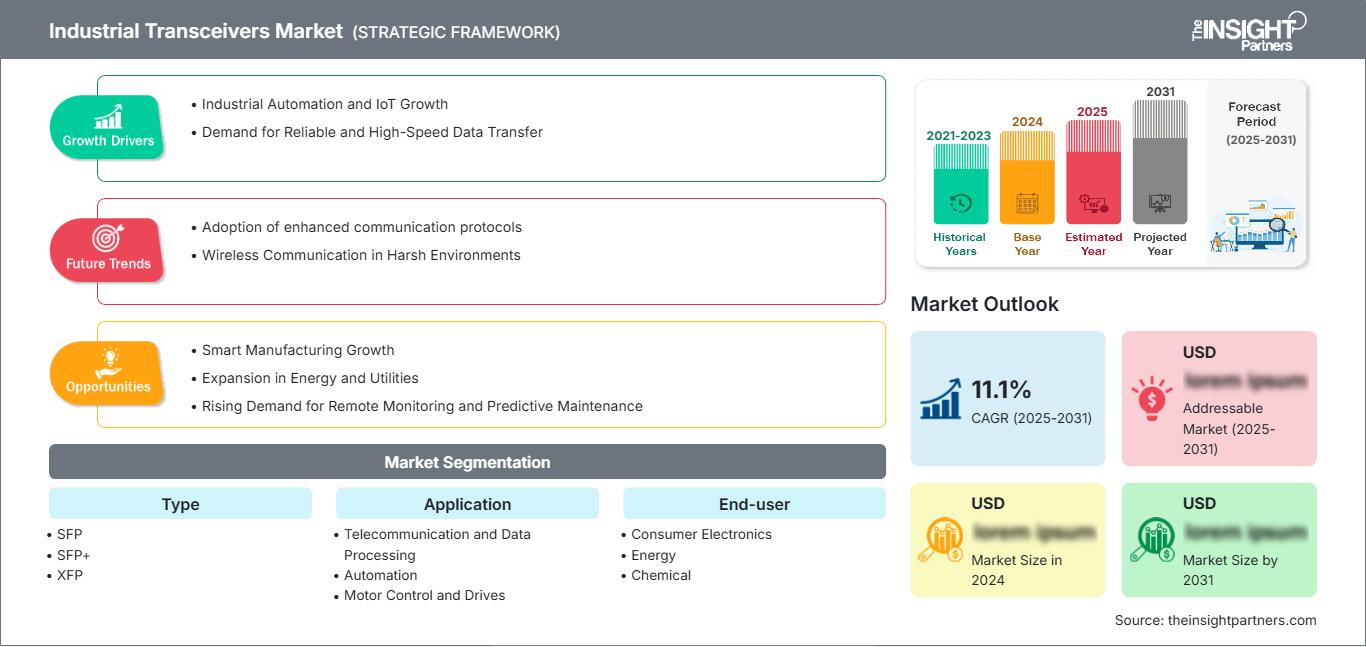
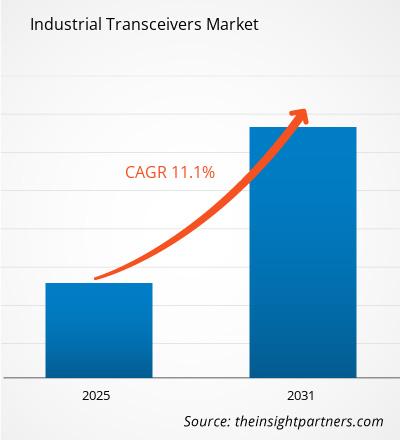
The Industrial Transceivers Market is valued at US$ 5.72 Billion in 2025 and is projected to reach US$ 10.36 Billion by 2034, expanding at a CAGR of 6.82% during 2026–2034. The market encompasses pluggable optical connectivity technologies used across industrial networking environments, with demand shaped by automation, resilient communications, energy infrastructure, and increasingly connected control systems requiring dependable high-speed data transmission.
North America Industrial Transceivers Market Size remains a strategically important market, supported by industrial automation modernization, data-intensive manufacturing, utility digitization, and continued investment in resilient Ethernet infrastructure. The regional outlook reflects an estimated 6.5–7.3% CAGR through 2034, with adoption reinforced by replacement of legacy connectivity, increasing edge computing deployment, and requirements for reliable communications in electrically noisy operating environments.
Industrial Transceivers Market Assessment and Insights
- North America: The region is estimated to represent 31–35% share in 2025, supported by automation and infrastructure modernization, with a 6.5–7.3% CAGR between 2026–2034.
- US: The US represents 56–61% of North American revenue in 2025 and is expected to expand at a 6.7–7.5% CAGR between 2026–2034.
- Europe: Germany, the UK, France, Italy, and Spain support a 21–25% regional share in 2025, with industrial digitization sustaining a 6.1–6.9% CAGR between 2026–2034.
- Asia Pacific: China, Japan, South Korea, and India underpin a 30–34% share in 2025, while manufacturing expansion and network investment support a 7.2–8.1% CAGR between 2026–2034.
- Largest Segment: SFP is estimated at a 46–51% market share in 2025, supported by interoperability and installed-base compatibility, with a 6.4–7.1% CAGR through 2034.
- High Growth Segment: Automation is estimated at a 24–29% market share in 2025 and is expected to record a 7.4–8.2% CAGR during 2026–2034.
- Key companies analyzed in detail: Advantech Co., Ltd.; Cisco Systems, Inc.; CTC Union Technologies Co., Ltd.; D-Link Corporation; Fujitsu Limited; Coherent Corp.; Infineon Technologies AG; Lumentum Holdings Inc.; Smiths Interconnect; Renesas Electronics Corporation.
Source: The Insight Partners' analysis based on proprietary research, government publications, company annual reports, investor presentations, industry databases, and expert interviews.
Industrial transceivers have been transformed into ruggedized, modular devices enabling distributed automation as well as dense networking within industry. Traditional fiber/Ethernet transceiver technology remains relevant due to standardized modules making device repair and replacement easier, while speedier models solve issues posed by an increase in the amount of data coming from vision technology, sensors, supervisors, and analytics performed at the edge. Temperature and electromagnetic resistance along with cybersecurity capability and longevity are critical considerations for manufacturing companies when ordering transceivers.
In the future, growth will be seen across manufacturing hubs, utility upgrades, transport facilities, and industrial edge installations. Suppliers will likely be expected to offer inter-operable, long-lasting, and environmentally robust modules. Smart manufacturing, grid modernization and integrated infrastructures may provide opportunities for companies that manufacture industrial Ethernet architectures based on optical standards.
Industrial Transceivers Market Report Scope
| Report Attribute | Details |
|---|---|
| Market size in 2025 | US$ 5.72 Billion |
| Market Size by 2034 | US$ 10.36 Billion |
| Global CAGR (2026 - 2034) | 6.82% |
| Historical Data | 2021-2024 |
| Forecast period | 2026-2034 |
Industrial Transceivers Market Analysis
Increasingly, demand will be related to the requirement of dependable communication between controllers, switches, sensors, drives, cameras, and edge computing devices. Optical connections offer immunity from electromagnetic interference and provide greater distances of transmission compared to traditional copper connections and are appropriate for use in factories, utilities, transport facilities, and process industries. The value chain in the Industrial Transceivers Market Report includes optical elements, semiconductor components, modules, network infrastructure, distributors, systems integrators, and industrial users. Supply continues to be affected by the availability of components, qualification processes, and rugged packaging.
The positioning of the company depends on the use of interoperable modules, environmental aspects, life cycle management, and compatibility with industrial networking solutions. Advantech Co., Ltd. and Cisco Systems, Inc. address the needs of industrial networking using larger infrastructure offerings, whereas CTC Union Technologies Co., Ltd. manufactures ruggedized communication systems. Fujitsu Limited, Coherent Corp., and Lumentum Holdings Inc. are industry leaders in optical networking solutions, and semiconductor solutions are provided by Infineon Technologies AG and Renesas Electronics Corporation.
More and more investments are made in high-bandwidth technology, low-power, optical integration, and manufacturing robustness. There are also some important points to be considered by the strategic suppliers such as qualification, security, and product longevity since the end users are mostly concerned about operation continuity rather than fast-changing products. These factors will create a market where there is an advantage for the integrated component supplier with application engineering skills.
● REPORT CUSTOMIZATION
Tailor This Report To Align With Your Specific Business Requirements
This report can be customized to align precisely with your business objectives, scope, and target markets. Customization options include tailored segmentation, geography, competitive analysis, and strategic insights to support informed decision-making.
Customize This Report →WHAT YOU CAN ADJUST
- ● Segmentations
- ● Geography
- ● Competitive Analysis
- ● Language Preferences
Industrial Transceivers Market: Strategic Insights
Regional Insights
North America Industrial Transceivers Market
North America is expected to contribute 31-35% of the 2025 Industrial Transceivers Market Share, where 56-61% of the regional demand comes from the US. North America will grow at a rate of 6.5-7.3% CAGR up to 2034, driven by automation of factories, modernization of utilities, networks for transport, and edge computing installations. Increasingly, industrial buyers are in need of optical connectivity that can preserve signals in environments rich in electricity.
The opportunity in this region is further fueled by the replacement of existing infrastructure and the deployment of Ethernet on isolated operational networks. The region’s contribution comes from Canada through applications in resources, utilities, and transport sectors, whereas Mexico gains from localized manufacturing and production facilities. Rugged temperature specifications, interoperability, cybersecurity preparedness, and long-term product support are becoming increasingly important during procurement.
U.S. Industrial Transceivers Market
U.S. constitutes an estimated 56-61% of North American revenues in 2025 and is forecasted to grow at a CAGR of 6.7-7.5% through 2034. Industrial automation, semiconductors fabrication, utility, transportation, and defense sectors contribute to sustained need for dependable optical networking solutions. The existing Ethernet infrastructure also favors incremental upgrades over full network reconstruction.
Business coverage encompasses infrastructure, optical components, and embedded connectivity. Cisco Systems, Inc., Advantech Co., Ltd., Coherent Corp., Lumentum Holdings Inc., Infineon Technologies AG, and Renesas Electronics Corporation engage in the ecosystem at various complementary layers. Application areas currently include machine vision, distributed control systems, predictive maintenance, edge computing, and highly available industrial optical networks that mitigate issues of electromagnetic interference.
Europe Industrial Transceivers Market
Europe is expected to account for 21-25% of revenues in 2025 with a forecasted CAGR of 6.1-6.9% until 2034. Germany has the largest regional demand, driven by strong manufacturing capabilities and automation. The UK, France, Italy, and Spain drive considerable demand with regard to transport, energy, process industries, and smart
The UK combines demand for industrial networks and data infrastructure updates, while Germany continues to be the leading country due to its highly developed ecosystem of automation and machinery. France has its advantage with energy, transport, aerospace and industrial digitization initiatives. Italy and Spain contribute through manufacturing modernization, utilities, transport, and renewable-energy infrastructure.
APAC Industrial Transceivers Market
APAC has a market share of 30-34% in 2025 and is expected to have a growth rate of 7.2-8.1% CAGR until 2034. APAC is led by China followed by Japan, South Korea, India, and Australia. Manufacturing scale, investment in telecommunication, automation, and digital infrastructure development drive the adoption of Industrial Internet of Things within the factories, utilities, transport, and industrially intensive data operations.
The government policies promoting domestic manufacturing and digital infrastructure add on to the demand in the region. China contributes manufacturing scale, Japan contributes automation, South Korea promotes semiconductor and electronics manufacturing, India contributes industrial digitization, and Australia contributes via mining, energy, and infrastructure.
Middle East & Africa Industrial Transceivers Market
Middle East and Africa is projected to grow at a 6.2–7.0% CAGR through 2034, led by Saudi Arabia and the UAE. Industrial connectivity requirements are expanding alongside energy diversification, smart-city investment, utilities, transportation, and large infrastructure projects.
South Africa continues to be a significant market for mining, power, manufacturing, and transportation industries, whereas the other countries in MEA region have their focus on targeted telecom, energy, and infrastructure developments. Products requiring robustness and reliability under high temperature and long distance are in demand.
Segmentation Analysis
Type
Type is expected to expand at a 6.4–7.1% CAGR during 2026–2034. SFP remains the principal architecture because standardized pluggability supports maintenance and incremental upgrades. SFP+ addresses higher bandwidth requirements, while XFP retains relevance in selected legacy and specialized network environments where installed equipment and interoperability influence purchasing decisions.
- SFP: SFP maintains the strongest installed-base position because compact modules support straightforward replacement, multiple fiber options, and broad compatibility across industrial switches, media converters, and communication equipment.
- SFP+: SFP+ serves higher-bandwidth industrial backbones and aggregation links, making it strategically important where machine data, video, and supervisory traffic exceed conventional gigabit requirements.
- XFP: XFP remains relevant in established 10G deployments, particularly where customers prioritize lifecycle continuity and compatibility with existing networking equipment rather than immediate migration to newer form factors.
Application
Application is forecast to grow at a 7.0–7.8% CAGR during 2026–2034. Industrial networking requirements increasingly extend beyond conventional communications into automation, drives, lighting, and smart-grid systems. Automation is positioned as the fastest-growing application because connected production systems require dependable, low-latency communication between control and monitoring layers.
- Telecommunication and Data Processing: This application supports high-volume connectivity requirements and remains strategically important where industrial sites integrate telecom infrastructure, edge computing, data processing, and enterprise networks.
- Automation: Automation drives demand for resilient optical links connecting programmable controllers, industrial switches, robots, sensors, cameras, and edge systems across electrically demanding production environments.
- Motor Control and Drives: Optical connectivity supports isolated communications around motors and drives, reducing exposure to electromagnetic interference and enabling reliable control information across distributed equipment.
- Lighting Power Management: Connected lighting and power-management architectures increasingly require networked monitoring and control, creating targeted demand for compact optical interfaces in large industrial and infrastructure installations.
- Smart Grid: Smart-grid deployments use reliable communications for substations, distributed assets, monitoring systems, and control equipment, supporting optical connectivity where electrical isolation and long-distance transmission are important.
End-user
End-user demand is projected to increase at a 6.6–7.4% CAGR during 2026–2034. Consumer electronics, energy, chemical processing, aerospace, and textile operations differ in environmental and performance requirements, but all benefit from resilient communications supporting automation, monitoring, and distributed control.
- Consumer Electronics: Electronics manufacturing requires dense, reliable networking for automated production, inspection, material handling, and high-throughput equipment, supporting optical connectivity in modern facilities.
- Energy: Utilities and energy operators value optical isolation, long-distance communication, and resilience for substations, generation facilities, renewable assets, and monitoring networks.
- Chemical: Chemical facilities require dependable communications in environments characterized by electromagnetic interference, process-critical operations, and demanding uptime expectations.
- Aerospace: Aerospace applications emphasize ruggedness, low weight, reliability, and high-speed data transmission, particularly in demanding embedded and test environments.
- Textile: Textile production increasingly integrates automated machinery, sensors, and supervisory systems, creating demand for reliable network connections across distributed production equipment.
Opportunity Snapshot
| End Users | Revenue Contribution (High/Medium/Low) | Trend Tag (MAX 2 words) | Adoption Stage (Emerging/Scaling/Mature) |
| Consumer Electronics | Medium | Factory Automation | Scaling |
| Energy | High | Grid Digitization | Scaling |
| Chemical | Medium | Process Control | Scaling |
| Aerospace | Medium | Rugged Networking | Mature |
| Textile | Low | Smart Manufacturing | Scaling |
| Others | Medium | Edge Connectivity | Emerging |
Industrial Transceivers Market Growth Drivers and Impact Analysis
Expansion of industrial Ethernet architectures
Industrial Ethernet is moving deeper into production, utilities, transport, and process-control environments as organizations consolidate operational and information networks. This transition increases the number of communication endpoints requiring dependable physical-layer connectivity and creates recurring demand for pluggable optical modules. The impact is strongest in facilities where copper links encounter distance, grounding, or electromagnetic interference limitations. Standardized SFP architectures can reduce replacement complexity because modules can be exchanged without redesigning entire switching platforms. Suppliers that support multiple fiber types, temperature ranges, and network speeds can therefore address broader installed bases. The market effect extends beyond initial hardware purchases because network expansion generates additional module requirements for aggregation, redundancy, and maintenance inventories.
Rising data intensity across connected factories
Machine vision, predictive maintenance, robotics, digital twins, and edge analytics are increasing the volume and frequency of information moving through industrial networks. Unlike traditional control architectures that exchanged relatively small datasets, modern systems may combine video, sensor streams, machine-state information, and enterprise analytics. Optical transceivers provide a practical connectivity layer where bandwidth, distance, and electromagnetic resilience are important. This trend increases demand for higher-speed modules and creates opportunities for equipment vendors to integrate optical interfaces more deeply into industrial switches and edge platforms. The commercial impact is particularly relevant to manufacturers upgrading brownfield sites because modular transceivers can enable staged capacity expansion without requiring simultaneous replacement of every network component.
Grid and infrastructure modernization
Electricity networks, transportation systems, and large infrastructure projects increasingly require communications that remain dependable across geographically distributed assets. Optical connectivity supports isolation between equipment and can accommodate longer transmission distances than conventional copper links, making it suitable for substations, control centers, tunnels, rail networks, and utility facilities. Grid modernization also increases the number of monitored assets, which expands communication requirements at the edge of infrastructure networks. The resulting market impact is not limited to new installations. Existing sites require replacement modules, redundancy upgrades, and network extensions as monitoring and automation capabilities expand. Suppliers able to meet industrial environmental requirements and infrastructure certifications can address procurement cycles where reliability and qualification are weighted heavily.
Industrial Transceivers Market Future Trends
Greater emphasis on power-efficient optical architectures
Future industrial networking designs are likely to place greater emphasis on energy efficiency as factories deploy more connected equipment and edge computing. Lower-power optical modules can reduce thermal loads in compact switching cabinets and improve system reliability where cooling capacity is limited. Suppliers are expected to refine transmitter and receiver efficiency while maintaining required reach and signal integrity. Silicon photonics and more integrated optical architectures may gradually influence selected high-bandwidth industrial applications as component economics improve. The Industrial Transceivers Market trend could also encourage equipment designers to treat transceiver power as part of total network operating cost rather than an isolated component specification, strengthening demand for modules that combine bandwidth, thermal efficiency, and compact packaging.
Increasing convergence of networking and industrial control
The next phase of industrial connectivity is likely to reduce separation between networking infrastructure and control architectures. Time-sensitive communications, edge processing, deterministic Ethernet, and higher-resolution sensing will require physical connectivity that can support tighter performance requirements. Optical modules are positioned to participate in this transition where electrical isolation, distance, and bandwidth are important. Vendors may increasingly package transceiver capabilities with switching, timing, diagnostics, and management functions to simplify deployment. This convergence should favor suppliers capable of validating complete connectivity chains rather than individual components. Over time, procurement decisions may shift toward certified interoperability and lifecycle management, particularly in facilities where network downtime directly affects production, safety, or infrastructure availability.
Industrial Transceivers Market Opportunities
Localized manufacturing and supply-chain diversification
Manufacturers can pursue opportunities by establishing regional production, testing, or final-configuration capabilities closer to major industrial customers. Supply-chain diversification has become strategically important because industrial customers require continuity over long equipment lifecycles and may face costly delays when specialized modules are unavailable. Regional inventory hubs, dual sourcing, and localized qualification can improve responsiveness without requiring complete vertical integration. Suppliers can also differentiate through application-specific configuration, temperature screening, and certification support. The strongest opportunities in the Industrial Transceivers Market Forecast are likely to emerge in Asia Pacific, North America, and selected European manufacturing clusters where automation investment remains substantial. A localized model can simultaneously reduce logistics exposure and strengthen relationships with system integrators and industrial equipment manufacturers.
High-reliability modules for infrastructure applications
Infrastructure modernization creates an opportunity for suppliers to develop transceivers specifically optimized for utilities, rail, transportation, energy, and harsh industrial installations. Buyers in these applications generally value predictable lifecycle support, environmental robustness, interoperability, and documentation alongside bandwidth. Products designed around extended temperature ranges, vibration tolerance, electromagnetic resilience, and application-specific certifications can command stronger strategic relevance than generic modules. Suppliers should prioritize qualification programs with infrastructure equipment manufacturers and integrators because these channels influence specification decisions before projects reach procurement. The opportunity also extends to replacement markets, where standardized modules can support upgrades without redesigning installed switching systems. This combination of new projects and recurring maintenance requirements can provide a durable revenue base.
Recent Developments
- March 2026: MaxLinear expanded its MxL8323x RS-485/RS-422 transceiver family with data rates up to 50Mbps, enhanced ESD/EFT protection, and broad voltage compatibility for harsh industrial environments. The devices target applications including factory automation, motor drives, HVAC, industrial computing, and smart grids.
- November 2024: SANWA Technologies announced the acquisition of YOKOWO’s optical device business, effective September 30, 2024. The deal transfers IP, manufacturing/sales rights, and production equipment, strengthening SANWA’s optical product portfolio and capabilities in miniaturization, low power consumption, and broadband technologies.
Frequently Asked Questions

- Comprehensive Market Sizing and Forecast Analysis
- Detailed Segmentation Analysis
- In-Depth Market Dynamics Assessment
- Regional and Country-Level Insights
- Competitive Landscape and Company Benchmarking
- Strategic Business Intelligence
Recent Reports
Testimonials

The Insight Partners' SCADA System Market report is comprehensive, with valuable insights on current trends and future forecasts. The team was highly professional, responsive, and supportive throughout. We are very satisfied and highly recommend their services.
RAN KEDEM Partner, Reali Technologies LTDs
I requested a report on a very specific software market and the team produced the report in a few days. The information was very relevant and well presented. I then requested some changes and additions to the report. The team was again very responsive and I got the final report in less than a week.
JEAN-HERVE JENN Chairman, Future Analytica
We worked with The Insight Partners for an important market study and forecast. They gave us clear insights into opportunities and risks, which helped shape our plans. Their research was easy to use and based on solid data. It helped us make smart, confident decisions. We highly recommend them.
PIYUSH NAGPAL Sr. Vice President, High Beam Global
The Insight Partners delivered insightful, well-structured market research with strong domain expertise. Their team was professional and responsive throughout. The user-friendly website made accessing industry reports seamless. We highly recommend them for reliable, high-quality research services
YUKIHIKO ADACHI CEO, Deep Blue, LLC.
This is the first time I have purchased a market report from The Insight Partners.While I was unsure at first, I visited their web site and felt more comfortable to take the risk and purchase a market report.I am completely satisfied with the quality of the report and customer service. I had several questions and comments with the initial report, but after a couple of dialogs over email with their analyst I believe I have a report that I can use as input to our strategic planning process.Thank you so much for taking the extra time and making this a positive experience.I will definitely recommend your service to others and you will be my first call when we need further market data.
JOHN SUZUKI President and Chief Executive Officer, Board Director, BK Technologies
I wish to appreciate your support and the professionalism you displayed in the course of attending to my request for information regarding to infectious disease IVD market in Nigeria. I appreciate your patience, your guidance, and the fact that you were willing to offer a discount, which eventually made it possible for us to close a deal. I look forward to engaging The Insight Partners in the future, all thanks to the impression you have created in me as a result of this first encounter.
DR CHIJIOKE ONYIA MANAGING DIRECTOR, PineCrest Healthcare Ltd.Reason to Buy
- Informed Decision-Making
- Understanding Market Dynamics
- Competitive Analysis
- Identifying Emerging Markets
- Customer Insights
- Market Forecasts
- Risk Mitigation
- Boosting Operational Efficiency
- Strategic Planning
- Investment Justification
- Tracking Industry Innovations
- Aligning with Regulatory Trends





 Get Free Sample for