
Ion Implanter Market Trends, Share & Demand by 2034
Coverage: by Product Type (Medium-current implanter, High-current implanter, High-energy implanter, Others); Application (Semiconductors, Metal finishing, Others) , and Geography (North America, Europe, Asia Pacific, and South and Central America)
- Status : Data Released
- Report Code : TIPRE00010119
- Category : Electronics and Semiconductor
- No. of Pages : 150
- Available Report Formats :


- Last update date : September 21, 2026


2025 Market Size
US$ 3.12 Bn
Base year value
2034 Forecast
US$ 6.5 Bn
Projected by 2034
CAGR 2026-2034
8.50 %
Growth rate
Addressable Market
US$ 43.17 Bn
(2026-2034)
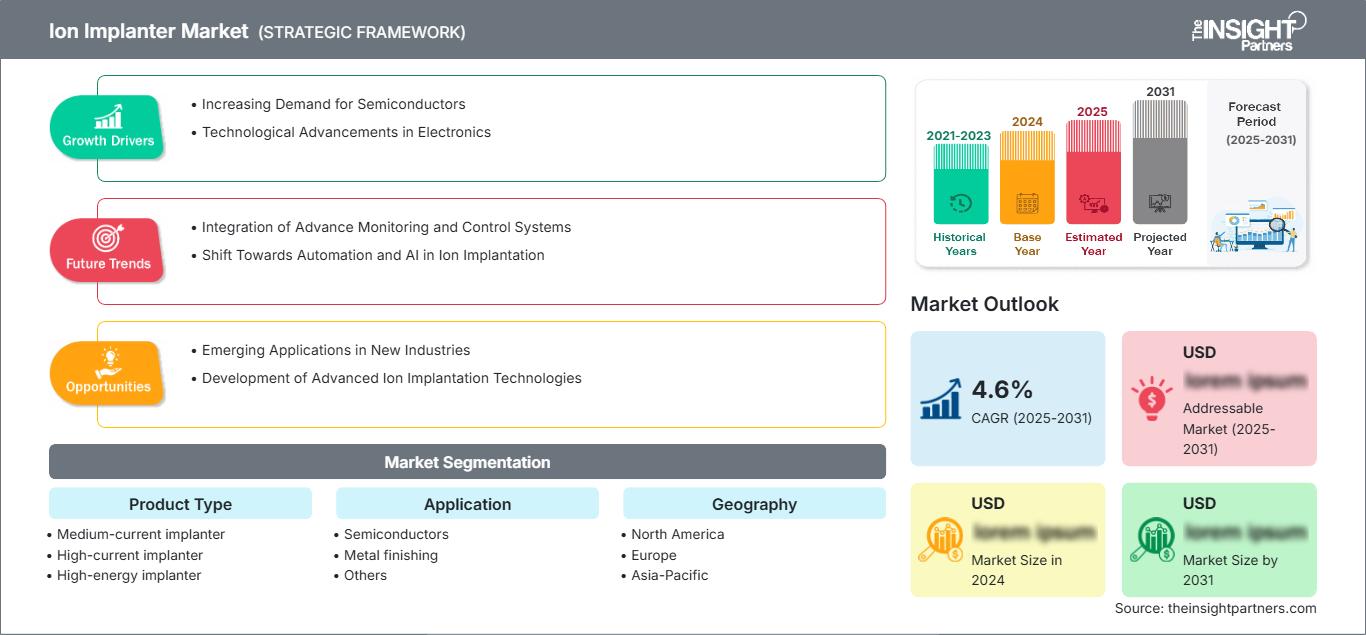
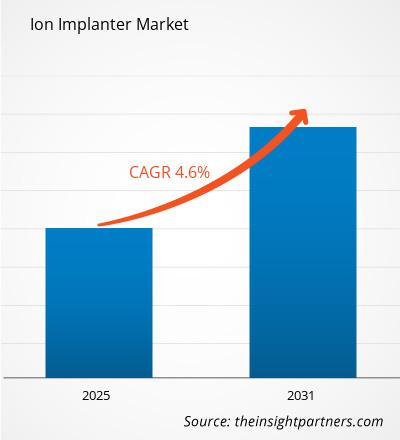
The Ion Implanter Market was valued at US$ 3.12 Billion in 2025 and is projected to reach US$ 6.5 Billion by 2034, expanding at a CAGR of 8.50% during 2026–2034. Ion implanter machines are important for semiconductor manufacturing because they provide the ability to control doping and modification of materials at specific depths and concentrations. The growth in demand will be linked to wafer fab capacity expansion, shifts in technology node, manufacturing of power semiconductors, and rising process complexity.
North America Ion Implanter Market Size is likely to remain an important source of demand, growing at a projected CAGR of 7.6%-8.4% during 2026-2034 driven by the growth of semiconductor manufacturing capacity and investments in advanced manufacturing capability. Localized manufacturing efforts backed by governments and the building of new semiconductor manufacturing facilities are improving the equipment eco-system, and advanced process capabilities enable replacement and upgrades.
Ion Implanter Market Assessment and Insights
- North America: North America is estimated to hold 18–22% share in 2025 and expand at a 7.6–8.4% CAGR between 2026–2034, supported by semiconductor localization, advanced-node investments, and equipment replacement programs.
- US: The US is estimated to represent 70–78% of North American demand in 2025 and grow at a 7.6–8.4% CAGR between 2026–2034, supported by new fabs and process modernization.
- Europe: Europe is estimated at 13–17% share in 2025, expanding at a 6.9–7.8% CAGR between 2026–2034, with Germany, France, Italy, and the Netherlands supporting automotive, industrial, and specialty semiconductor production.
- Asia Pacific: Asia Pacific is estimated to command 50–54% share in 2025 and grow at an 8.8–9.6% CAGR between 2026–2034, led by China, Taiwan, South Korea, and Japan through extensive fab investments.
- Largest Segment: Medium-current implanters are estimated to hold 42–47% market share in 2025, with an 8.0–8.8% CAGR during 2026–2034, reflecting broad process applicability.
- High Growth Segment: High-energy implanters are estimated at 18–22% market share in 2025, with a 9.2–10.1% CAGR during 2026–2034, supported by power and advanced-device applications.
- Key companies analyzed in detail: Advanced Ion Beam Technology Inc., Amtech Systems Inc., Applied Materials, Inc., Axcelis Technologies Inc., Intevac Inc., ion beam services SA, Ionoptika Ltd., Nissin Electric Co. Ltd., Sumitomo Heavy Industries Ltd., ULVAC Inc.
Source: The Insight Partners' analysis based on proprietary research, government publications, company annual reports, investor presentations, industry databases, and expert interviews.
From the traditional doping process applications to more advanced and specific techniques for logic and memory devices, power devices, compound semiconductors and material processing, ion implantation technology has been developing in the direction of specialization. The development of the equipment tends to focus on the stability of the beam current, accuracy of dose and energy, wafer temperature, automation and efficiency. In addition, the increased use of silicon carbide and other specialty materials also increases the demands of technology, especially in high-temperature ion implantation and control of substrates.
This positive trend is based on the continuous semiconductor fab regionalization, increased spending on advanced logic and memory, and power semiconductor capacity expansion. The semiconductor equipment spending hit an all-time high in 2025, with the leading investment region being Asia and 79% of the global semiconductor equipment spending made by China, Taiwan and South Korea.
Ion Implanter Market Report Scope
| Report Attribute | Details |
|---|---|
| Market size in 2025 | US$ 3.12 Billion |
| Market Size by 2034 | US$ 6.5 Billion |
| Global CAGR (2026 - 2034) | 8.50% |
| Historical Data | 2021-2024 |
| Forecast period | 2026-2034 |
Ion Implanter Market Analysis
There is a correlation between demand and wafer fabrication capacity, process node evolution, and precision of dopant placement. The Ion Implanter Market growth ecosystem encompasses equipment makers, semiconductor IDM, foundries, power device makers, component makers, service providers, and fab integrators. More investments into fabs mean more opportunities for equipment in new build, upgrade, and replacement.
The technical nature of the supplier base is concentrated since the ion implanter requires special ion source, mass analyzer, accelerator, beam transport, end station, vacuum system, temperature control, and process software. Competitiveness of equipment producers relates to the accuracy of implantation, beam efficiency, uptime, throughput, contamination minimization, and cost of ownership. Investments in advanced semiconductor manufacturing continue to be concentrated in Asia. China, Taiwan, and South Korea were the top destinations for semiconductor equipment in 2025.
Positioning relies on technology, qualification history, installed base, service capabilities, and special application capabilities. Applied Materials, Inc., Axcelis Technologies Inc., Nissin Electric Co. Ltd., Sumitomo Heavy Industries Ltd., and ULVAC Inc. represent companies active in specific equipment and process segments, whereas Advanced Ion Beam Technology Inc., Amtech Systems Inc., Intevac Inc., ion beam services SA, and Ionoptika Ltd. have specialized capabilities. Therefore, Ion Implanter Market Report takes into account the global equipment and special application capabilities.
Capital expenditures will be driven by advanced node logic, high bandwidth memory, power semiconductors, and region-specific supply chain considerations. According to SEMI, global sales of semiconductor manufacturing equipment in 2025 stood at US$135.1 billion, growing 15% from the prior year, with a rise of 12% in wafer-processing equipment sales. Expansion results in more opportunity for implantation equipment when fabs enter new process generations and localize production.
● REPORT CUSTOMIZATION
Tailor This Report To Align With Your Specific Business Requirements
This report can be customized to align precisely with your business objectives, scope, and target markets. Customization options include tailored segmentation, geography, competitive analysis, and strategic insights to support informed decision-making.
Customize This Report →WHAT YOU CAN ADJUST
- ● Segmentations
- ● Geography
- ● Competitive Analysis
- ● Language Preferences
Ion Implanter Market: Strategic Insights
Regional Insights
North America Ion Implanter Market
North America is anticipated to hold a 18-22% Ion Implanter Market share in 2025, where the regional market is forecast to grow at a 7.6-8.4% CAGR over 2034. The United States makes up the largest regional demand driver, aided by growth in semiconductor manufacturing capacity, investments in advanced nodes, and attempts to boost its own manufacturing capabilities. Canada drives demand through research, specialty electronics, and new applications for semiconductors.
Increasingly, the regional demand picture is driven by new fabrication plants and upgrading of the existing semiconductor facilities. Equipment customers value efficiency, process repeatability, prompt service, and compatibility with sophisticated semiconductor fabs. Logic and memory devices, power semiconductors, and specialty semiconductors offer multiple opportunities for application. The United States spent $10.9 billion on semiconductor equipment in 2025, which speaks volumes about the size of the domestic equipment ecosystem overall, despite the year-on-year decrease.
U.S. Ion Implanter Market
The US is estimated to represent 70–78% of North American demand in 2025, with a 7.6–8.4% CAGR during 2026–2034. New fab construction, advanced-node manufacturing, government incentives, and domestic supply-chain strategies are strengthening demand for specialized semiconductor production equipment.
Applied Materials, Inc., Axcelis Technologies Inc., et al. have existing ties within the US semiconductor industry. These are used in logic chips, memory chips, power chips, and speciality chips. The growth in semiconductor production in the US is pertinent since the implantation machine is a high-cost front-end system that requires process qualification. There will be continued investment in semiconductor equipment in the Americas due to regionalization and AI chip demand.
Europe Ion Implanter Market
The estimated share of Europe in 2025 will be 13-17%, with 6.9-7.8% CAGR from 2026 to 2034. Germany is the dominant market in the region due to its need for automotive semiconductors and industrial semiconductors. Contributions from the United Kingdom, France, Italy, and Spain are due to specialty electronic devices, power semiconductors, automotive semiconductors, research, and industrial semiconductor manufacturing.
Semiconductor research and specialty devices help the United Kingdom gain a dominant position in the region, while Germany's significance is due to automotive electronics, industrial automation, and power semiconductors. Power and advanced semiconductor technology is an opportunity for France, while Italy and Spain contribute to the region's needs with automotive, industrial, and energy semiconductor manufacturing. Europe has a more volatile equipment investment environment compared to Asia, since 2025 sees decreased spending on semiconductor equipment.
APAC Ion Implanter Market
It is expected that APAC will have 50%-54% of the share by 2025 and will grow by 8.8%-9.6% CAGR until 2034. China is the largest market; the other markets are Taiwan, South Korea, Japan, and India. Wafer fabs investment, memory expansion, advanced logic, and power semiconductor manufacturing drive regional demand.
China has an advantage from the increase in domestic semiconductor capacity; Taiwan is vital in advanced node production. South Korea receives investments in memory and HBM, while Japan combines mature semiconductor manufacturing and domestic capacity expansion. India is a new semiconductor manufacturing country, while Australia preserves the research and special roles. The superiority of Asia is supported by the concentration of equipment investments: China, Taiwan, and Korea represent 79% of world-wide semiconductor equipment investments in 2025.
Middle East & Africa Ion Implanter Market
However, Middle East and Africa account for lower equipment base, where demand stems from nascent development of semiconductors, research, specialty electronics and industrial technologies.
The regional market is projected to grow at a 6.1%-7.0% CAGR during 2026-2034. Opportunities exist in relation to localization programs, research facilities and technology diversification. Demand will most probably be project-based rather than comparable with the developed Asian manufacturing regions. Therefore, cooperation with universities, technology centers and specialty-device manufacturers may be relevant to equipment suppliers seeking to enter the region.
Segmentation Analysis
Product Type
Product Type represents a core dimension of the Ion Implanter Market scope. The segment is projected to expand at an 8.2–9.1% CAGR during 2026–2034, supported by continued demand for different implantation energies and beam-current configurations. Selection depends on wafer size, dopant species, process depth, device architecture, throughput requirements, and application-specific thermal constraints.
- Medium-current implanter: Medium-current implanters maintain broad process relevance because they support common semiconductor doping applications requiring balanced beam current, implantation accuracy, throughput, and flexible process control across established and advanced manufacturing environments.
- High-current implanter: High-current implanters address applications requiring high-dose implantation and productivity, making them strategically important for mature technologies, power devices, and high-volume manufacturing processes where throughput is a major consideration.
- High-energy implanter: High-energy implanters support deeper implantation profiles and specialized device structures, increasing their relevance for power semiconductors, image sensors, and applications requiring controlled dopant placement at greater substrate depths.
- Others: Other product configurations serve specialized implantation requirements and research-oriented applications where conventional equipment architectures may not provide the necessary energy, beam, substrate, or process flexibility.
Application
Application represents another important dimension of the Ion Implanter Market, with the segment expected to grow at an 8.7–9.5% CAGR during 2026–2034. Semiconductor manufacturing remains the central demand base, while specialized applications provide incremental opportunities as ion-beam technologies expand into material engineering and advanced device development.
- Semiconductors: Semiconductors remain the primary application because implantation enables controlled doping, threshold adjustment, conductivity modification, and device formation across logic, memory, power, sensor, and specialty semiconductor manufacturing.
- Metal finishing: Metal finishing uses ion-beam processes for surface modification and material-property enhancement, creating specialized demand where wear resistance, hardness, adhesion, or surface engineering characteristics are important.
- Others: Other applications include research, specialty material modification, and emerging technology uses where ion-beam processing can modify substrate properties or introduce controlled material characteristics.
Opportunity Snapshot
| Application | Revenue Contribution | Trend Tag | Adoption Stage |
| Semiconductors | High | Node Migration | Mature |
| Metal finishing | Medium | Surface Engineering | Scaling |
| Others | Low | Specialty Processing | Emerging |
Ion Implanter Market Growth Drivers and Impact Analysis
Expansion of advanced semiconductor fabrication capacity
Semiconductor-fab expansion is a fundamental driver because every new wafer-processing line requires a broad set of front-end equipment, including implantation systems. Investment is increasingly directed toward advanced logic, memory, power devices, and geographically distributed manufacturing capacity. SEMI reported that global semiconductor equipment sales reached US$135.1 billion in 2025, while wafer-processing equipment sales increased 12%, demonstrating continued investment across the front-end ecosystem. For implanter suppliers, new fabs create opportunities for initial tool placement, process qualification, and subsequent capacity additions. Technology transitions also encourage existing fabs to replace or supplement equipment as device architectures change. The resulting demand is therefore linked not only to wafer volumes but also to the number of process generations and manufacturing locations being introduced.
Growing adoption of power semiconductors and SiC devices
Power semiconductor manufacturing is creating additional opportunities because silicon carbide and other wide-bandgap technologies require specialized implantation conditions. SiC wafers differ from conventional silicon substrates in thermal behavior, surface characteristics, and implantation requirements, increasing the importance of high-temperature processing and precise dopant control. Sumitomo Electric describes ion implantation as a critical step for power-device production and highlights the technical challenges associated with SiC processing. These requirements create opportunities for equipment designed around specialized thermal control, high-energy operation, and stable beam delivery. The impact extends beyond electric vehicles to renewable-energy systems, industrial power conversion, charging infrastructure, and energy-efficient electrical equipment. As power-device production scales, suppliers with dedicated implantation architectures can address a market less dependent on conventional logic-node cycles.
Regionalization of semiconductor supply chains
Semiconductor manufacturing is becoming more geographically distributed as governments and manufacturers seek greater supply-chain resilience. Regional investment creates opportunities for equipment suppliers because new fabrication clusters require complete front-end production capabilities rather than isolated capacity additions. SEMI expects global 300mm fab equipment spending to total US$374 billion from 2026 through 2028, with major investments concentrated in China, Korea, Taiwan, and the Americas. For implantation suppliers, regionalization can broaden the customer base and reduce dependence on individual manufacturing clusters. It also increases the importance of local service infrastructure, application engineering, spare-parts availability, and customer support. Vendors that establish technical teams near emerging fabs can improve qualification responsiveness and strengthen long-term relationships with manufacturers building new production capacity.
Ion Implanter Market Future Trends
Advanced implantation for power and wide-bandgap devices
The Ion Implanter Market trends are increasingly shaped by the requirements of silicon carbide and other wide-bandgap semiconductor technologies. Future equipment development is likely to focus on higher-temperature wafer handling, improved beam stability, specialized ion species, and better control of implantation-induced defects. SiC processing requires substantially different thermal conditions from conventional silicon implantation, creating opportunities for dedicated platforms rather than simple adaptations of established tools. ULVAC currently offers a high-temperature ion implanter designed for mass production of SiC, with continuous high-temperature implantation and energy capability up to 700 keV. As power-device architectures evolve, equipment suppliers are likely to differentiate through thermal uniformity, automation, process repeatability, and integration with downstream activation and annealing processes.
Greater integration of process control and automation
Future equipment development is expected to place greater emphasis on automated process monitoring, recipe management, predictive maintenance, and integrated data analysis. Implantation involves multiple tightly controlled parameters, including ion species, energy, beam current, dose, wafer position, temperature, and vacuum conditions. Greater integration of sensors and software can help manufacturers identify deviations earlier and improve equipment utilization. Axcelis has emphasized beam quality, source life, particle control, dosimetry, throughput, and reliability in its next-generation Purion H6 platform, illustrating the direction of equipment development. As fabs become increasingly automated, implanters will be expected to operate as connected production assets rather than isolated process tools, increasing the importance of interoperability and data availability.
Ion Implanter Market Opportunities
Replacement of aging implantation equipment
The Ion Implanter Market Forecasts indicate an opportunity in the replacement of aging equipment across established semiconductor manufacturing locations. Older systems can remain operational for many years, but limitations in throughput, process control, automation, spare-parts availability, and compatibility with modern fab-management systems can increase lifecycle costs. Replacement programs allow manufacturers to upgrade capability without constructing entirely new facilities. Vendors can strengthen this opportunity by providing migration planning, compatible wafer handling, process-transfer support, and service agreements. The opportunity is particularly relevant for mature-node fabs, specialty semiconductor manufacturers, and power-device producers where long production lifecycles coexist with evolving quality and productivity requirements. Equipment suppliers with established installed bases can benefit from replacement demand because existing customer relationships reduce qualification barriers and provide access to recurring service and modernization projects.
New fab projects and localized equipment ecosystems
New semiconductor fabrication projects create opportunities to influence equipment specifications before production begins. Regionalization is encouraging investment across North America, Asia, Europe, and emerging semiconductor locations, creating new demand for implantation systems as fabs establish complete process flows. SEMI expects investment in 300mm equipment to remain strong through 2028, driven by AI demand and regional supply-chain restructuring. Suppliers can pursue these opportunities through partnerships with engineering contractors, system integrators, device manufacturers, and local service organizations. Early engagement can improve specification positioning while enabling suppliers to demonstrate total cost of ownership, process capability, automation compatibility, and lifecycle support. The strongest opportunities are likely to arise where new fabs combine advanced logic, memory, power devices, or specialty semiconductor production.
Recent Developments
- February 2026: Axcelis Technologies unveiled the Purion H6, a next-generation high-current ion implanter for advanced semiconductor manufacturing. It combines high throughput with improved dose control, particle control and beam stability. The system is designed to improve precision, yield, productivity and cost of ownership across logic, memory and image-sensor applications.
- January 2026: The Hebrew University of Jerusalem introduced a new ion implanter at its Brojde Center, the only such device in Israel and one of few worldwide. The equipment precisely inserts ions into solid materials to modify their electrical and physical properties. It will support research in semiconductors, microelectronics, quantum materials, physics and chemistry.
- January 2026: China achieved beam extraction from its first domestically developed tandem high-energy hydrogen ion implanter. Developed by the China Institute of Atomic Energy, the system reportedly reaches performance comparable with advanced international equipment. The breakthrough strengthens China’s domestic semiconductor equipment capabilities, particularly for power semiconductor manufacturing..
Frequently Asked Questions

- Comprehensive Market Sizing and Forecast Analysis
- Detailed Segmentation Analysis
- In-Depth Market Dynamics Assessment
- Regional and Country-Level Insights
- Competitive Landscape and Company Benchmarking
- Strategic Business Intelligence
Recent Reports
Testimonials

The Insight Partners provided valuable market intelligence that supported our global go-to-market strategy. Their team was professional, responsive, and attentive to our feedback, providing thoughtful analysis and helpful methodological clarifications throughout the project.
Junmo Kim Chief Financial Officer (CFO), Enertech Co., Ltd.
The Insight Partners' SCADA System Market report is comprehensive, with valuable insights on current trends and future forecasts. The team was highly professional, responsive, and supportive throughout. We are very satisfied and highly recommend their services.
RAN KEDEM Partner, Reali Technologies LTDs
I requested a report on a very specific software market and the team produced the report in a few days. The information was very relevant and well presented. I then requested some changes and additions to the report. The team was again very responsive and I got the final report in less than a week.
JEAN-HERVE JENN Chairman, Future Analytica
We worked with The Insight Partners for an important market study and forecast. They gave us clear insights into opportunities and risks, which helped shape our plans. Their research was easy to use and based on solid data. It helped us make smart, confident decisions. We highly recommend them.
PIYUSH NAGPAL Sr. Vice President, High Beam Global
The Insight Partners delivered insightful, well-structured market research with strong domain expertise. Their team was professional and responsive throughout. The user-friendly website made accessing industry reports seamless. We highly recommend them for reliable, high-quality research services
YUKIHIKO ADACHI CEO, Deep Blue, LLC.
This is the first time I have purchased a market report from The Insight Partners.While I was unsure at first, I visited their web site and felt more comfortable to take the risk and purchase a market report.I am completely satisfied with the quality of the report and customer service. I had several questions and comments with the initial report, but after a couple of dialogs over email with their analyst I believe I have a report that I can use as input to our strategic planning process.Thank you so much for taking the extra time and making this a positive experience.I will definitely recommend your service to others and you will be my first call when we need further market data.
JOHN SUZUKI President and Chief Executive Officer, Board Director, BK Technologies
I wish to appreciate your support and the professionalism you displayed in the course of attending to my request for information regarding to infectious disease IVD market in Nigeria. I appreciate your patience, your guidance, and the fact that you were willing to offer a discount, which eventually made it possible for us to close a deal. I look forward to engaging The Insight Partners in the future, all thanks to the impression you have created in me as a result of this first encounter.
DR CHIJIOKE ONYIA MANAGING DIRECTOR, PineCrest Healthcare Ltd.Reason to Buy
- Informed Decision-Making
- Understanding Market Dynamics
- Competitive Analysis
- Identifying Emerging Markets
- Customer Insights
- Market Forecasts
- Risk Mitigation
- Boosting Operational Efficiency
- Strategic Planning
- Investment Justification
- Tracking Industry Innovations
- Aligning with Regulatory Trends





 Get Free Sample for