
Land Mobile Wireless Systems Market Demand, Size & Forecast by 2034
Coverage: By Type (Hand Portable, In-Vehicle (Mobile)); Technology (Analog, Digital) , and Geography (North America, Europe, Asia Pacific, and South and Central America)
- Status : Data Released
- Report Code : TIPRE00023917
- Category : Electronics and Semiconductor
- No. of Pages : 150
- Available Report Formats :


- Last update date : September 21, 2026


2025 Market Size
US$ 22.32 Bn
Base year value
2034 Forecast
US$ 37.72 Bn
Projected by 2034
CAGR 2026-2034
6.01 %
Growth rate
Addressable Market
US$ 272.01 Bn
(2026-2034)
The Land Mobile Wireless Systems Market was valued at US$ 22.32 Billion in 2025 and is projected to reach US$ 37.72 Billion by 2034, expanding at a CAGR of 6.01% from 2026 to 2034. The market includes vital and professional wireless communication services employed within the sectors of public safety, transport, utilities, military, industry, and commercial establishments, where reliable voice communication remains a key requirement despite growing cellular and broadband services.
North America will continue to hold an important share in the Land Mobile Wireless Systems Market with market growth driven by investments in public safety modernization and infrastructure resilience, as well as replacement of outdated radio fleets. Growth rate in the region is expected to be in the range of 4.8%-5.3% CAGR during the period from 2026 to 2034.
Land Mobile Wireless Systems Market Assessment and Insights
- North America: North America is expected to represent a 31–34% share in 2025 and expand at a 4.8–5.3% CAGR between 2026–2034, supported by public-safety investment, fleet modernization, and established P25 infrastructure.
- US: The US is estimated to account for a 82–85% share of North American demand in 2025 and grow at a 4.7–5.2% CAGR between 2026–2034, driven by public-safety modernization.
- Europe: Europe is projected to hold a 17–19% share in 2025 and grow at a 5.0–5.6% CAGR between 2026–2034. Germany, the UK, France, and Spain remain important markets as TETRA modernization continues.
- Asia Pacific: Asia Pacific is estimated at a 39–42% share in 2025 and is projected to expand at an 8.0–8.7% CAGR between 2026–2034, led by China, Japan, India, South Korea, and Australia.
- Largest Segment: Hand Portable systems represent a 52–56% market share in 2025 and are projected to grow at a 5.6–6.2% CAGR during 2026–2034, supported by field mobility.
- High Growth Segment: Digital technology holds a 64–68% market share in 2025 and is expected to grow at an 8.2–9.0% CAGR during 2026–2034, reflecting modernization and spectrum efficiency.
- Key companies analyzed in detail: Motorola Solutions, Inc., Simoco Wireless Solutions, Raytheon Company, JVCKENWOOD Corporation, Thales Group, RELM Wireless Corporation, Hytera Communications Corporation Limited, Tait Radio Communications Limited, Sepura PLC, L3Harris Technologies, Inc.
Source: The Insight Partners' analysis based on proprietary research, government publications, company annual reports, investor presentations, industry databases, and expert interviews.
It has evolved from being analog voice-based systems to being digital systems that offer encryption, GPS, data messaging, trunking, and interoperability. Handheld devices are still a key part of field work while vehicular radios offer greater power capacity for mobile personnel. There is increased emphasis on ruggedization, cybersecurity, energy efficiency, software-defined capabilities, and multi-standard compatibility for both radio and broadband networks.
Future investments will focus on hybrid systems that connect LMRs to LTE, 5G, Wi-Fi, and satellite connectivity. New markets in Asia-Pacific and the Middle East region will play a key role in driving purchases from public safety agencies, transportation companies, utilities, and industries as they upgrade their communication capabilities. Appropriate spectrum policies, cybersecurity, emergency planning programs, and infrastructure spending will facilitate equipment upgrades and network enhancements.
Land Mobile Wireless Systems Market Report Scope
| Report Attribute | Details |
|---|---|
| Market size in 2025 | US$ 22.32 Billion |
| Market Size by 2034 | US$ 37.72 Billion |
| Global CAGR (2026 - 2034) | 6.01% |
| Historical Data | 2021-2024 |
| Forecast period | 2026-2034 |
Land Mobile Wireless Systems Market Analysis
The demand arises from the need for reliable communication during times when the commercial cellular networks are either not available or cannot be used due to congestion or other issues. It provides structural support to the development of the Land Mobile Wireless Systems market among the police force, fire brigade, paramedics, utilities companies, transport agencies, mining operations, construction companies, and military. The value chain involves producers of radios, suppliers of chipsets, network integrators, infrastructure providers, spectrum regulators, software providers, distributors, and maintenance companies. The procurement processes have started taking into consideration the performance over the entire lifecycle instead of the cost of the handset only.
There are more changes coming due to the digital migration and hybrid connectivity in the value chain of the industry. Digital radios provide increased spectrum efficiency and offer the ability to encrypt communications, locate, message, and run applications, while analog radios stay important in the areas where lower prices and existing infrastructures affect the decision making process. Vendors will need to integrate broadband technology in addition to supporting interoperability among such standards like TETRA, DMR, P25 and others.
Competitive positioning is influenced by differences in the technology portfolio, installed base, geographical coverage, and specialization in either public safety or industrial communications. According to the analysis of Land Mobile Wireless Systems Market Report, Motorola Solutions, Inc. has a wide mission-critical ecosystem; while Thales Group, JVCKENWOOD Corporation, Hytera Communications Corporation Limited, and L3Harris Technologies, Inc. are involved in various combinations of public safety, defense, transportation and other applications. Sepura PLC and Tait Radio Communications Limited remain specialists in critical communications.
The strategic investment becomes more focused on convergence than radio alone. Motorola Solutions, Inc. expands LMR towards broadband and satellite communications, while JVCKENWOOD Corporation has improved its broadband push-to-talk solutions. Hytera Communications Corporation Limited develops hybrid terminals with narrowband and LTE capabilities. Thales Group and Raytheon Company still have advantages in their relationship with defense and government customers; while Simoco Wireless Solutions, RELM Wireless Corporation and Tait Radio Communications Limited concentrate on special applications and product lifecycle.
● REPORT CUSTOMIZATION
Tailor This Report To Align With Your Specific Business Requirements
This report can be customized to align precisely with your business objectives, scope, and target markets. Customization options include tailored segmentation, geography, competitive analysis, and strategic insights to support informed decision-making.
Customize This Report →WHAT YOU CAN ADJUST
- ● Segmentations
- ● Geography
- ● Competitive Analysis
- ● Language Preferences
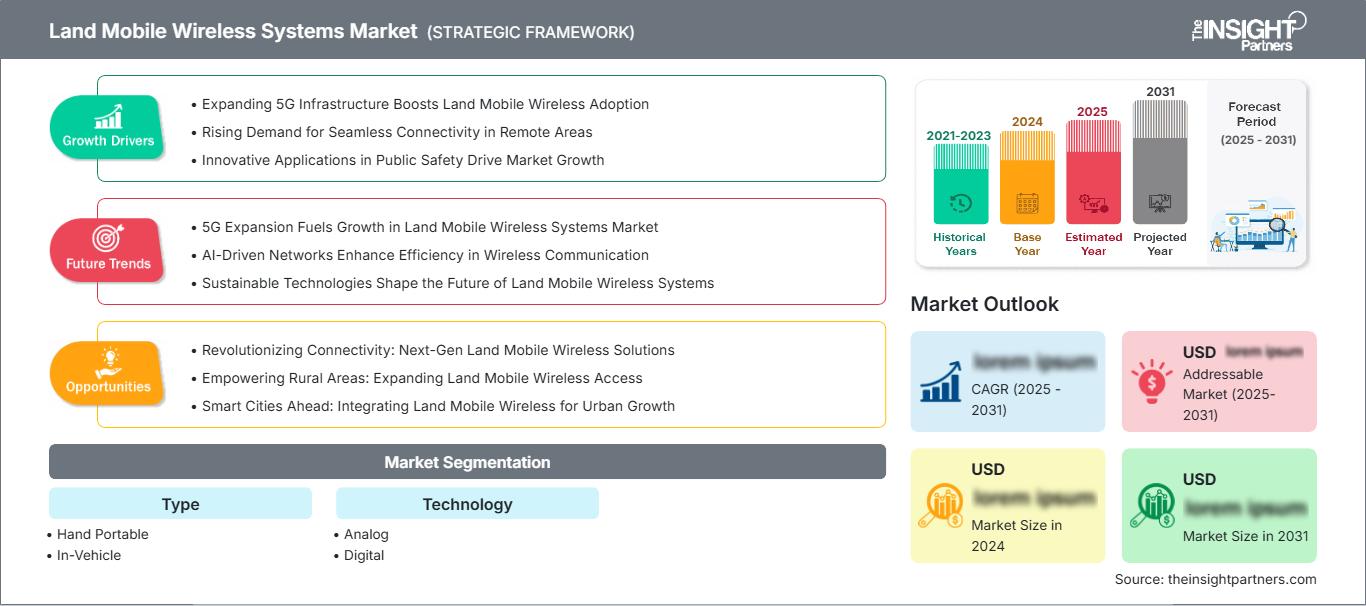
Land Mobile Wireless Systems Market: Strategic Insights
Regional Insights
North America Land Mobile Wireless Systems Market
It is expected that North America will have a Land Mobile Wireless Systems Market share of 31–34% in 2025 and will witness a CAGR of 4.8–5.3% from 2026 to 2034. This region is favored by advanced public safety communications infrastructure, strong P25 ecosystem, emergency response needs, and replacement of old radio systems. In addition to federal, state, and local government purchases, utilities, transportation, and industrial players generate demand for private communications.
The United States accounts for 82–85% of the North American demand in 2025 and is set to witness a CAGR of 4.7–5.2% during the forecast period. Procurement focuses on interoperability, encryption, broadband communication, and operational continuity. Canada contributes due to public safety, resources industry, transport and remote communications. The installed base in the region offers opportunities for replacements and integration with LTE, 5G, and satellite communications.
U.S. Land Mobile Wireless Systems Market
The US has an estimated market share of 82–85% for North America in 2025 and is expected to experience a growth rate of 4.7–5.2% CAGR up to 2034. Public-safety departments at the federal, state, and municipal levels are the key consumers of the technology, aided by funding in the area of emergency communication, interoperability, encryption, and infrastructure reliability. Motorola Solutions, Inc., L3Harris Technologies, Inc., JVCKENWOOD Corporation, and Raytheon Company have considerable presence in the market.
New applications include location-based services, dispatch integration, broadband services, and smart field operations. Utilities, railways, airports, logistics firms, and industrial companies all need reliable communication in areas where cellular network services might be inadequate. Refreshment projects for fleets and transition from outdated analog systems create ongoing procurement needs, especially where agencies need to ensure their interoperability with regional networks.
Europe Land Mobile Wireless Systems Market
Europe represented around 17–19% share in 2025, and it is forecasted to register 5.0–5.6% CAGR during 2026–2034. Germany is one of the key markets followed by the United Kingdom and France, where the TETRA network enables public safety, transportation, utilities, and industrial usage. Digital migration and network upgrade are critical criteria for purchasing.
In the United Kingdom, there is continuous demand due to public-safety communication and transportation network, while Germany is benefited due to the industry, emergency services, and professional radio communications. In France, there is constant investment in secure government and critical infrastructure communications. There is demand from Italy and Spain due to transport, utilities, public safety, and industrial sectors. European demand increasingly focuses on interoperability, cybersecurity, spectrum utilization, and migration to mission-critical broadband communications technology.
APAC Land Mobile Wireless Systems Market
Asia Pacific region holds a market share of 39–42% in 2025 and has been projected to maintain a CAGR of 8.0–8.7% from 2026 to 2034. China is the dominant player in the market, whereas Japan, South Korea, India, and Australia are contributing in the segment through public safety, manufacturing, mining, transport, and utilities. Digitalization in industry and infrastructure development are enhancing the requirement for reliable private communication solutions.
Middle East & Africa Land Mobile Wireless Systems Market
The demand from Middle East and Africa is expected to witness a 5.8–6.5% CAGR until 2034, with the highest demand from Saudi Arabia, followed by UAE and South Africa. Big infrastructure projects, energy operations, public safety, and transport lead to demands for secure radio networks in challenging environments.
Big investments in smart cities, security, energy, and transport are made in Saudi Arabia and UAE, whereas there is already demand for such systems in South Africa in sectors such as mining, utilities, logistics, and public safety. Procurement in the rest of MEA region depends on factors like available infrastructure, spectrum management, funding for the project, and distributors.
Segmentation Analysis
Type
Type demand is projected to expand at a 5.4–6.1% CAGR during 2026–2034, reflecting the continued importance of mobile communications across field and vehicle-based operations. The Land Mobile Wireless Systems Market scope includes equipment selected according to user mobility, power requirements, coverage conditions, and operational environment. Hand portable radios remain highly versatile, while in-vehicle systems support mobile command and field operations.
- Hand Portable: Hand Portable radios maintain the leading position because responders, security teams, utility workers, and industrial personnel require mobility. Ruggedization, battery endurance, audio quality, encryption, and compact form factors influence replacement decisions.
- In-Vehicle: In-Vehicle systems serve police fleets, emergency vehicles, transportation operators, utility trucks, and defense platforms. Higher transmit power, external antennas, vehicle integration, and dispatch connectivity make these systems strategically important for mobile operations.
Technology
Technology segment in the Land Mobile Wireless Systems Market is projected to grow at a 6.8–8.2% CAGR during 2026–2034 as digital migration accelerates across public safety, transportation, utilities, defense, and industrial communications. Digital platforms increasingly combine secure voice with location, messaging, and data functions, although analog systems remain useful where simplicity and existing infrastructure remain decisive.
- Analog: Analog systems retain demand where organizations prioritize low acquisition costs, straightforward operation, and compatibility with established networks. Remote industrial sites and smaller organizations can continue using analog equipment where migration economics remain unfavorable.
- Digital: Digital systems hold the stronger strategic position because encryption, spectrum efficiency, GPS, messaging, trunking, and application integration support more demanding operational requirements. Public-safety modernization and interoperability initiatives reinforce adoption.
Opportunity Snapshot
| End User | Revenue Contribution (High/Medium/Low) | Trend Tag (MAX 2 words) | Adoption Stage (Emerging/Scaling/Mature) |
| Public Safety | High | Mission Critical | Mature |
| Transportation | High | Fleet Mobility | Scaling |
| Energy and Utilities | High | Remote Coverage | Scaling |
| Defense | High | Secure Voice | Mature |
| Mining and Construction | Medium | Rugged Mobility | Scaling |
| Commercial | Medium | Private Networks | Scaling |
Land Mobile Wireless Systems Market Growth Drivers and Impact Analysis
Public-Safety Modernization Sustains Replacement and Upgrade Cycles
Public-safety agencies increasingly require communications infrastructure that supports encrypted voice, interoperability, location awareness, and reliable operation during emergencies. Existing radio fleets must therefore evolve without compromising established coverage or mission-critical voice performance. The resulting replacement cycle creates stable demand for new terminals, infrastructure, software, accessories, and integration services. Budget allocations for emergency preparedness can accelerate procurement when agencies face aging equipment or changing interoperability requirements. Digital standards also provide a pathway to introduce additional functionality without immediately abandoning installed networks. Vendors with strong service organizations benefit because public-safety customers typically require testing, configuration, training, maintenance, and long-term technical support. This driver therefore affects not only equipment volumes but also the composition of revenue, shifting procurement toward integrated communications ecosystems with longer customer relationships and higher service requirements.
Industrial Operations Require Reliable Communications Beyond Cellular Coverage
Industrial environments create persistent demand for communications systems that remain dependable across mines, energy facilities, rail networks, ports, warehouses, construction sites, and remote infrastructure. Commercial cellular networks may not provide adequate coverage, redundancy, or operational control in these locations, particularly across large private sites or geographically isolated areas. LMR systems provide organizations with dedicated communication channels and predictable group calling, supporting coordination among mobile teams and control centers. Industrial requirements also influence equipment specifications, increasing demand for rugged enclosures, high-audio performance, long battery life, GPS functionality, and vehicle integration. As industrial automation expands, radio networks can increasingly complement private broadband rather than operate independently. This creates opportunities for vendors that can integrate voice communications with dispatch, telemetry, location services, and operational applications while maintaining reliable performance in demanding physical environments.
Digital Migration Improves Spectrum Efficiency and Functional Capability
The transition from analog to digital radio systems is creating demand for equipment that can deliver greater functionality within constrained spectrum resources. Digital platforms can support more efficient channel utilization while adding encryption, authentication, GPS, messaging, and application interfaces. These capabilities are especially relevant to public-safety agencies and infrastructure operators managing large user groups across congested environments. Migration is not uniform because organizations must consider network replacement costs, workforce training, interoperability, and existing equipment lifecycles. Consequently, many buyers adopt phased strategies that combine legacy and digital equipment during transition periods. This supports demand for multimode devices and flexible infrastructure capable of operating across standards. Over time, digital migration should increase the value of software, device management, integration, and professional services relative to basic radio hardware, creating broader commercial opportunities for technically capable suppliers.
Land Mobile Wireless Systems Market Future Trends
Hybrid LMR and Broadband Networks Will Reshape Mission-Critical Connectivity
Future Land Mobile Wireless Systems Market trends will increasingly center on hybrid architectures that combine established narrowband radio with LTE, 5G, Wi-Fi, and satellite connectivity. Instead of treating broadband as a replacement for LMR, operators are likely to use multiple layers according to mission requirements. Narrowband systems can preserve dependable voice and group communications, while broadband networks provide higher-speed data, video, mapping, and application access. Intelligent devices may automatically select available networks based on coverage and service priorities. This architecture can extend operational communications into areas where traditional radio infrastructure is limited without forcing immediate network replacement. The resulting transition will favor vendors capable of providing interoperable devices, network management, cybersecurity, and application integration across heterogeneous connectivity environments while preserving the reliability expected from mission-critical communications.
Software-Defined Radios Will Increase Fleet Flexibility
Software-defined architectures are likely to become more influential as users seek equipment that can support multiple standards, frequency configurations, and evolving communication requirements. Instead of replacing hardware whenever protocols change, organizations can increasingly use software updates to add functions, improve security, or enable interoperability. This approach can reduce lifecycle costs while extending equipment usefulness, particularly for large government and industrial fleets. Device management platforms will become more important because administrators must control configuration, firmware, authentication, and security policies across thousands of endpoints. Open interfaces may also encourage greater integration with dispatch systems, command platforms, and operational applications. Over the forecast period, buyers are therefore likely to evaluate radios according to upgradeability and software ecosystems in addition to physical specifications, shifting competitive differentiation toward architecture, cybersecurity, management capabilities, and long-term platform support.
Land Mobile Wireless Systems Market Opportunities
Hybrid Communications Create New Investment Pathways
Land Mobile Wireless Systems Market Forecasts point toward opportunities in hybrid communications equipment that connects narrowband radio with LTE, 5G, Wi-Fi, and satellite networks. Vendors and investors can target devices that preserve mission-critical voice while adding broadband data and application capabilities. This model addresses the practical challenge of modernization because agencies can introduce new services without immediately replacing established radio networks. Opportunities extend to gateways, network management software, dispatch platforms, cybersecurity, and integration services. Transportation, public safety, utilities, and defense are particularly attractive because these sectors require resilient communications across changing geographic and operational conditions. Companies with installed radio bases can potentially leverage existing customer relationships to introduce broadband functionality, while specialized suppliers can focus on interoperability layers that connect heterogeneous networks and reduce migration complexity for large organizations.
Lifecycle Services Can Expand Recurring Revenue Opportunities
Lifecycle services provide an actionable opportunity for suppliers seeking more stable revenue beyond equipment procurement. Large radio fleets require programming, configuration, preventive maintenance, battery management, repair, software updates, cybersecurity controls, and eventual replacement. Service providers can package these activities through multi-year agreements, reducing administrative burdens for customers while creating predictable recurring revenue. The model is especially relevant to public-safety agencies and industrial organizations with geographically distributed equipment. Remote diagnostics and centralized device management can further reduce service costs by identifying equipment problems before failure and minimizing physical intervention. Investors can evaluate suppliers based on installed-base depth, service coverage, software capabilities, and customer retention rather than hardware sales alone. This approach also creates opportunities for channel partners and integrators that can provide localized support around specialized radio platforms and infrastructure.
Recent Developments
- November 2025: Vodafone and AST SpaceMobile selected Germany for a European Sovereign Satellite Operations Centre. The centre will manage satellite connectivity for mobile network operators across Europe. It is part of a planned EU satellite constellation designed to strengthen digital sovereignty, connectivity and emergency communications.
- April 2024: Mobix Labs launched the MBX3110, described as the world’s first high-power SP10T RF switch for the land mobile radio market. The CMOS-based switch supports high-power, multi-band LMR applications with low insertion loss and high linearity. It is aimed at critical communications used by first responders, public safety and other demanding users.
Frequently Asked Questions

- Comprehensive Market Sizing and Forecast Analysis
- Detailed Segmentation Analysis
- In-Depth Market Dynamics Assessment
- Regional and Country-Level Insights
- Competitive Landscape and Company Benchmarking
- Strategic Business Intelligence
Recent Reports
Testimonials

The Insight Partners provided valuable market intelligence that supported our global go-to-market strategy. Their team was professional, responsive, and attentive to our feedback, providing thoughtful analysis and helpful methodological clarifications throughout the project.
Junmo Kim Chief Financial Officer (CFO), Enertech Co., Ltd.
The Insight Partners' SCADA System Market report is comprehensive, with valuable insights on current trends and future forecasts. The team was highly professional, responsive, and supportive throughout. We are very satisfied and highly recommend their services.
RAN KEDEM Partner, Reali Technologies LTDs
I requested a report on a very specific software market and the team produced the report in a few days. The information was very relevant and well presented. I then requested some changes and additions to the report. The team was again very responsive and I got the final report in less than a week.
JEAN-HERVE JENN Chairman, Future Analytica
We worked with The Insight Partners for an important market study and forecast. They gave us clear insights into opportunities and risks, which helped shape our plans. Their research was easy to use and based on solid data. It helped us make smart, confident decisions. We highly recommend them.
PIYUSH NAGPAL Sr. Vice President, High Beam Global
The Insight Partners delivered insightful, well-structured market research with strong domain expertise. Their team was professional and responsive throughout. The user-friendly website made accessing industry reports seamless. We highly recommend them for reliable, high-quality research services
YUKIHIKO ADACHI CEO, Deep Blue, LLC.
This is the first time I have purchased a market report from The Insight Partners.While I was unsure at first, I visited their web site and felt more comfortable to take the risk and purchase a market report.I am completely satisfied with the quality of the report and customer service. I had several questions and comments with the initial report, but after a couple of dialogs over email with their analyst I believe I have a report that I can use as input to our strategic planning process.Thank you so much for taking the extra time and making this a positive experience.I will definitely recommend your service to others and you will be my first call when we need further market data.
JOHN SUZUKI President and Chief Executive Officer, Board Director, BK Technologies
I wish to appreciate your support and the professionalism you displayed in the course of attending to my request for information regarding to infectious disease IVD market in Nigeria. I appreciate your patience, your guidance, and the fact that you were willing to offer a discount, which eventually made it possible for us to close a deal. I look forward to engaging The Insight Partners in the future, all thanks to the impression you have created in me as a result of this first encounter.
DR CHIJIOKE ONYIA MANAGING DIRECTOR, PineCrest Healthcare Ltd.Reason to Buy
- Informed Decision-Making
- Understanding Market Dynamics
- Competitive Analysis
- Identifying Emerging Markets
- Customer Insights
- Market Forecasts
- Risk Mitigation
- Boosting Operational Efficiency
- Strategic Planning
- Investment Justification
- Tracking Industry Innovations
- Aligning with Regulatory Trends





 Get Free Sample for