
Micro Turbines Market Size, Growth & Trends by 2034
Coverage: by Power Rating (12-50 kW, 50-250 kW, 250-500 kW); Application (Standby Power, Combined Heat and Power); End User (Commercial, Industrial, Residential) , and Geography (North America, Europe, Asia Pacific, and South and Central America)
- Status : Data Released
- Report Code : TIPRE00008840
- Category : Electronics and Semiconductor
- No. of Pages : 150
- Available Report Formats :


- Last update date : September 30, 2026


2025 Market Size
US$ 337.56 Mn
Base year value
2034 Forecast
US$ 731.51 Mn
Projected by 2034
CAGR 2026-2034
8.97 %
Growth rate
Addressable Market
US$ 4,783.63 Mn
(2026-2034)
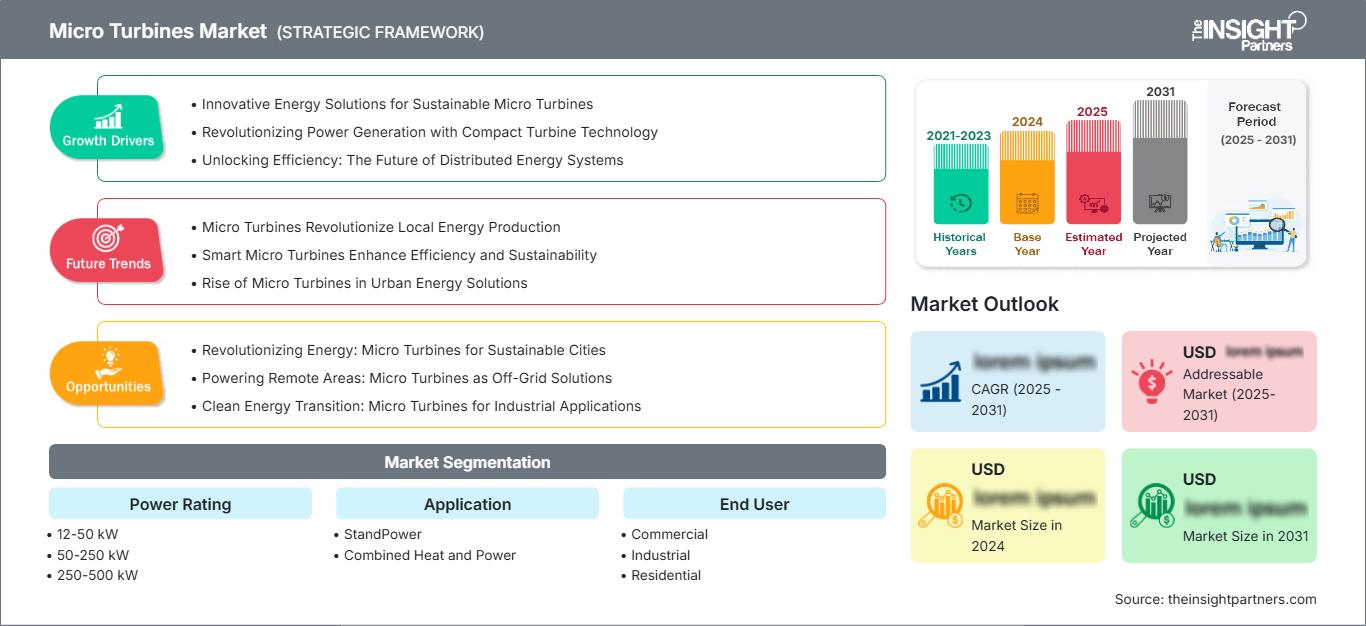
The micro turbines market stands at US$ 337.56 Million in 2025 and is projected to reach US$ 731.51 Million by 2034, expanding at a CAGR of 8.97% during 2026–2034. The expansion reflects rising interest in compact distributed generation, combined heat and power, resilient onsite electricity, and fuel-flexible turbine systems serving commercial and industrial loads where grid capacity or reliability can constrain operations.
Across North America, the micro turbines market size is supported by distributed generation, data center power requirements, industrial resilience, and combined heat and power deployment. The region is expected to expand at a modeled CAGR of 9.2–9.8% through 2034 as utilities, technology companies, and facility owners pursue onsite generation, faster interconnection alternatives, and lower-emission power architectures.
Micro Turbines Market Assessment and Insights
- North America: micro turbines market share in 2025 is estimated at 34–38%, with a CAGR between 2026–2034 of 9.2–9.8%. Data centers and resilient onsite generation support adoption.
- US: Share in 2025 is estimated at 72–78% of North America, growing at a CAGR between 2026–2034 of 9.4–10.0%, supported by grid constraints.
- Europe: Share in 2025 is estimated at 27–31%, growing at a CAGR between 2026–2034 of 8.1–8.7%. Germany, Italy, the UK, and France support CHP.
- Asia Pacific: Share in 2025 is estimated at 24–28%, growing at a CAGR between 2026–2034 of 9.6–10.3%. China, Japan, South Korea, and India advance distributed generation.
- Largest Segment: The 50-250 kW power rating holds an estimated 42–46% market share in 2025 and is expected to grow at a CAGR of 8.2–8.8% through 2034.
- High Growth Segment: Combined Heat and Power holds an estimated 48–52% market share in 2025 and is expected to expand at a CAGR of 10.0–10.8% through 2034.
- Key companies analyzed in detail: Ansaldo Energia S.p.A.; Aurelia Turbines Oy; Bladon Micro Turbine; Brayton Energy, LLC; Capstone Energy+, Inc.; Flex Energy Solutions; ICR Turbine Engine Corporation; Micro Turbine Technology B.V.; Toyota Motor Corporation; TurboTech Precision Engineering Pvt. Ltd.
Source: The Insight Partners' analysis based on proprietary research, government publications, company annual reports, investor presentations, industry databases, and expert interviews.
The tech base is moving towards modular platforms that deliver electricity and heat through commercial, industrial, and distributed energy solutions. Upgrades in recuperators, air bearings, combustion control, power electronics, and monitoring systems have increased flexibility. Manufacturing involves application-specific packages for CHP, microgrids, and critical power. Flexibility in fuel types will be important as developers think of gas, biogas, hydrogen, and alternative fuels. Modular solutions have also been facilitating easier replication, service delivery, and deployment planning.
Future demand may extend. Data centers, EV charger infrastructure, remote installations, hospitality, and energy communities may open up more order channels. Investments should focus on systems incorporating energy storage, heat recovery, control systems, and renewable fuels. Regulation focusing on carbon emissions, resilience, and energy security can help facilitate uptake where distributed energy generation helps to reduce grid dependency without the need for large centralized facilities. Potential applications can help increase geographical diversity while delivering repeatable service offerings.
Micro Turbines Market Report Scope
| Report Attribute | Details |
|---|---|
| Market size in 2025 | US$ 337.56 Million |
| Market Size by 2034 | US$ 731.51 Million |
| Global CAGR (2026 - 2034) | 8.97% |
| Historical Data | 2021-2024 |
| Forecast period | 2026-2034 |
Micro Turbines Market Analysis
Micro-turbines demand is driven by a need for electricity in areas where grid strengthening is either impossible or very expensive. This is an enabling factor for micro turbines market development because of their small size which can enable installation near the area of consumption in modules. The micro-turbines value chain has manufacturers, suppliers, producers of energy, contractors, fuel suppliers and services.
Suppliers in the micro turbines market are influenced by special equipment, heat-resistant materials, controls and certification process. Services are a way to reduce risks at the stage of commissioning, while specialists try to compete by developing new areas of applications and working with different kinds of fuel. Cogeneration projects provide monetization of recovered heat, while others pay attention to reliability.
Micro turbines market competitive landscape analysis provides micro turbine market analysis through engineering companies and niche manufacturers. The emphasis of Ansaldo Energia S.p.A. is on modularity of AE-T100 system and fuel flexibility. Efficient generation is the emphasis of Aurelia Turbines Oy. Bladon Micro Turbine concentrates on small-scale telecom and remote power generation. Expansion of Capstone Energy+, Inc., through its current organizational set up is towards integrated energy systems. Low emission power generation is emphasized by Flex Energy Solutions for commercial and industrial applications.
The micro turbines market forecast shows that strategic investments are made in hydrogen capability, CHP capability, digital control and dense power generation. The engineering capability contribution comes from Brayton Energy, LLC and ICR Turbine Engine Corporation. Specialized technologies are offered by Micro Turbine Technology B.V. and TurboTech Precision Engineering Pvt. Ltd. Distributed energy and fuel flexible systems are provided by Toyota Motor Corporation. Reliability, economics of service, emissions, integration and fuel flexibility provide differentiation.
● REPORT CUSTOMIZATION
Tailor This Report To Align With Your Specific Business Requirements
This report can be customized to align precisely with your business objectives, scope, and target markets. Customization options include tailored segmentation, geography, competitive analysis, and strategic insights to support informed decision-making.
Customize This Report →WHAT YOU CAN ADJUST
- ● Segmentations
- ● Geography
- ● Competitive Analysis
- ● Language Preferences
Micro Turbines Market: Strategic Insights
Regional Insights
North America micro turbines market
North America accounts for a 34–38% micro turbines market share in 2025 and is projected to expand at a CAGR of 9.2–9.8% through 2034. The region benefits from data centers, industrial electrification, gas, and grid delays. Microgrid development also creates applications where onsite generation supports resilience during grid disturbances. Canada contributes through remote industrial, resource, and commercial installations.
The United States takes the lead in terms of regional demand, whereas Canada plays its role via remote industrial and business facilities. The most popular among those who appreciate dispatchability, small size, cost-efficiency of combined heat and power systems, or faster deployment than utility-scale systems. Behind-the-meter electricity generation for data centers and critical facilities should provide for demand for equipment, especially for scalable solutions.
U.S. micro turbines Market
The U.S. represents 72–78% of North American revenue in 2025 and is expected to grow at a CAGR of 9.4–10.0%. Structural drivers encompass demand for electricity at data centers, lack of grid capacity, need for resilient systems, and local production. Suppliers rely on proven distributor, engineering, and maintenance channels. Resource sector electrification also drives demand.
Application cases range from CHP in hospitality and manufacturing through oil and gas, water treatment, remote infrastructure, and data centers. Competitors like Capstone Energy+, Inc. and Flex Energy Solutions do so through modularity, service, low emissions, and fuel flexibility. Best opportunities arise when customers require power prior to grid extension.
Europe micro turbines Market
The micro turbines market report shows that Europe holds a 27–31% share in 2025 and is projected to expand at a CAGR of 8.1–8.7%, with Germany leading. The UK, France, Italy, and Spain bring additional possibilities due to distributed generation, energy efficiency in industry, energy security, and decarbonization initiatives. Germany is still vital in CHP, industrial energy management, and flexible generation.
The UK offers resilience mandates coupled with distributed energy deployment within commercial buildings and infrastructure. Germany focuses on energy efficiency, CHP, industrial energy management, and flexible generation. France, Italy, and Spain provide possibilities for hospitality, manufacturing, agriculture, and islanded solutions. The trend in European regulations leans towards reduced emissions and fuel flexibility, raising the interest in biogas, hydrogen-ready technology, and heat recovery.
APAC micro turbines Market
APAC holds a 24–28% share in 2025 and is forecast to grow at a CAGR of 9.6–10.3%, with China leading. These countries can also offer extra demand due to industrial efficiency, backup generation, distributed generation, and energy security initiatives.
Industrial development, urban resilience, and distributed energy can enable installation of these technologies. China and India can offer large industrial pools for the use of these technologies, while Japan and South Korea can stress efficiency in distributed energy. The country of Australia can offer off-grid locations in the energy and resource sector.
Middle East & Africa micro turbines Market
Middle East and Africa demand is expected to expand at a modeled CAGR of 7.0–7.8%. Saudi Arabia and the UAE lead regional investment, while South Africa and the rest of MEA provide opportunities in mining, utilities, commercial facilities, and remote infrastructure.
Energy-intensive operations, expanding infrastructure, and the need for reliable electricity support adoption. Saudi Arabia and the UAE can use distributed systems for commercial and industrial resilience, while South Africa has applications linked to grid reliability and onsite generation. Remote mining and infrastructure projects can favor compact systems where fuel availability and maintenance logistics support decentralized power.
Segmentation Analysis
Power Rating
The power rating segment reflects load size, footprint, fuel availability, and economics, defining the micro turbines market scope. It is expected to grow at a CAGR of 8.1–9.0% during 2026–2034. The 50-250 kW category is the largest modeled segment, with larger systems serving industrial and CHP projects. Overall demand remains aligned with distributed generation and incremental capacity requirements.
- 12-50 kW: Compact systems serve telecom, residential-scale, remote, and small commercial applications where limited footprint and reliable onsite generation are priorities.
- 50-250 kW: This range addresses commercial buildings, hospitality, light industry, and medium-scale CHP installations. Its balance of capacity, footprint, and scalability supports distributed generation.
- 250-500 kW: Larger modules support industrial facilities, campuses, data infrastructure, and high-load CHP applications. Buyers prioritize thermal recovery, resilience, and microgrid integration.
Application
Application selection in the micro turbines market depends on electricity or combined services. The application segment is expected to grow at a CAGR of 9.1–10.2%. The Combined Heat and Power configuration has the strongest modeled growth because recovered thermal energy can improve utilization where stable heat loads exist. Economics remain dependent on operating hours, fuel prices, and local electricity tariffs.
- StandPower: StandPower systems address sites requiring dedicated electricity without continuous thermal loads. They suit remote infrastructure and locations where grid access or reliability is limited.
- Combined Heat and Power: CHP systems capture useful heat for hotels, manufacturers, campuses, and wastewater plants. Their value rises where thermal demand is predictable.
End User
End-user demand varies with electricity intensity, resilience, operating schedules, and heat loads. The end-user segment is expected to grow at a CAGR of 8.3–9.2% through 2034. Commercial and industrial facilities provide the broadest deployment base, while residential adoption remains more selective because project economics and system scale can be harder to justify.
- Commercial: Hotels, offices, campuses, retail facilities, and service businesses can deploy systems for resilience and CHP. Adoption is strongest with long operating hours and simultaneous electricity and heat demand.
- Industrial: Manufacturing, food processing, mining, oil and gas, and wastewater operations can use onsite generation to manage grid constraints. High utilization and process heat can strengthen economics.
- Residential: Residential applications remain specialized for premium distributed energy, remote properties, and reliability-constrained locations. Compact equipment, low maintenance, and fuel flexibility are key considerations.
Opportunity Snapshot
| Application | Revenue Contribution | Trend Tag | Adoption Stage |
|---|---|---|---|
| StandPower | Medium | Remote Power | Scaling |
| Combined Heat and Power | High | Heat Recovery | Scaling |
Micro Turbines Market Growth Drivers and Impact Analysis
Rising Demand for Resilient Behind-the-Meter Power
Grid congestion and lengthy interconnection timelines are changing how large electricity consumers evaluate supply options. Data centers, industrial plants, resource operations, and critical facilities increasingly require power that can be deployed close to the load. Microturbines can provide dispatchable generation while avoiding some constraints associated with long transmission expansions. Their modular architecture also allows capacity to be added as demand increases. The commercial impact is strongest in regions where utility infrastructure cannot expand at the same pace as new loads. Projects can also combine generation with battery storage and advanced controls, improving flexibility. As resilience becomes a board-level consideration, equipment selection is increasingly linked to continuity requirements, fuel availability, maintenance support, and the ability to operate during grid disturbances.
Growing Value of Combined Heat and Power Integration
CHP adoption can improve project economics by converting waste heat into usable thermal energy instead of rejecting it. This matters for facilities with stable hot-water or process-heat requirements, including hotels, food processors, hospitals, campuses, and wastewater plants. Microturbines are well suited to these applications because electrical and thermal outputs can be configured around site demand. The impact extends beyond energy efficiency because recovered heat can reduce boiler fuel consumption and support operational continuity. Developers increasingly assess CHP through annual operating hours, thermal load profiles, fuel costs, avoided electricity purchases, and emissions requirements. As energy-intensive businesses seek more predictable operating costs, integrated generation and heat recovery can strengthen the investment case for onsite systems while creating opportunities for service contracts and long-term performance management.
Fuel Flexibility and Lower-Emission Distributed Generation
Fuel flexibility is becoming a strategic differentiator as customers seek lower-emission power without abandoning dispatchability. Modern systems can be configured for natural gas, biogas, and selected hydrogen blends, while advanced combustion and control technologies support evolving fuel strategies. The impact is particularly relevant for facilities with access to renewable gases, waste-derived fuels, or future hydrogen infrastructure. Developers can evaluate systems not only on current fuel cost but also on compatibility with future decarbonization pathways. This broadens the addressable project base across agriculture, wastewater, industrial processing, and energy communities. Equipment capable of switching or adapting to different fuels can reduce technology obsolescence risk. Over time, this flexibility may influence procurement decisions as emissions rules tighten and customers seek practical routes toward lower-carbon onsite generation.
Micro Turbines Market Future Trends
Digital Microgrid Integration and Autonomous Energy Management
Digital control platforms are likely to become a defining feature of new distributed generation projects, shaping micro turbines market trends. Future systems will increasingly coordinate microturbines with batteries, solar generation, thermal storage, electric vehicle charging, and controllable loads. Advanced forecasting can schedule generation around electricity prices, weather, production requirements, and resilience priorities. Remote diagnostics can identify performance deviations before they become failures, reducing unplanned downtime and improving service planning. This trend will shift competition toward software. The strongest adoption should occur at complex sites requiring coordinated energy assets. Customers may purchase integrated platforms, creating opportunities in monitoring, optimization, maintenance, and upgrades. Suppliers with strong control architectures can differentiate hardware through operating intelligence, while customers gain greater visibility over energy assets and system performance.
Hydrogen-Ready and Renewable-Fuel Microturbine Platforms
Fuel evolution is expected to influence equipment design, certification, and long-term procurement decisions. Hydrogen-ready combustion systems can provide a pathway from conventional natural gas toward lower-carbon operation as fuel infrastructure develops. Biogas and synthetic fuels may also gain importance where local resources support decentralized generation. Future platforms will need combustion stability, materials compatibility, emissions control, and flexible fuel ranges. Suppliers that validate systems under multiple fuel scenarios can strengthen their position with customers planning long asset lives. The opportunity is particularly relevant to energy communities, industrial clusters, wastewater facilities, and remote sites with renewable fuels. Standardized interfaces for fuel handling and controls could accelerate adoption by lowering engineering complexity. Fuel certification will remain critical because actual operating capability must match procurement assumptions.
Micro Turbines Market Opportunities
Data Center and High-Density Computing Power Systems
Rapid growth in computing infrastructure creates an opportunity for modular onsite generation where utility connections cannot meet required capacity or deployment schedules. Microturbine systems can provide scalable electricity close to high-density loads, while integrated heat recovery and cooling technologies can improve overall energy utilization. Investors and technology suppliers can target engineered packages that combine generation, storage, power electronics, controls, and service agreements. The opportunity extends to edge computing. Developers should prioritize regions with constrained grid capacity. Equipment suppliers can strengthen returns through standardized modules that reduce engineering time. The commercial proposition is strengthened when generation can operate continuously and coordinate with storage, renewable resources, and site controls. Suppliers that package hardware with commissioning, monitoring, and maintenance can create additional recurring revenue while reducing integration complexity for data center operators.
Waste-to-Energy and Renewable Gas Applications
Waste-derived fuels can create a differentiated pathway for distributed generation because the fuel source and energy demand may be colocated. Wastewater plants, agricultural operations, food processors, landfills, and industrial sites can convert biogas into electricity while using recovered heat for onsite processes. Developers can pursue projects where renewable gas is already available, minimizing fuel transportation requirements. Providers can add value through fuel conditioning, CHP integration, monitoring, and service. The opportunity is relevant to energy communities and remote sites with renewable fuels. Investors should assess feedstock consistency, gas quality, thermal demand, permitting, and tariffs before selecting project configurations. This model can improve resource utilization while supporting localized energy production. Long-term service agreements can further improve project predictability where operators require continuous equipment availability and technical support.
Frequently Asked Questions

- Comprehensive Market Sizing and Forecast Analysis
- Detailed Segmentation Analysis
- In-Depth Market Dynamics Assessment
- Regional and Country-Level Insights
- Competitive Landscape and Company Benchmarking
- Strategic Business Intelligence
Recent Reports
Testimonials

The Insight Partners provided valuable market intelligence that supported our global go-to-market strategy. Their team was professional, responsive, and attentive to our feedback, providing thoughtful analysis and helpful methodological clarifications throughout the project.
Junmo Kim Chief Financial Officer (CFO), Enertech Co., Ltd.
The Insight Partners' SCADA System Market report is comprehensive, with valuable insights on current trends and future forecasts. The team was highly professional, responsive, and supportive throughout. We are very satisfied and highly recommend their services.
RAN KEDEM Partner, Reali Technologies LTDs
I requested a report on a very specific software market and the team produced the report in a few days. The information was very relevant and well presented. I then requested some changes and additions to the report. The team was again very responsive and I got the final report in less than a week.
JEAN-HERVE JENN Chairman, Future Analytica
We worked with The Insight Partners for an important market study and forecast. They gave us clear insights into opportunities and risks, which helped shape our plans. Their research was easy to use and based on solid data. It helped us make smart, confident decisions. We highly recommend them.
PIYUSH NAGPAL Sr. Vice President, High Beam Global
The Insight Partners delivered insightful, well-structured market research with strong domain expertise. Their team was professional and responsive throughout. The user-friendly website made accessing industry reports seamless. We highly recommend them for reliable, high-quality research services
YUKIHIKO ADACHI CEO, Deep Blue, LLC.
This is the first time I have purchased a market report from The Insight Partners.While I was unsure at first, I visited their web site and felt more comfortable to take the risk and purchase a market report.I am completely satisfied with the quality of the report and customer service. I had several questions and comments with the initial report, but after a couple of dialogs over email with their analyst I believe I have a report that I can use as input to our strategic planning process.Thank you so much for taking the extra time and making this a positive experience.I will definitely recommend your service to others and you will be my first call when we need further market data.
JOHN SUZUKI President and Chief Executive Officer, Board Director, BK Technologies
I wish to appreciate your support and the professionalism you displayed in the course of attending to my request for information regarding to infectious disease IVD market in Nigeria. I appreciate your patience, your guidance, and the fact that you were willing to offer a discount, which eventually made it possible for us to close a deal. I look forward to engaging The Insight Partners in the future, all thanks to the impression you have created in me as a result of this first encounter.
DR CHIJIOKE ONYIA MANAGING DIRECTOR, PineCrest Healthcare Ltd.Reason to Buy
- Informed Decision-Making
- Understanding Market Dynamics
- Competitive Analysis
- Identifying Emerging Markets
- Customer Insights
- Market Forecasts
- Risk Mitigation
- Boosting Operational Efficiency
- Strategic Planning
- Investment Justification
- Tracking Industry Innovations
- Aligning with Regulatory Trends





 Get Free Sample for