
Mining Drills and Breakers Market Size, Growth & Demand by 2034
Coverage: By Product (Drills, Breakers); Application (Metal Mining, Mineral Mining, Coal Mining) , and Geography (North America, Europe, Asia Pacific, and South and Central America)
- Status : Data Released
- Report Code : TIPRE00018577
- Category : Manufacturing and Construction
- No. of Pages : 150
- Available Report Formats :


- Last update date : July 24, 2026


2025 Market Size
US$ 18.9 Bn
Base year value
2034 Forecast
US$ 29.19 Bn
Projected by 2034
CAGR 2026-2034
4.95 %
Growth rate
Addressable Market
US$ 218.27 Bn
(2026-2034)
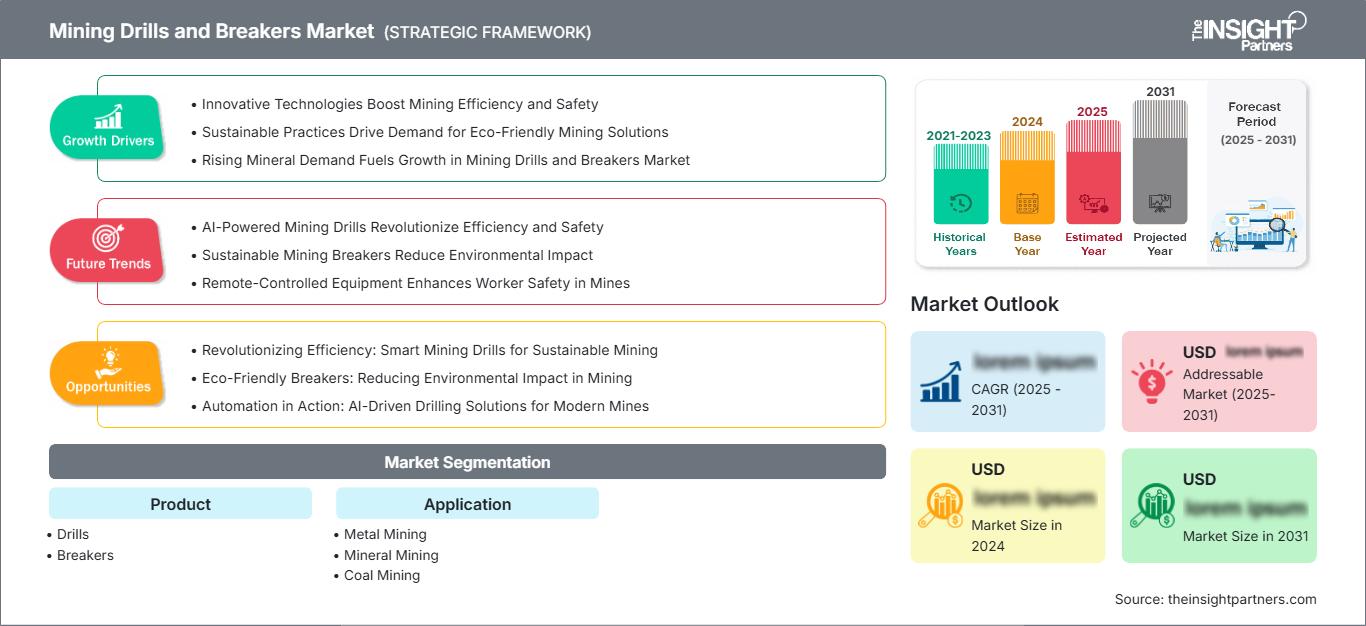
The Mining Drills and Breakers Market is predicted to reach $18.9 billion in 2025 growing to $29.19 billion by 2034, marking a CAGR of 4.95% over 2026-2034. Factors fueling the growth include exploration of deeper ore bodies, increased extraction of critical minerals, and adoption of machinery for rock breaking over manual techniques.
In North America, the global Mining Drills and Breakers Market size is forecast to grow at a 4.6–5.1% CAGR, driven by the adoption of new technology in hard rock mines, capacity expansions in copper and gold mines, and increased emphasis on safety measures. Other factors driving demand for mining machinery include replacement of old machinery, an increase in autonomous drilling, and active quarrying in connection with infrastructure rebuilding initiatives.
Mining Drills and Breakers Market Assessment and Insights
- North America accounted for 18–22% Mining Drills and Breakers Market share in 2025 and is expected to grow at a CAGR of 4.6–5.1% between 2026–2034, supported by copper, gold, aggregates, and underground mine automation investments.
- US represented 68–72% of North America in 2025 and is projected to grow at a CAGR of 4.5–5.0% between 2026–2034.
- Europe held 12–15% share in 2025 and is forecast to grow at a CAGR of 3.8–4.3% between 2026–2034, led by Sweden, Germany, Finland, and Poland.
- Asia Pacific captured 46–50% share in 2025 and is expected to grow at a CAGR of 5.2–5.8% between 2026–2034, led by China, India, Australia, Indonesia, and Japan.
- Largest Segment Drills held 58–62% market share in 2025 and is expected to grow at a CAGR of 4.8–5.3% during 2026–2034 as precision blasthole and underground drilling demand increases.
- High Growth Segment Metal Mining held 42–46% market share in 2025 and is projected to grow at a CAGR of 5.3–5.9% during 2026–2034, supported by copper, nickel, iron ore, and battery mineral extraction.
- Key companies analyzed in detail: Atlas Copco AB, Boart Longyear Group Ltd., Casagrande S.p.A., Caterpillar Inc., Epiroc AB, Furukawa Co., Ltd., Hennessy International Inc., Komatsu Ltd., Sandvik AB, Soosan USA Inc.
Source: The Insight Partners' analysis based on proprietary research, government publications, company annual reports, investor presentations, industry databases, and expert interviews.
There has been a transition from mechanically operated drills and impactors to sensor-based rigs, hydraulic hammers, and electro-compatible equipment to improve the accuracy of hole placement and drilling cycles, and the safety of drill operators. The Mining Drills and Breakers Market growth is linked to changes in production dynamics, as miners prioritize equipment availability, spare parts support, fuel economy, and remote monitoring capabilities due to reduced ore grades and mining in deep, difficult geological conditions.
The future demand for equipment will depend on new copper belts, lithium regions, and brownfields expansion in APAC, Africa, and America. The regulatory push on dust control, machine guards, and low emissions is encouraging adoption of advanced drills and breakers with automation capabilities. The capital expenditure is likely to be focused on replacement of old fleets, after sales contracts, and equipment with safe operations in restricted underground headings.
Mining Drills and Breakers Market Report Scope
| Report Attribute | Details |
|---|---|
| Market size in 2025 | US$ 18.9 Billion |
| Market Size by 2034 | US$ 29.19 Billion |
| Global CAGR (2026 - 2034) | 4.95% |
| Historical Data | 2021-2024 |
| Forecast period | 2026-2034 |
Mining Drills and Breakers Market Analysis
The demand for the product line is based on mineral security, infrastructure minerals, and mine productivity programs. Drilling precision and rock fragmentation for copper, iron ore, aggregates, gold, and coal mining operations are necessary to ensure production efficiency without much use of explosives. The product ecosystem comprises OEMs, component suppliers, rental companies, maintenance services, and companies providing digital control services to support mine planning and reduce costs.
There still persists a certain supply dependency on steel, hydraulics components, electronics, and regional service network presence. Increasingly, customers assess not only the cost of acquiring mining equipment but total cost of ownership, which is why they are more likely to prefer connected drilling systems, powerful hydraulic rock breakers, and easily available spare parts close to remote mines.
The competition exists mainly among diversified mining equipment groups and specialized drilling companies. Epiroc AB, Sandvik AB, Komatsu Ltd., Caterpillar Inc. and Atlas Copco AB companies compete via automation systems, service capabilities, and electric pathways whereas Boart Longyear Group Ltd., Casagrande S.p.A., Furukawa Co., Ltd., Hennessy International Inc., and Soosan USA Inc. focus on specialized rigs, tooling, and breaker applications.
Investment trends include the development of autonomous blasthole drills, battery-electric systems, reconditioned parts, and digital maintenance programs. The strategic positioning becomes more dependent on aftermarket agreements, training programs, and integration of the fleets with mine-dispatch systems. Manufacturers of robust, mechanically capable products and efficient analysis and energy systems will be better positioned to protect their margins as miners standardize fleets across multi-country operations.
● REPORT CUSTOMIZATION
Tailor This Report To Align With Your Specific Business Requirements
This report can be customized to align precisely with your business objectives, scope, and target markets. Customization options include tailored segmentation, geography, competitive analysis, and strategic insights to support informed decision-making.
Customize This Report →WHAT YOU CAN ADJUST
- ● Segmentations
- ● Geography
- ● Competitive Analysis
- ● Language Preferences
Mining Drills and Breakers Market: Strategic Insights
Regional Insights
North America Mining Drills and Breakers Market
In 2025, North America represented 18-22% of the total revenue in the market and is expected to grow at a rate of 4.6-5.1% CAGR from 2026-2034. The North American demand scenario is influenced by the copper, gold, metallurgical coal, and aggregates applications, where equipment availability and drilling accuracy impacts on fragmentation, hauling, and processing costs.
The market in North America is further driven by mine life extension projects, high safety standards, and a well-established aftermarket. Fleet replacement is gaining importance in North America, as operators seek reduced diesel dependence, improved dust management, tele-remote capabilities, and condition monitoring to minimize unplanned downtime.
U.S. Mining Drills and Breakers Market
The United States makes up 68-72% of North America in 2025 and is projected to have a CAGR of 4.5-5.0% up until 2034. High demand is observed in copper, gold, limestone, phosphate, and coal mining areas since drill accuracy and breaker efficiency contribute to a consistent mining schedule for both open-pit and underground mines.
Market participants include companies such as Caterpillar Inc., Epiroc AB, Sandvik AB, Komatsu Ltd., Boart Longyear Group Ltd., and Soosan USA Inc. Trending applications include blasthole drilling, secondary breaking, underground heading rehabilitation, and after-market rebuilds. U.S. buyers require assistance from dealers and safety practice compliance in highly productive mines.
Europe Mining Drills and Breakers Market
The European region had a market share between 12-15% in 2025 and is forecast to expand at a CAGR of 3.8-4.3% in the period of 2026-2034. Leading country in Europe is Sweden, driven by underground iron ore resources, base metals, and advanced equipment innovation hubs. UK sees demand arising from aggregates, tunneling-associated quarrying and mine reclamation, where smaller-sized breakers and silent drilling machinery prevail.
Germany enjoys the presence of industrial minerals, potash deposits and engineering-based adoption of equipment, whereas France, Italy, and Spain provide their contribution via quarrying, cement minerals, and underground infrastructure mining. The market in Europe faces regulatory restrictions but enjoys policy of critical raw materials, safety regulations and precision-low emissions requirements.
APAC Mining Drills and Breakers Market
The Asia-Pacific market captured a 46-50% share in 2025 and will experience a CAGR of 5.2-5.8% growth between 2026 and 2034. China is still dominating in the region; other countries that are playing their roles include India, Australia, Indonesia, Japan, and South Korea via mining coal, iron ore, copper, limestone, and the modernization of mines using technology.
Expanding industries, national security of minerals, and infrastructural development are driving purchasing decisions. The demand is fueled by the autonomous mining operations of Australia in iron ore, India in coal and limestone, and China in safety systems for underground operations.
Middle East & Africa Mining Drills and Breakers Market
The Middle East & Africa are forecast to have a CAGR of 5.0–5.6% over 2026–2034. South Africa drives regional demand from platinum group metals, gold, coal, and manganese mining, while Saudi Arabia and UAE enhance mineral exploration and quarrying activities on account of economic diversification and infrastructure developments.
The Rest of the MEA demand is driven by gold, copper, phosphate, and construction minerals in Africa. Increasing energy developments, transport corridors, and mine site mechanization is generating opportunities for rugged breakers and drills. Financial limitations remain an issue, emphasizing the role of rental, rebuild, and servicing-driven business models.
Segmentation Analysis
Product
Product is expected to register a CAGR of 4.7–5.2% during 2026–2034. Product demand reflects the Mining Drills and Breakers Market scope across primary drilling, secondary breaking, scaling, tunneling support, and quarry extraction. Buyers increasingly select equipment based on hole precision, impact energy, serviceability, automation compatibility, and operating cost rather than basic capacity alone.
- Drills maintain the largest position as blasthole, production, and exploration drilling remain essential to mine planning, ore access, fragmentation control, and safer underground advance.
- Breakers serve secondary fragmentation, oversize reduction, scaling, and quarrying tasks, making them strategically important where controlled rock removal reduces blasting intensity and crusher blockage risk.
Application
Application is projected to grow at a CAGR of 5.0–5.5% during 2026–2034. Application demand is led by orebody complexity, mine expansion, and energy-transition mineral requirements. Metal operations demand high-performance drilling, mineral mines prioritize steady output and lower operating cost, and coal mines continue to invest selectively in safety-focused mechanization.
- Metal Mining is strategically important because copper, iron ore, nickel, zinc, and precious metals require accurate drilling, high uptime, and dependable breaking in hard-rock conditions.
- Mineral Mining supports demand from limestone, phosphate, potash, gypsum, and industrial minerals, where quarry productivity and consistent fragmentation influence downstream crushing and processing economics.
- Coal Mining remains relevant in selected regions, with equipment demand focused on overburden removal, underground safety, seam access, and productivity improvements in mechanized mines.
Opportunity Snapshot
| Application | Revenue Contribution | Trend Tag | Adoption Stage |
| Metal Mining | High | Critical Metals | Scaling |
| Mineral Mining | Medium | Quarry Automation | Mature |
| Coal Mining | Medium | Safety Upgrades | Mature |
Mining Drills and Breakers Market Growth Drivers and Impact Analysis
Critical mineral extraction is intensifying fleet renewal
Transition energy metals are adding to the operating intensities of hard rock mining operations, especially for copper, nickel, lithium, and iron ore mining facilities. The decrease in quality of the ores implies that increased drilling, blasting, and breaking is needed in order to achieve the same level of metal production, which adds to machinery utilization. The positive effects on the market for Mining Drills and Breakers will come from upgrading existing equipment with higher-accuracy drills and breakers. This effect will be most noticeable when expanding mining facilities need constant benching and underground development.
Automation and safety standards are changing procurement criteria
The mining industry is taking measures to limit employees' exposure to vibration, dust, noise, falling rocks, and blast areas. This is making operators prefer machines with remote breaker control, automatic drilling capabilities, cameras, crash detection, and machine health monitoring. The procurement process is becoming increasingly focused on comparing safety records, digital and training capabilities, in addition to the machines' power and toughness. The end product is an increased value placed on equipment that limits manual labor and increases predictability.
Aftermarket economics are supporting equipment lifecycle spending
High replacement cost and long mine lives are making rebuilds, parts, and service contracts central to purchasing decisions. Operators are extending fleet value through component remanufacturing, hydraulic-system upgrades, drill-string optimization, and breaker maintenance programs. OEMs with regional workshops and inventory depth can capture recurring revenue while improving customer retention. This dynamic supports the market because buyers are more willing to standardize equipment families when lifecycle support reduces downtime, logistics risk, and spare-parts uncertainty at remote mine locations.
Mining Drills and Breakers Market Future Trends
Autonomous drilling will move from pilots to fleet standards
The Mining Drills and Breakers Market trends point toward autonomous drilling becoming standard in large surface mines and selected underground operations. Over the next decade, rigs will increasingly receive digital drill plans, adjust feed pressure automatically, and transmit hole-quality data to blasting and dispatch systems. The shift will reduce variability between operators and improve bench productivity. Adoption will be fastest where high fleet utilization, remote mine locations, and safety targets justify investment in control rooms, connectivity, and standardized training. Advances in artificial intelligence, machine learning, and real-time sensor technologies will further enhance drilling precision, predictive maintenance, and operational visibility. Mining companies investing in integrated automation platforms and workforce upskilling programs can improve resource utilization, reduce downtime, and strengthen long-term productivity while maintaining higher safety standards across operations.
Electrification will reshape product engineering priorities
Electrified drills and energy-efficient hydraulic systems will become more important as mines pursue lower diesel use and ventilation savings. Engineering priorities will shift toward battery compatibility, cable management, regenerative functions, thermal control, and lighter but stronger structures. Underground sites may adopt electric equipment sooner because ventilation cost savings are measurable. Surface mines will transition more selectively, beginning with high-duty routes, renewable-powered operations, and corporate decarbonization programs that require visible emissions reductions. Growing investment in renewable energy integration, advanced battery technologies, and intelligent energy management systems will accelerate this transition. Equipment manufacturers that optimize charging infrastructure, improve component durability, and deliver reliable performance under demanding mining conditions can gain a competitive advantage while supporting sustainability objectives and reducing total operating costs.
Mining Drills and Breakers Market Opportunities
Service-led expansion in emerging mining districts
Emerging copper, gold, lithium, phosphate, and bauxite districts offer attractive openings for OEMs that pair equipment sales with training, parts, and rebuild capacity. Mining Drills and Breakers Market Forecasts indicate that new projects in Asia Pacific, Africa, and parts of Latin America will need reliable support more than isolated machine deliveries. Suppliers can differentiate by establishing regional service hubs, financing options, and operator certification programs. This approach reduces adoption barriers for miners while creating recurring revenue streams beyond initial capital equipment purchases.
Digital retrofit packages for installed equipment bases
A large installed base of conventional drills and breakers creates an opportunity for sensor kits, telematics, predictive-maintenance modules, and operator-assist upgrades. Retrofit packages can help mines improve uptime and safety without immediate full fleet replacement. Vendors that offer modular digital upgrades, transparent payback cases, and integration with mine-management software can capture spending from budget-constrained operators. This opportunity is especially relevant in mid-tier mines, quarries, and underground sites where capital cycles are disciplined but productivity pressure remains high.
Recent Developments
- June 2026: Sandvik Mining has unveiled the new Sandvik DD423iE - the second machine in its next-generation development drilling offering. Sandvik has now expanded the range with a battery electric option, combining proven drilling performance with significant advancements in battery-powered productivity.
- November 2025: Epiroc AB announces the launch of the Smart DM series, featuring the new Smart DM45 and Smart DML blasthole drills. The Smart DM series combines Epiroc's renowned durability and performance with the advanced intelligence of the Rig Control System (RCS 5). The result is a lineup of drills that are safer, more productive, and technology-ready for the evolving needs of today's surface mining operations.
- June 2025: Hycroft Mining Holding Corporation announces it will soon be initiating its 2025-2026 Exploration Drill Program (the "2025-2026 Exploration Drill Program") at the Hycroft Mine, located in Nevada, USA, a Tier-1 mining jurisdiction. The 2025-2026 Exploration Drill Program comprises approximately 14,500 meters of core drilling utilizing two drill rigs.
Frequently Asked Questions

- Comprehensive Market Sizing and Forecast Analysis
- Detailed Segmentation Analysis
- In-Depth Market Dynamics Assessment
- Regional and Country-Level Insights
- Competitive Landscape and Company Benchmarking
- Strategic Business Intelligence
Recent Reports
Testimonials

The Insight Partners' SCADA System Market report is comprehensive, with valuable insights on current trends and future forecasts. The team was highly professional, responsive, and supportive throughout. We are very satisfied and highly recommend their services.
RAN KEDEM Partner, Reali Technologies LTDs
I requested a report on a very specific software market and the team produced the report in a few days. The information was very relevant and well presented. I then requested some changes and additions to the report. The team was again very responsive and I got the final report in less than a week.
JEAN-HERVE JENN Chairman, Future Analytica
We worked with The Insight Partners for an important market study and forecast. They gave us clear insights into opportunities and risks, which helped shape our plans. Their research was easy to use and based on solid data. It helped us make smart, confident decisions. We highly recommend them.
PIYUSH NAGPAL Sr. Vice President, High Beam Global
The Insight Partners delivered insightful, well-structured market research with strong domain expertise. Their team was professional and responsive throughout. The user-friendly website made accessing industry reports seamless. We highly recommend them for reliable, high-quality research services
YUKIHIKO ADACHI CEO, Deep Blue, LLC.
This is the first time I have purchased a market report from The Insight Partners.While I was unsure at first, I visited their web site and felt more comfortable to take the risk and purchase a market report.I am completely satisfied with the quality of the report and customer service. I had several questions and comments with the initial report, but after a couple of dialogs over email with their analyst I believe I have a report that I can use as input to our strategic planning process.Thank you so much for taking the extra time and making this a positive experience.I will definitely recommend your service to others and you will be my first call when we need further market data.
JOHN SUZUKI President and Chief Executive Officer, Board Director, BK Technologies
I wish to appreciate your support and the professionalism you displayed in the course of attending to my request for information regarding to infectious disease IVD market in Nigeria. I appreciate your patience, your guidance, and the fact that you were willing to offer a discount, which eventually made it possible for us to close a deal. I look forward to engaging The Insight Partners in the future, all thanks to the impression you have created in me as a result of this first encounter.
DR CHIJIOKE ONYIA MANAGING DIRECTOR, PineCrest Healthcare Ltd.Reason to Buy
- Informed Decision-Making
- Understanding Market Dynamics
- Competitive Analysis
- Identifying Emerging Markets
- Customer Insights
- Market Forecasts
- Risk Mitigation
- Boosting Operational Efficiency
- Strategic Planning
- Investment Justification
- Tracking Industry Innovations
- Aligning with Regulatory Trends





 Get Free Sample for