
Satellite Communication System Market Size, Share & Forecast by 2034
Coverage: by Component (Equipment, Services); Satellite Constellations (Low Earth Orbit Satellites, Medium Earth Orbit Satellites, Geostationary Equatorial Orbit Satellites); Frequency Band (L-band, S-band, C-band, X-band, Ku-band, Ka-band); Vertical (Energy and Utility, Transport and Cargo, Mining and Oil and Gas, Agriculture); and Geography (North America, Europe, Asia Pacific, and South and Central America)
- Status : Data Released
- Report Code : TIPRE00003308
- Category : Electronics and Semiconductor
- No. of Pages : 150
- Available Report Formats :


- Last update date : September 21, 2026


2025 Market Size
US$ 67.84 Bn
Base year value
2034 Forecast
US$ 170.85 Bn
Projected by 2034
CAGR 2026-2034
10.81 %
Growth rate
Addressable Market
US$ 1,056.25 Bn
(2026-2034)
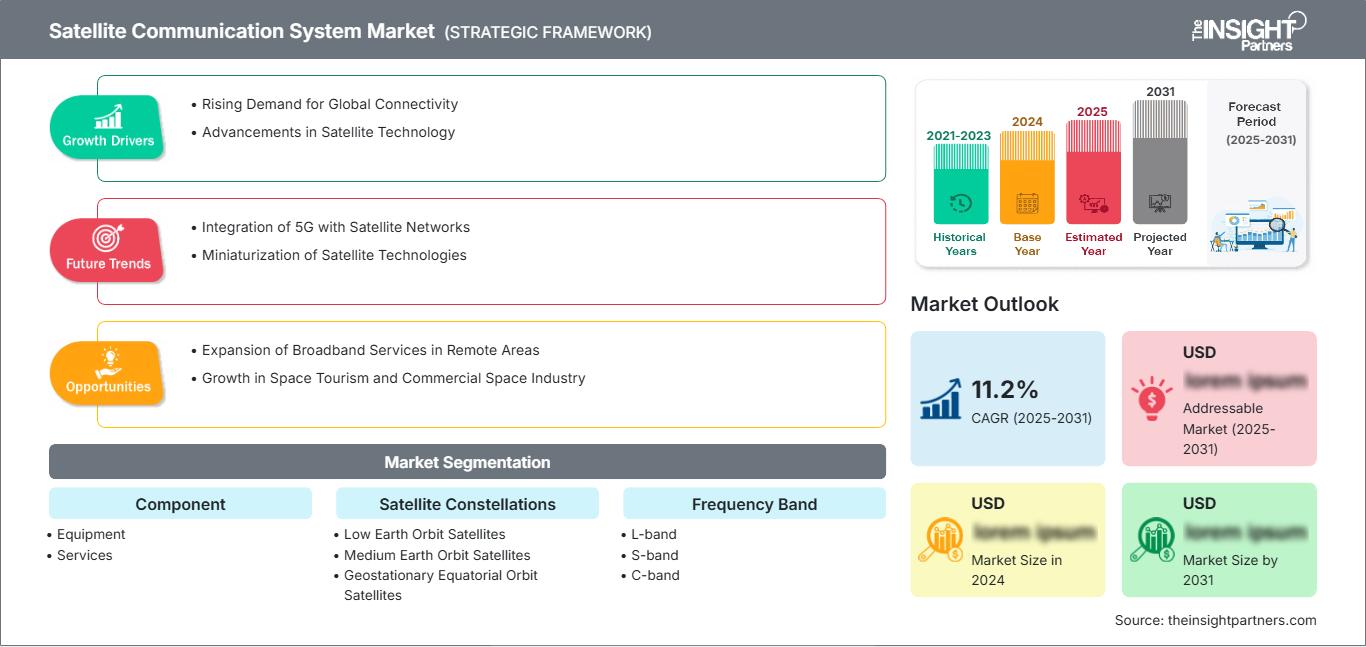
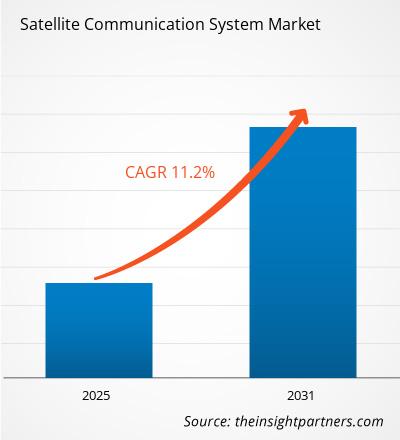
The satellite communication system market was valued at US$ 67.84 Billion in 2025 and is projected to reach US$ 170.85 Billion by 2034, growing at a CAGR of 10.81% during 2026–2034. Demand is expanding as satellite links support broadband access, emergency connectivity, asset monitoring, aviation, maritime, agriculture, energy, utilities, transport, mining, and oil and gas operations.
North America remains a major contributor to the satellite communication system market size due to defense communications, enterprise remote connectivity, aviation broadband, and energy-sector demand. The region is estimated to hold 35–38% share in 2025 and grow at a CAGR of 10.0–10.7% during 2026–2034, supported by strong satellite manufacturing, ground systems, and service-provider investment.
Satellite Communication System Market Assessment and Insights
- North America holds 35–38% share in 2025 and is growing at a CAGR of 10.0–10.7% between 2026–2034, supported by defense, aviation, energy, and enterprise communications upgrades.
- US accounts for 80–84% of North America in 2025 and is growing at a CAGR of 10.2–10.9% during 2026–2034 due to commercial and military SATCOM investments.
- Europe holds 23–26% share in 2025 and is growing at a CAGR of 9.4–10.1% during 2026–2034, led by the UK, Germany, France, Italy, and Spain.
- Asia Pacific represents 27–30% share in 2025 and is growing at a CAGR of 11.5–12.4% during 2026–2034, with China, India, Japan, South Korea, and Australia supporting demand.
- Largest Segment: services hold 56–60% market share in 2025 and are growing at a CAGR of 10.9–11.6% during 2026–2034 due to recurring connectivity and managed network demand.
- High Growth Segment: low earth orbit satellites hold 38–42% share in 2025 and are growing at a CAGR of 12.8–14.0% during 2026–2034 as low-latency constellations scale.
- Key companies analyzed in detail: AvL Technologies, Inc., Cobham Limited, General Dynamics Corporation, L3Harris Technologies, Inc., Infosat Communications LP, Intellian Technologies Inc., Mitsubishi Electric Corporation, ST Engineering iDirect, Inc., Satcom Global Ltd., and Viasat, Inc.
Source: The Insight Partners' analysis based on proprietary research, government publications, company annual reports, investor presentations, industry databases, and expert interviews.
The market has shifted from fixed geostationary links toward integrated multi-orbit systems that combine terminals, managed services, gateways, and software-defined network control. Satellite Industry Association data showing record 2025 satellite deployment and higher satellite broadband subscribers validates the stronger equipment and service pull generated by constellation growth, direct-to-device planning, and expanding ground-network revenue.
Future demand will be shaped by underserved broadband, resilient defense networks, smart energy assets, and digitalized transport corridors. Emerging Asian and Middle Eastern space programs are widening adoption, while North America and Europe focus on secure communications and interoperability. Vendors able to deliver lifecycle service, certified terminals, and multi-band support will be positioned for long-term growth.
Satellite Communication System Market Report Scope
| Report Attribute | Details |
|---|---|
| Market size in 2025 | US$ 67.84 Billion |
| Market Size by 2034 | US$ 170.85 Billion |
| Global CAGR (2026 - 2034) | 10.81% |
| Historical Data | 2021-2024 |
| Forecast period | 2026-2034 |
Satellite Communication System Market Analysis
The satellite communication system market growth is supported by remote operations that need resilient voice, video, positioning, and data links beyond terrestrial coverage. Energy field operations, farms, mining sites, maritime vessels, air transportation systems, and freight fleets depend on satellite communications for telemetry, safety, navigation, and continuity purposes. The value chain in satellite communication is constituted of satellite operators, suppliers of the ground equipment, satellite terminal manufacturers, service providers, system integrators, telecom operators, and vertical-specific platforms owners.
Supply economics are driven by the availability of antennas, modem capabilities, frequency allocation, the schedule of launching satellites into orbit, the establishment of gateways, and the economics of managed services. Satellite communication users are more inclined to consider the entire end-to-end performance rather than purchase individual components. Such an approach makes it possible to generate recurring service income.
The satellite communication system market analysis shows competition across equipment, services, terminals, gateways, and vertical applications. Both AvL Technologies, Inc. and Intellian Technologies Inc. focus on antennas and mobile terminals, Cobham Limited and Satcom Global Ltd. offer services for maritime, land, and enterprise sectors, whereas General Dynamics Corporation and L3Harris Technologies, Inc. play significant roles in secure mission communications.
Areas of investment are the following: electronically steered antennas, managed access to LEO, multi-band modems, transportable terminals, and service orchestration. Mitsubishi Electric Corporation is associated with satellite systems and national space capabilities, ST Engineering iDirect, Inc. provides ground networking solutions, Infosat Communications LP delivers enterprise connectivity solutions, and Viasat, Inc. improves broadband and aviation communications.
● REPORT CUSTOMIZATION
Tailor This Report To Align With Your Specific Business Requirements
This report can be customized to align precisely with your business objectives, scope, and target markets. Customization options include tailored segmentation, geography, competitive analysis, and strategic insights to support informed decision-making.
Customize This Report →WHAT YOU CAN ADJUST
- ● Segmentations
- ● Geography
- ● Competitive Analysis
- ● Language Preferences
Satellite Communication System Market: Strategic Insights
Regional Insights
North America satellite communication system market
North America accounts for 35–38% satellite communication system market share in 2025 and is forecast to grow at a CAGR of 10.0–10.7% during 2026–2034. The region benefits from defense procurement, commercial satellite broadband, aviation connectivity, energy operations, and emergency communications. Strong launch activity and ground equipment investment support terminals, services, and managed networks.
Enterprises use satellite links for distributed assets, while government buyers emphasize secure, resilient, and interoperable networks. The presence of General Dynamics Corporation, L3Harris Technologies, Inc., AvL Technologies, Inc., and Viasat, Inc. strengthens ecosystem depth. Demand is moving toward multi-orbit service plans, transportable antennas, higher-throughput modems, and cybersecurity-ready connectivity packages.
U.S. satellite communication system Market
The U.S. represents 80–84% of North America in 2025 and is growing at a CAGR of 10.2–10.9% through 2034. Defense modernization, aviation broadband, rural connectivity, enterprise continuity, and space-based services are major demand centers. Commercial operators and government programs keep procurement active across user terminals, network services, gateways, and mission communications.
Company presence is strong through General Dynamics Corporation, L3Harris Technologies, Inc., AvL Technologies, Inc., Intellian Technologies Inc., and Viasat, Inc. Application trends favor SATCOM-on-the-move, multi-orbit tracking antennas, managed LEO access, direct-to-device planning, and hybrid cellular-satellite continuity for emergency response, energy sites, commercial aviation, maritime users, and enterprise networks.
Europe satellite communication system Market
Europe holds 23–26% share in 2025 and is projected to grow at a CAGR of 9.4–10.1% during 2026–2034. The UK supports maritime and secure communications, Germany contributes to industrial and defense demand, and France remains central to satellite services and space policy. Italy and Spain add aviation, transport, and government connectivity requirements.
European buyers emphasize sovereign capability, service reliability, and regulated spectrum use. Cobham Limited gives the region important terminal and antenna capability, while service partners support shipping, energy, and government users. Growth is steady rather than explosive because terrestrial networks are mature, but resilience, mobility, and institutional satellite programs sustain investment.
APAC satellite communication system Market
APAC holds 27–30% share in 2025 and is expected to grow at a CAGR of 11.5–12.4% during 2026–2034. China leads through large satellite programs, while India expands rural connectivity, navigation, and government applications. Japan, South Korea, and Australia support high-reliability electronics, defense communications, mining, agriculture, and remote infrastructure.
Demand is supported by underserved broadband, maritime routes, disaster response, smart agriculture, and industrial digitization. Mitsubishi Electric Corporation and Intellian Technologies Inc. reinforce regional capability, while local operators expand satellite service access. APAC is the fastest-growing region because connectivity gaps and sovereign space ambitions are both increasing.
Middle East & Africa satellite communication system Market
The Middle East and Africa are projected to grow at a CAGR of 10.5–11.4% during 2026–2034. Saudi Arabia and the UAE lead adoption through national space strategies, smart infrastructure, defense connectivity, and energy operations. South Africa supports enterprise communications, mining, broadcasting, and regional service distribution.
Energy sites, ports, aviation routes, emergency agencies, and remote communities require dependable satellite access where terrestrial networks are limited. Import reliance creates opportunity for partners with local service centers, stocked terminals, and training. Growth is led by the UAE and Saudi Arabia because investment capacity and infrastructure programs are strongest.
Segmentation Analysis
Component
Component demand within the satellite communication system market scope is growing at a CAGR of 10.4–11.2% during 2026–2034. Equipment remains essential for antennas, modems, gateways, and power systems, while services dominate recurring revenue as users prefer managed connectivity, airtime packages, installation, network monitoring, and technical support.
- Equipment demand is tied to antennas, terminals, modems, routers, gateways, and power systems required for deployment, upgrades, and integration across land, maritime, air, and fixed-site applications.
- Services generate higher recurring revenue because customers need bandwidth, network management, installation, cybersecurity, maintenance, and service-level support for distributed and mission-critical communications.
Satellite Constellations
Satellite Constellations demand is growing at a CAGR of 11.7–12.8% during 2026–2034. LEO adoption is accelerating because lower latency benefits broadband and mobility, MEO supports navigation and enterprise backhaul, and GEO remains critical for broadcast, wide-area coverage, and established high-capacity communications.
- Low Earth Orbit Satellites are strategically important for low-latency broadband, direct-to-device trials, mobility services, and constellation-based capacity expansion across consumer, government, and enterprise applications.
- Medium Earth Orbit Satellites support navigation, resilient backhaul, and specialized connectivity where lower latency than GEO and broader coverage than LEO can improve service reliability.
- Geostationary Equatorial Orbit Satellites remain valuable for broadcasting, maritime coverage, aviation connectivity, weather resilience, and wide-area services requiring stable fixed orbital positioning.
Frequency Band
Frequency Band demand is growing at a CAGR of 10.1–10.9% during 2026–2034. Band selection depends on propagation, bandwidth, terminal size, weather resilience, and mission security. Ku-band and Ka-band support high-capacity services, while L-band and S-band remain important for resilient mobility and narrowband applications.
- L-band supports reliable mobile connectivity, safety services, tracking, and narrowband links where weather resilience and small terminals are more important than very high throughput.
- S-band is used in mobile satellite, telemetry, tracking, and specialized government applications where balanced propagation and device compatibility support operational continuity.
- C-band remains relevant for tropical regions, broadcasting, and resilient fixed links because it performs better in heavy rain than higher-frequency alternatives.
- X-band is strategically important for military and government users that need secure communications, protected spectrum access, and mission-specific terminal compatibility.
- Ku-band is widely used for maritime, aviation, enterprise, and VSAT services because it balances antenna size, capacity, and established satellite coverage.
- Ka-band enables high-throughput broadband, aviation connectivity, and advanced gateway networks, although careful planning is needed to manage rain fade and link availability.
Vertical
Vertical demand is growing at a CAGR of 10.6–11.5% during 2026–2034. Energy, transport, mining, oil and gas, utilities, and agriculture use satellite links to connect remote assets, reduce downtime, improve safety, and support automation where terrestrial coverage is unavailable or insufficient.
- Energy and Utility users need satellite links for grid assets, substations, renewable sites, pipelines, and field teams where remote monitoring and continuity improve operating resilience.
- Transport and Cargo demand is supported by fleet tracking, maritime connectivity, rail operations, aviation broadband, and logistics visibility across cross-border and offshore routes.
- Mining and Oil and Gas operations rely on satellite communications for worker safety, drilling sites, production monitoring, emergency response, and operational data in remote environments.
- Agriculture applies satellite connectivity to precision farming, irrigation control, weather monitoring, machinery tracking, and rural broadband, where cellular coverage remains limited.
Opportunity Snapshot
| Vertical | Revenue Contribution | Trend Tag | Adoption Stage |
| Energy and Utility | High | Grid Resilience | Scaling |
| Transport and Cargo | High | Fleet Visibility | Mature |
| Mining and Oil and Gas | Medium | Remote Operations | Mature |
| Agriculture | Medium | Precision Farming | Scaling |
Satellite Communication System Market Growth Drivers and Impact Analysis
Expansion of Multi-Orbit Connectivity
The trend toward multi-orbital connectivity is growing because it allows combining the benefits of GEO, MEO, and LEO in one service concept. It helps to satisfy the needs of aviation, marine, enterprise, emergency, and governmental customers that do not want to depend only on one orbit. The effect of this change is apparent through the increased demand for tracking antennas, smart modems, gateways, and services orchestration.
Rising Need for Remote Asset Communications
The energy, mining, agriculture, utility, and logistics industries are increasingly networking their remote assets through satellite technologies in order to gain better visibility, increased safety, and uptime. With satellite solutions, operators can keep track of their machinery, manage their field workforce, and send data where there is no connectivity with cellular or fiber infrastructure. The technology enables regular service, machine-to-machine communication, Internet of Things (IoT), and industrial-grade terminals.
Government Demand for Resilient Networks
There is a rising expenditure by government organizations in satellite communications due to vulnerabilities in ground communication networks posed by natural disasters, cyber threats, and geopolitical situations. The defense segment requires secure communications for its command and control function, while the civilian segment requires deployable communication capabilities in emergency situations. This is one driver that increases the demand for portable terminals, secure modems, X-band capabilities, and hardened network management.
Satellite Communication System Market Future Trends
Direct-to-Device Service Integration
The satellite communication system market trends will increasingly include direct-to-device services that connect phones, sensors, and compact terminals outside cellular coverage. Early use cases focus on emergency messaging, remote monitoring, and public safety, but broader commercial models will follow as spectrum coordination and device compatibility mature. This trend will influence payload design, gateway planning, and service packaging. Operators able to integrate satellite links with telecom networks will gain stronger customer access.
Software-Defined Network Control
Forthcoming satellite systems will be more software-defined in terms of routing and beam allocation, as well as cloud-based management of services. End users will require dynamic bandwidth allocation between aircraft, vessels, energy locations, and corporate locations. There will therefore be a need for intelligent modems, interoperable terminals, security features, and applications-aware service platforms. Suppliers of hardware with software that can be upgraded will have an edge over their competitors.
Satellite Communication System Market Opportunities
Managed Connectivity for Industrial Verticals
The satellite communication system market forecasts indicate a strong opportunity in managed connectivity for energy, mining, utilities, cargo, and agriculture users. These buyers often lack internal satellite expertise and prefer service packages that include terminals, airtime, monitoring, installation, and support. Providers can increase account value by linking connectivity with asset tracking, predictive maintenance, and field-worker safety applications. The most attractive contracts will involve multi-site networks with long operating lives.
Ground Segment Modernization
Improvements to ground systems become an area of growth for providers of LEO and multi-orbit capability as they expand their services. Providers need to develop gateways, antennas, modems, teleports, cybersecurity systems, and network management platforms to accommodate increased activity on the part of satellites. Providers can pursue government agencies and enterprises looking for increased throughput and routing options. Ground systems improvements also ensure the reliability of services due to the inability of older ground systems to handle changing beams and frequencies.
Frequently Asked Questions

- Comprehensive Market Sizing and Forecast Analysis
- Detailed Segmentation Analysis
- In-Depth Market Dynamics Assessment
- Regional and Country-Level Insights
- Competitive Landscape and Company Benchmarking
- Strategic Business Intelligence
Recent Reports
Testimonials

The Insight Partners provided valuable market intelligence that supported our global go-to-market strategy. Their team was professional, responsive, and attentive to our feedback, providing thoughtful analysis and helpful methodological clarifications throughout the project.
Junmo Kim Chief Financial Officer (CFO), Enertech Co., Ltd.
The Insight Partners' SCADA System Market report is comprehensive, with valuable insights on current trends and future forecasts. The team was highly professional, responsive, and supportive throughout. We are very satisfied and highly recommend their services.
RAN KEDEM Partner, Reali Technologies LTDs
I requested a report on a very specific software market and the team produced the report in a few days. The information was very relevant and well presented. I then requested some changes and additions to the report. The team was again very responsive and I got the final report in less than a week.
JEAN-HERVE JENN Chairman, Future Analytica
We worked with The Insight Partners for an important market study and forecast. They gave us clear insights into opportunities and risks, which helped shape our plans. Their research was easy to use and based on solid data. It helped us make smart, confident decisions. We highly recommend them.
PIYUSH NAGPAL Sr. Vice President, High Beam Global
The Insight Partners delivered insightful, well-structured market research with strong domain expertise. Their team was professional and responsive throughout. The user-friendly website made accessing industry reports seamless. We highly recommend them for reliable, high-quality research services
YUKIHIKO ADACHI CEO, Deep Blue, LLC.
This is the first time I have purchased a market report from The Insight Partners.While I was unsure at first, I visited their web site and felt more comfortable to take the risk and purchase a market report.I am completely satisfied with the quality of the report and customer service. I had several questions and comments with the initial report, but after a couple of dialogs over email with their analyst I believe I have a report that I can use as input to our strategic planning process.Thank you so much for taking the extra time and making this a positive experience.I will definitely recommend your service to others and you will be my first call when we need further market data.
JOHN SUZUKI President and Chief Executive Officer, Board Director, BK Technologies
I wish to appreciate your support and the professionalism you displayed in the course of attending to my request for information regarding to infectious disease IVD market in Nigeria. I appreciate your patience, your guidance, and the fact that you were willing to offer a discount, which eventually made it possible for us to close a deal. I look forward to engaging The Insight Partners in the future, all thanks to the impression you have created in me as a result of this first encounter.
DR CHIJIOKE ONYIA MANAGING DIRECTOR, PineCrest Healthcare Ltd.Reason to Buy
- Informed Decision-Making
- Understanding Market Dynamics
- Competitive Analysis
- Identifying Emerging Markets
- Customer Insights
- Market Forecasts
- Risk Mitigation
- Boosting Operational Efficiency
- Strategic Planning
- Investment Justification
- Tracking Industry Innovations
- Aligning with Regulatory Trends





 Get Free Sample for