
Screw Compressor Market Trends, Share & Demand by 2034
Coverage: By Technology (Oil-injected Screw Compressor, Oil-free Screw Compressor); Stage (Single-Stage Screw Compressors, Multi-Stage Screw Compressors); Industry (Manufacturing , Oil and Gas , Mining , Construction , Other) , and Geography (North America, Europe, Asia Pacific, and South and Central America)
- Status : Data Released
- Report Code : TIPRE00020766
- Category : Electronics and Semiconductor
- No. of Pages : 150
- Available Report Formats :


- Last update date : September 21, 2026


2025 Market Size
US$ 14.18 Bn
Base year value
2034 Forecast
US$ 24.25 Bn
Projected by 2034
CAGR 2026-2034
6.15 %
Growth rate
Addressable Market
US$ 174.05 Bn
(2026-2034)
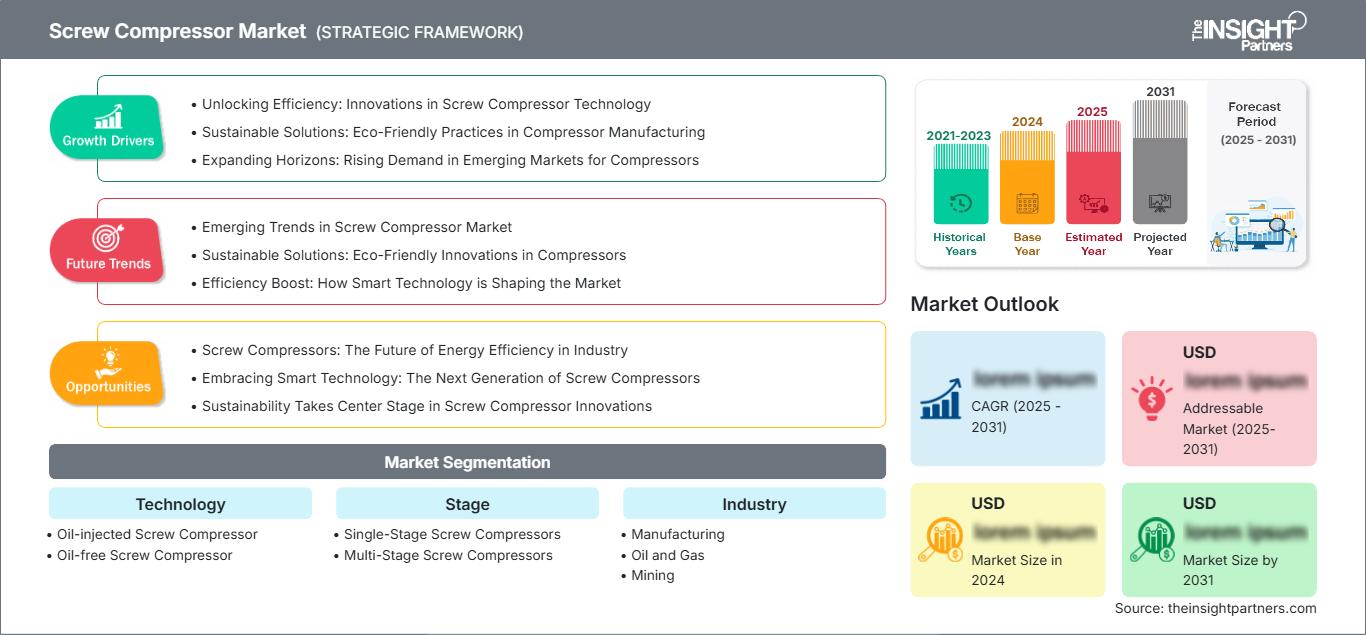
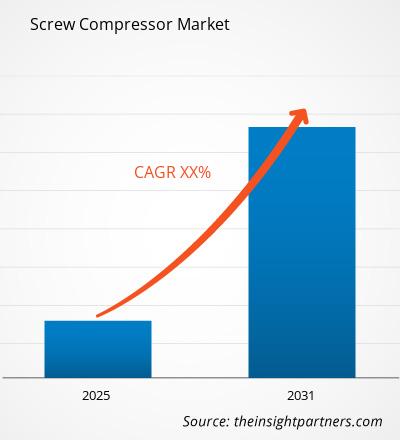
The Screw compressors are widely used for continuous compressed-air and process-gas requirements across industrial operations. The screw compressor market was valued at US$ 14.18 Billion in 2025 and is projected to reach US$ 24.25 Billion by 2034, registering a CAGR of 6.15% from 2026 to 2034. Demand is supported by manufacturing expansion, energy-efficiency requirements, process automation, and the replacement of aging compressed-air infrastructure.
North America remains an important technology and replacement market, with an estimated 5.7–6.2% CAGR during 2026–2034. Industrial automation and investments in oil and gas infrastructure are strengthening compressor demand, while efficiency regulations encourage variable-speed drives, advanced controls, heat recovery, and higher-efficiency air ends across established installations, supporting growth in the Screw Compressor Market size.
Screw Compressor Market Assessment and Insights
- North America: North America is estimated to represent 27–31% share in 2025, with a 5.7–6.2% CAGR between 2026–2034. Industrial modernization, energy projects, and replacement demand support sustained compressor deployment across manufacturing and process industries.
- US: The US represents approximately 68–72% of North America's 2025 market, growing at 5.8–6.3% CAGR between 2026–2034, supported by manufacturing investment and energy infrastructure.
- Europe: Europe is estimated at 22–26% share in 2025, expanding at 4.9–5.5% CAGR between 2026–2034. Germany, Italy, France, and the UK remain important demand centers because of industrial automation and efficiency programs.
- Asia Pacific: Asia Pacific accounts for approximately 40–44% share in 2025, expanding at 6.1–6.7% CAGR between 2026–2034. China, Japan, India, and South Korea lead regional demand through manufacturing capacity additions and infrastructure investment.
- Largest Segment: Oil-injected screw compressors hold approximately 62–68% market share in 2025, with a 5.6–6.1% CAGR during 2026–2034, reflecting broad industrial applicability and established service infrastructure.
- High Growth Segment: Oil-free screw compressors represent approximately 28–34% market share in 2025, recording a 6.5–7.0% CAGR during 2026–2034 as contamination-sensitive industries expand.
- Key companies analyzed in detail: Atlas Copco AB, BAUER COMP Holding GmbH, BOGE Kompressoren Otto Boge GmbH & Co. KG, Gardner Denver, Hitachi, Ltd., Howden Group, Ingersoll Rand Inc., KOBE STEEL, LTD., Siemens AG, Sullair, LLC.
Source: The Insight Partners' analysis based on proprietary research, government publications, company annual reports, investor presentations, industry databases, and expert interviews.
The screw compressor market has evolved from mechanically optimized compression equipment toward integrated systems combining efficient air ends, variable-speed drives, permanent-magnet motors, intelligent controllers, and remote monitoring. Increasingly, production approaches rely on modular designs capable of being set up for pressure, flow, duty cycles, and environmental factors. Machines featuring oil injection are commonly used, but oil-free machines have become increasingly important in cases where compressed air purity is key to operations.
In the future, investments will be made in efficient substitutes, digital service systems, and compressor solutions focused on low energy consumption throughout their life cycle. New manufacturing centers located in India and Southeast Asia will be able to increase the installed capacity, whereas Europe’s efficiency standards will promote equipment upgrades. Demand from data centers, semiconductor production, food processing, pharmaceuticals, and energy projects should create additional opportunities for specialized compression systems and service contracts, as highlighted in the Screw Compressor Market report.
Screw Compressor Market Report Scope
| Report Attribute | Details |
|---|---|
| Market size in 2025 | US$ 14.18 Billion |
| Market Size by 2034 | US$ 24.25 Billion |
| Global CAGR (2026 - 2034) | 6.15% |
| Historical Data | 2021-2024 |
| Forecast period | 2026-2034 |
Screw Compressor Market Analysis
Demand is fundamentally linked to industrial production because compressed air powers pneumatic tools, material handling, instrumentation, automation, and process equipment. The screw compressor market growth therefore, follows manufacturing output, infrastructure development, process-industry investment, and replacement cycles. The value chain includes air-end manufacturers, motor and drive suppliers, controls providers, distributors, system integrators, maintenance contractors, and end users.
Increasingly, the supply structure is shifting towards those suppliers that can offer complete compressor systems as opposed to standalone machines. Consumers are considering energy efficiency, pressure consistency, maintenance schedules, noise, footprint size, and electronic diagnostics, along with cost, during their decision-making process. Variable speed systems can coordinate compressor performance according to varying demands and recovery systems can increase energy efficiency within the factory.
Competition is concentrated among diversified industrial-equipment companies and specialist compressor manufacturers. The screw compressor market analysis indicates that Atlas Copco AB and Ingersoll Rand Inc. compete through broad product portfolios, distribution networks, and lifecycle services, while Siemens AG and Hitachi, Ltd. emphasize engineering, controls, industrial integration, and energy performance. KOBE STEEL, LTD., Howden Group, BOGE Kompressoren Otto Boge GmbH & Co. KG, and Sullair, LLC maintain differentiated positions across industrial and process applications.
More investment is being made in oil-less technology, speed variation, digitization, and local production. In addition, there is an improvement of after-market products by means of predictive maintenance, availability of spare parts, remote diagnostics, and modernization kits. Positioning becomes, therefore, about more than compressor efficiency. It also requires the capability of lowering the total cost of ownership and application engineering.
● REPORT CUSTOMIZATION
Tailor This Report To Align With Your Specific Business Requirements
This report can be customized to align precisely with your business objectives, scope, and target markets. Customization options include tailored segmentation, geography, competitive analysis, and strategic insights to support informed decision-making.
Customize This Report →WHAT YOU CAN ADJUST
- ● Segmentations
- ● Geography
- ● Competitive Analysis
- ● Language Preferences
Screw Compressor Market: Strategic Insights
Regional Insights
North America Screw Compressor Market
North America is estimated to hold 27–31% of the Screw Compressor Market share in 2025 and expand at a 5.7–6.2% CAGR through 2034. The US leads in terms of regional demand, thanks to manufacturing, energy, chemical processing, food production, and replacing old compressed air machines. Canada helps out in mining, energy, metals, and industrial applications.
Energy efficiency is one of the most important factors in purchases since compressed air equipment could be quite an essential part of industrial electricity usage. Variable speed drives, leak management, control technologies, and heat recovery are therefore becoming increasingly important. Oil and gas applications have high demands for compression under harsh operating conditions. Pharmaceutical and semiconductor companies are also promoting the development of oil-free machines.
U.S. Screw Compressor Market
The US represents approximately 68–72% of North America's 2025 Screw Compressor Market and is expected to grow at 5.8–6.3% CAGR through 2034. The demand is divided amongst sectors such as manufacturing, the oil and gas industry, chemicals, food processing, pharmaceuticals, vehicle manufacturing, construction, and power generation. Increasingly, large-scale industries are measuring the performance of their compressors in terms of lifecycle energy efficiency.
Some of the major players in this sector include companies like Atlas Copco AB, Ingersoll Rand Inc., Hitachi, Ltd., Siemens AG, and Sullair, LLC. Trends in application include the adoption of a variable speed compressor for varying load conditions and an oil-free compressor in cases where air purity is critical. Modernization of infrastructure, investments in the manufacturing industry, and growth in energy generation facilities will support demand for replacements and new equipment.
Europe Screw Compressor Market
Europe is estimated to account for 22–26% share of the Screw Compressor Market in 2025, with a 4.9–5.5% CAGR through 2034. Germany remains the leading country because of its large manufacturing base, followed by Italy, France, the UK, and Spain. Industrial decarbonization policies strengthen the business case for efficient compressor replacement.
The United Kingdom has a high focus on energy efficiency, food processing, pharmaceuticals, and industrial services, while Germany has gained advantage from automobiles, machinery, chemicals, and engineered manufacturing. The need in France arises from aerospace, food, chemicals, and industrial manufacturing. Machinery and manufacturing industries in Italy are responsible for the high application of compressors, while Spain has its advantages from automobiles, food, chemicals, construction, and renewable energy equipment.
APAC Screw Compressor Market
APAC represents approximately 40–44% share in 2025 and is projected to expand at 6.1–6.7% CAGR, making it the leading regional market. China remains the largest country, while Japan and South Korea contribute through advanced manufacturing and electronics. India and Australia add demand from infrastructure, mining, metals, and industrial expansion.
Industrial policy, manufacturing localization, semiconductor investment, and infrastructure development are strengthening compressor requirements. China and India provide particularly broad opportunities for localized production and aftermarket services, while Japan and South Korea favor high-efficiency and application-specific systems. Australia's mining and resources industries support heavy-duty compressor deployment.
Middle East & Africa Screw Compressor Market
The Middle East and Africa demand is expected to grow at 5.0–5.5% CAGR through 2034, with Saudi Arabia leading regional investment. UAE projects support oil and gas, construction, logistics, and industrial diversification, while South Africa contributes to mining and manufacturing demand. The rest of MEA remains driven by energy and infrastructure development.
Energy-related projects need reliable compressors under high usage, whereas programs for diversifying industries are finding new applications of compressors beyond hydrocarbons. The industrial investments by Saudi Arabia will provide scope for compressors in the petrochemical, metallurgy, utilities and manufacturing industries. The UAE market is related to big infrastructure and energy projects. The mining industry in South Africa will cater to the needs of tough machinery.
Segmentation Analysis
Technology
Oil-injected and oil-free technologies serve distinct operating requirements. Oil-injected systems remain dominant because of their broad applicability, established maintenance practices, and favorable economics. Oil-free machines command stronger growth where contamination control is essential. The technology segment is expected to expand at approximately 5.8–6.3% CAGR during 2026–2034, supported by industrial replacement and efficiency upgrades, according to the Screw Compressor Market forecast.
- Oil-injected Screw Compressor: Oil-injected machines remain the primary choice for general manufacturing, construction, mining, and many process applications because lubrication supports sealing, cooling, durability, and reliable operation under demanding duty cycles.
- Oil-free Screw Compressor: Oil-free systems address applications requiring clean compressed air, including pharmaceuticals, food processing, electronics, and selected chemical operations where downstream contamination can compromise product quality.
Stage
Stage selection depends on required pressure, flow profile, energy performance, and operating conditions. Single-stage machines benefit from simpler configurations and broad industrial deployment, while multi-stage systems can deliver efficiency advantages for higher-pressure requirements. The stage segment is estimated to grow at 5.7–6.2% CAGR during 2026–2034, reflecting evolving Screw Compressor Market trends.
- Single-Stage Screw Compressors: Single-stage machines retain strong demand because of straightforward installation, broad availability, and suitability for general industrial air requirements with moderate pressure specifications.
- Multi-Stage Screw Compressors: Multi-stage systems are strategically important where higher pressure or improved compression efficiency is required, particularly across energy-intensive industrial and process applications.
Industry
Manufacturing remains the principal demand center because compressed air supports automation, pneumatic equipment, assembly, machining, packaging, and material handling. Oil and gas require specialized compression for process and utility functions, while mining and construction depend on rugged equipment. Industry demand is expected to grow at 5.9–6.4% CAGR during 2026–2034.
- Manufacturing: Manufacturing facilities use compressors across production lines, automation systems, tools, cleaning, packaging, and instrumentation, creating recurring demand for reliable equipment and lifecycle maintenance services.
- Oil and Gas: Oil and gas operations require compressors for process support, instrumentation, gas handling, and related applications, emphasizing reliability, engineered packages, and specialized field service.
- Mining: Mining operations prioritize rugged compressors capable of sustained performance in dusty, remote, and demanding environments, supporting applications such as drilling, ventilation, processing, and pneumatic tools.
- Construction: Construction demand is supported by portable and stationary compressors used for pneumatic tools, drilling, blasting, concrete-related activities, and infrastructure projects requiring flexible compressed-air availability.
Opportunity Snapshot
| Industry | Revenue Contribution | Trend Tag | Adoption Stage |
| Manufacturing | High | Factory Automation | Mature |
| Oil and Gas | High | Process Compression | Mature |
| Mining | Medium | Remote Mining | Scaling |
| Construction | Medium | Site Electrification | Scaling |
Screw Compressor Market Growth Drivers and Impact Analysis
Industrial Automation and Manufacturing Capacity Expansion
Industrial facilities rely on reliable compressed air for robotic tooling, pneumatics, assembly machinery, packaging and automated material handling systems. Increasing the production capacity will thus lead to increased demand for compressors as well as the modernization of older facilities. In particular, variable speed systems become more pertinent for cases where there is a variation in air usage as per shifts in production. It will not just affect the demand for the equipment but will also have implications regarding the need for associated equipment, including dryers, filtration, control systems, storage receivers, pipes and services. In economies where industrialization is developing, localized production and industrial complexes provide an opportunity to build clusters of compressed air users. There is an alternative opportunity in mature markets through modernization and replacement of old machines.
Energy Efficiency and Lifecycle Cost Optimization
Electricity consumption is a major operating consideration for compressed-air systems, making efficiency improvements commercially relevant even when equipment replacement requires substantial upfront investment. Variable-speed drives, high-efficiency motors, optimized air ends, improved controls, and heat recovery can reduce avoidable energy consumption. Industrial buyers increasingly evaluate equipment through total cost of ownership rather than purchase price alone. This shifts competitive emphasis toward measured performance, service agreements, and digital monitoring. The impact is strongest where compressors operate continuously or under high utilization, including process manufacturing, metals, chemicals, and food production. Efficiency requirements also encourage the replacement of older fixed-speed equipment. Suppliers that can quantify energy savings, identify operating inefficiencies, and provide modernization packages are therefore positioned to benefit from recurring retrofit demand.
Growth of Contamination-Sensitive Industrial Processes
Compressed air used in the pharmaceutical industry, the food and beverages industry, electronics manufacturing, semiconductors, and certain types of chemical processes must have purity characteristics that are very specific. Oil-free screw compressors have become increasingly relevant due to the fact that the absence of lubricant in the compressor cavity minimizes the chances of contamination and also makes air treatment much easier. It is not just about the effect in terms of the compressor alone. The customer may need special filters, dryers, measuring devices, validated installation procedures, etc. In the semiconductor and pharmaceutical industries, the issue of reliability is particularly important because disruptions in compressed air supply can disturb the entire controlled process and cause considerable production losses. With industrial facilities becoming more automated, there is more demand for suppliers with oil-free and engineered solutions.
Screw Compressor Market Future Trends
Intelligent Compressor Rooms and Predictive Maintenance
The process of digitalization is likely to lead to a move away from the scheduled servicing model towards a condition-based approach to compressor management. The sensors that measure parameters like pressure, temperature, vibrations, motor operation, and runtime will be able to provide data to centralized platforms that will be able to recognize signs of faulty operations and servicing needs. Remote monitoring will allow plant managers to compare each individual machine, detect the operating points that are not efficient enough, and schedule servicing before an equipment breakdown affects the company's operation. In the future, compressors are likely to become a part of a larger industrial energy management platform rather than stand-alone equipment. Machine learning can facilitate anomaly detection if there is enough operational data at hand.
Electrification and Heat-Recovery Integration
There will certainly be more opportunities for integration of the compressors into the plant’s electrification efforts as well as its energy recovery programs. Electric-powered units can serve as a replacement for diesel-powered devices when applied in proper conditions, decreasing pollution locally while making their operation possible indoors due to the inability to manage exhaust gases. Moreover, stationary compressors could integrate heat recovery modules, which could harness the thermal power generated during the compression process and put it to use as hot water or process heating needs. In such a way, the total energy value of the compressor exceeds that of the compressed air generated by it. Thus, future installations could be viewed as part of a plant’s energy architecture rather than independent utility systems.
Screw Compressor Market Opportunities
Localized Production and Aftermarket Expansion
Manufacturers can strengthen regional positions by developing localized production, component sourcing, distributor networks, and service capabilities in high-growth industrial economies. India, Southeast Asia, and selected Middle Eastern markets offer opportunities because manufacturing, infrastructure, energy, and resource projects are expanding installed equipment bases. Localization can reduce delivery times, improve spare parts availability, and support application-specific configurations. Aftermarket services provide an additional strategic opportunity because compressors require filters, lubricants, separators, valves, controls, and periodic air-end maintenance. Suppliers with established installed bases can use digital monitoring to identify replacement cycles and maintenance needs. Building regional service hubs can therefore increase customer retention while creating recurring revenue. The screw compressor market forecasts indicate that suppliers combining equipment sales with lifecycle services can improve resilience against fluctuations in new-machine capital expenditure.
Specialized Compression for High-Purity and Energy Applications
Specialized applications offer attractive opportunities where customers prioritize process reliability, purity, or energy performance over minimum acquisition cost. Oil-free systems can target pharmaceuticals, semiconductor fabrication, food processing, and other contamination-sensitive operations, while engineered compressors can address hydrogen, petrochemical, gas-processing, and energy infrastructure requirements. Suppliers can differentiate through certification, application engineering, controls, monitoring, and integration rather than competing solely on machine price. Partnerships with EPC contractors and industrial automation providers can expand access to large projects. The opportunity is especially relevant where equipment downtime carries substantial financial consequences. Product portfolios that combine standard compressors with engineered packages can address a broader range of operating requirements while supporting higher-value service relationships and customized lifecycle contracts.
Frequently Asked Questions

- Comprehensive Market Sizing and Forecast Analysis
- Detailed Segmentation Analysis
- In-Depth Market Dynamics Assessment
- Regional and Country-Level Insights
- Competitive Landscape and Company Benchmarking
- Strategic Business Intelligence
Recent Reports
Testimonials

The Insight Partners provided valuable market intelligence that supported our global go-to-market strategy. Their team was professional, responsive, and attentive to our feedback, providing thoughtful analysis and helpful methodological clarifications throughout the project.
Junmo Kim Chief Financial Officer (CFO), Enertech Co., Ltd.
The Insight Partners' SCADA System Market report is comprehensive, with valuable insights on current trends and future forecasts. The team was highly professional, responsive, and supportive throughout. We are very satisfied and highly recommend their services.
RAN KEDEM Partner, Reali Technologies LTDs
I requested a report on a very specific software market and the team produced the report in a few days. The information was very relevant and well presented. I then requested some changes and additions to the report. The team was again very responsive and I got the final report in less than a week.
JEAN-HERVE JENN Chairman, Future Analytica
We worked with The Insight Partners for an important market study and forecast. They gave us clear insights into opportunities and risks, which helped shape our plans. Their research was easy to use and based on solid data. It helped us make smart, confident decisions. We highly recommend them.
PIYUSH NAGPAL Sr. Vice President, High Beam Global
The Insight Partners delivered insightful, well-structured market research with strong domain expertise. Their team was professional and responsive throughout. The user-friendly website made accessing industry reports seamless. We highly recommend them for reliable, high-quality research services
YUKIHIKO ADACHI CEO, Deep Blue, LLC.
This is the first time I have purchased a market report from The Insight Partners.While I was unsure at first, I visited their web site and felt more comfortable to take the risk and purchase a market report.I am completely satisfied with the quality of the report and customer service. I had several questions and comments with the initial report, but after a couple of dialogs over email with their analyst I believe I have a report that I can use as input to our strategic planning process.Thank you so much for taking the extra time and making this a positive experience.I will definitely recommend your service to others and you will be my first call when we need further market data.
JOHN SUZUKI President and Chief Executive Officer, Board Director, BK Technologies
I wish to appreciate your support and the professionalism you displayed in the course of attending to my request for information regarding to infectious disease IVD market in Nigeria. I appreciate your patience, your guidance, and the fact that you were willing to offer a discount, which eventually made it possible for us to close a deal. I look forward to engaging The Insight Partners in the future, all thanks to the impression you have created in me as a result of this first encounter.
DR CHIJIOKE ONYIA MANAGING DIRECTOR, PineCrest Healthcare Ltd.Reason to Buy
- Informed Decision-Making
- Understanding Market Dynamics
- Competitive Analysis
- Identifying Emerging Markets
- Customer Insights
- Market Forecasts
- Risk Mitigation
- Boosting Operational Efficiency
- Strategic Planning
- Investment Justification
- Tracking Industry Innovations
- Aligning with Regulatory Trends





 Get Free Sample for