
Smart Pneumatics Market Share, Size & Demand by 2034
Coverage: by Component (Hardware, Software, Services); Type (Smart Pneumatic Valves, Smart Pneumatic Actuators, Smart Pneumatic Modules); Industry (Oil and Gas, Energy and Power, Water and Wastewater, Automotive, Semiconductor, Food and Beverages, Chemicals, Pharmaceuticals) , and Geography (North America, Europe, Asia Pacific, and South and Central America)
- Status : Data Released
- Report Code : TIPRE00004149
- Category : Electronics and Semiconductor
- No. of Pages : 150
- Available Report Formats :


- Last update date : August 26, 2026


2025 Market Size
US$ 5.19 Bn
Base year value
2034 Forecast
US$ 7.86 Bn
Projected by 2034
CAGR 2026-2034
5.33 %
Growth rate
Addressable Market
US$ 61.10 Bn
(2026-2034)
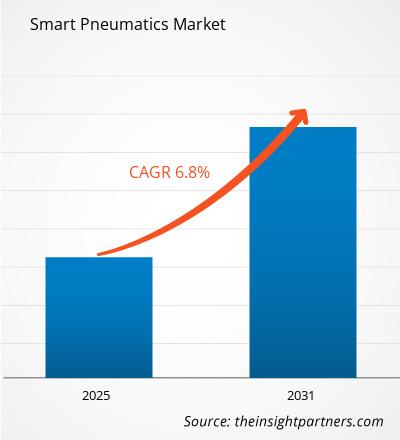
The global Smart Pneumatics Market was valued at US$ 5.19 billion in 2025 and is projected to reach US$ 7.86 billion by 2034, registering a compound annual growth rate (CAGR) of 5.33% during the forecast period from 2026 to 2034. This market encompasses intelligent pneumatic components and systems that integrate sensors, software, and connectivity to enable real-time monitoring, diagnostics, and control in industrial automation applications across multiple sectors.
North America represents a substantial share of the Smart Pneumatics Market size, with an estimated CAGR of 4.8-5.2% from 2026 to 2034. Structural growth drivers in the region include the rapid adoption of Industry 4.0 technologies across manufacturing facilities and significant investments in upgrading legacy automation infrastructure. The presence of major automotive and semiconductor manufacturing hubs further accelerates regional market expansion.
Smart Pneumatics Market Assessment and Insights
- North America: North America captured 25-29% of the global Smart Pneumatics market share in 2025, growing at a CAGR of 4.8-5.2% during 2026-2034. The market benefits from early adoption of industrial IoT solutions and substantial capital expenditure on factory automation in automotive and semiconductor industries.
- US: The US held 20-24% of the global Smart Pneumatics market in 2025, growing at a CAGR of 4.9-5.3% during 2026-2034. Strong manufacturing sector recovery and federal incentives for domestic semiconductor production drive demand for advanced pneumatic automation systems.
- Europe: Europe accounted for 22-26% of the global market share in 2025, with a CAGR of 4.6-5.0% during 2026-2034. Leading countries include Germany, the UK, and France, where stringent energy efficiency regulations and automotive industry transformation are key adoption drivers.
- Asia Pacific: Asia Pacific held 32-36% of the global share in 2025 and is projected to grow at a CAGR of 6.2-6.6% during 2026-2034. China, Japan, India, and South Korea are key markets, driven by rapid industrialization, expanding manufacturing capacity, and government-backed automation initiatives.
- Largest Segment: Hardware represented the largest component segment, accounting for 58-62% market share in 2025, with a CAGR of 4.8-5.2% during 2026-2034. Smart pneumatic valves and actuators form the core of industrial automation systems across diverse end-use industries.
- High Growth Segment: Software is the high-growth component segment, with a 6.5-6.9% CAGR during 2026-2034, holding 18-22% share in 2025. Increasing demand for predictive maintenance analytics and real-time system optimization drives software adoption.
- Key companies analyzed in detail: Bimba Manufacturing Company, Bosch Rexroth AG, Eaton, Emerson Electric Co., Festo Group, Ingersoll-Rand plc, Metso Corporation, Parker Hannifin Corp, Rotork, Thomson Industries Inc.
Source: The Insight Partners' analysis based on proprietary research, government publications, company annual reports, investor presentations, industry databases, and expert interviews.
The Smart Pneumatics Market report indicates that significant changes are happening in the market in comparison with the conventional pneumatic systems due to the use of digital technologies. Currently, modern components for smart pneumatic systems are fitted with embedded sensors and microprocessors and communication protocols which allow performing condition monitoring and predictive maintenance of such devices. Current production of these products tends to be modular allowing easier integration into existing production plants. Companies in the Smart Pneumatics industry pay more attention to development of energy efficient components that minimize compressed air usage.
The future development of the Smart Pneumatics market will be influenced by appearance of new industrial centers in Southeast Asia and Latin America due to modernization of manufacturing facilities there. The use of digital twins and cloud based platforms will change approach to designing and maintaining pneumatic systems. Regulatory tailwinds that will force companies to implement energy efficient pneumatic systems will also contribute to market growth.
Smart Pneumatics Market Report Scope
| Report Attribute | Details |
|---|---|
| Market size in 2025 | US$ 5.19 Billion |
| Market Size by 2034 | US$ 7.86 Billion |
| Global CAGR (2026 - 2034) | 5.33% |
| Historical Data | 2021-2024 |
| Forecast period | 2026-2034 |
Smart Pneumatics Market Analysis
Market drivers for Smart Pneumatics are mainly related to the drive for industrial automation across the globe and need for efficient operations in manufacturing processes. Many industries such as automotive, food and beverages, and semiconductor manufacturing utilize smart pneumatics to increase precision, reduce downtime and improve speed of manufacturing process cycles.
In terms of value chain, software providers play a very crucial role in making decisions based on data. Supply dynamics are mainly driven by the availability of semiconductor chips and raw materials required for the manufacture of electronic components of smart pneumatics.
The main market players in the Smart Pneumatics market consist of established leaders of industrial automation including Festo Group, Bosch Rexroth AG and Parker Hannifin Corp along with specialists like Rotork and Metso Corporation. The main investment trend includes integration of hardware and software and development of comprehensive automation solutions.
Companies are forming partnerships with technology firms to enhance connectivity features and data analytics capabilities. Strategic positioning increasingly revolves around industry-specific expertise, with players developing tailored solutions for oil and gas, semiconductor, and automotive applications to capture niche market segments .
● REPORT CUSTOMIZATION
Tailor This Report To Align With Your Specific Business Requirements
This report can be customized to align precisely with your business objectives, scope, and target markets. Customization options include tailored segmentation, geography, competitive analysis, and strategic insights to support informed decision-making.
Customize This Report →WHAT YOU CAN ADJUST
- ● Segmentations
- ● Geography
- ● Competitive Analysis
- ● Language Preferences
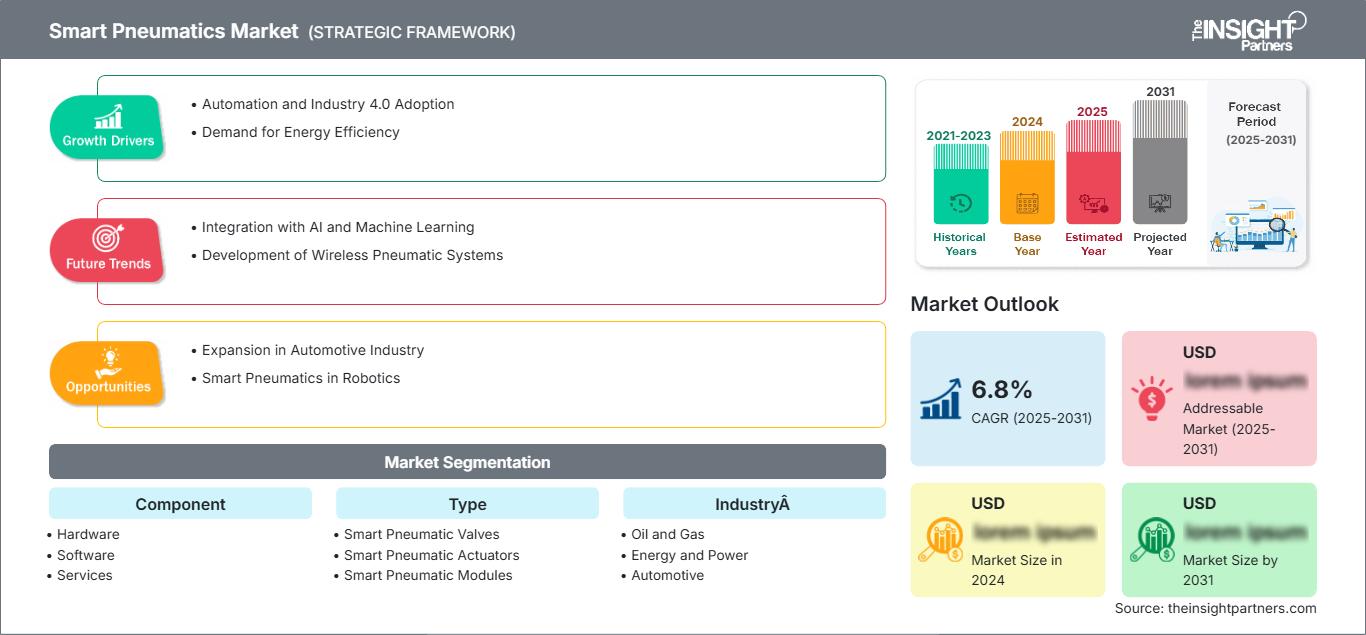
Smart Pneumatics Market: Strategic Insights
Regional Insights
North America Smart Pneumatics Market
North America held 25-29% of the global Smart Pneumatics market share in 2025 and is expected to grow at a CAGR of 4.8-5.2% through 2034. In the regional market, advanced manufacturing technology use and operational efficiencies are widespread within automotive and semiconductor sectors. Major automation firms and qualified labor force facilitate the implementation of technology.
Some structural factors are investment in the reshoring of manufacturing capabilities, as well as the government’s incentive schemes to manufacture semiconductors in the country according to the CHIPS Act. Electric vehicle production shift by the automotive industry is another factor leading to pneumatic automation.
U.S. Smart Pneumatics Market
The U.S. market represents the largest in North America, accounting for 78-82% of the region's share, valued at 20-24% of the global market in 2025. The United States is expected to experience a growth rate of 4.9% to 5.3% CAGR from 2026 to 2034. Manufacturing strength and technology drive the market; leading market participants include Emerson Electric Co. and Parker Hannifin Corp.
Emerging trends highlight the rising usage of predictive maintenance solutions and the increasing connection between pneumatic systems and automation across the entire manufacturing plant. The expansion of the semiconductor industry due to increased domestic manufacturing leads to plenty of opportunities for smart pneumatic components.
Europe Smart Pneumatics Market
Europe accounted for 22-26% of the global market share in 2025, with a projected CAGR of 4.6-5.0% during 2026-2034. The main countries that represent markets are Germany and United Kingdom due to the presence of expertise in automotive manufacturing as well as in industrial automation. Also, there is another set of countries that includes France, Italy, and Spain and represents significant markets with food and beverage and pharmaceutical industries driving growth.
The market of Germany has a great requirement of precision engineering systems while the market of United Kingdom is characterized by the use of the technology in aerospace and defense applications.
APAC Smart Pneumatics Market
APAC is the fastest-growing and largest regional market, holding 32-36% of the global share in 2025, with a CAGR of 6.2-6.6% during 2026-2034. China, Japan, South Korea, India, and Australia represent significant participants. China leads as a manufacturer and as a consumption economy, whereas India becomes a high-growth location owing to growing industries.
Industrial and policy forces that drive the industry's development involve state policies like "Made in China 2025" and "Make in India" aimed at fostering the implementation of automation. The fast expansion of the production of electronics and semiconductors generates an ongoing need for pneumatic controls.
Middle East & Africa Smart Pneumatics Market
The Middle East & Africa Smart Pneumatics Market shows promising growth potential with a projected CAGR of 5.0-5.4%. Key markets include Saudi Arabia, the UAE, and South Africa. The UAE and Saudi Arabia are investing in industrial diversification, creating demand for automation across downstream oil and gas and manufacturing sectors.
The region's energy and infrastructure context influences the market significantly. Economic diversification initiatives like Saudi Vision 2030 are driving investment in manufacturing capabilities. Oil and gas industry modernization and infrastructure development projects are key demand drivers for smart pneumatic components.
Segmentation Analysis
Component
Hardware segment in the Smart Pneumatics Market dominates the component segment, accounting for 58-62% of the global market share in 2025 with a CAGR of 4.8-5.2% through 2034. Hardware includes smart pneumatic valves, actuators, and other physical components that form the foundation of automated systems. The segment's leadership stems from the essential role of hardware in enabling intelligent control and actuation in industrial environments.
- Hardware: The largest segment, encompassing physical components with embedded intelligence. Demand is driven by ongoing industrial automation projects and replacement of legacy pneumatic components.
- Software: The fastest-growing segment, including analytics platforms and control software. Increasing focus on predictive maintenance and operational optimization drives software adoption.
- Services: Includes installation, maintenance, and consulting services. Growth is supported by the need for technical expertise in implementing and integrating smart pneumatic solutions.
Type
Smart Pneumatic Valves represent the dominant product type, accounting for a significant share with a CAGR of 4.9-5.3% through 2034. These valves incorporate position sensors and communication capabilities that enable precise flow control and real-time diagnostics. Demand is driven by widespread application across all end-use industries, particularly in automotive and food processing.
- Smart Pneumatic Valves: The core control component, featuring integrated sensors and communication protocols for precise flow management.
- Smart Pneumatic Actuators: Converts pneumatic energy into mechanical motion with position feedback. Growing demand in robotics and material handling applications.
- Smart Pneumatic Modules: Integrated systems combining multiple functions. Increasing adoption in modular automation setups for manufacturing flexibility.
Industry
Automotive represents the largest end-use industry, accounting for a substantial share with a CAGR of 4.7-5.1% through 2034. The industry's heavy reliance on pneumatic systems for assembly, welding, and painting operations drives consistent demand. Transition toward electric vehicle production is creating new requirements for precision automation.
- Oil and Gas: Demands robust smart pneumatics for harsh environments. Increasing adoption for valve control and process automation.
- Energy and Power: Relies on pneumatics for turbine control and power generation automation.
- Automotive: The dominant end-user, driven by assembly line automation and vehicle production.
- Semiconductor: Requires high-precision pneumatics for wafer handling and cleanroom applications.
- Food and Beverages: Demands hygienic and washable pneumatic components for processing and packaging.
Opportunity Snapshot
| Industry | Revenue Contribution | Trend Tag | Adoption Stage |
|---|---|---|---|
| Automotive | High | EV Production Shift | Scaling |
| Semiconductor | High | Precision Automation | Emerging |
| Oil and Gas | Medium | Predictive Maintenance | Scaling |
| Energy and Power | Medium | Grid Modernization | Mature |
| Food and Beverages | High | Hygiene Automation | Scaling |
Smart Pneumatics Market Growth Drivers and Impact Analysis
Industrial IoT Integration in Manufacturing
The proliferation of Industrial Internet of Things (IIoT) technology is a significant Smart Pneumatics market trend. Manufacturers are increasingly connecting pneumatic components to centralized monitoring systems to gather performance data, enabling real-time diagnostics and predictive maintenance. Ericsson reports that global IoT connections reached 13.2 billion in 2022 and are projected to grow 18% to 34.7 billion by 2028, creating a vast connectivity ecosystem. Smart pneumatics with embedded sensors form the backbone of this connected industrial environment, reducing unplanned downtime by up to 30% and extending equipment life. This integration delivers measurable operational cost savings and productivity gains.
Industry 4.0 and Factory Automation Demand
The global shift toward Industry 4.0 principles is accelerating adoption of smart pneumatic systems. Manufacturers are investing heavily in automation infrastructure to remain competitive, with pneumatic components incorporating intelligence for self-diagnostics and adaptive control. Smart pneumatics enable flexible manufacturing, rapid changeover, and enhanced quality control in production lines. The automotive and semiconductor industries, in particular, are driving demand through their requirements for high precision and reproducibility. Government incentives for manufacturing modernization in economies such as the U.S., Germany, and China further amplify this growth trajectory.
Energy Efficiency and Sustainability Mandates
Increasing regulatory pressure and corporate sustainability goals are compelling manufacturers to adopt energy-efficient automation solutions. Compressed air systems account for approximately 10-15% of industrial electricity consumption, with significant potential for optimization through smart pneumatics. Intelligent components monitor air consumption, detect leaks, and optimize pressure settings, reducing energy waste. Companies are implementing energy management systems that integrate with smart pneumatics to achieve sustainability targets and reduce operational costs. This driver aligns with global carbon reduction commitments and is particularly strong in regulated markets such as Europe.
Smart Pneumatics Market Future Trends
AI-Enabled Predictive Maintenance and Analytics
The integration of artificial intelligence with smart pneumatic systems represents a transformative trend shaping the Smart Pneumatics market. AI algorithms analyze operational data from connected pneumatic components to detect anomalies, predict failures, and recommend optimal maintenance schedules. This capability shifts maintenance from reactive or scheduled approaches to truly predictive models, minimizing unplanned downtime and reducing spare parts inventory. Manufacturers are increasingly demanding AI-powered analytics platforms that provide actionable insights and enable condition-based monitoring across distributed operations.
Ecosystem and Cloud-Based Asset Management
The Smart Pneumatics market is trending toward integrated digital ecosystems that connect pneumatic components with cloud-based asset management platforms. Manufacturers are developing comprehensive digital twins of pneumatic systems, enabling simulation, optimization, and remote monitoring from any location. Cloud connectivity facilitates data aggregation across multiple sites, supporting enterprise-level analytics and benchmarking. This trend is enabling new business models, including performance-based contracts and equipment-as-a-service offerings, where manufacturers pay for outcomes rather than components.
Smart Pneumatics Market Opportunities
Emerging Market Manufacturing Expansion
The rapid industrialization of emerging economies in Southeast Asia, India, and Latin America presents significant opportunities for Smart Pneumatics market forecasts. These regions are establishing new manufacturing facilities and modernizing existing ones to compete globally. Smart pneumatics offer the dual benefits of improved efficiency and reduced operational costs, attractive propositions in cost-sensitive markets. Companies can capitalize on this opportunity by offering scalable solutions tailored to the specific needs and budget constraints of manufacturers in these emerging industrial hubs.
Integration with Digital Twin and Simulation Platforms
The growing adoption of digital twin technology creates opportunities for providers in the Smart Pneumatics market to offer integrated simulation and monitoring solutions. Digital twins enable manufacturers to model pneumatic systems virtually, optimizing design and performance before physical implementation. Real-time data from smart pneumatics can be fed back into digital twin platforms to enhance accuracy and enable scenario analysis. This integration supports faster product development cycles and improved system reliability, appealing to manufacturers in automotive, aerospace, and semiconductor industries.
Recent Developments
- June 2026: Keyence has introduced a new family of smart pneumatic devices built around the CS-L linear cylinder sensor, the SP-C smart cushion valve, and the SP-N/V smart valve manifold. The company is positioning the line as a way to add position feedback, impact control, and network diagnostics to pneumatic cylinders, areas where conventional pneumatic systems have offered little visibility. The three products are designed to work together. The CS-L sensor reports piston position, the SP-C valve uses that position data to slow a cylinder before it hits its end stop, and the SP-N/V manifold collects the sensor and valve data and passes it to a controller over an industrial network.
- June 2025: Local manufacturers are increasingly adopting smart pneumatics to modernise operations, reduce unplanned downtime and improve energy efficiency, says fluid control systems manufacturer Bürkert. Consequently, the company has launched two new products for the South African and broader African market – the valve island Type 8652 AirLINE and the field device Type 8653 AirLINE Field. These solutions are designed to simplify the setup and maintenance of pneumatic systems and lower the risk of process failure; they can be installed either within control cabinets or directly on the production floor.
- December 2025: IMI has launched a new high-performance digital pneumatic positioner to provide reliable safety functions for blowdown and emergency shutdown valve actuation in critical applications. With a patented algorithm and high output CV that delivers ultra-fast stroking times for enhanced safety performance, the SHP-SIS Safety Smart High-Performance Positioner is used in safety instrumented systems (SIS), working within pneumatic operating pressures of 2.5 to 10.5 bar (150 PSI) and ambient temperatures between -55 to 85°C (-67 to 186°F). The SHP-SIS’s built-in partial stroke testing (PST) and SOV diagnostic capabilities ensure compliance with functional safety requirements and assist in supporting preventative maintenance practices.
Frequently Asked Questions

- Comprehensive Market Sizing and Forecast Analysis
- Detailed Segmentation Analysis
- In-Depth Market Dynamics Assessment
- Regional and Country-Level Insights
- Competitive Landscape and Company Benchmarking
- Strategic Business Intelligence
Recent Reports
Testimonials

The Insight Partners' SCADA System Market report is comprehensive, with valuable insights on current trends and future forecasts. The team was highly professional, responsive, and supportive throughout. We are very satisfied and highly recommend their services.
RAN KEDEM Partner, Reali Technologies LTDs
I requested a report on a very specific software market and the team produced the report in a few days. The information was very relevant and well presented. I then requested some changes and additions to the report. The team was again very responsive and I got the final report in less than a week.
JEAN-HERVE JENN Chairman, Future Analytica
We worked with The Insight Partners for an important market study and forecast. They gave us clear insights into opportunities and risks, which helped shape our plans. Their research was easy to use and based on solid data. It helped us make smart, confident decisions. We highly recommend them.
PIYUSH NAGPAL Sr. Vice President, High Beam Global
The Insight Partners delivered insightful, well-structured market research with strong domain expertise. Their team was professional and responsive throughout. The user-friendly website made accessing industry reports seamless. We highly recommend them for reliable, high-quality research services
YUKIHIKO ADACHI CEO, Deep Blue, LLC.
This is the first time I have purchased a market report from The Insight Partners.While I was unsure at first, I visited their web site and felt more comfortable to take the risk and purchase a market report.I am completely satisfied with the quality of the report and customer service. I had several questions and comments with the initial report, but after a couple of dialogs over email with their analyst I believe I have a report that I can use as input to our strategic planning process.Thank you so much for taking the extra time and making this a positive experience.I will definitely recommend your service to others and you will be my first call when we need further market data.
JOHN SUZUKI President and Chief Executive Officer, Board Director, BK Technologies
I wish to appreciate your support and the professionalism you displayed in the course of attending to my request for information regarding to infectious disease IVD market in Nigeria. I appreciate your patience, your guidance, and the fact that you were willing to offer a discount, which eventually made it possible for us to close a deal. I look forward to engaging The Insight Partners in the future, all thanks to the impression you have created in me as a result of this first encounter.
DR CHIJIOKE ONYIA MANAGING DIRECTOR, PineCrest Healthcare Ltd.Reason to Buy
- Informed Decision-Making
- Understanding Market Dynamics
- Competitive Analysis
- Identifying Emerging Markets
- Customer Insights
- Market Forecasts
- Risk Mitigation
- Boosting Operational Efficiency
- Strategic Planning
- Investment Justification
- Tracking Industry Innovations
- Aligning with Regulatory Trends





 Get Free Sample for