
Utility Locator Market Size, Share & Forecast by 2034
Coverage: by Technique (Electromagnetic Field, Ground Penetrating Radar, Others); Offering (Equipment, Services); End-User (Transportation, Water and Sewage, Telecommunications, Electricity, Others) , and Geography (North America, Europe, Asia Pacific, and South and Central America)
- Status : Data Released
- Report Code : TIPEL00002502
- Category : Electronics and Semiconductor
- No. of Pages : 150
- Available Report Formats :


- Last update date : September 17, 2026


2025 Market Size
US$ 929.37 Mn
Base year value
2034 Forecast
US$ 1,609.89 Mn
Projected by 2034
CAGR 2026-2034
6.29 %
Growth rate
Addressable Market
US$ 11,488.58 Mn
(2026-2034)
The utility locator market is projected to grow from US$ 929.37 million in 2025 to US$ 1,609.89 million by 2034, registering a CAGR of 6.29% during 2026–2034. Growth is supported by wider adoption of electromagnetic field detection and ground penetrating radar across transportation, water and sewage, telecommunications, and electricity networks, where accurate underground asset identification is becoming central to excavation safety and infrastructure continuity.
North America remains a major demand center as aging underground infrastructure, fiber deployment, road rehabilitation, and utility modernization programs increase the need for precise locating before excavation. The utility locator market size in the region is supported by stronger one-call compliance practices, contractor safety requirements, and the integration of digital mapping tools with field locating equipment.
Utility Locator Market Assessment and Insights
- North America: The region accounted for an estimated 32–36% share in 2025 and is expected to grow at a CAGR of 5.8–6.4% during 2026–2034, supported by damage prevention mandates and utility renewal spending.
- U.S.: The U.S. represented an estimated 76–80% of North America in 2025, with growth supported by broadband expansion, municipal utility upgrades, and high locate-ticket volumes.
- Europe: Europe held an estimated 24–28% share in 2025 and is projected to grow at 5.4–6.0%, led by the UK, Germany, France, Italy, and Spain.
- Asia Pacific: Asia Pacific accounted for an estimated 22–26% share in 2025 and is expected to grow at 6.8–7.5%, led by China, Japan, India, South Korea, and Australia.
- Largest Segment: Electromagnetic field detection held an estimated 55–60% market share in 2025, with a CAGR of 5.7–6.2% through 2034.
- High Growth Segment: Ground penetrating radar recorded an estimated 40–45% share in 2025 and is expected to grow at 6.7–7.4% through 2034.
- Key companies analyzed in detail: 3M Company, Guideline Geo AB, Leica Geosystems AG, Maverick Inspection Ltd., On Target Utility Services, Radiodetection Ltd., Ridge Tool Company, Sensors & Software Inc., USIC LLC, and Vivax-Metrotech Corporation.
Source: The Insight Partners' analysis based on proprietary research, government publications, company annual reports, investor presentations, industry databases, and expert interviews.
Utility locating has evolved from basic pipe and cable detection into a data-driven infrastructure protection workflow. Contractors increasingly combine electromagnetic locators, GPR, GNSS, and cloud records to improve confidence before excavation. This shift is changing equipment procurement, operator training, and service delivery as asset owners seek traceable, repeatable, and auditable locate outcomes.
Over the forecast period, the market growth will be shaped by infrastructure replacement, urban congestion, smart city investment, and stricter excavation risk controls. Emerging geographies are also expanding adoption as utility density rises and project owners require better subsurface visibility before transportation, power, and broadband works begin.
Utility Locator Market Report Scope
| Report Attribute | Details |
|---|---|
| Market size in 2025 | US$ 929.37 Million |
| Market Size by 2034 | US$ 1,609.89 Million |
| Global CAGR (2026 - 2034) | 6.29% |
| Historical Data | 2021-2024 |
| Forecast period | 2026-2034 |
Utility Locator Market Analysis
Market expansion is due to an intrinsic demand for safe excavations, minimum disruptions, and accurate underground assets data. Transportation infrastructure projects, replacement of water pipelines, electricity transmission networks, and laying of telecommunication fiber lines necessitate the use of pre-construction detection technology. With more crowded utility corridors, buyers are focusing on accuracy, depth determination, workflow, and geo-information system compatibility.
In terms of supply-side factors, the equipment market will be affected by a combination of equipment suppliers, service providers, mapping technology, and inspection companies. Equipment is highly demanded among contractors and government organizations, whereas services are gaining popularity in case specialized operators are needed for complicated projects, non-metallic utilities, congested corridors, and high-risk excavation areas.
The market analysis reveals that the competitive environment is segmented between the international brands of instruments, GPR suppliers, and service-oriented companies that perform location. Radiodetection Ltd., Leica Geosystems AG, Vivax-Metrotech Corporation, Sensors & Software Inc., 3M Company, and Ridge Tool Company stand out with their detection accuracy, ease of use, connectivity, and durability. USIC LLC and others provide their competitive advantage by offering scale, availability of trained personnel, and reliability of processes.
The investment trends reveal the increasing interest in the digital connection of the locating equipment, automation of the reports, and the integration with the maps, permits, and assets' database. The vendors position their product according to the reduction of the risk of strikes, faster surveying, and improved field documentation.
● REPORT CUSTOMIZATION
Tailor This Report To Align With Your Specific Business Requirements
This report can be customized to align precisely with your business objectives, scope, and target markets. Customization options include tailored segmentation, geography, competitive analysis, and strategic insights to support informed decision-making.
Customize This Report →WHAT YOU CAN ADJUST
- ● Segmentations
- ● Geography
- ● Competitive Analysis
- ● Language Preferences
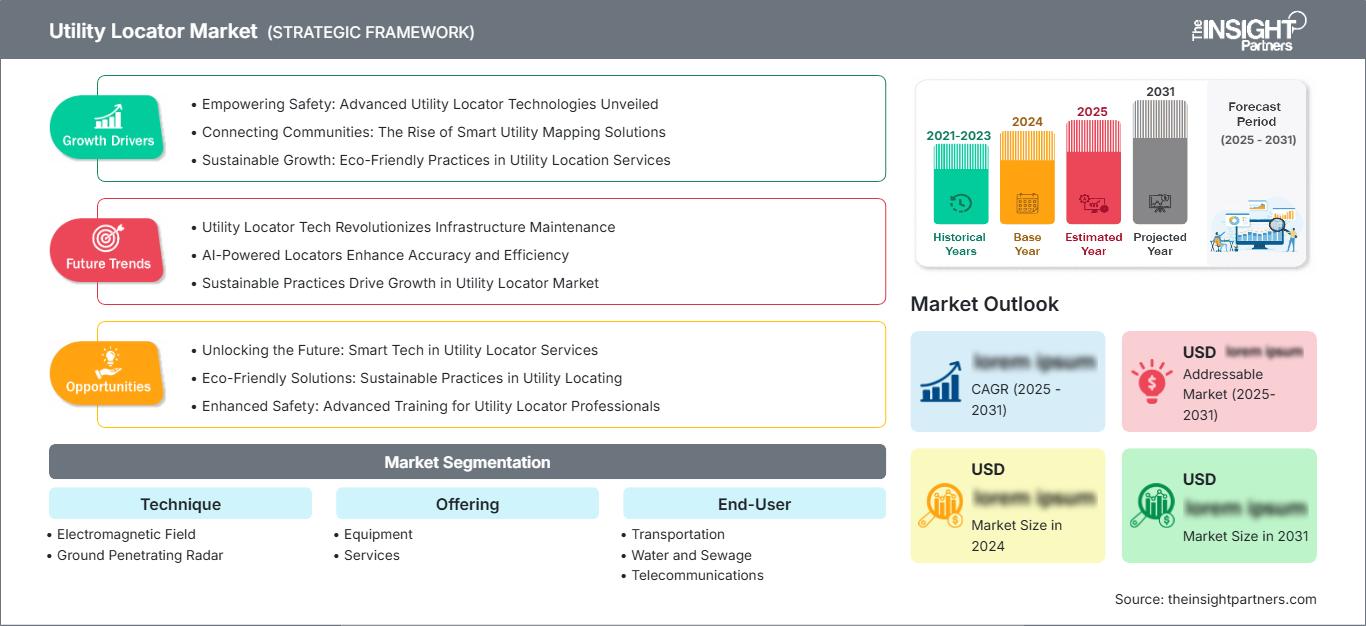
Utility Locator Market: Strategic Insights
Regional Insights
North America utility locator market
North America held an estimated 32–36% utility locator market share in 2025 and is projected to grow at 5.8–6.4% during 2026–2034. Demand is supported by dense underground electricity, gas, water, and telecommunications networks, along with strict excavation notification practices. The region’s high cost of utility strikes increases demand for equipment and services that improve locate accuracy.
The region also benefits from broadband expansion, grid modernization, and municipal water rehabilitation programs. Contractors increasingly use EM locators with mapping-enabled workflows, while GPR is used where non-metallic pipes, concrete structures, or uncertain records create added risk.
U.S. utility locator Market
The U.S. accounted for an estimated 76–80% of North America in 2025 and is expected to grow at 5.9–6.5% through 2034. Large locate-ticket volumes, state-level damage prevention programs, and continued telecom network construction support sustained demand for utility locating services and field equipment.
Company presence is strong across service and equipment categories. USIC LLC provides large-scale locating services, while 3M Company, Radiodetection Ltd., Leica Geosystems AG, and Vivax-Metrotech Corporation support contractors with locators, transmitters, detection accessories, and digital workflows.
Europe utility locator Market
Europe represented an estimated 24–28% share in 2025 and is expected to grow at 5.4–6.0% during 2026–2034. The UK and Germany lead adoption due to utility mapping standards, roadworks controls, and high urban utility density. France, Italy, and Spain show steady demand from rail, water, and telecom modernization.
European infrastructure owners are increasingly emphasizing survey quality and documentation before excavation. GPR adoption is important in cities with mixed metallic and non-metallic utility networks, while electromagnetic technologies remain the preferred first-line tool for conductive assets.
APAC utility locator Market
Asia Pacific held an estimated 22–26% share in 2025 and is projected to grow at 6.8–7.5% through 2034. China leads regional demand through urban utilities, transport corridors, and municipal infrastructure upgrades, while Japan, South Korea, India, and Australia expand adoption across smart city and telecom projects.
Rapid utility installation creates strong demand for reliable detection before road widening, metro construction, and broadband deployment. The region is expected to be the fastest-growing market as cities increase underground asset documentation and excavation safety requirements.
Middle East & Africa utility locator Market
The Middle East & Africa market is expected to grow at 5.6–6.3% during 2026–2034. Saudi Arabia and the UAE lead demand through energy, construction, district cooling, and smart city projects, while South Africa supports demand through utility maintenance and urban infrastructure repair.
Adoption is influenced by large project sites, high-value buried assets, and the need to limit disruptions in dense urban and industrial zones. Utility locator market Forecasts indicate rising opportunities for service providers where trained operators are required.
Segmentation Analysis
Technique
Technique is central to market scope because detection requirements differ by utility material, depth, soil conditions, and site complexity. This segment is projected to grow at 6.1–6.7% during 2026–2034 as buyers combine complementary methods to improve survey confidence and reduce excavation risk.
- Electromagnetic Field: Electromagnetic field locators dominate routine conductive pipe and cable detection because they are portable, familiar to technicians, and effective for power, telecom, and metallic utility tracing.
- Ground Penetrating Radar: Ground penetrating radar is gaining importance where non-metallic pipes, concrete structures, and incomplete utility records require broader subsurface visibility before excavation.
Offering
Offering is expected to grow at 6.0–6.6% during 2026–2034 as equipment purchases and professional services expand together. Buyers increasingly seek reliable technology, operator training, reporting support, and repeatable field methods that reduce project delays and liability exposure.
- Equipment: Equipment demand is led by locators, transmitters, GPR systems, accessories, and mapping-enabled devices used by contractors, utilities, municipalities, and survey professionals.
- Services: Services remain important for complex sites where experienced operators interpret signals, validate records, mark assets, and support excavation planning.
End-User
End-User demand is projected to grow at 6.2–6.9% during 2026–2034. Electricity and telecommunications users show strong momentum, while water, sewage, and transportation applications remain critical because buried infrastructure renewal requires accurate detection before digging, according to the Utility Locator Market report.
- Transportation: Transportation projects require utility locating before road, rail, bridge, and airport works to reduce project delays and avoid accidental strikes in congested corridors.
- Water and Sewage: Water and sewage utilities rely on locating to support rehabilitation, leak investigation, pipeline replacement, and safe excavation around aging distribution networks.
- Telecommunications: Telecommunications demand is supported by fiber expansion, 5G backhaul, duct mapping, and the need to protect existing cables during network densification.
- Electricity: Electricity users adopt locating technologies to identify underground power cables, reduce outage risk, and support grid modernization, maintenance, and distribution upgrades.
Opportunity Snapshot
| End-User | Revenue Contribution | Trend Tag | Adoption Stage |
| Transportation | Medium | Corridor Safety | Scaling |
| Water and Sewage | Medium | Pipe Renewal | Scaling |
| Telecommunications | High | Fiber Buildout | Scaling |
| Electricity | High | Grid Upgrade | Mature |
Utility Locator Market Growth Drivers and Impact Analysis
Rising excavation safety and damage prevention requirements
Damage prevention remains the strongest driver for the utility locator market because underground utility strikes can cause outages, repair costs, work stoppages, and safety incidents. Contractors and municipalities are therefore strengthening pre-excavation locating processes, especially in congested urban corridors. One-call practices, site documentation, and project risk controls increase demand for reliable detection tools and trained locating services. The impact is strongest in transportation, electricity, water, and telecom projects where utility density is high and project delays are expensive.
Infrastructure renewal across aging utility networks
The aging of underground water pipe systems, electricity conduits, sewerage systems, and telecom ducts is resulting in the increased need for the collection of accurate subsurface data prior to carrying out repairs or replacements. The available old data records may not be sufficient or consistent and, therefore, necessitate field confirmation. This driver increases the use of both electromagnetic location services and GPR due to the need to locate metallic and non-metallic underground utilities in different circumstances.
Telecom fiber deployment and smart city construction
The deployment of fiber, 5G backhaul, and smart city projects requires repeated digging activities on streets, pavements, campuses, and industrial areas. It leads to continuous requirements for locating devices and services to prevent any cable damage, disruption, and rework. There is another factor that drives the demand for locators in telecoms: as the network gets upgraded, records become outdated and have to be revised, which gives an added boost to the use of map-based locators. This trend is highly apparent in North America and the Asia Pacific regions.
Utility Locator Market Future Trends
Connected locating and digital field documentation
Utility locator market trends increasingly favor connected devices that capture location, depth, operator notes, timestamps, and survey paths in digital formats. This change allows for better quality control, improved reporting, and increased compatibility with GIS and asset management systems. Ultimately, through continuous workflow, connected processes can allow the project owner to compare field data against legacy maps and decrease informational gaps.
Broader use of multi-sensor locating workflows
In locating work going forward, the use of electromagnetic locating, GPR, GNSS, manual surveying, and data interpretation through software is likely to become even more prevalent. The use of multiple technologies ensures more certainty in cases where the nature of utilities, the type of soil, and the quality of information vary from place to place. This will enable greater value from equipment packages and service offerings.
Utility Locator Market Opportunities
Expansion of professional locating services
Utility locator market Forecasts point to strong opportunities for professional service providers as project owners face workforce constraints, complex underground environments, and higher accountability for excavation outcomes. Service specialists can combine trained technicians, standardized field methods, reporting software, and multi-technology surveys to support contractors that lack in-house expertise. This opportunity is strongest in municipal works, telecom deployment, and large transportation projects where accuracy, documentation, and turnaround time are critical.
Integration with GIS and asset management platforms
A major opportunity lies in connecting locate data with GIS, permitting systems, and utility asset management platforms. Many utilities still rely on incomplete historical maps, creating risk during excavation and maintenance. Vendors that support seamless data capture, export, and validation can help customers convert field locating into long-term asset intelligence. This creates recurring value through software, training, data services, and equipment upgrades.
Frequently Asked Questions

- Comprehensive Market Sizing and Forecast Analysis
- Detailed Segmentation Analysis
- In-Depth Market Dynamics Assessment
- Regional and Country-Level Insights
- Competitive Landscape and Company Benchmarking
- Strategic Business Intelligence
Recent Reports
Testimonials

The Insight Partners' SCADA System Market report is comprehensive, with valuable insights on current trends and future forecasts. The team was highly professional, responsive, and supportive throughout. We are very satisfied and highly recommend their services.
RAN KEDEM Partner, Reali Technologies LTDs
I requested a report on a very specific software market and the team produced the report in a few days. The information was very relevant and well presented. I then requested some changes and additions to the report. The team was again very responsive and I got the final report in less than a week.
JEAN-HERVE JENN Chairman, Future Analytica
We worked with The Insight Partners for an important market study and forecast. They gave us clear insights into opportunities and risks, which helped shape our plans. Their research was easy to use and based on solid data. It helped us make smart, confident decisions. We highly recommend them.
PIYUSH NAGPAL Sr. Vice President, High Beam Global
The Insight Partners delivered insightful, well-structured market research with strong domain expertise. Their team was professional and responsive throughout. The user-friendly website made accessing industry reports seamless. We highly recommend them for reliable, high-quality research services
YUKIHIKO ADACHI CEO, Deep Blue, LLC.
This is the first time I have purchased a market report from The Insight Partners.While I was unsure at first, I visited their web site and felt more comfortable to take the risk and purchase a market report.I am completely satisfied with the quality of the report and customer service. I had several questions and comments with the initial report, but after a couple of dialogs over email with their analyst I believe I have a report that I can use as input to our strategic planning process.Thank you so much for taking the extra time and making this a positive experience.I will definitely recommend your service to others and you will be my first call when we need further market data.
JOHN SUZUKI President and Chief Executive Officer, Board Director, BK Technologies
I wish to appreciate your support and the professionalism you displayed in the course of attending to my request for information regarding to infectious disease IVD market in Nigeria. I appreciate your patience, your guidance, and the fact that you were willing to offer a discount, which eventually made it possible for us to close a deal. I look forward to engaging The Insight Partners in the future, all thanks to the impression you have created in me as a result of this first encounter.
DR CHIJIOKE ONYIA MANAGING DIRECTOR, PineCrest Healthcare Ltd.Reason to Buy
- Informed Decision-Making
- Understanding Market Dynamics
- Competitive Analysis
- Identifying Emerging Markets
- Customer Insights
- Market Forecasts
- Risk Mitigation
- Boosting Operational Efficiency
- Strategic Planning
- Investment Justification
- Tracking Industry Innovations
- Aligning with Regulatory Trends





 Get Free Sample for