
Water Automation and Instrumentation Market Trends, Size & Growth by 2034
Coverage: by Automation Technology (DCS, SCADA, PLC, IAM, HMI, Others); Instrumentation Solution (Pressure Transmitter, Level Transmitter, Temperature Transmitter, Liquid Analyzers, Gas Analyzers, Leakage Detection Systems, Density Measurement, Others); End-User (Chemical, Manufacturing, Food and Beverage, Utilities, Paper and Pulp, Others) , and Geography (North America, Europe, Asia Pacific, and South and Central America)
- Status : Data Released
- Report Code : TIPRE00006314
- Category : Electronics and Semiconductor
- No. of Pages : 150
- Available Report Formats :


- Last update date : September 28, 2026


2025 Market Size
US$ 43.84 Bn
Base year value
2034 Forecast
US$ 63.78 Bn
Projected by 2034
CAGR 2026-2034
4.25 %
Growth rate
Addressable Market
US$ 488.65 Bn
(2026-2034)
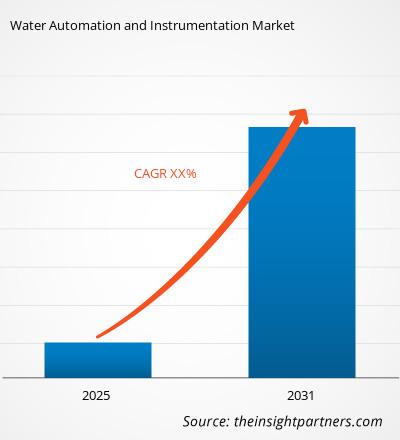
The global Water Automation and Instrumentation market was valued at US$ 43.84 billion in 2025 and is expected to reach US$ 63.78 billion by 2034; it is estimated to record a CAGR of 4.25% during 2026-2034.
Water Automation and Instrumentation Market Assessment and Insights
- North America: North America accounted for 34–38% share in 2025 and is expected to grow at a 4.3–5.1% CAGR between 2026–2034, supported by utility modernization, industrial water reuse, and digital control upgrades.
- US: The US represented 70–74% of North America's 2025 market and is projected to grow at a 4.2–5.0% CAGR between 2026–2034 as utilities modernize monitoring and treatment infrastructure.
- Europe: Europe held a 25–29% share in 2025 and is projected to advance at a 4.0–4.8% CAGR during 2026–2034, with Germany, the UK, France, Italy, and Spain supporting demand through infrastructure renewal and water-efficiency requirements.
- Asia Pacific: Asia Pacific represented 22–26% share in 2025 and is anticipated to record a 5.5–6.4% CAGR during 2026–2034, led by China, Japan, India, South Korea, and Australia as industrialization and urban water investments accelerate.
- Largest Segment: SCADA represented a 28–32% market share in 2025 and is expected to grow at a 5.2–5.8% CAGR between 2026–2034, reflecting centralized monitoring requirements.
- High Growth Segment: Leakage Detection Systems held a 7–10% market share in 2025 and are forecast to grow at a 7.0–8.0% CAGR during 2026–2034 as utilities prioritize loss reduction.
- Key companies analyzed in detail: ABB Ltd., Emerson Electric Company, Endress+Hauser AG, EurotekIndia, General Electric, Mitsubishi Electric Corporation, Rockwell Automation Inc., Schneider Electric SE, Siemens AG, and Yokogawa Electric Corporation.
Source: The Insight Partners' analysis based on proprietary research, government publications, company annual reports, investor presentations, industry databases, and expert interviews.
The water automation and instrumentation market has evolved from isolated control loops and conventional plant instrumentation toward connected architectures combining SCADA, PLCs, HMIs, transmitters, analyzers, and remote monitoring. Industrial operators increasingly connect field devices with supervisory platforms to improve visibility across pumps, treatment stages, storage, and distribution. The transition is also changing procurement, with lifecycle support, cybersecurity, interoperability, and data integration becoming more important alongside hardware specifications.
The Water Automation and Instrumentation Market report indicates that forward momentum is likely to broaden geographically as emerging economies upgrade water treatment capacity and industrial users improve process-water management. Capital allocation is increasingly directed toward systems that can integrate with existing equipment rather than requiring complete infrastructure replacement. Regulatory attention to water quality, discharge compliance, resource conservation, and infrastructure resilience is also encouraging utilities and manufacturers to combine measurement technologies with automated corrective actions, creating a more integrated and data-driven technology environment.
Water Automation and Instrumentation Market Report Scope
| Report Attribute | Details |
|---|---|
| Market size in 2025 | US$ 43.84 Billion |
| Market Size by 2034 | US$ 63.78 Billion |
| Global CAGR (2026 - 2034) | 4.25% |
| Historical Data | 2021-2024 |
| Forecast period | 2026-2034 |
Water Automation and Instrumentation Market Analysis
The water automation and instrumentation market is supported by demand from utilities and process industries that require continuous visibility into pressure, level, temperature, chemical conditions, and leakage. Ecosystems range from automation suppliers, instrumentation suppliers, system integrators, engineering contractors, utilities, industrial plants, and maintenance companies. SCADA and PLC architecture control the field devices, while transmitters and analyzers deliver the operational information. This inter-connected ecosystem fosters repeat business in terms of calibration, up-gradation, software, cybersecurity, and replacement equipment.
Industries with high water usage create further demand since any disruptions, contamination, or inefficient treatments have an impact on their economic feasibility. The chemical, manufacturing, food & beverage, and paper & pulp industries need more automation for consistent processes. The supply chain continues to be impacted by semiconductors, electronics, sensors, engineering, and local integration abilities. Automation solution providers can offer control, instrumentation, drives, communication, and service, while focused solution providers can leverage their measurement precision and application expertise.
The water automation and instrumentation market remains competitive because global automation companies can address multiple layers of the control architecture. ABB Ltd. specializes in automation and drives, whereas Siemens AG and Schneider Electric SE excel in control systems and digital platforms. The industrial control domain is contested by Emerson Electric Company, Rockwell Automation Inc., and Mitsubishi Electric Corporation, whereas Yokogawa Electric Corporation and Endress+Hauser AG have an edge in instrumentation and process measurement. General Electric and EurotekIndia are some other companies that add to this competitive landscape.
The investment models are shifting from product-centric sales to an approach that focuses more on interoperability and lifecycle value through software services. In today’s times, it is important for companies to develop their offerings based on digital twins, remote monitoring, predictive maintenance, connected instrumentation, and cybersecurity. This makes integration of older assets with the modern system a key differentiator for companies in this competitive environment. Utility companies, engineering firms, and technology partners can speed up the process of implementation, while common interfaces will enable the operator not to depend too much on proprietary architecture.
● REPORT CUSTOMIZATION
Tailor This Report To Align With Your Specific Business Requirements
This report can be customized to align precisely with your business objectives, scope, and target markets. Customization options include tailored segmentation, geography, competitive analysis, and strategic insights to support informed decision-making.
Customize This Report →WHAT YOU CAN ADJUST
- ● Segmentations
- ● Geography
- ● Competitive Analysis
- ● Language Preferences
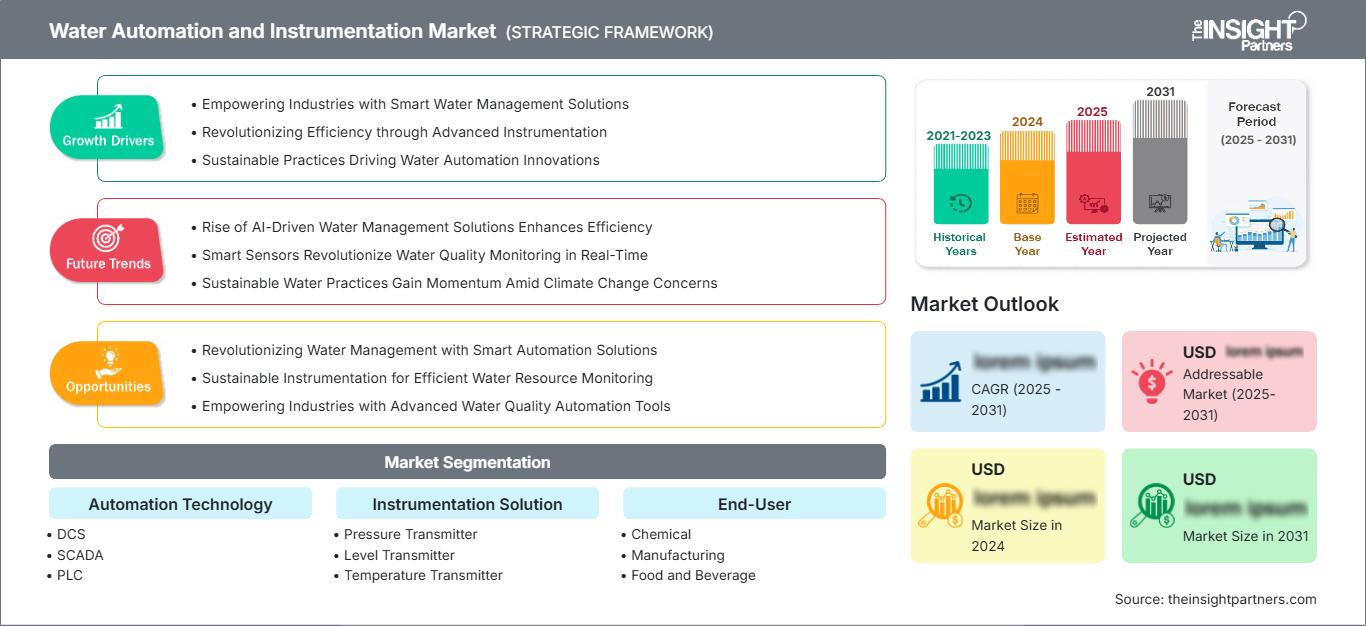
Water Automation and Instrumentation Market: Strategic Insights
Regional Insights
North America Water Automation and Instrumentation Market
North America is expected to maintain the largest regional position, with a 34–38% of the Water Automation and Instrumentation Market share in 2025 and a 4.3–5.1% CAGR through 2034. Assets for aging treatment, upgrades of legacy automation controls, and increased needs for resiliency drive expenditures in local municipalities and industry. Remote monitoring and automation controls for efficient pumping are increasing to deliver service while minimizing costs of energy and maintenance.
US accounts for 70–74% of the 2025 market in North America and expected to record 4.2–5.0% CAGR growth between 2025 and 2034. Drivers include infrastructure renewal, industrial reuse of water, and digitization of distributed assets. Canadian demand will come from modernizing municipalities and industries that are intensive resource users. Schneider Electric's 2025 Conroe project is an example of software-defined automation implementation at 19 water and wastewater plants.
U.S. Water Automation and Instrumentation Market
The US accounts for 70–74% of North America's 2025 Water Automation and Instrumentation Market and is expected to register a 4.2–5.0% CAGR through 2034. There is an increasing trend among municipal utilities, industrial facilities, and water infrastructure providers in upgrading their SCADA, PLC, HMI, and instrumentation systems to enhance the visibility of their assets. There is significant potential for retrofitting in this regard due to the large number of legacy systems installed.
The application areas in focus now are mainly the remote asset management, predictive maintenance, leak detection, and process optimization. These firms have the technological competencies required for addressing these applications. Moreover, industrial users are also linking their instrumentation information with enterprise systems in order to enhance energy management, maintenance scheduling, and compliance reporting.
Europe Water Automation and Instrumentation Market
Europe represented 25–29% share of the Water Automation and Instrumentation Market in 2025 and is forecast to expand at a 4.0–4.8% CAGR through 2034. Germany is still a key market, relying on its advanced process industries and automation systems. Additionally, the UK, France, Italy, and Spain contribute through their utilities modernization projects, water treatment, and resource-efficiency programs. The trend now is toward networked instrumentation rather than standalone devices.
Germany has an established ecosystem for industrial automation, with a range of demand stemming from chemical, manufacturing, food processing, and municipal operations. The UK focuses on network efficiency and modernized treatment facilities, while France keeps building its water system and monitoring it digitally. Meanwhile, resource management requirements in Italy and Spain provide opportunities for instrumentation, leakage prevention, and automated treatment.
APAC Water Automation and Instrumentation Market
APAC held a 22–26% share of the Water Automation and Instrumentation Market in 2025 and is projected to grow at a 5.5–6.4% CAGR through 2034, making it the fastest-growing major region. China is at the top of the region’s demand, trailed by Japan, India, South Korea, and Australia. The development of industries and urban infrastructures is reinforcing the need for automation of water treatment and monitoring systems.
The growth in China and India lies in the construction of capacity for both industry and municipalities, while Japan and South Korea concentrate on automation and optimization. Australia emphasizes water conservation and monitoring owing to resource limitations. Industrial policies, smart cities, wastewater recycling, and an increase in manufacturing capacity are driving the use of SCADA, PLCs, transmitters, analyzers, and leakage detection systems.
Middle East & Africa Water Automation and Instrumentation Market
The Middle East & Africa Water Automation and Instrumentation Market is projected to expand at a 4.6–5.5% CAGR through 2034. Saudi Arabia and UAE drive regional demand with desalination, water reuse, industrial facilities, and smart utility systems. South Africa has demand due to its municipalities and industries' development, whereas the remaining MEA countries are faced with the need for monitoring their water-stressed resources.
Water infrastructure development in Saudi Arabia and UAE's projects on desalination and reuse create opportunities in automation and instrumentation. South Africa is characterized by municipal water treatment and industrial facilities, whereas the remaining MEA countries need solutions that will help to enhance the reliability of systems in water-stressed regions. Solutions on digital control, remote monitoring, and efficient pumps are very suitable since water production/distribution may be costly.
Segmentation Analysis
Automation Technology
Water Automation and Instrumentation Market forecast indicates that the Automation Technology segment is projected to grow at a 5.0–5.6% CAGR during 2026–2034. Adoption is driven by the need to coordinate distributed assets, improve operator visibility, and integrate plant-level information. SCADA remains central to remote supervision, while PLCs provide dependable local control. DCS platforms are relevant to complex process environments, and HMI systems support operator interaction. IAM is becoming increasingly important as connected infrastructure expands the number of users, endpoints, and access pathways.
- DCS: Distributed control systems serve complex continuous processes where coordinated control, alarm management, and centralized visibility are important for treatment and industrial water operations.
- SCADA: SCADA provides centralized supervision of geographically distributed assets, supporting pump stations, treatment facilities, storage systems, alarms, and remote operational decisions.
- PLC: PLC platforms provide reliable machine-level control for pumps, valves, motors, dosing systems, and treatment equipment, particularly where deterministic response is required.
- IAM: Identity and access management strengthens control-system governance by managing user privileges, authentication, and access to increasingly connected water infrastructure.
- HMI: Human machine interfaces translate process information into actionable operator views, helping personnel monitor equipment conditions, alarms, trends, and treatment parameters.
Instrumentation Solution
Water Automation and Instrumentation Market trends indicate that the Instrumentation Solution segment is expected to expand at a 4.4–5.0% CAGR between 2026–2034. Measurement accuracy directly influences treatment performance, asset protection, compliance, and resource utilization. Pressure, level, and temperature transmitters remain fundamental field devices, while liquid and gas analyzers support quality control. Leakage detection systems are gaining strategic relevance because they allow operators to identify abnormal conditions earlier and reduce avoidable losses.
- Pressure Transmitter: Pressure transmitters support pump control, pipeline monitoring, filtration, and process protection by providing continuous measurements required for stable system operation.
- Level Transmitter: Level transmitters help maintain tank inventories, prevent overflow or dry running, and automate chemical dosing and pumping sequences across treatment facilities.
- Temperature Transmitter: Temperature transmitters support process monitoring where thermal conditions influence treatment chemistry, equipment performance, biological processes, or industrial production quality.
- Liquid Analyzers: Liquid analyzers measure parameters such as pH and other water-quality characteristics, helping operators maintain treatment targets and compliance requirements.
- Gas Analyzers: Gas analyzers monitor relevant gaseous conditions in treatment and industrial processes, supporting safety, process optimization, and environmental management requirements.
- Leakage Detection Systems: Leakage detection systems identify abnormal flow or pressure behavior and help utilities prioritize network intervention, reducing water losses and improving asset efficiency.
- Density Measurement: Density measurement assists process operators where concentration or solids characteristics influence treatment performance, material handling, and process consistency.
End-User
The End-User segment is forecast to grow at a 4.6–5.2% CAGR during 2026–2034. Utilities provide a broad installed base because automation is required across collection, treatment, pumping, and distribution. Chemical and manufacturing facilities emphasize process reliability and water reuse, while food and beverage producers prioritize quality and hygiene. Paper and pulp operators increasingly require tighter water and wastewater control because water efficiency can influence both environmental performance and production economics.
- Chemical: Chemical facilities require accurate monitoring and automated control to manage process water, wastewater characteristics, chemical dosing, and compliance-sensitive treatment operations.
- Manufacturing: Manufacturing plants adopt automation to stabilize water-intensive processes, reduce unplanned interruptions, optimize pumping, and improve visibility across distributed utility systems.
- Food and Beverage: Food and beverage facilities prioritize reliable water quality, hygienic operations, and efficient wastewater handling because water performance can directly influence production continuity.
- Utilities: Utilities represent a core adoption base, using automation and instrumentation across treatment, pumping, distribution, monitoring, leakage management, and remote operations.
- Paper and Pulp: Paper and pulp facilities require continuous water monitoring and treatment control because water consumption, recycling, and wastewater characteristics influence operating efficiency.
Opportunity Snapshot
| End-User | Revenue Contribution (High/Medium/Low) | Trend Tag | Adoption Stage |
| Chemical | Medium | Process Quality | Mature |
| Manufacturing | Medium | Water Reuse | Scaling |
| Food and Beverage | Medium | Hygienic Monitoring | Scaling |
| Utilities | High | Smart Networks | Mature |
| Paper and Pulp | Medium | Closed Loop | Scaling |
Water Automation and Instrumentation Market Growth Drivers and Impact Analysis
Expansion of Smart and Remote Water Infrastructure
Water system providers are now increasingly shifting from manual monitoring to central monitoring, remote telemetry, and automation. This will create the need for SCADA systems, PLC, HMIs, communication tools, transmitters, and analyzers capable of working within a network of dispersed installations. It provides visibility at a distance so that water utilities can monitor pressure issues, machine operation issues, and water quality issues without depending solely on physical inspections. The implications go beyond city water systems since industrial facilities use such an architecture to link their pump stations, treatment facilities, reservoirs, and reuse facilities. With more facilities being connected, automation providers have an opportunity to extract value from software, security, analytics, and lifecycle management services. The end market result is a slow evolution of the procurement process from one-off hardware purchases to infrastructure programs that entail periodic upgrades.
Rising Need to Reduce Water Loss and Operating Costs
The problem of water shortages and higher operating costs of utilities is creating increased focus on the need for accurate measurements, leak detection, efficient pumping, and optimization of treatment processes. It is the job of instrumentation to collect data related to unusual operations and automation systems to interpret that information into action. Leak detection is especially important in distribution systems because undetected leaks lead to higher production needs without better quality of service delivery. In treatment plants, effective pumping and process control would help in reducing energy consumption and maintaining chemical dosages. For industrial users, the need for better instrumentation and automation results from the fact that water inefficiencies increase both operating costs and the need for wastewater treatment. There is strong market potential wherever operators can demonstrate savings from losses, energy consumption, maintenance, and risks.
Stronger Digitalization of Industrial Water Management
Industries are now incorporating water measurement systems into their digital manufacturing and asset management plans. Connected devices can feed process data to control systems, while analytics can assist in detecting any abnormalities before turning into a production issue or an environmental one. Such a strategy is especially useful in chemical plants, manufacturing plants, food and beverage plants, and pulp and paper industries, as water quality and availability may affect the continuous flow of production. This way of measuring water helps industries benchmark water usage in different production lines, inefficient machines, and even set operational benchmarks. With the ongoing digitalization in industries, compatibility with enterprise-level software, secure communication, and standardized data architecture become increasingly important for procurement processes. The providers who can deliver field measurement, automation, analytics, and support services are now able to join major modernization projects.
Water Automation and Instrumentation Market Future Trends
AI-Assisted Water Process Optimization
The water automation and instrumentation market is moving toward AI-assisted decision support that can interpret continuous process information and recommend operational adjustments. Future systems will use historical measurements, condition monitoring data from equipment, weather data, consumption trends, and treatment parameters to enhance forecasting. Rather than being used to replace the existing PLCs or SCADAs, the AI technology will increasingly be used in analysis layers that will be integrated with the control systems. Digital twins will help test scenarios before changes are made to actual equipment configurations. The impact on business will be an increased software component in water-management projects. Providers will require accurate measurements, interoperability architecture, and cybersecurity capabilities for AI technologies to become useful.
Convergence of Operational Technology and Cloud Platforms
Future implementation will see increased coupling of operations at the plant level with cloud and edge-computing platforms that ensure security. With edge computing, the system will allow for fast control locally, while the cloud platform will allow for consolidation of data from different treatment plants, pump stations, or even factories. Such architecture allows for enterprise benchmarking, centralized maintenance planning, and remote engineering without having to compromise on local control capabilities. Security will be a key component in future designs due to the increasing number of communication channels and devices in the water infrastructure. Future suppliers will focus on secure connectivity, access based on roles, network segmentation, and life cycle patching alongside automation capabilities.
Water Automation and Instrumentation Market Opportunities
Modernization of Legacy Utility Control Systems
A substantial opportunity exists in replacing aging control and measurement infrastructure without requiring the complete reconstruction of treatment facilities. Utilities can progressively upgrade PLCs, SCADA interfaces, transmitters, communications equipment, and cybersecurity layers while retaining selected mechanical assets. This approach reduces implementation disruption and allows capital expenditure to be distributed over multiple project phases. Vendors can strengthen their positions by offering migration tools, engineering services, compatibility modules, training, and long-term support. Modernization projects can also incorporate remote monitoring and improved alarm management, increasing operational visibility without changing every field device simultaneously. Suppliers that demonstrate clear interoperability with installed systems are well-positioned to capture retrofit demand. For investors and technology providers, legacy-system modernization offers a comparatively resilient opportunity because infrastructure renewal can continue even when entirely new greenfield projects fluctuate.
Digital Water Management for Industrial Reuse
Industrial water reuse offers an opportunity to combine instrumentation, automation, analytics, and process optimization into integrated projects. Chemical, manufacturing, food and beverage, and paper and pulp facilities can use continuous measurement to determine water quality, identify reuse opportunities, and maintain treatment performance. Automation can coordinate filtration, dosing, pumping, and storage while instrumentation verifies operating conditions. The opportunity becomes more attractive where freshwater costs, discharge requirements, or production risks justify investment in closed-loop or partially recycled systems. Technology suppliers can differentiate through packaged solutions that combine measurement hardware with control logic, analytics, and service contracts. System integrators can also create value by linking water-management data with broader plant-management platforms. Over the forecast period, industrial reuse should therefore provide opportunities for both equipment vendors and digital solution providers.
Frequently Asked Questions

- Comprehensive Market Sizing and Forecast Analysis
- Detailed Segmentation Analysis
- In-Depth Market Dynamics Assessment
- Regional and Country-Level Insights
- Competitive Landscape and Company Benchmarking
- Strategic Business Intelligence
Recent Reports
Testimonials

The Insight Partners provided valuable market intelligence that supported our global go-to-market strategy. Their team was professional, responsive, and attentive to our feedback, providing thoughtful analysis and helpful methodological clarifications throughout the project.
Junmo Kim Chief Financial Officer (CFO), Enertech Co., Ltd.
The Insight Partners' SCADA System Market report is comprehensive, with valuable insights on current trends and future forecasts. The team was highly professional, responsive, and supportive throughout. We are very satisfied and highly recommend their services.
RAN KEDEM Partner, Reali Technologies LTDs
I requested a report on a very specific software market and the team produced the report in a few days. The information was very relevant and well presented. I then requested some changes and additions to the report. The team was again very responsive and I got the final report in less than a week.
JEAN-HERVE JENN Chairman, Future Analytica
We worked with The Insight Partners for an important market study and forecast. They gave us clear insights into opportunities and risks, which helped shape our plans. Their research was easy to use and based on solid data. It helped us make smart, confident decisions. We highly recommend them.
PIYUSH NAGPAL Sr. Vice President, High Beam Global
The Insight Partners delivered insightful, well-structured market research with strong domain expertise. Their team was professional and responsive throughout. The user-friendly website made accessing industry reports seamless. We highly recommend them for reliable, high-quality research services
YUKIHIKO ADACHI CEO, Deep Blue, LLC.
This is the first time I have purchased a market report from The Insight Partners.While I was unsure at first, I visited their web site and felt more comfortable to take the risk and purchase a market report.I am completely satisfied with the quality of the report and customer service. I had several questions and comments with the initial report, but after a couple of dialogs over email with their analyst I believe I have a report that I can use as input to our strategic planning process.Thank you so much for taking the extra time and making this a positive experience.I will definitely recommend your service to others and you will be my first call when we need further market data.
JOHN SUZUKI President and Chief Executive Officer, Board Director, BK Technologies
I wish to appreciate your support and the professionalism you displayed in the course of attending to my request for information regarding to infectious disease IVD market in Nigeria. I appreciate your patience, your guidance, and the fact that you were willing to offer a discount, which eventually made it possible for us to close a deal. I look forward to engaging The Insight Partners in the future, all thanks to the impression you have created in me as a result of this first encounter.
DR CHIJIOKE ONYIA MANAGING DIRECTOR, PineCrest Healthcare Ltd.Reason to Buy
- Informed Decision-Making
- Understanding Market Dynamics
- Competitive Analysis
- Identifying Emerging Markets
- Customer Insights
- Market Forecasts
- Risk Mitigation
- Boosting Operational Efficiency
- Strategic Planning
- Investment Justification
- Tracking Industry Innovations
- Aligning with Regulatory Trends





 Get Free Sample for