
Water Heater Market Size, Trends & Growth by 2034
Coverage: By Product Type (Gas, Instant, Storage, Solar); Application (Residential, Commercial, Industrial); Capacity (Up to 30 Liters, 30-100 Liters, 100-250 Liters, 250-400 Liters, Above 400 Liters) , and Geography (North America, Europe, Asia Pacific, and South and Central America)
- Status : Data Released
- Report Code : TIPTE100000489
- Category : Electronics and Semiconductor
- No. of Pages : 150
- Available Report Formats :


- Last update date : September 28, 2026


2025 Market Size
US$ 32.31 Bn
Base year value
2034 Forecast
US$ 51.28 Bn
Projected by 2034
CAGR 2026-2034
5.27 %
Growth rate
Addressable Market
US$ 379.24 Bn
(2026-2034)
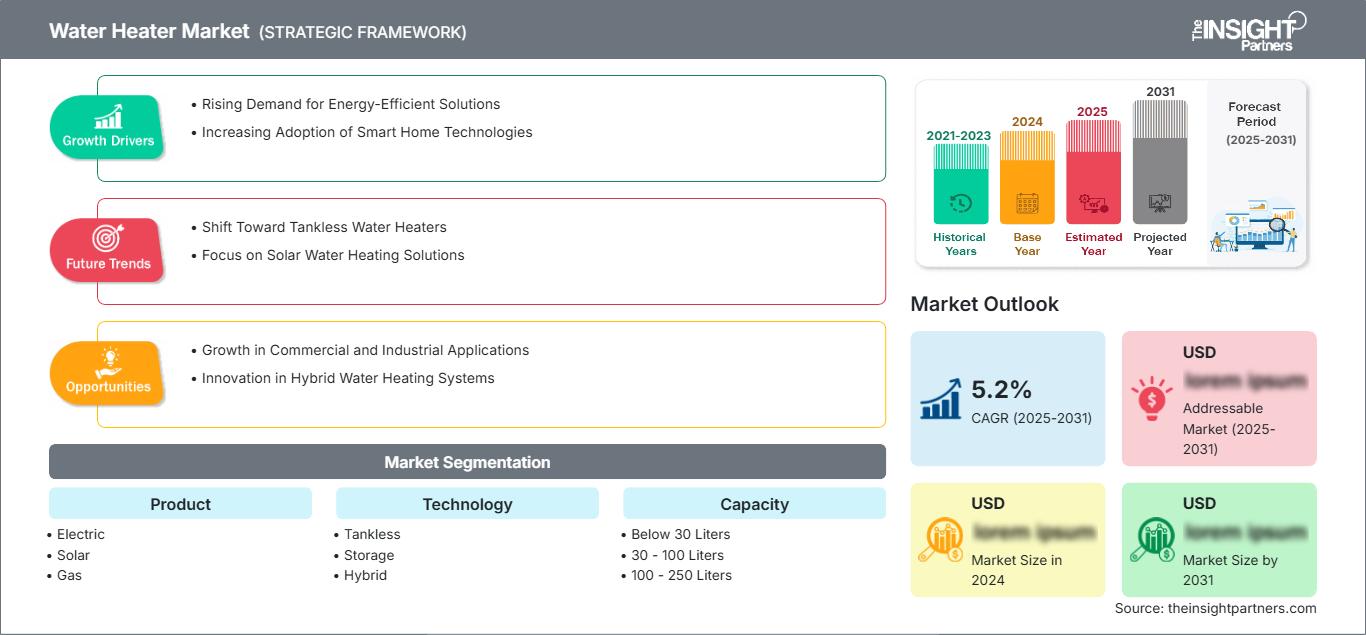
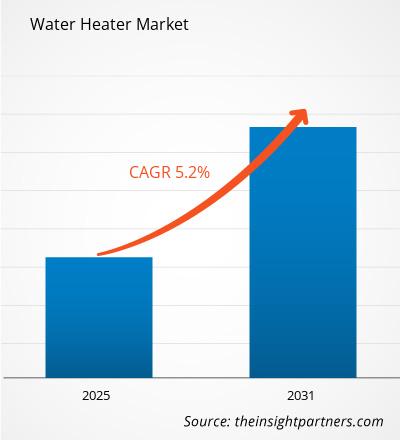
The water heater market is valued at US$ 32.31 Billion in 2025 and is projected to reach US$ 51.28 Billion by 2034, expanding at a CAGR of 5.27% from 2026 to 2034. Market development is supported by replacement demand, residential construction, commercial hot-water requirements, and increasing preference for energy-efficient heating technologies across developed and emerging economies.
In North America, the water heater market size is expected to expand at an estimated 4.5–5.8% CAGR between 2026 and 2034, supported by the replacement of aging equipment, efficiency regulations, and the rising adoption of heat-pump and high-efficiency electric systems. Commercial construction, remodeling activity, and greater consumer awareness of lifecycle energy costs are also supporting technology upgrades across the region.
Water Heater Market Assessment and Insights
- North America: The region is expected to account for 25–29% share in 2025, with demand supported by replacement cycles, commercial installations, efficiency standards, and electrification. It is projected to grow at a 4.5–5.8% CAGR between 2026–2034.
- US: The US is estimated to represent 19–22% of global demand in 2025, equivalent to 74–78% of North American demand, with growth projected at a 4.4–5.6% CAGR between 2026–2034.
- Europe: Europe is expected to hold 20–24% share in 2025 and expand at a 4.8–6.0% CAGR between 2026–2034, led by Germany, the UK, France, Italy, and Spain, where efficiency upgrades and electrification are strengthening replacement demand.
- Asia Pacific: Asia Pacific is estimated to command 37–41% share in 2025, with China, India, Japan, and South Korea forming major demand centers. The region is projected to register a 6.0–7.2% CAGR between 2026–2034, supported by urbanization and rising household incomes.
- Largest Segment: Electric products are estimated to hold a 44–48% market share in 2025, supported by broad residential penetration and infrastructure availability, with a 5.4–6.1% CAGR between 2026–2034.
- High Growth Segment: Hybrid technology is estimated to represent an 8–10% market share in 2025 and is projected to record an 8.5–10.2% CAGR between 2026–2034 as efficiency-focused buyers seek lower operating costs.
- Key companies analyzed in detail: Ariston Thermo S.p.A.; Bajaj Electricals Limited; Bosch Industriekessel GmbH; Bradford White Corporation; Bradley Corporation; BSH Hausgeräte GmbH; Eccotemp Systems, LLC; A. O. Smith Corporation; Rinnai America Corporation; Venus Home Appliances (P) Ltd.
Source: The Insight Partners' analysis based on proprietary research, government publications, company annual reports, investor presentations, industry databases, and expert interviews.
The water heater market has evolved from conventional fuel-based storage equipment toward diversified electric, solar, gas, tankless, hybrid, and connected configurations. Manufacturers will increasingly distinguish themselves by way of thermal transfer efficiency, insulating ability, compact design, digitized controls, corrosion protection, and ease of installation. Manufacturing methods will also be changing towards localized manufacturing and modular systems, which will allow the manufacturer to provide for the demands of different capacities and applications while controlling component cost and supply chain risks.
Over the forecast period, investments will be shifting towards electrification, intelligent control, high-efficiency energy storage, and hybrid designs. Emerging markets will be responsible for generating large unit sales from urban homes that have dependable access to energy and modern sanitation services. Regulatory requirements concerning efficiency, emissions, standby losses, and product safety will influence product specifications, while financing and incentive mechanisms can accelerate adoption of premium technologies where upfront costs remain a barrier, according to the Water Heater Market report.
Water Heater Market Report Scope
| Report Attribute | Details |
|---|---|
| Market size in 2025 | US$ 32.31 Billion |
| Market Size by 2034 | US$ 51.28 Billion |
| Global CAGR (2026 - 2034) | 5.27% |
| Historical Data | 2021-2024 |
| Forecast period | 2026-2034 |
Water Heater Market Analysis
The water heater market growth is closely linked to residential replacement demand, new housing construction, hospitality development, healthcare facilities, and commercial buildings requiring dependable hot-water availability. The ecosystem encompasses heating element and burner suppliers, tank manufacturers, controls suppliers, insulation suppliers, distribution, installation, utilities, and post-sale servicing organizations. Electricity-based solutions get an advantage out of the relatively simple process of installation and increased electricity accessibility, while gas-powered equipment stays relevant in places where there is well-developed fuel infrastructure.
Increasingly, supply chain is influenced by steel, copper, electronics, insulation materials, and specialized valves. Suppliers adjust to this situation through standardization of platform, flexible sourcing, and local production. In some developing countries, distribution is still fragmented, thus the relationship with installers and replacement availability matter for competitive advantage. In addition, commercial customers put more weight on the total costs of operation, maintenance, backup, and system compatibility.
The water heater market analysis indicates a competitive environment combining multinational manufacturers, regional appliance companies, and specialized technology providers. A. O. Smith Corporation holds a strong presence in both residential and commercial water heaters, whereas Rinnai America Corporation focuses on tankless water heaters and commercial water heating. Ariston Thermo S.p.A., Bajaj Electricals Limited, and Venus Home Appliances (P) Ltd. hold substantial regional coverage, especially in the residential sector.
Bosch Industriekessel GmbH, BSH Hausgeräte GmbH, Bradford White Corporation, Bradley Corporation, and Eccotemp Systems, LLC play their roles through their differentiating product range, distribution alliances, commercial applications, and special installation needs. The competitive positioning is becoming increasingly dependent on efficiency, product dependability, installer assistance, technology integration, and lifecycle economics rather than just purchase cost. Strategic investment is therefore moving toward higher-efficiency platforms, localized production, service networks, and technology combinations that reduce energy consumption without compromising hot-water availability, as highlighted in the Water Heater Market forecast.
● REPORT CUSTOMIZATION
Tailor This Report To Align With Your Specific Business Requirements
This report can be customized to align precisely with your business objectives, scope, and target markets. Customization options include tailored segmentation, geography, competitive analysis, and strategic insights to support informed decision-making.
Customize This Report →WHAT YOU CAN ADJUST
- ● Segmentations
- ● Geography
- ● Competitive Analysis
- ● Language Preferences
Water Heater Market: Strategic Insights
Regional Insights
North America water heater market
North America is expected to account for 25–29% share of the Water Heater Market in 2025 and expand at a 4.5–5.8% CAGR through 2034. Replacement demand is a central structural driver because a substantial installed base requires periodic equipment renewal. Residential remodeling, multifamily construction, hospitality development, and commercial building upgrades provide additional demand across storage, tankless, and high-efficiency systems.
The US represents the largest regional market, while Canada contributes through residential replacement and commercial applications. Regulatory attention toward efficiency and emissions is encouraging manufacturers to improve thermal performance and develop electric and hybrid alternatives. Consumers are increasingly considering lifetime energy expenditure alongside purchase price, particularly where utility costs make inefficient equipment expensive to operate. Manufacturers are consequently emphasizing smart controls, improved insulation, heat-pump configurations, and compact systems that can fit replacement installations without extensive structural modifications.
U.S. water heater Market
The US is estimated to represent 74–78% of North American Water Heater Market demand in 2025 and is projected to grow at a 4.4–5.6% CAGR through 2034. Replacement installations remain fundamental because residential and commercial systems have defined service lives and require periodic upgrades. Application demand spans single-family homes, multifamily properties, hotels, healthcare facilities, restaurants, and institutional buildings.
A. O. Smith Corporation, Bradford White Corporation, Rinnai America Corporation, Bradley Corporation, and Eccotemp Systems, LLC maintain meaningful market participation through varied product and distribution strategies. Tankless systems are gaining relevance in applications requiring continuous hot-water delivery or space savings, while electric and hybrid technologies are increasingly considered where efficiency and electrification objectives influence procurement. Commercial buyers also emphasize service availability, installation time, redundancy, and compatibility with existing plumbing infrastructure.
Europe water heater Market
Europe is estimated to hold 20–24% share of the Water Heater Market in 2025 and is projected to grow at a 4.8–6.0% CAGR through 2034. Germany is a leading market, supported by replacement demand and energy-efficiency priorities. The UK, France, Italy, and Spain also contribute significantly through residential renovation and modernization. Electrification, efficiency standards, and integration with renewable energy are shaping purchasing decisions.
The UK continues to emphasize efficient household energy use, with replacement demand supported by aging heating infrastructure. Germany benefits from strong engineering capabilities and demand for efficient electric and hybrid equipment. France, Italy, and Spain provide diverse opportunities across apartments, detached homes, hospitality properties, and small commercial facilities. Regional manufacturers are increasingly differentiating products through compact designs, digital controls, improved insulation, and compatibility with broader home-energy systems.
APAC water heater Market
APAC is estimated to command 37–41% of the Water Heater Market share in 2025 and is projected to expand at a 6.0–7.2% CAGR through 2034. China is the leading market, followed by Japan, India, South Korea, and Australia. Urbanization, housing construction, improving sanitation infrastructure, and rising disposable income support long-term demand.
China combines substantial residential volume with strong manufacturing capabilities, while India is experiencing expanding penetration of modern water-heating equipment. Japan and South Korea emphasize compact, efficient, and technologically advanced systems, while Australia presents opportunities for solar and electric configurations. Industrial and commercial construction further broadens the addressable market. Policy emphasis on energy efficiency and renewable integration is expected to encourage investment in higher-performance systems.
Middle East & Africa water heater Market
The Middle East and Africa Water Heater Market is projected to grow at a 5.0–6.3% CAGR through 2034, with Saudi Arabia and the UAE representing important Middle Eastern demand centers and South Africa leading demand in the African market. Residential construction, hospitality projects, and infrastructure investment support equipment deployment.
Energy availability, climate conditions, and building design strongly influence product selection. Solar water heating has particular relevance in high-solar-resource markets, while electric and gas systems remain important where conventional infrastructure dominates. Commercial projects require dependable hot-water capacity for hotels, hospitals, and institutional facilities. Across the rest of MEA, urbanization and improving access to modern household services should gradually broaden adoption, although affordability and distribution infrastructure remain important procurement considerations.
Segmentation Analysis
Product
The Product segment is projected to grow at a 4.8–6.2% CAGR from 2026–2034. Electric products maintain the broadest application base, while solar and gas configurations serve specific energy, climate, infrastructure, and operating-cost requirements. Product selection increasingly reflects installation conditions, energy prices, efficiency requirements, and consumer preferences, reflecting key Water Heater Market trends.
- Electric: Electric systems maintain broad residential relevance because installation is comparatively straightforward and electricity networks are widely available. Demand is also supported by electrification initiatives and improving controls.
- Solar: Solar systems are strategically important in regions with strong solar resources and suitable building conditions. They can reduce conventional energy consumption, particularly for residential and institutional hot-water applications.
- Gas: Gas products remain relevant where natural gas infrastructure is established and rapid heating or high-volume hot-water delivery is required. Commercial users continue to value their established operating characteristics.
Technology
The Technology segment is projected to register a 5.8–7.1% CAGR from 2026–2034. Tankless systems benefit from space efficiency and continuous heating, storage systems remain the mainstream configuration, and hybrid platforms gain traction as buyers prioritize efficiency and operating-cost reduction.
- Tankless: Tankless systems provide hot water on demand and reduce storage requirements. They are particularly suitable for compact residences, commercial facilities, and applications with variable consumption patterns.
- Storage: Storage technology remains strategically important because it offers predictable hot-water availability and compatibility with diverse energy sources. Replacement demand supports continued use across residential and commercial buildings.
- Hybrid: Hybrid systems combine complementary heating approaches to improve efficiency and operational flexibility. Their relevance is increasing where energy savings, electrification, and reduced lifecycle costs influence procurement decisions.
Capacity
The Capacity segment is projected to expand at a 4.9–5.8% CAGR from 2026–2034. Capacity selection depends on household size, usage intensity, installation constraints, peak demand, and application type. Commercial and industrial users generally require higher throughput and greater redundancy.
- Below 3 Liters: Very small systems serve point-of-use applications where limited hot-water demand and restricted installation space are key considerations, particularly in compact residential or specialized commercial settings.
- 3 - 1 Liters: This capacity range addresses localized hot-water requirements and smaller installations where moderate output is sufficient. Compact dimensions can support replacement projects with constrained installation footprints.
- 1 - 25 Liters: Mid-range capacity supports broader residential requirements and selected commercial uses. Demand is influenced by household occupancy, consumption patterns, and the availability of electrical infrastructure.
- 25 - 4 Liters: Larger systems serve higher-demand residential, commercial, and institutional applications where dependable stored hot water is required. Procurement emphasizes recovery performance, durability, and operating economics.
- Above 4 Liters: Very large-capacity systems primarily address commercial and industrial requirements involving sustained hot-water consumption. Reliability, redundancy, serviceability, and system integration become central selection criteria.
Application
The Application segment is forecast to grow at a 5.1–6.4% CAGR from 2026–2034. Residential demand provides broad unit volume, while commercial and industrial installations generate higher-value opportunities through larger capacities, continuous usage, and specialized operating requirements.
- Residential: Residential applications represent the broadest installed base, driven by new housing, replacement cycles, household comfort requirements, and growing preference for efficient and space-conscious heating solutions.
- Commercial: Commercial applications include hotels, restaurants, offices, hospitals, and educational facilities. Demand centers on dependable supply, high recovery performance, service continuity, and predictable operating expenditure.
- Industrial: Industrial installations require robust systems capable of supporting process-adjacent hot water, employee facilities, and specialized operations. Buyers prioritize durability, capacity, controls, and integration with broader utility systems.
Opportunity Snapshot
| Application | Revenue Contribution | Trend Tag | Adoption Stage |
| Residential | High | Smart Heating | Mature |
| Commercial | Medium | High Recovery | Scaling |
| Industrial | Medium | Process Heating | Scaling |
Water Heater Market Growth Drivers and Impact Analysis
Replacement of Aging Water-Heating Infrastructure
Replacement demand is an important factor driving growth, as water heating equipment has a limited operational life, and its capacity slowly deteriorates due to corrosion, scale formation, and wear and tear. Property owners are replacing their equipment before it fails as the cost of maintenance and loss of efficiency become high. This leads to an increase in demand for products that have similar dimensions, are more efficient, easy to install, and offer good warranties. The effect is highly pronounced in mature markets having larger installed bases, as the cycles of replacements will keep on generating demand irrespective of new constructions. Commercial properties provide demand as well since downtimes cause operational problems for businesses.
Electrification and Efficiency-Oriented Procurement
Electrification influences purchasing decisions, as consumers become more concerned about energy efficiency, emissions exposure, and operational cost savings. This technology works well in areas that have efficient and robust electricity networks along with regulatory policies. The influence goes beyond sales, as demand for better controls, better wiring, and proper installation increases. Product development that aligns with the changing building-energy system can help companies get an edge in the market. However, the higher cost involved and the complexity of components pose obstacles to success.
Urbanization and Expansion of Modern Hot-Water Access
The urbanization process keeps on promoting demand in the sense that more homes, apartments, hotels, hospitals, and commercial buildings that need hot water systems will be constructed. It is even more evident in developing countries where higher incomes and improved housing standards encourage the adoption of appliances. In terms of new constructions, there are chances to shape the decision-making process in the choice of equipment, and in terms of renovations and modernization of buildings, there is additional retrofit demand created. More dense areas have a preference for compact, efficient, and controlled technology.
Water Heater Market Future Trends
Connected Water Heating and Predictive Energy Management
Connectable water heaters are likely to progress from remote-controlled operations to predictive operations by leveraging usage patterns, occupancy, tariff rates, and operational efficiency of the device. Temperature, operating cycles, notifications, and maintenance requirements can be monitored using digital platforms. The use of machine learning technology would allow for the optimization of the heating cycle without compromising hot water availability. As such, software capabilities, connectivity, security, and data management are emerging competitive differentiators along with thermal performance of the devices. Commercial applications benefit more from monitoring in a centralized manner since it is easier to recognize irregularities in consumption and equipment functioning before any problem occurs.
Hybridization of Heating Sources and Energy Systems
The significance of hybrid water heaters has grown in light of the need for flexibility from building owners in relation to energy types such as electricity, solar energy, heat pumps, and traditional heat sources. Hybrid water heaters have the capability of distributing heat according to the cost of energy, the presence of renewable energy sources, environmental conditions, and demand cycles. This kind of technology is especially significant in cases where peak demand is variable or there are constraints in the electricity supply grid. The development of hybrid water heaters is conducive to the incorporation of solar, battery storage, smart meters, and energy management in buildings.
Water Heater Market Opportunities
Localized Manufacturing and Regional Product Platforms
Manufacturers can expand regional production and develop product platforms tailored to local energy infrastructure, regulations, climate conditions, and installation practices. Localization helps reduce delivery times, limit logistics-related risks, and improve responsiveness to replacement demand. Regional engineering also allows adaptation of capacity, voltage, fuel compatibility, controls, and installation requirements without redesigning entire product lines. This strategy is particularly relevant in Asia Pacific, the Middle East, and parts of Latin America, where market requirements differ from those in mature economies. Investors may favor manufacturers with strong distributor networks and scalable assembly operations, as these capabilities support expansion while controlling costs. Partnerships with installers, utilities, and property developers can further strengthen market penetration and specification rates.
Commercial High-Efficiency System Replacement
Commercial buildings present attractive opportunities for suppliers that combine high efficiency with reliable hot-water performance and practical installation requirements. Hotels, hospitals, restaurants, schools, and multifamily properties operate equipment extensively, making energy consumption and downtime critical purchasing factors. Replacement projects often offer faster sales opportunities than new construction because the need for equipment upgrades is already established. Suppliers can differentiate through modular designs, staged heating systems, remote monitoring, redundancy features, and service agreements. Financing options that distribute costs over the equipment lifecycle may improve adoption where capital budgets are limited. Water Heater Market forecasts should therefore consider not only unit demand growth but also the increasing value of high-efficiency commercial systems, digital service offerings, and retrofit solutions that minimize installation disruption.
Frequently Asked Questions

- Comprehensive Market Sizing and Forecast Analysis
- Detailed Segmentation Analysis
- In-Depth Market Dynamics Assessment
- Regional and Country-Level Insights
- Competitive Landscape and Company Benchmarking
- Strategic Business Intelligence
Recent Reports
Testimonials

The Insight Partners provided valuable market intelligence that supported our global go-to-market strategy. Their team was professional, responsive, and attentive to our feedback, providing thoughtful analysis and helpful methodological clarifications throughout the project.
Junmo Kim Chief Financial Officer (CFO), Enertech Co., Ltd.
The Insight Partners' SCADA System Market report is comprehensive, with valuable insights on current trends and future forecasts. The team was highly professional, responsive, and supportive throughout. We are very satisfied and highly recommend their services.
RAN KEDEM Partner, Reali Technologies LTDs
I requested a report on a very specific software market and the team produced the report in a few days. The information was very relevant and well presented. I then requested some changes and additions to the report. The team was again very responsive and I got the final report in less than a week.
JEAN-HERVE JENN Chairman, Future Analytica
We worked with The Insight Partners for an important market study and forecast. They gave us clear insights into opportunities and risks, which helped shape our plans. Their research was easy to use and based on solid data. It helped us make smart, confident decisions. We highly recommend them.
PIYUSH NAGPAL Sr. Vice President, High Beam Global
The Insight Partners delivered insightful, well-structured market research with strong domain expertise. Their team was professional and responsive throughout. The user-friendly website made accessing industry reports seamless. We highly recommend them for reliable, high-quality research services
YUKIHIKO ADACHI CEO, Deep Blue, LLC.
This is the first time I have purchased a market report from The Insight Partners.While I was unsure at first, I visited their web site and felt more comfortable to take the risk and purchase a market report.I am completely satisfied with the quality of the report and customer service. I had several questions and comments with the initial report, but after a couple of dialogs over email with their analyst I believe I have a report that I can use as input to our strategic planning process.Thank you so much for taking the extra time and making this a positive experience.I will definitely recommend your service to others and you will be my first call when we need further market data.
JOHN SUZUKI President and Chief Executive Officer, Board Director, BK Technologies
I wish to appreciate your support and the professionalism you displayed in the course of attending to my request for information regarding to infectious disease IVD market in Nigeria. I appreciate your patience, your guidance, and the fact that you were willing to offer a discount, which eventually made it possible for us to close a deal. I look forward to engaging The Insight Partners in the future, all thanks to the impression you have created in me as a result of this first encounter.
DR CHIJIOKE ONYIA MANAGING DIRECTOR, PineCrest Healthcare Ltd.Reason to Buy
- Informed Decision-Making
- Understanding Market Dynamics
- Competitive Analysis
- Identifying Emerging Markets
- Customer Insights
- Market Forecasts
- Risk Mitigation
- Boosting Operational Efficiency
- Strategic Planning
- Investment Justification
- Tracking Industry Innovations
- Aligning with Regulatory Trends





 Get Free Sample for