
White Box Server Market Share, Demand & Growth by 2034
Coverage: By Form Factor (Tower Server, Blade Server, Rack Server, Density-Optimized Server); Business Type (Data Centers, Enterprise Customers); Processor Type (X86 Server, Non-X86 Server); Operating System (Linux, Windows, Others) , and Geography (North America, Europe, Asia Pacific, and South and Central America)
- Status : Data Released
- Report Code : TIPRE00006380
- Category : Electronics and Semiconductor
- No. of Pages : 150
- Available Report Formats :


- Last update date : September 28, 2026


2025 Market Size
US$ 7.35 Bn
Base year value
2034 Forecast
US$ 20.25 Bn
Projected by 2034
CAGR 2026-2034
11.92 %
Growth rate
Addressable Market
US$ 121.14 Bn
(2026-2034)
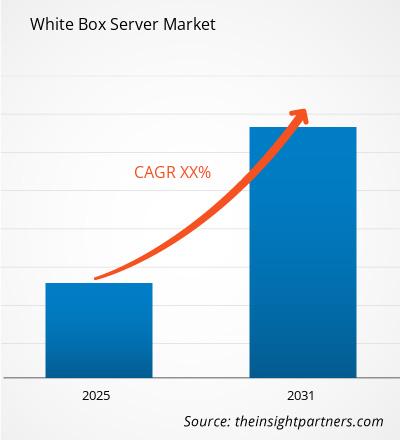
The global White Box Server market was valued at US$ 7.35 billion in 2025 and is expected to reach US$ 20.25 billion by 2034; it is estimated to record a CAGR of 11.92% during 2026-2034.
White Box Server Market Assessment and Insights
- North America: The region is estimated to represent a 35–38% share in 2025 and is projected to expand at a 12–15% CAGR between 2026–2034, supported by hyperscale capacity additions, AI workloads, and localized manufacturing.
- US: The US represents approximately 72–76% of North America's 2025 demand and is expected to grow at a 13–15% CAGR between 2026–2034, led by hyperscale and cloud infrastructure investment.
- Europe: Europe accounts for an estimated 22–25% share in 2025 and is anticipated to grow at a 10–13% CAGR between 2026–2034, with Germany, the UK, France, Italy, and Spain supporting adoption through cloud modernization and energy-efficiency priorities.
- Asia Pacific: Asia Pacific holds approximately 28–31% share in 2025 and is expected to register a 14–17% CAGR between 2026–2034, driven by China, Japan, South Korea, India, and Australia and expanding regional digital infrastructure.
- Largest Segment: Data Centers account for an estimated 65–70% market share in 2025 and are projected to grow at a 14–16% CAGR during 2026–2034, reflecting hyperscale procurement and customized rack deployments.
- High Growth Segment: Density-Optimized Server represents approximately 16–19% market share in 2025 and is expected to grow at a 15–18% CAGR during 2026–2034 as compute density and space efficiency become procurement priorities.
- Key companies analyzed in detail: Compal Electronics, Inc.; Hon Hai Precision Industry Co., Ltd.; Hyve Solutions Corporation; Inventec Corporation; Jabil Inc.; MiTAC Holdings Corporation; Penguin Solutions, Inc.; Quanta Computer Inc.; Equus Computer Systems, Inc.; Wistron Corporation; Super Micro Computer, Inc.; Celestica Inc.
Source: The Insight Partners' analysis based on proprietary research, government publications, company annual reports, investor presentations, industry databases, and expert interviews.
From relatively commoditized standard server systems, the market has transitioned into modular systems built based on workload, power, cooling, networking, and acceleration requirements. OCP specifications, disaggregated architecture, customized motherboards, and rack-scale engineering are boosting OEMs’ participation in the market. Growing AI use cases are increasingly influencing the focus of design to be high density, interconnect capability, liquid cooling capability, and quick qualifying of the next processor/accelerator generation.
In terms of procurement trends, we expect procurement to diversify geographically in the coming years. The White Box Server Market forecast suggests that North American manufacturing investments, Asian production depth, European energy constraints, and emerging data-center clusters across the Middle East and India will shape sourcing decisions. Open standards and modular designs should also support broader interoperability, while regulatory attention to energy efficiency and data sovereignty increasingly influences infrastructure specifications.
White Box Server Market Report Scope
| Report Attribute | Details |
|---|---|
| Market size in 2025 | US$ 7.35 Billion |
| Market Size by 2034 | US$ 20.25 Billion |
| Global CAGR (2026 - 2034) | 11.92% |
| Historical Data | 2021-2024 |
| Forecast period | 2026-2034 |
White Box Server Market Analysis
Demand is being shaped by hyperscale cloud expansion, AI training and inference, enterprise virtualization, and growing requirements for workload-specific compute. The ecosystem links processor and accelerator suppliers, memory and storage vendors, motherboard designers, ODMs, contract manufacturers, rack integrators, cooling providers, distributors, and cloud operators. White box server market growth is therefore increasingly connected to the speed of platform qualification and component availability.
The supply situation is becoming more challenging due to the battle between GPUs, memory, network and thermal technologies for the available production capacities. Vertically integrated and globally distributed ODMs are able to reduce validation periods and better coordinate their component sourcing activities. Value created by them goes beyond mere reduction of hardware costs since it provides configuration capabilities enabling users to tailor their solutions in terms of compute density, power budgets, storage architecture and replacement cycles.
Competitive advantage is now based more on engineering capabilities than on simple volume of assembly. Large-volume ODM projects involve such companies as Quanta Computer Inc., Wistron Corporation, Inventec Corporation, Compal Electronics, Inc. and Hon Hai Precision Industry Co., Ltd., while Hyve Solutions Corporation and Equus Computer Systems, Inc. focus on custom infrastructures. This white box server market analysis also shows increasing differentiation through AI-ready rack integration, cooling expertise, firmware customization, and customer-specific validation.
Investment priorities are moving toward AI infrastructure, regional production, liquid-cooling capabilities, and rack-level integration. Wistron Corporation reported strong 2025 expansion in AI and general-purpose server revenue, while Compal Electronics, Inc. increased North American investment. Jabil Inc., MiTAC Holdings Corporation, Penguin Solutions, Inc., Super Micro Computer, Inc., and Celestica Inc. further broaden competitive alternatives through manufacturing, integration, systems engineering, and specialized infrastructure capabilities. The white box server market report, therefore, reflects a competitive environment where supply-chain resilience and engineering responsiveness increasingly influence purchasing decisions.
● REPORT CUSTOMIZATION
Tailor This Report To Align With Your Specific Business Requirements
This report can be customized to align precisely with your business objectives, scope, and target markets. Customization options include tailored segmentation, geography, competitive analysis, and strategic insights to support informed decision-making.
Customize This Report →WHAT YOU CAN ADJUST
- ● Segmentations
- ● Geography
- ● Competitive Analysis
- ● Language Preferences
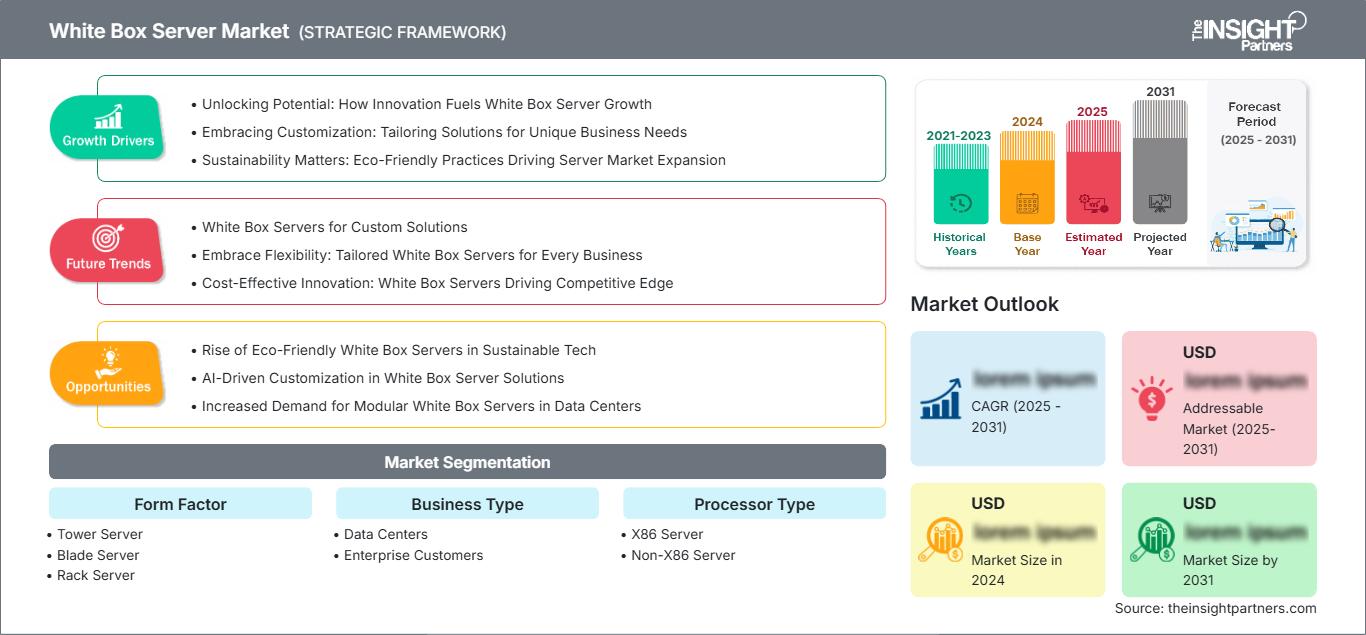
White Box Server Market: Strategic Insights
Regional Insights
North America white box server market
North America is estimated to hold a 35–38% of the white box server market share in 2025 and is projected to expand at a 12–15% CAGR through 2034. The region benefits from extensive hyperscale capacity, AI investment, cloud adoption, and large enterprise computing requirements. The United States is seeing more demands for customized platforms in order to maximize efficiency, energy usage, and timing of deployments. The sourcing process itself is also becoming more relevant due to tariffs, logistical considerations, and time to build out data centers.
Canada has its input in terms of cloud, telecommunication, governmental, and resources computing needs, while Mexico is increasingly becoming important with respect to electronics manufacturing. AI-related infrastructure needs are driving the demand for high density racks, accelerator ready platforms, and sophisticated thermal management solutions. Large volume buying is possible thanks to the number of cloud providers and technology suppliers available in the region. Open hardware efforts facilitate compatibility of hardware and software and allow splitting them when necessary.
U.S. white box server Market
The US represents approximately 72–76% of North America's 2025 white box server market demand and is projected to grow at a 13–15% CAGR through 2034. Large cloud service providers, AI developers, colocation operators, and enterprises are increasing demand for customized compute platforms. Procurement tends to lean towards designs that are compatible with accelerators, fast networking, increased memory, and enhanced cooling while still maintaining flexibility during deployment.
Domestic production is increasingly significant in this industry. Compal Electronics, Inc. has invested heavily in US-based server production, while Hon Hai Precision Industry Co., Ltd. is ramping up its AI server production capacity. The areas of application range from AI, cloud computing, virtualization, data analysis, telecommunications, and databases. Linux continues to be relevant in cloud native and high-performance environments, but Windows still has significance in enterprise application use cases.
Europe white box server Market
Europe is estimated at a 22–25% share of the white box server market in 2025 and is projected to grow at a 10–13% CAGR. Germany is expected to expand at 12–14%, supported by industrial digitalization, cloud modernization, and energy-conscious infrastructure procurement. The UK is projected at 11–13%, with financial services, cloud platforms, and AI workloads supporting customized infrastructure adoption.
France is expected to grow at 11–13%, while Italy and Spain are projected at 10–12% and 11–13%, respectively. Germany remains the leading European country because of its industrial base and data-center demand. European buyers increasingly evaluate equipment through energy consumption, lifecycle efficiency, interoperability, and regional compliance considerations. Consequently, modular architectures, efficient power delivery, and liquid-cooling readiness are becoming more influential in larger deployments.
APAC white box server Market
APAC is estimated to represent a 28–31% share of the white box server market in 2025 and is projected to grow at a 14–17% CAGR. China is expected to grow at 15–17%, Japan at 12–14%, South Korea at 14–16%, India at 16–18%, and Australia at 12–14%. China remains the leading production and demand center, supported by extensive electronics manufacturing and domestic computing investment.
India is gaining strategic importance as cloud capacity, digital services, and local data-center development expand. South Korea benefits from semiconductor and AI infrastructure capabilities, while Japan emphasizes enterprise modernization and advanced computing. Australia continues to develop cloud and sovereign infrastructure. Regional industrial policies, semiconductor ecosystems, and growing data-center capacity are reinforcing ODM advantages in manufacturing scale, component access, engineering, and platform customization.
Middle East & Africa white box server Market
The Middle East and Africa white box server market is expected to expand at a 11–14% CAGR through 2034, with Saudi Arabia projected at 12–14%, the UAE at 13–15%, South Africa at 10–12%, and the rest of MEA at 11–13%. The UAE is emerging as a leading regional hub through cloud expansion, AI initiatives, and large-scale digital infrastructure programs.
Saudi Arabia is strengthening data-center capacity alongside economic diversification, while South Africa remains an important gateway for regional cloud and enterprise services. Energy availability, infrastructure modernization, sovereign computing requirements, and telecommunications investment are creating demand for configurable servers. The regional opportunity is particularly relevant for modular platforms that can be deployed rapidly and adapted to changing compute, storage, and power requirements.
Segmentation Analysis
Form Factor
Form Factor is projected to expand at a 12–15% CAGR during 2026–2034. Rack-oriented configurations remain central to data-center deployment because they support standardized installation, scalable expansion, and efficient networking. Blade and density-focused architectures address space-constrained environments, while tower systems retain relevance for smaller enterprise installations requiring straightforward deployment and serviceability. Current White Box Server Market trends indicate growing preference for high-density, modular form factors that optimize power efficiency, cooling performance, and scalability for cloud, AI, and hyperscale data-center environments.
- Tower Server: Tower Server configurations remain relevant among smaller enterprises, branch environments, and organizations requiring standalone systems. Their accessible installation model supports applications where rack infrastructure is unnecessary or economically unjustified.
- Blade Server: Blade Server platforms provide consolidated computing and shared infrastructure characteristics. Demand is linked to environments prioritizing centralized management, high compute density, and efficient use of data-center floor space.
- Rack Server: Rack Server systems represent the core deployment architecture for scalable infrastructure. Standardized dimensions simplify integration with power, networking, cooling, and storage systems while enabling incremental capacity additions.
- Density-Optimized Server: Density-Optimized Server platforms address workloads requiring greater compute capacity within constrained physical footprints. Their strategic importance rises as accelerator-heavy deployments increase rack-level power and space requirements.
Business Type
Business Type is expected to register a 13–15% CAGR during 2026–2034. Data centers dominate procurement because hyperscalers and cloud operators value direct configuration control and volume economics. Enterprise customers are increasingly adopting customized platforms for specialized workloads, although service, warranty, and support considerations remain important procurement filters.
- Data Centers: Data Centers represent the principal demand center, supported by hyperscale expansion, AI computing, cloud services, and large infrastructure refresh programs requiring scalable customized hardware.
- Enterprise Customers: Enterprise Customers increasingly consider customized servers for virtualization, analytics, private cloud, and specialized applications. Adoption depends strongly on integration support, lifecycle management, service availability, and internal technical expertise.
Processor Type
Processor Type is forecast to expand at a 12–14% CAGR during 2026–2034. X86 architectures retain broad compatibility with existing software and operating environments, while non-X86 platforms are gaining attention where power efficiency, workload specialization, or architectural independence provides measurable advantages.
- X86 Server: X86 Server platforms remain central because of extensive software compatibility, mature developer ecosystems, broad processor availability, and established enterprise operating environments.
- Non-X86 Server: Non-X86 Server adoption is increasing where alternative architectures can improve efficiency, workload specialization, or platform-level economics, particularly in hyperscale and emerging AI infrastructure.
Operating System
Operating System is expected to grow at a 12–14% CAGR during 2026–2034. Linux maintains strong relevance in cloud-native, AI, high-performance, and hyperscale environments, while Windows remains important across enterprise workloads requiring established commercial software compatibility and administrative tooling.
- Linux: Linux remains strategically important for cloud-native applications, AI frameworks, high-performance computing, containers, and software-defined infrastructure, supporting flexible hardware configurations and extensive open-source ecosystems.
- Windows: Windows continues to support enterprise applications, database environments, business software, and organizations that prioritize established management frameworks, commercial application compatibility, and familiar administrative workflows.
Opportunity Snapshot
| Business Type | Revenue Contribution | Trend Tag | Adoption Stage |
| Data Centers | High | Hyperscale AI | Mature |
| Enterprise Customers | Medium | Private Cloud | Scaling |
White Box Server Market Growth Drivers and Impact Analysis
Hyperscale Expansion and AI Compute Intensification
The fast-growing trend of building hyperscale facilities creates a rising demand for servers that can be customized depending on compute, accelerator, memory, network, and thermal requirements. AI applications contribute to this trend since legacy configurations can fail to effectively support high-power accelerators and rapidly evolving interconnect standards. Its effect covers the entire ecosystem, motivating ODMs to build closer ties with semiconductor vendors, cloud providers, cooling experts, and rack vendors. Increased purchasing volumes create an opportunity for custom engineering and manufacturing solutions. In order to speed up platform introduction, suppliers with fast validation processes become strategically valuable. Hence, this trend changes competitive pressure from commodity hardware pricing to engineering agility, manufacturing scale, thermal knowledge, and lifecycle management.
Open Hardware Standards and Disaggregated Infrastructure Adoption
With open infrastructure standards, there is less reliance on proprietary designs of hardware and an increasing modularization of servers. According to the Open Compute Project, the investments in OCP-certified infrastructure were forecasted to increase greatly between 2025 and 2029. This indicates the increasing adoption of open practices in terms of servers, storage systems, networking devices, and data centers' hardware. The impact on the market is considerable due to the fact that open specifications create more opportunities for large corporations to choose the components and manufacturers. With disaggregated architectures, it becomes easier to upgrade the devices since computing, storage, network, and management are separated from each other.
Supply-Chain Localization and Regional Manufacturing
Geopolitical uncertainties, tariff policies, semiconductor restrictions, and logistics constraints are prompting server makers to diversify their production base. Regionally located manufacturing bases have the potential to decrease transportation risks, enhance delivery speed, and meet customer demands for locally produced goods or resilient data center operations. In that vein, Compal Electronics, Inc. has extended its manufacturing presence within North America, but other manufacturers from Asia are continuing to diversify their geographically located manufacturing footprint. This phenomenon is not limited to the final stage of manufacturing because companies are increasingly localizing engineering services, testing, repairs, and component sourcing. The buyer can thus mitigate lead-time uncertainty risks, and the manufacturer gains access to key market segments.
White Box Server Market Future Trends
Rack-Scale Customization and Liquid-Cooling Integration
The future of platforms seems to involve moving from server-level personalization to overall rack-level optimization. Rather than choosing individual servers in a disconnected way, hyperscale and AI infrastructure customers now demand integrated designs that include compute, accelerators, network, power delivery, cooling, and servicing aspects. Liquid cooling solutions will become increasingly popular due to high power densities in racks and the decreasing efficiency of air cooling in some applications using many accelerators. In this case, success will be on the side of vendors who can combine their expertise in mechanical, electrical, firmware, and thermal engineering in a single design cycle. Using standardized rack interfaces will help maintain interoperability while providing customer-specific options.
Software-Defined Management and Platform-Level Observability
The procurement of servers is likely to see a trend towards increased integration of software-defined management, telemetry, diagnostics, and lifecycle management. Hardware platforms are going to become more equipped with open interfaces enabling the operator to measure the health of components, power consumption, temperature, firmware state, and performance. This level of visibility can increase efficiency, help prevent unexpected outages, and increase the efficiency of assets within large fleets. This level of visibility can also help with predicting problems before an outage occurs. Open management standards could potentially decrease reliance on proprietary management applications and make management in heterogeneous environments more efficient. The message to the ODM industry is that firmware development, management controller functionality, security, and API interoperability are going to become key areas of differentiation.
White Box Server Market Opportunities
Localized Manufacturing and Regional Service Ecosystems
Opportunities can be gained by having regional capabilities of assembling, testing, repairing, and providing technical support in areas close to clusters of data centers that are experiencing high growth. The North American region presents itself as an opportunity owing to the fact that investments in hyperscale, building of AI infrastructure, and the desire for resilience are driving customers to diversify their sources of procurement. There is a similar opportunity in countries such as India, Southeast Asia, the Middle East, and certain parts of Europe, where investments in digital infrastructure are increasing. The following factors can be used to determine the best locations: availability of semiconductors, power, labor, trade policies, incentives, transport, and proximity to key customers.
Specialized Platforms for Sovereign and Edge Computing
Cloud and edge solutions enable the development of special server builds that differ from the traditional hyperscale solutions. It is possible that governments and regulated industries will give preference to local management, security, data location, and stable infrastructure supply. Edge sites might have some limitations associated with space, power, cooling, remote management, and accessibility. This requirement can be satisfied by vendors by means of compact designs, robust build, modular storage, low-power chips, and management capabilities. There are some new areas where special server builds might be used, including telecom, industrial automation, healthcare, transportation, and energy networks. It is important to provide a good combination of customization and standardized elements to make specialized platforms cost-effective.
Frequently Asked Questions

- Comprehensive Market Sizing and Forecast Analysis
- Detailed Segmentation Analysis
- In-Depth Market Dynamics Assessment
- Regional and Country-Level Insights
- Competitive Landscape and Company Benchmarking
- Strategic Business Intelligence
Recent Reports
Testimonials

The Insight Partners provided valuable market intelligence that supported our global go-to-market strategy. Their team was professional, responsive, and attentive to our feedback, providing thoughtful analysis and helpful methodological clarifications throughout the project.
Junmo Kim Chief Financial Officer (CFO), Enertech Co., Ltd.
The Insight Partners' SCADA System Market report is comprehensive, with valuable insights on current trends and future forecasts. The team was highly professional, responsive, and supportive throughout. We are very satisfied and highly recommend their services.
RAN KEDEM Partner, Reali Technologies LTDs
I requested a report on a very specific software market and the team produced the report in a few days. The information was very relevant and well presented. I then requested some changes and additions to the report. The team was again very responsive and I got the final report in less than a week.
JEAN-HERVE JENN Chairman, Future Analytica
We worked with The Insight Partners for an important market study and forecast. They gave us clear insights into opportunities and risks, which helped shape our plans. Their research was easy to use and based on solid data. It helped us make smart, confident decisions. We highly recommend them.
PIYUSH NAGPAL Sr. Vice President, High Beam Global
The Insight Partners delivered insightful, well-structured market research with strong domain expertise. Their team was professional and responsive throughout. The user-friendly website made accessing industry reports seamless. We highly recommend them for reliable, high-quality research services
YUKIHIKO ADACHI CEO, Deep Blue, LLC.
This is the first time I have purchased a market report from The Insight Partners.While I was unsure at first, I visited their web site and felt more comfortable to take the risk and purchase a market report.I am completely satisfied with the quality of the report and customer service. I had several questions and comments with the initial report, but after a couple of dialogs over email with their analyst I believe I have a report that I can use as input to our strategic planning process.Thank you so much for taking the extra time and making this a positive experience.I will definitely recommend your service to others and you will be my first call when we need further market data.
JOHN SUZUKI President and Chief Executive Officer, Board Director, BK Technologies
I wish to appreciate your support and the professionalism you displayed in the course of attending to my request for information regarding to infectious disease IVD market in Nigeria. I appreciate your patience, your guidance, and the fact that you were willing to offer a discount, which eventually made it possible for us to close a deal. I look forward to engaging The Insight Partners in the future, all thanks to the impression you have created in me as a result of this first encounter.
DR CHIJIOKE ONYIA MANAGING DIRECTOR, PineCrest Healthcare Ltd.Reason to Buy
- Informed Decision-Making
- Understanding Market Dynamics
- Competitive Analysis
- Identifying Emerging Markets
- Customer Insights
- Market Forecasts
- Risk Mitigation
- Boosting Operational Efficiency
- Strategic Planning
- Investment Justification
- Tracking Industry Innovations
- Aligning with Regulatory Trends





 Get Free Sample for