
Wireless Speaker Market Size, Growth & Trends by 2034
Coverage: by Connectivity (Bluetooth, Wi-Fi); Distribution Channel (Online, Offline); End-user (Residential, Commercial) , and Geography (North America, Europe, Asia Pacific, and South and Central America)
- Status : Data Released
- Report Code : TIPRE00011513
- Category : Electronics and Semiconductor
- No. of Pages : 150
- Available Report Formats :


- Last update date : September 30, 2026


2025 Market Size
US$ 35.86 Bn
Base year value
2034 Forecast
US$ 66.77 Bn
Projected by 2034
CAGR 2026-2034
7.15 %
Growth rate
Addressable Market
US$ 463.12 Bn
(2026-2034)
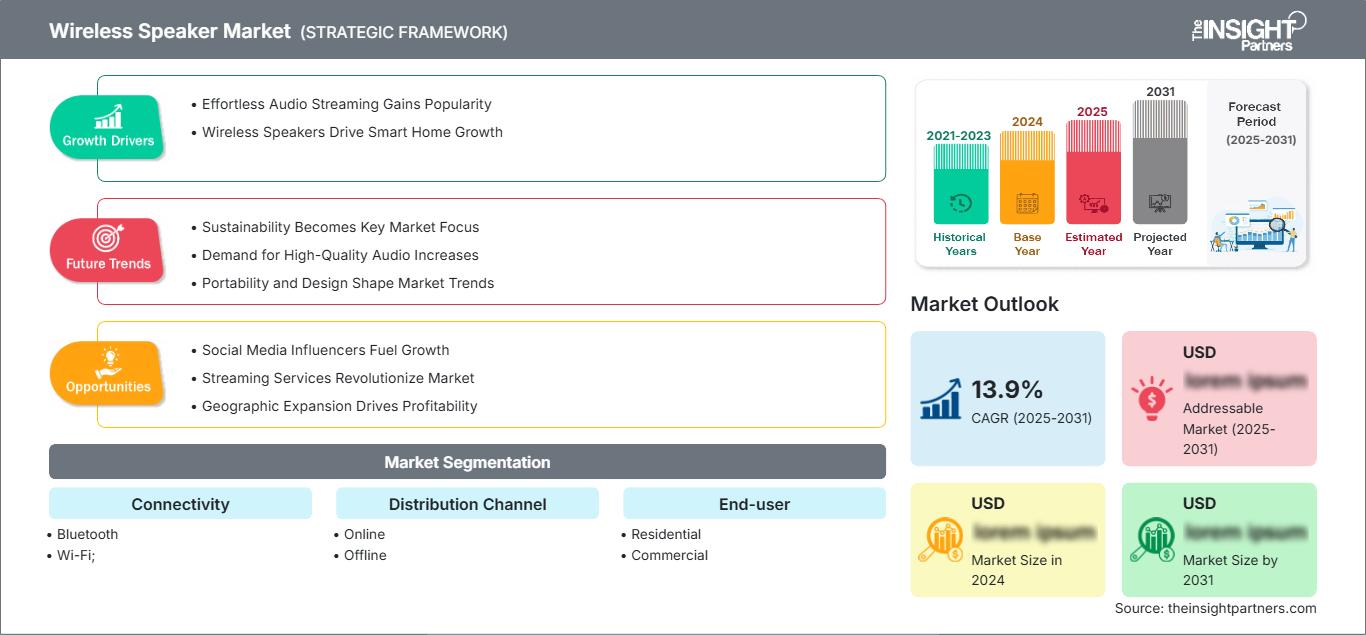
The Wireless speaker market reached US$ 35.86 Billion in 2025 and is projected to reach US$ 66.77 Billion by 2034, registering a CAGR of 7.15% during 2026–2034. The market reflects continued migration from wired audio toward portable, connected, and multiroom listening products. Demand spans residential entertainment, hospitality, retail, education, and other commercial environments, with connectivity, acoustic performance, portability, and ecosystem compatibility shaping purchasing decisions.
North America remains a structurally attractive arena, with the wireless speaker market size supported by high household connectivity, established streaming habits, replacement demand, and premium audio adoption. A modeled 6.8–7.6% CAGR during 2026–2034 is supported by smart-home integration, multiroom audio, product refresh cycles, and continued uptake of portable speakers for outdoor and leisure use.
Wireless Speaker Market Assessment and Insights
- North America: North America accounted for a modeled 27–31% wireless speaker market share in 2025 and is expected to expand at a 6.8–7.6% CAGR between 2026–2034, supported by premium audio demand, connected homes, and replacement purchases.
- US: The US represented approximately 78–83% of North American demand in 2025 and is projected to grow at a 6.7–7.5% CAGR during 2026–2034, led by connected-home adoption.
- Europe: Europe held a modeled 22–26% share in 2025 and is projected to grow at a 6.3–7.1% CAGR during 2026–2034, with Germany, the UK, France, Italy, and Spain providing significant demand.
- Asia Pacific: Asia Pacific represented about 31–35% of the market in 2025 and is forecast to grow at a 7.8–8.7% CAGR during 2026–2034, led by China, Japan, South Korea, and India.
- Largest Segment: Bluetooth connectivity held an estimated 67–72% market share in 2025 and is expected to record a 6.9–7.7% CAGR during 2026–2034 because of device compatibility and portability.
- High Growth Segment: Wi-Fi connectivity held approximately 28–33% market share in 2025 and is projected to register an 8.2–9.1% CAGR during 2026–2034, supported by multiroom and smart-home applications.
- Key companies analyzed in detail: Apple Inc. (Beats), Bose Corporation, HARMAN International Industries, Incorporated, Koninklijke Philips N.V., LG Electronics Inc., Panasonic Holdings Corporation, Skullcandy, Inc., Sonos, Inc., Sony Corporation, and Zebronics India Private Limited.
Source: The Insight Partners' analysis based on proprietary research, government publications, company annual reports, investor presentations, industry databases, and expert interviews.
From the early days of simple Bluetooth players, the wireless speaker market has expanded to cover all sorts of audio-connected products, including portable, home, smart, stereo and multiroom speakers. Bluetooth SIG stated that 262 million Bluetooth speakers would ship in 2024, while more general Bluetooth device shipments are forecasted to reach 5.3 billion devices in 2025. The growing installed base improves compatibility and reduces consumer friction.
In the future, the wireless speaker market will see further improvements through better integration with smart home systems, high-fidelity wireless codecs, voice-controlled interfaces, and greater flexibility in room-to-room solutions. Developing markets will provide additional unit volume, driven by smartphone penetration, broadband Internet access, music streaming subscription services and organized retail. Energy efficiency and electronic waste legislation could impact components choices, repairability, batteries, packing and life-cycle practices among others.
Wireless Speaker Market Report Scope
| Report Attribute | Details |
|---|---|
| Market size in 2025 | US$ 35.86 Billion |
| Market Size by 2034 | US$ 66.77 Billion |
| Global CAGR (2026 - 2034) | 7.15% |
| Historical Data | 2021-2024 |
| Forecast period | 2026-2034 |
Wireless Speaker Market Analysis
This industry's growth is due to the consumers' inclination towards portability, ease of installation, and integration with mobile phones, televisions, computers, and home networking systems. The technology that is critical is Bluetooth since it provides easy interoperability without network setup while Wi-Fi provides higher bandwidths for audio streams, multiroom synchronization, and connected home features. The supply chain involves suppliers of acoustic components, semiconductor firms, enclosure firms, software providers, OEMs, distribution firms, and the retailers as well as streaming services.
The dynamics within the supply sector are now increasingly based on compact acoustic engineering, DSP technology, battery optimization, and connectivity rather than speaker itself. Branding is achieved via tuning, spatial audio, microphones, app environment, and strong industrial design. The factors of component supply and price are important since amplifiers, processors, wireless chips, batteries, and speakers drive the bill of materials cost structure. The wireless speaker industry thus increasingly favors firms that can integrate hardware, software, connectivity, and after-sale support in a product design.
The competitive intensity will be determined by a combination of premium audio brands, consumer electronics conglomerates, and lifestyle brands. Apple Inc. (Beats), Bose Corporation, Sony Corporation, and Sonos, Inc. engage in competition by means of their brand equity, acoustic innovation, ecosystem integration, and premium branding. HARMAN International Industries, Incorporated and LG Electronics Inc. are characterized by extensive consumer electronics portfolio, whereas Koninklijke Philips N.V. and Panasonic Holdings Corporation target multiple price levels and applications. Skullcandy, Inc. and Zebronics India Private Limited provide differentiated positioning for portable and value segments.
Strategic investment priorities now shift towards software-driven audio, intelligent sound processing, industrial design and connectivity interoperability. Sonos, Inc. focused on systems development through launching new speakers that make connected home audio setup easy to launch and scale, and Bose Corporation launched products combining Bluetooth technology with Google Cast and Apple AirPlay. These examples signal the change in strategy from selling individual devices to maintaining customer relationships via expanding audio ecosystems.
● REPORT CUSTOMIZATION
Tailor This Report To Align With Your Specific Business Requirements
This report can be customized to align precisely with your business objectives, scope, and target markets. Customization options include tailored segmentation, geography, competitive analysis, and strategic insights to support informed decision-making.
Customize This Report →WHAT YOU CAN ADJUST
- ● Segmentations
- ● Geography
- ● Competitive Analysis
- ● Language Preferences
Wireless Speaker Market: Strategic Insights
Regional Insights
North America wireless speaker market
North America represented an estimated 27–31% share of the wireless speaker market in 2025 and is expected to grow at a 6.8–7.6% CAGR through 2034. High broadband penetration, high use of smartphones, developed habits of music streaming, and high replacement needs indicate potential for continuous category growth. Consumers prefer devices that offer both portability and premium sound and connectivity capabilities.
This market segment is supported by the development of smart homes ecosystems and the acceptance of connected consumer electronics. Usage of the business applications in sectors like hospitality, retail, fitness, education, and the business sector leads to the growth in demand beyond the household use. This market segment creates value for the premium brands in the spatial sound, multiroom synchronizations, voice control capability, and long battery life. The US is the primary regional market, whereas Canada is the secondary regional market.
U.S. wireless speaker market
The US accounted for approximately 78–83% of North American wireless speaker market demand in 2025 and is projected to grow at a 6.7–7.5% CAGR through 2034. Deep penetration of mobile phones, video streaming, smart home solutions, and smart TVs makes interaction with wireless headphones possible. The replacement process is driven by devices with enhanced battery life, more advanced microphones, and spatial audio technology.
The application scope ranges from outdoor listening to home theater, kitchen audio, games, and even whole house audio experiences. Companies like Bose Corporation, Sonos, Inc., Apple Inc. (Beats), as well as other existing players stay relevant in both premium and lifestyle segments, whereas mass market vendors increase availability of their products.
Europe wireless speaker market
Europe held an estimated 22–26% share in 2025 and is forecast to grow at a 6.3–7.1% CAGR through 2034. Germany, the UK, France, Italy, and Spain represent some of the significant national markets, where the demand is affected by factors such as streaming, connected home devices, design, and environmental awareness. Germany continues to be a prominent market due to its well-established consumer electronics industry and audio segment.
The UK represents a market where streaming is highly prevalent and demand for smart and multiroom audio solutions already exists. In France, consumers tend to prefer design-driven solutions and connected home entertainment. In Italy and Spain, there are opportunities that are related to portable audio consumption and the hospitality sector. The European consumer also becomes more interested in sustainability of products.
APAC wireless speaker market
APAC accounted for approximately 31–35% of the wireless speaker market in 2025 and is expected to register a 7.8–8.7% CAGR through 2034. Demand from China is leading in the region, backed by its electronics production, online shopping, urbanization, and consumers’ usage of connected gadgets.
Japan and South Korea will continue with their efforts for high-end audio innovations, while India can make up for volumes due to its smartphones usage, growth in online business, and increased disposable incomes. Australia will contribute because of its demand for portable and home entertainment equipment. Competitiveness of prices, energy savings, smaller size, and smarter connections are becoming common traits for regional manufacturers.
Middle East & Africa wireless speaker market
The Middle East and Africa region is expected to expand at a 6.5–7.4% CAGR through 2034, with Saudi Arabia leading demand across Gulf markets. UAE purchasing power, hospitality investment, and premium retail support higher-value audio products, while South Africa remains an important Southern African market.
Energy diversification, tourism infrastructure, commercial construction, and smart-building initiatives create opportunities for installed and portable audio. Saudi Arabia and UAE benefit from large entertainment and hospitality projects, whereas South Africa and the Rest of MEA offer opportunities through expanding retail access. Distribution capabilities, affordability, battery performance, and after-sales service remain important determinants of regional penetration.
Segmentation Analysis
Connectivity
Connectivity is divided into Bluetooth and Wi-Fi. The segment is expected to expand at a 7.3–8.0% CAGR during 2026–2034 as consumers increasingly demand easy device pairing alongside networked audio functionality. Bluetooth provides broad compatibility, while Wi-Fi enables higher-value connected applications.
- Bluetooth: Bluetooth remains the dominant connectivity architecture because it works across smartphones, tablets, computers, and numerous consumer-electronics platforms. Its low setup complexity and portability support broad household and outdoor usage.
- Wi-Fi: Wi-Fi is strategically important for multiroom audio, higher-bandwidth streaming, smart-home integration, and network-based control. Adoption is strongest where consumers prioritize synchronized playback and persistent home connectivity.
Distribution Channel
Distribution Channel comprises Online and Offline channels and is projected to grow at a 7.0–7.8% CAGR during 2026–2034. Channel development increasingly reflects consumer preference for product comparison, rapid fulfillment, experiential retail, and omnichannel purchasing.
- Online: Online channels benefit from extensive assortment, price transparency, reviews, promotional events, and direct-to-consumer fulfillment. They are particularly important for portable speakers and digitally marketed lifestyle products.
- Offline: Offline stores remain strategically relevant where consumers want to evaluate sound quality, build quality, size, and design before purchase. Demonstration-led retail supports premium positioning and assisted decision-making.
End-user
End-user includes Residential and Commercial, with the segment forecast to grow at a 6.8–7.6% CAGR during 2026–2034. Residential use remains the core demand base, while commercial applications broaden the addressable opportunity.
- Residential: Residential demand covers portable listening, television audio, home entertainment, multiroom music, gaming, and smart-home applications. Replacement purchases increasingly favor better sound, longer battery life, and ecosystem compatibility.
- Commercial: Commercial deployments span hospitality, restaurants, retail, offices, fitness facilities, education, and event venues. Buyers prioritize reliability, coverage, centralized control, installation flexibility, and compatibility with existing audiovisual infrastructure.
Opportunity Snapshot
| End-user | Revenue Contribution (High/Medium/Low) | Trend Tag (MAX 2 words, specific) | Adoption Stage (Emerging/Scaling/Mature) |
| Residential | High | Multiroom Audio | Mature |
| Commercial | Medium | Venue Audio | Scaling |
Wireless Speaker Market Growth Drivers and Impact Analysis
Expansion of Connected-Home Audio Ecosystems
The expansion of connected-home ecosystems is changing how consumers evaluate audio equipment. Instead of purchasing isolated speakers, households increasingly seek products that communicate with televisions, mobile devices, voice assistants, streaming services, and other smart-home components. This creates incremental value for manufacturers that provide dependable applications, simple setup, synchronized playback, and cross-device control. The impact extends across product design because network capability, software architecture, microphone performance, and cybersecurity become important purchasing considerations. Multiroom functionality can also increase customer lifetime value by encouraging additional speaker purchases after an initial installation. As connected-home adoption deepens, the wireless speaker market should increasingly favor vendors that can combine acoustic performance with reliable digital experiences rather than competing solely on hardware specifications.
Improving Portable Audio Performance and Battery Efficiency
Portable speakers are benefiting from advances in acoustic miniaturization, digital signal processing, amplifier efficiency, battery management, and rugged enclosure design. Consumers increasingly expect compact products to deliver substantial bass response, clear vocals, extended playback, and resistance to environmental conditions. These expectations expand the category beyond casual listening toward travel, outdoor recreation, social gatherings, and flexible home use. Longer battery endurance also reduces the practical limitations associated with portable audio and supports greater frequency of use. Manufacturers can differentiate through charging speed, power management, thermal design, durability, and lightweight construction. The resulting product improvements broaden the potential user base while supporting replacement demand as consumers trade older speakers for models offering more capable acoustic and connectivity features. This dynamic strengthens the market's premium and mid-range tiers.
Growth of Streaming-Centric Consumer Entertainment
Streaming has shifted audio consumption toward continuous digital access, increasing the importance of convenient devices capable of receiving content from multiple sources. Music services, podcasts, video platforms, gaming, and internet radio all create use cases for wireless audio products. Consumers therefore increasingly evaluate speakers according to compatibility, latency, voice clarity, and ease of switching between sources. For manufacturers, streaming-centric behavior encourages investment in software interfaces, codec support, firmware updates, and application ecosystems. Commercial environments also benefit as restaurants, hotels, stores, and fitness venues can distribute streamed content without extensive cabling. The broader consequence is a transition from speaker hardware as a standalone endpoint toward an interactive entertainment interface. Vendors that support varied content sources and maintain software reliability can strengthen customer retention and encourage ecosystem expansion.
Wireless Speaker Market Future Trends
LE Audio, Spatial Sound, and Smarter Wireless Architectures
The wireless speaker market forecast shows that future wireless audio products are likely to integrate more advanced Bluetooth LE Audio capabilities, improved synchronization, spatial rendering, and intelligent signal processing. Bluetooth SIG has identified LE Audio and related technologies as important elements of its technology roadmap, while overall Bluetooth device shipments are projected to approach 8 billion annually by 2029. Speakers may increasingly use distributed processing to adapt sound to room geometry, listener position, content type, and multiple connected devices. This could narrow the distinction between compact portable speakers and sophisticated home systems. At the same time, interoperability will become more valuable as households combine products from different ecosystems. Manufacturers that support flexible standards while preserving differentiated acoustic processing can improve consumer choice and reduce technology lock-in across connected audio environments.
Adaptive, Interoperable Multiroom Audio
The wireless speaker market trends indicate that multiroom audio is expected to evolve toward more adaptive systems that automatically coordinate speakers, recognize room characteristics, and provide consistent listening experiences across different spaces. Future platforms may combine Wi-Fi, Bluetooth, voice control, streaming services, and smart-home automation within a single interface. Bose's 2026 Lifestyle Collection illustrates this direction by supporting Google Cast and Apple AirPlay alongside Bluetooth and allowing grouped playback across compatible devices. Such interoperability could encourage consumers to add speakers incrementally rather than replacing entire systems. Commercial deployments may similarly benefit from centralized configuration, remote monitoring, and flexible zoning. The strategic implication is that software architecture and ecosystem compatibility will increasingly determine product differentiation, while acoustic hardware remains essential but becomes only one component of the overall user experience.
Wireless Speaker Market Opportunities
Localized Product Platforms for High-Growth Asian Markets
Asia offers manufacturers an opportunity to develop products specifically around local price structures, room sizes, retail behavior, language requirements, and mobile ecosystems. India, Indonesia, Vietnam, and other developing markets can support broader adoption when manufacturers combine durable hardware with accessible pricing and efficient distribution. Localized applications, multilingual voice interfaces, regional streaming compatibility, and service networks can strengthen customer confidence. Manufacturers can also use online-first launches to test demand before expanding through physical retail. Partnerships with local distributors and electronics retailers can improve availability outside major metropolitan areas. The opportunity is not limited to low-cost products; premium tiers can also grow as urban households adopt connected entertainment systems. A tiered portfolio can therefore address entry-level portability, mainstream home use, and premium multiroom applications within the same regional strategy.
Commercial Audio Solutions for Hospitality and Smart Venues
Hospitality, retail, restaurants, fitness centers, coworking facilities, and entertainment venues provide opportunities for suppliers to expand beyond household applications. These customers require reliable wireless coverage, flexible installation, simple content management, and consistent audio quality across multiple zones. Wireless architectures can reduce cabling requirements and simplify changes to layouts, particularly in renovated or temporary spaces. Suppliers can create differentiated offerings by combining speakers with centralized software, remote diagnostics, scheduling tools, and service contracts. Hotels and mixed-use developments may also integrate audio into broader smart-building systems, creating recurring opportunities for upgrades and managed services. Vendors with commercial-grade reliability and installation support can capture higher-value contracts than those focused exclusively on consumer retail. This application-led approach also diversifies revenue exposure across residential replacement cycles.
Frequently Asked Questions

- Comprehensive Market Sizing and Forecast Analysis
- Detailed Segmentation Analysis
- In-Depth Market Dynamics Assessment
- Regional and Country-Level Insights
- Competitive Landscape and Company Benchmarking
- Strategic Business Intelligence
Recent Reports
Testimonials

The Insight Partners provided valuable market intelligence that supported our global go-to-market strategy. Their team was professional, responsive, and attentive to our feedback, providing thoughtful analysis and helpful methodological clarifications throughout the project.
Junmo Kim Chief Financial Officer (CFO), Enertech Co., Ltd.
The Insight Partners' SCADA System Market report is comprehensive, with valuable insights on current trends and future forecasts. The team was highly professional, responsive, and supportive throughout. We are very satisfied and highly recommend their services.
RAN KEDEM Partner, Reali Technologies LTDs
I requested a report on a very specific software market and the team produced the report in a few days. The information was very relevant and well presented. I then requested some changes and additions to the report. The team was again very responsive and I got the final report in less than a week.
JEAN-HERVE JENN Chairman, Future Analytica
We worked with The Insight Partners for an important market study and forecast. They gave us clear insights into opportunities and risks, which helped shape our plans. Their research was easy to use and based on solid data. It helped us make smart, confident decisions. We highly recommend them.
PIYUSH NAGPAL Sr. Vice President, High Beam Global
The Insight Partners delivered insightful, well-structured market research with strong domain expertise. Their team was professional and responsive throughout. The user-friendly website made accessing industry reports seamless. We highly recommend them for reliable, high-quality research services
YUKIHIKO ADACHI CEO, Deep Blue, LLC.
This is the first time I have purchased a market report from The Insight Partners.While I was unsure at first, I visited their web site and felt more comfortable to take the risk and purchase a market report.I am completely satisfied with the quality of the report and customer service. I had several questions and comments with the initial report, but after a couple of dialogs over email with their analyst I believe I have a report that I can use as input to our strategic planning process.Thank you so much for taking the extra time and making this a positive experience.I will definitely recommend your service to others and you will be my first call when we need further market data.
JOHN SUZUKI President and Chief Executive Officer, Board Director, BK Technologies
I wish to appreciate your support and the professionalism you displayed in the course of attending to my request for information regarding to infectious disease IVD market in Nigeria. I appreciate your patience, your guidance, and the fact that you were willing to offer a discount, which eventually made it possible for us to close a deal. I look forward to engaging The Insight Partners in the future, all thanks to the impression you have created in me as a result of this first encounter.
DR CHIJIOKE ONYIA MANAGING DIRECTOR, PineCrest Healthcare Ltd.Reason to Buy
- Informed Decision-Making
- Understanding Market Dynamics
- Competitive Analysis
- Identifying Emerging Markets
- Customer Insights
- Market Forecasts
- Risk Mitigation
- Boosting Operational Efficiency
- Strategic Planning
- Investment Justification
- Tracking Industry Innovations
- Aligning with Regulatory Trends





 Get Free Sample for