
E-scrap Recycling Market Key Companies and SWOT Analysis by 2034
Coverage: By Product Type (IT & Telecom Equipment, Small Household Appliances, Large White Goods, Consumer Electronics, and Others), Processed Material Type (Metal, Glass, Plastic, and Others) and Geography
- Status : Data Released
- Report Code : TIPRE00007570
- Category : Electronics and Semiconductor
- No. of Pages : 150
- Available Report Formats :


- Last update date : August 27, 2026


2025 Market Size
US$ 5.35 Bn
Base year value
2034 Forecast
US$ 17.80 Bn
Projected by 2034
CAGR 2026-2034
14.3 %
Growth rate
Addressable Market
US$ 99.63 Bn
(2026-2034)
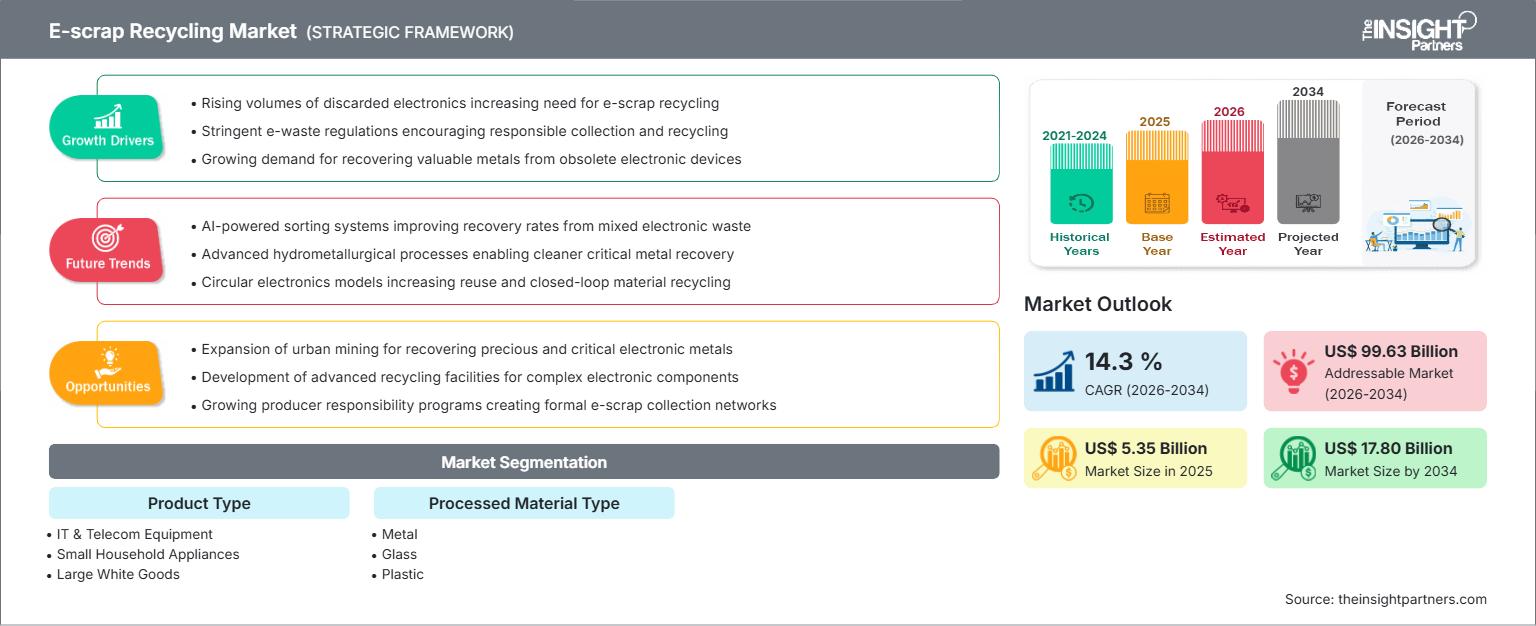
The E-Scrap Recycling Market was valued at US$ 5.35 Billion in 2025 and is projected to reach US$ 17.80 Billion by 2034, registering a CAGR of 14.3 % from 2026 to 2034. The Market is expanding as electronics lifecycles shorten, enterprise IT refreshes rise, and regulated recovery of metals, plastics, and glass becomes central to circular economy planning.
Across North America, the E-Scrap Recycling Market size is expected to expand at a CAGR range of 12.8–13.6% through 2034, supported by certified electronics recycling networks, data-center equipment replacement, and state-level stewardship laws. Structural demand is reinforced by corporate ESG reporting, secure asset disposition requirements, and higher recovery value from servers, telecom equipment, smartphones, and appliances.
E-scrap Recycling Market Assessment and Insights
- North America held 26–29% share in 2025 and is growing at a CAGR range of 12.8–13.6% during 2026–2034, helped by certified recyclers, IT asset disposition, and state collection programs.
- US represented 78–82% of North America in 2025 and is growing at a CAGR range of 13.0–13.8%, led by enterprise IT, data centers, and electronics take-back channels.
- Europe accounted for 30–34% share in 2025 and is advancing at a CAGR range of 11.8–12.6%, with Germany, the UK, France, Italy, and Spain leading regulated WEEE recovery.
- Asia Pacific captured 31–35% share in 2025 and is expanding at a CAGR range of 15.6–16.4%, led by China, Japan, South Korea, India, and Australia.
- Largest Segment IT & Telecom Equipment held 34–38% market share in 2025 and is growing at a CAGR range of 14.8–15.6%, supported by enterprise hardware replacement and server recycling.
- High Growth Segment Metal held 58–62% market share in 2025 and is growing at a CAGR range of 15.4–16.2%, driven by copper, aluminum, precious metals, and critical material recovery.
- Key companies analyzed in detail: DOWA Holdings Co., Ltd., Ecoreco Ltd., ERI, Enviro-Hub Holdings Ltd., JX Advanced Metals Corporation, Sims Limited, Stena Metall AB, Tetronics Technologies Limited, Umicore SA, and Quantum Lifecycle Partners LP.
Source: The Insight Partners' analysis based on proprietary research, government publications, company annual reports, investor presentations, industry databases, and expert interviews.
The developments in the market will be guided by the shift in focus from basic dismantling to automation in sorting, secure data destruction, hydrometallurgical extraction, and plastics segregation. The market will be driven by rapid turnover of IT equipment, increased appliance penetration rate, and infrastructure upgrade in the telecom sector. In 2022, the global e-waste production stood at 62 million tonnes whereas the documented recycling rate was 22.3%.
Future success will be most evident where consumption of electronic products, stringent enforcement of policy measures, and advanced industrial capability in recycling of electronic items coincide. Europe will leverage the WEEE policy, North America will rely on the enterprise compliance measures, and Asia Pacific region will capitalize on its huge number of devices in addition to its manufacturing systems.
E-scrap Recycling Market Report Scope
| Report Attribute | Details |
|---|---|
| Market size in 2025 | US$ 5.35 Billion |
| Market Size by 2034 | US$ 17.80 Billion |
| Global CAGR (2026 - 2034) | 14.3 % |
| Historical Data | 2021-2024 |
| Forecast period | 2026-2034 |
E-scrap Recycling Market Analysis
E-Scrap Recycling Market Drivers include growing volumes of electronic waste, hazardous waste legislation, and the need to recover such precious metals as copper, gold, palladium, aluminum, steel, glass, and plastic. The value chain consists of collectors, retailers, government organizations, ITADs, disassemblers, shredders, smelters, refiners, OEMs recycling initiatives, and corporate sustainability. High demand is seen when all three elements intersect.
Suppliers remain fragmented when collecting material, but increasingly specialized when processing. Accredited processors purchase equipment that allows for depollution, battery extraction, optical sorting, and further downstream metals reclamation to satisfy client requirements. The E-Scrap Recycling Market report identifies greater profit potential in those instances where recyclers leverage logistic density, data cleansing services, and long-term agreements with manufacturers, utilities, governments, telecom providers, and hyperscale data center operators.
Positioning will depend on credibility in terms of compliance, recovery rate, geographic coverage, and downstream refining facilities. The main firms like DOWA Holdings Co., Ltd., JX Advanced Metals Corporation, Umicore SA, and Tetronics Technologies Limited concentrate on efficient metals recovery, while ERI, Sims Limited, Stena Metall AB, Enviro-Hub Holdings Ltd., Ecoreco Ltd., and Quantum Lifecycle Partners LP work on building better recycling facilities.
The industry prefers complete recycling over cheap disposal. Customers are increasingly demanding that there be evidence of destruction, controlled exporting, and chain of custody. Given that electronic products are made of important raw materials and harmful substances, recyclers that are transparent in their activities, use robotics, and have good downstream refining connections have great chances of obtaining lucrative corporate or governmental contracts.
● REPORT CUSTOMIZATION
Tailor This Report To Align With Your Specific Business Requirements
This report can be customized to align precisely with your business objectives, scope, and target markets. Customization options include tailored segmentation, geography, competitive analysis, and strategic insights to support informed decision-making.
Customize This Report →WHAT YOU CAN ADJUST
- ● Segmentations
- ● Geography
- ● Competitive Analysis
- ● Language Preferences
E-scrap Recycling Market: Strategic Insights
Regional Insights
North America E-Scrap Recycling Market
In 2025, North America represented a 26–29% market share and will see CAGR growth between 12.8–13.6% until 2034. Growth of the E-Scrap Recycling Market share is driven by IT refresh cycle, recycling mandates at the state level, hyperscale data-center refresh, and established certification. U.S. EPA guidelines still define e-scrap as valuable used electronics whereby reuse, refurbishment, and recycling minimize landfill dumping and improper exports.
Strong regional growth dynamics come from servers, networking gear, mobile devices, and appliances containing recoverable metals like copper, aluminum, steel, and plastics, along with circuit boards. Growth drivers are also linked to company’s security concerns for data, certifications like R2 and e-Stewards, and preference for documented recycling. Canada contributes to regional dynamics via provincial extended producer responsibility program and IT asset disposition demand.
U.S. E-Scrap Recycling Market
The US accounted for 78–82% of North America in 2025 and is expected to record a CAGR of 13.0–13.8%. Replacement technologies for enterprise hardware, investments in cloud infrastructure, upgrades in telecom equipment, and take-back services by retailers generate steady inflows of electronics. ERI, Sims Limited, Quantum Lifecycle Partners LP, and Stena Metall AB contribute in this industry by means of processing, logistics, refurbishing, and downstream recovery.
Applications include secure disposal of storage media, sale of functional equipment, printed circuit board recovery, and recycling of lithium-ion batteries. There are varied collection rates based on state laws; however, larger corporations have been standardizing recycling contracts nationally.
Europe E-Scrap Recycling Market
Europe had a market share of 30-34% in 2025 and will be growing in a CAGR range of 11.8-12.6%. Germany dominates its regional penetration due to its industrial recycling capacity as well as enforcement of EPR program. Meanwhile, the United Kingdom sustains a strong IT asset disposition and appliance recovery channels. France promotes take-back via eco-organizations and obligations of retailers, leading to higher visibility of its formal collection processes.
There has been an increase in the number of compliant WEEE collection in Italy and Spain despite regional discrepancies. According to European Environment Agency, the EU’s WEEE collection rate stood at 40.6% in 2022, lower than the 65% directive rate. The market gets influenced by policies, the high per-capita use of electronics, and strategic raw materials considerations.
APAC E-Scrap Recycling Market
APAC’s market share is estimated at 31-35% for 2025 and is expected to grow at the CAGR rate of 15.6-16.4%. The country that has the greatest market presence in terms of volumes of electronic products and generation of manufacturing scrap is China; while Japan and South Korea add to their market share through better recycling techniques.
The driving factors behind the market development in APAC include electronics production, replacement of smartphones, penetration of appliances, and bans on informal processing activities. The market of E-Scrap Recycling in APAC is also fueled by the need for metals and circular economy initiatives in APAC.
Middle East & Africa E-Scrap Recycling Market
Middle East & Africa is projected to grow at a CAGR range of 10.8–11.6% as Saudi Arabia, the UAE, South Africa, and the rest of MEA expand digital infrastructure and electronics consumption. The UAE leads formal demand through smart-city investment, data centers, and corporate IT refresh programs.
Sectors like energy, telecommunications, and infrastructure result in the creation of e-waste in the form of routers, servers, power electronics, and consumer electronics. The formal system of recycling is not as advanced as that of Europe or North America, with the recycling rate in Africa being less than 1% in 2022.

Segmentation Analysis
Product Type
Product Type is projected to grow at a CAGR range of 14.1–14.9% during 2026–2034 as recyclers process higher volumes from enterprise IT, telecom networks, appliances, and consumer electronics. The market scope is shaped by product complexity, resale potential, hazardous components, and material yield. IT and telecom equipment remains the most valuable stream because circuit boards and servers hold recoverable metals.
- IT & Telecom Equipment leads demand through servers, laptops, routers, switches, and storage devices, where data security, refurbishment value, and metal-rich circuit boards support premium recycling contracts.
- Small Household Appliances generate distributed volumes from urban households, requiring efficient collection, depollution, and plastics separation to improve economics across kettles, tools, personal care devices, and small electronics.
- Large White Goods provide high ferrous and non-ferrous metal recovery from refrigerators, washers, and air conditioners, but require careful refrigerant, foam, compressor, and hazardous component handling.
- Consumer Electronics remains strategically important because smartphones, TVs, audio products, and gaming devices contain mixed plastics, displays, batteries, and circuit boards with recoverable precious metals.
Processed Material Type
Processed Material Type is forecast to grow at a CAGR range of 14.6–15.4% during 2026–2034 as recovery economics move beyond bulk scrap toward refined metals, glass reuse, and plastics circularity. Metal dominates value capture, while glass and plastic streams gain relevance as policy and OEM procurement increase recycled-content expectations and restrict landfill disposal.
- Metal delivers the highest revenue contribution through copper, aluminum, steel, gold, silver, palladium, and specialty metals recovered from boards, wiring, frames, motors, and appliance components.
- Glass demand is linked to screens, monitors, lighting, and appliance doors, with value depending on safe separation, contamination control, and availability of downstream reuse or aggregate applications.
- Plastic recovery is improving as recyclers add polymer identification, flame-retardant screening, and separation technologies to convert housings and components into compliant secondary plastic streams.
Opportunity Snapshot
Market Opportunity Snapshot
| Product Type | Revenue Contribution | Trend Tag | Adoption Stage |
| IT & Telecom Equipment | High | Data Security | Mature |
| Small Household Appliances | Medium | Urban Collection | Scaling |
| Large White Goods | High | Metal Recovery | Mature |
| Consumer Electronics | High | Device Takeback | Scaling |
E-scrap Recycling Market Growth Drivers and Impact Analysis
Rising Global E-Waste Volumes Expand Formal Recycling Need
The world-wide generation rate of e-waste is increasing at a much higher pace compared to recycling rates, thereby giving rise to a structural need for recycling infrastructure. According to the report "Global E-waste Monitor" of 2022, there was an estimated generation of 62 million tonnes of e-waste in 2022 and expected generation of 82 million tonnes in 2030, but the recycling infrastructure accounted for 22.3% only. This gap has increased pressure from both policy-making as well as business standpoints on recycling facilities. The effect on the market can be seen in terms of larger municipal contracts, stringent OEM take back programs, and increasing business demand for recycling.
Enterprise IT Refresh and Data Security Raise Processing Value
The increasing frequency of technology refresh cycles at corporations is raising the importance of professional management of e-scrap due to the residual asset value and data security issues associated with the servers, laptops, storage arrays, routers and telecom equipment. The customers now do not buy recycling as a disposal solution anymore but want wiping services, destruction, serial tracking, resale management and further material tracking of the items. This will result in more revenues for those recyclers who are able to dispose of the IT assets, have proper logistics and sales channel. From the market standpoint this means more value per ton of IT and telecom equipment than the low grade mixed scrap.
Critical Material Recovery Supports Circular Supply Chains
These electronic waste materials include copper, aluminum, precious metals, specialty metals, and certain critical minerals, which can mitigate reliance on primary mining if extracted on a large scale. As per the Global E-Waste Monitor, the total value of natural resources worth US$ 62 billion was not accounted for in 2022, thereby reflecting the economic losses due to insufficient recycling. Hence, there is now a demand on the part of formal processors and downstream refiners to be incorporated within the circular supply chains of electronics, automotive, telecom, and renewable energy sectors.
E-scrap Recycling Market Future Trends
AI-Based Sorting and Robotics Improve Recovery Yields
E-Scrap Recycling Market trends will increasingly center on robotics, AI vision, and sensor-based sorting that improve separation of circuit boards, batteries, plastics, ferrous metals, and non-ferrous fractions. Automated systems reduce worker exposure to hazardous components and improve consistency when product designs vary widely. Over the next decade, processors will use machine learning to classify device types, detect batteries, and optimize dismantling routes. This trend supports higher material purity, better downstream pricing, and lower rejection rates. Operators with capital access and strong inbound volume will be best placed to justify automation investments and defend margins.
Traceable Recycling Becomes a Procurement Requirement
Future demand will be shaped by customers requiring proof that e-scrap is processed responsibly, domestically where necessary, and without unauthorized export. Chain-of-custody documentation, carbon reporting, certificate verification, and downstream vendor audits will become standard elements of procurement. This trend will favor recyclers with digital tracking systems, certified facilities, and transparent relationships with smelters and refiners. Smaller operators may remain active in local collection, but larger contracts will concentrate around companies that can demonstrate compliance across regions. Traceability will also help customers link e-scrap recycling outcomes to ESG and circular economy targets.
E-scrap Recycling Market Opportunities
Closed-Loop Metal Recovery Partnerships
Recyclers can build higher-margin models by partnering with electronics manufacturers, battery companies, refiners, and metal users to return recovered materials into new production. E-Scrap Recycling Market Forecasts point to stronger demand for copper, precious metals, and secondary aluminum as electrification and digital infrastructure expand. Closed-loop contracts can reduce commodity exposure because pricing is linked to service quality, recovery yield, and verified recycled content. Investment opportunities include circuit board pre-processing, sampling technology, refining alliances, and customer dashboards that quantify metal recovery. This approach can convert recycling from a waste service into a supply-chain resilience solution.
Formalization of Emerging-Market Collection Networks
Emerging markets offer significant opportunity because device ownership is rising while formal recycling infrastructure remains underdeveloped. Companies can invest in collection hubs, retailer partnerships, technician training, and safe dismantling systems that redirect material from informal channels. The opportunity is strongest where governments are introducing EPR rules but need private capacity to execute collection and processing. Practical action includes building franchise-style collection models, working with telecom operators on handset take-back, and creating export-compliant pathways for fractions requiring advanced refining. Success will depend on community trust, transparent pricing, and consistent enforcement against unsafe handling.
Recent Developments
- April 2026: DOWA Holdings Co., Ltd. announced a strategic partnership agreement in the metal recycling field to strengthen resource circulation and recycling capabilities. The initiative supports broader recovery of valuable metals from complex waste streams and aligns with rising demand for decarbonized, traceable secondary raw materials.
- February 2026: Umicore SA reported full-year 2025 results and reorganized activities around foundation businesses and battery materials solutions, including battery recycling operations. The update emphasized operational discipline, metal-price exposure, and capital allocation, reinforcing the company’s role in advanced materials recovery and circular metal flows.
- April 2025: DOWA Holdings Co., Ltd. acquired an industrial site in Tochigi, Japan, for a complex base facility supporting environmental management and recycling business expansion. The planned site will strengthen logistics, waste recycling support, and future recycling businesses including solar panels and biomass fuels.
Frequently Asked Questions

- Comprehensive Market Sizing and Forecast Analysis
- Detailed Segmentation Analysis
- In-Depth Market Dynamics Assessment
- Regional and Country-Level Insights
- Competitive Landscape and Company Benchmarking
- Strategic Business Intelligence
Recent Reports
Testimonials

The Insight Partners provided valuable market intelligence that supported our global go-to-market strategy. Their team was professional, responsive, and attentive to our feedback, providing thoughtful analysis and helpful methodological clarifications throughout the project.
Junmo Kim Chief Financial Officer (CFO), Enertech Co., Ltd.
The Insight Partners' SCADA System Market report is comprehensive, with valuable insights on current trends and future forecasts. The team was highly professional, responsive, and supportive throughout. We are very satisfied and highly recommend their services.
RAN KEDEM Partner, Reali Technologies LTDs
I requested a report on a very specific software market and the team produced the report in a few days. The information was very relevant and well presented. I then requested some changes and additions to the report. The team was again very responsive and I got the final report in less than a week.
JEAN-HERVE JENN Chairman, Future Analytica
We worked with The Insight Partners for an important market study and forecast. They gave us clear insights into opportunities and risks, which helped shape our plans. Their research was easy to use and based on solid data. It helped us make smart, confident decisions. We highly recommend them.
PIYUSH NAGPAL Sr. Vice President, High Beam Global
The Insight Partners delivered insightful, well-structured market research with strong domain expertise. Their team was professional and responsive throughout. The user-friendly website made accessing industry reports seamless. We highly recommend them for reliable, high-quality research services
YUKIHIKO ADACHI CEO, Deep Blue, LLC.
This is the first time I have purchased a market report from The Insight Partners.While I was unsure at first, I visited their web site and felt more comfortable to take the risk and purchase a market report.I am completely satisfied with the quality of the report and customer service. I had several questions and comments with the initial report, but after a couple of dialogs over email with their analyst I believe I have a report that I can use as input to our strategic planning process.Thank you so much for taking the extra time and making this a positive experience.I will definitely recommend your service to others and you will be my first call when we need further market data.
JOHN SUZUKI President and Chief Executive Officer, Board Director, BK Technologies
I wish to appreciate your support and the professionalism you displayed in the course of attending to my request for information regarding to infectious disease IVD market in Nigeria. I appreciate your patience, your guidance, and the fact that you were willing to offer a discount, which eventually made it possible for us to close a deal. I look forward to engaging The Insight Partners in the future, all thanks to the impression you have created in me as a result of this first encounter.
DR CHIJIOKE ONYIA MANAGING DIRECTOR, PineCrest Healthcare Ltd.Reason to Buy
- Informed Decision-Making
- Understanding Market Dynamics
- Competitive Analysis
- Identifying Emerging Markets
- Customer Insights
- Market Forecasts
- Risk Mitigation
- Boosting Operational Efficiency
- Strategic Planning
- Investment Justification
- Tracking Industry Innovations
- Aligning with Regulatory Trends






 Get Free Sample for