
Digital Phase Shifter Market Size, Share & Growth by 2034
Coverage: by Bits (4-Bits, 5-Bits, 6-Bits, 8-bits, Others); Frequency Range (5 to 6 GHz, 6 to 18 GHz, 8.5 to 10 GHz, 32 to 37 GHz); Application (Defense, Telecommunication, Radar, Others) , and Geography (North America, Europe, Asia Pacific, and South and Central America)
- Status : Data Released
- Report Code : TIPRE00010756
- Category : Electronics and Semiconductor
- No. of Pages : 150
- Available Report Formats :


- Last update date : August 10, 2026


2025 Market Size
US$ 515.39 Mn
Base year value
2034 Forecast
US$ 889.77 Mn
Projected by 2034
CAGR 2026-2034
6.25 %
Growth rate
Addressable Market
US$ 6,358.15 Mn
(2026-2034)
The Digital Phase Shifter Market is valued at US$ 515.39 Million in 2025 and will grow to reach US$ 889.77 Million by 2034, witnessing a CAGR of 6.25% from 2026 to 2034. Growing demand for compact RF components capable of repeatable phase shift in the microwave and millimeter-wave bands is seen, driven by applications in phased-array antennas, electronically steered radars, satellite payloads, and 5G systems.
Geographically, North America continues to be a key region owing to the need for modernization of defense electronics, SATCOM terminal development, and local development of the semiconductor supply chain. North American market size is forecasted to witness growth at a CAGR of 5.9–6.6% during 2026–2034, driven by active electronically scanned array developments, robust aerospace budgets, and fast prototyping capabilities of U.S. RF design houses.
Digital Phase Shifter Market Assessment and Insights
- North America: The region holds 35–38% share in 2025 and grows at a CAGR of 5.9–6.6% during 2026–2034, driven by AESA radar refresh cycles, space payload electronics, and defense-qualified RF sourcing.
- US: The country represents 78–82% of North America in 2025 and grows at a CAGR of 6.0–6.8% during 2026–2034.
- Europe: Europe accounts for 21–24% share in 2025 and grows at a CAGR of 5.4–6.1% during 2026–2034, led by the UK, Germany, France, Italy, and Spain.
- Asia Pacific: Asia Pacific represents 28–31% share in 2025 and grows at a CAGR of 6.8–7.5% during 2026–2034, with China, Japan, South Korea, India, and Australia anchoring demand.
- Largest Segment: 6-Bits phase shifters hold 39–43% market share in 2025 and grow at a CAGR of 6.1–6.8% during 2026–2034.
- High Growth Segment: 32 to 37 GHz devices hold 12–15% market share in 2025 and grow at a CAGR of 7.4–8.2% during 2026–2034.
- Key companies analyzed in detail: Analog Devices, Inc.; Astra Microwave Products Limited; L3Harris Technologies, Inc.; Narda-MITEQ; MACOM Technology Solutions Holdings, Inc.; Mercury Systems, Inc.; Murata Manufacturing Co., Ltd.; Planar Monolithics Industries, Inc.; Pulsar Microwave Corporation; Qorvo, Inc.; SAGE Millimeter, Inc.
Source: The Insight Partners' analysis based on proprietary research, government publications, company annual reports, investor presentations, industry databases, and expert interviews.
Commercialization is transitioning from mechanical tuning phase control circuits to devices like GaAs, SiGe, SOI, and CMOS-friendly digital devices that minimize size, enhance repeatability, and facilitate calibration of arrays. The production environment now focuses on achieving low insertion loss, minimized RMS phase errors, fast-switching abilities, thermal stability, and appropriate package design for transmit/receive modules. Manufacturers are also focusing on matching their catalog offerings to customer defense programs, satellite payload requirements, and telecommunication beamforming applications.
Future possibilities in this market segment will revolve around higher demand for high-frequency bands, software-defined payloads, and multi-beams antenna that can support fine phase accuracy and lower power usage. Emerging geographies are adding value to manufacturing of radars, electronic warfare systems, and satellites, but spectrum and security issues indicate local radio frequency component production. Suppliers who have qualification history, foundry stability, and application-based reference designs are those who will benefit the most from the procurement channel.
Digital Phase Shifter Market Report Scope
| Report Attribute | Details |
|---|---|
| Market size in 2025 | US$ 515.39 Million |
| Market Size by 2034 | US$ 889.77 Million |
| Global CAGR (2026 - 2034) | 6.25% |
| Historical Data | 2021-2024 |
| Forecast period | 2026-2034 |
Digital Phase Shifter Market Analysis
The Market is enabled by electronically-steered antennas used as an alternative to mechanical scanning for radar, SATCOM, and communications applications. High demand exists where there is a need for agile beams, low latency, and small form factor RF front-end. The market consists of MMIC companies, compound semiconductor foundries, module suppliers, antenna array producers, defense primes, satellite OEMs, telecom equipment vendors, test houses, and specialty distributors.
The supply side is influenced by wafer capacity, export regulations, military screening programs, and long life cycles of products. Bit resolution, phase step resolution, insertion loss, switch speed, control voltage, package, temperature range, and availability of evaluation kits are among characteristics that buyers use when making purchasing decisions. Phase shifter choice is more and more made at the array architecture level since it affects amplifier size, calibration effort, thermal management, and module cost.
The competition is very specialized, and the Digital Phase Shifter Market report reveals diverse strengths of catalog MMICs, tailored microwave modules, and qualified defense subsystems. The key competitors include Analog Devices, Inc., Qorvo, Inc., and MACOM Technology Solutions Holdings, Inc., whose success depends on the variety of RF products, while the success of Mercury Systems, Inc. and L3Harris Technologies, Inc. depends on system integration.
Trends of investments include high frequency packages, space-qualified die, and module components for phased arrays. The players who cater to special requirements of niche frequencies, reliability, and integration include Astra Microwave Products Limited, Narda-MITEQ, Planar Monolithics Industries, Inc., Pulsar Microwave Corporation, SAGE Millimeter, Inc., and Murata Manufacturing Co., Ltd. The strategy relies on qualifications, technical expertise, and continuity of product availability over several years for defense and satellite programs.
● REPORT CUSTOMIZATION
Tailor This Report To Align With Your Specific Business Requirements
This report can be customized to align precisely with your business objectives, scope, and target markets. Customization options include tailored segmentation, geography, competitive analysis, and strategic insights to support informed decision-making.
Customize This Report →WHAT YOU CAN ADJUST
- ● Segmentations
- ● Geography
- ● Competitive Analysis
- ● Language Preferences
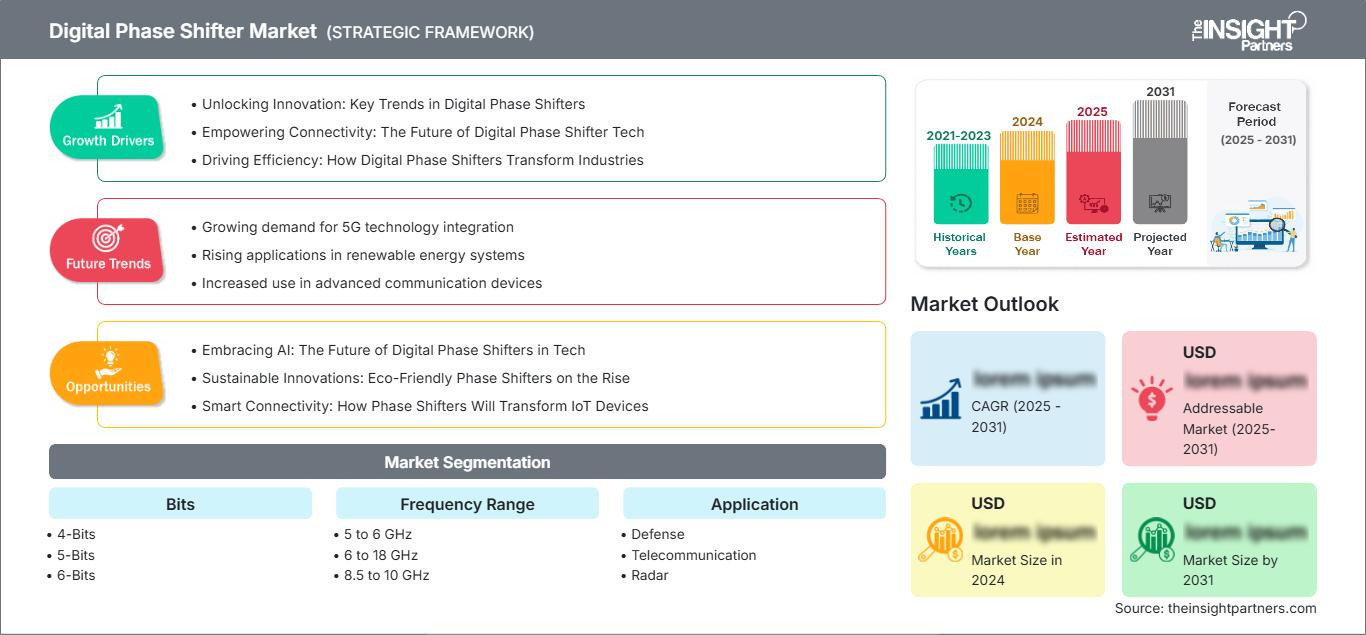
Digital Phase Shifter Market: Strategic Insights
Regional Insights
North America Digital Phase Shifter Market
The Digital Phase Shifter Market Share in North America is estimated at 35-38%, while the region is expected to grow with a CAGR of 5.9-6.6% for the period of 2026-2034. Market share for Digital Phase Shifter will be supported by AESA radar upgrade, SATCOM ground station, electronic warfare, and secure communication initiatives. Budgets of US defense electronics and commercial space payloads will drive demand for microwave and millimeter-wave bands.
Analog Devices, Inc., Qorvo, Inc., MACOM Technology Solutions Holdings, Inc., Mercury Systems, Inc., Narda-MITEQ, Planar Monolithics Industries, Inc., Pulsar Microwave Corporation, and SAGE Millimeter, Inc. help to increase supply capabilities of the region. Purchasers pay attention to ITAR-compliant sourcing, component tracking, radiation capability, and evaluation services. While Canada adds to demand via space, radar, and RF-related research at universities, U.S. demand dominates.
U.S. Digital Phase Shifter Market
The U.S. constitutes 78-82% of the North American demand in 2025 and is forecasted to have a CAGR of 6.0-6.8% during the period 2026-2034. The applications are defense radars, missile seekers, shipborne electronic warfare systems, LEO satellite communications, and 5G test instrumentation.
The leading manufacturers that have an advantage because of domestic expertise and connections in the defense sector include Analog Devices, Inc., Qorvo, Inc., MACOM Technology Solutions Holdings, Inc., Mercury Systems, Inc., and L3Harris Technologies, Inc. The current trends are the use of 6-bit and 8-bit resolutions, positive control logic, surface mount components, and components ranging from C, X, Ku, Ka, and millimeter wavebands.
Europe Digital Phase Shifter Market
The Europe region holds 21–24% market share by 2025 and will see a CAGR of 5.4–6.1% over the forecast period from 2026 to 2034. The United Kingdom leads in terms of radar upgrade systems, space communications payload, and purchase of defense electronics. Germany demands industrial radar, automotive test equipment, SATCOMs, and RF module manufacture.
France is contributing via aerospace sector, naval radar and secure communication projects, Italy and Spain generate demands for satellites manufacturing, defense electronics, and telecom testing infrastructure. Buyers in Europe focus on radiation hardening, ESA compliance, data security and supply chain stability. Market demand in Europe is fragmented but NATO interoperability requirement drives RF components performance standards.
APAC Digital Phase Shifter Market
The APAC region holds 28-31% share in 2025 and will grow at a CAGR of 6.8-7.5% between 2026 and 2034. APAC is driven by China because of its radar, satellite, 5G infrastructure and microwave components in the domestic market. Japan and South Korea fuel demand for products through electronics manufacturing, telecom equipment and space payload engineering.
Increased procurement of products like surveillance radar, communication systems and space systems are seen in India and Australia. Factors that drive policies within the region include localization, spectrum expansion, semiconductor policy and indigenous defense systems. An example of APAC companies within the market is Murata Manufacturing Co., Ltd. and Astra Microwave Products Limited.
Middle East & Africa Digital Phase Shifter Market
The Middle East & Africa market is expected to experience a CAGR of 4.9%-5.7% in 2026-2034. Growth is led by Saudi Arabia with investments in air defense modernization and satellite communications, while the UAE is driven by space programs, smart infrastructure, airport security, and telecom trials.
Selective use in South Africa and the rest of MEA will include surveillance for defense, protection of energy and infrastructure, and reliable communication. Projects in the region will drive demand for radar-enabled monitoring and secure communication links. Growth is contingent upon the capacity of system integrators, import policies, maintenance requirements, and alignment with defense procurements.
Segmentation Analysis
Bits
The Bits segment is projected to grow at a CAGR of 5.8–6.6% during 2026–2034. Market scope spans low-resolution, cost-efficient devices for simple beam steering and higher-resolution architectures for precision phased arrays. Selection depends on phase step, control complexity, insertion loss, calibration time, and the required beam pointing accuracy across defense, telecom, and radar systems.
- 4-Bits devices serve cost-sensitive arrays, training systems, and compact modules where broader phase steps are acceptable and lower control complexity supports simplified RF layouts.
- 5-Bits devices balance resolution and circuit size, making them useful for intermediate beam-steering requirements in test equipment, compact radar, and communications modules.
- 6-Bits devices lead adoption because 5.625-degree phase steps provide practical precision for phased-array radar, SATCOM terminals, and wideband transmit-receive modules.
- 8-bits devices address high-precision beamforming where finer steering, calibration flexibility, and array sidelobe control are more important than added logic and design complexity.
Frequency Range
The Frequency Range segment is expected to grow at a CAGR of 6.0–6.9% during 2026–2034 as design activity shifts across C-band, X-band, Ku-band, and Ka-band systems. Frequency selection reflects antenna size, propagation requirements, bandwidth needs, and semiconductor process capability. Higher-frequency devices command engineering attention because package parasitics, insertion loss, and thermal behavior become more difficult to control.
- 5 to 6 GHz devices support C-band radar, wireless infrastructure, and compact phased-array modules where propagation resilience and established RF design practices remain valuable.
- 6 to 18 GHz devices cover wideband defense, EW, instrumentation, and SATCOM applications, making them strategically important for flexible microwave system architectures.
- 8.5 to 10 GHz devices align with X-band radar, weather monitoring, maritime surveillance, and aerospace systems that require compact arrays and reliable beam steering.
- 32 to 37 GHz devices support Ka-band satellite links, high-throughput communications, and advanced radar where bandwidth, antenna miniaturization, and precise packaging drive adoption.
Application
The Application segment is forecast to grow at a CAGR of 6.1–7.0% during 2026–2034. Defense remains the most demanding application because radar, electronic warfare, and secure communications require proven reliability. Telecommunication adoption increases with beamforming, massive MIMO, and SATCOM terminals, while radar demand spans surveillance, automotive test, weather systems, and industrial sensing.
- Defense demand is anchored by AESA radar, electronic warfare, missile guidance, naval systems, and secure communications where qualification, traceability, and long-term availability matter.
- Telecommunication users adopt digital phase shifters for beam steering, SATCOM ground equipment, massive MIMO development, and high-frequency test platforms requiring repeatable phase control.
- Radar applications include surveillance, weather monitoring, air traffic systems, industrial sensing, and automotive testing where stable phase accuracy improves detection and tracking performance.
Opportunity Snapshot
| Application | Revenue Contribution | Trend Tag | Adoption Stage |
| Defense | High | AESA Upgrade | Mature |
| Telecommunication | Medium | SATCOM Beam | Scaling |
| Radar | High | X-Band Arrays | Mature |
Digital Phase Shifter Market Growth Drivers and Impact Analysis
Expansion of Electronically Steered Defense Arrays
Defense departments are moving from mechanically scanning antennas to phased arrays that use several thousands of repeatable phase control channels. This is a market force because each phase array element or sub-element requires precise phase control for beam forming, reducing side lobes, and mission switching. As a result, the Market Demand increases with radar upgrades, electronic warfare systems, seeker heads for missiles, maritime surveillance and air defense systems. Purchase decisions favor components that have minimal phase error, rapid switching speed, good thermal stability, and appropriate documentation for defense qualification. Those suppliers who can offer a long-life support cycle and controlled sourcing are in a position for ongoing program revenues.
Growth in SATCOM and Multi-Beam Connectivity
Communications using satellite technology are moving to electronically-steered terminals, gateways, and payloads that enable the tracking of orbiting satellites without physically realigning the terminals. Phase shifters offer agility in forming beams, allow multiple beams to be formed, and assist in the retention of good link qualities in varying elevation angles. These are reflected in the activities within the Ka band and Ku band markets, where small antenna panels have to use phase control in an efficient manner while minimizing insertion losses. Radiation resistance, thermal cycling, and package challenges need to be tackled by suppliers for space terminals and outdoor terminals.
RF Miniaturization and Higher-Frequency Integration
System engineers are making RF functionality available in smaller modules in order to decrease weight of antennas, facilitate assembly, and enhance performance at the system level. This has a positive effect on digital phase shifters, since integration of MMICs allows replacing large analog or mechanical components and providing electrical control capabilities. Increased use of high frequencies makes the design more challenging in terms of package parasitics, insertion loss, heat dissipation, and calibration. The result is greater need for surface-mount components, known-good dies, evaluation boards, and customized modules that reduce development times. Manufacturers who have both semiconductor fabrication knowledge and application engineering skills can reap additional rewards..
Digital Phase Shifter Market Future Trends
Software-Calibrated Phased Arrays
Digital Phase Shifter Market trends will increasingly center on software-calibrated arrays that compensate for component tolerances, temperature drift, and aging. Future systems will combine phase shifter control, embedded sensors, and calibration algorithms to maintain beam accuracy without extensive manual tuning. This will reduce factory test time and improve field reliability for defense, telecom, and satellite antennas. Device vendors will need clearer digital interfaces, repeatable state behavior, and characterization data across operating conditions. The trend favors suppliers that can support reference designs, simulation models, and array-level validation rather than selling components only.
Ka-Band and Millimeter-Wave Product Expansion
Next-generation systems will require more devices operating above traditional microwave bands as SATCOM, radar, and high-capacity wireless links move into Ka-band and adjacent millimeter-wave ranges. This trend will push suppliers to improve die-level matching, packaging transitions, and thermal stability while keeping insertion loss manageable. Customers will value parts that simplify dense array layouts and support automated calibration. Competitive differentiation will shift toward proven high-frequency models, space-grade screening options, and module-ready formats. Companies able to combine broad frequency coverage with reliable manufacturing yields will be better positioned for long-term programs.
Digital Phase Shifter Market Opportunities
Defense-Qualified Module Platforms
Digital Phase Shifter Market Forecasts indicate actionable opportunity in pre-qualified module platforms that combine phase shifters with switches, attenuators, amplifiers, control logic, and thermal packaging. Defense customers often need faster integration timelines but cannot compromise reliability documentation. Suppliers can create value by offering configurable building blocks for C-band, X-band, Ku-band, and Ka-band arrays with known performance limits. This approach reduces engineering risk for primes, supports repeatable production, and expands revenue per design win. Investment should focus on environmental testing, configuration control, and collaboration with antenna integrators during early architecture decisions.
Telecom and SATCOM Reference Designs
Telecom and SATCOM equipment makers need shorter development cycles as antennas become flatter, lighter, and more software controlled. Vendors can capture opportunity by supplying reference designs that include digital phase shifters, beamforming control, power management, and validated PCB transitions. This investment-oriented path helps customers compare insertion loss, phase accuracy, power consumption, and manufacturability before committing to array layouts. The opportunity is strongest for electronically steered terminals, private network equipment, test systems, and gateway antennas. Suppliers that support simulation files, evaluation boards, and application engineering can improve customer retention.
Recent Developments
- May 2026: The Technical University of Munich (TUM), through the Horizon Europe-funded M&MEMS (Magnonics Meets Micro Electro Mechanical Systems) project, showcased a multi-channel magnonic-MEMS phase shifter for adaptive mobile communication systems. The compact, energy-efficient device enables more than 360° RF phase shifting across four independently controllable channels using minimal power, supporting advanced beamforming for 5G/6G networks, satellite communications, and radar systems. The technology is designed to reduce space and power requirements while improving signal stability and transmission efficiency in next-generation wireless communication systems.
- January 2022: GE Renewable Energy’s Grid Solutions announced that its digital power transformers had been selected for multiple grid modernization and renewable energy projects across Scotland, the UK, Germany, and Nigeria. The projects include 1,200 MVA 400 kV autotransformers for Scotland’s Kintore substation, 14 MVA–66 kV transformers for the Dogger Bank offshore wind farm, 340 MVA transformers for grid stability in Germany, and 330/132/33 kV autotransformers for Nigeria’s transmission network. The deployments support renewable energy integration, grid reliability, and energy transition initiatives, while leveraging GE’s portfolio of digital monitoring, protection, and high-voltage transformer technologies.
Frequently Asked Questions

- Comprehensive Market Sizing and Forecast Analysis
- Detailed Segmentation Analysis
- In-Depth Market Dynamics Assessment
- Regional and Country-Level Insights
- Competitive Landscape and Company Benchmarking
- Strategic Business Intelligence
Recent Reports
Testimonials

The Insight Partners' SCADA System Market report is comprehensive, with valuable insights on current trends and future forecasts. The team was highly professional, responsive, and supportive throughout. We are very satisfied and highly recommend their services.
RAN KEDEM Partner, Reali Technologies LTDs
I requested a report on a very specific software market and the team produced the report in a few days. The information was very relevant and well presented. I then requested some changes and additions to the report. The team was again very responsive and I got the final report in less than a week.
JEAN-HERVE JENN Chairman, Future Analytica
We worked with The Insight Partners for an important market study and forecast. They gave us clear insights into opportunities and risks, which helped shape our plans. Their research was easy to use and based on solid data. It helped us make smart, confident decisions. We highly recommend them.
PIYUSH NAGPAL Sr. Vice President, High Beam Global
The Insight Partners delivered insightful, well-structured market research with strong domain expertise. Their team was professional and responsive throughout. The user-friendly website made accessing industry reports seamless. We highly recommend them for reliable, high-quality research services
YUKIHIKO ADACHI CEO, Deep Blue, LLC.
This is the first time I have purchased a market report from The Insight Partners.While I was unsure at first, I visited their web site and felt more comfortable to take the risk and purchase a market report.I am completely satisfied with the quality of the report and customer service. I had several questions and comments with the initial report, but after a couple of dialogs over email with their analyst I believe I have a report that I can use as input to our strategic planning process.Thank you so much for taking the extra time and making this a positive experience.I will definitely recommend your service to others and you will be my first call when we need further market data.
JOHN SUZUKI President and Chief Executive Officer, Board Director, BK Technologies
I wish to appreciate your support and the professionalism you displayed in the course of attending to my request for information regarding to infectious disease IVD market in Nigeria. I appreciate your patience, your guidance, and the fact that you were willing to offer a discount, which eventually made it possible for us to close a deal. I look forward to engaging The Insight Partners in the future, all thanks to the impression you have created in me as a result of this first encounter.
DR CHIJIOKE ONYIA MANAGING DIRECTOR, PineCrest Healthcare Ltd.Reason to Buy
- Informed Decision-Making
- Understanding Market Dynamics
- Competitive Analysis
- Identifying Emerging Markets
- Customer Insights
- Market Forecasts
- Risk Mitigation
- Boosting Operational Efficiency
- Strategic Planning
- Investment Justification
- Tracking Industry Innovations
- Aligning with Regulatory Trends





 Get Free Sample for