
Direct Attach Cable Market Size, Share & Forecast by 2034
Coverage: by Product Type (Direct Attach Copper Cables, Active Optical Cables); Form Factor (QSFP, SFP, CXP, Cx4, CFP, CDFP); End-user (Networking, Telecommunications, Data Storage, High-Performance Computing (HPC) Centers, Others) , and Geography (North America, Europe, Asia Pacific, and South and Central America)
- Status : Data Released
- Report Code : TIPRE00009585
- Category : Electronics and Semiconductor
- No. of Pages : 150
- Available Report Formats :


- Last update date : August 05, 2026


2025 Market Size
US$ 16.16 Bn
Base year value
2034 Forecast
US$ 91. Bn
Projected by 2034
CAGR 2026-2034
21.17 %
Growth rate
Addressable Market
US$ 428.31 Bn
(2026-2034)
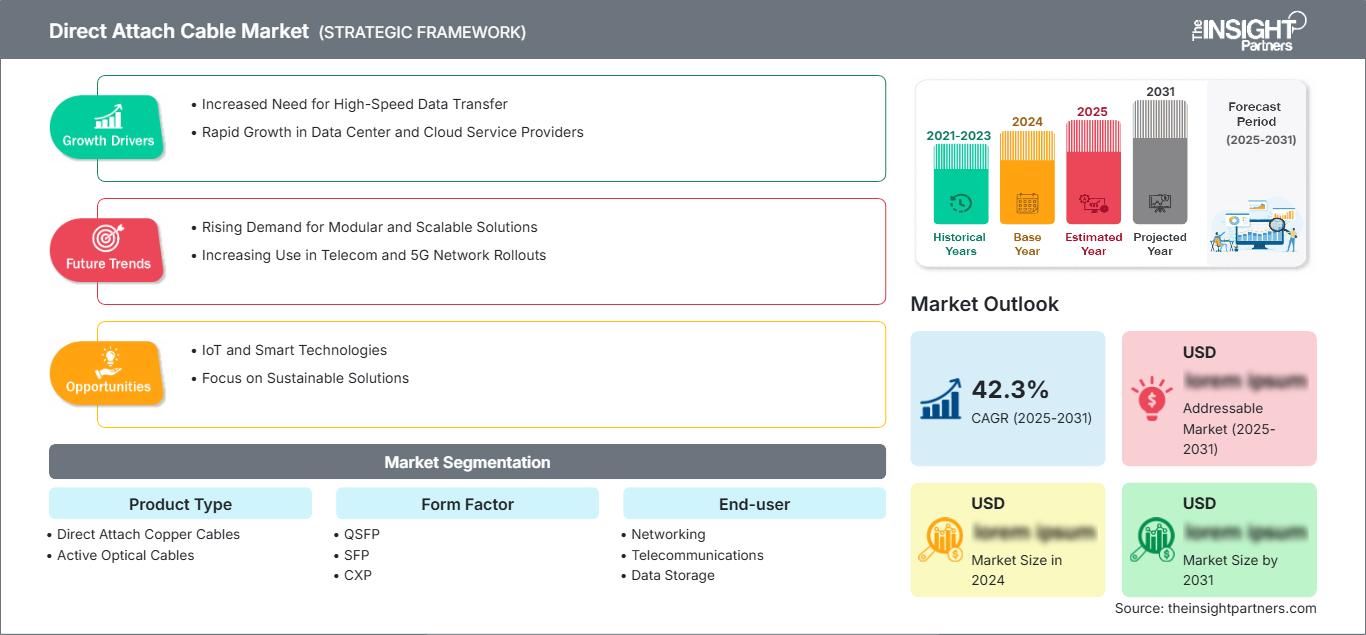
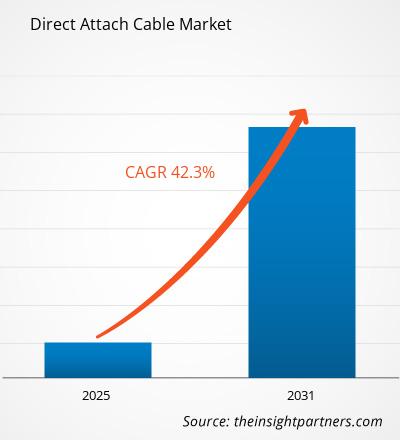
The Direct Attach Cable Market size was estimated at US$ 16.16 Billion in 2025 and will hit US$ 91.0 Billion by 2034, recording a CAGR of 21.17% during 2026-2034. There is increasing demand due to rising need for AI cluster, hyperscale data centers, telecom routing, and high-performance computing solutions that require short-reach interconnect.
In North America, the Direct Attach Cable Market growth is expected at a CAGR between 20.2-22.4%, owing to growth in cloud regions, AI training campuses, and deployment of 400G to 800G Ethernet. The region boasts of hyperscale investments, strong network ecosystem, and early adoption of efficient rack-level connections.
Direct Attach Cable Market Assessment and Insights
- North America held 33–37% share in 2025 and is growing at a CAGR range of 20.2–22.4% during 2026–2034, supported by hyperscale cloud, AI data centers, and network refresh cycles.
- US represented 78–82% of North America in 2025 and is growing at a CAGR range of 20.5–22.7%, led by cloud campuses and switch fabric upgrades.
- Europe accounted for 18–22% share in 2025 and is advancing at a CAGR range of 18.8–20.6%, with Germany, the UK, France, Netherlands, and Ireland leading deployments.
- Asia Pacific captured 34–38% share in 2025 and is expanding at a CAGR range of 22.4–24.6%, led by China, Japan, South Korea, India, Singapore, and Australia.
- Largest Segment Direct Attach Copper Cables held 58–62% market share in 2025 and is growing at a CAGR range of 19.8–21.5%, supported by short-reach cost and latency advantages.
- High Growth Segment Active Optical Cables held 38–42% market share in 2025 and is growing at a CAGR range of 22.6–24.8%, driven by longer rack spans and dense AI fabrics.
- Key companies analyzed in detail: 3M Company, Arista Networks, Inc., Cisco Systems, Inc., Hitachi, Ltd., Juniper Networks, Inc., Molex, LLC, Nexans S.A., Panduit Corp., TE Connectivity Ltd., and Tripp Lite by Eaton.
Source: The Insight Partners' analysis based on proprietary research, government publications, company annual reports, investor presentations, industry databases, and expert interviews.
Technology innovation has moved the Direct Attach Cable Market from 10G and 40G server connections to 100G, 200G, 400G, and 800G connectors that fit well into denser switch fabrics. Manufacturing trends have been shaped by signal integrity in twinax connectors, shielding and temperature performance, EEPROM encoding, testing interoperability, and bend radius management. As rack configurations increasingly feature GPUs, manufacturers are designing copper and optical assemblies with reduced power consumption, faster qualification, and easier installation in mind.
Future growth drivers will come from developing cloud regions, telecommunications edge facilities, national data centers, and AI infrastructure programs. Funding will be invested in fast deployments, pre-qualified connector kits, and faster connector form factors. Tailwinds in regulation in terms of data localization and efficient digital infrastructure will work in favor of those who can prove reliability, compliance, and performance.
Direct Attach Cable Market Report Scope
| Report Attribute | Details |
|---|---|
| Market size in 2025 | US$ 16.16 Billion |
| Market Size by 2034 | US$ 91. Billion |
| Global CAGR (2026 - 2034) | 21.17% |
| Historical Data | 2021-2024 |
| Forecast period | 2026-2034 |
Direct Attach Cable Market Analysis
DAC and AOC Demand relies on bandwidth upgrade, training of AI models, migration to the cloud, and resource-hungry applications. DAC and AOC provide better latency performance than individual modules and patch cords do. Their value chain includes copper wires, fiber optic assemblies, connector cages, switch manufacturers, buyers from hyperscale organizations, distributors, and system integrators which validate each cable by its compatibility with equipment firmware and port speed.
Market fundamentals are still driven by the availability of copper wire, capability of optical components, retiming semiconductor solutions, accurate termination, and robustness of regional manufacturing capabilities. Large customers need more and more coded cables with breakout options along with certification for QSFP, SFP, CXP, Cx4, CFP, and CDFP ports.
The Direct Attach Cable market analysis reveals competition revolving around issues such as interoperability, performance of signal, cost-per-port, lead time certainty, and next generation of Ethernet. Network hardware, cable assemblies, and structured connectivity platforms are driving procurement of direct attach cable by companies like Cisco Systems, Inc., Arista Networks, Inc., Juniper Networks, Inc., Molex, LLC, TE Connectivity Ltd., and Panduit Corp. Nexans S.A., 3M Company, Hitachi, Ltd., and Tripp Lite by Eaton offer diversity in the cabling, electronics, and infrastructure routes.
Investment will be towards cables that support 800G architecture, active copper cabling, increased reach of optical technology, and regional supply chain proximity to hyperscale deployments. Positioning for success requires proven compatibility of platform, thermal performance in high density racks, and ability to rapidly deploy AI clusters. Cables from vendors who have both engineering and availability for distribution will have an edge.
● REPORT CUSTOMIZATION
Tailor This Report To Align With Your Specific Business Requirements
This report can be customized to align precisely with your business objectives, scope, and target markets. Customization options include tailored segmentation, geography, competitive analysis, and strategic insights to support informed decision-making.
Customize This Report →WHAT YOU CAN ADJUST
- ● Segmentations
- ● Geography
- ● Competitive Analysis
- ● Language Preferences
Direct Attach Cable Market: Strategic Insights
Regional Insights
North America Direct Attach Cable Market
North America held 33–37% share in 2025 and is projected to grow at a CAGR range of 20.2–22.4% through 2034. Direct Attach Cable Market share is supported by hyperscale campuses, AI accelerator clusters, cloud availability zones, and enterprise data center modernization. Operators prefer DACs for short top-of-rack links because they reduce power consumption and simplify port provisioning.
The region benefits from major network equipment vendors, semiconductor design ecosystems, and early adoption of 400G and 800G Ethernet. Canada contributes through cloud regions and colocation expansion, while Mexico supports electronics manufacturing and nearshoring. Growth is constrained by qualification cycles, but urgent AI infrastructure timelines are shortening procurement windows.
U.S. Direct Attach Cable Market Market
The US represented 78–82% of North America in 2025 and is forecast to grow at a CAGR range of 20.5–22.7%. Cisco Systems, Inc., Arista Networks, Inc., Juniper Networks, Inc., Molex, LLC, Panduit Corp., TE Connectivity Ltd., and Tripp Lite by Eaton maintain strong channel relevance across cloud, networking, colocation, and enterprise facilities.
Application trends include GPU server uplinks, spine-leaf switching, storage fabrics, telecom routing, and high-performance computing laboratories. US buyers prioritize coded compatibility, vendor-approved cable matrices, and short lead times for large data halls. The strongest demand comes from AI clusters where hundreds of short links per rack make cable density, airflow, and bend radius operationally important.
Europe Direct Attach Cable Market Market
Europe accounted for 18–22% in 2025 and is forecast to register CAGR between 18.8% and 20.6%. Germany is leading on the back of industrial cloud, automotive computing, and enterprise data center deployments. The UK takes advantage of its financial services network and artificial intelligence capacity. Cloud region, submarine connectivity, colocation, and telco modernization drive growth from France, the Netherlands, Ireland, Italy, and Spain.
European buying focuses on power efficiency, RoHS compliance, supply chain traceability, and data sovereignty. Urban data centers may favor AOCs where cable routing and weight management become more challenging than in greenfield facilities. Growth is managed cautiously because of restricted power availability although digital transformation by governments and corporate cloud migration continue driving high-speed cabling upgrades.
APAC Direct Attach Cable Market Market
The share of the Asia Pacific region was in the range of 34-38% in 2025 and is projected to grow at a CAGR of 22.4-24.6%. China dominates due to scale of cloud computing, telecommunication, AI, and electronics manufacture; Japan and South Korea focus on high-reliability data centers; India, Singapore, and Australia add cloud regions and colocations.
There are favorable policies related to digital infrastructure, semiconductor ecosystem, and 5G backhaul. Direct Attach Cable Market in APAC is favored by close proximity to manufacturing components and fast construction of hyperscale facilities, although export restrictions and platform certification affect sourcing choices.
Middle East & Africa Direct Attach Cable Market Market
Middle East & Africa is projected to grow at a CAGR range of 19.4–21.2% as Saudi Arabia, the UAE, South Africa, and the rest of MEA invest in data centers, telecom cores, smart cities, and digital government. The UAE leads high-density colocation, while Saudi Arabia adds demand through sovereign cloud and AI initiatives.
Regional adoption is linked to energy-rich digital infrastructure, submarine cable landing points, and enterprise cloud migration. Projects often require robust supply planning because high-speed cabling must match imported switches and servers. Growth remains project-led, but premium data center specifications support higher-value DAC and AOC assemblies.
Segmentation Analysis
Product Type
Product Type is expected to grow at a CAGR range of 20.8–22.9% during 2026–2034 as the Direct Attach Cable Market scope spans copper economics and optical reach. Procurement decisions depend on link distance, port speed, airflow, power budget, and interoperability. Copper assemblies dominate short intra-rack links, while active optical assemblies support longer, lighter, and more flexible pathways.
- Direct Attach Copper Cables remain the volume foundation because they offer low latency, low power, and lower cost for short switch-to-server, switch-to-switch, and storage links.
- Active Optical Cables gain strategic importance where higher speeds, longer rack spans, reduced cable bulk, and improved airflow outweigh the premium over copper assemblies.
Form Factor
Form Factor is projected to grow at a CAGR range of 21.0–23.2% during 2026–2034 as equipment refresh cycles shift port density and speed requirements. QSFP and SFP remain central in data centers and enterprise networking, while CXP, Cx4, CFP, and CDFP address specific legacy, telecom, or high-density applications where compatibility and upgrade timing matter.
- QSFP leads high-speed switching because compact density, breakout flexibility, and 100G to 800G migration make it central to hyperscale and AI network fabrics.
- SFP remains essential in enterprise access, telecom, and storage environments where lower port speeds, compact interfaces, and broad equipment compatibility sustain demand.
- CXP serves selected high-density and high-performance computing systems where parallel data paths and legacy architecture compatibility continue to influence replacement procurement.
- Cx4 persists in older InfiniBand and Ethernet installations where maintenance, spares, and controlled migration planning support limited but necessary demand.
- CFP addresses telecom and carrier-grade environments where legacy optical and electrical interfaces require dependable cabling during phased network modernization.
- CDFP supports niche high-density applications where compact multi-lane connectivity and equipment-specific qualification are more important than broad market volume.
End-user
End-user is expected to grow at a CAGR range of 21.2–23.5% during 2026–2034 as networking, telecommunications, data storage, and high-performance computing centers increase bandwidth per rack. Demand is strongest where port counts rise faster than floor space, making pre-terminated, validated, and power-efficient assemblies a core part of infrastructure planning.
- Networking uses these assemblies for switch fabrics, enterprise backbones, and cloud leaf-spine architectures where predictable latency and port economics shape procurement.
- Telecommunications relies on compact interconnects for routing, transport, edge computing, and 5G infrastructure where reliability and equipment qualification are critical.
- Data Storage requires high-throughput, low-latency links between servers, arrays, and storage switches, especially as analytics and AI workloads expand.
- High-Performance Computing Centers prioritize signal integrity, dense cabling, and low latency because simulation, AI training, and research clusters depend on efficient node-to-node communication.
Opportunity Snapshot
| End-user | Revenue Contribution | Trend Tag | Adoption Stage |
| Networking | High | Leaf Spine | Mature |
| Telecommunications | Medium | Edge Core | Scaling |
| Data Storage | Medium | NVMe Fabric | Scaling |
| High-Performance Computing Centers | High | AI Clusters | Scaling |
| Others | Low | Special Links | Emerging |
Direct Attach Cable Market Growth Drivers and Impact Analysis
AI Data Centers Multiply Short-Reach Interconnect Demand
Training cluster for AI needs highly connected GPUs, network interface cards, top-of-rack switches, and storage systems. Every rack could have a lot more high-performance connections than ordinary enterprise servers; thus, cabling becomes a limiting factor compared to a simple add-on to the infrastructure. These changes are clearly seen in purchasing trends – organizations purchase certified assemblies in bulk quantities, ask for smaller bend radii, and focus on air circulation. While DACs are a preferred option for short interconnects due to their lower power consumption and lower latency, AOCs become an answer for longer and weight-sensitive connections.
Ethernet Speed Migration Raises Cable Qualification Value
The shift in migration from 100G towards 400G/800G complicates the business value proposition of cable engineering due to increased challenges associated with managing insertion loss, crosstalk, EEPROM programming, and thermal performance. It becomes impossible to treat assemblies as generic accessories, given that a single faulty cable can cause problems for an entire costly data center or a training cluster. The practical implications of this migration trend include a clear preference for vendor-certified component numbers, platform-specific programming, and test reports. It complicates the process for low-cost vendors while offering opportunities for higher margins for manufacturers with good precision termination, testing capability, and relations with switch vendors.
Cloud, Telecom, and Storage Convergence Expands Use Cases
Cloud providers, telecom operators, and storage architects are converging around distributed, low-latency infrastructure. Edge computing moves compute closer to users, storage fabrics support real-time analytics, and telecom cores require compact links for routing and transport equipment. This widens the addressable base beyond hyperscale facilities. The market impact is diversified demand across port speeds, reach lengths, and form factors, reducing reliance on one application cycle. Assemblies that support networking, telecommunications, data storage, and high-performance computing centers can serve multiple budgets. Vendors with broad portfolios are better positioned when customers standardize cabling across regional cloud, edge, and enterprise deployments.
Direct Attach Cable Market Future Trends
800G and 1.6T Architectures Become Procurement Reference Points
Direct Attach Cable Market trends will increasingly be shaped by the transition from 400G deployments to 800G production networks and early 1.6T planning. Even when customers continue buying 100G or 400G cables, procurement teams are evaluating whether vendors can support the next interface generation. This future-ready qualification approach will influence framework agreements, inventory planning, and supplier selection. Cable makers will need tighter electrical models, improved shielding, and clearer compatibility documentation. AOCs will also gain attention where higher speeds make copper reach shorter. The winning vendors will make speed migration less disruptive for data center operators.
Pre-Engineered Cabling Kits Reduce Deployment Risk
Future deployments will favor rack-specific and cluster-specific cabling kits that arrive labeled, tested, and matched to switch, server, and storage configurations. This model reduces installation errors and supports faster turnover of AI and cloud halls. Integrators will increasingly specify complete interconnect packages rather than individual cable lines, especially when projects involve repeated rack patterns. Suppliers can differentiate through digital bills of material, cable length optimization, and packaging that simplifies field staging. The approach also reduces waste because excess cable length affects airflow and serviceability. Pre-engineered kits will make cable vendors more embedded in infrastructure design.
Direct Attach Cable Market Opportunities
AI Cluster Refresh Programs for Hyperscale and Colocation Buyers
Direct Attach Cable Market Forecasts point to a major opportunity in AI cluster refresh programs where buyers replace general-purpose server networks with GPU-dense architectures. Vendors can target this opportunity through validated 400G and 800G DAC and AOC portfolios, breakout assemblies, airflow-friendly designs, and fast fulfillment models. The investment case is strongest when suppliers provide engineering support before installation, reducing rework during commissioning. Colocation providers also need standardized bundles for enterprise AI tenants that lack hyperscale procurement teams. Cable makers that align with switch OEMs, integrators, and rack builders can convert infrastructure refresh cycles into recurring multi-site supply agreements.
Regional Supply Chains for Sovereign and Edge Data Centers
Sovereign cloud, edge computing, and data localization policies create opportunities for regional cabling supply and customization. Governments, telecom operators, and regulated enterprises increasingly prefer resilient sourcing, traceable components, and local support for critical digital infrastructure. Suppliers can invest in regional inventory hubs, coding services, and technical teams that accelerate replacements and project changes. This opportunity is action-oriented because lead time can decide whether a facility opens on schedule. Vendors able to combine global engineering with local assembly or kitting can reduce logistics risk. Regionalization also helps customers manage tariffs, compliance documentation, and emergency service needs.
Recent Developments
- July 2026: Molex, LLC announced a long-term supply agreement with Prysmian to expand U.S. fiber optic cable capacity for AI-driven data center growth, supporting supply resilience and accelerated customer buildouts. The agreement strengthens Molex’s position in high-speed interconnect infrastructure as hyperscale operators require reliable optical and copper connectivity supply.
- January 2025: The Siemon Company introduced high-density 200G, 400G, and 800G direct attach copper and active copper cable assemblies for data center switch-to-switch, switch-to-server, and storage applications. The portfolio supports OSFP, QSFP-DD, QSFP, SFP-DD, and SFP112 connectors, addressing low-latency and cable-management needs in dense environments.
- October 2025: Arista Networks (NYSE: ANET), a leader of cloud and artificial intelligence (AI) networking, today announced the next generation family of R4 Series platforms for AI, data center (DC), and routed backbone deployment. The R4 family of routers helps customers reduce the total cost of ownership (TCO) while ensuring high performance, low AI job completion time, low power consumption, and integrated security. Arista enables high capacity DC/AI clusters with a dense 800 Gbps R4 system, thereby setting a new benchmark with the introduction of 3.2 Tbps HyperPorts. This offers distributed AI workloads with ultra-capacity for distributed scale-across and multiplanar networking.
Frequently Asked Questions

- Comprehensive Market Sizing and Forecast Analysis
- Detailed Segmentation Analysis
- In-Depth Market Dynamics Assessment
- Regional and Country-Level Insights
- Competitive Landscape and Company Benchmarking
- Strategic Business Intelligence
Recent Reports
Testimonials

The Insight Partners provided valuable market intelligence that supported our global go-to-market strategy. Their team was professional, responsive, and attentive to our feedback, providing thoughtful analysis and helpful methodological clarifications throughout the project.
Junmo Kim Chief Financial Officer (CFO), Enertech Co., Ltd.
The Insight Partners' SCADA System Market report is comprehensive, with valuable insights on current trends and future forecasts. The team was highly professional, responsive, and supportive throughout. We are very satisfied and highly recommend their services.
RAN KEDEM Partner, Reali Technologies LTDs
I requested a report on a very specific software market and the team produced the report in a few days. The information was very relevant and well presented. I then requested some changes and additions to the report. The team was again very responsive and I got the final report in less than a week.
JEAN-HERVE JENN Chairman, Future Analytica
We worked with The Insight Partners for an important market study and forecast. They gave us clear insights into opportunities and risks, which helped shape our plans. Their research was easy to use and based on solid data. It helped us make smart, confident decisions. We highly recommend them.
PIYUSH NAGPAL Sr. Vice President, High Beam Global
The Insight Partners delivered insightful, well-structured market research with strong domain expertise. Their team was professional and responsive throughout. The user-friendly website made accessing industry reports seamless. We highly recommend them for reliable, high-quality research services
YUKIHIKO ADACHI CEO, Deep Blue, LLC.
This is the first time I have purchased a market report from The Insight Partners.While I was unsure at first, I visited their web site and felt more comfortable to take the risk and purchase a market report.I am completely satisfied with the quality of the report and customer service. I had several questions and comments with the initial report, but after a couple of dialogs over email with their analyst I believe I have a report that I can use as input to our strategic planning process.Thank you so much for taking the extra time and making this a positive experience.I will definitely recommend your service to others and you will be my first call when we need further market data.
JOHN SUZUKI President and Chief Executive Officer, Board Director, BK Technologies
I wish to appreciate your support and the professionalism you displayed in the course of attending to my request for information regarding to infectious disease IVD market in Nigeria. I appreciate your patience, your guidance, and the fact that you were willing to offer a discount, which eventually made it possible for us to close a deal. I look forward to engaging The Insight Partners in the future, all thanks to the impression you have created in me as a result of this first encounter.
DR CHIJIOKE ONYIA MANAGING DIRECTOR, PineCrest Healthcare Ltd.Reason to Buy
- Informed Decision-Making
- Understanding Market Dynamics
- Competitive Analysis
- Identifying Emerging Markets
- Customer Insights
- Market Forecasts
- Risk Mitigation
- Boosting Operational Efficiency
- Strategic Planning
- Investment Justification
- Tracking Industry Innovations
- Aligning with Regulatory Trends





 Get Free Sample for