
Electrical Enclosures Market Size, Growth & Demand by 2034
Coverage: by Type (Metallic and Non-metallic); Mounting Type (Wall-Mounted, Underground, and Free-Standing); and Industry Vertical (Oil & Gas, Power Generation, Metals & Mining, Transportation, Food & Beverage, and Others), and Geography (North America, Europe, Asia Pacific, and South and Central America)
- Status : Data Released
- Report Code : TIPEL00002636
- Category : Electronics and Semiconductor
- No. of Pages : 150
- Available Report Formats :


- Last update date : September 03, 2026


2025 Market Size
US$ 8.41 Bn
Base year value
2034 Forecast
US$ 14.27 Bn
Projected by 2034
CAGR 2026-2034
6.05 %
Growth rate
Addressable Market
US$ 102.70 Bn
(2026-2034)
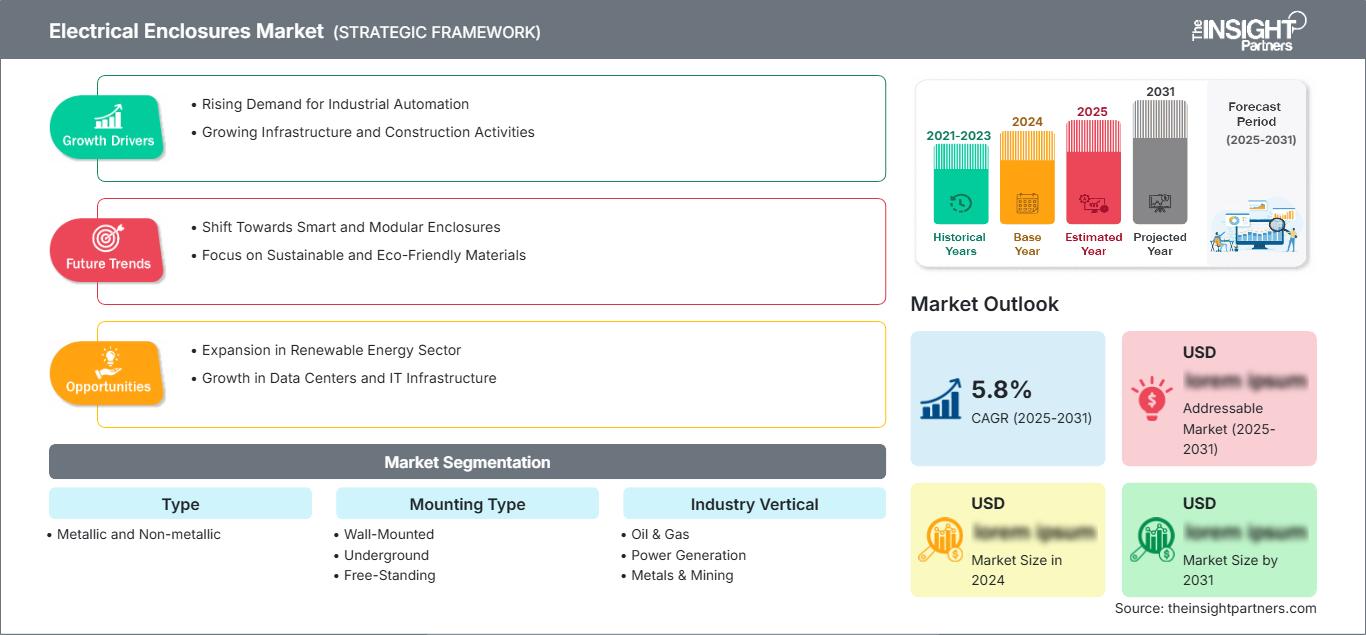
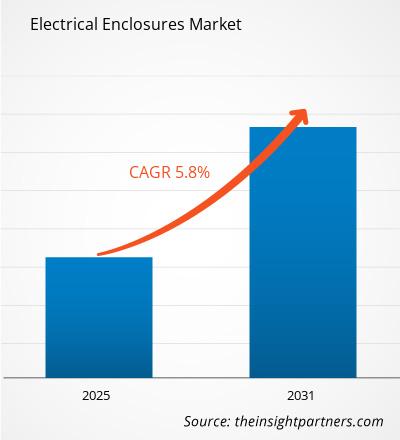
The Electrical Enclosures Market size, valued at US$ 8.41 Billionin 2025, is projected to reach US$ 14.27 Billion by 2034, expanding at a CAGR of 6.05% during 2026–2034. The market encompasses protective housings for electrical, automation, power distribution, and control equipment across industrial and infrastructure environments. Demand is increasingly shaped by electrification, equipment-density requirements, environmental protection standards, industrial automation, and investments in resilient power infrastructure.
North America remains a structurally important demand center, with an estimated 5.8–6.4% CAGR between 2026 and 2034. Replacement of aging electrical infrastructure, expansion of data centers and manufacturing capacity, grid modernization, and stricter requirements for equipment protection support sustained enclosure procurement. Demand is also shifting toward engineered configurations offering thermal management, corrosion resistance, modular installation, and compliance with recognized NEMA and IEC protection requirements.
Electrical Enclosures Market Assessment and Insights
- North America: The region is expected to account for 26–30% Electrical Enclosures Market share in 2025 and expand at a 5.8–6.4% CAGR between 2026–2034, supported by manufacturing investment, data-center construction, grid modernization, and replacement of aging electrical infrastructure.
- US: The US represents 72–76% of North American demand in 2025 and is projected to grow at a 5.9–6.5% CAGR between 2026–2034, driven by industrial expansion and power infrastructure investment.
- Europe: Europe is estimated at 28–32% share in 2025, with a 5.5–6.1% CAGR between 2026–2034. Germany, the UK, France, Italy, and Spain benefit from industrial automation, renewable integration, electrification, and infrastructure modernization.
- Asia Pacific: Asia Pacific is estimated at 32–36% share in 2025 and is projected to grow at a 6.7–7.4% CAGR between 2026–2034, led by China, India, Japan, South Korea, and Australia through manufacturing expansion and grid investment.
- Largest Segment: Metallic enclosures hold an estimated 63–66% market share in 2025 and are projected to expand at a 5.6–6.1% CAGR during 2026–2034, reflecting strength and shielding requirements.
- High Growth Segment: Non-metallic enclosures represent approximately 34–37% share in 2025 and are expected to grow at a 7.0–7.8% CAGR during 2026–2034, supported by corrosion resistance and lightweight construction.
- Key companies analyzed in detail: ABB Ltd., Eaton Corporation plc, Schneider Electric SE, Emerson Electric Co., Pentair plc, Legrand SA, Hubbell Incorporated, Hammond Manufacturing Company Limited, Leviton Manufacturing Co., Inc., and Adalet, LLC.
Source: The Insight Partners' analysis based on proprietary research, government publications, company annual reports, investor presentations, industry databases, and expert interviews.
Production is shifting from standardized metal boxes toward configurable systems incorporating thermal management, modular mounting, improved ingress protection, and application-specific materials. Stainless steel remains important in harsh environments, while engineered polymers and fiberglass gain traction where corrosion, weight, and installation time matter. Manufacturers are also localizing production to shorten lead times and reduce exposure to steel, aluminum, resin, and freight volatility.
Looking ahead, investment is likely to favor high-specification enclosures for renewable generation, substations, industrial automation, transportation, and data infrastructure. Emerging economies offer volume opportunities as electrification expands, while mature markets emphasize replacement and compliance upgrades. IEC 60529, UL, NEMA, and hazardous-location requirements will continue influencing product specifications, qualification costs, and supplier selection across infrastructure-intensive applications.
Electrical Enclosures Market Report Scope
| Report Attribute | Details |
|---|---|
| Market size in 2025 | US$ 8.41 Billion |
| Market Size by 2034 | US$ 14.27 Billion |
| Global CAGR (2026 - 2034) | 6.05% |
| Historical Data | 2021-2024 |
| Forecast period | 2026-2034 |
Electrical Enclosures Market Analysis
The Electrical Enclosures Market report shows that growth is linked to electrical distribution, industrial controls, renewable energy production, electric transportations, and digital infrastructure developments. The value chain includes processors of steel and aluminum, producers of polymers and composites, fabricators, component manufacturers, distributors, system integrators, and end-users. End-users tend to select enclosure suppliers based on protection capabilities, customization, thermal management, certifications, supply stability, and life cycle costs, not only the price of an enclosure.
The market supply is still affected by the prices of metal and polymer inputs, availability of fabricating capabilities, and regional manufacturing capabilities. Wall-mounted enclosures serve the needs for standardized distribution solutions, while large free-standing enclosures satisfy the requirements of switchgear, motor control, automation, and power applications. Custom fabrication provides market differentiation because enclosure size, cable entry, cooling, hazardous area certifications, and mounting arrangements can differ per projects.
Competitive positioning includes comprehensive electrical product offerings along with engineering, certification, and regional distribution. ABB Ltd., Eaton Corporation plc, Schneider Electric SE, Emerson Electric Co., and Legrand SA engage in competition through comprehensive electrical product offerings, while Pentair plc, Hubbell Incorporated, Hammond Manufacturing Company Limited, Leviton Manufacturing Co., Inc., and Adalet, LLC target protection and enclosure applications. Electrical Enclosures Market thus requires greater emphasis on broad product offerings and application engineering.
Investments are being made in localized manufacturing capabilities, engineered-to-order offerings, digital specification tools, and product offerings for data centers and electrification projects. Eaton Corporation plc gained ground in its modular power infrastructure business through its Fibrebond acquisition in 2025, whereas Schneider Electric SE is expanding its investments in the United States and India. Such efforts suggest that strategic positioning is increasingly becoming reliant on close proximity to large infrastructure projects.
● REPORT CUSTOMIZATION
Tailor This Report To Align With Your Specific Business Requirements
This report can be customized to align precisely with your business objectives, scope, and target markets. Customization options include tailored segmentation, geography, competitive analysis, and strategic insights to support informed decision-making.
Customize This Report →WHAT YOU CAN ADJUST
- ● Segmentations
- ● Geography
- ● Competitive Analysis
- ● Language Preferences
Electrical Enclosures Market: Strategic Insights
Regional Insights
North America Electrical Enclosures Market
North America accounts for around 26% to 30% in 2025 and is forecast to achieve 5.8% to 6.4% CAGR till 2034. The key driver for North America is US demand driven by reshored manufacturing, construction of data centers, modernization of utilities, and upgrades of the aging industrial electrical system. Canada gains from mining, energy infrastructure, and transport infrastructure development, whereas Mexico gains from manufacturing localization.
Trends in the region include shifting from cabinets to engineered cabinets with better thermal performance, corrosion resistance, and higher ingress protection. Data centers need enclosures for electrical and control systems. Advanced manufacturing requires automation cabinets. Compliance and certifications motivate suppliers to have regional engineering and manufacturing facilities to overcome procurement challenges during cyclical construction and industrial downturns.
U.S. Electrical Enclosures Market
The United States holds 72–76% share of North America’s demand in 2025 and is forecasted to grow at a 5.9–6.5% CAGR until 2034. Major vendors like ABB Ltd., Eaton Corporation plc, Schneider Electric SE, Emerson Electric Co., Pentair plc, and Hubbell Incorporated have a sizable market share in electrical distribution, industrial automation, utilities, commercial, and infrastructure sectors.
Market demand is driven by increased demand from semiconductor fabrication, data centers, renewable energy projects, utility infrastructure improvements, and transportation infrastructure. Industrial users prefer reliable metal enclosures for their switchgear and automation components, whereas special cases tend to go for composites due to concerns related to corrosion and weight. NEMA ratings, UL approval, customization, thermal efficiency, and lead times also play an important role in procurement.
Europe Electrical Enclosures Market
Europe constitutes a 28–32% share in 2025 and is forecast to increase at a CAGR of 5.5–6.1% through 2034. Germany takes the top spot for regional demand, ahead of the UK, France, Italy, and Spain, with industrial automation, electrification, renewable integration, and infrastructure upgrade contributing to replacement and new build demands.
The UK and Germany retain significance as manufacturing and automation hubs. Germany enjoys advantages of high density of industrial manufacture, machine construction, and transition-to-renewable energy investments, while the UK offers grid modernization along with data center and infrastructure modernization. The contributions of France, Italy, and Spain come from renewables, transportation infrastructure, industrial complexes, and buildings modernization. Buyers in Europe have strong preference for safety, environmental resilience, modularity, and lifecycle performance, seeking certified suppliers and application engineering capabilities.
APAC Electrical Enclosures Market
APAC has a market share of 32-36% in 2025 and is expected to grow at a CAGR of 6.7-7.4% till 2034, driven by demand from China. Japan and South Korea contribute to industrial applications using sophisticated technology, whereas India and Australia contribute towards infrastructure and energy.
China capitalizes on economies of manufacturing and energy power infrastructure, India on electricity and industrial investments, Japan and South Korea due to automation-driven manufacturing, and Australia via mining and energy projects. Manufacturing investments, renewable energy projects, grid infrastructure development, and transport investments create opportunities for demand for both metal and engineered non-metallic enclosures.
Middle East & Africa Electrical Enclosures Market
Demand in the Middle East and Africa region will grow with a 6.2%-6.9% CAGR till 2034, mainly driven by Saudi Arabia; however, UAE and South Africa will act as additional demand drivers. Infrastructure projects, large-scale power generation, transportation, industry projects, and industrial infrastructures will create demands for the need for protected enclosures for electrical distribution and control.
Infrastructure diversification and energy projects will support demand in Saudi Arabia and the UAE, whereas South Africa will require modernization in the utility sector, mining, and industrial projects. Rest of the MEA will continue being project-driven markets with the demand driven by access to power and growth of the industrial sector. High ambient temperature, dust, and corrosive environment will make enclosure rating more critical.
Segmentation Analysis
Type
Metallic and non-metallic designs address different environmental and performance requirements. Metallic products retain broad adoption where mechanical strength, electromagnetic shielding, fire performance, and high-current equipment protection are priorities. Non-metallic alternatives increasingly compete in corrosive or lightweight applications. The Type segment is expected to expand at a 5.8–6.4% CAGR during 2026–2034, with material selection becoming increasingly application-specific.
- Metallic: Steel, stainless steel, and aluminum enclosures remain preferred for demanding industrial, power, oil and gas, and automation environments requiring structural rigidity and electromagnetic shielding.
- Non-metallic: Fiberglass, polycarbonate, and related composites support corrosion-sensitive and lightweight installations, particularly where chemical exposure, outdoor deployment, or simplified handling influences purchasing decisions.
Mounting Type
Mounting configuration directly affects installation space, accessibility, cable routing, and equipment capacity. Wall-mounted products support distributed control and compact electrical installations, whereas underground and free-standing systems address specialized infrastructure and higher-capacity equipment. The Mounting Type segment is forecast to grow at a 5.9–6.5% CAGR during 2026–2034 as modular installation becomes more important.
- Wall-Mounted: Compact cabinets remain widely used for distribution boards, control systems, automation equipment, and retrofit projects where floor space and installation time are constrained.
- Underground: Underground enclosures serve infrastructure applications requiring concealed equipment placement, physical protection, and controlled access, particularly in utility and transportation installations.
- Free-Standing: Free-standing systems accommodate larger electrical assemblies and complex internal layouts, making them strategically important for switchgear, motor control, automation, and industrial power distribution.
Industry Vertical
Industrial applications remain central because electrical equipment requires protection from dust, moisture, chemicals, mechanical impact, and unauthorized access. Oil and gas demand emphasizes hazardous-area protection, while power generation and metals and mining require rugged configurations. Transportation and food and beverage increasingly specify corrosion-resistant and hygienic designs. The Industry Vertical segment is projected to grow at a 6.1–6.8% CAGR during 2026–2034.
- Oil & Gas: Harsh environments and hazardous-area requirements sustain demand for certified enclosures designed for flammable atmospheres, corrosion exposure, and demanding maintenance conditions.
- Power Generation: Generation and distribution facilities require durable cabinets for protection, switching, monitoring, control, and auxiliary systems across conventional and renewable assets.
- Metals & Mining: Mining operations favor mechanically robust and corrosion-resistant enclosures capable of protecting control equipment under dust, vibration, moisture, and temperature extremes.
- Transportation: Rail, metro, airport, and road infrastructure increasingly requires compact, secure, and environmentally protected enclosures for signaling, traction, control, and distribution equipment.
- Food & Beverage: Hygienic production environments prioritize stainless-steel construction, smooth surfaces, washdown resistance, and designs that minimize contamination risks around electrical systems.
- Others: Diverse commercial and industrial applications create recurring demand for configurable cabinets, particularly where electrical equipment requires localized protection, controlled access, and standardized installation practices.
Opportunity Snapshot
| Industry Vertical | Revenue Contribution | Trend Tag | Adoption Stage |
|---|---|---|---|
| Oil & Gas | High | Hazard Protection | Mature |
| Power Generation | High | Grid Modernization | Mature |
| Metals & Mining | Medium | Harsh Environment | Mature |
| Transportation | Medium | Rail Electrification | Scaling |
| Food & Beverage | Medium | Hygienic Design | Scaling |
| Others | Low | Retrofit Demand | Scaling |
Electrical Enclosures Market Growth Drivers and Impact Analysis
Industrial automation increases demand for protected control infrastructure
The Electrical Enclosures Market trends show that inclination toward industrial automation has increased the density and complexity of electrical and control devices within the factory environment. The controllers, drives, networking hardware, power devices, and safety systems need to be kept in an environment that is free from dust, moisture, temperature, and mechanical hazards. This will create more demand for customized enclosures based on their own unique configuration requirements, rather than standard enclosures. The effect will be seen especially at places where existing production lines have been automated without constructing a new factory. Firms capable of offering configurable panels, thermal solutions, cabling options, and documentation will earn more valuable contracts. Automating systems leads to a short replacement cycle since the process of replacing controllers is linked with modifying the enclosures.
Grid modernization expands enclosure requirements across power assets
Power systems have seen the introduction of renewables, digital substations, distributed energy sources, energy storage, and improved protection mechanisms, all of which mean more applications in which there is a need for electrical equipment to be environmentally protected. New and refurbished substations would need cabinets for relays, communication systems, monitoring, switching and auxiliary power systems. The same can be said for renewable energy projects, where there is a need for environmental protection around inverters, controls, transformers, and even the collection systems. These developments mean that enclosure requirements are now expanding from just traditional utility cabinets to specialized enclosures for outdoor applications and high-temperature environments. There is an increasing need by utilities to standardize equipment, and common enclosure standards would make maintenance and spare parts handling easier across different geographical locations.
Data-center expansion increases demand for engineered electrical protection
Construction of the data center causes high demands on electrical distribution devices, backup energy sources, monitoring devices, and control equipment. Uptime, cooling, installation time, and maintenance are among other demands associated with hyperscale and colocation facilities. These demands create the advantage for modular and engineered enclosures which can be assembled and tested before delivery. Moreover, the investment effect does not end within the data hall because substations, battery storage, cooling infrastructure, and connections with utilities all need some electrical equipment to be enclosed. Multiple site deployments allow suppliers to take benefits from frameworks and configurations as opposed to separate orders of the products. This situation motivates enclosure companies to provide integrated solutions for thermal and monitoring needs as well as modularity and increases demand for products which can accommodate high density of electrical equipment.
Electrical Enclosures Market Future Trends
Smart monitoring will become embedded within enclosure architectures
Enclosures of the future will feature sensors for temperature, humidity, door openings, vibrations, corrosion warnings, and the state of the power system. Communication will enable facility managers to determine when environmental conditions become unfavorable for the sensitive electronics inside. This can turn enclosure devices into monitored pieces of infrastructure rather than simply protective products. Integration with industrial networks and building-management systems will facilitate condition-based maintenance and prevent unnecessary on-site inspection visits. Sensors might be offered by suppliers along with special doors, mounting hardware, and communication ports as part of the standard product configuration. Digital commissioning procedures, configuration software, and remote diagnostics might also accelerate deployment cycles. It makes sense to initiate the adoption of this technology with data centers, utilities, and process industries in which costs of downtime are high.
Modular engineering will reshape procurement and installation models
Modular enclosure systems should receive increased attention as industrial installations grow more standardized and schedules become more urgent. Rather than designing each enclosure from the outer housing down, companies can now provide configurable systems that feature established mounting patterns, heat accessories, cable entries, and interior assemblies. Such solutions can enable repetition for factories, renewable installations, transportations systems, and data facilities. It may also assist in factory testing by allowing configurations to be tested prior to shipping. End-users can take advantage of decreased installation times and increased procurement predictability. Manufacturers can enjoy savings from the reuse of parts and manufacturing processes. Modular systems may eliminate the distinction between enclosure manufacturing and system assembly in the long run. Companies must have configuration capabilities, engineering software, certifications, and scalability.
Electrical Enclosures Market Opportunities
Localized manufacturing can capture infrastructure-led regional demand
This approach will provide manufacturers with the ability to establish or expand their presence with regional manufacturing facilities close to major infrastructure projects. Regional manufacturing minimizes the risk of transport, increases speed of delivery, facilitates regional certifications and customization according to project specifications. This approach becomes highly important for regions like India, Southeast Asia, the Middle East and North America, where there is a lot of development taking place in industrialization and electricity generation infrastructure, thus creating consistent demand for equipment. Investors should concentrate on facilities with capabilities to manufacture not only commodity equipment but also engineered equipment. Sourcing regional materials like steel, polymers, hardware and accessories can add to the robustness of operations when international logistics become unstable. Partnership with electrical distributors and system integrators can speed up market entry.
Engineered enclosure platforms can expand value per customer
Suppliers can increase revenue quality by moving beyond standalone cabinets toward engineered enclosure platforms that combine mechanical protection with thermal management, internal mounting, cable management, monitoring readiness, and factory assembly. Such offerings address customers seeking shorter installation cycles and predictable system performance. The Electrical Enclosures Market Forecasts therefore points toward opportunities where suppliers can standardize core architectures while customizing interfaces for individual applications. Data centers, utilities, transportation projects, and advanced manufacturing offer particularly suitable targets because equipment layouts repeat across projects but still require application-specific modifications. Strategic investment in digital configuration tools can reduce engineering effort and improve quotation accuracy. Companies can also create recurring relationships through maintenance kits, replacement panels, accessories, and lifecycle services, shifting the commercial model from one-time enclosure sales toward longer-term account development and application support.
Recent Developments
- March 2026: Legrand launched Chroma Link™, a color-indexed, hyper-density fiber-optic cabling solution designed for AI and machine learning data centers supporting 800G applications and higher. The turnkey solution integrates enclosures, trunks, and harnesses, with configurations supporting up to 2,304 fibers in 1RU enclosures and 4,608 fibers in 2RU enclosures. Its color-indexing system matches ports on the enclosure with corresponding trunks and harnesses, helping technicians simplify fiber identification, reduce installation errors, and accelerate deployment and maintenance in increasingly dense data-center environments.
- August 2025: ABB launched new labor- and space-saving electrical solutions designed to enhance data center infrastructure, addressing the growing power and space requirements of AI-driven data centers. The solutions are designed to accommodate larger electrical loads while reducing equipment weight, installation space, and deployment time. The portfolio supports more efficient power distribution and infrastructure deployment in data centers, helping operators address increasing electrical capacity requirements while optimizing facility space. The launch strengthens ABB’s electrical infrastructure portfolio and supports the growing demand for compact, efficient electrical equipment and enclosure-based power distribution solutions in data center applications.
- August 2025: Pepperl+Fuchs launched one of the first Ethernet-APL control cabinet solutions on the market, combining a 24-port FieldConnex Ethernet-APL switch with an LB Remote I/O backplane featuring 22 slots. The switch and Remote I/O system are fully pre-wired and vertically mounted, enabling faster commissioning, simplified installation, and easier maintenance. The modular control cabinet solution is designed to support Ethernet-APL connectivity and digitalization in process automation environments, strengthening Pepperl+Fuchs’ industrial control infrastructure portfolio and supporting demand for advanced control cabinets and electrical enclosure solutions.
Frequently Asked Questions

- Comprehensive Market Sizing and Forecast Analysis
- Detailed Segmentation Analysis
- In-Depth Market Dynamics Assessment
- Regional and Country-Level Insights
- Competitive Landscape and Company Benchmarking
- Strategic Business Intelligence
Recent Reports
Testimonials

The Insight Partners' SCADA System Market report is comprehensive, with valuable insights on current trends and future forecasts. The team was highly professional, responsive, and supportive throughout. We are very satisfied and highly recommend their services.
RAN KEDEM Partner, Reali Technologies LTDs
I requested a report on a very specific software market and the team produced the report in a few days. The information was very relevant and well presented. I then requested some changes and additions to the report. The team was again very responsive and I got the final report in less than a week.
JEAN-HERVE JENN Chairman, Future Analytica
We worked with The Insight Partners for an important market study and forecast. They gave us clear insights into opportunities and risks, which helped shape our plans. Their research was easy to use and based on solid data. It helped us make smart, confident decisions. We highly recommend them.
PIYUSH NAGPAL Sr. Vice President, High Beam Global
The Insight Partners delivered insightful, well-structured market research with strong domain expertise. Their team was professional and responsive throughout. The user-friendly website made accessing industry reports seamless. We highly recommend them for reliable, high-quality research services
YUKIHIKO ADACHI CEO, Deep Blue, LLC.
This is the first time I have purchased a market report from The Insight Partners.While I was unsure at first, I visited their web site and felt more comfortable to take the risk and purchase a market report.I am completely satisfied with the quality of the report and customer service. I had several questions and comments with the initial report, but after a couple of dialogs over email with their analyst I believe I have a report that I can use as input to our strategic planning process.Thank you so much for taking the extra time and making this a positive experience.I will definitely recommend your service to others and you will be my first call when we need further market data.
JOHN SUZUKI President and Chief Executive Officer, Board Director, BK Technologies
I wish to appreciate your support and the professionalism you displayed in the course of attending to my request for information regarding to infectious disease IVD market in Nigeria. I appreciate your patience, your guidance, and the fact that you were willing to offer a discount, which eventually made it possible for us to close a deal. I look forward to engaging The Insight Partners in the future, all thanks to the impression you have created in me as a result of this first encounter.
DR CHIJIOKE ONYIA MANAGING DIRECTOR, PineCrest Healthcare Ltd.Reason to Buy
- Informed Decision-Making
- Understanding Market Dynamics
- Competitive Analysis
- Identifying Emerging Markets
- Customer Insights
- Market Forecasts
- Risk Mitigation
- Boosting Operational Efficiency
- Strategic Planning
- Investment Justification
- Tracking Industry Innovations
- Aligning with Regulatory Trends





 Get Free Sample for