
Embedded Systems in Automobiles Market Size, Share & Growth by 2034
Coverage: By Type (Embedded Hardware, Embedded Software); Component (Sensors, Microcontrollers (MCU), Transceivers, Memory Devices); Vehicle Type (Passenger Cars, Commercial Vehicles), and Geography (North America, Europe, Asia Pacific, and South and Central America)
- Status : Data Released
- Report Code : TIPRE00016007
- Category : Electronics and Semiconductor
- No. of Pages : 150
- Available Report Formats :


- Last update date : August 26, 2026


2025 Market Size
US$ 5.99 Bn
Base year value
2034 Forecast
US$ 11.37 Bn
Projected by 2034
CAGR 2026-2034
7.38 %
Growth rate
Addressable Market
US$ 78.27 Bn
(2026-2034)
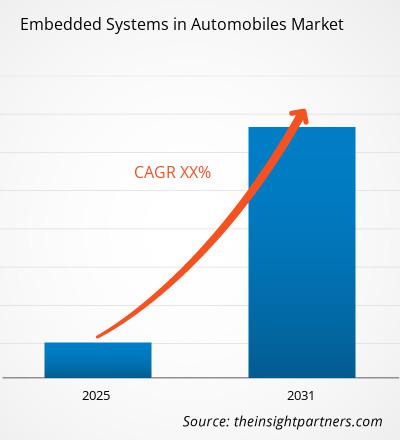
The Embedded Systems in Automobiles market stood at US$ 5.99 Billion in 2025 and is estimated to rise up to US$ 11.37 Billion by 2034, growing at a CAGR of 7.38% from 2026 to 2034. The trends in vehicle electrification, centralized computing, advanced driver assistance, connected car services, and software defined architecture result in higher embedded content demand per vehicle, in addition to the need by automakers of scalable platforms which include deterministic control, functional safety, cybersecurity, and upgradability.
North America is estimated to grow at 6.8% - 7.4% during 2034, as there is consolidation of electronics control unit along with growth in zonal network architecture by automakers in the region. The Embedded Systems in Automobiles market size in North America is driven by its leading position in software platforms, semiconductor design, and high value light trucks in addition to regulatory pressure on active safety.
Embedded Systems in Automobiles Market Assessment and Insights
- North America: Represented 28–31% share in 2025 and is expected to grow at 6.8–7.4% CAGR between 2026–2034, supported by software-defined vehicle programs, advanced safety adoption, and regional semiconductor investment.
- US: Accounted for 82–86% of North American demand in 2025 and is projected to expand at 6.9–7.5% CAGR between 2026–2034.
- Europe: Held 25–28% share in 2025 and should grow at 6.5–7.1% CAGR between 2026–2034, led by Germany, the UK, and France under stringent safety and emissions rules.
- Asia Pacific: Captured 36–39% share in 2025 and is forecast to rise at 8.1–8.8% CAGR between 2026–2034, with China, Japan, South Korea, and India anchoring output and electronics supply.
- Largest Segment: Embedded hardware represented 61–65% market share in 2025 and is expected to grow at 6.6–7.2% CAGR between 2026–2034.
- High Growth Segment: Embedded software held 35–39% market share in 2025 and is projected to expand at 8.4–9.1% CAGR between 2026–2034.
- Key companies analyzed in detail: Continental AG, DENSO CORPORATION, ETAS GmbH, HARMAN International Industries, Incorporated, Infineon Technologies AG, Mitsubishi Electric Corporation, NXP Semiconductors N.V., Panasonic Holdings Corporation, Texas Instruments Incorporated, and Toshiba Information Systems (Japan) Corporation.
Source: The Insight Partners' analysis based on proprietary research, government publications, company annual reports, investor presentations, industry databases, and expert interviews.
The evolution of vehicle electronics architecture is shifting from distributed controllers that perform a single function towards domains/zones that consolidate compute, memory, and networks. This trend means sourcing for hardware and software platforms as opposed to individual components, hence making middleware and virtualization solutions essential. The development cycle still exposes the supply chain to automotive semiconductors lead times, but the advances made by 16 nm microcontrollers, embedded non-volatile memory, Ethernet, and edge accelerators are increasing performance per watt while minimizing cabling and controller redundancy.
Through 2034, investments shall remain in China, India, Southeast Asia, and some selected Middle East assembly locations where increased volume production shall support engineering ecosystem development. UN ECE security and update standards, Euro NCAP test methods, and national electrification strategies shall make development traceable and computationally rich. Suppliers capable of offering extended lifecycle support, secure toolchain, and scalable domains shall capture design wins amid the emerging-market automakers that are directly moving towards central electrical/electronic architectures.
Embedded Systems in Automobiles Market Report Scope
| Report Attribute | Details |
|---|---|
| Market size in 2025 | US$ 5.99 Billion |
| Market Size by 2034 | US$ 11.37 Billion |
| Global CAGR (2026 - 2034) | 7.38% |
| Historical Data | 2021-2024 |
| Forecast period | 2026-2034 |
Embedded Systems in Automobiles Market Analysis
Embedded Systems in Automobiles Market Drivers include increasing electronics content in electric powertrains, automation features, digital cockpits, and connected body functions. The sales volume of electric vehicles was above 17 million in 2024, and EV sales constituted more than 20% of the global sales of cars, making powertrain controller solutions, battery management sensors, secure gateways, and thermal management software highly demanded.
This ecosystem includes semiconductor foundry companies, suppliers of devices, OS providers, middleware vendors, Tier 1 integrators, OEM engineering staff, and validation experts. Supply chain choices become increasingly dependent on automotive qualification, cybersecurity, functional safety, software compatibility, and fifteen years of availability. Platform reuse and dual sourcing minimize the risks of disruption, while system consolidation to domain controllers increases importance of high-performance processors, memory, transceivers, and lifecycle software.
Embedded Systems in Automobiles Market research shows that competition is shifting from the performance of components to platform capabilities and developer productivity. NXP Semiconductors N.V. and Infineon Technologies AG offer scalable automotive processing, while Continental AG, DENSO CORPORATION, ETAS GmbH, and HARMAN International Industries, Incorporated integrate their systems and software, cockpit, and mobility expertise.
Investment favors zonal control, in-vehicle Ethernet, AI-enabled sensing, virtual development, and secure update infrastructure. Panasonic Holdings Corporation, Mitsubishi Electric Corporation, Texas Instruments Incorporated, and Toshiba Information Systems (Japan) Corporation compete through electronics depth and application engineering. Strategic positioning depends on reference designs, pre-integrated software, safety evidence, and ecosystem partnerships that shorten OEM validation cycles. Suppliers with interoperable toolchains can capture recurring software value while protecting component design wins.
● REPORT CUSTOMIZATION
Tailor This Report To Align With Your Specific Business Requirements
This report can be customized to align precisely with your business objectives, scope, and target markets. Customization options include tailored segmentation, geography, competitive analysis, and strategic insights to support informed decision-making.
Customize This Report →WHAT YOU CAN ADJUST
- ● Segmentations
- ● Geography
- ● Competitive Analysis
- ● Language Preferences
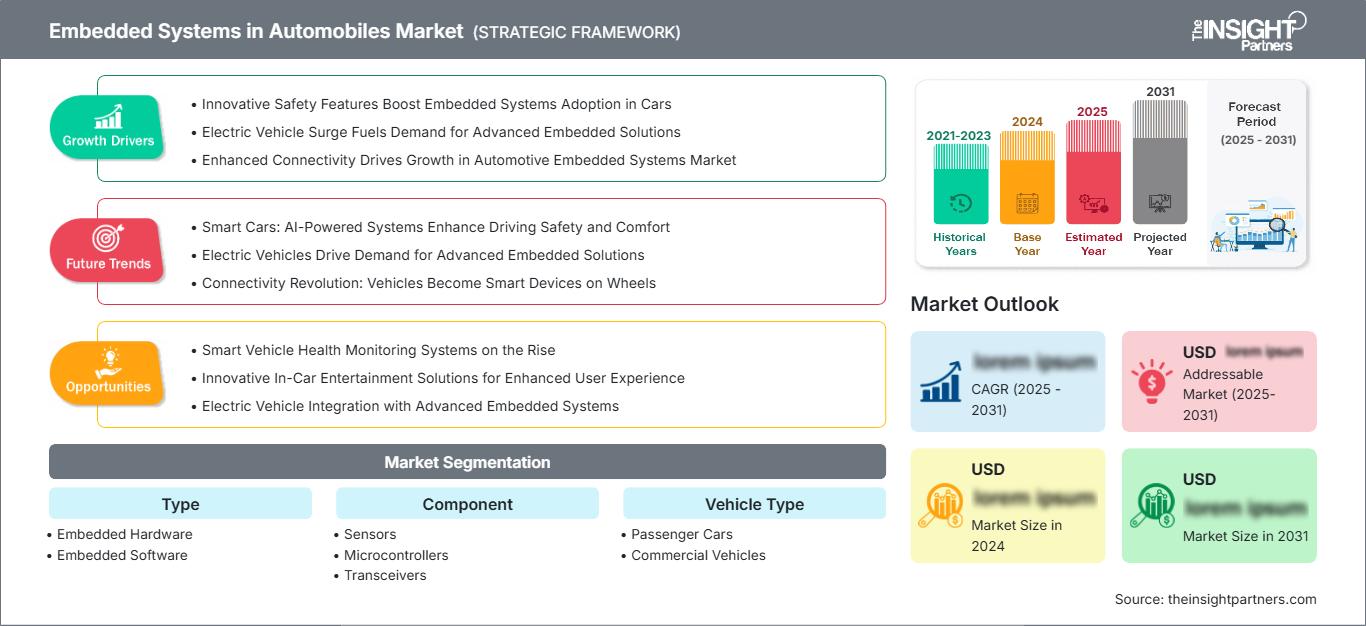
Embedded Systems in Automobiles Market: Strategic Insights
Regional Insights
North America Embedded Systems in Automobiles Market
North America was estimated to account for 28-31% of the worldwide market revenue in 2025, expected to grow at a rate of 6.8-7.4% CAGR till 2034. North America Embedded Systems in Automobiles Market Share indicates high level of electronics in pick-ups, SUVs, luxury cars, and commercial vehicles. Driver assistance, digital cockpits, telematics, and battery management applications will drive processors, sensors, transceivers, and embedded software requirements.
Strong regional presence due to U.S. semiconductor design, automotive software, cloud computing, engineering services, along with Canadian testing capabilities and Mexican automotive manufacturing. Domestic production of semiconductors provides increased robustness of supply chains, whereas cyber security and safety regulations increase the qualification requirements. Reducing harness weight and controllers numbers in order to increase zonal architecture, Ethernet backbone, and central computers in efforts of OEMs offers opportunities for long-term availability and security.
U.S. Embedded Systems in Automobiles Market
The U.S. accounted for 82–86% of North American demand in 2025 and is forecast to experience 6.9–7.5% CAGR through 2034. High-volume light vehicles, premium features, and advanced driver assistance systems drive up demands for deterministic control, sensing, displays, communications, and security solutions. The growing market for electric pickups and delivery vans and new software-upgradable vehicle platforms increase compute and memory content beyond traditional powertrain applications.
Large semiconductor suppliers and cockpit vendors operate engineering and sales facilities in the country, allowing tighter cooperation with automakers. Application evolution includes moving away from individual ECUs toward highly capable domain controllers and zone gateways that include body, chassis, infotainment, and energy domains. Federal emphasis on safety and regional initiatives to advance zero emissions facilitate investment, while fleet managers are interested in remote diagnosis, predictive maintenance, and secure over-the-air updates to cut down on vehicle downtime.
Europe Embedded Systems in Automobiles Market
Europe had 25–28% share of global revenues in 2025 and is expected to grow at a 6.5–7.1% CAGR up to 2034. In Germany, leadership arises from advanced engineering for premium cars, Tier 1s' concentration, and early implementations of centralized architectures. The increasing standardization of software platforms in combustion engines, hybrids, and BEVs is driving demand for security-qualified microcontrollers, memory, sensors, and Ethernet.
In the UK, leadership comes from motorsports engineering, autonomous vehicle testing, and semiconductors design. The focus of adoption is placed on advanced driver assistance systems and connected car services. In France, there is an emphasis on electrification in the mainstream segment and suppliers specializing in control systems. In Italy, performance and industrial electronics prevail, while Spain has its leadership based on assembly capacity. Security requirements of UNECE regulation and Euro NCAP protocol, along with EU emissions regulations, dictate lifecycle management criteria across the region.
APAC Embedded Systems in Automobiles Market
The Asia-Pacific market took up 36-39% of revenues in 2025 and will be growing by 8.1-8.8% until 2034. China dominates due to vehicle manufacturing, electric vehicles (EVs), regional semiconductor projects, and fast cockpit installation. Automotive electronics from Japan and South Korea, as well as Indian assembly and software skills, provide an expanded addressable pool of potential customers.
Connected fleet and safety applications exist in Australia regardless of low production capacity in the region. Electrification and manufacturing policies in Asia-Pacific increase the usage of embedded control systems. Cost-effective platforms use scalable microcontrollers, connectivity, and flexible software.
Middle East & Africa Embedded Systems in Automobiles Market
MEA and Africa will see their demand grow at a pace of 7.0%-7.7% up to 2034. The market leader in MEA and Africa will be Saudi Arabia due to industrial diversification, electric car manufacturing plans and smart mobility investment initiatives. The UAE has its focus on connectivity of vehicle fleets and luxury cars whereas South Africa offers assembly capacity and supply chain expertise.
Rest of MEA uptake varies since vehicle cost and availability of infrastructure is different. The energy transition schemes and logistics improvements along with urban transport investments enable implementation of telematics, battery management systems and safety electronics.
Segmentation Analysis
Type
The Type segment is projected to grow at 7.1–7.8% during 2026–2034. Embedded Systems in Automobiles Market scope across hardware and software reflects a shift toward platform purchasing, where compute capability, middleware, safety mechanisms, and update support are evaluated together. Hardware retains the larger revenue base, while software gains strategic weight as OEMs separate application development from physical controller cycles.
- Embedded Hardware: Hardware leads because every control, sensing, networking, and display function requires qualified processors, memory, interfaces, and power management designed for temperature, vibration, reliability, and long vehicle lifecycles.
- Embedded Software: Software demand scales with feature reusability, virtualization, secure updates, diagnostics, and data services, making operating systems, middleware, cybersecurity stacks, and development tools central to platform differentiation.
Component
The Component segment is expected to expand at 7.0–7.7% during 2026–2034. Greater sensor density, centralized processing, faster in-vehicle networking, and richer software images raise demand across the component stack. Selection priorities include functional safety, deterministic latency, thermal efficiency, cybersecurity, supply continuity, and compatibility with established development ecosystems, particularly for platforms shared across several model years.
- Sensors: Safety, battery, powertrain, cabin, and chassis applications sustain broad demand, with sensor fusion increasing the strategic importance of accuracy, redundancy, calibration stability, diagnostics, and rugged automotive packaging.
- Microcontrollers: Microcontrollers remain foundational for real-time control and safety partitioning, while next-generation devices add higher core performance, embedded nonvolatile memory, security accelerators, networking, and virtualization support.
- Transceivers: Transceivers enable reliable movement of growing data volumes across CAN, LIN, Ethernet, and other networks, making electromagnetic compatibility, low latency, fault tolerance, and power efficiency critical.
- Memory Devices: Larger software stacks and persistent vehicle data increase requirements for high-endurance nonvolatile storage and fast working memory, with safety, cybersecurity, retention, and extended availability guiding qualification.
Vehicle Type
The Vehicle Type segment is forecast to grow at 7.2–7.9% during 2026–2034. Passenger cars create scale for digital cockpit, driver assistance, connectivity, and electrified powertrain platforms. Commercial vehicles add strong lifecycle economics for telematics, energy optimization, remote diagnostics, and predictive maintenance, encouraging robust controllers and software designed for high utilization and longer service intervals.
- Passenger Cars: Passenger cars contribute the broader volume base as connected infotainment, active safety, electrification, and personalized features spread from premium models into mass-market platforms through modular electronics.
- Commercial Vehicles: Commercial vehicles prioritize uptime, fuel or energy efficiency, fleet visibility, and regulatory compliance, supporting embedded systems for telematics, powertrain control, safety assistance, diagnostics, and route-aware operation.
Opportunity Snapshot
| Vehicle Type | Revenue Contribution | Trend Tag | Adoption Stage |
| Passenger Cars | High | Zonal Computing | Scaling |
| Commercial Vehicles | Medium | Fleet Intelligence | Scaling |
Embedded Systems in Automobiles Market Growth Drivers and Impact Analysis
Electrification Raises Control and Sensing Intensity
The efficient operation of electric cars depends on a high degree of coordination among battery management, inverter management, thermal management, charging communications, isolation monitoring, and energy management. According to IEA, there were more than 17 million sales of electric cars in 2024, surpassing one-fifth of the total number of car sales worldwide and forecasted sales in 2025 to be above 20 million units. The use of each such platform increases the need for robust microcontrollers, current and temperature sensors, memory, and real-time software. This is due to the fact that electric car manufacturers usually introduce new powertrain systems in combination with centralized electronics and digital cockpits.
Safety Regulation Expands Deterministic Computing
New safety requirements involve monitoring of drivers, automated safety interventions, occupant detection, and safe diagnostics of sensors. These operations require more cameras, radars, ultrasonic sensors, sensor fusion software, and fail-operational controller design, making higher computing power and increased memory necessary in cars. There is a new regulation in purchasing as well – manufacturers need to describe behavior of software, security controls and updates during the life cycle of a car and not just at its release date. It becomes more difficult for companies without necessary knowledge and competencies to enter the market. Only companies with ISO 26262, ISO 21434, long-term product support, and traceable toolchain can succeed.
Architecture Consolidation Reduces Lifecycle Cost
Automakers are replacing dozens of isolated controllers with domain computers, central processors, and zonal gateways connected by high-speed networks. NXP Semiconductors N.V. reported that a jointly developed architecture with Rimac Technology could consolidate more than 20 electronic control units into three centralized units. Consolidation can reduce wiring, packaging, duplicate compute, and software maintenance while enabling cross-domain features. It also concentrates design risk, making deterministic performance, isolation, thermal design, and security essential. The commercial effect is a shift from numerous low-value devices toward fewer, higher-value processors, networking components, and software platforms, creating larger design wins but demanding deeper collaboration among chip vendors, Tier 1 suppliers, and OEMs.
Embedded Systems in Automobiles Market Future Trends
Open Instruction Sets Enter Automotive Control
Embedded Systems in Automobiles Market trends will increasingly reflect open instruction-set adoption as suppliers seek portability, customization, and lower ecosystem lock-in. Infineon Technologies AG announced an automotive RISC-V microcontroller family for applications ranging from entry-level control to high-performance systems, supported by virtual prototypes for pre-silicon software work. Broader adoption could diversify processor road maps and let automakers tailor accelerators, safety partitions, and security functions without abandoning established software assets. Success will depend on mature compilers, debuggers, operating systems, safety certification, and long-term support. RISC-V is therefore more likely to complement Arm and proprietary architectures before displacing them across safety-critical domains.
Vehicle Intelligence Moves to Central AI Hubs
Next-generation vehicles will centralize sensor fusion, personalization, predictive maintenance, and virtual sensing around processors that combine real-time control with AI acceleration. NXP Semiconductors N.V. introduced the S32N7 series in January 2026 as a 5 nm central platform intended to consolidate core vehicle functions and support fleetwide AI innovation. This architecture separates rapidly evolving AI compute from longer-lived vehicle controls through high-speed backbones and isolation. Suppliers will compete on software portability, model deployment, deterministic latency, power efficiency, and cybersecurity rather than peak processing alone. Central intelligence can also support recurring feature activation, provided OEMs establish trusted update, data governance, and safety-assurance processes.
Embedded Systems in Automobiles Market Opportunities
Pre-Integrated Platforms for Emerging Automakers
New and expanding vehicle manufacturers in India, Southeast Asia, the Middle East, and Africa need modern electronics without duplicating the engineering scale of established global OEMs. Vendors can package qualified microcontrollers, transceivers, safety middleware, diagnostics, and reference hardware into configurable platforms for body, powertrain, and cockpit functions. Local application teams and production test support can shorten launch schedules and improve first-pass validation. The investment case is strongest where a common platform serves multiple price points and vehicle classes. Partnerships with regional Tier 1 suppliers, engineering services firms, and universities can create support capacity while preserving global safety, cybersecurity, and lifecycle standards.
Lifecycle Software and Secure Update Services
Embedded Systems in Automobiles Market Forecasts support investment in post-sale software infrastructure because vehicles require security patches, feature upgrades, diagnostics, and compliance evidence over long service lives. Suppliers can build recurring revenue through update orchestration, fleet health analytics, vulnerability monitoring, and validated middleware maintenance. The opportunity is not limited to passenger cars: commercial fleets can quantify value through reduced downtime, remote fault resolution, and energy optimization. Winning offers should provide hardware-rooted security, rollback protection, campaign monitoring, and clear responsibility across OEM, Tier 1, and cloud environments. Contract structures can combine platform licenses, per-vehicle activation, and managed services while maintaining data ownership and safety governance.
Recent Developments
- March 2026: Microchip Technology has introduced the SAM9X75D5M, an automotive-grade System-in-Package (SiP) solution aimed at powering vehicle displays and human-machine interface (HMI) applications. The AEC-Q100 Grade 2-qualified device combines an Arm926EJ-S processor with 512 Mbit of DDR2 SDRAM in a single package.
- June 2026: Infineon Technologies has partnered with Amazon Web Services (AWS) to introduce a cloud-based platform designed to accelerate the evaluation and development of automotive microcontrollers (MCUs). The virtual platform allows engineers to test Infineon automotive MCUs without requiring physical hardware, potentially reducing evaluation cycles from several weeks to just a few minutes. The platform is aimed at helping automotive developers shorten development timelines, particularly as software-defined vehicles increase the importance of faster software and hardware evaluation
- May 2025: QNX, a division of BlackBerry, has launched QNX Hypervisor 8.0, an embedded virtualization platform designed to simplify and accelerate software development for automotive and other embedded applications. Built on the QNX Software Development Platform (SDP) 8.0, the solution allows multiple operating systems to run securely on a single system-on-chip (SoC).
Frequently Asked Questions

- Comprehensive Market Sizing and Forecast Analysis
- Detailed Segmentation Analysis
- In-Depth Market Dynamics Assessment
- Regional and Country-Level Insights
- Competitive Landscape and Company Benchmarking
- Strategic Business Intelligence
Recent Reports
Testimonials

The Insight Partners provided valuable market intelligence that supported our global go-to-market strategy. Their team was professional, responsive, and attentive to our feedback, providing thoughtful analysis and helpful methodological clarifications throughout the project.
Junmo Kim Chief Financial Officer (CFO), Enertech Co., Ltd.
The Insight Partners' SCADA System Market report is comprehensive, with valuable insights on current trends and future forecasts. The team was highly professional, responsive, and supportive throughout. We are very satisfied and highly recommend their services.
RAN KEDEM Partner, Reali Technologies LTDs
I requested a report on a very specific software market and the team produced the report in a few days. The information was very relevant and well presented. I then requested some changes and additions to the report. The team was again very responsive and I got the final report in less than a week.
JEAN-HERVE JENN Chairman, Future Analytica
We worked with The Insight Partners for an important market study and forecast. They gave us clear insights into opportunities and risks, which helped shape our plans. Their research was easy to use and based on solid data. It helped us make smart, confident decisions. We highly recommend them.
PIYUSH NAGPAL Sr. Vice President, High Beam Global
The Insight Partners delivered insightful, well-structured market research with strong domain expertise. Their team was professional and responsive throughout. The user-friendly website made accessing industry reports seamless. We highly recommend them for reliable, high-quality research services
YUKIHIKO ADACHI CEO, Deep Blue, LLC.
This is the first time I have purchased a market report from The Insight Partners.While I was unsure at first, I visited their web site and felt more comfortable to take the risk and purchase a market report.I am completely satisfied with the quality of the report and customer service. I had several questions and comments with the initial report, but after a couple of dialogs over email with their analyst I believe I have a report that I can use as input to our strategic planning process.Thank you so much for taking the extra time and making this a positive experience.I will definitely recommend your service to others and you will be my first call when we need further market data.
JOHN SUZUKI President and Chief Executive Officer, Board Director, BK Technologies
I wish to appreciate your support and the professionalism you displayed in the course of attending to my request for information regarding to infectious disease IVD market in Nigeria. I appreciate your patience, your guidance, and the fact that you were willing to offer a discount, which eventually made it possible for us to close a deal. I look forward to engaging The Insight Partners in the future, all thanks to the impression you have created in me as a result of this first encounter.
DR CHIJIOKE ONYIA MANAGING DIRECTOR, PineCrest Healthcare Ltd.Reason to Buy
- Informed Decision-Making
- Understanding Market Dynamics
- Competitive Analysis
- Identifying Emerging Markets
- Customer Insights
- Market Forecasts
- Risk Mitigation
- Boosting Operational Efficiency
- Strategic Planning
- Investment Justification
- Tracking Industry Innovations
- Aligning with Regulatory Trends





 Get Free Sample for