
Environmental Remediation Market Size, Demand & Growth by 2034
Environmental Remediation Market Size and Forecasts (2021 - 2034), Global and Regional Share, Trends, and Growth Opportunity Analysis Report Coverage : By Technology (Air Sparging, Soil Washing, Chemical Treatment, Bioremediation, Electrokinetic Remediation, Excavation, Permeable Reactive Barriers, Others); Environment Medium (Soil, Groundwater); Site Type (Private, Public); Application (Mining and Forestry, Oil & Gas, Agriculture, Automotive, Others)
- Status : Data Released
- Report Code : TIPRE00039420
- Category : Electronics and Semiconductor
- No. of Pages : 150
- Available Report Formats :


- Last update date : August 26, 2026


2025 Market Size
US$ 133.25 Bn
Base year value
2034 Forecast
US$ 246.35 Bn
Projected by 2034
CAGR 2026-2034
7.07 %
Growth rate
Addressable Market
US$ 1,713.89 Bn
(2026-2034)
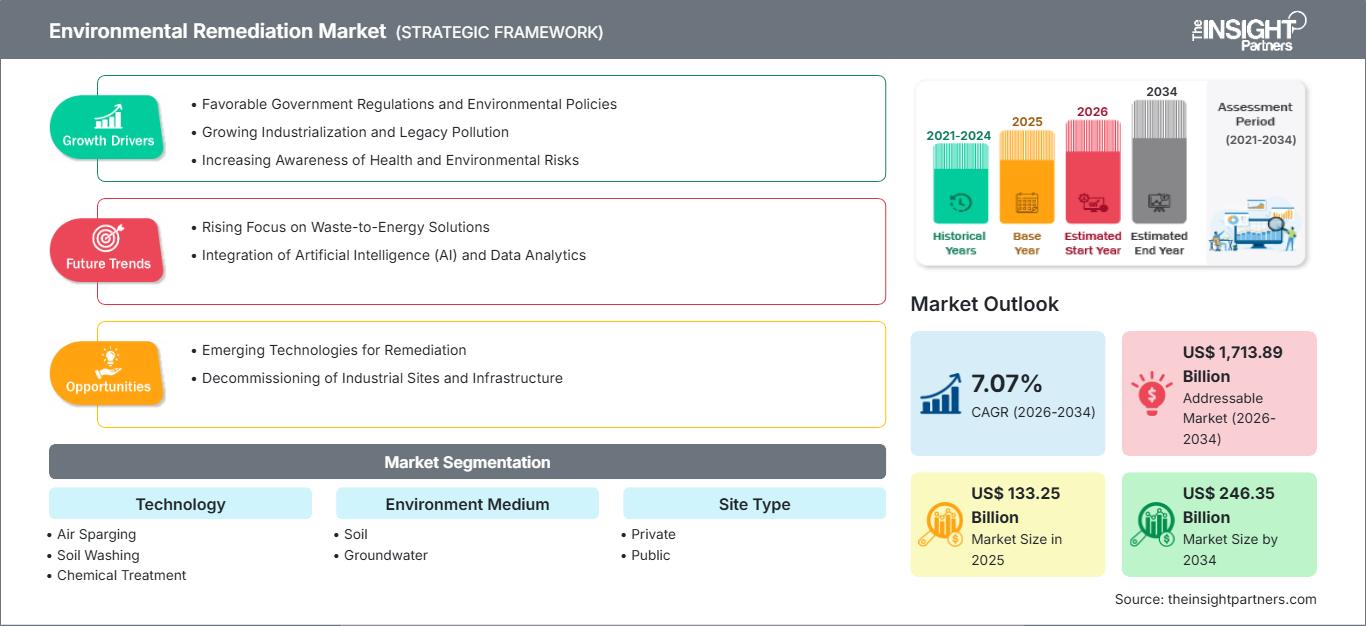
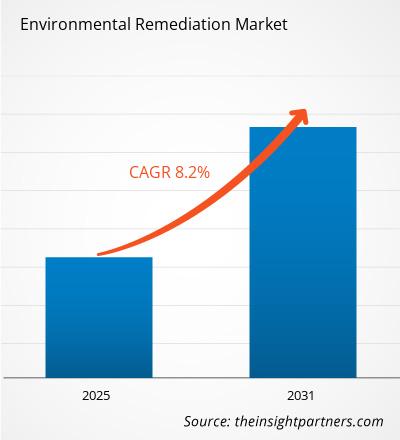
The Environmental Remediation Market was valued at US$ 133.25 Billion in 2025 and is projected to reach US$ 246.35 Billion by 2034, expanding at a CAGR of 7.07% from 2026 to 2034. Demand is supported by the systematic treatment of contaminated soil and groundwater across industrial, mining, agricultural, automotive, and oil and gas sites, where liability management and land restoration increasingly influence capital allocation and operating decisions.
North America remains the most established regional opportunity, with an estimated 2026–2034 CAGR of 6.4–6.8%. The Environmental Remediation Market size benefits from mature liability frameworks, publicly funded brownfield programs, defense-site cleanup, and treatment demand for persistent contaminants. Federal and state procurement supports long-duration project pipelines, while land reuse economics encourage private owners to remediate assets before redevelopment, refinancing, or divestment.
Environmental Remediation Market Assessment and Insights
- North America held 36–38% share in 2025 and is projected to grow at a CAGR of 6.4–6.8% during 2026–2034, supported by Superfund, brownfield, defense, and industrial compliance programs.
- US represented 82–84% of North American revenue in 2025 and is expected to advance at a 6.5–6.9% CAGR through 2034.
- Europe accounted for 27–29% in 2025 and should grow at 6.2–6.6%, led by Germany and the UK, with France, Italy, and Spain expanding contaminated-site inventories.
- Asia Pacific held 24–26% in 2025 and is forecast to rise at 8.3–8.7%, led by China, Japan, India, South Korea, and Australia.
- Largest Segment Soil represented 58–60% in 2025 and is expected to grow at 6.7–7.1% as redevelopment and mining restoration accelerate.
- High Growth Segment Bioremediation held 12–14% in 2025 and is projected to grow at 9.2–9.6% as lower-impact, in-situ treatment gains acceptance.
- Key companies analyzed in detail: Clean Harbors, Inc.; AECOM; Jacobs Solutions Inc.; Tetra Tech, Inc.; BRISEA Group, Inc.; ENTACT, LLC; Terra Systems, Inc.; HDR, Inc.; Fluor Corporation; and Bechtel Corporation.
Source: The Insight Partners' analysis based on proprietary research, government publications, company annual reports, investor presentations, industry databases, and expert interviews.
Remediation methods in the Environmental Remediation Market have shifted from excavation-based decontamination to risk-based, treatment-train remediation techniques comprising of site characterization, in-situ chemical reaction, bio-remediation, barriers, and digital monitoring. Remediation contractors are using performance-based contracting to incorporate laboratory analysis, hydrogeology, engineering, construction, waste disposal and operation logistics. Remediation production is increasingly becoming an exercise in securing specialized equipment, sourcing treatment media, providing adequate disposal facility, and coordinating site work activities with ongoing production sites. Persistent contaminants and co-mingled contaminant plumes are more likely to be handled using modular equipment that can be modified as better information becomes available.
Capital investments from 2017 to 2034 should expand to include Asia Pacific industrial zones, European contaminated land projects, and Middle Eastern energy assets. Disclosures and public inventories can convert contingent liabilities into investment opportunities, while infrastructure revitalization can improve development economics. Investors will prefer technology companies which offer investigation through closure services, have strong data security, and provide low-hauling, low carbon footprint, and socially disruptive technologies. Procurement policies will be influenced by measurable mass removal and risk reduction technologies.
Environmental Remediation Market Report Scope
| Report Attribute | Details |
|---|---|
| Market size in 2025 | US$ 133.25 Billion |
| Market Size by 2034 | US$ 246.35 Billion |
| Global CAGR (2026 - 2034) | 7.07% |
| Historical Data | 2021-2024 |
| Forecast period | 2026-2034 |
Environmental Remediation Market Analysis
The Environmental Remediation market growth is a function of tougher thresholds for contaminants, old industrial assets, mine closures, and the development of idle lands into residential, logistics, and infrastructure use. The supply chain starts with sampling, lab analysis, risk assessment, and remedial design; then progresses to include equipment, reagents, treatment media, civil works, waste transportation and disposal, monitoring, and finally, regulatory close-out. Customers increasingly buy packages to minimize interface risks and expedite decision-making.
The supply in the Environmental Remediation Market is specialized as geology, contaminant chemistry, permits, and site access are all different. Hydrogeologists, field technicians, and qualified subcontractors can become a limiting factor in terms of time. The contractors standardize their mobile treatment equipment, digital field data capture systems, and supplier network, but maintain site-specific engineering. The cost of disposal and media availability determines the type of solution chosen, which makes in-situ solutions more favorable.
The Environmental Remediation Market analysis shows that there is competition among diversified engineering firms, specialty contractors, and vertically-integrated waste service firms. Clean Harbors, Inc. offers response capabilities along with treatment and disposal solutions, whereas AECOM, Jacobs Solutions Inc., Tetra Tech, Inc., and HDR, Inc. focus on technical design and program management. ENTACT, LLC and Terra Systems, Inc. are competing based on implementation services. Size provides advantages in bonding, safety systems, national accounts, and public projects.
Strategic investments in the Environmental Remediation Market are now focused on PFAS services, high resolution characterizations, automation of monitoring, and data platforms to link field information with optimized remedies. The Fluor Corporation and Bechtel Corporation offer megaproject management to energy and industrial decommissioning, while BRISEA Group, Inc. meets the specific requirements of the sites. Differentiation now requires proven performance, life cycle costs, regulation credibility, and the capacity to perform critical services without losing technology neutrality.
● REPORT CUSTOMIZATION
Tailor This Report To Align With Your Specific Business Requirements
This report can be customized to align precisely with your business objectives, scope, and target markets. Customization options include tailored segmentation, geography, competitive analysis, and strategic insights to support informed decision-making.
Customize This Report →WHAT YOU CAN ADJUST
- ● Segmentations
- ● Geography
- ● Competitive Analysis
- ● Language Preferences
Environmental Remediation Market: Strategic Insights
Regional Insights
North America Environmental Remediation Market
North America held 36–38% of global revenue in 2025 and is expected to grow at 6.4–6.8% through 2034. The Environmental Remediation Market share reflects mature enforcement, extensive legacy industrial land, and sustained federal, state, provincial, and municipal procurement. Brownfield grants, Superfund work, defense installations, mine reclamation, and pipeline or terminal cleanups create diversified demand.
Technologies are now focusing more on PFAS, chlorinated solvents, petroleum hydrocarbons, metals, and sediment. An integrated company has several advantages with laboratories across the country, transportation of waste, engineering skills, and emergency services. Canada adds mining, energy, and site restoration in the North, whereas the United States provides funding. Economics of redevelopment help to choose a method that will allow using the restored site for logistics, housing, or energy production.
U.S. Environmental Remediation Market
The US represented 82–84% of North American revenue in 2025 and should expand at a 6.5–6.9% CAGR. Federal remediation programs, state cleanup funds, and private liability management sustain a deep pipeline. Clean Harbors, Inc., AECOM, Jacobs Solutions Inc., Tetra Tech, Inc., ENTACT, LLC, HDR, Inc., Fluor Corporation, and Bechtel Corporation maintain relevant capabilities across investigation, design, construction, treatment, and monitoring.
The scope of demand is expanding from traditional crude oil and solvent contamination sites to PFAS contamination, munition residue contamination, coal combustion residuals, and complex groundwater plume contamination. Applications involving mining and oil and gas use large earthworks and water handling and closure strategies, whereas automotive applications focus on brownfield remediation. Agricultural applications involve strategic soil and groundwater interventions.
Europe Environmental Remediation Market
Europe held 27–29% in 2025 and is projected to grow at 6.2–6.6%. Germany leads through industrial redevelopment, stringent soil protection, and dense manufacturing legacies. The UK combines brownfield-led urban development with risk-based contaminated-land practice, encouraging investigations before property transactions and infrastructure construction.
Soil treatment is part of industrial restructuration and transportation in France, while Italy and Spain have the advantage of sites previously occupied by manufacturing plants, ports, refineries, and mines. The European Union’s Soil Monitoring Law, which will be valid from December 2025, emphasizes the importance of identifying contaminated sites and informing the public about the sites, making the national inventory commercially significant.
APAC Environmental Remediation Market
Asia Pacific represented 24–26% in 2025 and should post an 8.3–8.7% CAGR. China is at the forefront of industry relocation, brownfield redevelopment, and mining remediation. Japan and South Korea focus on technical excellence for areas near established industrial complexes, whereas India’s development drives assessment and remediation efforts.
Mine closures, hydrocarbon sites, and defense locations are Australia’s contributions to the market. Growth in the region relies upon consistency in enforcement, appreciation in property values, and local engineering talent. Soil washing, excavation, barriers, and bioremediation technologies benefit from dense urban environments and industrial concerns wanting reduced liability.
Middle East & Africa Environmental Remediation Market
Middle East and Africa is projected to expand at 7.3–7.7% through 2034. Saudi Arabia leads through energy-site restoration, industrial-city investment, and redevelopment linked to economic diversification. The UAE emphasizes ports, logistics, construction, and hydrocarbon assets, often requiring rapid site characterization and groundwater protection.
South Africa adds mining, acid drainage, and industrial-land demand, while the rest of MEA remains project-led. Growth depends on stronger enforcement, financing, and qualified field capacity. International contractors can differentiate through water-scarcity-aware remedies, remote-site logistics, and integration with major infrastructure programs.
Segmentation Analysis
Technology
Technology is expected to advance at a 7.4–7.8% CAGR during 2026–2034. The Environmental Remediation Market scope spans destructive, separation, containment, and biologically mediated remedies. Selection depends on contaminant properties, depth, hydrogeology, cleanup targets, land use, schedule, carbon impact, and disposal access. Hybrid treatment trains increasingly outperform single-method approaches by managing source zones, dissolved plumes, residual mass, and rebound risk within one adaptive plan.
- Air Sparging supports volatile contaminant removal below the water table, particularly at petroleum and solvent sites, and remains strategically useful when paired with vapor extraction and monitoring.
- Soil Washing concentrates contaminants into smaller waste fractions, supporting material recovery at granular sites where excavation is feasible and disposal costs justify on-site processing.
- Chemical Treatment provides rapid oxidation, reduction, stabilization, or precipitation, making it important for source control, metals immobilization, and difficult plumes requiring measurable short-term action.
- Bioremediation uses microbial pathways to degrade compatible contaminants, offering lower disturbance and energy intensity, while requiring careful amendment delivery, geochemical control, and performance verification.
- Electrokinetic Remediation mobilizes ions through low-permeability soils, giving it strategic relevance for clays and fine-grained formations where conventional hydraulic delivery performs poorly.
- Excavation delivers immediate mass removal and redevelopment certainty, retaining a strong position for shallow hotspots despite hauling, disposal, community, and carbon constraints.
- Permeable Reactive Barriers intercept groundwater plumes passively, providing long-duration containment and treatment where predictable flow paths, suitable media, and maintainable installations can be established.
Environment Medium
Environment medium is projected to grow at a 6.8–7.2% CAGR. Soil represented the largest segment, with 58–60% share in 2025 and a 6.7–7.1% CAGR, because redevelopment, excavation, mine restoration, and industrial closure create visible liabilities. Groundwater projects are longer and monitoring-intensive, often requiring source control plus plume treatment to achieve durable regulatory closure.
- Soil demand centers on industrial land, mines, refineries, agricultural areas, and automotive sites, with treatment selected according to depth, reuse objectives, contaminant concentration, and soil texture.
- Groundwater requires sustained hydrogeological investigation, plume delineation, treatment, and verification, making lifecycle optimization and data continuity strategically important for owners and regulators.
Site Type
Site type is expected to record a 6.9–7.3% CAGR. Private sites generate transaction, compliance, closure, and redevelopment work, while public sites support multi-year cleanup frameworks for defense property, brownfields, infrastructure, and abandoned liabilities. Public procurement rewards auditability and stakeholder engagement; private buyers emphasize schedule certainty, indemnity management, and land-value recovery.
- Private projects are driven by mergers, property transfers, permit obligations, asset retirement, and redevelopment, favoring commercially aligned remedies with defined cost and schedule outcomes.
- Public projects frequently involve complex ownership histories, community consultation, transparent procurement, and long monitoring periods, sustaining demand for multidisciplinary program management and defensible technical records.
Application
Application is forecast to expand at a 7.1–7.5% CAGR. Mining and forestry require large-area restoration and water management; oil and gas sites combine hydrocarbons, terminals, pipelines, and legacy infrastructure; agriculture emphasizes soil productivity and water protection; automotive properties create repeatable brownfield opportunities. Each application imposes different access, safety, contaminant, and closure requirements.
- Mining and Forestry demand includes tailings, waste rock, acid drainage, erosion control, and revegetation, making watershed-scale planning and long-term financial assurance strategically important.
- Oil & Gas sites require treatment of petroleum hydrocarbons, produced-water impacts, terminals, pipelines, and refineries, with emergency response and asset-retirement capabilities shaping contractor selection.
- Agriculture applications focus on pesticide residues, nutrient impacts, metals, and irrigation-water quality, where low-disturbance remedies must preserve productive land use and community confidence.
- Automotive demand concentrates around former plants, dealerships, service facilities, and supply-chain sites, where rapid characterization supports redevelopment, portfolio transactions, and industrial conversion.
Opportunity Snapshot
| Application | Revenue Contribution | Trend Tag | Adoption Stage |
| Mining and Forestry | High | Mine Closure | Scaling |
| Oil & Gas | High | Asset Retirement | Mature |
| Agriculture | Medium | Soil Recovery | Emerging |
| Automotive | Medium | Brownfield Reuse | Scaling |
Environmental Remediation Market Growth Drivers and Impact Analysis
Tighter Contaminant Standards Convert Monitoring into Funded Cleanup
Regulators are expanding attention from conventional hydrocarbons and metals to persistent compounds, vapor intrusion, sediment, and cumulative exposure. This converts sampling programs into remedial design, pilot testing, construction, and long-term monitoring. Owners face stronger incentives to quantify liabilities before transactions or permit renewals, while public agencies must address contaminated drinking-water sources and defense properties. The practical market impact is a larger addressable pipeline with higher technical content. Contractors capable of tracing contaminants across soil, groundwater, air, and waste streams can capture more lifecycle value. Treatment providers benefit when standards create measurable endpoints, though evolving rules also increase technology-performance risk and demand transparent data quality.
Brownfield Redevelopment Links Cleanup Spending to Land Value
Urban land scarcity makes contaminated property economically relevant rather than permanently stranded. Developers can justify investigation and treatment when cleanup unlocks housing, logistics, manufacturing, renewable energy, or transport infrastructure. Public grants reduce early assessment risk, while tax incentives and revolving funds can bridge financing gaps. This driver shifts procurement toward schedule certainty because remediation must align with planning approvals, demolition, utilities, and construction. It also favors excavation, soil washing, stabilization, and rapid verification where carrying costs are high. Firms that integrate environmental engineering with civil design and stakeholder engagement can reduce handoffs. The resulting impact is faster conversion of environmental liabilities into productive assets and broader private participation.
Mine Closure and Industrial Asset Retirement Expand Complex Scopes
Mining, oil and gas, chemicals, automotive, and heavy manufacturing operators are retiring aging assets while facing obligations for soil, groundwater, tailings, sediments, and structures. Closure programs require baseline studies, source removal, water treatment, demolition coordination, revegetation, and decades of monitoring. Their scale supports multi-year frameworks and creates demand for project controls, remote logistics, safety systems, and financial assurance. Climate variability further affects water balances, erosion, and contaminant transport, requiring adaptive designs. Market impact extends beyond construction because owners purchase modeling, monitoring, operations, and reporting throughout the liability lifecycle. Providers with engineering, field execution, and treatment capabilities can manage interfaces and reduce total closure uncertainty.
Environmental Remediation Market Future Trends
Adaptive Remedies Powered by Digital Site Models
Environmental Remediation Market trends will increasingly reflect continuous optimization rather than fixed designs. High-resolution sampling, connected sensors, GIS, three-dimensional visualization, and predictive models can update conceptual site models as field evidence arrives. Project teams will use these tools to target injections, adjust pumping, verify barrier performance, and identify rebound earlier. Digital records also strengthen regulatory defensibility and facilitate portfolio comparisons. The commercial change is significant: contractors can move from episodic reporting toward outcome-based operations, while owners gain better forecasts of closure timing and remaining liability. Adoption will depend on data governance, sensor reliability, interoperability, and clear accountability for model-informed decisions.
Lower-Carbon Treatment Trains Replace Disposal-First Strategies
Remedy selection will place greater weight on truck movements, energy use, material recovery, water consumption, and community disruption. In-situ biological or chemical treatment, permeable barriers, on-site soil processing, and renewable-powered groundwater systems can reduce lifecycle impacts when site conditions are suitable. Excavation will remain essential for hotspots, but it will increasingly form one component of a treatment train rather than the default answer. Clients will request comparable carbon and waste metrics alongside cost and risk reduction. Providers that can quantify trade-offs credibly, source lower-impact reagents, and reuse treated material will gain differentiation without compromising cleanup objectives or regulatory acceptance.
Environmental Remediation Market Opportunities
Build Integrated PFAS Investigation-to-Destruction Platforms
Investors and service providers can assemble capabilities spanning sampling, laboratory analytics, hydrogeology, source control, water treatment, residual management, and verified destruction. Fragmented delivery creates handoff risk because captured contaminants remain a liability until concentrated media or liquids are managed appropriately. An integrated platform can standardize quality assurance, accelerate pilot-to-full-scale transitions, and offer customers a documented chain of custody. Partnerships between engineering firms, treatment-media suppliers, waste operators, and destruction-technology developers can lower commercialization risk. Priority customers include defense installations, airports, industrial facilities, landfills, and water utilities. Action should focus on validated performance, regulatory engagement, scalable logistics, and transparent mass-balance reporting.
Expand Regional Delivery Hubs in High-Growth Industrial Corridors
Asia Pacific and selected Middle Eastern markets offer opportunities for local laboratories, mobile treatment units, trained field crews, and design partnerships. Entry strategies should target industrial corridors where land redevelopment, manufacturing expansion, mining closure, and infrastructure investment overlap. Acquiring local specialists can provide permits, relationships, and geological knowledge, while global platforms contribute safety systems, complex-contaminant expertise, and project controls. Investors should avoid broad geographic expansion without anchor clients because utilization and mobilization determine economics. A hub-and-spoke model can serve multiple sites with shared equipment and analytics. Success requires local talent development, reagent supply resilience, and remedies adapted to water scarcity, monsoon conditions, or remote logistics.
Recent Developments
- June 2026: Periodic Products has announced plans to expand its Chelok Polymer Technology into Southern Africa through a strategic initiative with Square Gate Group, targeting the region’s mining, extractives and environmental remediation sectors. The initiative is focused on developing opportunities for more efficient metal recovery, water treatment and resource sustainability. Chelok is a patented polymer technology designed to remove, concentrate and recover metals from a range of industrial and environmental inputs.
- January 2026: Product Recovery Management (PRM) has acquired Clean Globe Environmental (CGE), strengthening its environmental remediation and landfill gas service capabilities across the northeastern United States. The acquisition was completed on January 2, 2026, and establishes CGE as a new Long Island-based division of PRM. Clean Globe Environmental, based in Brentwood, Long Island, New York, provides environmental operations and maintenance, sampling, chemical injection and geophysical services. The company has worked with engineering firms, industrial customers and government agencies throughout the Northeast.
- August 2026: DISA Technologies has launched DISA Uranium Corporation, a new US-based company focused on recovering domestic uranium, remediating abandoned uranium mine sites and developing new uranium processing capacity. The company is headquartered in Casper, Wyoming, and is positioning its operations around both resource recovery and strengthening the US nuclear fuel supply chain. As part of the launch, DISA Uranium has entered into an agreement to acquire IsoEnergy's Utah uranium portfolio, which includes the Tony M, Daneros and Rim mines, along with the Sage Plain and Flatiron projects. The portfolio provides the new company with a conventional uranium resource base that complements its focus on recovering uranium and vanadium from abandoned my waste.
Frequently Asked Questions

- Comprehensive Market Sizing and Forecast Analysis
- Detailed Segmentation Analysis
- In-Depth Market Dynamics Assessment
- Regional and Country-Level Insights
- Competitive Landscape and Company Benchmarking
- Strategic Business Intelligence
Recent Reports
Testimonials

The Insight Partners' SCADA System Market report is comprehensive, with valuable insights on current trends and future forecasts. The team was highly professional, responsive, and supportive throughout. We are very satisfied and highly recommend their services.
RAN KEDEM Partner, Reali Technologies LTDs
I requested a report on a very specific software market and the team produced the report in a few days. The information was very relevant and well presented. I then requested some changes and additions to the report. The team was again very responsive and I got the final report in less than a week.
JEAN-HERVE JENN Chairman, Future Analytica
We worked with The Insight Partners for an important market study and forecast. They gave us clear insights into opportunities and risks, which helped shape our plans. Their research was easy to use and based on solid data. It helped us make smart, confident decisions. We highly recommend them.
PIYUSH NAGPAL Sr. Vice President, High Beam Global
The Insight Partners delivered insightful, well-structured market research with strong domain expertise. Their team was professional and responsive throughout. The user-friendly website made accessing industry reports seamless. We highly recommend them for reliable, high-quality research services
YUKIHIKO ADACHI CEO, Deep Blue, LLC.
This is the first time I have purchased a market report from The Insight Partners.While I was unsure at first, I visited their web site and felt more comfortable to take the risk and purchase a market report.I am completely satisfied with the quality of the report and customer service. I had several questions and comments with the initial report, but after a couple of dialogs over email with their analyst I believe I have a report that I can use as input to our strategic planning process.Thank you so much for taking the extra time and making this a positive experience.I will definitely recommend your service to others and you will be my first call when we need further market data.
JOHN SUZUKI President and Chief Executive Officer, Board Director, BK Technologies
I wish to appreciate your support and the professionalism you displayed in the course of attending to my request for information regarding to infectious disease IVD market in Nigeria. I appreciate your patience, your guidance, and the fact that you were willing to offer a discount, which eventually made it possible for us to close a deal. I look forward to engaging The Insight Partners in the future, all thanks to the impression you have created in me as a result of this first encounter.
DR CHIJIOKE ONYIA MANAGING DIRECTOR, PineCrest Healthcare Ltd.Reason to Buy
- Informed Decision-Making
- Understanding Market Dynamics
- Competitive Analysis
- Identifying Emerging Markets
- Customer Insights
- Market Forecasts
- Risk Mitigation
- Boosting Operational Efficiency
- Strategic Planning
- Investment Justification
- Tracking Industry Innovations
- Aligning with Regulatory Trends





 Get Free Sample for