
ESD Protection Devices Market Size, Share & Growth by 2034
Coverage: by Device Type (Traditional ESD Protection Devices, Ceramic ESD Protection Devicesm, and Silicon ESD Protection Devices); Application (Computers, Digital Screens, Mobile Devices, Automotive electronics, Test equipment, Point-of-sales terminals, Servers, Medical equipment, Security and alarm systems, and Others), and Geography (North America, Europe, Asia Pacific, and South and Central America)
- Status : Data Released
- Report Code : TIPRE00003278
- Category : Electronics and Semiconductor
- No. of Pages : 150
- Available Report Formats :


- Last update date : August 18, 2026


2025 Market Size
US$ 1,970.92 Mn
Base year value
2034 Forecast
US$ 2,700.93 Mn
Projected by 2034
CAGR 2026-2034
3.56 %
Growth rate
Addressable Market
US$ 21,214.93 Mn
(2026-2034)
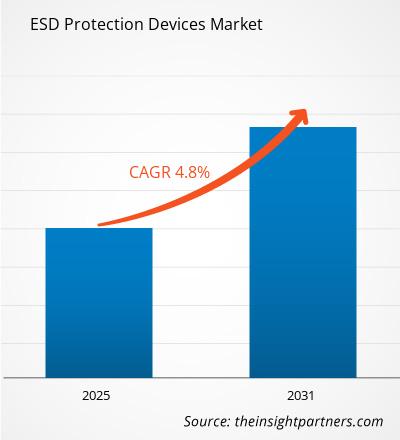
The ESD Protection Devices Market generated revenue of US$ 1,970.92 Million in 2025 and is projected to reach US$ 2,700.93 Million by 2034, expanding at a CAGR of 3.56% during 2026–2034. Growth reflects the increasing electronic content of connected products, rising interface speeds, vehicle electrification, and broader deployment of protection components across consumer, automotive, industrial, healthcare, and communication equipment.
North America ESD Protection Devices Market Size remains a technically advanced demand center, supported by semiconductor design, cloud infrastructure, medical electronics, defense systems, and automotive software development. The regional outlook indicates an estimated CAGR range of 3.2–3.8% through 2034. Structural growth drivers include stricter reliability requirements for connected equipment and continuing investment in data centers, high-speed interfaces, electric vehicles, and industrial automation.
ESD Protection Devices Market Assessment and Insights
- North America: North America is expected to hold a 28–32% share in 2025 and grow at a CAGR of 3.2–3.8% between 2026–2034, supported by advanced electronics design, automotive innovation, and data infrastructure investment.
- US: The US is estimated to represent 82–86% of North America’s 2025 demand, expanding at a CAGR of 3.3–3.9% through 2034 as cloud, defense, healthcare, and automotive electronics scale.
- Europe: Europe is projected to account for 22–26% of global 2025 demand and expand at a CAGR of 3.0–3.6%, led by Germany, the UK, France, Italy, and Spain.
- Asia Pacific: Asia Pacific is estimated to capture 40–44% of 2025 demand and register a CAGR of 4.0–4.8%, led by China, Japan, South Korea, India, and Taiwan.
- Largest Segment: Silicon ESD Protection Devices are estimated to hold a 42–46% market share in 2025 and grow at a CAGR of 3.7–4.3% between 2026–2034.
- High Growth Segment: Automotive Electronics is estimated to represent an 18–22% market share in 2025 and expand at a CAGR of 5.0–5.8% through 2034.
- Key companies analyzed in detail: Bourns, Inc., Infineon Technologies AG, Littelfuse, Inc., Murata Manufacturing Co., Ltd., Nexperia, ProTek Devices LP, ROHM Co., Ltd., Semtech Corporation, STMicroelectronics N.V., and Texas Instruments Incorporated.
Source: The Insight Partners' analysis based on proprietary research, government publications, company annual reports, investor presentations, industry databases, and expert interviews.
The market has progressed beyond basic board-level surge suppression to application-specific solutions that incorporate integrity of signal, packaging miniaturization, low clamping voltage, and high transient immunity. The silicon-based array solutions have found their way into USB, HDMI, automotive communication, display, and RF interfaces, whereas the ceramic and standard devices still offer value where cost, toughness, or simplicity of circuit is an issue. The production trends include the wafer fabrication, ceramic formulation, precise assembly, and growing automation of surface-mounting.
The future perspective is driven by the growth in electronics manufacturing in South and Southeast Asia, further regionalization of semiconductor production networks, and investments in electric vehicles, intelligent factories, medical equipment, and digital infrastructure. The regulatory requirements for the electromagnetic compatibility and functional reliability should facilitate the design-in, but the qualification cycles, component pricing pressure, and uneven demand of consumer electronics may slow down the trend.
ESD Protection Devices Market Report Scope
| Report Attribute | Details |
|---|---|
| Market size in 2025 | US$ 1,970.92 Million |
| Market Size by 2034 | US$ 2,700.93 Million |
| Global CAGR (2026 - 2034) | 3.56% |
| Historical Data | 2021-2024 |
| Forecast period | 2026-2034 |
ESD Protection Devices Market Analysis
Factors driving ESD Protection Devices Market include an increasing amount of sensitive integrated circuits, connectors, touch panels, cameras, sensors, and wireless communication devices in each final product. With reduced margins of voltage and higher data rates, OEMs need solutions that absorb the transient energy without affecting insertion loss, impedance, and transmission rate. Hence, demand is moving away from standard components to customized arrays, low-capacitance diodes, automotive parts, and protection platform solutions.
The supply chain includes silicon wafers, ceramic powders, polymer compounds, electrodes, packaging substrates, and assembly equipment. Device companies use these inputs for the manufacture of diodes, suppressors, varistors, arrays, and multi-layered components. These are distributed to semiconductor, automotive, medical, industrial, and consumer electronics companies through distributors or direct sale. Factors affecting supply chain performance include wafer capacity, specialty materials, test capability, package supply, and qualification inventory. The multi-sourcing strategy is relevant since the protection component can be a limiting factor in the production process.
Competitive firms in the ESD Protection Devices Market Report include general line semiconductor manufacturers and manufacturers concentrating on circuit protection, sensing, passives, and interfaces. Infineon Technologies AG, STMicroelectronics N.V., Texas Instruments Incorporated, Nexperia, and ROHM Co., Ltd. compete based on silicon technology, automotive qualifications, application support, and product lines. Littelfuse, Inc., Bourns, Inc., ProTek Devices LP, Murata Manufacturing Co., Ltd., and Semtech Corporation contribute to the market through protection technologies, ceramic technologies, discrete products, and package offerings.
Investments are made in the form of low capacitance circuits, small packages, automotive qualification, and manufacturing capacity. Market positioning cannot be achieved simply by maximum surge ratings because consumers consider leakage current, clamping characteristics, temperature sensitivity, response time, form factors, traceability, qualification data, and supply security. Competitors with reference designs and laboratory facilities are in a position to capture design wins sooner whereas distributors have an effect on availability and substitution decisions.
● REPORT CUSTOMIZATION
Tailor This Report To Align With Your Specific Business Requirements
This report can be customized to align precisely with your business objectives, scope, and target markets. Customization options include tailored segmentation, geography, competitive analysis, and strategic insights to support informed decision-making.
Customize This Report →WHAT YOU CAN ADJUST
- ● Segmentations
- ● Geography
- ● Competitive Analysis
- ● Language Preferences
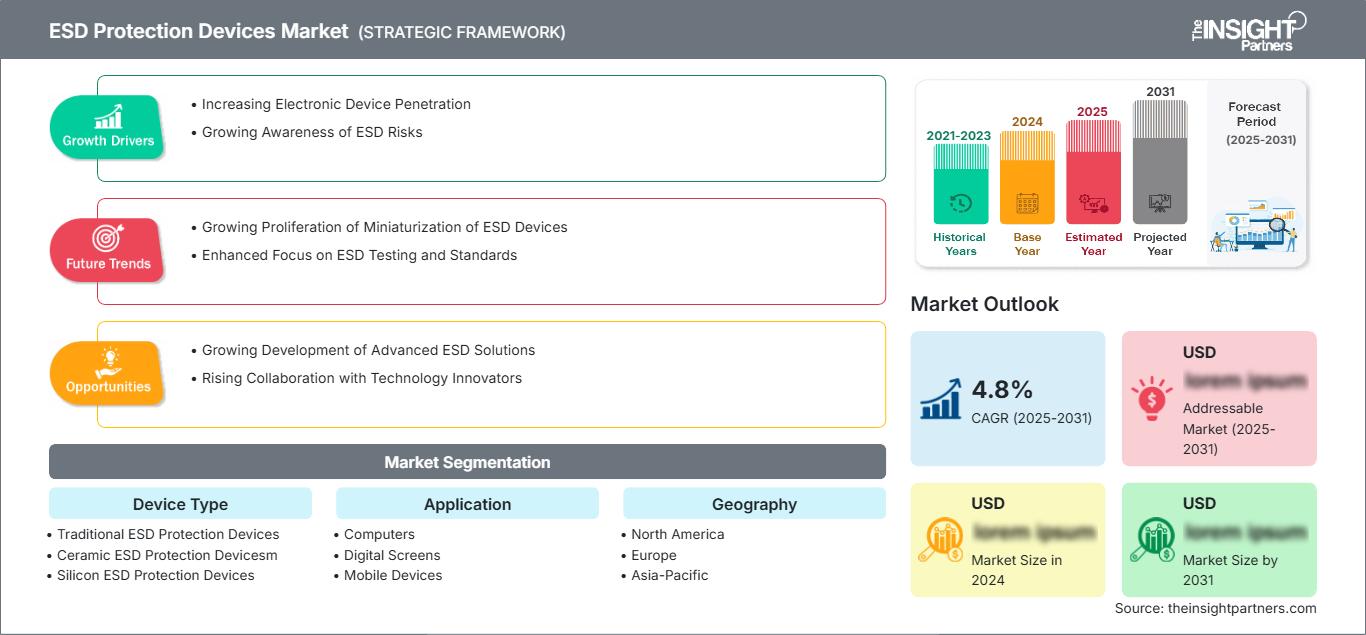
ESD Protection Devices Market: Strategic Insights
Regional Insights
North America ESD Protection Devices Market
North America represents around 28-32% of ESD Protection Devices Market Share in 2025 with a regional CAGR of 3.2-3.8% from 2024 through 2034. North American demand is led by US demand, where semiconductors manufacturers, cloud computing facilities, medical device manufacturers, defense manufacturers, and electric vehicle manufacturers all call for protection at board and system levels. Canadian contribution comes through aerospace, industrial automation, telecoms, and equipment for the resource sector.
The North American demand structure gains from the development of data centers, high-speed networking, ADAS, and connected health care devices. Specifications are characterized by low capacitance, fast action, automotive-grade, and long-term availability. Manufacturers include Bourns, Inc., Littelfuse, Inc., ProTek Devices LP, Semtech Corporation, Texas Instruments Incorporated, among others. All have technical and/or business presence in North America. The manufacturing demand in Mexico is included through the automotive and electronics assembly industries. Specifications for purchase in North America value reliability and support over cheapest unit price.
U.S. ESD Protection Devices Market
The US is estimated to account for 82–86% of North America’s 2025 demand and is projected to grow at a CAGR of 3.3–3.9% during 2026–2034. Its share reflects the concentration of semiconductor development, hyperscale computing, aerospace electronics, medical equipment, automotive software, and high-value industrial production.
Trends in application areas revolve around server boards, optical networking, POS terminals, electric cars, digital cockpits, diagnostic equipment, and security systems. Major suppliers of this market include Bourns, Inc., Littelfuse, Inc., ProTek Devices LP, Semtech Corporation, Infineon Technologies AG, and Texas Instruments Incorporated who supply products through their local manufacturing, design centers, distributors, and global logistics networks. Re-shoring and advanced manufacturing efforts are also contributing to demand generation, but sourcing teams still look for second source providers for mature products at reasonable prices.
Europe ESD Protection Devices Market
The Europe region will capture 22–26% market share and register growth at a CAGR of 3.0–3.6% over the forecast period. Germany is the most dominant country in this market, driven by applications such as automotive electronics, industrial control, automation, medical engineering, and an extensive supplier network. The demands for this region arise from reliability, safety, energy efficiency, and electromagnetic compatibility considerations.
The UK provides demand in this market through applications such as aerospace, defense, telecommunications, fintech infrastructure, and healthcare technology; procurement in these sectors involves certification and lifecycle support. Germany continues to be the leading country for both automotive and industrial markets; electric drivetrain, sensors, and automation equipment generate repeated protection demands in these markets. France, Italy, and Spain provide demand in this market through applications such as rail transportation, aerospace, industrial equipment, automotive manufacturing, renewable energy equipment, and consumer electronics distribution.
APAC ESD Protection Devices Market
APAC is estimated to hold a 40–44% share in 2025 and grow at a CAGR of 4.0–4.8%, making it the leading region. China leads through electronics assembly, displays, telecommunications, electric vehicles, and semiconductor manufacturing. Japan, South Korea, India, and Australia contribute through automotive, industrial, consumer, and infrastructure applications.
Industrial policies, investments in semiconductors in the region, increased exports of electronics, and vehicle electrification provide demand for components. In Japan, there is an emphasis on accuracy and reliability; South Korea specializes in displays, memories, mobile phones, and automobile systems, while in India, manufacturing and digital technologies are on the rise. In Australia, although the country is much smaller, it still has some relevance to mining equipment, communication, medical systems, and energy projects.
Middle East & Africa ESD Protection Devices Market
Middle East and Africa demand is expected to expand at a CAGR of 4.5–5.2% through 2034. Saudi Arabia leads regional opportunity through smart-city programs, industrial diversification, telecommunications, and energy infrastructure. The UAE follows with data centers, aviation, logistics, security systems, and digitally enabled commercial facilities.
South Africa acts as a base for products related to mining, automation in industries, medical devices and telecommunications, whereas the Rest of MEA region is driven by energy projects, mobility, infrastructure development, and electronics imported from other countries. The modernization of energy sector makes necessary the use of reliable security solutions for control systems and field devices. Implementation is still driven by distributors, with specifications and maintenance needs playing a larger role than mass consumer demand.
Segmentation Analysis
Device Type
Device Type Segment in the ESD Protection Devices Market is divided into Traditional ESD Protection Devices, Ceramic ESD Protection Devices, and Silicon ESD Protection Devices. The segment is projected to grow at a CAGR of 3.4–4.0% between 2026–2034. Selection depends on transient severity, signal speed, space constraints, cost, thermal conditions, and qualification requirements. Silicon devices gain design preference in high-speed and automotive interfaces, while ceramic products remain valuable for compact passive protection.
- Traditional ESD Protection Devices: Traditional devices retain demand in general-purpose electronics, low-complexity boards, industrial controls, and cost-sensitive assemblies where proven protection, availability, and straightforward integration outweigh advanced signal requirements.
- Ceramic ESD Protection Devices: Ceramic devices serve compact consumer and communication products requiring stable passive behavior, small footprints, and cost-efficient protection across signal lines exposed to repeated handling and switching events.
- Silicon ESD Protection Devices: Silicon devices occupy a strategic position in high-speed interfaces, automotive electronics, displays, servers, and medical equipment because low capacitance and controlled clamping support signal integrity.
Application
Application Segment in the ESD Protection Devices Market includes Computers, Digital Screens, Mobile Devices, Automotive Electronics, Test Equipment, Point-of-Sales Terminals, Servers, Medical equipment, Security and Alarm Systems, and Others. The segment is expected to expand at a CAGR of 3.8–4.4%. Automotive Electronics is the fastest-growing area, while mobile devices, computers, servers, and digital screens provide broad recurring demand. Application-specific qualification increasingly determines component selection.
- Computers: Computers require protection for USB, audio, keyboard, display, networking, and power interfaces, with demand linked to enterprise refresh cycles, education, gaming, and distributed work environments.
- Digital Screens: Digital screens use protection around touch panels, display connectors, cameras, and control boards, making low capacitance and minimal visual or signal interference strategically important.
- Mobile Devices: Mobile devices require miniature arrays for charging, data, audio, antenna, and touch interfaces, with adoption shaped by compact design, high-volume production, and rapid product refresh cycles.
- Automotive Electronics: Automotive Electronics demand is supported by electric vehicles, ADAS, infotainment, battery systems, cameras, radar, and vehicle networks requiring qualified protection under harsh electrical and thermal conditions.
- Test Equipment: Test equipment uses precise protection to safeguard measurement ports and sensitive instrumentation while preserving accuracy, repeatability, bandwidth, and calibration stability.
- Point-of-Sales Terminals: Point-of-sales terminals need protection for payment, touch, communication, and peripheral interfaces because frequent handling and public use increase exposure to electrostatic events.
- Servers: Servers require protection across high-speed data, management, storage, and power interfaces, with procurement emphasizing uptime, low insertion loss, thermal endurance, and lifecycle availability.
- Medical equipment: Medical equipment uses protection in patient-connected, diagnostic, imaging, monitoring, and communication subsystems where reliability, traceability, and controlled electrical behavior are critical.
- Security and Alarm Systems: Security and Alarm Systems apply protection to sensors, access controls, cameras, signaling lines, and network interfaces deployed in buildings, transport facilities, and industrial sites.
Opportunity Snapshot
| Application | Revenue Contribution | Trend Tag | Adoption Stage |
|---|---|---|---|
| Computers | High | USB-C Interfaces | Mature |
| Digital Screens | Medium | Touch Displays | Scaling |
| Mobile Devices | High | Miniature Arrays | Mature |
| Automotive Electronics | High | EV Platforms | Scaling |
| Test Equipment | Medium | Precision Ports | Mature |
| Point-of-Sales Terminals | Medium | Contactless Payments | Scaling |
| Servers | High | High-Speed Links | Scaling |
| Medical equipment | Medium | Connected Diagnostics | Scaling |
| Security and Alarm Systems | Low | Network Sensors | Scaling |
| Others | Low | Industrial Nodes | Emerging |
ESD Protection Devices Market Growth Drivers and Impact Analysis
Vehicle Electrification and Electronic Content Expansion
Electric vehicles, hybrids, and advanced driver-assistance systems increase the number of control units, sensors, communication links, cameras, displays, and power-management circuits installed per vehicle. Each added interface creates a potential electrostatic or transient exposure point, while safety expectations make failure more costly than in many consumer applications. This shifts purchasing toward automotive-qualified devices, validated application designs, and suppliers able to support long vehicle programs. The impact extends across silicon diodes, arrays, ceramic components, and high-reliability packages. Automotive customers also encourage second sourcing, traceability, and tighter process control. Consequently, vehicle electrification raises both unit content and technical value per protected circuit, supporting a faster growth profile than mature general-purpose electronics.
High-Speed Connectivity and Signal-Integrity Requirements
USB-C, USB4, Thunderbolt, high-resolution displays, Ethernet, 5G equipment, and automotive communication networks transmit data at speeds that make conventional protection choices more difficult. A device must divert an ESD event while introducing minimal capacitance, insertion loss, distortion, and leakage. This requirement expands the addressable value of ultra-low-capacitance silicon protection, specialized arrays, and application-engineered packages. It also increases the importance of reference layouts, connector-level testing, and system simulation. Suppliers that combine component specifications with design guidance can influence decisions before production begins. The commercial impact is a migration from undifferentiated low-cost parts toward technically differentiated devices, particularly in servers, mobile products, digital screens, automotive electronics, and professional test equipment.
Industrial Digitization and Connected Infrastructure
Factories, warehouses, payment networks, hospitals, security systems, utilities, and transport infrastructure are becoming more connected, increasing the number of electronic nodes operating in environments with frequent human contact, cable exposure, motor switching, and variable power quality. Protection devices reduce the risk of downtime and field failures in controllers, gateways, sensors, terminals, and communication equipment. Industrial customers typically value long product lifecycles, documented robustness, and predictable supply, creating opportunities for suppliers with stable portfolios and engineering support. The impact is distributed across mature and emerging applications rather than concentrated in one device category. As connected infrastructure expands in developing markets, distributors and system integrators will become increasingly important routes to adoption.
ESD Protection Devices Market Future Trends
Ultra-Low-Capacitance Protection for Emerging Interfaces
Future products will increasingly combine very low capacitance with stronger surge handling, smaller packages, and lower dynamic resistance in the ESD Protection Devices Market Trends. The objective is to protect high-speed signal paths without compromising bandwidth, eye diagrams, wireless performance, or display quality. This trend will influence USB4, Thunderbolt, automotive Ethernet, radar, cameras, 5G radio modules, and next-generation computing platforms. Product development is likely to emphasize co-optimization of silicon geometry, package parasitics, board layout, and connector design rather than component performance in isolation. Suppliers may offer more application-specific arrays, integrated common-mode solutions, and reference circuits. Evaluation criteria will increasingly include signal-integrity simulation, thermal cycling, qualification evidence, and automated placement compatibility.
Protection Designed Around Software-Defined Vehicles
As vehicles become software-defined, electronic architectures will shift toward centralized computing, zonal controllers, higher-speed networks, and more sensors. This architecture may reduce some wiring complexity while concentrating data and control functions in high-value modules. Protection requirements will therefore become more demanding because a single transient-related failure can affect multiple vehicle functions. Future demand will favor devices qualified for automotive temperature ranges, repetitive electrical stress, and high-speed communication protocols. Suppliers will likely collaborate earlier with vehicle manufacturers, tier-one suppliers, connector makers, and semiconductor designers. The trend also creates opportunities for diagnostic capabilities, standardized qualification data, and protection strategies integrated into broader power and signal-management platforms.
ESD Protection Devices Market Opportunities
Localized Supply and Design Support in Asia
Manufacturing expansion in India, Vietnam, Malaysia, Indonesia, and other Asian locations creates an opportunity for suppliers to establish local distribution, application laboratories, technical sales teams, and qualification support. Customers increasingly want shorter lead times, second-source options, and assistance adapting global reference designs to regional production. A localized model can also improve demand visibility for mobile devices, computers, displays, automotive electronics, and industrial equipment. Investment priorities should include inventory hubs, authorized channel partnerships, failure-analysis capability, and documentation adapted to local engineering teams. Companies that combine dependable supply with rapid design support can capture value even when competing against lower-priced components, because production interruptions and redesign costs often outweigh modest differences in unit price.
Integrated Protection Platforms for Medical and Industrial Systems
Medical equipment, industrial controllers, test instruments, and security systems increasingly combine power conversion, data communication, sensing, and wireless connectivity in compact architectures. This creates an opportunity in the ESD Protection Devices Market Forecast to package protection around complete interface requirements rather than sell isolated components. Suppliers can develop application platforms covering connector protection, power transients, grounding constraints, thermal behavior, and compliance testing. Such solutions may reduce engineering time and support repeatable qualification across product families. Investment should focus on reference designs, laboratory validation, configurable arrays, and lifecycle commitments. The strongest opportunities will occur where downtime, field service, or certification costs are high enough for customers to value engineering assurance alongside the component itself.
Recent Developments
- May 2026: ROHM Co., Ltd. developed the RESDxVx series of ESD protection diodes for high-speed interfaces. The series combines ultra-low capacitance with low dynamic resistance, targeting applications where protection must preserve signal quality across advanced data and communication interfaces. The development indicates continued component-level optimization around high-frequency performance and compact system design.
- February 2025: ROHM Co., Ltd. announced the ESDCANxx series of bidirectional TVS diodes compatible with CAN FD high-speed in-vehicle communication. The devices address automotive network protection requirements, where transient robustness and communication integrity must coexist. The launch reinforces the movement toward application-specific protection for vehicle electronics, particularly as vehicle architectures add more connected control and sensing functions.
- January 2025: Infineon Technologies AG published qualification information for the ESD188-B1-W0201 ultra-low-capacitance bidirectional protection device. The 0201-format component is intended for space-constrained signal-line protection and reflects supplier emphasis on miniaturization, low insertion loss, and qualification evidence for compact electronics. Such product development supports design requirements in mobile, wireless, computing, and other high-density applications.
Frequently Asked Questions

- Comprehensive Market Sizing and Forecast Analysis
- Detailed Segmentation Analysis
- In-Depth Market Dynamics Assessment
- Regional and Country-Level Insights
- Competitive Landscape and Company Benchmarking
- Strategic Business Intelligence
Recent Reports
Testimonials

The Insight Partners' SCADA System Market report is comprehensive, with valuable insights on current trends and future forecasts. The team was highly professional, responsive, and supportive throughout. We are very satisfied and highly recommend their services.
RAN KEDEM Partner, Reali Technologies LTDs
I requested a report on a very specific software market and the team produced the report in a few days. The information was very relevant and well presented. I then requested some changes and additions to the report. The team was again very responsive and I got the final report in less than a week.
JEAN-HERVE JENN Chairman, Future Analytica
We worked with The Insight Partners for an important market study and forecast. They gave us clear insights into opportunities and risks, which helped shape our plans. Their research was easy to use and based on solid data. It helped us make smart, confident decisions. We highly recommend them.
PIYUSH NAGPAL Sr. Vice President, High Beam Global
The Insight Partners delivered insightful, well-structured market research with strong domain expertise. Their team was professional and responsive throughout. The user-friendly website made accessing industry reports seamless. We highly recommend them for reliable, high-quality research services
YUKIHIKO ADACHI CEO, Deep Blue, LLC.
This is the first time I have purchased a market report from The Insight Partners.While I was unsure at first, I visited their web site and felt more comfortable to take the risk and purchase a market report.I am completely satisfied with the quality of the report and customer service. I had several questions and comments with the initial report, but after a couple of dialogs over email with their analyst I believe I have a report that I can use as input to our strategic planning process.Thank you so much for taking the extra time and making this a positive experience.I will definitely recommend your service to others and you will be my first call when we need further market data.
JOHN SUZUKI President and Chief Executive Officer, Board Director, BK Technologies
I wish to appreciate your support and the professionalism you displayed in the course of attending to my request for information regarding to infectious disease IVD market in Nigeria. I appreciate your patience, your guidance, and the fact that you were willing to offer a discount, which eventually made it possible for us to close a deal. I look forward to engaging The Insight Partners in the future, all thanks to the impression you have created in me as a result of this first encounter.
DR CHIJIOKE ONYIA MANAGING DIRECTOR, PineCrest Healthcare Ltd.Reason to Buy
- Informed Decision-Making
- Understanding Market Dynamics
- Competitive Analysis
- Identifying Emerging Markets
- Customer Insights
- Market Forecasts
- Risk Mitigation
- Boosting Operational Efficiency
- Strategic Planning
- Investment Justification
- Tracking Industry Innovations
- Aligning with Regulatory Trends





 Get Free Sample for