
Field Device Management Market Size, Share & Demand by 2034
Coverage: by Components (Hardware, Software) ; Communication Protocol (Foundation Fieldbus and Hart, Profibus, Profinet, Ethernet, Modbus, Others) ; Deployment Mode (Cloud, On-Premises) ; Industry Type (Oil and Gas, Energy and Power, Chemicals, Pharmaceuticals, Automotive, Manufacturing) , and Geography (North America, Europe, Asia Pacific, and South and Central America)
- Status : Data Released
- Report Code : TIPRE00005813
- Category : Electronics and Semiconductor
- No. of Pages : 150
- Available Report Formats :


- Last update date : September 09, 2026


2025 Market Size
US$ 1.99 Bn
Base year value
2034 Forecast
US$ 3.44 Bn
Projected by 2034
CAGR 2026-2034
6.27 %
Growth rate
Addressable Market
US$ 24.57 Bn
(2026-2034)
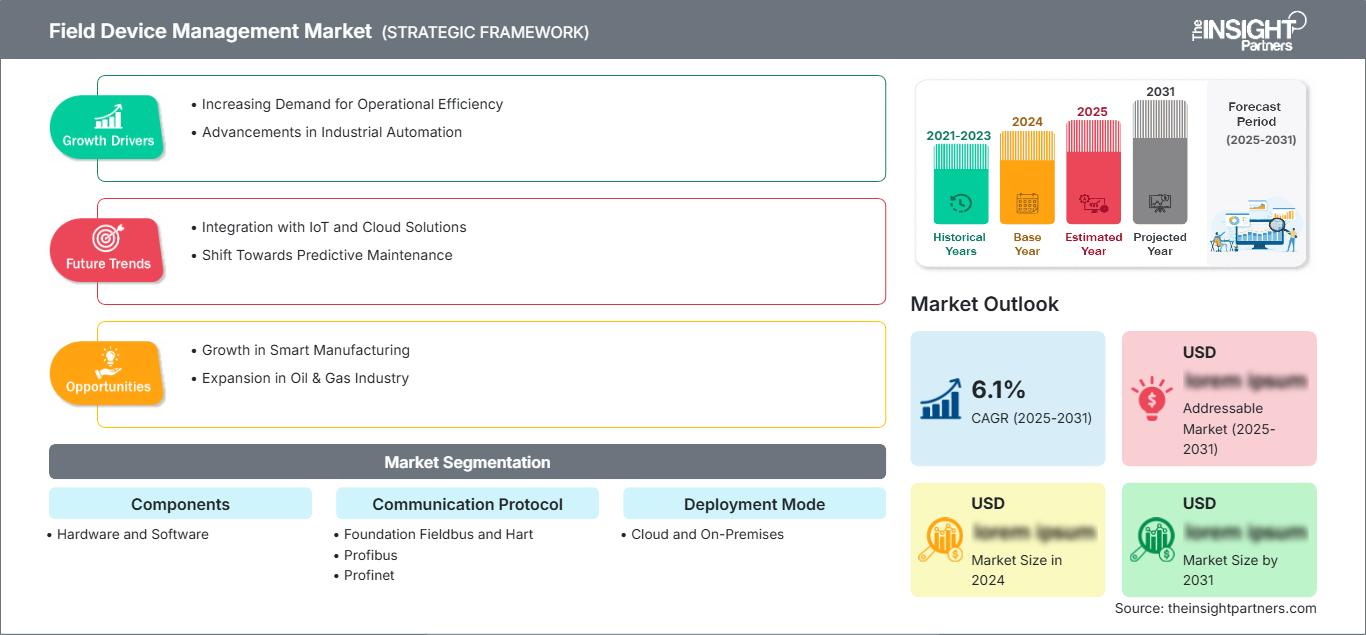
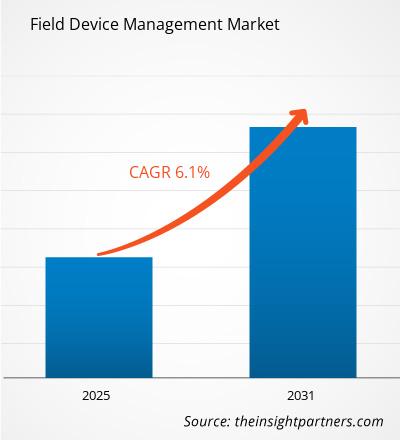
The Field Device Management Market is positioned as a core layer of industrial automation, linking intelligent instruments, controllers, communication networks, and asset-management applications. It is valued at US$ 1.99 Billion in 2025 and forecasted to hit US$ 3.44 Billion by 2034 with CAGR of 6.27% in 2026-2034. The growing deployment of field assets connectivity, diagnostic, and lifecycle management features is increasing the adoption rate in process and discrete industries.
Adoption of Field Device Management Market in North America is driven by the availability of automation infrastructure, widespread installation of smart instrumentation, and continued modernization of industry plants. FDM size forecast points out the projected regional CAGR of 5.6-6.2% till 2034. Demand is primarily driven by cybersecurity needs, brownfield installations, predictive maintenance plans, and the requirement to manage device estates in the existing control system architecture.
Field Device Management Market Assessment and Insights
- North America: North America represents a leading installed-base market, with a 2025 share of 31–35% and CAGR of 5.6–6.2% between 2026–2034. Mature process automation, refinery modernization, and industrial cybersecurity requirements support sustained investment.
- US: The US accounts for 25–29% of North American demand in 2025 and is expected to expand at 5.7–6.3% CAGR between 2026–2034, supported by manufacturing modernization and asset reliability programs.
- Europe: Europe holds a 25–29% share in 2025 and is projected to grow at 5.3–5.9% CAGR through 2034, led by Germany, the UK, France, Italy, and Spain, where industrial digitalization and energy efficiency remain priorities.
- Asia Pacific: Asia Pacific represents 24–28% share in 2025 and is forecast to expand at 6.7–7.5% CAGR during 2026–2034, led by China, Japan, South Korea, and India as factories upgrade automation infrastructure.
- Largest Segment: Software is the largest component, holding a modeled 54–58% market share in 2025 and growing at 6.6–7.2% CAGR during 2026–2034, supported by centralized diagnostics.
- High Growth Segment: Cloud deployment is the high-growth segment, representing 20–24% share in 2025 and expanding at 8.1–9.0% CAGR during 2026–2034 as remote operations mature.
- Key companies analyzed in detail: ABB Group, Emerson Electric Co., FANUC, Honeywell International Inc., Metso Corporation, OMRON Corporation, Rockwell Automation, Inc., Schneider Electric, Siemens AG, Yokogawa Electric Corporation.
Source: The Insight Partners' analysis based on proprietary research, government publications, company annual reports, investor presentations, industry databases, and expert interviews.
Industrial device management has moved from local device configuration utilities towards comprehensive solutions for commissioning, diagnostics, parameter management, device health and inventory. HART, FOUNDATION Fieldbus, PROFIBUS, PROFINET, Modbus, and Ethernet-based technologies are all used within brownfield facilities, leading to higher needs for interoperable management layers. Current platforms tend to include device information, central databases, diagnostics and events, and secured access, while edge computing lessens the reliance on constant connectivity to the outside world.
In the future, budgeting will be done for asset inventories with cloud computing, remote engineering, and life cycle management at geographically separated sites. The industrialized nations in development are expected to adopt hybrid approaches, whereby the control remains local but some of the management capabilities get delegated to the enterprise-level systems. The interest from regulation in cybersecurity, traceability, and functional safety will result in spending on authentic access, parameter configuration, and changes auditing.
Field Device Management Market Report Scope
| Report Attribute | Details |
|---|---|
| Market size in 2025 | US$ 1.99 Billion |
| Market Size by 2034 | US$ 3.44 Billion |
| Global CAGR (2026 - 2034) | 6.27% |
| Historical Data | 2021-2024 |
| Forecast period | 2026-2034 |
Field Device Management Market Analysis
Field Device Management Market growth environment is based on a growing number of smart sensors, transmitters, actuators, valves, and analyzers on factory floors. Field Device Management applications reside in between field devices and automation or enterprise level applications providing configuration, diagnostics, maintenance, and inventory control functionality. Thus, demand will grow as plants seek for asset availability improvement without growing the number of specialists.
The Field Device Management environment consists of instrument manufacturers, automation companies, system integrators, engineering companies, software suppliers, and end users. There is hardware for gateways, interfaces, hand-held communicators, and supporting industrial computers, software for device libraries, diagnostics, configuration management, and reports. The supply is shifting towards modular systems which are able to coexist with existing control systems and not require full system replacement.
According to the Field Device Management Market report, competition is characterized by interoperability, existing automation footprints, protocols, cybersecurity, and integrations with asset performance management software. Companies such as Emerson, Honeywell, Siemens, ABB Group, Schneider Electric, and Yokogawa Electric Corporation compete by leveraging automation ecosystems, and Rockwell Automation, FANUC, OMRON Corporation, Metso Corporation, among others, leverage specializations in discrete, process, machinery, and industrial automation solutions.
Growing investments are made in software-based asset management, device discovery, edge connectivity, and cloud-based solutions. Examples of such strategies include Emerson's AMS solution suite, Siemens Industrial Asset Hub, Honeywell Field Device Manager, and ABB's Smart Device Manager. The companies that have strong engineering services offerings and large footprints have an opportunity to sell their management capabilities when upgrading their customers' facilities, while the interoperability still plays a role in brownfield sites.
● REPORT CUSTOMIZATION
Tailor This Report To Align With Your Specific Business Requirements
This report can be customized to align precisely with your business objectives, scope, and target markets. Customization options include tailored segmentation, geography, competitive analysis, and strategic insights to support informed decision-making.
Customize This Report →WHAT YOU CAN ADJUST
- ● Segmentations
- ● Geography
- ● Competitive Analysis
- ● Language Preferences
Field Device Management Market: Strategic Insights
Regional Insights
North America Field Device Management Market
North America held an estimated 31–35% Field Device Management Market share in 2025 and is expected to expand at 5.6–6.2% CAGR through 2034. The region benefits from established process automation, large installed bases of intelligent instruments, refinery and chemical modernization, and growing requirements for operational technology security. Replacement of obsolete engineering workstations and expansion of remote maintenance capabilities also support recurring software demand.
The US continues to be the dominant regional demand center, with Canada being involved in energy, mining, chemicals, and utilities. The trend is toward centralized management of devices and diagnostics that will work well with the legacy DCS, PLCs, and fieldbus systems. Investments in manufacturing, energy, and digitization of industries should ensure continued spending in device lifecycle management. The region prefers hybrid models of deployment wherein sensitive operations will continue to be managed locally.
U.S. Field Device Management Market
The U.S. represented approximately 83–85% of North American demand in 2025 and is projected to grow at 5.7–6.3% CAGR through 2034. Strong company presence from Emerson, Honeywell International Inc., Rockwell Automation, Inc., ABB Group, Siemens AG, and Schneider Electric supports broad technology availability across process and discrete industries.
Examples range from energy sector applications such as oil and gas production and refining and chemicals through automotive, pharmaceuticals, and advanced manufacturing. Remote configuration, diagnostic functions, firmware management, and inventory of assets have become increasingly important for brownfield facilities as full system replacement is costly and disruptive. There is also demand driven by industrial cybersecurity requirements for credentialing, auditing, and network segmentation of enterprise versus operational networks.
Europe Field Device Management Market
Estimated Europe market share stood at 25-29% in 2025 with a projected growth of 5.3-5.9% CAGR during 2025-2034. Germany takes the lead in terms of regional implementation thanks to process automation, manufacturing of machinery, car manufacturing, and industrial digitalization. Additional market opportunities for Europe come from the UK, France, Italy, and Spain with respect to the development of energy, chemical, pharmaceutical industry, manufacturing, and infrastructure improvement.
In the UK, the focus is on the modernization of industrial and energy infrastructure, which includes remote diagnostics and monitoring the entire lifecycle of such installations. In Germany, the adoption of IIoT technology is facilitated by the development of automation ecosystem and good integration between industrial equipment, engineering systems, and manufacturing software. Expansion of needs in France, Italy, and Spain comes from the process industry and discrete manufacturing. The factors driving European investments include cybersecurity, energy efficiency, and interoperability, which are favorable to the use of platforms that can manage mixed-generations of industrial equipment.
APAC Field Device Management Market
APAC held 24-28% share in 2025 and is expected to experience 6.7-7.5% CAGR, thus becoming the leading growing region. APAC includes the following markets that adopt IIoT technologies: China, Japan, South Korea, India, and Australia. The major driving factors behind the adoption include factory automation, semiconductors, chemicals, pharmaceuticals, and energy-related projects.
The current industrial policy that focuses on smart manufacturing and digital infrastructure encourages the adoption and modernization of industries. China and South Korea focus on automation of manufacturing, Japan prioritizes durability of equipment and advanced manufacturing, India increases capacity and digital manufacturing infrastructure, and Australia is in need for resource-related solutions. Adoption increasingly combines local device management and analytics, hence providing opportunities for those who can operate multiple protocols and plant architectures.
Middle East & Africa Field Device Management Market
Middle East and Africa demand is smaller but strategically significant, and has a projected CAGR of 5.9 – 6.7%. The leaders are Saudi Arabia and UAE because of their industrial initiatives in energy, petrochemicals, infrastructure and diversification programs. South Africa has contribution via mining, metals, chemicals, manufacturing, and utilities.
There are intensive energy processes, which cause a need in reliable instruments, diagnostics and tracking of maintenance. There are investments into the development of new industrial infrastructure by Saudi Arabia and UAE in which the architecture of devices will be chosen at the beginning of work, whereas the contribution of South Africa lies in a large brownfield opportunity. The remaining MEA has a shortage in engineering skills and geographically distributed assets.
Segmentation Analysis
Components
The components segment in the Field Device Management Market covers hardware and software required to configure, monitor, diagnose, and maintain industrial field devices. Software commands a larger position because centralized device databases and diagnostics support scalable lifecycle management. The segment is expected to grow at 6.2–7.0% CAGR during 2026–2034, with software benefiting from recurring functionality and integration with enterprise asset platforms.
- Hardware: Hardware remains essential for field interfaces, communication gateways, portable communicators, and industrial computing. Demand is concentrated in brownfield modernization, commissioning, hazardous environments, and installations requiring dedicated local access.
- Software: Software supports centralized configuration, diagnostics, device libraries, audit trails, and asset visibility. Its strategic importance increases as plants seek standardized management across multiple vendors and communication architectures.
Communication Protocol
Communication protocol compatibility remains fundamental because industrial facilities rarely operate with a single generation of networking technology. The segment is expected to expand at 5.9–6.7% CAGR during 2026–2034. Vendors that support established fieldbus standards while extending Ethernet and modern industrial networking can address both brownfield and greenfield requirements.
- Foundation Fieldbus and Hart: These protocols retain strong relevance in process industries because large installed bases require dependable configuration, diagnostics, calibration, and lifecycle support.
- Profibus: Profibus remains important across established factory and process installations, particularly where existing engineering environments and device inventories support continued lifecycle management.
- Profinet: Profinet benefits from industrial Ethernet adoption, supporting integration between field devices, controllers, engineering systems, and higher-level manufacturing applications.
- Ethernet: Ethernet-based architectures provide scalable connectivity and facilitate convergence between operational networks and broader industrial data infrastructures.
- Modbus: Modbus remains strategically relevant because of its broad installed base, straightforward integration, and compatibility with equipment spanning multiple generations.
- Others: Additional protocols address specialized equipment and emerging connectivity requirements, helping operators integrate diverse assets without replacing functioning infrastructure.
Deployment Mode
Deployment mode is shifting toward hybrid architectures, with on-premises systems retaining importance for control-sensitive environments and cloud services expanding for inventory, analytics, and multi-site visibility. The segment in the Field Device Management Market is expected to grow at 6.8–7.8% CAGR during 2026–2034, with cloud adoption increasing faster from a smaller base.
- Cloud: Cloud deployment supports centralized asset inventories, remote access, cross-site analytics, and scalable software administration, making it attractive for enterprises managing geographically distributed facilities.
- On-Premises: On-premises deployment remains preferred where latency, availability, cybersecurity, data sovereignty, or operational isolation require local management and direct plant-level control.
Industry Type
Industry demand in the Field Device Management Market is diversified across asset-intensive process and discrete manufacturing environments. This segment is expected to advance at 6.0–6.8% CAGR through 2034. Oil and gas, energy, chemicals, and pharmaceuticals emphasize instrument reliability, while automotive and manufacturing increasingly require standardized device management across automated production lines.
- Oil and Gas: Remote diagnostics, hazardous-area requirements, and high asset criticality make device lifecycle visibility strategically important across upstream, midstream, refining, and petrochemical operations.
- Energy and Power: Utilities require dependable instrumentation and configuration governance across generation, transmission, and plant support systems where equipment availability is closely monitored.
- Chemicals: Chemical producers prioritize diagnostics, safety, calibration, and device traceability because process variability and hazardous conditions increase the cost of instrument failures.
- Pharmaceuticals: Regulated production increases demand for controlled configuration, auditability, calibration management, and reliable device records across manufacturing environments.
- Automotive: Highly automated production lines require rapid device commissioning, diagnostics, and standardized parameter management to reduce disruption during model changes and equipment upgrades.
- Manufacturing: Manufacturing plants increasingly integrate sensors, controllers, and machinery networks, creating demand for centralized device visibility and maintenance workflows across diverse equipment.
Opportunity Snapshot
| Industry Type | Revenue Contribution (High/Medium/Low) | Trend Tag | Adoption Stage |
| Oil and Gas | High | Remote Diagnostics | Mature |
| Energy and Power | High | Asset Reliability | Mature |
| Chemicals | High | Safety Diagnostics | Mature |
| Pharmaceuticals | Medium | Audit Control | Scaling |
| Automotive | Medium | Smart Factories | Scaling |
| Manufacturing | High | Device Visibility | Scaling |
Field Device Management Market Growth Drivers and Impact Analysis
Expansion of intelligent industrial instrumentation
The installed base of smart sensors, transmitters, analyzers, actuators, and digitally enabled valves is expanding the volume of information that plants must configure and maintain. Each additional device can introduce parameters, diagnostic states, firmware considerations, and communication dependencies that are difficult to govern through manual processes. As a result, management software increasingly becomes a coordination layer rather than a standalone maintenance utility. The commercial impact is strongest in large process plants, where heterogeneous equipment from multiple vendors must remain operational for long periods. Vendors can monetize this complexity through device libraries, diagnostic modules, engineering services, and lifecycle subscriptions. The effect also extends to brownfield modernization because management platforms allow operators to extract more value from installed instruments without replacing entire control systems.
Rising industrial cybersecurity and configuration governance
Operational technology cybersecurity is increasing the importance of controlled device access, authenticated engineering activity, configuration records, and traceable changes. Field devices can influence physical processes, making unauthorized parameter modifications materially different from conventional enterprise software incidents. Management platforms therefore increasingly incorporate permissions, audit trails, secure communications, and controlled synchronization between engineering databases and field equipment. This changes procurement criteria from basic protocol support toward broader lifecycle governance. Industrial operators benefit through better accountability during maintenance and commissioning, while vendors gain opportunities to integrate device management with security operations and asset-performance systems. The market impact is particularly relevant for energy, chemicals, pharmaceuticals, and critical manufacturing, where process integrity and compliance requirements make undocumented device changes operationally costly.
Shortage of specialized industrial maintenance expertise
Industrial facilities face increasing pressure to maintain complex automation environments while experienced instrumentation specialists become harder to deploy across every site. Device management platforms address this constraint by consolidating diagnostics, parameter information, historical records, and troubleshooting workflows into accessible interfaces. Remote support can allow centralized engineering teams to assist technicians without requiring specialists to travel for every instrument issue. The commercial effect is a shift toward software and services that reduce dependence on individual device expertise. Operators can standardize maintenance procedures across multiple facilities, while vendors can package remote assistance, device libraries, analytics, and training into recurring offerings. This driver is especially significant for geographically dispersed energy assets, large manufacturing networks, and facilities operating continuously where delays in diagnosing instrumentation faults can affect production schedules.
Field Device Management Market Future Trends
AI-assisted device diagnostics
AI-assisted diagnostics are likely to evolve from rule-based alerts toward contextual recommendations that combine device status, historical failures, process conditions, maintenance records, and engineering knowledge. Future platforms in the Field Device Management Market Trends could prioritize faults by operational consequence rather than simply listing alarms, helping technicians distinguish instrumentation degradation from process abnormalities. Device-management vendors are also likely to introduce natural-language interfaces that allow engineers to query asset histories without navigating multiple software screens. Integration with digital twins may further improve root-cause analysis by comparing actual behavior with expected operating states. Adoption will depend on trustworthy industrial datasets, explainable recommendations, cybersecurity controls, and careful separation between advisory analytics and safety-critical control functions. Vendors that establish strong data models will have an advantage when extending AI across heterogeneous installed bases.
Protocol abstraction across mixed industrial estates
Protocol abstraction is expected to become increasingly important as facilities combine legacy fieldbus systems with industrial Ethernet, wireless instruments, and cloud-connected applications. Instead of requiring separate management tools for each communication technology, future platforms are likely to present a common device model above the underlying transport layer. Such architectures can simplify inventory, configuration, diagnostics, and lifecycle governance while preserving the technical characteristics of individual protocols. Greater use of open device descriptions and standardized information models should also improve interoperability among instruments from different suppliers. The commercial opportunity extends beyond new installations because brownfield sites represent a large installed base that cannot economically be replaced at once. Hybrid protocol management can therefore become a differentiator for long-term modernization programs.
Field Device Management Market Opportunities
Multi-site industrial asset management platforms
Enterprises operating multiple plants can create significant value by consolidating device inventories, configuration histories, diagnostic events, and maintenance information within a common governance framework. Investment should prioritize architectures that maintain local operational autonomy while enabling enterprise-level visibility through secure gateways and standardized data models. Vendors can differentiate through fleet analytics, role-based access, lifecycle reporting, and integration with computerized maintenance management systems. The Field Device Management Market Forecasts outlook supports an investment case centered on recurring software revenue rather than one-time device sales. Industrial groups with facilities acquired at different times are particularly attractive because heterogeneous automation environments create immediate interoperability needs. A scalable platform can also establish a foundation for future predictive analytics without requiring simultaneous modernization of every control system.
Device lifecycle services for brownfield modernization
Brownfield facilities offer an actionable opportunity because operators often need to extend the useful life of installed automation assets while improving diagnostics and cybersecurity. Suppliers can develop service packages combining device inventories, configuration audits, protocol assessments, firmware governance, replacement planning, and remote troubleshooting. Such offerings can generate recurring revenue while reducing the technical burden on plant engineering teams. Investment should focus on tools capable of discovering heterogeneous equipment and translating legacy device information into standardized asset records. Partnerships with system integrators can accelerate deployment because local engineering knowledge remains important during commissioning and validation. This model also allows vendors to identify future hardware replacement requirements from actual lifecycle data, creating a structured pathway from device management toward broader industrial modernization.
Recent Developments
- July 2026: ABB Group agreed to acquire Rotork for an enterprise value of approximately US$5.5 billion. The transaction would expand ABB’s automation portfolio at the field-device layer, adding Rotork’s flow-control, instrumentation, and electric-actuator capabilities across process industries. The acquisition is expected to close in the first half of 2027, subject to shareholder and regulatory approvals.
- February 2026: Totalmobile and Solvares Group announced their merger to create an international field service and workforce optimization technology provider. The combined business brings together field service execution, workforce scheduling, planning, and optimization capabilities, with more than 800 employees and over 4,000 customers across Europe, the UK, and Australasia. The transaction strengthens the software ecosystem surrounding mobile workforce management and connected field operations.
- June 2024: FieldComm Group completed its acquisition of FDT Group, bringing FDT/DTM technology and related device-integration capabilities under FieldComm Group. The transaction is relevant to device interoperability and standardized management across industrial automation environments. Because your required Recent Developments window allows 2024 when newer information is unavailable, this item can qualify.
Frequently Asked Questions

- Comprehensive Market Sizing and Forecast Analysis
- Detailed Segmentation Analysis
- In-Depth Market Dynamics Assessment
- Regional and Country-Level Insights
- Competitive Landscape and Company Benchmarking
- Strategic Business Intelligence
Recent Reports
Testimonials

The Insight Partners' SCADA System Market report is comprehensive, with valuable insights on current trends and future forecasts. The team was highly professional, responsive, and supportive throughout. We are very satisfied and highly recommend their services.
RAN KEDEM Partner, Reali Technologies LTDs
I requested a report on a very specific software market and the team produced the report in a few days. The information was very relevant and well presented. I then requested some changes and additions to the report. The team was again very responsive and I got the final report in less than a week.
JEAN-HERVE JENN Chairman, Future Analytica
We worked with The Insight Partners for an important market study and forecast. They gave us clear insights into opportunities and risks, which helped shape our plans. Their research was easy to use and based on solid data. It helped us make smart, confident decisions. We highly recommend them.
PIYUSH NAGPAL Sr. Vice President, High Beam Global
The Insight Partners delivered insightful, well-structured market research with strong domain expertise. Their team was professional and responsive throughout. The user-friendly website made accessing industry reports seamless. We highly recommend them for reliable, high-quality research services
YUKIHIKO ADACHI CEO, Deep Blue, LLC.
This is the first time I have purchased a market report from The Insight Partners.While I was unsure at first, I visited their web site and felt more comfortable to take the risk and purchase a market report.I am completely satisfied with the quality of the report and customer service. I had several questions and comments with the initial report, but after a couple of dialogs over email with their analyst I believe I have a report that I can use as input to our strategic planning process.Thank you so much for taking the extra time and making this a positive experience.I will definitely recommend your service to others and you will be my first call when we need further market data.
JOHN SUZUKI President and Chief Executive Officer, Board Director, BK Technologies
I wish to appreciate your support and the professionalism you displayed in the course of attending to my request for information regarding to infectious disease IVD market in Nigeria. I appreciate your patience, your guidance, and the fact that you were willing to offer a discount, which eventually made it possible for us to close a deal. I look forward to engaging The Insight Partners in the future, all thanks to the impression you have created in me as a result of this first encounter.
DR CHIJIOKE ONYIA MANAGING DIRECTOR, PineCrest Healthcare Ltd.Reason to Buy
- Informed Decision-Making
- Understanding Market Dynamics
- Competitive Analysis
- Identifying Emerging Markets
- Customer Insights
- Market Forecasts
- Risk Mitigation
- Boosting Operational Efficiency
- Strategic Planning
- Investment Justification
- Tracking Industry Innovations
- Aligning with Regulatory Trends





 Get Free Sample for