
Field Emission Display Market Share, Size & Demand by 2034
Coverage: By Component (Conductive Layer, Organic Material, Backlight Panel, Others); Display Size (Less than 10 Inches, 10"20 Inches, 20"30 Inches, 30"40 Inches, 40"50 Inches, Above 50 Inches); Application (Smartphones, Tablets, Laptops, TVs, OLED Display, Others); Industry Vertical (Chemical and Petrochemical, Oil and Gas, Energy and Power, Automotive, Food and Beverages, Healthcare, Others) , and Geography (North America, Europe, Asia Pacific, and South and Central America)
- Status : Data Released
- Report Code : TIPRE00019009
- Category : Electronics and Semiconductor
- No. of Pages : 150
- Available Report Formats :


- Last update date : September 09, 2026


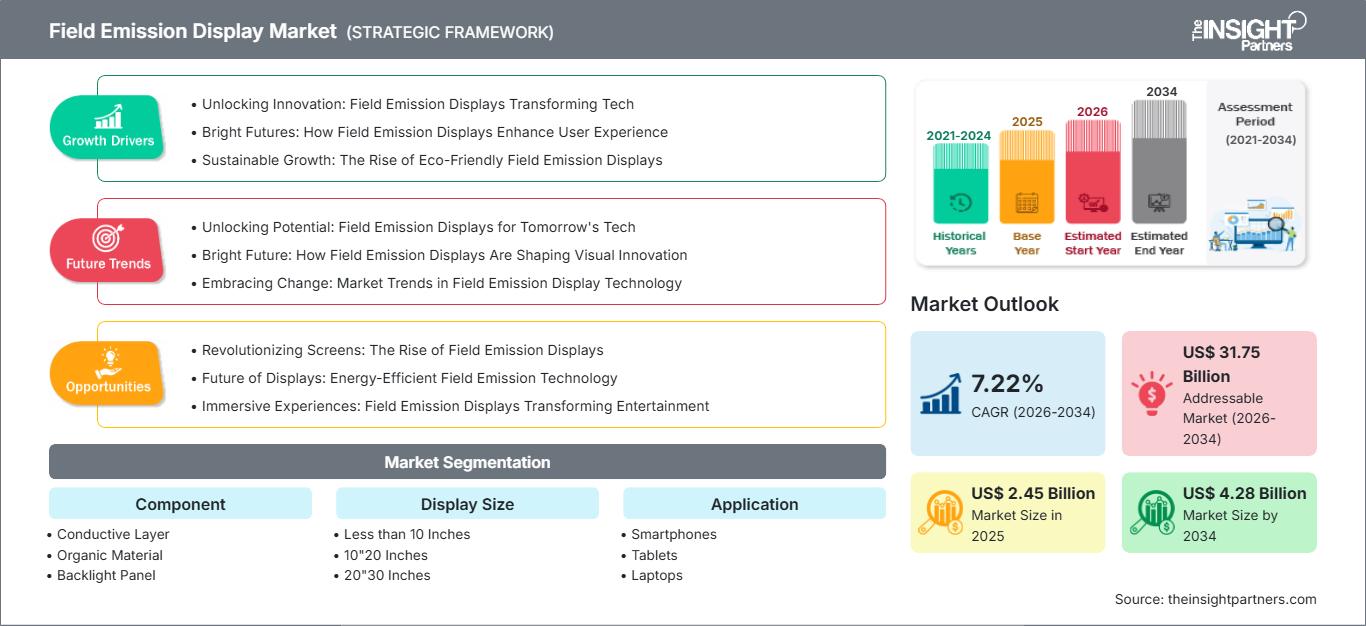
2025 Market Size
US$ 2.45 Bn
Base year value
2034 Forecast
US$ 4.28 Bn
Projected by 2034
CAGR 2026-2034
6.39 %
Growth rate
Addressable Market
US$ 30.44 Bn
(2026-2034)
The global Field Emission Display market was valued at US$ 2.45 billion in 2025 and is expected to reach US$ 4.28 billion by 2034; it is estimated to record a CAGR of 6.39% during 2026-2034.
Field Emission Display Market Assessment and Insights
- North America: North America is expected to account for a 29–33% share in 2025 and grow at a 6.7–7.4% CAGR between 2026–2034, supported by advanced electronics, automotive displays, defense applications, and industrial modernization.
- US: The US is expected to represent 22–26% of the global market in 2025 and expand at a 6.8–7.5% CAGR between 2026–2034, supported by defense electronics, healthcare equipment, and specialized visualization.
- Europe: Europe is projected to hold a 23–27% share in 2025 and register a 6.3–7.1% CAGR between 2026–2034. Germany, France, the UK, and Italy provide important demand through automotive engineering, industrial equipment, and healthcare electronics.
- Asia Pacific: Asia Pacific is estimated at a 31–35% share in 2025 and is expected to grow at a 7.6–8.5% CAGR between 2026–2034. China, Japan, South Korea, and India benefit from electronics manufacturing, display research, and industrial automation.
- Largest Segment: Application-wise, TVs are modelled as the largest segment, with a 24–28% market share in 2025 and a 6.9–7.6% CAGR during 2026–2034, reflecting large-screen replacement and premium visualization demand.
- High Growth Segment: Automotive is identified as the high-growth industry vertical, representing a 14–18% market share in 2025 and expanding at a 8.0–8.8% CAGR during 2026–2034 as vehicle displays become increasingly sophisticated.
- Key companies analyzed in detail: LG Display Co. Ltd., Samsung, Sharp Corporation, Japan Display Inc., Sony Electronics Inc., NEC Display Solutions, Ltd., Panasonic Corporation, AU Optronics Corp., E Ink Holdings Inc., Crystal Display Systems Ltd.
Source: The Insight Partners' analysis based on proprietary research, government publications, company annual reports, investor presentations, industry databases, and expert interviews.
Field Emission Display Market depend on innovations in electron-emission structures, conductive materials, micro-fabrication and high performance panels. Cost considerations will continue to depend on issues such as yields, emitter uniformity, vacuum stability, substrate handling and component procurement. Although OLEDs and more advanced LCDs dominate general applications, there will be situations where field emission displays have significance because of their brightness, ruggedness, fast responses, and special operational needs.
Adoption will probably focus on special applications during the forecast period instead of being spread throughout consumer electronics devices. The investments will be focused in areas that require application-specific engineering, automotive visualization, industrial interfaces and robust equipment. Energy efficiency and environmental regulations related to the sustainable development of electronic products can drive the need to optimize power use, material use and product life cycle in some cases.
Field Emission Display Market Report Scope
| Report Attribute | Details |
|---|---|
| Market size in 2025 | US$ 2.45 Billion |
| Market Size by 2034 | US$ 4.28 Billion |
| Global CAGR (2026 - 2034) | 6.39% |
| Historical Data | 2021-2024 |
| Forecast period | 2026-2034 |
Field Emission Display Market Analysis
Increasingly, demand is driven by requirements for display performance rather than merely the need for panel replacement. Growth in the Field Emission Display Market is underpinned by applications that require high luminance, wide viewing capabilities, fast response time, and reliability in tough conditions. Applications such as automotive, industrial control, healthcare, and visualization may have greater value added than consumer displays.
From emitters and conductors, material suppliers, substrate suppliers, panel manufacturers, electronics assembly houses, OEMs and applications developers make up the ecosystem. This is dependent on the processes of yield, new materials, tools and intellectual property rights. Companies that have control over various parts of supply chain can reduce integration risk, and specialist companies will contribute their share in emitters, coatings, backlighting or specific application modules.
The competitive positioning is determined by technology specialization, manufacturing scale, application connections, and research capacity. The companies which have developed strong technological capacities within the entire display industry include LG Display Co. Ltd., Samsung, Sharp Corporation, and Japan Display Inc. On the other hand, Sony Electronics Inc. and Panasonic Corporation have established application channels. The Field Emission Display Market report includes positioning for Crystal Display Systems Ltd. and technology capacities of E Ink Holdings Inc.
Technologies which are not incompatible with current display manufacturing capacities are becoming more popular among investors. The companies like AU Optronics Corp. and NEC Display Solutions, Ltd. complement each other in display engineering and business expertise, and large corporations can use their supply chain and customers' relations. Therefore, strategic differentiation is based on having certain performance advantage for particular applications compared to existing OLED, LCD, and other displays.
● REPORT CUSTOMIZATION
Tailor This Report To Align With Your Specific Business Requirements
This report can be customized to align precisely with your business objectives, scope, and target markets. Customization options include tailored segmentation, geography, competitive analysis, and strategic insights to support informed decision-making.
Customize This Report →WHAT YOU CAN ADJUST
- ● Segmentations
- ● Geography
- ● Competitive Analysis
- ● Language Preferences
Field Emission Display Market: Strategic Insights
Regional Insights
North America Field Emission Display Market
North America represents a market of 29%–33% Field Emission Display Market share in 2025 with an annual growth rate of 6.7%–7.4% up until 2034. The region is well served with advanced technology for defense, automotive, medical, and industrial applications. US-based research institutes and technology firms are engaged in development of advanced displays, whereas the supply chain for electronics helps with prototyping and integration.
There is also a demand due to the modernization of industries and increasing need for strong man-machine interface. Markets are available in Canada in aerospace, mining and industrial sectors while the United States is the key player in the regional market due to advanced technology base and defense expenditure. Selection criteria include reliability, lifecycle parameters, environmental compatibility and flexibility for integration, which leads to the use of unique display technologies.
U.S. Field Emission Display Market
The US represents a modelled 76–80% share of North American demand in 2025 and is expected to grow at a 6.8–7.5% CAGR through 2034. The country benefits from defense electronics, aerospace systems, healthcare devices, automotive technologies, and industrial controls requiring specialized visualization capabilities.
Suppliers like LG Display Co. Ltd., Samsung, Sony Electronics Inc., Panasonic Corporation, and others from abroad enjoy good commercial or technological ties within the entire U.S. display industry. The trend towards applications is to focus on high-performing interfaces, large-format visualization, automotive displays, and systems that will be applied in challenging environments. Total lifecycle cost, availability of parts, cybersecurity, and compatibility with embedded computer platforms are being considered in the purchasing process.
Europe Field Emission Display Market
Europe will have a market share of 23–27% in 2025 and grow at a CAGR of 6.3–7.1% from 2025 to 2034. The region is dominated by demand from Germany owing to automotive OEMs and industrial technology companies which embed complex interfaces in vehicles and machines. The UK and France create opportunities due to aerospace, healthcare, defense, and electronics industries.
Germany continues to be the leader due to the use of interfaces in automobiles and machinery by automotive OEMs and industrial technology companies. UK provides opportunities through aerospace, defense, medical devices and professional visualizations. France provides opportunities for the application of interfaces through automotive, aerospace, energy and government technology sectors. Italy and Spain provide opportunities through industrial machinery, transport, healthcare and commercial display sectors. European buyers value energy efficiency, durability, reparability and proper materials management.
APAC Field Emission Display Market
Asia Pacific has been assumed to have a market share ranging between 31% to 35% in 2025, and a compounded annual growth rate between 7.6% to 8.5% until 2034. The largest market share holder in Asia Pacific is China, followed by Japan, South Korea, India, and Australia. The key drivers include electronics manufacture, automotive production, and industrial automation.
The key drivers in China include manufacturing strength and electronics investments in the country. In Japan, advanced display technology is driving the market, and South Korea holds advantages in its panel technology. The key drivers in India are electronic manufacture and increasing demand in auto and industries, while Australia derives its contribution through mining, infrastructure, and special equipment.
Middle East & Africa Field Emission Display Market
Middle East and Africa offers a relatively smaller regional market with estimated modelled CAGR of 5.8-6.6% until 2034. Leading markets in the region include Saudi Arabia, UAE, and South Africa. Needs for energy infrastructure, industry digitalisation, transportation infrastructure development, healthcare system development, and smart cities generate special needs for display solutions.
Digitally enabled infrastructure and industry investments are being implemented in Saudi Arabia and the UAE, while South Africa offers demand from mining, utilities, healthcare and transportation segments. RoMEA is fragmented, with the demand driven by infrastructure and industrial investments. Reliability, resistance to environmental conditions, ease of servicing and system integration become important criteria in purchases of displays used in difficult temperature conditions, dusty environment, and continuous operation mode.
Segmentation Analysis
Component
Component demand is influenced by emitter performance, conductive characteristics, optical efficiency, and integration requirements. The segment is projected to expand at a 6.8–7.5% CAGR during 2026–2034. Supplier competitiveness depends on material consistency, manufacturing precision, thermal characteristics, and compatibility with panel fabrication processes. The Field Emission Display Market scope increasingly includes specialized component engineering as manufacturers seek performance improvements without substantially increasing system complexity.
- Conductive Layer: Conductive layers provide electrical pathways supporting electron-emission operation and panel functionality. Demand is linked to material uniformity, conductivity, thermal stability, manufacturing precision, and compatibility with increasingly compact display architectures.
- Organic Material: Organic materials can support specialized optical and electronic functions within display structures. Their strategic importance depends on stability, processing compatibility, material purity, and the ability to support consistent panel performance.
- Backlight Panel: Backlight panels support brightness and visual performance in applicable architectures. Demand is influenced by luminance requirements, optical efficiency, thermal management, panel thickness, and integration requirements across professional and consumer applications.
Display Size
Display-size demand varies according to application density, viewing distance, portability, and installation environment. The segment is expected to register a 6.5–7.3% CAGR during 2026–2034. Larger formats provide opportunities in professional visualization and automotive environments, while smaller formats remain relevant for portable and embedded applications. Manufacturing economics and yield remain critical as dimensions increase.
- Less than 10 Inches: Compact displays serve embedded electronics, handheld equipment, medical instruments, and portable systems where space efficiency and readability are important purchasing considerations.
- 10"20 Inches: This range supports control panels, portable computing, industrial interfaces, and specialized equipment, balancing usable viewing area with relatively compact installation requirements.
- 20"30 Inches: Mid-sized displays address professional monitors, industrial systems, automotive interfaces, and specialized visualization applications where readability and installation flexibility are both important.
- 30"40 Inches: Displays in this category support control rooms, professional visualization, transportation, and selected commercial applications requiring greater viewing distance and information density.
- 40"50 Inches: This range is relevant to larger professional screens, televisions, automotive visualization environments, and specialized installations requiring substantial viewing areas.
- Above 50 Inches: Large-format panels target television, digital visualization, command environments, and professional applications where immersive viewing, brightness, and visual scale influence purchasing decisions.
Application
Application demand is expected to grow at a 7.0–7.8% CAGR during 2026–2034 as display requirements diversify across personal electronics and larger visualization platforms. Smartphones, tablets, laptops, TVs, and OLED Display applications differ substantially in power, resolution, size, response, and integration requirements. The Field Emission Display Market analysis therefore emphasizes application-specific performance rather than uniform technology substitution.
- Smartphones: Smartphone applications prioritize compact dimensions, brightness, power efficiency, touch integration, and durability, making display architecture selection closely linked to device design and battery-management requirements.
- Tablets: Tablets require a balance between viewing quality, portability, battery life, and touch responsiveness, supporting demand for thin, efficient, and visually consistent display solutions.
- Laptops: Laptop applications emphasize readability, energy efficiency, refresh performance, thinness, and mechanical durability, particularly as premium computing increasingly incorporates advanced visualization features.
- TVs: TVs represent a major large-screen application, with purchasing decisions shaped by brightness, contrast, viewing angle, resolution, energy consumption, and manufacturing economics.
- OLED Display: OLED Display applications create technology overlap where manufacturers compare alternative architectures based on luminance, response, durability, power characteristics, manufacturing complexity, and premium positioning.
Industry Vertical
Industry vertical demand is projected to expand at an 7.4–8.2% CAGR through 2034, supported by increasing digitization of industrial and transportation systems. Automotive applications are expected to exhibit particularly strong momentum, while energy, healthcare, and process industries require dependable interfaces for monitoring, control, and operational visualization. Industrial procurement typically evaluates lifecycle reliability alongside display performance.
- Chemical and Petrochemical: Process plants require reliable visualization for monitoring, control, safety systems, and instrumentation, with environmental tolerance and continuous operation influencing display selection.
- Oil and Gas: Remote facilities and control environments prioritize rugged interfaces, readability, reliability, and serviceability, particularly where equipment must operate continuously under challenging environmental conditions.
- Energy and Power: Utilities require displays for control rooms, substations, monitoring equipment, and grid-management systems, creating demand for dependable visualization integrated with industrial control infrastructure.
- Automotive: Automotive displays increasingly support instrument clusters, infotainment, passenger interfaces, and advanced vehicle systems, with durability, brightness, response, and integration driving technology selection.
- Food and Beverages: Processing facilities use displays for production monitoring, quality control, packaging, and equipment operation, where cleanability, reliability, and intuitive interfaces influence adoption.
- Healthcare: Medical systems require consistent visualization for diagnostic equipment, monitoring systems, patient interfaces, and clinical workflows, emphasizing accuracy, reliability, and long operating life.
Opportunity Snapshot
| Industry Vertical | Revenue Contribution (High/Medium/Low) | Trend Tag | Adoption Stage |
|---|---|---|---|
| Chemical and Petrochemical | Medium | Process Control | Scaling |
| Oil and Gas | Medium | Remote Monitoring | Scaling |
| Energy and Power | High | Grid Visualization | Scaling |
| Automotive | High | Cockpit Displays | Scaling |
| Food and Beverages | Low | Factory Interfaces | Emerging |
| Healthcare | High | Clinical Imaging | Scaling |
Field Emission Display Market Growth Drivers and Impact Analysis
Increasing Demand for High-Performance Visualization
The desire for greater brightness, increased speed, and improved durability of visualization is giving rise to opportunities in terms of advanced display architectures. In vehicle instrumentation, industrial control rooms, medical instrumentation, and professional visualization systems, there is an increasing need for uniform performance across various lighting conditions. This need may favor the adoption of field-emission devices in scenarios where certain features make them a better choice compared to traditional devices. The market effects are seen particularly where equipment downtime and degradation of visualization performance have implications on cost. Suppliers will now be able to pursue a strategy of differentiation based on reliability, contrast, speed, and environmental performance and not on panel cost alone.
Industrial Digitization Expands Specialized Display Requirements
Digitization of industry is creating more electronic interfaces for use in manufacturing, utility, transport, and process industries. Increasingly, modern plants are using human-machine interfaces, control room consoles, machine vision interfaces, and digital monitoring systems. There are different requirements put forth for displays in such an environment compared to consumer electronics, which include high operating time, reliability, servicing capability, and durability in harsh conditions. Such a demand will allow for display manufacturers that are able to combine display panels with industrial computers and control systems. Future growth will be seen in areas where the failure of displays will have an impact on production process or safety.
Automotive Electronics Increase Display Content per Vehicle
Vehicle architectures are evolving toward greater electronic integration, increasing the number and importance of displays used inside passenger cabins. Instrument clusters, central information screens, passenger displays, head-up systems, and rear-seat interfaces create multiple opportunities for display suppliers. Automotive buyers emphasize wide operating temperature ranges, optical performance, mechanical durability, low power consumption, and long product availability. These requirements can create favorable conditions for differentiated technologies when they demonstrate measurable advantages over incumbent solutions. The commercial opportunity also extends beyond panel supply because automotive programs require engineering collaboration, qualification, software integration, and production consistency. Suppliers capable of meeting stringent automotive validation requirements can develop longer customer relationships and improve visibility across vehicle platforms, although qualification timelines remain a significant market-entry consideration.
Field Emission Display Market Future Trends
Convergence of Display Engineering and Embedded Intelligence
The Field Emission Display Market trends are likely to increasingly reflect convergence between display hardware, embedded intelligence, sensing, and application software. Future systems may dynamically adjust brightness, contrast, refresh characteristics, and interface presentation according to environmental conditions and user requirements. Automotive and industrial platforms are particularly suitable because displays increasingly operate as interactive system components rather than passive output devices. Manufacturers can differentiate through integrated optical sensing, adaptive control electronics, and application-specific software interfaces. This direction may also encourage modular display architectures that allow the same underlying panel technology to support multiple equipment configurations. Investment priorities are therefore expected to move toward system-level engineering, where display performance is evaluated alongside computing capability, connectivity, sensing, thermal management, and lifecycle support rather than as an isolated component.
Advanced Materials Support More Specialized Display Architectures
Future development is expected to focus on conductive materials, emitter structures, substrates, optical layers, and manufacturing processes capable of improving consistency and reducing production complexity. Material innovation could help address limitations related to emission uniformity, thermal stability, manufacturing yield, and long-term reliability. Research programs are likely to prioritize combinations of nanomaterials, precision coatings, advanced substrates, and improved fabrication techniques. Such developments can expand the range of environments in which field-emission architectures are technically competitive. The emphasis will increasingly be on manufacturability rather than laboratory performance alone. Commercial success will depend on whether improvements can be translated into repeatable production, manageable costs, reliable supply chains, and application-specific qualification. This creates opportunities for material suppliers and display manufacturers to form deeper technology partnerships.
Field Emission Display Market Opportunities
Specialized Automotive and Mobility Platforms
Automotive platforms provide an investment opportunity because display content is expanding across instrument clusters, infotainment, passenger information, and advanced vehicle interfaces. Suppliers can target applications where high brightness, response performance, reliability, and environmental durability are valued more heavily than minimum unit cost. The Field Emission Display Market Forecasts can therefore support strategic evaluation of premium automotive programs, particularly where qualification barriers protect established suppliers from rapid commoditization. Investment should prioritize engineering partnerships with automotive OEMs, tier-one suppliers, and cockpit-system integrators rather than relying solely on open-market panel sales. Product roadmaps should address automotive temperature ranges, optical consistency, electromagnetic compatibility, mechanical durability, and long-term availability. Early engagement is important because vehicle-platform qualification cycles can extend over several development phases.
Industrial and Healthcare Display Modules
Industrial and healthcare equipment offer opportunities for application-specific display modules that prioritize reliability, serviceability, optical stability, and lifecycle availability. Manufacturers can develop standardized platforms customized for control rooms, diagnostic systems, monitoring equipment, laboratory instruments, and process automation. The Field Emission Display Market scope can broaden when suppliers provide complete modules incorporating electronics, mechanical protection, interfaces, and application-specific controls. Investment decisions should focus on recurring equipment programs where lifecycle requirements create stronger margins than commodity consumer applications. Partnerships with equipment manufacturers can reduce customer acquisition costs while improving product qualification and forecasting visibility. Suppliers should also evaluate regional service capabilities, spare-parts planning, and documentation because industrial and healthcare buyers typically assess total ownership requirements alongside technical specifications.
Recent Developments
- September 2025: LG Display Co. Ltd. announced that its fourth-generation OLED panels received UL Solutions verification for Perfect Reproduction technology, with the company stating that the panels accurately reproduced more than 95% of original images under specified lighting conditions. The development reinforces continued investment in advanced brightness, color reproduction, and premium display engineering.
- August 2025: Sharp Corporation introduced its PN-E Series commercial displays in seven screen-size categories ranging from 32-inch to 86-inch class models. The portfolio targets digital signage, workplace collaboration, and visual communication applications, reflecting continuing expansion of professional display solutions across commercial environments and large-format visualization.
- February 2025: Japan Display Inc. announced a strategic investment in OLEDWorks and a partnership intended to support advanced OLED manufacturing in the US. The initiative demonstrates continued diversification toward advanced display technologies and manufacturing capabilities, while strengthening the company's positioning in next-generation display development and localized production.
Frequently Asked Questions

- Comprehensive Market Sizing and Forecast Analysis
- Detailed Segmentation Analysis
- In-Depth Market Dynamics Assessment
- Regional and Country-Level Insights
- Competitive Landscape and Company Benchmarking
- Strategic Business Intelligence
Recent Reports
Testimonials

The Insight Partners provided valuable market intelligence that supported our global go-to-market strategy. Their team was professional, responsive, and attentive to our feedback, providing thoughtful analysis and helpful methodological clarifications throughout the project.
Junmo Kim Chief Financial Officer (CFO), Enertech Co., Ltd.
The Insight Partners' SCADA System Market report is comprehensive, with valuable insights on current trends and future forecasts. The team was highly professional, responsive, and supportive throughout. We are very satisfied and highly recommend their services.
RAN KEDEM Partner, Reali Technologies LTDs
I requested a report on a very specific software market and the team produced the report in a few days. The information was very relevant and well presented. I then requested some changes and additions to the report. The team was again very responsive and I got the final report in less than a week.
JEAN-HERVE JENN Chairman, Future Analytica
We worked with The Insight Partners for an important market study and forecast. They gave us clear insights into opportunities and risks, which helped shape our plans. Their research was easy to use and based on solid data. It helped us make smart, confident decisions. We highly recommend them.
PIYUSH NAGPAL Sr. Vice President, High Beam Global
The Insight Partners delivered insightful, well-structured market research with strong domain expertise. Their team was professional and responsive throughout. The user-friendly website made accessing industry reports seamless. We highly recommend them for reliable, high-quality research services
YUKIHIKO ADACHI CEO, Deep Blue, LLC.
This is the first time I have purchased a market report from The Insight Partners.While I was unsure at first, I visited their web site and felt more comfortable to take the risk and purchase a market report.I am completely satisfied with the quality of the report and customer service. I had several questions and comments with the initial report, but after a couple of dialogs over email with their analyst I believe I have a report that I can use as input to our strategic planning process.Thank you so much for taking the extra time and making this a positive experience.I will definitely recommend your service to others and you will be my first call when we need further market data.
JOHN SUZUKI President and Chief Executive Officer, Board Director, BK Technologies
I wish to appreciate your support and the professionalism you displayed in the course of attending to my request for information regarding to infectious disease IVD market in Nigeria. I appreciate your patience, your guidance, and the fact that you were willing to offer a discount, which eventually made it possible for us to close a deal. I look forward to engaging The Insight Partners in the future, all thanks to the impression you have created in me as a result of this first encounter.
DR CHIJIOKE ONYIA MANAGING DIRECTOR, PineCrest Healthcare Ltd.Reason to Buy
- Informed Decision-Making
- Understanding Market Dynamics
- Competitive Analysis
- Identifying Emerging Markets
- Customer Insights
- Market Forecasts
- Risk Mitigation
- Boosting Operational Efficiency
- Strategic Planning
- Investment Justification
- Tracking Industry Innovations
- Aligning with Regulatory Trends





 Get Free Sample for