
Frequency Converter Market Size, Growth & Demand by 2034
Coverage: by Type (Static Frequency Converter, Rotary Frequency Converter); End-user (Aerospace and Defense, Energy and Power, Process Industry, Oil and Gas, Marine, Others) , and Geography (North America, Europe, Asia Pacific, and South and Central America)
- Status : Data Released
- Report Code : TIPRE00009354
- Category : Electronics and Semiconductor
- No. of Pages : 150
- Available Report Formats :


- Last update date : September 17, 2026


2025 Market Size
US$ 26.42 Bn
Base year value
2034 Forecast
US$ 36.89 Bn
Projected by 2034
CAGR 2026-2034
3.78 %
Growth rate
Addressable Market
US$ 287.56 Bn
(2026-2034)
The Frequency Converter Market was valued at US$ 26.42 Billion in 2025 and is projected to reach US$ 36.89 Billion by 2034, expanding at a CAGR of 3.78% during 2026–2034. Market development is supported by increasing requirements for controlled power conversion across industrial equipment, aircraft ground systems, marine applications, and power infrastructure. The outlook reflects sustained investment in efficient electrical systems and the replacement of legacy conversion equipment with digitally monitored architectures.
North America remains a strategically important market, supported by aerospace modernization, defense procurement, industrial automation, and data-center infrastructure. The Frequency Converter Market size is influenced by demand for reliable power conditioning, frequency conversion, and equipment compatibility across 50 Hz, 60 Hz, and specialized-frequency environments. Replacement cycles, stringent reliability requirements, and domestic manufacturing initiatives provide a relatively stable demand base through the forecast period.
Frequency Converter Market Assessment and Insights
- North America accounts for a modeled 31–33% Frequency Converter Market share in 2025 and is expected to grow at a 3.4–3.7% CAGR between 2026–2034, supported by aerospace, defense, industrial automation, and critical-power investments.
- US represents 73–75% of North America's 2025 market and is projected to expand at a 3.2–3.5% CAGR between 2026–2034, underpinned by defense modernization and infrastructure investment.
- Europe holds a modeled 27–29% share in 2025 and is expected to grow at a 3.5–3.8% CAGR between 2026–2034, with Germany, the UK, France, Italy, and Spain providing established industrial demand.
- Asia Pacific represents an estimated 29–31% share in 2025 and is projected to record a 4.3–4.7% CAGR between 2026–2034, led by China, Japan, South Korea, India, and Australia.
- Largest Segment: Static Frequency Converter holds a modeled 72–76% market share in 2025 and is projected to grow at a 3.6–3.9% CAGR during 2026–2034.
- High Growth Segment: Marine is modeled at a 7–9% 2025 share and is expected to expand at a 4.6–5.0% CAGR during 2026–2034, reflecting shore-power and vessel electrification requirements.
- Key companies analyzed in detail: ABB Ltd, Aplab Limited, Danfoss A/S, General Electric Company, Georator Corporation, NOVA ELECTRIC, Piller Power Systems, Power Systems and Controls, Inc., Power Systems International, Siemens AG.
Source: The Insight Partners' analysis based on proprietary research, government publications, company annual reports, investor presentations, industry databases, and expert interviews.
The Frequency Converter Market has transitioned from being primarily electromechanical and rotary to solid-state with power semiconductors, insulated gate bipolar transistors, pulse width modulation, and electronics control. Static converters are also incorporating voltage regulation, isolation, protection, communication, and diagnostics. Economies of manufacture are changing due to modularity and reduced customization, while local manufacturing and application engineering will still be necessary for aerospace, maritime, defense, and industrial applications with particular environmental requirements.
For future expansion, the Frequency Converter Market will benefit from growing use in new manufacturing and infrastructure developments where frequency synchronization and power quality are operational considerations. Electrification, renewable energy, data centers, ports, and advanced manufacturing developments are expected to provide new opportunities. Regulations focused on energy efficiency and emission reduction favor electronic conversion to inefficient mechanical conversion, while localization of the supply chain is encouraging manufacturers to produce, service, and integrate in the region close to major customers.
Frequency Converter Market Report Scope
| Report Attribute | Details |
|---|---|
| Market size in 2025 | US$ 26.42 Billion |
| Market Size by 2034 | US$ 36.89 Billion |
| Global CAGR (2026 - 2034) | 3.78% |
| Historical Data | 2021-2024 |
| Forecast period | 2026-2034 |
Frequency Converter Market Analysis
Market Growth is being driven by increasing demand for reliable and controllable electrical outputs in equipment working at various types of grids and operating frequencies. The value chain comprises semiconductors, transformers, capacitors, cooling systems, controls, software, converters, systems integrators, distribution companies, and aftermarket service providers. Equipment down time costs in terms of economic losses or safety risks are critical factors that determine demand, which includes aircraft support equipment, machinery, pumps and compressors, ships, and power equipment.
Supply is shifting in favor of vendors offering integrated solutions with embedded monitoring, protection, and application-specific controls. Availability of components, heat dissipation needs, power density requirements, and certifications may have material impact on order processing periods. Leading players can take advantage of their engineering capacities and installed bases, while specialists compete on their capacity for customization, ruggedization, shorter delivery time, and specialization. Therefore, service contracts, replacement modules, and retrofit engineering become relevant complement to equipment sale.
The Frequency Converter Market analysis highlights that the market exhibits moderate fragmentation and consists of multinational electrical equipment manufacturers and power converter manufacturers. ABB Ltd, Danfoss A/S, General Electric Company, and Siemens AG compete relying on comprehensive automation, electrification, drive, and power solutions. Aplab Limited, NOVA ELECTRIC, Piller Power Systems, Power Systems International, as well as other specialists work on solving application-specific problems. Georator Corporation and Power Systems and Controls, Inc. offer specialized competencies in harsh conditions of frequency converters.
Investments are focused on increasing efficiency of semiconductors, digital monitoring, modularization, renewable integration, and localized production. Software enabled drive optimization became a key direction for Siemens AG, whereas power conversion solutions of ABB Ltd have been augmented by portfolio acquisition. Ecosystem based motor and drive solutions is another direction for Danfoss A/S. Thus, competitive positioning relies on lifecycle efficiency, engineering support, integration, reliability, and configurability for aerospace, marine, industrial, and energy segments.
● REPORT CUSTOMIZATION
Tailor This Report To Align With Your Specific Business Requirements
This report can be customized to align precisely with your business objectives, scope, and target markets. Customization options include tailored segmentation, geography, competitive analysis, and strategic insights to support informed decision-making.
Customize This Report →WHAT YOU CAN ADJUST
- ● Segmentations
- ● Geography
- ● Competitive Analysis
- ● Language Preferences
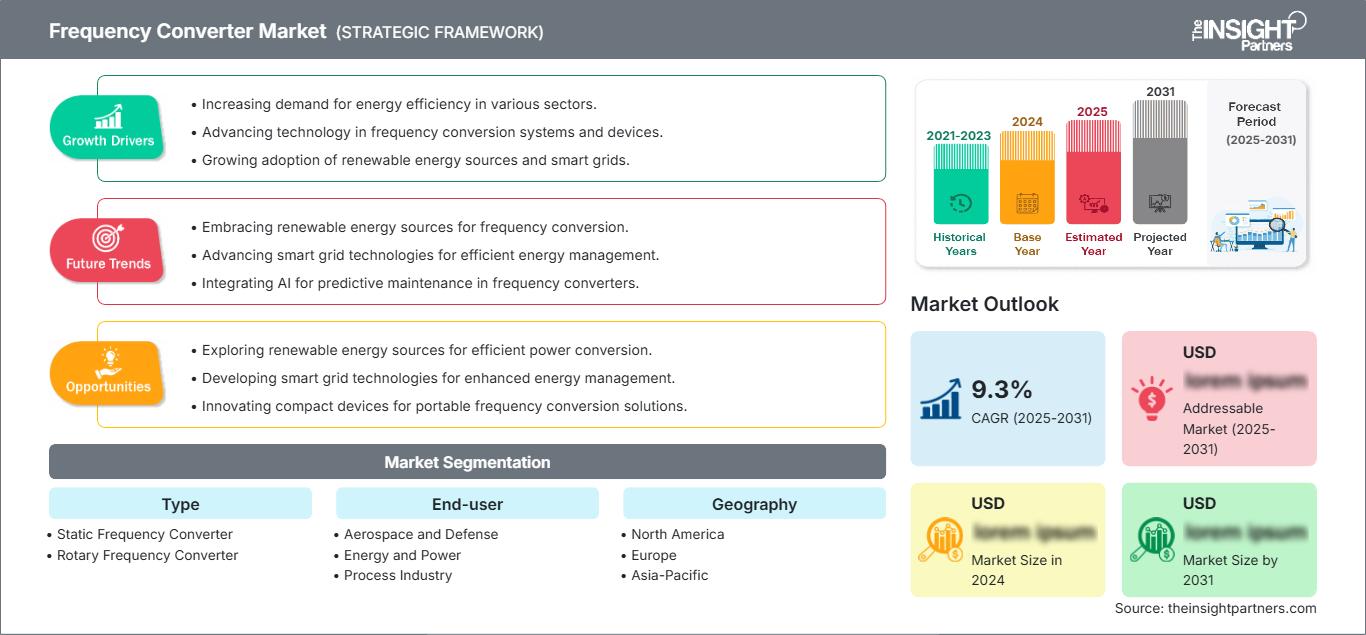
Frequency Converter Market: Strategic Insights
Regional Insights
North America Frequency Converter Market
North America represented a modeled 31–33% share in 2025, with the region projected to expand at a 3.4–3.7% CAGR through 2034. Demand is underpinned by aerospace manufacturing, defense electronics, industrial automation, data center infrastructure, and the need to replace old power conversion equipment. While the US continues to lead, the Canadian market is supported by energy infrastructure, mining operations, transportation sector, and industrial establishments demanding robust frequency conversion.
One important structural element of the market is the focus on reliable electricity supply infrastructure. The demand from the aerospace and defense sectors includes tight control over the power quality for the purpose of testing, ground support, simulations, and mission equipment. The trend towards digital monitoring and modularity of the power conversion equipment makes maintenance easier. Growth will be gradual as the bulk of installed equipment is mature; however, there are sources of additional demand such as data centers, advanced manufacturing, and electrification.
U.S. Frequency Converter Market
The US accounted for a modeled 73–75% share of North America's 2025 market and is expected to grow at a 3.2–3.5% CAGR through 2034. Demand is supported by defense modernization, aircraft manufacturing, industrial facilities, data centers, and critical-power applications. The market also benefits from a large installed base requiring replacement, retrofit, and service support across multiple industrial frequencies.
The range of company activities includes international suppliers and engineering companies. The applications are shifting toward programmable outputs, reduced harmonic distortion, redundancy, remote monitoring, and small footprint. Growth in the data center sector leads to new needs for power conditioning and frequency stability, while the aerospace segment keeps demanding special 400 Hz devices. Modernization in the industrial segment creates a secondary demand channel due to improved control of motors and processes, efficiency, and energy savings.
Europe Frequency Converter Market
Europe represented a modeled 27–29% share in 2025 and is forecast to grow at a 3.5–3.8% CAGR through 2034. Germany is the strongest national market, driven by industries such as machinery manufacturing, automation, automobile manufacturing, chemicals, and industrial electrification. There are also legacy industries like maritime, aerospace, and energy equipment, which have need for power conversion under control.
The UK sustains demand for aerospace, defense, maritime, and infrastructure applications, while Germany uses its strength in industrial automation and large-scale engineering. France is characterized by aerospace and defense applications, Italy brings in its expertise in machinery, manufacturing, and maritime applications, and Spain has renewable energy and industrial investments to drive demand. Within all these segments, there is emphasis on efficiency, electrification, and replacement of legacy power conversion systems, which drive electronically controlled solutions, as well as lifecycle management approaches.
APAC Frequency Converter Market
APAC held a modeled 29–31% share in 2025 and is expected to record a 4.3–4.7% CAGR through 2034, making it the fastest-growing major region. China dominates the regional market, followed by Japan, South Korea, India, and Australia. The key drivers of the demand side are electrification of industries, investments in manufacturing, renewable power, and infrastructural development.
The demand for electricity in China and industrial activities will create significant needs for conversions, whereas India will be backed by rapid electrification and infrastructural growth. Japan and South Korea have well-developed aerospace, electronics, shipbuilding, and industrial applications. Australia has mining and energy and remote infrastructural demands. Policies favoring local manufacturing and renewable power will help to promote local production and application engineering.
Middle East & Africa Frequency Converter Market
Middle East and Africa demand is projected to grow at a modeled 3.8–4.2% CAGR through 2034, led by Saudi Arabia and the UAE. Energy infrastructure, desalination, oil and gas, ports, and large construction projects support conversion requirements. South Africa contributes through mining, utilities, manufacturing, and industrial maintenance.
Saudi Arabia and the UAE are expanding infrastructure and industrial capacity, creating demand for reliable power-conditioning equipment in large facilities. South Africa remains important for mining and utility applications, while the Rest of MEA includes marine, oil and gas, and remote-power projects. The region's combination of harsh operating environments and infrastructure expansion favors rugged systems, service capability, and equipment designed for thermal, voltage, and frequency variability.
Segmentation Analysis
Type
Type segmentation comprises Static Frequency Converter and Rotary Frequency Converter. Static Frequency Converter is projected to grow at a 3.6–3.9% CAGR during 2026–2034. The Frequency Converter Market scope within this segment is strengthened by compact architectures, high conversion efficiency, programmable controls, reduced maintenance, and suitability for aerospace, marine, industrial, and critical-power applications.
- Static Frequency Converter: Dominates adoption where compact size, high efficiency, low maintenance, and programmable output are required. Demand is particularly strong for aerospace ground equipment, industrial machinery, marine shore power, testing systems, and critical infrastructure.
- Rotary Frequency Converter: Retains relevance for legacy installations and applications requiring robust electromechanical conversion characteristics. Replacement demand remains supported by compatibility requirements, installed-base continuity, and situations where established operating practices favor rotary equipment.
End-user
End-user includes Aerospace and Defense, Energy and Power, Process Industry, Oil and Gas, Marine, Others. The segment is projected to expand at a 3.5–3.9% CAGR during 2026–2034, with demand shaped by equipment modernization, power-quality requirements, electrification, and application-specific reliability standards.
- Aerospace and Defense: Requires highly controlled frequency output for aircraft systems, ground support, testing, simulation, and defense electronics. Reliability, environmental qualification, and low maintenance make specialized conversion systems strategically important.
- Energy and Power: Demand is linked to generation, grid infrastructure, renewable integration, and auxiliary equipment. Conversion technologies help accommodate frequency differences, stabilize loads, and support efficient operation of power-system assets.
- Process Industry: Chemical, food, metals, and manufacturing facilities use controlled power conversion for motors, pumps, compressors, and process equipment. Energy efficiency and uptime increasingly influence equipment replacement and retrofit decisions.
- Oil and Gas: Refining, production, pipelines, terminals, and offshore facilities require reliable conversion under demanding operating conditions. Rugged designs, redundancy, and service availability remain important procurement considerations.
- Marine: Ship electrification, shore-power connections, propulsion systems, and port infrastructure are strengthening demand. Compatibility between vessel and shore electrical characteristics makes frequency conversion strategically important for decarbonization and operational flexibility.
Opportunity Snapshot
| End Users | Revenue Contribution | Trend Tag | Adoption Stage |
|---|---|---|---|
| Aerospace and Defense | High | 400 Hz Systems | Mature |
| Energy and Power | High | Grid Integration | Scaling |
| Process Industry | High | Motor Efficiency | Mature |
| Oil and Gas | Medium | Offshore Power | Mature |
| Marine | Medium | Shore Power | Scaling |
| Others | Low | Specialized Loads | Emerging |
Frequency Converter Market Growth Drivers and Impact Analysis
Industrial electrification and motor-control modernization
Industrial electrification is expanding the addressable base for controlled power conversion because factories increasingly rely on electric motors, pumps, compressors, fans, and automated production equipment. The IEA stated that world demand for electricity grew by 4.3% in 2024, and in 2026 review suggested that there was an estimated 3% growth in 2025. With such growth, the importance of devices that help with voltage, frequency, harmonics, and motor operation conditions becomes greater. Conversion equipment providers are able to generate value in the case of retrofits when clients want to improve efficiency without changing their entire production lines. The particular driver applies to process, water, manufacturing and power plants sectors.
Growth of aviation, defense, and mission-critical electrical systems
Aviation and defense applications create durable demand because aircraft support equipment, testing infrastructure, simulation systems, and specialized electronics require tightly controlled electrical characteristics. IATA reported that global passenger demand increased 5.3% in 2025, while international demand rose 7.1%, reinforcing the need for continued fleet and airport infrastructure investment. Aircraft programs and the expansion of ground maintenance facilities may generate greater demands on ground power and test gear. Modernizing the defense system introduces yet another factor in that procurement programs look for robustness, durability, and longevity. Thus, providers of proven and rugged systems of ground power will be able to supply projects where technical and longevity considerations outweigh initial cost factors.
Expansion of power-intensive infrastructure and distributed energy systems
Data centers, renewable-energy installations, ports, microgrids, and electrified infrastructure are creating new operating environments for frequency and power conversion technologies. According to the International Energy Agency, the main sources of rising electricity consumption until 2026 include data centers, industrial electrification, and air conditioning needs. Distributed energy systems can be the source of variable energy and different electricity characteristics, which have to be conditioned for supplying the power to the loads. It offers various options to combine frequency conversion with monitoring, energy management, storage interfaces, and redundancy for suppliers. The business opportunity is not limited to the sale of devices due to the need to provide services to implement the infrastructure projects.
Frequency Converter Market Future Trends
Digital condition monitoring becomes a standard architecture
Frequency Converter Market trends increasingly point toward connected equipment capable of reporting operating temperature, load conditions, fault codes, harmonic behavior, and component health. Future systems are likely to integrate edge analytics with centralized asset-management platforms so operators can identify degradation before failures interrupt production. Artificial intelligence will have a practical role in anomaly detection, particularly where large installed bases generate sufficient operating data. Cybersecurity will become equally important as conversion equipment connects to industrial networks. Suppliers are therefore likely to differentiate through secure software, open communications protocols, remote diagnostics, and predictive maintenance capabilities rather than hardware specifications alone. This shift can also change procurement from one-time equipment purchases toward longer-term service relationships.
Higher power density and modular conversion architectures
Future conversion platforms are expected to emphasize smaller footprints, higher efficiency, modular construction, and simplified field replacement. Advances in power semiconductors, thermal management, digital control, and packaging can allow manufacturers to increase power density while maintaining reliability. Modular architectures should be particularly valuable for data centers, marine systems, aerospace facilities, and distributed infrastructure because capacity can be expanded without redesigning the complete electrical installation. Standardized modules can also reduce maintenance inventories and shorten repair times. As customers increasingly evaluate total ownership cost, suppliers that combine efficient hardware with scalable configurations and standardized service components should gain an advantage. This trend also supports regional assembly and faster customization for application-specific voltage and frequency requirements.
Frequency Converter Market Opportunities
Localized manufacturing for emerging industrial hubs
The Frequency Converter Market Forecasts indicate meaningful investment opportunities in countries where industrial capacity, renewable generation, ports, and infrastructure are expanding faster than legacy electrical supply chains. India, Southeast Asia, the Middle East, and selected Latin American markets can support localized assembly, application engineering, testing, and service centers. Establishing regional capabilities can reduce delivery times, improve compliance with local procurement requirements, and provide faster field support. Investors should prioritize facilities positioned near aerospace clusters, industrial corridors, ports, and renewable-energy projects rather than relying solely on broad geographic coverage. Partnerships with system integrators and equipment manufacturers can further improve market access by embedding conversion technologies into larger automation, power, and infrastructure projects.
Marine and shore-power conversion ecosystems
Marine electrification offers an investment pathway because ports and vessel operators increasingly need compatible electrical interfaces while reducing emissions from auxiliary generation. Suppliers can move beyond standalone converters by developing integrated shore-power packages containing conversion, protection, monitoring, synchronization, and service capabilities. Shipyards, port authorities, ferry operators, naval facilities, and offshore asset owners represent distinct customer groups with different voltage and frequency requirements. Investment should focus on modular systems capable of supporting future vessel upgrades and variable shore infrastructure. Service networks are particularly important because marine customers value rapid intervention and equipment availability. Strategic alliances with shipbuilders, port engineering firms, and electrical contractors can create recurring project pipelines and improve specification influence.
Recent Developments
- March 2025: Anritsu expanded its vector signal generation capability to frequencies up to 44 GHz by combining its MG3710E Vector Signal Generator with TMY Technology (TMYTEK) frequency converters. The joint solution supports testing for 5G, satellite communications, Wi-Fi 6/7 and Ultra-Wideband applications across the 6–20 GHz and 24–44 GHz bands, which enable high-speed, low-latency and high-data-rate communications.
- April 2025: Astronics Corporation was selected to provide the Frequency Converter Unit (FCU) for NASA and Boeing’s Transonic Truss-Braced Wing (TTBW) X-66 aircraft demonstrator. Astronics will design the FCU and support project stakeholders through ground and flight testing, scheduled to begin in 2028. The unit will convert the X-66’s newly adapted 115VAC, three-phase variable-frequency generator output into 115VAC, three-phase constant-frequency 400 Hz power for the aircraft’s main power buses, enabling the continued use of legacy onboard systems designed for 400 Hz power.
- April 2026: Hitachi Energy was awarded contracts by Elektrizace železnic Praha a.s. to support the modernization and expansion of the Czech Republic’s rail traction power system. The company will supply 13 PCS6000 Rail Static Frequency Converters across traction substations in Plzeň, Nezamyslice, Nedakonice and Bučovice, creating a stable interface between the public three-phase electricity grid and the railway’s single-phase 25 kV, 50 Hz AC system.
Frequently Asked Questions

- Comprehensive Market Sizing and Forecast Analysis
- Detailed Segmentation Analysis
- In-Depth Market Dynamics Assessment
- Regional and Country-Level Insights
- Competitive Landscape and Company Benchmarking
- Strategic Business Intelligence
Recent Reports
Testimonials

The Insight Partners provided valuable market intelligence that supported our global go-to-market strategy. Their team was professional, responsive, and attentive to our feedback, providing thoughtful analysis and helpful methodological clarifications throughout the project.
Junmo Kim Chief Financial Officer (CFO), Enertech Co., Ltd.
The Insight Partners' SCADA System Market report is comprehensive, with valuable insights on current trends and future forecasts. The team was highly professional, responsive, and supportive throughout. We are very satisfied and highly recommend their services.
RAN KEDEM Partner, Reali Technologies LTDs
I requested a report on a very specific software market and the team produced the report in a few days. The information was very relevant and well presented. I then requested some changes and additions to the report. The team was again very responsive and I got the final report in less than a week.
JEAN-HERVE JENN Chairman, Future Analytica
We worked with The Insight Partners for an important market study and forecast. They gave us clear insights into opportunities and risks, which helped shape our plans. Their research was easy to use and based on solid data. It helped us make smart, confident decisions. We highly recommend them.
PIYUSH NAGPAL Sr. Vice President, High Beam Global
The Insight Partners delivered insightful, well-structured market research with strong domain expertise. Their team was professional and responsive throughout. The user-friendly website made accessing industry reports seamless. We highly recommend them for reliable, high-quality research services
YUKIHIKO ADACHI CEO, Deep Blue, LLC.
This is the first time I have purchased a market report from The Insight Partners.While I was unsure at first, I visited their web site and felt more comfortable to take the risk and purchase a market report.I am completely satisfied with the quality of the report and customer service. I had several questions and comments with the initial report, but after a couple of dialogs over email with their analyst I believe I have a report that I can use as input to our strategic planning process.Thank you so much for taking the extra time and making this a positive experience.I will definitely recommend your service to others and you will be my first call when we need further market data.
JOHN SUZUKI President and Chief Executive Officer, Board Director, BK Technologies
I wish to appreciate your support and the professionalism you displayed in the course of attending to my request for information regarding to infectious disease IVD market in Nigeria. I appreciate your patience, your guidance, and the fact that you were willing to offer a discount, which eventually made it possible for us to close a deal. I look forward to engaging The Insight Partners in the future, all thanks to the impression you have created in me as a result of this first encounter.
DR CHIJIOKE ONYIA MANAGING DIRECTOR, PineCrest Healthcare Ltd.Reason to Buy
- Informed Decision-Making
- Understanding Market Dynamics
- Competitive Analysis
- Identifying Emerging Markets
- Customer Insights
- Market Forecasts
- Risk Mitigation
- Boosting Operational Efficiency
- Strategic Planning
- Investment Justification
- Tracking Industry Innovations
- Aligning with Regulatory Trends





 Get Free Sample for