
Frequency Counter Market Size, Share & Demand by 2034
Coverage: by Method (Direct, Reciprocal); Type (Handheld, Rack-mounted); End-use Industry (Aerospace and Defense, Automotive, Telecommunication, Others) , and Geography (North America, Europe, Asia Pacific, and South and Central America)
- Status : Data Released
- Report Code : TIPRE00005261
- Category : Electronics and Semiconductor
- No. of Pages : 150
- Available Report Formats :


- Last update date : September 10, 2026


2025 Market Size
US$ 682.35 Mn
Base year value
2034 Forecast
US$ 973.75 Mn
Projected by 2034
CAGR 2026-2034
4.55 %
Growth rate
Addressable Market
US$ 7,722.04 Mn
(2026-2034)
The Frequency Counter Market size was valued at US$ 682.35 Million in 2025 and is projected to reach US$ 973.75 Million by 2034, registering a CAGR of 4.55% during 2026–2034. The market covers instruments used to measure signal frequency, period, pulse characteristics, and related timing parameters across electronic test environments. Demand is supported by communications development, aerospace testing, automotive electronics validation, industrial automation, and increasingly sophisticated research applications requiring precise signal characterization.
North America is expected to maintain a substantial position, with estimated regional growth of 4.8–5.2% during 2026–2034. The regional outlook is supported by aerospace and defense electronics programs, semiconductor research, telecommunications modernization, and extensive laboratory infrastructure. Demand is also reinforced by replacement of aging test equipment and the integration of frequency measurement into broader automated test systems, where synchronized and remotely controlled instrumentation improves laboratory productivity and repeatability.
Frequency Counter Market Assessment and Insights
- North America is estimated to hold a 2025 Frequency Counter Market share of 29–31% and grow at a CAGR of 4.8–5.2% between 2026–2034, supported by aerospace electronics, communications testing, semiconductor research, and established calibration infrastructure.
- US represents approximately 82–84% of North American demand in 2025 and is projected to grow at a CAGR of 4.9–5.3% during 2026–2034, driven by defense electronics, telecommunications, and advanced research.
- Europe is estimated at a 23–25% share in 2025, growing at a CAGR of 4.3–4.7%; Germany, the UK, France, and Italy remain important markets because of automotive, industrial, aerospace, and communications testing.
- Asia Pacific is estimated to account for 37–39% in 2025 and expand at a CAGR of 5.0–5.4% through 2034, led by China, Japan, South Korea, Taiwan, and India through electronics manufacturing and telecommunications investment.
- Largest Segment is Direct method, with a 2025 market share of 55–57% and a CAGR of 4.2–4.5%, reflecting broad adoption in conventional frequency measurement and laboratory applications.
- High Growth Segment is Reciprocal method, with a 2025 market share of 43–45% and a CAGR of 4.9–5.3%, benefiting from precision requirements across RF, communications, and research applications.
- Key companies analyzed in detail: B and K Precision Corporation, Berkeley Nucleonics Corporation, Keysight Technologies Inc., National Instruments, OMRON Corporation, Rohde and Schwarz GmbH and Co KG, Schneider Electric, Stanford Research Systems, TE Connectivity Ltd., Yokogawa Electric Corporation.
Source: The Insight Partners' analysis based on proprietary research, government publications, company annual reports, investor presentations, industry databases, and expert interviews.
Measurement technology has developed from individual measuring tools to multi-function instruments that incorporate frequency, period, pulse width, ratio, time interval, and signal analysis functions. Advances in higher resolution time references, digital signal processing, remote interfacing, and automatic test software are influencing instrument design. Differentiation is now achieved by way of measurement stability, input bandwidth, synchronization, software interfaces, and compactness, and production methods use modular components that enable different instrument designs.
The Frequency Counter Market trends show that future demand will increasingly come from high-frequency communications, automobile electronics, satellites, semiconductors, and automated production facilities. Spending on the development of 5G, future 6G, radar, electric vehicles, IoT, and smart manufacturing will ensure a steady flow of replacement and growth buying. The need for electromagnetic compatibility, calibration, and quality of product also ensures ongoing buying of measurement equipment, especially when documentation of test results on more complex electrical systems is required.
Frequency Counter Market Report Scope
| Report Attribute | Details |
|---|---|
| Market size in 2025 | US$ 682.35 Million |
| Market Size by 2034 | US$ 973.75 Million |
| Global CAGR (2026 - 2034) | 4.55% |
| Historical Data | 2021-2024 |
| Forecast period | 2026-2034 |
Frequency Counter Market Analysis
The demand for frequency measurement is highly correlated with overall demand for electronic testing products. The Frequency Counter Market growth estimates are based on requirements from signal generators, oscilloscopes, spectrum analyzers, network analyzers, automated test equipment, calibration labs, and production test systems. The supply chain involves precision reference components, timing circuits, input conditioners, displays, embedded microprocessors, software, distribution, calibration, and after-sales services, where accuracy and compatibility form key purchase criteria.
The supply of the instruments is influenced by the supply of semiconductors, precision oscillators, radio frequency components, display modules, embedded computing, and measurement software. Direct counters have certain advantages when straightforward counting and ease of use are sufficient. Reciprocal architecture offers higher accuracy in many low-frequency and variable signal applications. Manufacturers often utilize programmable interfaces and measurement software libraries to facilitate integration into automatic test stations and minimize manual effort and improve measurement repeatability.
The Frequency Counter Market is characterized by a competitive industry structure dominated by the existing suppliers of test-and-measurement equipment and instrument manufacturers specialized in measurement solutions. Keysight Technologies Inc., Rohde & Schwarz GmbH & Co KG, B & K Precision Corporation, Berkeley Nucleonics Corporation, Stanford Research Systems, and Yokogawa Electric Corporation offer solutions combining various aspects of measurement precision, bandwidth, portability, and application-specific features. National Instruments and TE Connectivity Ltd. offer frequency counter solutions through broader test-and-measurement instrumentation and connectivity ecosystem, not solely using standalone counters.
Strategic positioning of the Frequency Counter Market increasingly relies on comprehensive portfolios and software integration of the offered solutions. OMRON Corporation and Schneider Electric benefit from their industrial automation business segments. Berkeley Nucleonics Corporation and Stanford Research Systems focus on specialized laboratory requirements. There are investment flows towards measurement instruments capable of combining measurement functionality with remote control, synchronization, and data management capabilities. The suppliers integrating frequency counters into testing environment increase customer loyalty by embedding their instruments into engineering and manufacturing workflows.
● REPORT CUSTOMIZATION
Tailor This Report To Align With Your Specific Business Requirements
This report can be customized to align precisely with your business objectives, scope, and target markets. Customization options include tailored segmentation, geography, competitive analysis, and strategic insights to support informed decision-making.
Customize This Report →WHAT YOU CAN ADJUST
- ● Segmentations
- ● Geography
- ● Competitive Analysis
- ● Language Preferences
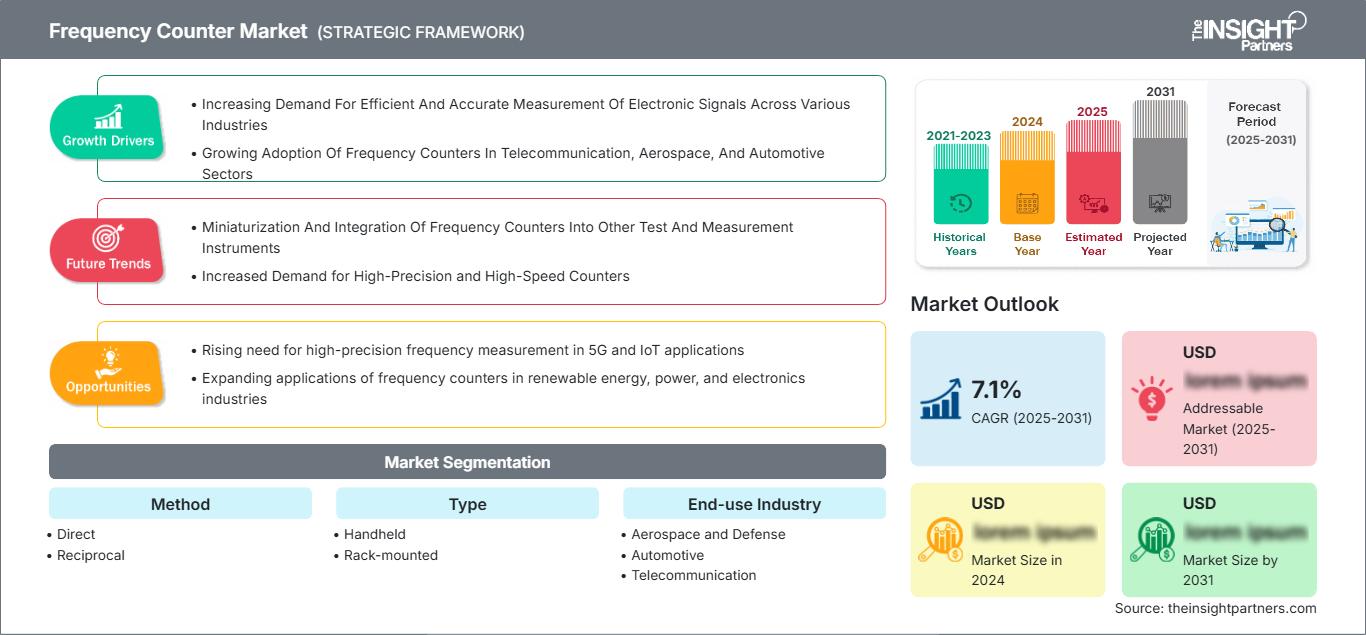
Frequency Counter Market: Strategic Insights
Regional Insights
North America Frequency Counter Market
North America is estimated to represent 29–31% of global Frequency Counter Market in 2025 and is projected to grow at a CAGR of 4.8–5.2% through 2034. This market is fortunate to have a lot of developments in the fields of aerospace and defense electronics, semiconductors, telecommunications labs, and even calibration. The United States contributes the most towards regional demand, and the other major contributors include Canada and Mexico in industrial electronics, automotive production, and telecommunications respectively.
In regional purchases, the trend of looking for measuring instruments that have the capacity to be operated remotely and collect data automatically is on the rise. The aerospace companies need reliable measuring equipment for use in radar, avionics, satellites, and communications, while the semiconductors and wireless companies need accurate measuring instruments for their high-frequency devices.
U.S. Frequency Counter Market
The US represents approximately 82–84% of North American demand in 2025 and is expected to expand at a CAGR of 4.9–5.3% through 2034. Robust spending on aerospace and defense, semiconductors R&D, telecommunication technology, and advanced automotive electronics ensures regular buying cycles. The market will also be boosted by the presence of a huge number of test and measurement equipment used in laboratories and production that needs to be upgraded regularly.
Key companies like Keysight Technologies Inc., B and K Precision Corporation, Berkeley Nucleonics Corporation, National Instruments, and Stanford Research Systems, among others, have significant importance in laboratory and engineering uses. Rack mount solutions are especially well-suited for automation testing purposes, while portable products meet the field service requirement. There is an increasing demand for equipment that offers programmable interface and synchronization capabilities.
Europe Frequency Counter Market
Europe is estimated to hold a 23–25% share in 2025 and is projected to grow at a CAGR of 4.3–4.7%. Germany is the leading national market, followed by the UK, France, and Italy, supported by automotive engineering, industrial automation, aerospace, communications, and advanced electronics manufacturing. Precision testing remains important as European manufacturers pursue higher product reliability and more automated production environments.
The market for advanced laboratory and industrial measuring devices is strong in Germany and the UK, driven by needs in the automotive, telecommunications, research, and defense fields that call for improved equipment. France has the advantage of the development in aerospace, defense, and electronics industries, whereas Italy has potential in the industrial machinery and automotive electronics sectors.
APAC Frequency Counter Market
APAC is estimated to account for 37–39% of global demand in 2025 and is expected to grow at a CAGR of 5.0–5.4%, making it the leading regional market. China leads regional consumption, while Japan, South Korea, India, and Australia provide significant demand through electronics, automotive, telecommunications, and industrial applications.
Electronics assembly industries, investment in semiconductors, growth of telecommunication, and industrial modernization backed by government make measurement necessary. Japan and South Korea have a focus on precision manufacturing and research, China has a combination of manufacturing and telecommunication investments, India has a growth in electronics manufacturing, and Australia through its defense and telecommunication programs contributes to these requirements.
Middle East & Africa Frequency Counter Market
Middle East and Africa Frequency Counter Market is expected to record a CAGR of 3.7–4.2% during 2026–2034. Saudi Arabia leads regional demand, supported by communications infrastructure, industrial diversification, defense modernization, and electronics-related investment. The UAE represents another important market because of advanced communications, aerospace, and technology infrastructure, while South Africa provides a comparatively established industrial and research base.
Rest of MEA demand remains more selective and is concentrated around telecommunications operators, industrial facilities, universities, maintenance organizations, and government laboratories. Energy infrastructure and digital connectivity projects create requirements for signal verification and equipment calibration. Portable instruments can be particularly relevant where field-service conditions dominate, while centralized laboratories favor rack-mounted systems with automated data collection and remote management.
Segmentation Analysis
Method
Direct remains the largest method category, with an estimated CAGR of 4.2–4.5% during 2026–2034. Its established architecture, straightforward operation, and suitability for conventional periodic signals support continued use in laboratories, maintenance environments, educational facilities, and general electronics testing. The method benefits from familiarity among technicians and comparatively uncomplicated integration into existing measurement workflows.
- Direct: Direct counting maintains a broad installed base because it provides an intuitive measurement approach for recurring signals. Demand remains strongest where operational simplicity, dependable readings, and conventional frequency measurement are primary purchasing requirements.
- Reciprocal: Reciprocal counting is increasingly important where measurement resolution and timing performance are prioritized. Its strategic relevance rises in communications, RF development, calibration, and research applications requiring precise measurements across varied signal frequencies.
Type
Rack-mounted systems are expected to grow at a CAGR of 4.8–5.2% during 2026–2034 as automated test environments expand. Integration into production lines, research benches, calibration systems, and centralized instrumentation architectures supports demand for programmable equipment with standardized interfaces, synchronization, and remote control.
- Handheld: Handheld counters serve field technicians, maintenance teams, installers, and service organizations. Their value comes from portability, rapid troubleshooting, battery operation, and simplified measurement workflows where fixed laboratory infrastructure is unavailable.
- Rack-mounted: Rack-mounted instruments support repeatable laboratory and production measurements. Their strategic importance increases where multiple instruments must be synchronized, remotely controlled, centrally managed, or integrated into automated test sequences.
End-use Industry
Telecommunication is projected to grow at a CAGR of 5.2–5.6% during 2026–2034, making it the strongest growth-oriented end-use industry. Expansion of advanced wireless networks, RF equipment, satellite communications, and network infrastructure requires accurate signal verification throughout development, deployment, maintenance, and calibration activities.
- Aerospace and Defense: Demand centers on radar, avionics, satellite communications, electronic warfare, and secure communications. Precision timing and signal verification are strategically important because equipment must operate reliably under demanding electromagnetic conditions.
- Automotive: Vehicle electrification, connected systems, advanced driver-assistance electronics, and automotive radar expand measurement requirements. Manufacturers increasingly require repeatable frequency and timing tests during component validation, system integration, and production quality control.
- Telecommunication: Wireless infrastructure, RF components, satellite links, and network equipment require precise signal characterization. Frequency counters support design verification, installation, maintenance, and calibration across increasingly complex communication architectures.
- Others: Industrial automation, research institutions, education, energy, and electronics maintenance represent diversified demand. These applications value flexible instruments that can accommodate different signal types without requiring highly specialized test platforms.
Opportunity Snapshot
| End-use Industry | Revenue Contribution | Trend Tag | Adoption Stage |
| Aerospace and Defense | High | Radar Testing | Mature |
| Automotive | Medium | EV Validation | Scaling |
| Telecommunication | High | RF Testing | Scaling |
| Others | Medium | Lab Automation | Mature |
Frequency Counter Market Growth Drivers and Impact Analysis
Expansion of High-Frequency Wireless Infrastructure
Further development of advanced wireless infrastructure technology creates an increased need for reliable frequency measurement in the context of engineering and maintenance services. Modern communication technology uses larger bandwidths, higher carrier frequencies, and more complicated synchronization systems, making it necessary to have measurement devices able to detect small time and frequency differences. The business opportunity is not limited to the telecommunication companies as other organizations including device manufacturers, component providers, certification labs, and field service organizations need the corresponding measurement devices. Consequently, frequency counters remain competitive along with spectrum analyzers and network analyzers in RF test environments. To tap into the demand, suppliers may offer high-frequency input capabilities, stable reference sources, automatic measurements, and software interface with the current lab software.
Increasing Electronics Content in Vehicles
Vehicle electrification and the expansion of connected and electronically controlled systems are broadening the role of precision frequency measurement in automotive engineering. Electric powertrains, battery-management electronics, radar systems, communication modules, sensors, and control units require verification of timing and signal behavior at multiple development stages. Automotive suppliers therefore need equipment that can move between laboratory characterization, validation benches, and production environments. The market impact is strongest where test procedures are becoming automated, because programmable frequency counters can be integrated with broader measurement sequences and quality-control databases. This creates demand for rack-mounted instruments and software-enabled systems rather than isolated manual equipment. Suppliers with strong automation capabilities can benefit from deeper integration into validation processes, while portable instruments remain relevant for service, troubleshooting, and installation activities across distributed manufacturing operations.
Greater Automation of Test and Measurement Workflows
Automation is changing the purchasing criteria for frequency measurement equipment by shifting attention from standalone accuracy toward repeatability, connectivity, synchronization, and data handling. Engineering organizations increasingly seek instruments that can be remotely configured, triggered, monitored, and incorporated into automated test sequences. This approach reduces manual measurement steps and creates structured datasets that can be used for quality analysis and equipment characterization. The impact is particularly significant in high-volume manufacturing, calibration laboratories, and research environments where hundreds or thousands of measurements may be performed during a test program. Rack-mounted systems benefit from this transition because they can operate as components within centralized instrument architectures. Vendors that provide drivers, application programming interfaces, synchronized reference inputs, and compatible software can therefore increase the value of individual counters while strengthening their position within larger automated test platforms.
Frequency Counter Market Future Trends
Instrument Integration Creates Multifunction Measurement Platforms
Future instruments are expected to combine frequency counting with time-interval, pulse, ratio, signal-generation, and waveform-analysis capabilities within increasingly compact platforms. This convergence can reduce the number of separate instruments required in engineering laboratories and production test systems while improving synchronization between measurements. Software will become more important as users configure complex measurement sequences, store results, and transfer data into automated analysis environments. Manufacturers are likely to emphasize modular architectures that allow customers to select input options and measurement functions according to application requirements. The distinction between a standalone counter and a broader timing or RF measurement platform will consequently become less pronounced. This trend should favor suppliers with extensive instrument portfolios, strong software ecosystems, and established integration capabilities across laboratory, manufacturing, and field-service environments.
Remote and Networked Measurement Becomes Standard Practice
Network connectivity is expected to become a routine feature as laboratories and production facilities increasingly centralize measurement resources. Engineers will be able to configure instruments remotely, monitor measurements, retrieve datasets, and coordinate multiple devices from centralized applications. Ethernet, USB, LXI-compatible environments, and software APIs will support these workflows while reducing dependence on front-panel operation. Cloud-connected analysis may emerge selectively where cybersecurity and data-governance requirements permit, particularly for distributed engineering organizations. Networked operation can also support remote diagnostics and equipment utilization monitoring, allowing organizations to identify underused instruments and improve asset allocation. For suppliers, connectivity creates opportunities to differentiate through software, instrument management, cybersecurity features, and integration support. Customers will increasingly evaluate frequency counters as connected measurement assets rather than isolated pieces of laboratory hardware.
Frequency Counter Market Opportunities
High-Precision Applications in Advanced RF Development
The Frequency Counter Market Forecast presents an opportunity for suppliers to target advanced RF development, satellite communications, radar, and emerging wireless research with higher-frequency and higher-resolution instruments. Investment should focus on stable reference architectures, low phase-noise timing, advanced input conditioning, and measurement capabilities that remain reliable as signal complexity increases. Suppliers can also develop application-specific packages combining counters with signal generators, analyzers, and software to address complete RF workflows. Such bundles can increase equipment utilization and reduce integration effort for customers. Research institutions and specialized engineering organizations may accept premium pricing when instruments provide measurable improvements in accuracy, synchronization, and automation. Partnerships with universities, defense laboratories, semiconductor companies, and communications developers can create reference applications and accelerate adoption of specialized measurement technologies.
Localized Solutions for Expanding Electronics Manufacturing
Expansion of electronics manufacturing in Asia and other emerging production centers creates opportunities for suppliers offering cost-effective instruments with strong service support. Localized distribution, calibration, training, and application engineering can be as important as product specifications because production organizations require dependable equipment availability and rapid maintenance. Vendors can address this opportunity through modular product families that share software and accessories while covering different performance levels. Educational programs and technical partnerships can also build familiarity among engineers entering rapidly expanding electronics sectors. The opportunity extends to automotive suppliers, telecommunications manufacturers, contract electronics producers, and industrial automation companies establishing new facilities. Providers that combine competitive pricing with traceability, remote support, and integration capabilities can establish durable positions as customers standardize measurement platforms across multiple plants and engineering centers.
Recent Developments
- June 2026: Bourns completed its acquisition of Rakon, expanding into frequency-control and timing solutions for telecommunications, aerospace, defense, positioning, and other high-precision applications. The acquisition adds approximately 750 employees, four manufacturing facilities, and six R&D centers across New Zealand, France, the UK, and India, while bringing Rakon’s proprietary XMEMS® microfabrication technology and in-house ASIC capabilities into Bourns’ portfolio. The deal strengthens Bourns’ position in high-performance timing and frequency-control technologies and broadens its global engineering and manufacturing footprint.
- August 2026: Lynk Global and Omnispace completed their merger and launched Elveo Mobile, combining their low-Earth-orbit satellite assets and spectrum to pursue direct-to-device (D2D) mobile connectivity. The new company has commercial agreements with more than 50 mobile network operators and distribution partners across more than 60 countries, with plans to deploy a 320-satellite LEO constellation and begin services in early 2028. The merger strengthens the combined company's position in the emerging satellite-to-mobile market and provides a broader platform for connecting standard mobile devices directly to satellites.
- November 2024: AeroVironment announced an agreement to acquire BlueHalo in an all-stock transaction valued at approximately $4.1 billion, creating a more diversified defense technology company spanning autonomous systems, space, cyber, directed energy, and counter-UAS capabilities. The combination is intended to bring together complementary technologies, engineering talent, and customer relationships to accelerate development of next-generation defense solutions across multiple domains. The transaction was subsequently completed in May 2025, creating a larger all-domain defense technology platform.
Frequently Asked Questions

- Comprehensive Market Sizing and Forecast Analysis
- Detailed Segmentation Analysis
- In-Depth Market Dynamics Assessment
- Regional and Country-Level Insights
- Competitive Landscape and Company Benchmarking
- Strategic Business Intelligence
Recent Reports
Testimonials

The Insight Partners' SCADA System Market report is comprehensive, with valuable insights on current trends and future forecasts. The team was highly professional, responsive, and supportive throughout. We are very satisfied and highly recommend their services.
RAN KEDEM Partner, Reali Technologies LTDs
I requested a report on a very specific software market and the team produced the report in a few days. The information was very relevant and well presented. I then requested some changes and additions to the report. The team was again very responsive and I got the final report in less than a week.
JEAN-HERVE JENN Chairman, Future Analytica
We worked with The Insight Partners for an important market study and forecast. They gave us clear insights into opportunities and risks, which helped shape our plans. Their research was easy to use and based on solid data. It helped us make smart, confident decisions. We highly recommend them.
PIYUSH NAGPAL Sr. Vice President, High Beam Global
The Insight Partners delivered insightful, well-structured market research with strong domain expertise. Their team was professional and responsive throughout. The user-friendly website made accessing industry reports seamless. We highly recommend them for reliable, high-quality research services
YUKIHIKO ADACHI CEO, Deep Blue, LLC.
This is the first time I have purchased a market report from The Insight Partners.While I was unsure at first, I visited their web site and felt more comfortable to take the risk and purchase a market report.I am completely satisfied with the quality of the report and customer service. I had several questions and comments with the initial report, but after a couple of dialogs over email with their analyst I believe I have a report that I can use as input to our strategic planning process.Thank you so much for taking the extra time and making this a positive experience.I will definitely recommend your service to others and you will be my first call when we need further market data.
JOHN SUZUKI President and Chief Executive Officer, Board Director, BK Technologies
I wish to appreciate your support and the professionalism you displayed in the course of attending to my request for information regarding to infectious disease IVD market in Nigeria. I appreciate your patience, your guidance, and the fact that you were willing to offer a discount, which eventually made it possible for us to close a deal. I look forward to engaging The Insight Partners in the future, all thanks to the impression you have created in me as a result of this first encounter.
DR CHIJIOKE ONYIA MANAGING DIRECTOR, PineCrest Healthcare Ltd.Reason to Buy
- Informed Decision-Making
- Understanding Market Dynamics
- Competitive Analysis
- Identifying Emerging Markets
- Customer Insights
- Market Forecasts
- Risk Mitigation
- Boosting Operational Efficiency
- Strategic Planning
- Investment Justification
- Tracking Industry Innovations
- Aligning with Regulatory Trends





 Get Free Sample for