
Green Laser Diode Market Trends, Size & Forecast by 2034
Coverage: By Power Ratings (Upto 500mW, 500.1mW-5W, 5.1W-1kW, Above 1kW); Application (Heads-Up Display, Head Mounted Display, Pico-Projectors, Smart phones, Others) , and Geography (North America, Europe, Asia Pacific, and South and Central America)
- Status : Data Released
- Report Code : TIPRE00026014
- Category : Electronics and Semiconductor
- No. of Pages : 150
- Available Report Formats :


- Last update date : September 10, 2026


2025 Market Size
US$ 1.35 Bn
Base year value
2034 Forecast
US$ 3.06 Bn
Projected by 2034
CAGR 2026-2034
10.77 %
Growth rate
Addressable Market
US$ 20.98 Bn
(2026-2034)
The Green Laser Diode Market is valued at US$ 1.35 Billion in 2025 and is projected to reach US$ 3.06 Billion by 2034, expanding at a CAGR of 10.77% during 2026–2034. The market is being shaped by increasing adoption of compact photonic sources, improvements in semiconductor materials, and wider deployment of green wavelengths in display, projection, sensing, and precision processing applications across consumer and industrial systems.
North America presents a structurally attractive outlook, supported by automotive display integration, aerospace electronics, semiconductor manufacturing, and photonics research. The regional Green Laser Diode Market Size trajectory is expected to remain supported by approximately 9.8–10.8% CAGR through 2034, with investment focused on higher-efficiency emitters, compact modules, advanced packaging, and application-specific optical architectures.
Green Laser Diode Market Assessment and Insights
- North America: North America is expected to maintain a substantial position, supported by automotive HUD adoption, semiconductor manufacturing, defense electronics, and photonics R&D, with a 2025 share of 27–31% and CAGR of 9.8–10.8% during 2026–2034.
- US: The US accounts for 82–86% of North American demand in 2025, supported by advanced manufacturing, automotive electronics, aerospace programs, and photonics research, with CAGR of 10.0–11.0% through 2034.
- Europe: Europe is projected to hold a 22–26% share in 2025 and grow at 9.3–10.3% CAGR, led by Germany, France, the UK, Italy, and Spain through automotive electronics and industrial photonics.
- Asia Pacific: Asia Pacific represents 31–35% of 2025 demand and is projected to grow at 11.4–12.4% CAGR, led by China, Japan, South Korea, and India through electronics manufacturing and display investment.
- Largest Segment: Heads-Up Display is assessed as the largest application segment, holding a 30–34% market share in 2025 and expanding at 11.0–12.0% CAGR during 2026–2034.
- High Growth Segment: Head Mounted Display is the high-growth application segment, representing 20–24% of 2025 demand and expanding at 12.0–13.0% CAGR as compact optical architectures scale.
- Key companies analyzed in detail: Edmund Optics, Coherent Corp., IPG Photonics Corporation, Newport Corporation, OSRAM GmbH, Spectra-Physics, Sharp Corporation, SPI Lasers UK Ltd., Sumitomo Electric Industries, Ltd., Schneider Electric SE.
Source: The Insight Partners' analysis based on proprietary research, government publications, company annual reports, investor presentations, industry databases, and expert interviews.
The Green Laser Diode Market has been growing from traditional discrete lighting to integrated photonic light sources designed for maximum brightness, wavelength, thermal efficiency, and application-specified beam characteristics. Improvements in GaN-based emitters, packaging, optical coupling, and semiconductor technologies have increased the useful output while minimizing the limitations on integration. The suppliers in the industry are also expanding green laser products to process and machine vision.
The new markets that are forecast to become important for growth in the coming years are likely to include India, Southeast Asia, and select Middle Eastern technology centers along with existing East Asian production bases. Research and development will be focused on high-powered design, thermal management, smaller modules, and automation. Automobile display requirements, localization of semiconductors, and energy savings goals will help encourage adoption.
Green Laser Diode Market Report Scope
| Report Attribute | Details |
|---|---|
| Market size in 2025 | US$ 1.35 Billion |
| Market Size by 2034 | US$ 3.06 Billion |
| Global CAGR (2026 - 2034) | 10.77% |
| Historical Data | 2021-2024 |
| Forecast period | 2026-2034 |
Green Laser Diode Market Analysis
The growth of Green Laser Diode Market is fueled by the optical benefits of green laser beams, especially its high brightness perception and capability to work well in projection and sensing in ambient light conditions. Ecosystem comprises several stages, such as semiconductor epitaxy, wafering, die making, packaging, optics assembly, driver development, heat dissipation technology, module assembly, and final original equipment manufacturing. Therefore, demand is driven not only by diodes’ capabilities but also by availability of reliable, cost-effective integrated modules.
Market supply is still characterized by differences in terms of power and application. The low-power lasers compete in terms of package size, wavelength stability, and lifetime, while high-power ones need advanced heat dissipation technologies, beam shaping, and optical protection. The vertical integration is capable of bringing more uniformity and security of supply, while niche component suppliers have opportunities in optics, drivers, and custom modules markets.
In terms of the Green Laser Diode Market Report competitive analysis, there is diversity between diversified photonics companies and specialists. Coherent Corp. and IPG Photonics Corporation offer broad laser products for industrial and scientific uses, while Edmund Optics offers optical components and laser packages. Spectra-Physics and Newport Corporation add the ability to provide additional lasers and instrumentation, thus allowing for more bundle offerings than mere components.
The current trend of investment focuses on increased efficiency of the output, compactness, reliability, and mass production. OSRAM GmbH and Sharp Corporation bring semiconductor and optoelectronics knowledge, while Sumitomo Electric Industries, Ltd. shows its ability to develop true-green diodes. Other potential players in the market such as SPI Lasers UK Ltd. and Schneider Electric SE can compete using their specific applications, industrial connections, or optical systems.
● REPORT CUSTOMIZATION
Tailor This Report To Align With Your Specific Business Requirements
This report can be customized to align precisely with your business objectives, scope, and target markets. Customization options include tailored segmentation, geography, competitive analysis, and strategic insights to support informed decision-making.
Customize This Report →WHAT YOU CAN ADJUST
- ● Segmentations
- ● Geography
- ● Competitive Analysis
- ● Language Preferences
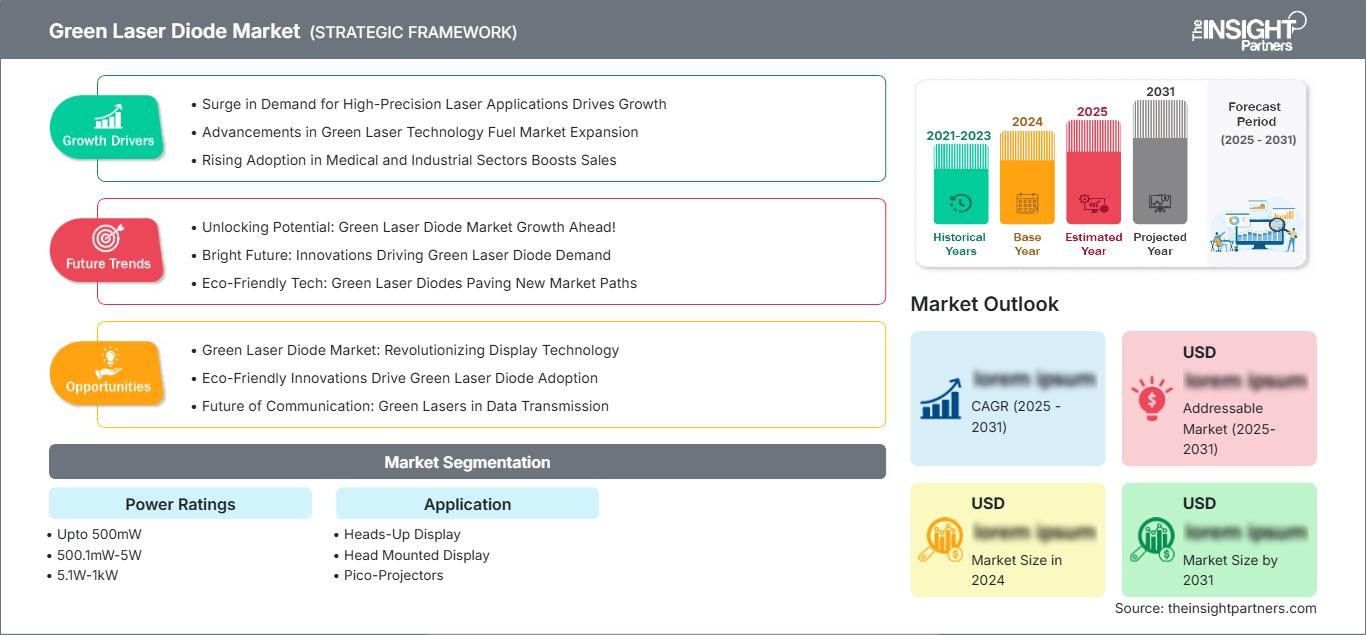
Green Laser Diode Market: Strategic Insights
Regional Insights
North America Green Laser Diode Market
North America is expected to be responsible for 27–31% of Green Laser Diode Market Share in 2025 and grow at 9.8–10.8% CAGR until 2034. The region is enabled by the development of automotive displays, semiconductor manufacturing, aerospace electronics, defense electronics, and photonics research at universities. The largest share of regional demand comes from the US, driven by advanced OEM ecosystems and demand for high-quality optical devices. Canada is represented by scientific instruments, advanced manufacturing, and research applications, whereas Mexico supplies manufacturing capability connected to electronics and automotive industries.
The regional market structure is favorable for suppliers who are capable of delivering quality modules, reliable thermal characteristics, and customizations for challenging conditions. Automotive head-up displays, machine vision, precision manufacturing, and scientific instruments ensure diversified demand beyond consumer electronics. Increasingly, procurement becomes oriented toward reliability of the lifecycle and integration assistance instead of mere diode prices. Production and semiconductor investments create additional strategic reasons for local photonics production capability, although specific components continue to be imported.
U.S. Green Laser Diode Market
The US accounts for 82–86% of demand in North America in 2025 and will experience a CAGR of 10.0–11.0% through 2034. Demand in this country covers automotive electronics, aerospace, defense, semiconductor equipment, medical instrumentation, scientific research, and industrial automation applications. Requirements are moving toward miniaturized light sources capable of producing specific wavelengths in reliable and stable way under various operational conditions.
Vendor landscape includes component providers, laser systems manufacturers, optical distributors, and integrated photonics vendors. Green laser sources find use in HUDs, machine vision, projection, metrology, and special manufacturing processes. Besides, federal initiatives promoting domestic semiconductor and advanced manufacturing technologies encourage localization of photonic supply chains. Therefore, the US market is characterized by high engineering value and relatively tight qualification criteria for light sources, providing opportunities for premium suppliers able to provide traceable and application-specific solutions.
Europe Green Laser Diode Market
Europe is expected to account for a market share of 22–26% in 2025 and register a growth rate of 9.3–10.3% CAGR between 2026 and 2034. Germany represents the top country in the region due to its automotive electronics, automation industry, precision engineering, and optical engineering industries. The United Kingdom features excellent science and photonics technologies, while France adds aerospace, defense, R&D, and advanced manufacturing industries. Italy and Spain add more automotive, industrial, and electronics applications. Adoption in Europe is increasingly affected by energy efficiency, miniaturized designs, and strict industrial quality standards.
Another factor that is contributing to demand growth in Europe is the transformation of the continent into an environment for electric mobility, renewable energy generation, smart manufacturing, and advanced industry. Investments in electric car manufacturing, battery production, charging stations, factory automation, and energy storage solutions have opened new application areas for advanced devices in some of the major economies of Europe. Furthermore, the growing substitution of traditional machines with energy efficient and digitally controlled systems is motivating manufacturers to implement advanced products capable of providing greater reliability, reduced power consumption, and higher efficiency. The development of Industry 4.0 projects along with the implementation of sensors, connectivity, and automation is expected to drive even stronger demand for these devices.
APAC Green Laser Diode Market
The APAC region is forecast to be between 31-35% of global demand by 2025 and to grow at an 11.4-12.4% CAGR. China dominates the market, driven by electronics manufacturing, display manufacture, automotive technology, and industrial automation. The contributions from Japan and South Korea are more advanced semiconductors and consumer electronics, while India and Australia offer emerging demand.
In industrial localization, investment in electronics and technological development assist production in the area. China and Japan remain significant for component systems, South Korea specializes in advanced displays and electronics, whereas India is increasingly becoming an emerging market through electronics manufacture and technology development.
Middle East & Africa Green Laser Diode Market
Demand from the Middle East & Africa is comparatively low but steadily gaining support from infrastructure upgrades, industrial automation, defense electronics, medical devices, and visualization solutions. Saudi Arabia and UAE lead in this region’s market, whereas South Africa serves as a basis for scientific, mining, industrial, and healthcare applications.
Expected CAGR in this region from 2022 to 2034 is estimated to be about 8.2-9.2%. The UAE is expected to act as one of the main adoption centers in the region. Programs for energy diversification and smart infrastructure development offer chances for adoption of machine vision systems, optical sensors, projection, and industrial solutions.
Segmentation Analysis
Power Ratings
Power Ratings remain a fundamental segmentation in the Green Laser Diode Market because output requirements vary substantially between consumer projection, automotive displays, industrial processing, and scientific systems. The segment is projected to expand at 10.5–11.5% CAGR during 2026–2034, with demand progressively shifting toward efficient higher-output devices where thermal management and beam quality can be controlled.
- Upto 500mW: Upto 500mW serves compact displays, machine vision, alignment, sensing, and portable optical systems. Demand emphasizes low power consumption, small packages, stable wavelength, and straightforward integration.
- 500.1mW-5W: 500.1mW-5W addresses brighter projection, specialized instrumentation, and demanding optical modules. Suppliers compete through beam quality, thermal stability, modulation performance, and packaging flexibility.
- 5.1W-1kW: 5.1W-1kW is strategically important for industrial processing and high-intensity optical systems. Adoption depends on efficient cooling, ruggedized construction, scalable architectures, and consistent power delivery.
- Above 1kW: Above 1kW represents specialized high-power applications requiring sophisticated beam delivery and thermal control. Its commercial importance is linked to industrial processing and advanced manufacturing rather than mass consumer deployment.
Application
Application segmentation in the Green Laser Diode Market captures the strongest variation in purchasing requirements, because HUDs prioritize visibility, HMDs emphasize compactness, projectors require brightness and efficiency, and smartphones require extreme miniaturization. The application segment is expected to grow at 11.0–12.0% CAGR during 2026–2034 as optical architectures diversify.
- Heads-Up Display: Heads-Up Display remains the largest application, supported by demand for bright, compact projection systems capable of maintaining visibility across varying ambient-light conditions and vehicle operating environments.
- Head Mounted Display: Head Mounted Display represents a rapidly developing opportunity where compact green sources can support high brightness, color performance, and optical efficiency within constrained wearable architectures.
- Pico-Projectors: Pico-Projectors require compact RGB sources, efficient thermal designs, and precise modulation. Green wavelengths remain strategically important because perceived brightness can support compact projection architectures.
- Smart phones: Smart phones represent a miniaturization-driven application requiring low-profile optical modules, efficient electrical operation, and strong manufacturing consistency. Integration opportunities extend across projection, sensing, and imaging functions.
Opportunity Snapshot
| Application | Revenue Contribution | Trend Tag | Adoption Stage |
| Heads-Up Display | High | Vehicle Projection | Scaling |
| Head Mounted Display | Medium | Wearable Optics | Emerging |
| Pico-Projectors | Medium | Compact Projection | Scaling |
| Smart phones | Medium | Optical Miniaturization | Emerging |
Green Laser Diode Market Growth Drivers and Impact Analysis
Automotive display architectures are increasing demand for visible laser sources
Automotive display development is creating a durable demand channel because drivers need information that remains discernible across changing illumination conditions. Green wavelengths are attractive for projection architectures because human visual sensitivity is comparatively high around the green portion of the spectrum, allowing designers to balance brightness with optical power. The impact extends across laser emitters, drivers, scanning optics, thermal components, and control electronics. As HUD systems move beyond premium vehicles, suppliers gain opportunities to standardize modules while maintaining automotive-grade reliability. Integration with advanced driver-assistance interfaces can further increase content density and refresh requirements, encouraging investment in modulation speed, wavelength stability, compact packaging, and optical safety. These requirements favor suppliers capable of providing qualified components and system-level engineering.
Miniaturized photonic modules are broadening deployment beyond conventional laser systems
Miniaturization is expanding the addressable market by allowing green optical sources to enter equipment where conventional laser architectures were previously constrained by size, heat, or power consumption. Compact emitters and integrated optics can support portable projection, wearable displays, machine vision, sensing, and specialized instrumentation. The commercial impact is particularly significant where optical performance must be maintained within restricted mechanical envelopes. Smaller modules also reduce assembly complexity and can enable higher levels of factory automation. Suppliers that combine emitters with drivers, optics, thermal management, and standardized interfaces can capture more value per system. This transition is changing procurement criteria from individual diode specifications toward module-level performance, reliability, integration time, and total cost of ownership, encouraging deeper collaboration between semiconductor manufacturers and system integrators.
Industrial precision processing is strengthening demand for higher-power green sources
Industrial users are adopting green wavelengths where material absorption characteristics can provide processing advantages compared with longer-wavelength sources. Applications include copper processing, semiconductor-related manufacturing, solar-cell processing, marking, micromachining, and selected non-metal applications. The impact is strongest in processes where smaller heat-affected zones, controlled energy deposition, or improved interaction with reflective materials can raise productivity. Higher-power architectures require more sophisticated cooling, beam shaping, pulse control, and process monitoring, increasing the value of integrated laser platforms. This dynamic benefits companies with established industrial laser ecosystems and creates opportunities for specialized suppliers in power modules, optics, and control systems. Over time, process qualification rather than component price is likely to become a stronger determinant of purchasing decisions in advanced manufacturing environments.
Green Laser Diode Market Future Trends
True-green semiconductor architectures will improve efficiency and integration
Future development in the in the Green Laser Diode Market Trends is likely to favor direct-emission green semiconductor architectures that reduce conversion stages and simplify optical paths. Improvements in GaN material quality, semipolar substrates, epitaxial structures, cavity design, and thermal packaging can progressively increase usable efficiency and lifetime. The commercial consequence will be greater freedom to integrate green sources into compact optical engines without relying as heavily on bulky conversion arrangements. Suppliers will increasingly differentiate through wavelength precision, temperature stability, modulation characteristics, and lifetime rather than output power alone. Packaging innovation should also support automated assembly and higher production yields. As these technologies mature, direct green emitters can become more practical for automotive displays, wearable systems, sensing, and other applications requiring a small footprint and predictable optical behavior.
Application-specific optical engines will replace generic component architectures
The next stage of market development is expected to involve more application-specific optical engines combining the laser source, driver, optics, thermal management, and monitoring functions. This architecture can shorten integration cycles and allow OEMs to specify performance at the system level rather than selecting individual components. Automotive HUDs may prioritize optical safety and temperature stability, while wearable systems will emphasize size and power consumption. Industrial modules will instead prioritize beam quality, uptime, and process repeatability. Such specialization should encourage suppliers to develop configurable platforms with common manufacturing foundations and application-specific interfaces. The resulting ecosystem will reward companies that can scale production while retaining flexibility, creating opportunities for modular designs, digital diagnostics, predictive maintenance, and tighter collaboration between laser manufacturers and equipment developers.
Green Laser Diode Market Opportunities
Localized photonics manufacturing can strengthen regional supply resilience
Regional manufacturing initiatives create an opportunity for suppliers to establish localized production, packaging, testing, and application engineering capabilities. Dependence on internationally distributed photonic components can expose OEMs to qualification delays, logistics disruptions, and long procurement cycles. Localized facilities can address these concerns while providing customers with faster technical support and shorter development loops. The strongest opportunities in the in the Green Laser Diode Market Forecast are likely to emerge in North America, Europe, India, and selected Asian manufacturing clusters where electronics and semiconductor ecosystems are expanding. Investors should prioritize facilities capable of serving several wavelength and power classes rather than single-product lines. Partnerships with automotive, semiconductor, display, and industrial-equipment manufacturers can provide anchor demand and improve capacity utilization while reducing commercialization risk.
Integrated high-efficiency modules can unlock premium application niches
A second opportunity lies in integrated modules that combine green sources with drivers, optics, thermal control, and diagnostics. Such products can command stronger economics where customers value predictable performance and faster system integration more than the lowest component price. Automotive displays, advanced machine vision, scientific instruments, medical equipment, and specialized manufacturing are suitable targets because qualification requirements create barriers to rapid substitution. Suppliers can improve differentiation through configurable beam profiles, wavelength options, digital monitoring, and application-specific safety features. Investment should focus on modular architectures that share manufacturing infrastructure across several applications, allowing economies of scale while preserving customization. This strategy can also create recurring revenue through service, replacement modules, calibration, and engineering support.
Recent Developments
- April 2026: Kyocera Corporation agreed to acquire Ushio Inc.’s semiconductor laser device business to strengthen its RGB laser capabilities. The transaction is intended to add red laser technology to Kyocera’s existing blue and green laser expertise, supporting automotive projection, augmented reality, and metaverse applications.
- July 2026: IPG Photonics Corporation announced a binding offer to acquire Lumibird Medical for €300 million in cash, with a potential additional earnout of up to €50 million. The acquisition is intended to create a scaled medical laser platform focused on ophthalmology and urology and expand IPG’s Advanced Solutions portfolio.
- May 2024: Hamamatsu Photonics K.K. completed its acquisition of NKT Photonics A/S, making NKT Photonics a subsidiary from June 1, 2024. The transaction combines Hamamatsu’s detectors and cameras with NKT Photonics’ fiber lasers and photonic crystal fibers, targeting quantum computing, semiconductor, medical, and hyperspectral imaging applications.
Frequently Asked Questions

- Comprehensive Market Sizing and Forecast Analysis
- Detailed Segmentation Analysis
- In-Depth Market Dynamics Assessment
- Regional and Country-Level Insights
- Competitive Landscape and Company Benchmarking
- Strategic Business Intelligence
Recent Reports
Testimonials

The Insight Partners' SCADA System Market report is comprehensive, with valuable insights on current trends and future forecasts. The team was highly professional, responsive, and supportive throughout. We are very satisfied and highly recommend their services.
RAN KEDEM Partner, Reali Technologies LTDs
I requested a report on a very specific software market and the team produced the report in a few days. The information was very relevant and well presented. I then requested some changes and additions to the report. The team was again very responsive and I got the final report in less than a week.
JEAN-HERVE JENN Chairman, Future Analytica
We worked with The Insight Partners for an important market study and forecast. They gave us clear insights into opportunities and risks, which helped shape our plans. Their research was easy to use and based on solid data. It helped us make smart, confident decisions. We highly recommend them.
PIYUSH NAGPAL Sr. Vice President, High Beam Global
The Insight Partners delivered insightful, well-structured market research with strong domain expertise. Their team was professional and responsive throughout. The user-friendly website made accessing industry reports seamless. We highly recommend them for reliable, high-quality research services
YUKIHIKO ADACHI CEO, Deep Blue, LLC.
This is the first time I have purchased a market report from The Insight Partners.While I was unsure at first, I visited their web site and felt more comfortable to take the risk and purchase a market report.I am completely satisfied with the quality of the report and customer service. I had several questions and comments with the initial report, but after a couple of dialogs over email with their analyst I believe I have a report that I can use as input to our strategic planning process.Thank you so much for taking the extra time and making this a positive experience.I will definitely recommend your service to others and you will be my first call when we need further market data.
JOHN SUZUKI President and Chief Executive Officer, Board Director, BK Technologies
I wish to appreciate your support and the professionalism you displayed in the course of attending to my request for information regarding to infectious disease IVD market in Nigeria. I appreciate your patience, your guidance, and the fact that you were willing to offer a discount, which eventually made it possible for us to close a deal. I look forward to engaging The Insight Partners in the future, all thanks to the impression you have created in me as a result of this first encounter.
DR CHIJIOKE ONYIA MANAGING DIRECTOR, PineCrest Healthcare Ltd.Reason to Buy
- Informed Decision-Making
- Understanding Market Dynamics
- Competitive Analysis
- Identifying Emerging Markets
- Customer Insights
- Market Forecasts
- Risk Mitigation
- Boosting Operational Efficiency
- Strategic Planning
- Investment Justification
- Tracking Industry Innovations
- Aligning with Regulatory Trends





 Get Free Sample for